
Battery Desulfator, Automatic Pulse Lead-Acid Battery Reconditioner
3.9Editor score
Automatic pulse operation
Broad vehicle compatibility
Simple terminal connection
Compare 10 Battery Restorer and and Desulfator options for lead-acid restoration, pulse desulfation, compatibility, ease of use, and routine battery maintenance
Battery restorers and desulfators are maintenance products intended to improve the performance of lead-acid batteries affected by sulfation, prolonged storage, or repeated charge-discharge cycles. A useful solution should be compatible with the battery type, suited to the number of cells being treated, and capable of supporting—not replacing—a proper charging routine.
This guide compares ten liquid restorers and electronic pulse desulfators using their stated battery compatibility, treatment method, capacity, safety features, installation requirements, and suitability for common vehicles and stationary applications. It includes products for cars, golf carts, RVs, marine batteries, solar systems, motorcycles, and maintenance fleets, while clearly noting important limitations.
Each review identifies the product's strongest use case, practical trade-offs, and who may benefit most from choosing it. The top selections represent the best balance of rating, functionality, and value across the list, while product features and availability can change over time, so readers should verify current specifications and current prices before purchasing.
3.9Editor score

4.1Editor score

3.8Editor score
The comparison below places the ten products side by side, distinguishing liquid chemical treatments from electronic pulse devices while highlighting capacity, voltage range, battery compatibility, and intended applications.




This 64-ounce battery restorer and desulfator is designed for lead-acid batteries used in cars, golf carts, RVs, motorcycles, boats, tractors, and other machinery. Its 3.8 rating reflects a mixed customer history, but the broad application range and large treatment size make it a practical option for owners with several serviceable batteries. Its standout feature is the combination of chemical restoration and battery-acid-refill positioning in one product.
We may earn a commission when you buy through this link, at no additional cost to you.
According to the product information, the formula is intended to remove harmful sulfation buildup and improve the chemical balance within the battery, which can support charge capacity and longer service life. The large container is especially relevant to golf carts, whose multi-battery packs can require a substantial volume of treatment. It is also presented as a gentler additive designed to protect internal battery components while restoration takes place.
The primary trade-off is that no desulfator can reliably recover every battery, particularly one with deeply damaged, dry, or completely dead cells. The 3.8 rating also suggests that experiences may vary considerably. Users should follow the complete application directions, maintain a proper charging routine, and avoid assuming that adding the liquid substitutes for checking battery condition or replacing a failed battery.
This is a strong choice for a homeowner or small maintenance operation that wants one liquid capable of addressing several lead-acid applications. It is especially appealing for a six-battery golf cart system or a collection of seasonal vehicles. Buyers who need an electronic maintenance unit with automatic voltage recognition may prefer a pulse device, but for broad chemical restoration in serviceable flooded batteries, this product remains versatile and approachable.
The formula is marketed for cars, golf carts, RVs, motorcycles, boats, tractors, and other machinery using lead-acid batteries. That flexibility helps owners standardize maintenance across mixed equipment rather than maintaining separate products for every vehicle class.
The 64-ounce format is the product's most obvious practical advantage over smaller liquid treatments. It offers more capacity for larger battery banks, repeated seasonal maintenance, or owners who want product on hand for several pieces of equipment.
We may earn a commission when you buy through this link, at no additional cost to you.
The Thermoil De-Sulfater 64oz is a liquid electrolyte additive made for mechanically sound lead-acid batteries that have developed sulfation. It carries a 3.8 rating, but its longer manufacturer history, no-Epsom-salt formulation, and explicit guarantee differentiate it from generic additives. The stated purpose is straightforward: help break down sulfate corrosion on plates and insulators so a usable battery can continue performing as intended.
We may earn a commission when you buy through this link, at no additional cost to you.
The product information claims reduced internal heating, improved power efficiency, and resistance reduction of up to 50 percent. Those claims are most relevant to batteries that are weak but mechanically sound, rather than units with damaged cases, severe internal corrosion, or dead cells. The formula is described as non-hazardous and safe across lead-acid batteries, and the 64-ounce size accommodates larger packs, fleets, or repeated applications without buying several smaller containers.
A 3.8 rating means expectations should remain realistic. Chemical additives cannot rebuild a battery whose internal damage is beyond chemical treatment, and the word guarantee does not change the physical limits of the battery being serviced. Users also need to add the product as an electrolyte additive and allow it to work as part of a proper charging and maintenance routine rather than treating it as an instant result.
This product is best for owners with several mechanically sound batteries who value a recognized treatment approach and the stated guarantee. Golf-course operators, marina managers, and collectors maintaining seasonal lead-acid equipment may appreciate the larger container. For a single small battery, the 12-ounce version provides a more focused alternative, while buyers seeking automatic electronics may prefer one of the pulse desulfators.
The manufacturer specifically distinguishes this additive from liquid desulfators containing Epsom salts. For buyers wary of changing the electrolyte with a simple mineral-based treatment, that distinction is a meaningful part of the product's positioning.
The product is intended for mechanically sound sulfated batteries. That qualification keeps the use case focused: it is maintenance for recoverable batteries, not a promised solution for batteries with dead cells, severe physical damage, or extensive internal corrosion.
We may earn a commission when you buy through this link, at no additional cost to you.
This professional-style battery desulfator is a wired electronic device designed to rejuvenate 12V through 72V lead-acid systems. Its 4.1 rating and unusually broad compatibility make it the strongest all-around choice in this guide. It works with AGM, gel, VRLA, SLA, and flooded batteries, covering cars, RVs, solar systems, marine equipment, golf carts, and backup power units.
We may earn a commission when you buy through this link, at no additional cost to you.
Unlike a liquid additive, this unit uses high-frequency, low-current pulses intended to prevent and dissolve lead-sulfate buildup. The product is not a charger and is most useful alongside a charging cycle. It can operate during charging, discharging, or standby, and its intelligent process may run for as many as 30 cycles. A typical improvement window is stated as two to four weeks, depending on the battery's initial condition.
The device includes low-voltage cutoffs, internal fuses, reverse-polarity protection, and a rugged aluminum shell for heat dissipation. Those protections make it better suited to repeat maintenance than a minimal pulse unit, although the stated two-to-four-week timeline means it is not an emergency roadside solution. It also cannot compensate for a battery that is physically damaged or has lost the ability to accept a charge.
This is the best fit for a technician, fleet manager, or serious enthusiast working with mixed battery types and voltage systems. It is particularly useful when one maintenance device must cover several classes of lead-acid equipment. Pairing it with a compatible charger can make it part of a repeatable battery-care program, but results should be judged over multiple cycles rather than minutes.
Supporting AGM, gel, VRLA, SLA, and flooded chemistries makes this a more useful option for mixed fleets. A user can move between vehicles, renewable-storage banks, marine equipment, and golf carts without changing device platforms.
Low-voltage cutoffs, internal fuses, reverse-polarity protection, and an aluminum enclosure provide a more considered safety design than a basic pulse maintainer. These features are especially valuable when the unit is intended for continuous maintenance.
We may earn a commission when you buy through this link, at no additional cost to you.
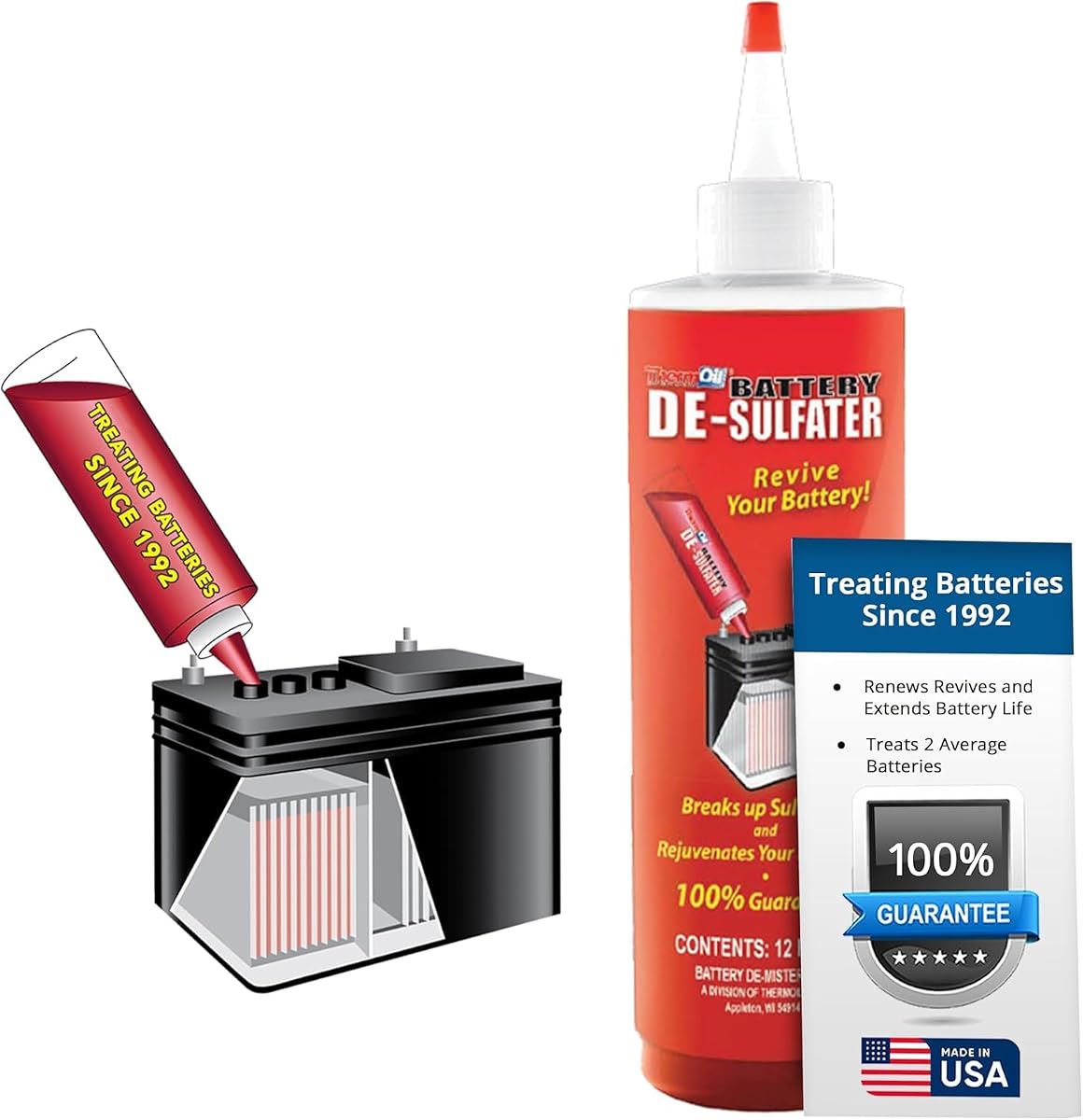
The 12-ounce Thermoil De-Sulfater is the smaller counterpart to the 64-ounce option and is intended for individual battery care. Its 3.8 rating is modest, yet the product is positioned as a guaranteed, non-hazardous, non-acid electrolyte additive for mechanically sound lead-acid batteries. It is particularly relevant to owners who want to address sulfate corrosion without purchasing a large maintenance quantity.
We may earn a commission when you buy through this link, at no additional cost to you.
According to the supplied information, it targets sulfation on battery plates and insulators, with the manufacturer reporting reduced internal heating, greater power efficiency, and resistance reduction of up to 50 percent. It is also described as helping protect new and used batteries from overcharging damage. The simple use model is a major convenience: add the treatment as an electrolyte additive and incorporate it into normal battery maintenance.
The smaller container is the primary limitation for fleet use. A golf cart with a full six-battery pack may require considerably more product, and repeated seasonal treatments can quickly use up a 12-ounce bottle. The moderate rating also indicates that customer experiences are not uniformly positive. As with every treatment in this category, a battery that is mechanically unsound cannot be made reliable simply by adding a chemical.
This is a sensible pick for a car, motorcycle, boat, or smaller battery bank where a measured amount of treatment is preferable to gallon-sized packaging. It also works for a homeowner who wants to try a liquid approach on one battery before committing to a larger container. For extensive fleets, the 64-ounce version provides better convenience, while electronic desulfators suit users who prefer automated pulses.
A 12-ounce format reduces the commitment associated with a large chemical treatment. It is easier to store, carry, and use when maintaining one or a small number of batteries.
Like other Thermoil products, it is framed around mechanically sound batteries. The treatment is meant to improve a weakened but functional battery, not reverse severe physical damage or create usable capacity in permanently dead cells.
We may earn a commission when you buy through this link, at no additional cost to you.
This one-gallon Battery Restore is a chemical desulfator built for serviceable lead-acid batteries and sizable maintenance fleets. Its 3.8 rating is complemented by a clearly defined dosing system: one gallon treats approximately three to six batteries, with 2 ounces per cell for 6V batteries or 3 ounces per cell for 8V and 12V batteries. That makes it particularly relevant to golf courses, marinas, solar installers, and farm-equipment operators.
We may earn a commission when you buy through this link, at no additional cost to you.
The formula is said to penetrate cells and dissolve hardened lead-sulfate crystals, allowing plates to hold and deliver a higher charge. The stated improvement window is seven to ten days of regular charging. It can be added directly to the cells without draining the electrolyte, and the manufacturer says no special tools or protective gear are required. The formula is non-toxic and is produced and bottled in the United States.
Compatibility is the critical trade-off. This product does not work on gel, AGM, or maintenance-free batteries, nor on completely dry, dead, or frozen cells. Its 3.8 rating suggests results are not identical for every user, and the multi-day treatment period means it should be introduced as part of a planned maintenance schedule. It is not designed to recover an end-of-life battery.
This gallon is the strongest liquid option for operators who routinely service several batteries and want adequate product without repeatedly buying smaller bottles. It is also a good seasonal preparation choice before golf season, spring vehicle use, or extended storage. The buyer should confirm that the batteries are flooded and still accept a charge before purchasing, then follow the specified dosage and charging schedule.
Treating three to six batteries from one gallon makes the product appealing to operators with repeated maintenance needs. The stated per-cell quantities also help prevent guesswork when servicing mixed 6V, 8V, and 12V equipment.
The formula is specifically for serviceable flooded lead-acid batteries that still accept a charge. Excluding AGM, gel, frozen, dry, and dead cells keeps expectations grounded and makes compatibility verification an essential part of the purchase decision.
We may earn a commission when you buy through this link, at no additional cost to you.
The PL04C-400AH Blue is an electronic pulse desulfator for lead-acid batteries, combining automatic operation with straightforward terminal connections. Its 3.9 rating places it above the midpoint of this list, and the device's stated support for car, marine, RV, and deep-cycle batteries gives it useful everyday versatility. The 400AH designation indicates the maximum battery capacity associated with the unit.
We may earn a commission when you buy through this link, at no additional cost to you.
The device sends specialized electronic pulses intended to help dissolve sulfate crystal buildup on battery plates. Because it can remain connected for maintenance and reconditioning, it offers a different maintenance model from a liquid additive: the battery stays connected to the unit while the pulse process works. Automatic controlled charging cycles simplify the process for users who do not want to measure doses or manually manage a chemical treatment.
The product information is less detailed about safety circuitry than the higher-capacity pulse devices in this guide. It also does not promise a specific recovery timetable, so buyers should treat it as a gradual maintenance tool rather than a rapid repair. A battery that no longer accepts a charge or has suffered serious physical damage is outside the reasonable scope of pulse desulfation.
This model is a good option for an individual owner seeking an electronic maintenance device without moving to a more elaborate multi-voltage system. It is particularly practical for a deep-cycle battery that spends time in storage or receives regular maintenance. Users should still follow correct polarity, monitor the battery's condition, and pair pulse treatment with suitable charging when needed.
Automatic operation removes much of the manual work involved in liquid dosing or cycle timing. Once correctly connected, the unit is designed to maintain and recondition the battery through controlled electronic pulses.
Support for car, marine, RV, and deep-cycle batteries makes the device practical for several common household and recreational applications. That range is useful for users who want one simple unit rather than separate maintenance products.
We may earn a commission when you buy through this link, at no additional cost to you.
Battery Renew Solution is a one-gallon chemical treatment designed primarily for flooded lead-acid batteries, with golf carts as its clearest use case. Its 4.1 rating is among the stronger results in the list. One gallon can treat approximately three to six batteries, making it a practical choice for golf courses, marinas, forklift operators, floor-scrubber fleets, and solar-storage installations.
We may earn a commission when you buy through this link, at no additional cost to you.
The formula targets lead-sulfate buildup on battery plates and is intended to restore charging capacity in batteries that have become weak or no longer hold a charge. The stated treatment period can reach ten days of regular charging, with the product added in the correct dose per cell and allowed to work between cycles. It is also positioned for seasonal preparation before golf season, winter storage, or other prolonged inactivity.
Like the Battery Restore gallon, it is not intended for gel batteries, AGM batteries, frozen batteries, completely dry cells, or dead and end-of-life units. The product information specifically recommends batteries approximately one to five years old that still accept a charge. That makes age and charge acceptance more useful selection criteria than a desire to rescue every old battery in a fleet.
This is a compelling choice for operators of several flooded lead-acid carts who need substantial treatment quantity and a clear dosing format. Its 4.1 rating gives it a stronger customer-feedback profile than many liquid competitors. Household users with only one small battery may find a smaller container more economical, while users needing AGM or gel support should select a compatible electronic pulse device instead.
The product's instructions and capacity are closely aligned with common multi-battery golf-cart packs. This makes it easier for course operators and owners to estimate how much formula a bank needs before beginning a treatment cycle.
Using the solution before golf season or before long storage can help address batteries that weakened while inactive. The ten-day charging period makes advance planning important if the equipment needs to be ready by a specific date.
We may earn a commission when you buy through this link, at no additional cost to you.
The 400AH Auto-Setting desulfator is a wired pulse device for 12V-to-48V lead-acid systems. It carries a 4.0 rating and supports batteries up to 400AH. The device uses high-frequency peak pulses intended to prevent sulfate crystals from sticking to electrodes and gradually break down existing buildup, making it relevant for maintenance programs rather than instant repairs.
We may earn a commission when you buy through this link, at no additional cost to you.
Automatic voltage recognition simplifies setup: connect red to positive and black to negative, and the device identifies the battery voltage without manual setting. The product can also be used with a charger, which is useful because a weak battery may need charging before pulse treatment becomes effective. A stated improvement window of two to three weeks reflects the gradual nature of chemical crystal removal.
The product instructions recommend testing battery voltage first. If voltage is below 11.5V, the battery should be charged before using the desulfator; above that level, the unit can be used. This prerequisite is important because a severely depleted battery may not operate the device as intended. The information also notes that heavier sulfate accumulation requires longer treatment, so users should judge the process over multiple weeks.
This model suits owners of medium-to-large lead-acid banks who want automatic setup and the ability to combine pulse treatment with charging. It is a good candidate for a workshop, garage, or renewable-storage setup that stays within the 12V-to-48V and 400AH limits. The trade-off is the need to monitor initial voltage and allow a long, repeatable treatment period.
Automatic voltage recognition removes the need to select a mode manually. The user only needs to make the correct polarity connection, while the unit determines the battery voltage.
The instruction to charge a battery below 11.5V before treatment establishes a practical threshold. Checking voltage first helps distinguish a sulfated battery that can benefit from pulses from one that requires basic charging before the device can work.
We may earn a commission when you buy through this link, at no additional cost to you.
The E-SDS Battery Restore Refill is a liquid renew solution for lead-acid batteries, with a 4.2 rating—the highest among the chemical treatments in this guide. It is positioned for batteries that cannot hold a full charge, especially common weak or depleted lead-acid systems in golf carts, motorcycles, trucks, boats, and snowmobiles.
We may earn a commission when you buy through this link, at no additional cost to you.
The product is said to break down a sulfide layer, clean other deposits, restore battery characteristics, resume charging, and allow normal discharge. Its application method is refreshingly straightforward: retain the original electrolyte, add the full recommended amount, and recharge the battery. The stated recharge time is one to two hours before fully improved charging capacity and performance should be evaluated.
Several exclusions are explicit. It cannot be used on physically damaged batteries, completely dry cells, frozen batteries, gel batteries, or batteries that cannot be recharged. The phrase battery fluid not included also clarifies that the refill is a treatment solution rather than a complete replenishment kit. Despite the short recharge guidance, the rating is only moderate, and actual outcomes depend on the battery's starting health.
This is a strong pick for a user seeking a small, straightforward liquid treatment with a favorable rating. It is especially convenient for motorcycle and boat batteries that accept a charge but have lost performance. Those maintaining several batteries should calculate quantities carefully, while a fleet operator needing broader chemical coverage may prefer a product explicitly sized for multiple batteries.
The stated one-to-two-hour recharge window is shorter than the multi-day treatment periods described for several competing liquids. It makes the solution attractive for owners who want a concise maintenance routine, though actual results still depend on battery condition.
The directions retain the original battery liquid and call for adding the full amount of reconditioning fluid. This avoids an unnecessary draining step and makes the product easier to use as part of routine servicing.
We may earn a commission when you buy through this link, at no additional cost to you.
The 200AH Auto Pulse Desulfator is a compact 2A electronic device for 12V-to-48V lead-acid batteries, and its 4.4 rating is the highest in this comparison. It supports AGM, SLA, and VRLA batteries and is designed to send high-frequency peak pulses that discourage sulfate crystals from adhering to electrodes and gradually break them down.
We may earn a commission when you buy through this link, at no additional cost to you.
The device automatically recognizes battery voltage after the user connects red to positive and black to negative. Its 200AH maximum is a notable limitation compared with 400AH alternatives, but it may be appropriate for individual vehicles, smaller deep-cycle packs, and equipment within the stated range. The two-amp output and automatic detection also make it convenient for routine maintenance.
The manufacturer expects noticeable performance improvement after two to three weeks, with longer treatment required when more sulfate has accumulated. As with the 400AH model, a battery with insufficient voltage may need charging before the unit operates effectively. A high customer rating is encouraging, but it does not change the limits of pulse technology or restore a battery that has reached end of life.
This is an attractive choice for a user who wants a compact, well-rated pulse desulfator and does not need to service very large battery banks. Its broad chemistry and voltage support make it more versatile than a basic single-vehicle maintainer. It is particularly reasonable for smaller installations where maximum battery capacity remains below 200AH.
A 4.4 rating makes this the highest-rated product in the guide. That feedback supports its position as a capable compact option, although the rating does not guarantee that every severely damaged battery will respond.
The 200AH ceiling is lower than that of the 400AH models, but compatibility with AGM, SLA, and VRLA makes the unit adaptable to several battery types. It is a better fit for smaller banks than full-size maintenance systems.
We may earn a commission when you buy through this link, at no additional cost to you.
The right choice depends on battery chemistry, condition, bank size, and whether you prefer an automated pulse device or a chemical treatment. Compatibility and realistic expectations matter more than broad promises because no product can recover every damaged or dead battery.
Choose a chemical product only when its listed exclusions match the battery's construction. Choose a pulse device when the battery falls within its supported chemistries and voltage range.
Prioritize batteries that still accept a charge but hold less power than they should. Avoid expecting chemical or pulse treatment to rescue a battery with clearly dead cells or physical damage.
Match the device to the battery's voltage and capacity, not merely its vehicle type. Select a pulse model whose stated limits comfortably cover the intended bank.
Estimate the number of cells, refer to the stated dosage, and choose a container with enough product for the full bank and likely follow-up treatments.
Choose liquid treatment for simple, scheduled chemical maintenance; choose pulse desulfation for automated operation and broader supported battery types.
Favor devices with documented cutoffs, fuses, polarity protection, and heat management. Follow all connection instructions and never attach a unit to a visibly damaged battery.
Allow multiple charging cycles and measure improvement consistently. A realistic timeline helps distinguish gradual recovery from a product that simply cannot address the battery's condition.
Use the application's battery-bank size and charging routine to guide the format. Choose enough treatment or adequate device capacity to serve the entire installation.
Begin with the battery, not the product. Disconnect power where appropriate, inspect the case and terminals, confirm the battery type and voltage, and test whether it still accepts a charge. Clean dirty or corroded connections and remove any metal jewelry from the work area. If using a liquid additive, open each applicable cell as directed and add the full specified dose without emptying the original electrolyte. Never mix products unless the manufacturer explicitly permits it.
Install a wired desulfator with the power off. Connect red to the positive terminal and black to the negative terminal, check polarity carefully, and turn the unit on only after both connections are secure. Some products require a minimum battery voltage, so charge a deeply depleted battery before relying on the device. For a chemical treatment, complete the recommended charging cycles between applications, and do not interrupt a stated treatment period simply because there is no immediate visible change.
After treatment, continue normal battery care. Use a charger appropriate for the battery chemistry, keep terminals clean and connections tight, and avoid leaving a deeply discharged battery stored for long periods. Check voltage, charge acceptance, and runtime before and after treatment so improvement can be measured. If a battery remains weak, heats excessively, leaks, swells, or will not hold a charge, discontinue use and have it assessed or replaced.
Usually not. A desulfator is intended for batteries that are weak or hold charge poorly but remain mechanically sound and able to accept a charge. Completely dry cells, frozen batteries, physically damaged units, severe internal corrosion, and end-of-life batteries are outside the scope of most products in this guide. A basic charge test and battery inspection can help determine whether treatment is reasonable.
The listed products describe different timelines. Several electronic pulse desulfators expect improvement after two to three weeks, while liquid treatments commonly require seven to ten days of regular charging or even longer. The E-SDS liquid includes a one-to-two-hour recharge instruction, but that recharge should not be confused with an instant permanent recovery. Results depend heavily on the amount of sulfation and the battery's starting condition.
In most cases, yes. A desulfator is not a substitute for a charger, and even products that can operate alongside a charger usually describe charging as part of the restoration process. A charger restores the electrical state of the battery, while the desulfator targets sulfate buildup. The battery should also be charged to the level recommended by the product's instructions before judging its performance.
That depends entirely on the product. Several liquid options in this guide explicitly exclude AGM, gel, maintenance-free, frozen, or completely dry batteries. Other general-purpose liquids may have broader claims, but the manufacturer instructions should control. If the battery type is not clearly identified, pause and verify it before adding an electrolyte additive, because the wrong chemical can be unsuitable for a sealed battery.
A desulfator is specifically intended to address sulfate buildup and recover reduced charging or storage performance. A maintainer primarily keeps a healthy battery topped up and ready during storage. Some pulse products perform both functions because their cycles are intended to revive and maintain batteries. The terminology can overlap, so buyers should look at the actual operating method, supported battery types, and whether the unit includes an actual charging function.
It depends on the cell count and voltage. The one-gallon gallon-size products state that they can treat three to six batteries, with one gallon treated as enough for a full six-battery golf-cart bank with solution to spare. Smaller bottles are better matched to a single battery or a small bank. Follow the stated per-cell dosage because adding more than directed is not a substitute for correct application.
Record the battery's resting voltage, charging behavior, and runtime under a consistent load before beginning treatment. Repeat those measurements after the product's recommended number of cycles rather than checking only immediately. For vehicles, a longer operating period can be informative, but it should not replace basic voltage and charge-acceptance checks. Continued poor performance may indicate a damaged or end-of-life battery.
No. It may help a mechanically sound battery that has accumulated sulfate, but it cannot prevent every form of battery wear. Age, plate corrosion, deep discharge, heat, physical damage, and prolonged neglect can end a battery's useful life independently of sulfation. Maintenance works best as part of a broader program involving suitable charging, clean terminals, temperature awareness, and timely replacement of unsafe batteries.
The 12V-to-72V Pulse Reconditioner is the most versatile overall selection because it combines broad voltage and chemistry support with automatic cycles and documented safety protections. The PL04C-400AH Blue is a budget-friendly electronic option for common vehicle and deep-cycle applications, while the one-gallon Battery Restore is the premier liquid choice for operators maintaining several flooded lead-acid batteries.
Before buying, prioritize exact battery compatibility, charge acceptance, voltage, and bank capacity over sweeping restoration claims. A compact single-battery owner may benefit more from a small liquid treatment, while a fleet manager may need gallon capacity or an automatic pulse unit. Any treatment should be paired with proper charging and realistic evaluation over the full stated timeline.
Features, ratings, and current prices can change, so check the latest product listing and manufacturer instructions before purchasing. Confirm compatibility with the exact battery, review the current directions, and compare the current cost against the value of maintaining an existing serviceable battery versus replacing it.