
Caiinei MFi Lightning Car Charger
4.3Editor score
Dual USB-A charging ports
Built-in 6FT coiled cable
MFi-certified smart protection
This Lightning Car Chargers guide compares charging speed, cable quality, safety features, compatibility, and design to help every driver choose the right
Lightning car chargers combine a 12-volt vehicle socket with cables and charging electronics designed for compatible Apple devices. A useful model should balance dependable charging, cable convenience, thermal protection, and a form factor that does not obstruct the dashboard or nearby controls.
This guide compares ten options using their published specifications, supported devices, included accessories, protection features, and customer ratings. It covers built-in coiled cables, multi-port adapters, USB-C Power Delivery, Lightning cable bundles, and compact designs for different driving and travel needs.
Each review identifies the charger’s strongest use case while noting practical trade-offs in power distribution, cable length, or compatibility. Ratings and product details can change over time, and current prices and availability should be checked on the linked retailer listings before purchasing.
4.3Editor score
4.7Editor score
4.6Editor score
The comparison below highlights each charger’s strongest hardware, charging configuration, included cable, and intended advantage. It is designed to make the differences between coiled-cable convenience, multi-port flexibility, compact construction, and higher total power easier to understand.


The Caiinei Apple MFi Certified iPhone Car Charger combines a dual USB-A adapter with a permanently attached coiled Lightning cable. Its 4.3 rating reflects a practical package that prioritizes cable convenience and broad iPhone compatibility over modern USB-C versatility. The built-in cable can stretch to six feet while returning to a shorter resting length, making it easy to reach a phone mounted near the passenger side.
We may earn a commission when you buy through this link, at no additional cost to you.
Its intelligent power system distributes up to 2.4A and 12W when one USB-A port is used, or 4.8A and 24W across both ports. The built-in Lightning connection uses an MFi-certified C89 terminal and a 56-ohm pull-up resistor. A dynamic temperature sensor, power tuner chip, surge protection, and short-circuit prevention are designed to regulate output as connected Apple devices are identified.
The main limitation is that the additional ports are USB-A rather than USB-C Power Delivery. A USB-C-to-Lightning phone may therefore charge at its cable and protocol limit rather than the higher rates available from a USB-C PD car adapter. The 24W total output is also modest for devices that support substantially higher charging power, although it remains suitable for many phones, tablets, and AirPods.
This is a sensible choice for drivers who want one permanently available Lightning cable and do not need laptop-level charging. It particularly suits older and mid-range iPhones, including the extensive list of models identified in the product information. For a streamlined budget setup with fewer separate accessories, it is one of the more complete options in the roundup.
The attached Lightning cable removes the need to search for a separate lead every time the phone is mounted. Its coiled design stores compactly and extends farther when a passenger, rear seat, or passenger-side mount needs additional reach.
Device recognition, dynamic output adjustment, temperature monitoring, and overload protection work together. These controls are particularly relevant in a vehicle, where prolonged heat and fluctuating electrical conditions can make charger construction important.
We may earn a commission when you buy through this link, at no additional cost to you.
The YEAHFUN 3-Port 70W Fast Car Charger is a high-output adapter for drivers who regularly connect more than one device. Its 4.6 rating combines a compact central body with three ports, broad protocol support, and a useful set of two short cables. The charger is designed for 12V and 24V vehicle sockets, extending its relevance beyond passenger cars to SUVs, pickups, vans, taxis, recreational vehicles, and commercial vehicles.
We may earn a commission when you buy through this link, at no additional cost to you.
Power is divided among one USB-C port capable of up to 36W under PD and two USB-A ports rated at up to 17W each. Support for PD, PPS, and QC allows the adapter to negotiate suitable output with compatible phones, tablets, and accessories. The package includes a three-foot USB-C-to-Lightning cable and a three-foot USB-A-to-Lightning cable, with the latter described as suitable for CarPlay connections as well as charging.
There is no permanently attached Lightning lead, which means buyers must keep one of the supplied cables available and route it properly. The listing also identifies the item as a two-pack even though its package description lists one charger adapter and two cables, creating some ambiguity that shoppers should resolve on the listing. Its 36W maximum on a single USB-C port is useful but below the output of the LISEN model.
The YEAHFUN is most attractive to people who want one adapter for several phones, an accessory, and a navigation device. It also offers a more current connector selection than chargers limited entirely to USB-A. The included CarPlay-oriented cable makes it a convenient choice for compatible vehicles, although actual CarPlay behavior depends on the car, phone, and operating system.
A parent, rideshare driver, or mobile worker can keep a phone, passenger phone, and smaller accessory connected at once. Intelligent output distribution is intended to allocate charging power according to the devices attached.
PD, PPS, and QC support broaden the adapter’s usefulness beyond Apple equipment. The two included Lightning cables provide a straightforward path for compatible iPhones while preserving a USB-A option for established CarPlay systems.
We may earn a commission when you buy through this link, at no additional cost to you.
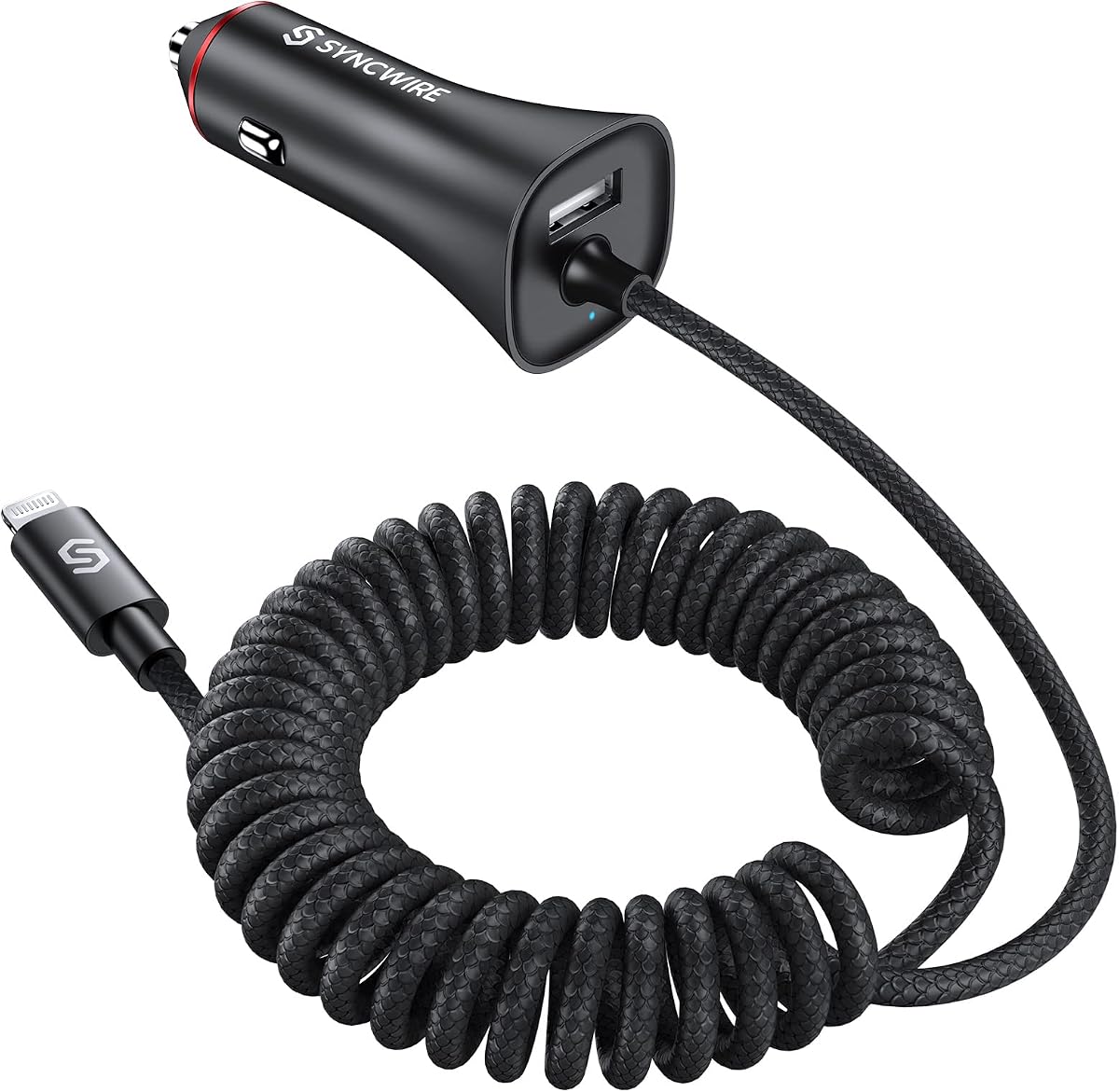
The Syncwire iPhone Car Charger offers a polished combination of a built-in coiled Lightning cable and an additional USB-A port. Its 4.5 rating places it among the stronger customer-rated options in the group, while the product information emphasizes MFi certification, intelligent power adjustment, and compatibility with numerous iPhone, iPad, and iPod models.
We may earn a commission when you buy through this link, at no additional cost to you.
The charger can operate the built-in Lightning connection and additional USB port at the same time, with total current described as up to 4.8A. The attached cable naturally rests at approximately 1.3 feet and can extend to five feet when pulled. Its shape retention and case-oriented design are useful because the connector must pass through openings in protective phone cases, including common LifeProof and OtterBox-style cases.
Unlike newer USB-C-focused alternatives, the extra port is USB-A, so it does not provide Power Delivery for USB-C phones. It also offers fewer external connection choices than the YEAHFUN and LISEN chargers. Nevertheless, for a driver whose priority is a reliable Lightning connection and no separate phone cable, those limitations are less disruptive than they would be for a mixed-device household.
This Syncwire model is best suited to owners of Lightning-equipped iPhones who value a long, permanently connected cable and occasionally need to charge a second USB-powered device. The sturdy polycarbonate shell, smart IC, thermal design, white status light, and stated certification standards make it a credible all-around choice for everyday commuting.
The retractable-style coil provides enough reach for common dashboard and seat placements without leaving a full six-foot cable permanently stretched across the cabin. When not needed, it returns to a compact resting form.
Many charging setups fail simply because a rigid connector cannot pass through a protective case. This charger is specifically designed with aftermarket case openings in mind, improving the likelihood of a clean phone-to-charger connection.
We may earn a commission when you buy through this link, at no additional cost to you.
The 67W 3-Port Super Fast Type C Car Charger is a versatile adapter with one USB-C and two USB-A ports. Its 4.7 rating is the highest among the ten products listed, making it a strong choice for shoppers who prioritize customer feedback alongside broad charging capability. The charger supports up to 37W over USB-C and 30W over USB-A, with a combined maximum of 67W.
We may earn a commission when you buy through this link, at no additional cost to you.
The product information claims that compatible phones can charge from zero to 50 percent in about 30 minutes, with performance up to three times faster than previous standard charging. It also lists compatibility across numerous iPhone, Samsung Galaxy, Google Pixel, iPad, and other USB devices. A three-foot USB-C-to-USB-C cable is included, along with a one-year replacement.
Lightning users will need to supply a compatible USB-C-to-Lightning cable because none is listed in the package. The model also has less of a clearly defined brand identity than the established-name alternatives, which may make the stated certifications, warranty handling, and listing support worth checking closely. Its most important tradeoff is that a high wattage figure is shared across multiple ports rather than available at full strength to every device.
This charger is a good fit for mixed Android, Apple, and accessory ecosystems that want fast USB-C charging without a permanently attached cable. It offers a strong balance of output, port count, and protection features. For the best experience, users should pair it with certified cables appropriate to their devices and verify the current listing details before ordering.
A 37W maximum on USB-C gives the adapter more capability than many compact two-port options. That headroom is useful for compatible phones, tablets, and other USB-C devices that can negotiate higher power levels.
An intelligent chip manages output and provides safeguards against overcurrent, overvoltage, overheating, and short circuits. The charger is also described as stopping output when a connected battery reaches full capacity.
We may earn a commission when you buy through this link, at no additional cost to you.
The LISEN 90W Car Charger is built around two USB-C Power Delivery ports, providing up to 90W in total and up to 45W per port. Its 4.6 rating reflects a capable adapter that combines high output, a very small enclosure, and a metal body. The package includes both a 60W USB-C-to-USB-C cable and a 27W USB-C-to-Lightning cable, which makes it unusually complete for newer and Lightning-equipped phones.
We may earn a commission when you buy through this link, at no additional cost to you.
The aluminum housing is described as scratch-resistant, durable, and effective at dissipating heat. Its stated dimensions of 2.1 by 0.9 inches are intended to keep the adapter close to the socket edge. The product information lists compatibility with 12V and 24V vehicles, including cars, trucks, and RVs, and highlights Samsung, Google, LG, Apple, iPad, and MacBook Air devices.
The tradeoff is that there are no USB-A ports. Accessories that require older USB-A charging cannot be connected directly. Modern USB-C-to-Lightning cables are also required to use the included Lightning lead with appropriate devices, and the actual charging rate remains controlled by the phone, cable, and charging protocol. A high-wattage charger cannot force a device to accept more power than it supports.
LISEN is the strongest selection here for a driver who wants maximum total charging capacity in a very small body and already uses USB-C accessories. The included cables reduce setup friction, while the full-metal construction and dual PD design make it appealing for phones, tablets, and lighter computer use.
The two-port design delivers substantial power while retaining a thumb-sized form factor. That balance is particularly helpful in vehicles with shallow dashboard sockets or crowded accessory areas.
Including both USB-C-to-USB-C and USB-C-to-Lightning cables allows the charger to serve modern USB-C devices and compatible Lightning phones. It is a more complete package than chargers that require every cable to be purchased separately.
We may earn a commission when you buy through this link, at no additional cost to you.
The iPhone Car Charger Fast Charging 60W Car Charger bundle offers two USB-C Power Delivery ports and includes one USB-C-to-USB-C cable plus one USB-C-to-Lightning cable. Its 4.5 rating reflects a broad package for owners who want both modern and legacy connector types without maintaining a separate collection of leads.
We may earn a commission when you buy through this link, at no additional cost to you.
The charger provides up to 30W on one USB-C port and up to 60W when both are used. It includes an MFi-certified C94 Lightning connector and a USB-C cable with an embedded E-Marker chip, allowing output to be adjusted to the connected device. The smart system detects the attached device, selects an appropriate current, monitors temperature, and is described as stopping charging when the battery is full.
The listing uses a generic product name, so buyers should pay attention to the package details and compatibility statements rather than assuming that every listed iPhone receives the same maximum rate. Lightning support covers a wide range of older and current models, while the USB-C cable is intended for the newer USB-C-equipped phones listed in the product information. There is no built-in cable, so a loose lead can still be lost or left in the wrong compartment.
This model is appealing for households that need to support both USB-C and Lightning devices while keeping the setup in a dual-port format. The combination of included cables, MFi certification, and broad protection coverage makes it more convenient than a basic adapter, although the 30W maximum per port is lower than the highest-output alternatives.
The bundled USB-C-to-USB-C and USB-C-to-Lightning leads mean the same adapter can serve phones on either connector standard. This reduces the need to carry unrelated charging leads for each device.
A blue ring indicator helps locate the socket in darkness, a small feature that matters when the charger is tucked below a dashboard or inside a recessed console.
We may earn a commission when you buy through this link, at no additional cost to you.
The Rombica Apple MFi Certified iPhone Car Charger is a dual-USB-A adapter supplied with two braided Lightning cables. Its 4.5 rating reflects a straightforward approach for people whose devices still rely on the Lightning connector. Because two separate cables are included, the setup can support two compatible Apple devices without relying on a permanently attached lead.
We may earn a commission when you buy through this link, at no additional cost to you.
The adapter offers up to 2.4A and 12W when one port is active, with a combined 4.8A and 24W when both are used. Its intelligent power-management chip and temperature-control system adjust output to the connected equipment. The supplied MFi-certified cables use a C89 terminal and a 56-ohm pull-up resistor, while surge protection and overvoltage safeguards help regulate the charging process.
The housing combines aluminum alloy with fireproof ABS and includes gold-plated tubing for heat reduction. A ring LED helps identify the ports in low light, and the compact body is intended to fit a cigarette-lighter socket without occupying excessive dashboard space. The main limitation is the absence of USB-C PD, which prevents the same level of fast charging for USB-C-equipped iPhones and other modern devices.
The Rombica charger is best for households with two Lightning-oriented iPhones, older iPads, or multiple accessories that use that connector. It is less attractive as a long-term mixed-device solution, but the two-cable bundle and dual-port output make it convenient for shared vehicles and family cars.
The pair of braided Lightning leads makes it easy to give both front-seat occupants a dependable connection. Braided jackets also offer a useful durability benefit in a cable that is repeatedly bent and routed inside a car.
The combination of an aluminum-alloy housing, fireproof ABS, gold-plated tubing, dynamic temperature sensing, and controlled current is designed to manage heat while multiple devices draw power.
We may earn a commission when you buy through this link, at no additional cost to you.
The Linocell 60W Dual USB C Car Charger combines two USB-C Power Delivery ports with two MFi-certified USB-C-to-Lightning braided cables. Its 4.5 rating reflects a well-rounded package for Apple users who want modern fast-charging ports and two durable Lightning leads in the vehicle.
We may earn a commission when you buy through this link, at no additional cost to you.
The charger provides 30W on each USB-C port for a total of 60W. Its Smart iQ chip detects connected devices and adjusts the current, while temperature control, surge protection, short-circuit prevention, and overcharge safeguards provide a broad protection layer. The all-aluminum housing is designed for scratch resistance and heat dissipation, and the ring indicator helps reveal the ports in low-light conditions.
The included cable is USB-C-to-Lightning rather than USB-C-to-USB-C. That makes the bundle ideal for Lightning-equipped iPhones, iPads, and AirPods but less convenient for newer USB-C phones unless another cable is already available. The absence of USB-A also means older accessories cannot be connected directly, although the product is clearly optimized around a newer multi-device setup.
Linocell is a good choice for families using several Lightning-era Apple devices and valuing braided cable durability. Its even 30W allocation across two USB-C ports is a clear advantage over adapters whose high headline wattage is concentrated in one socket. As with any Lightning charger, buyers should confirm that the included MFi-certified cable suits their device and use.
Braided jackets help resist the abrasion and repeated flexing associated with a permanently routed car cable. Having a spare also provides a practical backup when one lead is misplaced or damaged.
With 30W available from each USB-C port, two compatible devices can receive meaningful charging performance simultaneously. The design avoids concentrating all listed power in a single connection.
We may earn a commission when you buy through this link, at no additional cost to you.
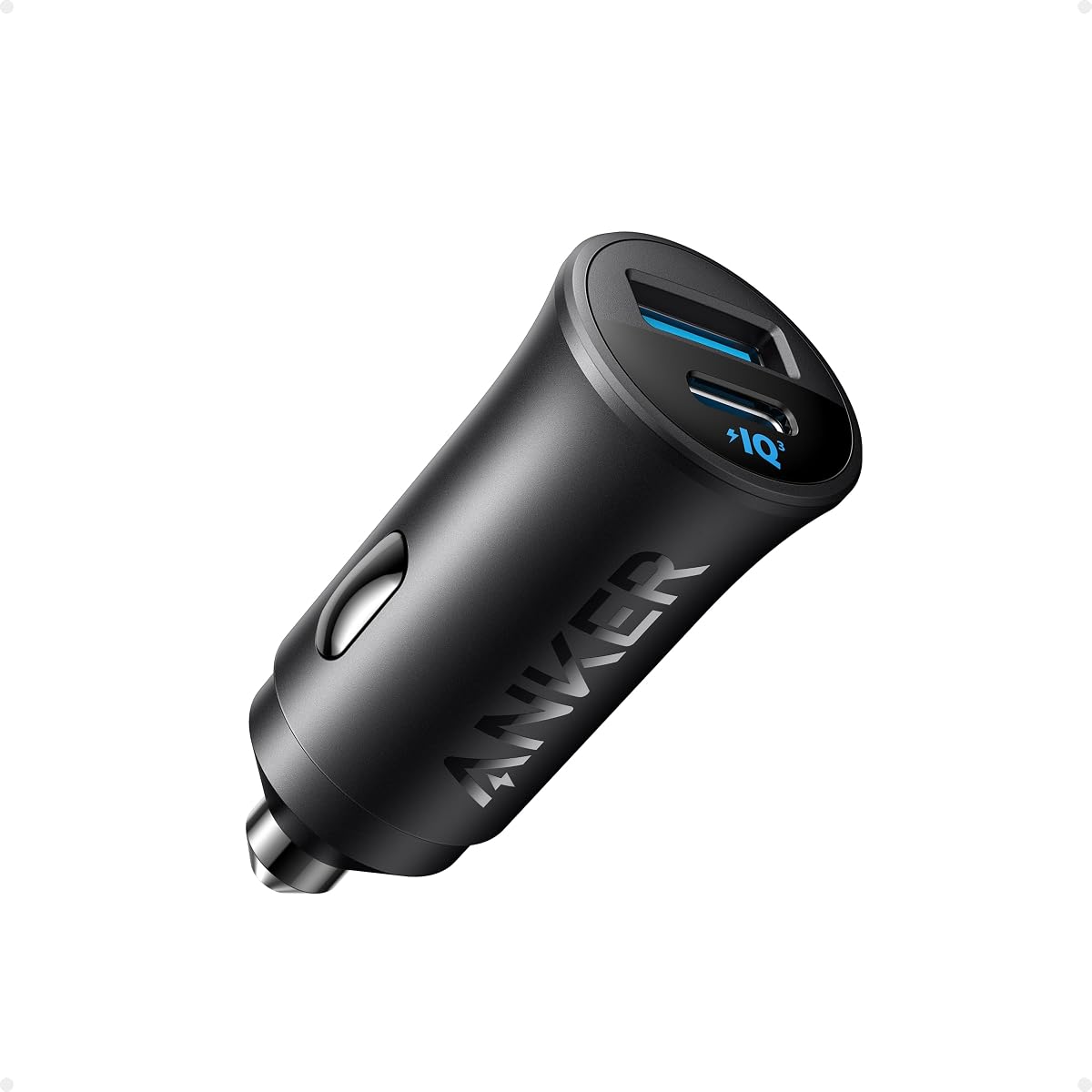
The Anker 30W 2-Port PowerIQ 3.0 USB C iPhone Car Charger is a compact adapter that delivers up to 30W through USB-C while retaining a USB-A port for a second device. Its 4.7 rating is among the highest in the roundup, and the product information highlights a miniature design, intelligent power allocation, and extensive electrical protection.
We may earn a commission when you buy through this link, at no additional cost to you.
The USB-C connection is positioned as up to three times faster than standard 5W charging, making it particularly relevant to iPhone 15 and 15 Pro users. The second port allows two phones or another USB-powered accessory to charge at the same time. Anker also includes a welcome guide and an 18-month warranty, adding reassurance for buyers who want established brand support.
The maximum output is 30W, so it cannot match the higher USB-C capacity of the 67W and 90W alternatives. No cable is included, and a Lightning-equipped iPhone will need a suitable USB-C-to-Lightning cable to use the main port. Buyers should also remember that the second device’s charging rate depends on the power split and the capabilities of the connected accessory.
The Anker is a top pick when space, reliability, and clean design matter more than maximum aggregate wattage. It is particularly compelling for newer USB-C iPhones and mixed devices that still use USB-A. For most everyday navigation, messaging, and battery-maintenance needs, 30W is ample, and the compact housing reduces dashboard clutter.
The adapter is explicitly designed to occupy little space around the vehicle socket. That helps preserve access to nearby controls, climate settings, and storage areas.
Overvoltage, undervoltage, overcurrent, and over-temperature protection work alongside intelligent power allocation. These features help maintain stable output when several devices or changing vehicle conditions are involved.
We may earn a commission when you buy through this link, at no additional cost to you.
The Syncwire 32W Super Fast Car Phone Charger combines a 20W USB-C Power Delivery connection, a 12W USB-A port, and a built-in MFi-certified coiled Lightning cable. Its 4.6 rating makes it one of the higher-rated products in the group, while the three-way connection arrangement offers a rare balance between fast charging, a second port, and a permanent phone lead.
We may earn a commission when you buy through this link, at no additional cost to you.
The Lightning lead uses an MFi-certified C94 chip and is listed as compatible with current and earlier Lightning-equipped iPhones, iPad Pro, and AirPods Pro. The product information states that an iPhone can reach 58 percent in 30 minutes under the supported fast-charging conditions. The attached coil rests at approximately 1.3 feet and extends to five feet, with a design intended to work through aftermarket phone cases.
The charger supports two-device operation, but the total 32W is divided between the 20W PD connection and 12W USB output. The USB-A port remains useful for older accessories and phones with legacy cables, although it cannot provide the benefits of USB-C PD. A polycarbonate shell, smart IC, thermal material, and blue status LED form the core physical design.
This is the most premium-oriented built-in-cable option because it combines a longer coiled lead with a meaningful 20W PD output. It is a strong recommendation for Lightning iPhone drivers who want a permanently connected cable and the ability to charge one additional device without carrying a separate adapter.
The built-in cable retains fast-charging functionality rather than forcing a basic 12-volt connection. This makes it useful for drivers who prioritize quick top-ups between destinations.
The five-foot extension reaches from the socket to many common mounting positions, while the coil returns to a shorter form when released. The case-compatible design improves practical usability with protected phones.
We may earn a commission when you buy through this link, at no additional cost to you.
The right Lightning car charger depends on connector type, output, included accessories, vehicle fit, and protection design. Comparing these factors before buying helps avoid a mismatched cable, an underpowered adapter, or a charger that crowds the dashboard.
Match the connector to the device, then confirm expected charging speed.
Prioritize usable per-port output, not only total wattage.
Choose permanence for convenience or separate cables for flexibility.
Verify PD, PPS, or QC support for the device you own.
Prioritize temperature monitoring and complete electrical safeguards.
Confirm 12V or 24V support and check dashboard clearance.
Match cable reach to the mounting position without crossing controls.
Consider certified components, durable construction, and reliable support.
Begin by confirming that the vehicle’s accessory socket matches the charger’s supported input, commonly 12V or 24V. Insert the adapter firmly but without forcing it. Connect the phone with the built-in or supplied cable, route the cable so it does not cross controls, and start the vehicle if you want to avoid a brief interruption while the electrical system changes state. A status light on models with one should confirm that the adapter is receiving power.
When adding a second device, use the port and protocol best suited to that device. For example, a USB-C phone may benefit more from the USB-C PD port, while an older accessory can use USB-A. Do not expect every device to receive the headline charging speed when two products are connected; power allocation depends on the charger’s design and each device’s accepted input. Remove valuables and loose cables before driving, and never allow a cable to interfere with the steering wheel or pedals.
For care, inspect the socket, adapter, and cable for bent contacts, damaged insulation, discoloration, or heat that persists after use. Pull the charger out by its body rather than tugging on the attached cable. Keep the ports covered when they are not in use to reduce the chance of collecting pocket debris. If charging becomes unusually slow, intermittent, hot, or noisy, disconnect the devices and have the charger checked. For long-term use, periodically confirm that the socket still holds the adapter securely and that the cable remains flexible at all bends.
A Lightning car charger uses Apple’s Lightning connector, traditionally with a USB-A plug on the charger end and a Lightning cable running to the phone. A USB-C car charger uses a reversible USB-C connection directly or provides USB-C PD output through a cable. Newer iPhones generally use USB-C, while many older iPhones, some iPads, and certain accessories use Lightning. The connector on the device should determine which charger fits best.
Yes, if the model includes a built-in Lightning connection plus an additional charging port. The two outputs normally share the charger’s available power, so each device may receive less than the maximum rate when both are active. The Syncwire and Caiinei models in this guide use this arrangement, while newer models increasingly use multiple USB-C ports and supply Lightning cables separately.
MFi certification indicates that the Lightning accessory has been authorized within Apple’s accessory program and includes appropriate connectivity hardware. It can provide greater confidence that the cable will negotiate charging correctly and is a meaningful advantage over an uncertified alternative. Certification applies to the relevant cable or connector, not automatically to every feature of the complete vehicle charger.
The phone, cable, charger, vehicle socket, and thermal conditions can all affect charging speed. The connected iPhone may support only a lower Lightning charging rate, while a non-MFi or damaged cable may limit performance. A loose socket, an overloaded multi-port charger, or protective heat management can also reduce output. Check the cable and connector, move to another outlet if possible, and verify the charger’s compatibility claims before concluding that it is defective.
A coiled cable is useful when the phone mount is close to the socket and a full-length cable would be untidy. It can also reach farther when needed, then compress back to a shorter form. If the mounted phone has a separate permanently routed cable, the convenience advantage is smaller. The important points are connector compatibility, adequate reach, and routing that does not interfere with driving.
Only if the charger’s specifications explicitly support 24V input. Many chargers support both 12V and 24V systems, making them suitable for many trucks, vans, and recreational vehicles, but compatibility should always be verified. Attempting to use a 12V-only adapter in an incompatible socket can damage the charger or create a safety problem.
Modern chargers commonly include overcharge, overcurrent, overvoltage, and temperature protections, but leaving unnecessary electronics connected for long periods is still avoidable. For regular overnight charging, choose a model with recognized safety protections and a secure socket connection, then remove valuable devices when practical. Disconnecting the adapter also makes inspection and cleaning the socket easier.
Usually, a quality USB-C-to-Lightning cable can connect a Lightning iPhone to a USB-C charger because the charger provides USB power and the cable handles device recognition and current negotiation. The fastest rate still depends on the charger, cable, and iPhone model. MFi-certified Lightning cables are generally preferable when compatibility and consistent fast charging are priorities.
The best overall choice depends on how the charger will be used. The Anker PowerIQ 3.0 stands out for compact construction, a 4.7 rating, USB-C output, and two-device flexibility, while the Caiinei model offers the most budget-friendly built-in cable package. For a premium permanent-cable experience, the Syncwire 32W charger adds a five-foot coil and 20W PD output.
Prioritize connector compatibility, usable per-port power, and the arrangement that suits your routine. A Lightning-focused driver may prefer a built-in coiled cable, while owners of newer USB-C phones should prioritize PD charging. Always include a suitable cable in the comparison, leave room for the adapter and connector in the dashboard, and verify the socket voltage before traveling with a new charger.
Ratings, included accessories, compatibility lists, and prices can change, so review the current retailer listing before ordering. Comparing the latest details against the needs identified in this guide is the most reliable way to choose a Lightning car charger that remains useful, safe, and convenient on every trip.
