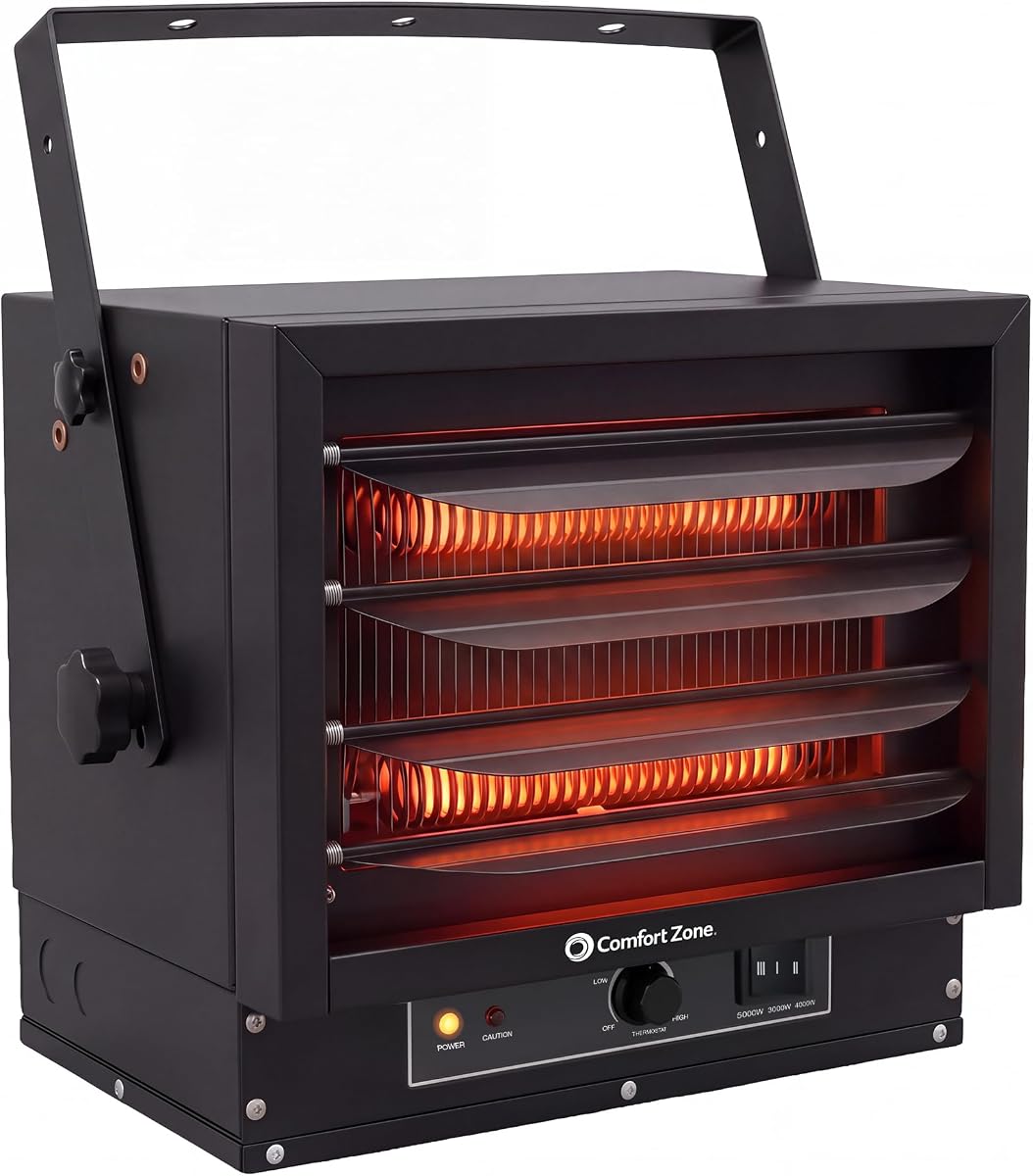
Comfort Zone CZ220BK
4.4Editor score
5,000-watt heating output
Dual-knob thermostat controls
Adjustable louvers and angle
Our 240 Volt Electric Heater guide compares ten garage and workshop heaters for heating power, mounting options, controls, safety, coverage, and ease of setup.
A 240 Volt electric heater is built for spaces that need serious, steady warmth, especially garages, workshops, warehouses, and other poorly insulated areas. Unlike lightweight household heaters, the models in this guide use dedicated circuits, powerful fan-forced airflow, and commercial-style construction. The right choice depends on room size, mounting preferences, electrical availability, and how precisely you need to control temperature.
We compared all ten products by examining their heating output, room coverage, installation method, mounting flexibility, thermostat options, timers, remote controls, fan operation, overheat protection, certifications, and practical garage or workshop features. The list includes ceiling-mounted and wall-mounted units, hard-wired systems, plug-in heaters, and a more compact wall heater, allowing you to compare both large commercial-style and space-conscious options.
Each review explains the strongest reason to consider the heater, along with its meaningful limitations and ideal buyer. The top picks highlight a versatile 7,500-watt option, a value-focused 5,000-watt unit, and a high-output 10,000-watt premium choice. Ratings and availability can change over time, so verify the latest listing details, electrical requirements, and current cost before purchasing.
4.4Editor score

4.4Editor score
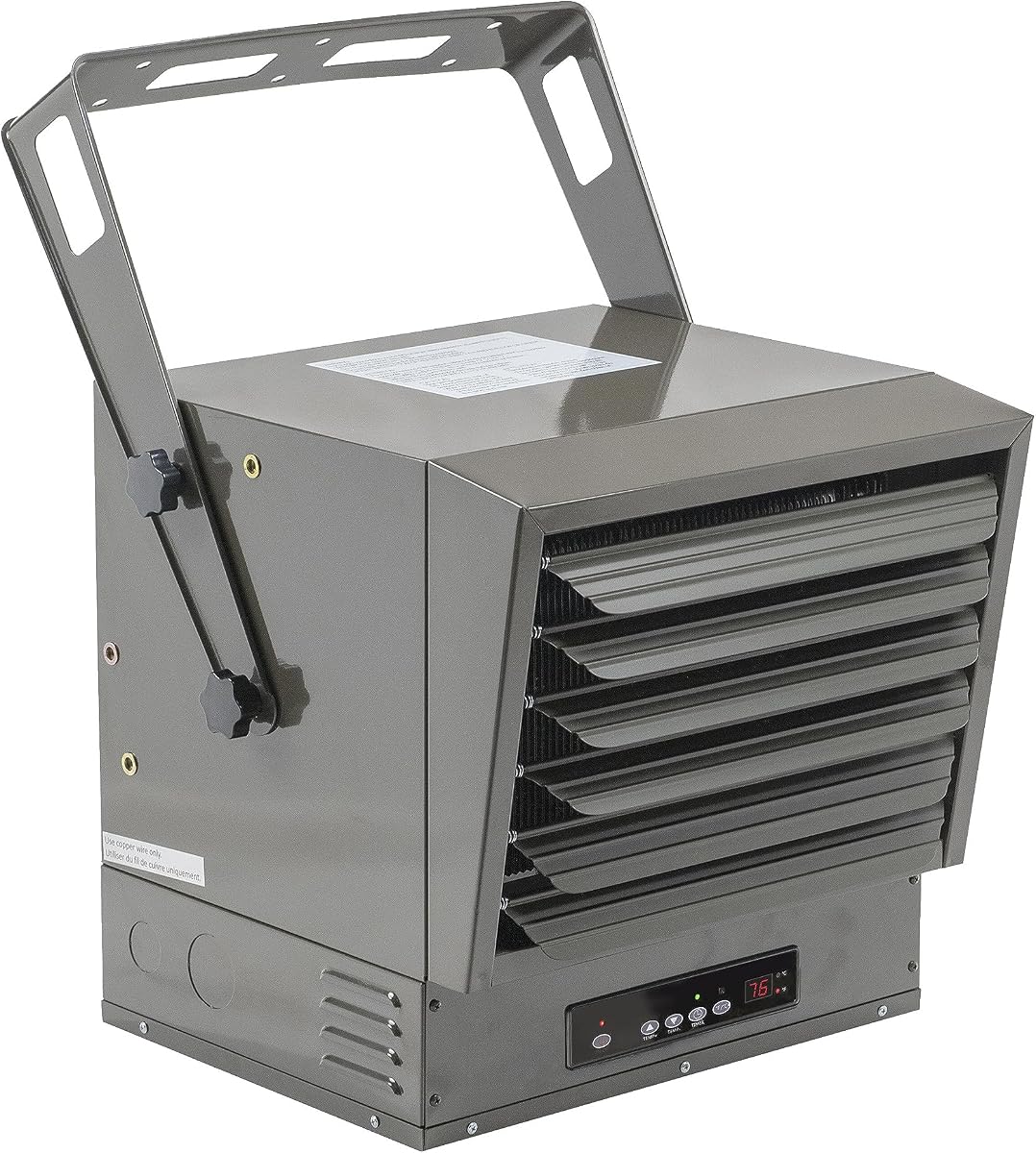
3.8Editor score
The table below compares all ten heaters by output, installation style, controls, and mounting flexibility. Use it to identify the appropriate electrical setup and feature set before checking the full reviews.


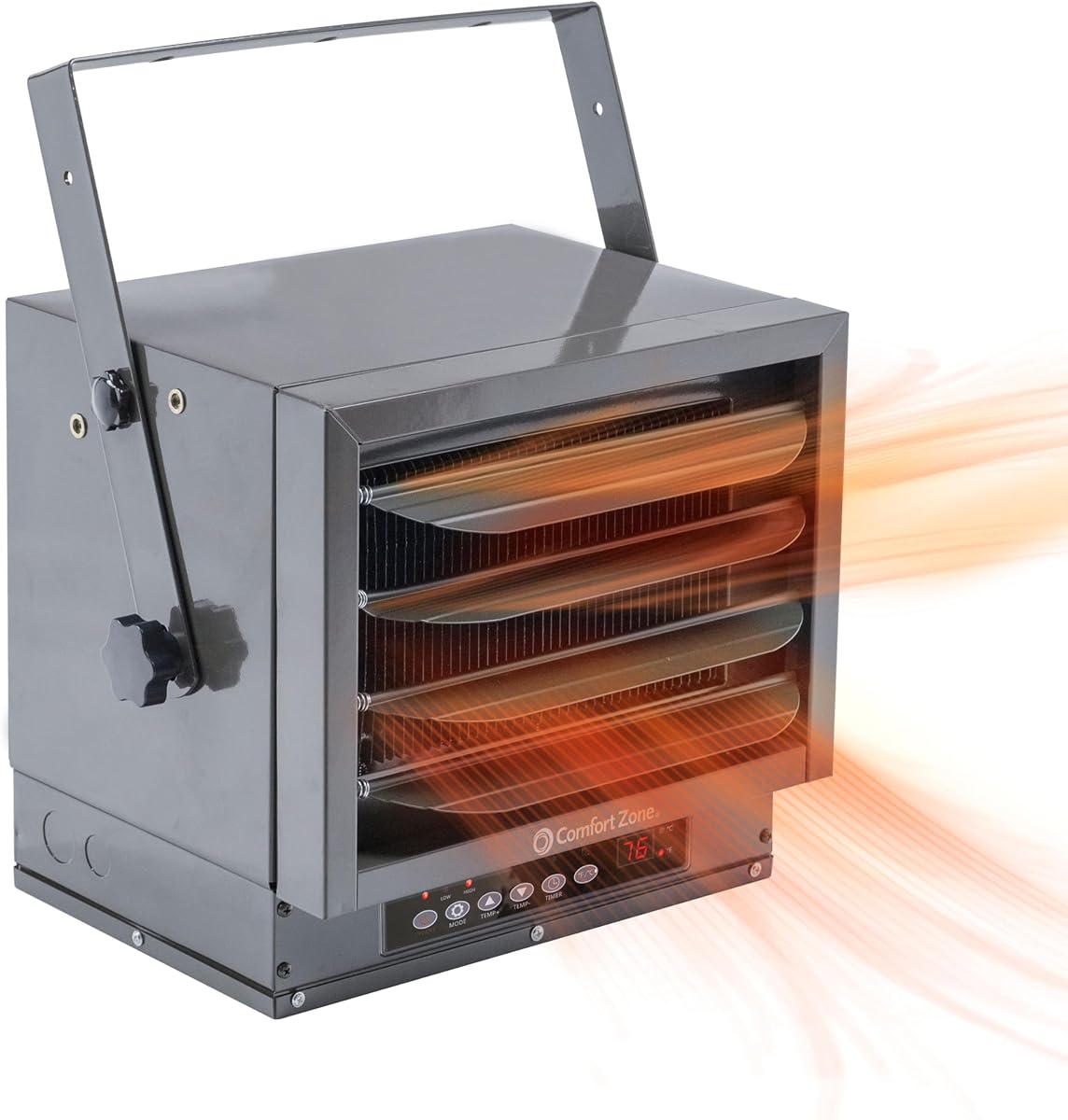


The Comfort Zone 5,000W Ceiling Mounted Garage Heater is a practical 240-volt option for garages, shops, warehouses, and storage areas where preserving floor space matters. It carries a 4.4 rating and stands out for its three heat settings, ETL listing, robust steel body, and straightforward dual-knob thermostat. The fan-forced design and ceiling placement make it especially useful when wall space is also limited.
We may earn a commission when you buy through this link, at no additional cost to you.
Its heavy-gauge steel construction is intended to withstand temperature fluctuations in poorly insulated surroundings, where a lightweight household appliance may be less suitable. Louvers and an adjustable mounting angle let you direct heated air toward a workbench, vehicle, or frequently occupied part of the room. The quick on-and-off function and simple thermostat controls make day-to-day operation approachable even for first-time garage-heater owners.
The trade-off is installation. This unit requires a hard-wired 240-volt connection, so a suitable circuit, wiring, and breaker are necessary. Its 5,000-watt output also provides less margin than the 7,500- and 10,000-watt models in this list, which may matter in very large, drafty, or poorly insulated spaces. Nevertheless, the simple controls, multiple heat levels, and compact ceiling footprint make it a sensible value-focused choice.
Buy this heater if you want capable 240-volt warmth without moving toward the highest-output models, particularly when the space has a usable ceiling location and a qualified electrician can complete the hard-wired installation. It is a strong fit for medium-sized garages and workshops where durability, floor clearance, and straightforward operation matter more than remote control or an extended timer.
Mounting the heater overhead keeps the work area clear for vehicles, storage, and workshop equipment. The adjustable mounting angle helps compensate for the typical heat rise that occurs near the ceiling, allowing the fan-forced airflow to be aimed into the occupied area rather than directly downward against the floor.
Three heat settings provide more flexibility than a single fixed output. The dual-knob thermostat also gives users direct control of the target temperature, while the separate quick on-and-off function makes daily shutdown straightforward.
We may earn a commission when you buy through this link, at no additional cost to you.
The Comfort Zone CZ230ERBK is the most balanced choice in this roundup, combining 7,500 watts of fan-forced heating with a digital thermostat, remote control, and a 12-hour timer. It has a 4.4 rating and is designed to heat areas up to 1,250 square feet. That combination makes it well suited to large garages, workshops, warehouses, and storage areas where consistent temperature control is important.
We may earn a commission when you buy through this link, at no additional cost to you.
The heavy-gauge steel body is designed for demanding environments and temperature changes common in poorly insulated spaces. Adjustable louvers and a variable mounting angle help target airflow, while the fan distributes warmth across the room. A digital thermostat offers more precise control than a basic mechanical knob, and the remote allows adjustments without leaving a work position. Its 12-hour timer adds scheduled operation for users who want the garage warmed before work begins.
As with other hard-wired commercial-style heaters, professional installation and the correct branch circuit are essential. The unit is also large in scope compared with the 3,750- and 5,000-watt choices, so a smaller garage may not need its full capacity. The remote is convenient, but buyers should confirm which batteries, if any, are included in the package before installation.
Overall, the CZ230ERBK is ideal for someone who wants substantial heating without moving to the 10,000-watt premium tier. It offers the most complete control package among the mid-to-high-output options, and its ceiling-mounted design protects valuable floor and wall space. For a large garage or workshop with available 240-volt wiring, it is the most versatile recommendation in the guide.
The included remote is especially useful in a garage or workshop where the heater is mounted overhead or positioned beyond arm's reach. Users can adjust the digital thermostat without walking across the space or interrupting a task.
A stated coverage area of up to 1,250 square feet makes this model appropriate for larger attached or detached work areas. Its 7,500-watt output provides a stronger reserve than midrange models while remaining more restrained than the 10,000-watt option.
We may earn a commission when you buy through this link, at no additional cost to you.
The Comfort Zone CZ220BK delivers 5,000 watts of 240-volt fan-forced heat in a ceiling-mounted, hard-wired design intended for workshops and garages. Its 4.4 rating reflects a well-regarded combination of useful airflow adjustment, simple controls, ETL compliance, and overheat protection. It is a compelling alternative for buyers who prioritize reliable function over digital extras.
We may earn a commission when you buy through this link, at no additional cost to you.
The heavy-gauge steel housing is built to tolerate temperature fluctuations in spaces that may not be well insulated. Louvers and a variable mounting angle let the user aim the airflow toward a work area, and the fan helps distribute warmth more consistently than a stationary radiant source. Its dual-knob thermostat provides uncomplicated temperature adjustment, while a separate quick on-and-off control makes operation easy to understand.
This heater does not include the remote control, digital thermostat, or timer found on the CZ230ERBK and CZ230ERBK's 7,500-watt sibling. That is its primary compromise. It also requires hard-wiring, so installation convenience depends on the electrical infrastructure already present. For smaller spaces or owners who prefer uncomplicated knobs, those limitations may be less important than the lower output and simpler operation.
Choose the CZ220BK for a medium-sized garage, home workshop, or storage area where a 240-volt circuit is available and clear airflow control is the goal. It is especially suitable for users who do not need scheduling or remote adjustment. Its combination of ETL compliance, thermal cut-out protection, and rugged construction makes it a sensible foundation for a practical garage heating setup.
The dual-knob interface provides a clear level of interaction for workshops where the heater will be adjusted occasionally. Avoiding a remote, digital display, and timer reduces the number of features that must be learned, programmed, or maintained.
Adjustable louvers and a variable mounting angle make it possible to direct the fan-forced output toward a bench, vehicle, or doorway. This flexibility is useful in open garages where one fixed direction would not serve every work area equally.
We may earn a commission when you buy through this link, at no additional cost to you.
The DR. INFRARED HEATER DR-988 stands apart because it can function as a portable floor heater or be mounted to a wall or ceiling. It combines 5,600 watts of 240-volt heating with a wide 37°F to 113°F thermostat range, continuous or automatic fan modes, and a dedicated NEMA 6-30 connection. Its 4.3 rating reflects a versatile design for garages, workshops, warehouses, and construction environments.
We may earn a commission when you buy through this link, at no additional cost to you.
The included six-foot cord terminates in a NEMA 6-30P plug and requires a dedicated NEMA 6-30R 250-volt, 30-amp outlet. That requirement is more involved than a standard household connection, but it provides a defined way to power this industrial-style unit. The all-metal housing, steel safety grille, and aluminum fan blades are built for demanding conditions, while automatic overheat cut-off adds a necessary layer of protection.
Its defining advantage is flexibility. The built-in cord storage keeps the setup tidy when the unit is moved, and the ability to use it as a portable heater makes it more adaptable than every ceiling-only model. The limitation is that it lacks the digital thermostat, remote control, and timer offered by several competitors. Fan mode can provide continuous circulation or automatic operation, but there is no remote scheduling function.
This is a compelling choice for owners who need one heater to serve changing tasks, such as warming a work area temporarily and then relocating it. It is also a sensible option if a wall or ceiling position is available but portability may become important later. Confirm that you can provide the required dedicated outlet and choose it when flexible placement matters more than integrated remote controls.
Fewer heaters in this guide can move between a floor position, wall bracket, and ceiling location. That adaptability is valuable in multipurpose garages where projects, vehicles, and storage layouts change over time.
The 37°F to 113°F thermostat range supports a broad range of operating environments. Automatic fan operation can maintain the selected temperature, while continuous mode keeps air moving even after the heating cycle has stopped.
We may earn a commission when you buy through this link, at no additional cost to you.
The InoKraft 7,500W Electric Garage Heater has the highest listed rating in this roundup at 4.6, reflecting a strong combination of features and customer feedback. It delivers up to 7,500 watts through a fan-forced 240-volt system, with manual high and low modes, an automatic ECO mode, a digital thermostat, and a programmable timer lasting one to 24 hours.
We may earn a commission when you buy through this link, at no additional cost to you.
Its stated heating area of up to 750 square feet is more conservative than the 1,250-square-foot claims associated with some 7,500-watt competitors. That does not make the unit less capable in cold or leaky buildings, but it is worth considering carefully. The 65-decibel operating level is also specified, which makes it a reasonable candidate for workshops where reducing distracting fan noise is important.
Installation uses an included 8.2-foot cord and NEMA 14-50P plug, while the unit supports wall or ceiling mounting to conserve floor space. Five angle adjustments and flexible louvers allow the airflow to be directed toward the area that needs warmth. The automatic fan delay helps distribute heat more effectively, although professional installation by an electrician is advised for safe operation.
This heater is a strong fit for a garage that can benefit from automatic operation, timer programming, and selectable output. It is especially appealing if you want wall mounting but prefer a plug-in approach rather than hard-wiring. Confirm that the electrical service can support the NEMA 14-50 connection, and consider room size when deciding whether the stated coverage is sufficient.
The automatic mode adjusts heating output according to ambient temperature and can shut off power when warmth is no longer required. This is useful for users who want consistent control without constantly adjusting the thermostat.
Five installation-angle choices complement the adjustable louvers, allowing the heated airflow to be aimed around a parked vehicle or toward a fixed workbench. Wall and ceiling mounting options make the unit adaptable to different garage layouts.
We may earn a commission when you buy through this link, at no additional cost to you.
The Comfort Zone CZ230ER is a 7,500-watt, 240-volt ceiling heater built for large garages, workshops, warehouses, and storage areas. It holds a 4.4 rating and includes a remote control, digital thermostat, 12-hour timer, adjustable louvers, and overheat protection. Its listed heating coverage of up to 1,250 square feet positions it as a strong whole-room option.
We may earn a commission when you buy through this link, at no additional cost to you.
The heavy-gauge steel body is intended to handle the demands of poorly insulated commercial and workshop environments. Its variable mounting angle helps direct the fan-forced airflow, while the digital thermostat provides precise temperature adjustment. Remote operation is particularly convenient because a ceiling-mounted unit may be difficult to reach routinely.
Its main drawback is the need for a hard-wired electrical installation. The 7,500-watt output also requires more electrical capacity than the 3,750-, 5,000-, and 5,600-watt alternatives, so the appropriate circuit must already be available or professionally installed. In addition, shoppers should compare this model carefully with the closely related CZ230ERBK, since their core listed features are very similar.
Choose the CZ230ER when large stated coverage, remote adjustment, and a 12-hour timer are important in a workshop or garage with a suitable circuit. It may appeal to buyers who prefer a proven ceiling-only configuration and do not need ECO mode or the longer 24-hour timer offered by the InoKraft. It is a capable, feature-focused hard-wired heater.
A ceiling location can be ideal for preserving floor space, but it also makes physical controls less convenient. The remote solves that practical problem by allowing users to change the thermostat setting from a workbench, vehicle, or nearby doorway.
The 12-hour timer can support routines that begin early in the day and finish within a predictable window. It offers a useful middle ground between basic on-and-off operation and longer programmable scheduling.
We may earn a commission when you buy through this link, at no additional cost to you.
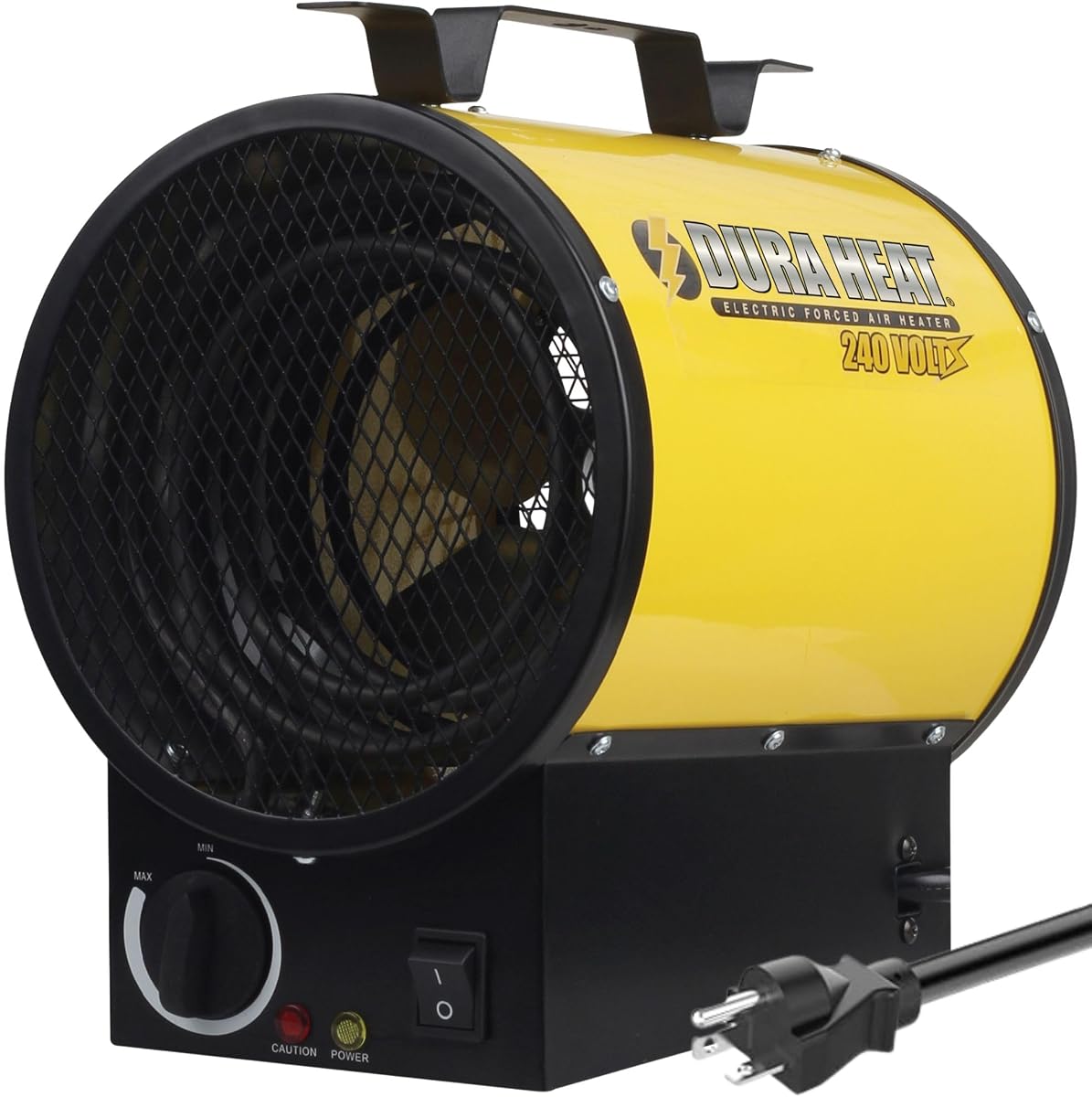
The Dura Heat EUH4000 is a 240-volt electric garage heater rated at 3,750 watts and 12,800 BTU, with a stated heating area of up to 500 square feet. It operates on a 20-amp circuit and has a 3.4 rating. Its lower output makes it more suitable for moderate conditions and smaller zones than the 5,000- to 10,000-watt heaters in this guide.
We may earn a commission when you buy through this link, at no additional cost to you.
The simple specification set focuses on the essentials: 240-volt power, a 20-amp requirement, 3,750 watts of output, and coverage up to 500 square feet. That can be attractive for a compact garage, small workshop, or utility area where installing a higher-capacity circuit would be unnecessary. It may also be easier to integrate into an existing electrical setup because of its lower amperage.
The limitation is that the supplied information offers much less detail about thermostat controls, fan modes, mounting, timers, and safety features than it does for the other products. Its 3.4 rating is also the lowest listed here. As a result, this model offers less certainty for buyers who prioritize sophisticated controls, verified certifications, flexible placement, or long-term scheduling.
Choose the EUH4000 when your heating area is around the stated 500-square-foot range and a 20-amp circuit is already available. It may serve as a supplemental heater for one section of a larger property rather than the sole source of warmth for an expansive garage. Carefully review the current product listing for installation, clearance, and control details before finalizing a purchase.
A 20-amp rating can be easier to accommodate than the requirements of many high-output heaters. It may be a practical option where 30- or 40-amp service would be a larger electrical upgrade, provided the circuit and heater specifications are properly matched.
The stated 500-square-foot coverage is most relevant to a compact garage, workshop, or storage room. Using it as the primary heater for a very large, poorly insulated space could leave it working continuously without maintaining a comfortable temperature.
We may earn a commission when you buy through this link, at no additional cost to you.
The TEMPWARE 240V Hardwired Electric Garage Heater combines 7,500 watts of output with a remote-controlled digital thermostat, two heat settings, and a programmable timer. It has a 4.4 rating, produces 25,590 BTU, and is stated to heat spaces up to 1,250 square feet. These specifications make it a strong candidate for large, high-ceiling garages and workshops.
We may earn a commission when you buy through this link, at no additional cost to you.
Low and high settings provide 6,250 and 7,500 watts respectively, giving users some control over the heating reserve. The digital thermostat spans 45°F to 95°F, while the timer can be programmed from one to 12 hours. Adjustable louvers and a variable mounting angle give control over airflow direction, and the remote allows changes without approaching a high-mounted unit.
The unit is built from heavy-duty steel and carries an ETL certification. Its overheat sensor provides automatic shutoff protection, adding a useful safeguard in dusty or poorly insulated environments. A power cord is not included, and the remote requires batteries that are not supplied. Most importantly, a qualified electrician should install it as a grounded hardwired system using a properly sized breaker and current protection under applicable codes.
This heater suits buyers who want precise scheduled control in a large space and already have, or can add, appropriate 240-volt hardwired service. It may be preferable to a basic knob-controlled model in a frequently used workshop. Those seeking a simpler installation should consider a plug-in 7,500-watt unit instead, while those needing still greater output can look toward the 10,000-watt option.
The 6,250-watt low setting can serve milder conditions or spaces that do not require maximum output. Moving to the 7,500-watt setting provides additional capacity for colder garage environments without needing a different heater.
The remote works with the digital thermostat and 12-hour timer, allowing users to adjust settings and establish a recurring operating window. Remote batteries must be added separately, so include that small item in your installation plan.
We may earn a commission when you buy through this link, at no additional cost to you.
The CSC152TW Electric Wall Heater is a complete wall-mounted unit designed for bathrooms, bedrooms, offices, hotels, nursing homes, and apartment buildings. It carries a 4.4 rating and distinguishes itself with low noise, a built-in thermostat, and straightforward installation. Rather than being a high-output garage machine, it is designed for more compact indoor spaces where quiet operation and unobtrusive wall mounting are priorities.
We may earn a commission when you buy through this link, at no additional cost to you.
The heater produces an airflow of 10 feet per second and operates at a stated 30 decibels, considerably quieter than the fan-forced garage models in this list. Its manual thermostat automatically starts or stops heating according to the room temperature. Because the thermostat is built in, the unit arrives as a complete heating package rather than requiring a separate control purchase.
The key concern is that the supplied product information does not explicitly state the voltage, wattage, electrical rating, overheat-protection feature, or certification. It therefore cannot be assumed to meet the 240-volt garage-heater specification simply because it appears in this comparison. Installation is described as relatively simple, but DIY work or an electrician should still be used according to the heater's actual instructions and local electrical requirements.
Choose the CSC152TW for a quiet, temperature-controlled interior room where a compact wall heater is needed. It is not the right selection for a large, open garage without verifying its electrical and heating specifications. If your priority is a dedicated 240-volt garage heater, choose one of the models with clearly stated wattage, fan-forced output, and commercial-style mounting details instead.
A stated 30-decibel operating level makes the heater more appropriate for bedrooms, offices, and similar occupied spaces than typical fan-forced workshop equipment. Lower noise can improve comfort during meetings, work, or rest.
The built-in thermostat and complete-unit format simplify initial setup. Once appropriately installed, the manual control starts and stops the heater automatically as it responds to room temperature.
We may earn a commission when you buy through this link, at no additional cost to you.
The Comfort Zone CZ260ER is the premium high-output option in this guide, providing 10,000 watts of 240-volt fan-forced heating in a ceiling-mounted design. It has a 3.8 rating and adds a full-function remote, digital thermostat, 12-hour timer, adjustable airflow vents, and an adjustable mounting bracket. It is aimed at large garages and workshops that may struggle to maintain comfort with lower-output models.
We may earn a commission when you buy through this link, at no additional cost to you.
The heavy-gauge steel body is reinforced by fully sheathed heating elements, while the enclosed motor is designed to protect the mechanism from dust and debris. Those details are meaningful in construction, warehouse, and workshop environments. Directed airflow vents and the adjustable bracket help spread heat across the room and focus it where occupants work.
The trade-offs are substantial. It has the highest wattage in the group, so it needs a correctly sized single-phase 240-volt hardwired connection and careful installation. Its 3.8 rating is lower than those of the other three selections, making the premium designation primarily about output and construction rather than the strongest customer-rating profile. The remote and timer also add complexity compared with basic mechanical controls.
Buy the CZ260ER if you have a very large, cold, or poorly insulated space and need maximum listed output. It is best suited to a buyer who values heating capacity, broad distribution, and remote control enough to justify the electrical requirements. For moderately sized garages, the 7,500-watt models may deliver a more balanced ownership experience.
At 10,000 watts, this unit has the highest stated output in the comparison. That reserve is most useful in expansive spaces, severe cold, or locations where heat loss occurs through open doors, unfinished walls, and poor insulation.
The enclosed motor helps shield operating components from dust and debris, a useful design in workshops and warehouses. Fully sheathed heating elements add another layer of protection to the core heating system.
We may earn a commission when you buy through this link, at no additional cost to you.
Choosing a 240 Volt electric heater requires balancing room size, heat loss, electrical capacity, mounting space, and control preferences. The most important step is matching the unit to both the area and the electrical service available at the installation site.
Wattage indicates the heater's maximum electrical heating capacity, while BTU expresses heat output in a more familiar thermal measure. A 3,750-watt model listed for up to 500 square feet may suit a modest garage or supplemental zone, while 7,500- and 10,000-watt units are better candidates for large workshops and open commercial spaces. Room dimensions alone are not enough, because ceiling height, insulation, drafts, and door openings determine how quickly heat is lost. Treat published coverage as a guide rather than a guarantee, and avoid assuming a small unit can maintain a comfortable temperature in a very open or drafty building.
Most high-output heaters require a dedicated branch circuit rather than a standard household receptacle. The requirements differ by model: the DR-988 specifies a NEMA 6-30R 250-volt, 30-amp outlet, the InoKraft uses a NEMA 14-50P plug, and several Comfort Zone and TEMPWARE models are hard-wired. A plug does not mean the heater can be connected to an ordinary outlet; its specific NEMA configuration and amperage must match the receptacle and circuit. For hardwired units, use a properly sized breaker, grounding, and current protection, and have a qualified electrician evaluate the panel and wiring.
Ceiling mounting keeps the floor clear but places the unit above the normal working area, making airflow direction and remote control more important. Wall mounting may provide easier access and can be effective near high workbenches, while portable placement allows temporary heating in changing areas. The DR-988 can be used in all three arrangements, whereas several Comfort Zone models are ceiling-only. The InoKraft offers wall or ceiling mounting with five angle choices. Before installing, check the manufacturer's required clearances from ceilings, walls, combustible materials, vehicles, and circulation paths, and make sure the mounting surface can support the unit.
A manual thermostat is adequate for occasional use, but a digital thermostat can provide a clearer setpoint display and more precise adjustment. Remote control is especially helpful for overhead heaters because it avoids climbing a ladder or walking to the unit. Timers are valuable in active garages, allowing heat to begin according to a work schedule, while automatic or ECO modes can reduce unnecessary operation. The simplest choice is the Comfort Zone CZ220BK with dual knobs. The CZ230ER, CZ230ERBK, TEMPWARE, and CZ260ER offer digital control, while the InoKraft adds ECO logic and the longest stated timer.
A fan-forced electric heater should include overheat protection, and many models also use thermal cut-out sensors, automatic shutdown, indicator lights, and enclosed motors. The Comfort Zone 5,000W is listed as ETL Listed, the CZ220BK is described as ETL compliant, the DR-988 is UL and C-UL listed, and the TEMPWARE is ETL certified. The CSC152TW's supplied data does not identify a certification, so that product requires closer verification. Overheat protection is one feature, not a substitute for proper clearances, sound electrical work, sound wiring, and periodic inspection.
The fan moves air through the heater and distributes warmth more evenly than a purely stationary heat source. Adjustable louvers and mounting angles let you point output toward a workbench, vehicle, or the center of the room. This is particularly helpful in garages with one primary work zone, although directing too much airflow toward a confined corner can waste energy. Ceiling mounting benefits from careful angle adjustment because warm air naturally rises. Look for multiple louvers, a variable bracket, or a wide distribution feature rather than relying on the heater to mix a large space evenly by default.
Portable heaters offer flexibility but can be moved into traffic paths, damaged by vehicles, or placed too close to combustible materials. Wall- or ceiling-mounted systems reduce accidental interference and free floor space, yet they require more planning and often more involved electrical work. The DR-988's folding handle, wheels, built-in cord storage, and multiple mounting positions make it unusually versatile. The InoKraft provides a dedicated 8.2-foot cord for a more convenient plug-in approach. Permanent mounting is generally tidier for a fixed workshop, while portability is valuable when garage space changes.
Garage heaters operate in dusty, dirty, and sometimes humid environments, so metal construction, a protected motor, and a durable safety grille are important. Heavy-gauge steel appears throughout the Comfort Zone line, while the DR-988 uses an all-metal housing, steel grille, and aluminum fan blades. Regardless of construction, inspect the unit periodically, keep intake and discharge openings clear, and gently clean accessible dust from the housing. Do not remove safety guards, and follow the manual's cleaning and inspection schedule because moisture, grease, and dust can affect performance over time.
Before installation, confirm that the area is suitable for the heater and that the electrical system meets the exact voltage, amperage, plug, grounding, and breaker requirements. A qualified electrician should complete hardwired connections, and even plug-in models with dedicated circuits may require professional installation. Read the manual, identify required clearances, and position the unit away from combustible materials, vehicles, extension cords, and foot traffic. Do not operate any heater until the installation has been inspected and tested.
Start with a moderate setpoint and an appropriate fan or heat mode, then allow the room to warm before making further adjustments. For remote-controlled and timer-equipped models, program the schedule around the time the space will be used rather than heating it unnecessarily. Keep louvers and the mounting angle aimed toward the occupied area, and avoid closing doors or blocking airflow. The thermostat should regulate cycling, but continuous operation can occur when the heater cannot reach the selected temperature because of severe heat loss.
For routine care, switch off and disconnect power according to the manual, then inspect the grille, louvers, housing, cord, and mounting hardware. Remove loose dust carefully without using excessive water or allowing moisture into electrical parts. Look for damaged wiring, loose brackets, unusual noise, blocked airflow, or signs of overheating, and stop use if any of these appear. Schedule professional service for electrical faults or internal problems rather than removing protective covers.
A properly installed 240-volt heater can be suitable for a residential garage, but it must use the correct dedicated circuit, grounding, breaker, and manufacturer-required clearances. Keep the unit away from combustible materials, vehicles, extension cords, and damp locations. If you are uncertain about your electrical service, have a qualified electrician inspect it before installation.
The requirement depends on the heater's wattage and design, and the models in this guide are not electrically interchangeable. Some use 20-amp service, others specify 30-amp outlets, and several require hardwired circuits sized for their output. Always follow the exact listing and manual, including the required plug, breaker, grounding, and conductor specifications.
Published coverage ranges from about 500 square feet for the Dura Heat EUH4000 to as much as 1,250 square feet for several 7,500-watt models. Actual performance also depends on insulation, ceiling height, weather, and how often exterior doors open. A room with severe drafts may need more output than its square footage suggests.
No. Higher wattage provides more heating capacity, but it also requires a more capable electrical circuit and may be excessive for a small, well-insulated space. A 3,750- or 5,000-watt model may be more appropriate for a modest garage, while 7,500 or 10,000 watts makes more sense for large or poorly insulated areas.
Do not assume an extension cord is safe for a 240-volt heater. The manufacturer's instructions may prohibit extension cords entirely because long or undersized cords can overheat and create a fire hazard. Plug-in models should be connected directly to the specified NEMA receptacle, while hardwired models require permanent installation by a qualified electrician.
Ceiling mounting preserves both floor and wall space and can distribute heat above the working area, but it makes physical adjustment less convenient. Wall mounting is often easier to reach and works well near benches or vehicle service areas. The DR-988 offers the most flexibility, while several Comfort Zone models focus on ceiling installation.
The products described here are heaters and circulate air within the space; they are not listed as fresh-air ventilators. They can move stale air around, but they do not replace a garage ventilation system designed to remove fumes, moisture, or combustion products. Keep any separate ventilation equipment operating as required for the space.
Several models include programmable timers that can run for a defined period, such as 12 or 24 hours, and the InoKraft also offers automatic ECO behavior. Timer functions differ by model, so review the exact controls and operating instructions. Also check whether the remote requires batteries that are not included.
The Comfort Zone CZ230ERBK is the strongest overall choice because it combines 7,500 watts of output with a digital thermostat, remote, timer, flexible ceiling mounting, and a stated coverage area of up to 1,250 square feet. The CZ220BK offers a simpler and more economical path into hardwired 5,000-watt ceiling heating, while the CZ260ER delivers the lineup's highest output for large, cold, or poorly insulated spaces.
Prioritize the electrical setup before every other feature. A heater cannot deliver its intended performance without the proper circuit, plug, grounding, and breaker, and several models require professional installation. Then match output to room size and heat loss, choose wall or ceiling placement around your available space, and select manual, digital, remote, or timer controls according to how often the garage is used.
Product listings, ratings, availability, and current cost can change, so review the latest specifications before purchasing. Check the manufacturer's installation instructions, electrical requirements, clearance rules, included accessories, and warranty information. Those final checks will help ensure that the selected 240 Volt electric heater fits both the space and the electrical service you actually have available.