
VDIAGTOOL V210 Wire Tracer Circuit Breaker Finder
4.2Editor score
Handles low-voltage DC systems
Finds opens, shorts, and breaks
Includes flexible seven-inch probe
Useful for automotive and garden wiring
Our Electrical Wire Tracers guide compares 10 top models for circuit tracing, cable location, tone generation, underground detection, and low-voltage diagnostic
Electrical wire tracers help technicians locate hidden conductors, identify active circuits, follow low-voltage cables, and diagnose wiring faults without unnecessary demolition. A useful tracer combines dependable signal generation, clear audio or visual feedback, safe voltage handling, and accessories suited to the wiring in front of you.
The products in this guide were compared using their stated tracing capabilities, supported wire types, voltage ranges, detection methods, displays, safety features, and intended applications. The list covers residential circuit finders, communication-cable toners, underground locators, and automotive low-voltage trackers rather than treating them as interchangeable tools.
Each review explains where a product stands out, where its limitations matter, and which technician or homeowner it best serves. Ratings reflect the supplied customer feedback, while availability, configurations, and prices can change. Always confirm the manual, voltage rating, and trace limitations before purchasing or operating any tracer.
4.2Editor score

4.7Editor score

4.5Editor score
The comparison below organizes all ten tracers by their core use, supported systems, sensing method, and major practical limitation. This makes it easier to distinguish full circuit tracers, data-cable toners, underground locators, and low-voltage automotive testers before choosing a specialized tool.




The Klein Tools ET450 Advanced Circuit Breaker Finder and Wire Tracer Kit holds a 4.7 rating and stands out as the most versatile general-purpose circuit tracer in this group. It can follow energized or non-energized breakers, fuses, and wires, giving electricians a practical way to identify circuits without immediately cutting power or removing finishes.
We may earn a commission when you buy through this link, at no additional cost to you.
Receiver sensitivity is adjustable, which helps when the target is behind drywall, cement block, shielded cable, or in an underground application subject to the manual's instructions. Audible beeps and visual indicators communicate signal strength, while the receiver's flashlight improves visibility in closets, crawlspaces, and unfinished areas. An NCV function adds a quick way to check whether a wire appears energized.
The transmitter includes external indicators for 12V, 48V, 120V, 240V, and 480V. That range of information is more useful than a simple on-or-off response, particularly when a technician needs to understand what type of circuit has been located. The supplied blade and ground prongs, alligator clips, plug leads, and three- and 20-foot adapters support several connection methods.
The ET450 is not an effortless tracer in every environment. Shielded cable, underground runs, dense bundles, and unusual materials can weaken or redirect the signal, so the manual remains important. Even so, it offers the broadest practical combination of household circuit tracing, voltage indication, and accessories in this list, making it the strongest all-around recommendation for electricians and serious DIY users.
The ability to trace energized or de-energized circuits makes the ET450 useful before and during electrical work. Adjustable sensitivity helps technicians move from accessible conductors to more challenging concealed routes without changing the basic operating approach.
Audible and visual signal-strength feedback, a receiver flashlight, NCV detection, and multiple lead adapters reduce guesswork. The complete package is particularly convenient for technicians who want one kit to cover several connection scenarios.
We may earn a commission when you buy through this link, at no additional cost to you.
The Klein Tools VDV500-820 earns a 4.7 rating and is tailored to low-voltage communication wiring rather than household branch circuits. It is designed to trace open-ended, non-energized wiring below 60V, including Ethernet, telephone, coax, video, data, and speaker cables, making it a natural fit for network installers and low-voltage technicians.
We may earn a commission when you buy through this link, at no additional cost to you.
Five distinct tone cadences make it easier to distinguish the intended signal from nearby activity. The generator can transmit over a stated 1,000 feet, while the rugged Angled Bed of Nails clips provide a stable attachment point. An RJ11 plug supports telephone and data connections, and the center pins on RJ45 provide another way to identify network wiring.
Continuity and polarity results appear through clearly labeled LEDs, turning the kit into more than a simple tone source. The probe also has a 3.5 mm headphone jack for noisy work areas, although headphones are not included. This audio option can make a weak signal easier to hear without relying entirely on the probe's built-in output.
This is not the tool for identifying live 120V or 240V branch circuits, and it will not trace through drywall, concrete, or another solid barrier. Those limitations are appropriate for its specialized purpose. For technicians who repeatedly map communication cables and need continuity testing alongside tone generation, the VDV500-820 is more focused and versatile than a general electrical circuit finder.
Multiple tone cadences help the user select a signal that remains recognizable among adjacent cables. Secure ABN clips and flexible lead options improve consistency when working with bundles and unterminated conductors.
Continuity and polarity indicators add diagnostic value beyond identifying a cable endpoint. The headphone jack is particularly beneficial in mechanical rooms, network racks, and other spaces where background noise can obscure a weak tone.
We may earn a commission when you buy through this link, at no additional cost to you.
This Underground Wire Locator has a 4.4 rating and focuses on the difficult task of following non-energized cables through soil. It is aimed at sprinkler wires, invisible-fence boundaries, buried communication lines, wall cables, and similar installations where blind digging can damage landscaping or create an unnecessary repair project.
We may earn a commission when you buy through this link, at no additional cost to you.
The stated tracking range reaches 1,000 feet, or 305 meters, while the product description claims detection to about three feet in open muddy ground. Around steel or iron pipe, and in some PVC environments, expected depth falls to roughly one or two feet. The description also suggests attaching the black alligator clip to a metal screwdriver inserted into moist soil when the signal is weak.
A built-in LED flashlight and independent headphone jack improve the experience in dark basements, ceilings, walls, and outdoor work areas. The transmitter also supports a 1–30V battery polarity test. Its built-in rechargeable battery, included transmitter and receiver, alligator leads, headphones, storage toolkit, and manual create a convenient set for daily work.
The most important limitation is conductor compatibility. It is designed for single-core and dual-core wires, not multi-core, bundled, or stranded cables, because neighboring conductors can introduce crosstalk and misleading results. It also is not a general live-circuit breaker finder. Landscapers, irrigation technicians, and homeowners repairing buried low-voltage systems are the strongest audience for it.
Following a buried conductor before excavation can protect irrigation lines, boundary wires, and landscaping. The locator's direction and position feedback helps narrow the search area before the ground is disturbed.
Tracking performance depends on the target, burial depth, soil, and nearby metal. The stated depth figures are best treated as operating conditions rather than guaranteed limits in every landscape.
We may earn a commission when you buy through this link, at no additional cost to you.
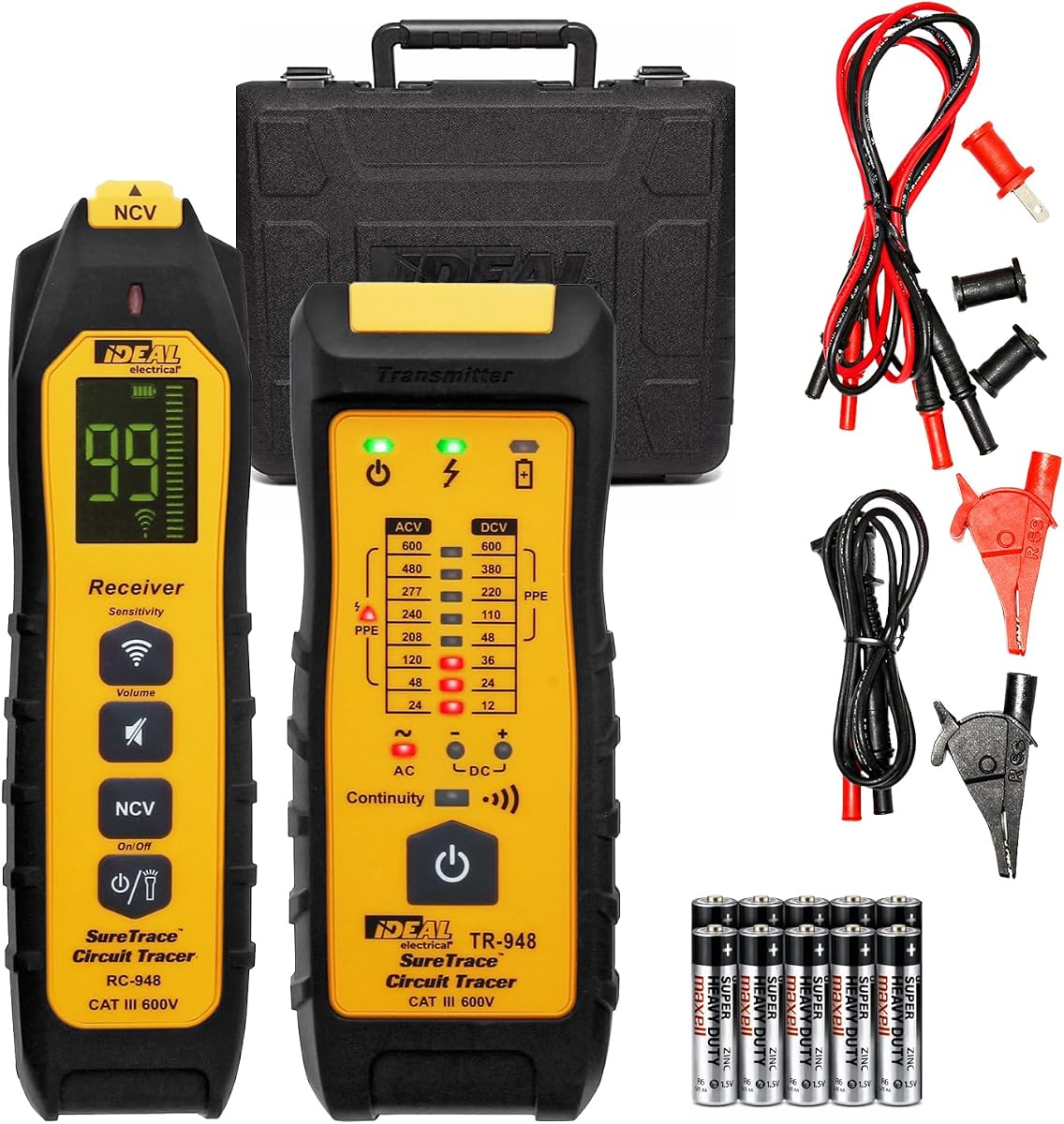
The Ideal Electrical SureTrace Plus Circuit Tracer has a 4.4 rating and is designed for electricians who need more than simple tone tracing. It detects breakers, conductors, fuses, dead shorts, and splice errors across electrical systems up to 600V AC or DC, including three-phase installations, and carries ETL CAT III certification.
We may earn a commission when you buy through this link, at no additional cost to you.
The transmitter provides DC polarity and eight voltage-level indications spanning 24–600V AC and 12–600V DC. A built-in continuity test reduces the need to carry a second tester, while the receiver's NCVT detects AC voltage. A 180-degree rotating main display and a TightSight bottom display make results easier to inspect in tight spaces and at awkward angles.
Signal strength is shown in both analog and digital forms, alongside sensitivity and battery level. CertainCircuit technology visibly indicates when the correct circuit has been de-energized at the panel and at the other end, supporting a one-person tracing workflow. The work light and mute control are practical additions, and the overmolded housing offers drop protection up to 6.6 feet.
This is a feature-dense instrument, so its controls and displays take more study than those of a simple automotive tracer. CertainCircuit and the 3D downloadable instructions can make that learning process easier. For professionals who regularly troubleshoot commercial or residential circuits and want voltage, continuity, and NCVT functions in one package, however, the combination is highly compelling.
Voltage indication, polarity, continuity, NCVT, and tracing functions reduce tool switching during a diagnostic session. That efficiency is valuable when the objective is finding a fault rather than merely identifying a conductor.
The rotating display and bottom-oriented readout address a common frustration when a receiver must remain connected in a panel, attic, or confined wall cavity. Adjustable audible output adds another way to interpret signal changes.
We may earn a commission when you buy through this link, at no additional cost to you.
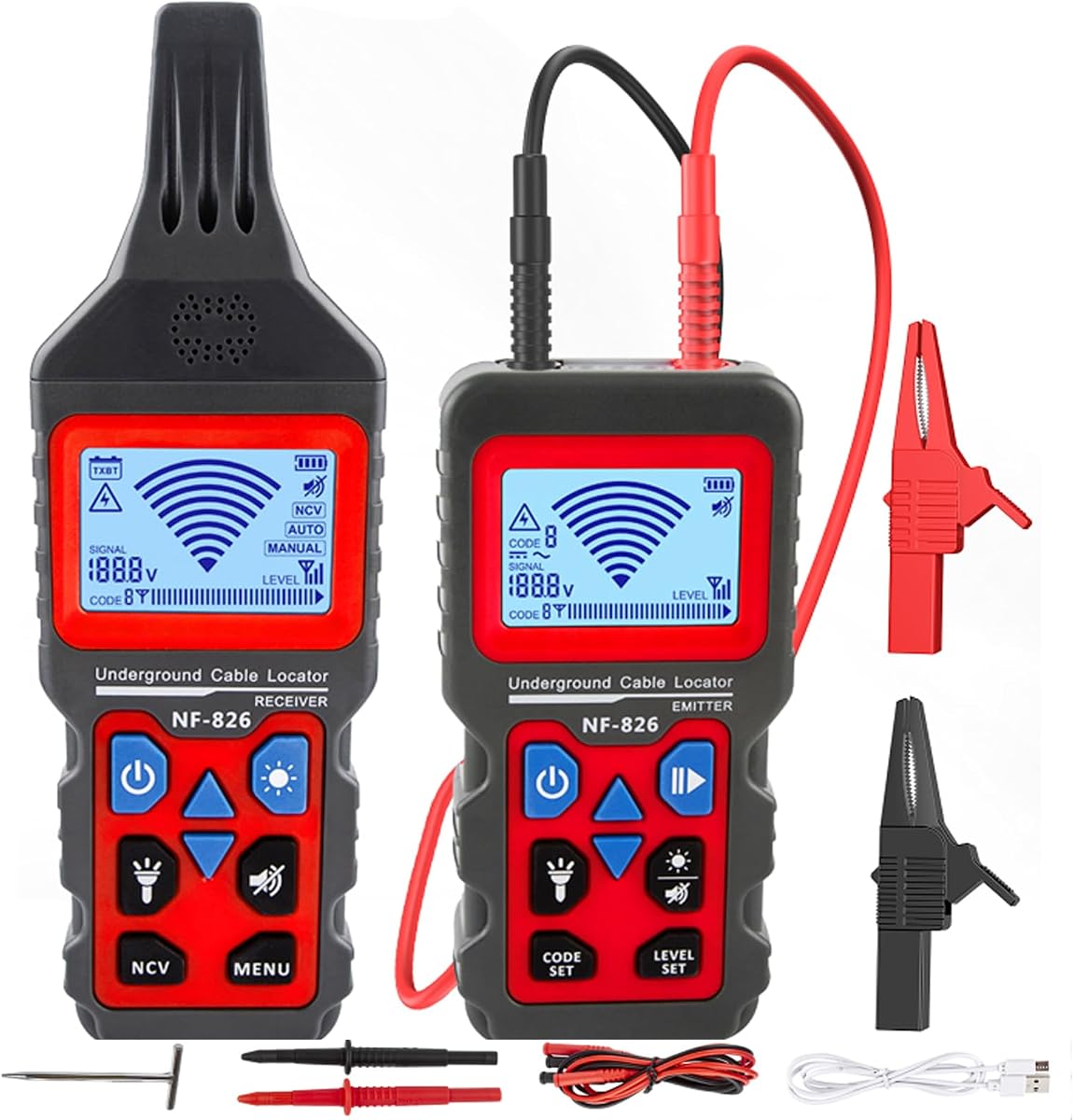
The NOYAFA NF-826 has a 4.2 rating and offers a broad underground-tracing package. It can locate buried cables and pipelines over a stated 2,000 feet, with a listed depth of roughly three to four feet. The transmitter, receiver, and accessories use digital circuitry to help users diagnose a route without excavating the entire path.
We may earn a commission when you buy through this link, at no additional cost to you.
A notable strength is its claimed ability to locate single-core and multi-core cables as well as metal pipes. That makes it relevant to weak-current systems, communications lines, computer networks, telephone wiring, underfloor electric heating lines, and covered electrical outlets. The breakpoint function can help find a short-circuit fault, but the user must already know which core is shorted.
Sensitivity can be adjusted manually or automatically, and an automatic frequency sweep helps locate the target. The receiver operates in mute mode and includes a flashlight, backlight, and automatic shutdown after ten minutes of inactivity. The transmitter's self-check function reports its operating status on the LCD, while the system can measure AC or DC voltage from 12V to 400V.
The built-in 1400mAh lithium battery is listed for six to ten hours of runtime and convenient charging. Its broad capabilities justify consideration by utility, irrigation, low-voltage, and installation technicians, but the fault-finding instructions and environmental sensitivity demand careful use. It is less suitable for someone who wants a simple circuit breaker finder.
The combination of route location and breakpoint finding is more useful than basic direction detection alone. Technicians can narrow the location of a buried fault before performing a targeted repair.
Automatic frequency sweeping offers a convenient starting point, while manual sensitivity adjustment provides control in difficult conditions. The LCD status display helps users confirm the transmitter is operating as intended.
We may earn a commission when you buy through this link, at no additional cost to you.
The TEMPO Communications 701K-G has a 4.5 rating and is built for technicians who install or repair voice, data, and video networks. It can identify wires in a bundle, monitor voltage passing through a circuit, check for breaks, and trace conductors through walls, floors, and ceilings made from non-conductive materials such as wood or drywall.
We may earn a commission when you buy through this link, at no additional cost to you.
Its most distinctive feature is the 200EP-G probe amplifier, which produces distinct warbling tones designed to remain recognizable in noisy environments. A tone-proximity LED illuminates more brightly as the probe nears the correct conductor, providing a visual alternative when audio cues are difficult to hear. A separate LED work light illuminates spaces behind furniture and inside equipment racks.
The kit includes a high-power 77HP-G generator, the 200EP-G amplifier probe, a modular plug, alligator test leads, RJ11 and RJ45 connections, a socket adapter, and a nylon carrying case. That collection supports both punch-down-style communication wiring and practical low-voltage testing arrangements, making it well suited to field installers.
Its purpose is specialized: this is not a breaker finder for energized household branch circuits, nor a locator for buried utility lines. For copper, DSL, Ethernet, fiber-optic support networks, and related service-provider work, however, the 701K-G provides an unusually complete and organized kit. TEMPO's long history in test and measurement also adds confidence for professional buyers.
Warbling tones help the user recognize a meaningful signal change, while the proximity LED offers a clear visual cue. These complementary indications are valuable in crowded racks and busy job sites.
The included generator, amplified probe, modular connections, test leads, adapter, and case cover common voice and data tasks. It reduces the need to assemble separate tracing components for a service visit.
We may earn a commission when you buy through this link, at no additional cost to you.
The VDIAGTOOL V210 carries a 4.2 rating and is the most accessible option in this guide for low-voltage DC diagnostics. It is designed around 6–42V systems and can identify open connections, broken wires, current leaks, and circuit paths without requiring the user to puncture wire insulation.
We may earn a commission when you buy through this link, at no additional cost to you.
The transmitter and receiver use LEDs and a changing buzzer tone to indicate open and short conditions. Receiver sensitivity is adjustable, and the seven-inch flexible probe can reach inside appliance housings, panels, and vehicle interiors. The tool can be used while flexing wires or connectors to identify intermittent faults in devices such as washers, refrigerators, or microwaves.
Automotive applications are especially prominent, covering cars, trailers, RVs, ATVs, boats, and motorcycles. The V210 can also follow de-energized doorbell wiring, in-wall speaker cables, LED-strip supply breaks, smart-home sensor wiring, and buried landscape-light, irrigation, and robot-mower boundary cables.
Its limits are significant but clearly stated: it must not be connected to 110V or 220V AC household mains, and de-energization should be verified before wall tracing. Shielding, resistance, circuit complexity, and nearby wires can distort the signal. Within the low-voltage DC niche, though, it delivers a useful set of diagnostics at a budget-friendly tier.
Open, short, leak, and intermittent-fault identification make the V210 more than a simple signal injector. The buzzer changes tone as the fault condition changes, providing quick feedback during a test.
The same kit can support vehicle wiring, trailer circuits, appliance harnesses, smart-home sensors, and garden cables. That flexibility makes it a practical first tracer for technicians or homeowners working outside conventional branch-circuit work.
We may earn a commission when you buy through this link, at no additional cost to you.
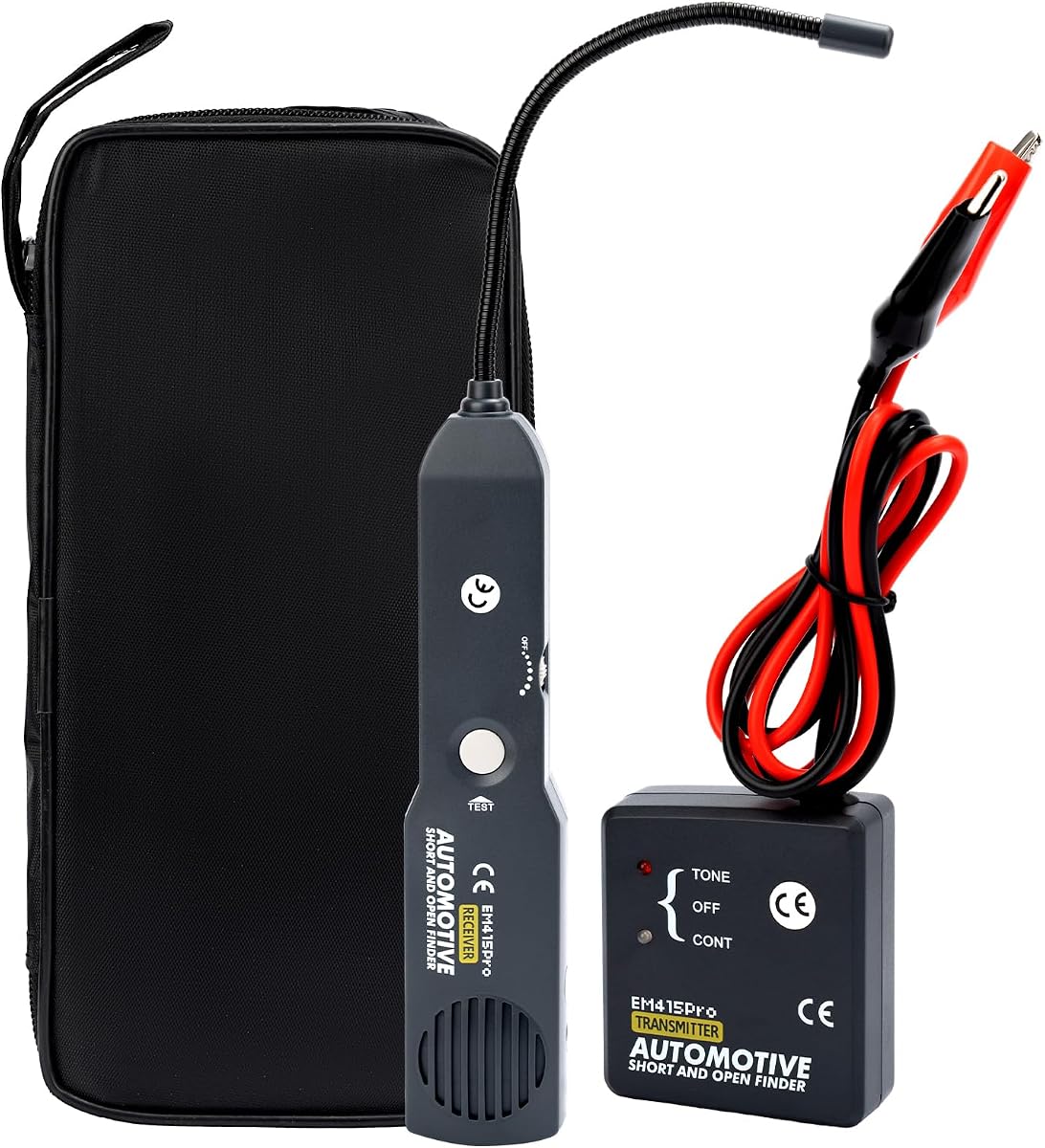
The EM415Pro has a 4.2 rating and offers a straightforward approach to automotive and low-voltage DC tracing. It uses a transmitter signal and audible receiver feedback to identify open wires, short circuits, and circuit paths, making it a practical choice for technicians who want a compact, uncomplicated tracker.
We may earn a commission when you buy through this link, at no additional cost to you.
The tool is intended for car repairs, trailers, trucks, and other systems operating from 6–42V DC. It can follow wiring concealed behind panels, beneath carpets, through wire harnesses, and in other accessible low-voltage spaces without cutting the conductor or damaging its insulation.
Its seven-inch flexible probe is the central ergonomic feature. It can bend around dashboard components, fuse boxes, connectors, and densely packed harnesses, giving the user more freedom than a rigid probe. The non-contact and easy-to-use circuit-tracing setup is suited to preliminary diagnosis where a technician needs to establish which conductor carries the signal.
This is a basic tracking tool rather than a full electrical analyzer. It does not offer the broader voltage, continuity, polarity, and short-circuit functions found in more specialized kits, and it remains outside its depth on household AC systems. For a technician seeking a straightforward automotive wire tracker, however, the EM415Pro covers the essential task with a focused feature set.
The bendable probe reaches into locations where a rigid metal tip is difficult to position. It is particularly helpful around dashboards, fuse boxes, and compact connector groups.
Audible feedback supports a quick identify-and-confirm workflow. It is most effective when the target circuit can be isolated from nearby conductors and the connection remains stable.
We may earn a commission when you buy through this link, at no additional cost to you.
The Klein Tools VDV500-705 earns a 4.4 rating and is a straightforward tone generator and probe for open-ended, non-active low-voltage wiring below 60V. It supports common tasks involving Ethernet, internet, telephone, speaker, coax, video, and data cables, giving everyday installers a simple way to map conductors.
We may earn a commission when you buy through this link, at no additional cost to you.
The toner's strong point is its combination of tracing and mapping. Along with the included RJ45-to-RJ45 cable, it can perform a pin-to-pin wire map, which helps confirm that each conductor reaches the intended position. Alligator clips support unterminated wires, while separating nearby conductors and using proper grounding improves tone detection and accuracy.
The probe includes a work light for poorly illuminated spaces and an adjustable volume control for different environments. Those practical details make the kit easier to use for a quick installation, move-out inspection, or repair where users may not need the more elaborate controls found on advanced analog toners.
Its scope is intentionally narrow. It is not a live household circuit breaker finder, and its listed low-voltage range limits it to appropriate communication and signal wiring. For a technician or homeowner who primarily needs reliable cable identification and basic wire mapping, the VDV500-705 provides useful capability without an unnecessarily complicated interface.
Pin-to-pin mapping gives users a more structured result than following a tone alone. It helps confirm cable orientation and individual conductor positions after installation or repair.
The analog interface, adjustable probe volume, and integrated work light keep the tool approachable. Included clips and test cables support the most common low-voltage connection methods.
We may earn a commission when you buy through this link, at no additional cost to you.
The Ideal Electrical SureTrace Pro has a 4.5 rating and represents the most capable premium instrument in this roundup. As an ETL Certified CAT III tracer, it detects breakers, conductors, fuses, dead shorts, and splice errors in systems up to 600V AC or DC, including three-phase electrical systems.
We may earn a commission when you buy through this link, at no additional cost to you.
Its scope extends beyond tracing. The receiver and transmitter measure voltage from 24–600V AC and 12–600V DC, confirm DC polarity, verify outlet wiring, detect AC voltage through the NCVT, and provide continuity testing. A patent-pending rechargeable inductive or sensing clamp measures AC amperage up to 600A, potentially replacing several separate instruments on a service call.
Two 90-degree rotating OLED displays, including a TightSight bottom display, keep numerical information visible from different working angles. Analog and digital signal strength, sensitivity, and battery level appear alongside adjustable volume and mute controls. CertainCircuit technology visually confirms when the correct circuit has been de-energized at the panel and at the other endpoint, allowing one technician to complete the process.
The premium hardware comes with fewer compromises than the general-purpose alternatives, but it is a substantial investment and offers more complexity than a homeowner needs for occasional cable tracing. The overmolded industrial housing provides grip and stated drop protection up to 6.6 feet, while free 3D instructions help users learn different tracing scenarios. For working electricians who need a single advanced diagnostic platform, this is the most ambitious recommendation.
Tracing, voltage measurement, polarity confirmation, outlet checks, continuity testing, NCVT, and AC amperage measurement reduce the need to carry several separate devices. The clamp-based current measurement is especially distinctive.
Rotating OLED screens improve visibility in panels and other confined spaces. The industrial overmold adds grip and impact protection, supporting the tool's suitability for demanding professional environments.
We may earn a commission when you buy through this link, at no additional cost to you.
The right wire tracer depends on the circuits, materials, fault types, and working environment involved. Start with the specific tracing task, then verify safety limits, supported conductor types, and the accessories needed to connect and follow the target.
Different tools are designed for very different electrical systems. A residential circuit breaker finder should support the voltage range and wiring methods found in the panel, while an Ethernet or telephone toner is designed for low-voltage communication conductors. Underground locators are intended for non-energized buried lines, and automotive trackers commonly operate only in 6–42V DC systems. Using a tracer outside its rated environment can produce misleading results or create a safety hazard.
Most wire tracers depend on a generated signal, but conductivity, shielding, moisture, metal, and the construction of the building affect how far it travels. Some analog toners can follow conductors through wood or drywall. Specialized kits can trace through cement block or shielded cable, subject to their manuals. Underground locators also have different performance in open soil, around metal pipes, and at greater burial depths.
Voltage capability is more than a specification to compare; it defines the conditions under which the tool should be used. The Klein ET450 traces energized or non-energized circuits, the Ideal models support systems to 600V AC or DC, and the VDIAGTOOL and EM415Pro are restricted to low-voltage DC. Always confirm the target is de-energized when using a low-voltage-only tracer, and follow the instructions for any energized-circuit operation.
The included attachments determine how conveniently the tracer can connect to the target. Alligator clips work with unterminated conductors, while RJ11, RJ12, and RJ45 connections serve communication cables. AC plug leads suit energized outlets in supported circuits, and ABN clips or modular adapters help attach a tone to a conductor without disturbing other wires. Check whether the intended connector and cable length are included.
Audible tones remain essential in noisy settings, but visual indicators can be equally important in walls, ceilings, and vehicle compartments. Look for adjustable volume, mute controls, signal-strength displays, proximity LEDs, work lights, and rotating screens. Models such as the SureTrace Pro use two rotating OLED displays, while simpler kits provide a single work light and an audible signal. The best interface is the one that remains easy for the intended user to interpret.
Tracing identifies a path; continuity, polarity, open-circuit, short-circuit, and voltage tests help determine what is wrong with it. The Ideal SureTrace products combine tracing with several electrical measurements, the NOYAFA supports breakpoint location, and the VDIAGTOOL V210 emphasizes open, short, leak, and intermittent-fault detection. If the work involves more than identifying a cable, these diagnostic functions may justify a more advanced kit.
The behavior of a target signal changes around adjacent conductors. Underground locator performance can suffer around steel, iron, and PVC pipes, while tone and automotive trackers may experience crosstalk in bundles. Grounding, separating nearby wires, reducing the signal level, and choosing the correct target conductor improve results. A tool explicitly restricted to single-core or dual-core cables is not a substitute for a system designed to handle complex bundles.
A comprehensive circuit tracer may include a transmitter, receiver, multiple leads, adapters, batteries, and a carrying case. Under-cable and automotive tools may be more compact and specialized. Consider where the instrument will be stored, how often it will move between vehicles or job sites, and whether the included case and accessories make it practical to carry. A feature-rich tool earns its size when those functions are routinely needed.
Begin by identifying the circuit and confirming the tracer's voltage rating. For any tool restricted to low-voltage or non-energized conductors, disconnect power and verify that the circuit is safe. Read the manual, inspect the leads and connections, install fresh or fully charged batteries, and perform the manufacturer's recommended self-check before touching the target wire.
Connect the transmitter to the correct conductor using the appropriate clip, plug, or lead. Select a tone or operating mode that is unlikely to conflict with nearby equipment, then set the receiver sensitivity based on the expected signal. Sweep the receiver slowly along the route, watch the signal-strength indicators, and isolate adjacent wires when possible to reduce capacitive coupling or crosstalk.
After use, disconnect the transmitter from the circuit and switch off both units. Remove the batteries if the manual recommends it, especially during long storage, and clean the housing, probe, and leads with a dry or lightly damp cloth. Store the kit in its case, protect cables from sharp bends, and recharge the battery systems as directed. Recheck the tool before the next job if it was dropped, exposed to moisture, or produced inconsistent readings.
It depends on the tracer and the installation. The Klein ET450 states that adjustable sensitivity can detect through drywall, cement block, and shielded cable, while the TEMPO 701K-G can trace through non-conductive walls, floors, and ceilings such as wood or drywall. Signal strength may still vary around metal, dense bundles, moisture, or poorly connected conductors. Consult the product manual and move the probe slowly while monitoring both audible and visual feedback.
A wire tracer is the broader category and may identify energized circuits, breakers, faults, buried cables, or conductors. A tone generator and probe system usually injects a recognizable signal into a specific low-voltage wire so the user can follow it. The Klein VDV500-820, VDV500-705, and TEMPO 701K-G are especially suited to communication-cable tracing, while the ET450 and Ideal models cover broader electrical diagnostics.
Models specifically designed for underground use can trace non-energized buried conductors. The NOYAFA NF-826 lists a route length of up to 2,000 feet and a depth of approximately three to four feet, while the dedicated underground locator lists a 1,000-foot range and up to three feet in open muddy ground. Results vary with soil, depth, shielding, and nearby metal, so none should be treated as having a guaranteed depth in every environment.
No, not unless the manufacturer specifically rates the tool for the voltage and connection method involved. The VDIAGTOOL V210 and EM415Pro are limited to 6–42V DC and specifically should not be used on 110V or 220V AC household mains. Always de-energize and verify the circuit before tracing. The ET450 and Ideal SureTrace models include energized-circuit capabilities, but their instructions and safety precautions still apply.
The generated field can induce a secondary signal in a neighboring conductor, a phenomenon commonly described as crosstalk or capacitive coupling. Bundles, parallel runs, shielding, resistance, and complex circuitry can increase the effect. Separate the target where possible, adjust receiver sensitivity, select a lower or more distinctive tone, and confirm the result at multiple points. Treat an audible signal as a lead that requires verification rather than definitive proof by itself.
Alligator clips are useful for unterminated conductors, while RJ11 and RJ45 leads or adapters support telephone and network wiring. A modular plug or socket adapter can help with terminated communication lines. The VDV500-820 includes ABN clips, RJ11 and RJ45-related support, while the VDV500-705 includes alligator clips and an RJ45-to-RJ45 test cable. Check the intended jack type and whether the target is terminated before choosing accessories.
A low-voltage automotive-style tracer can help identify opens and intermittent faults in appliance wiring harnesses when the appliance uses a compatible DC system. The VDIAGTOOL V210 is specifically described for troubleshooting breaks in washers, refrigerators, and microwaves, including faults that appear when wires or connectors are flexed. Internal components, shielding, and multiple conductors can affect the signal, so each section should be checked methodically and the appliance safely de-energized.
Follow the manufacturer's maintenance schedule and use the built-in self-check where provided. The NOYAFA NF-826 includes a transmitter self-check displayed on its LCD. For other models, routine care generally includes checking battery condition, lead continuity, connectors, probe cleanliness, and operation with a known target. Calibration or repair should be handled according to the manual if readings become inconsistent, especially after a drop or exposure to moisture.
The Klein Tools ET450 is the strongest all-around recommendation because it combines energized and non-energized tracing with adjustable sensitivity, voltage indicators, NCV detection, and a broad accessory package. The VDIAGTOOL V210 is the best budget choice for 6–42V DC automotive, appliance, and garden wiring, while the Ideal Electrical SureTrace Pro is the premium option for comprehensive diagnostics and AC amperage measurement.
For communication networks, the Klein VDV500-820, TEMPO 701K-G, and Klein VDV500-705 offer more suitable tone-generation methods, while the two dedicated underground products serve non-energized buried lines. The right choice depends on conductor type, environment, supported voltage, and whether you need simple identification or integrated fault testing. Always follow the manufacturer's instructions and use each tool only within its stated limits.
Product configurations and prices can change, so confirm the current listing, package contents, manufacturer instructions, and safety requirements before buying. Customer ratings are useful context, but they should be considered alongside fit, capability, and service support rather than treated as a substitute for a careful technical comparison.