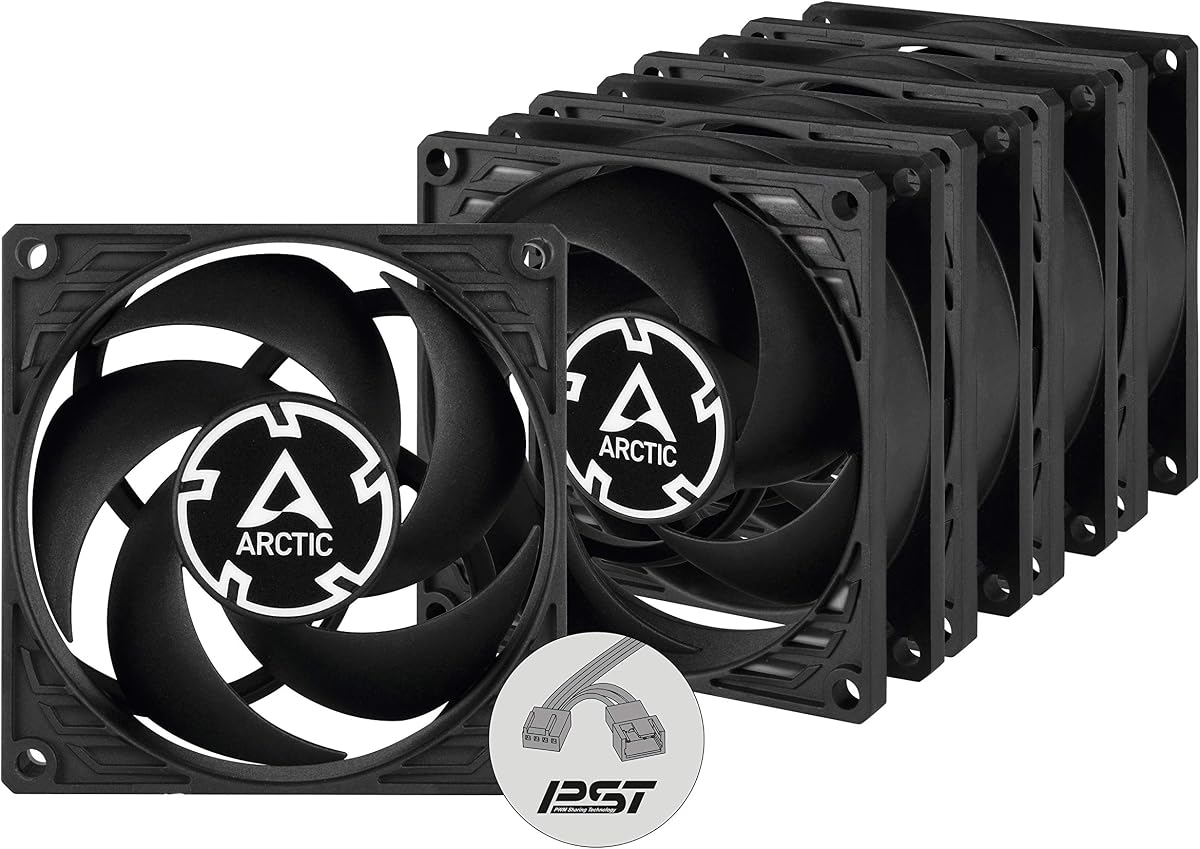
ARCTIC P8 PWM PST
4.7Editor score
Five-fan multipack
Synchronous PWM sharing
200–3000 RPM control
1.90 mmH₂O static pressure
Our 80mm case fan guide compares ten quiet, PWM, high-static-pressure, and budget options in 2026 to help you choose reliable airflow for compact PCs.
The best 80mm case fan depends on where it will be installed, how much noise you can tolerate, and whether your motherboard supports intelligent speed control. These compact 25mm-thick fans remain useful in small-form-factor PCs, NAS enclosures, server racks, radiators, and older cases that lack 120mm mounting options.
This guide compares ten available options using the supplied specifications, including airflow, operating speed, noise ratings, static pressure, bearing design, connector type, dimensions, and PWM support. It covers single fans, multipacks, premium quiet models, budget options, and specialized choices for high-air-resistance environments without claiming that every model was personally tested.
The rankings show where each fan stands out. Noctua models lead for refined acoustic design and broad PWM control, ARCTIC options cover silent, standard, and high-speed needs, and more budget-oriented alternatives provide practical replacement airflow. Prices and availability can change, so confirm current listings and case compatibility before purchasing.
4.7Editor score

4.9Editor score

4.8Editor score
This side-by-side comparison highlights the key differences in speed control, acoustic design, airflow, pressure capability, and physical format so you can identify the 80mm fan that best matches your system and operating priorities.


The Noctua NF-A8 PWM is a refined 80mm fan with a 4.9 rating, combining a broad 450–2200 RPM control range with a maximum noise specification of 17.7 dB(A). Its Flow Acceleration Channels, Advanced Acoustic Optimisation frame, and anti-vibration hardware make it a strong all-round choice for builders who want responsive cooling without an aggressive acoustic profile.
We may earn a commission when you buy through this link, at no additional cost to you.
The 80x80x25mm format fits the standard 80mm positions found in compact HTPCs, ITX cases, small-form-factor enclosures, and NAS devices. Automatic motherboard control allows the fan to react to system conditions, while the included Low-Noise Adaptor can reduce the maximum speed to 1750 RPM. Screws, an extension cable, and a y-cable add installation flexibility, although the y-cable still requires suitable power delivery from the motherboard.
The main limitation is that its 2200 RPM ceiling is lower than that of the ARCTIC P8, P8 PWM PST, and especially the P8 Max. It may therefore be less appropriate when maximum airflow through a restrictive heatsink or radiator is the sole priority. Its 25mm thickness also means it will not fit everywhere that thinner 15mm alternatives can go, so case clearance should be checked before buying.
This is the strongest general-purpose recommendation in the guide for users who prioritize quiet operation, intelligent control, and dependable compact-system cooling. It is particularly suitable for an office PC, media server, or small workstation that runs frequently but should remain unobtrusive. For maximum-speed enthusiasts or installations with severe airflow restriction, one of the higher-RPM ARCTIC models may be a better fit.
The 450–2200 RPM range provides enough adjustment for responsive thermal management without forcing the fan to run at maximum speed constantly. The included Low-Noise Adaptor lowers that ceiling further for especially sensitive environments.
Its standard 25mm thickness and supplied mounting hardware suit many 80mm positions in NAS enclosures and compact PCs. Always verify the available depth because some slim chassis and coolers provide only 15mm of clearance.
We may earn a commission when you buy through this link, at no additional cost to you.
The ARCTIC P8 five-pack pairs a 4.6 rating with a straightforward 80mm format and a 3000 RPM operating speed. It delivers up to 23.4 CFM and is optimized for static pressure, making it useful behind restrictive components such as heatsinks and radiators where a high-speed fan can move air through obstacles more effectively.
We may earn a commission when you buy through this link, at no additional cost to you.
This version uses a three-pin connector, so it does not provide native four-pin PWM control. It can still function in systems that regulate fan voltage, but a three-pin connection is less flexible when you want precise, temperature-linked speed changes through a dedicated PWM header. The five-fan quantity also makes it more appropriate for a multi-position case, compact server, or a planned whole-system replacement than for a single-fan repair.
Its fluid dynamic bearing uses an oil capsule intended to prevent lubricant leakage, while the redesigned blades and motor construction support efficiency and durability. At full speed, the stated 0.3 Sone level is likely to be more noticeable than the very quiet specialty models in this list, so the P8 is better suited to users who prioritize cooling headroom and balanced noise than absolute silence.
Choose this multipack when you need several dependable 80mm fans and have mounting positions that can benefit from 3000 RPM performance. It is a practical pick for compact servers or densely packed enclosures. If intelligent, semi-passive operation is essential, the ARCTIC P8 PWM PST offers a more direct solution.
The pressure-optimized blades help maintain useful airflow when the fan faces a heatsink, radiator, filter, or other resistance. This makes the P8 more versatile than a model designed only for open intake positions.
A five-fan pack can populate multiple intake and exhaust positions without requiring separate purchases. It is especially practical for multi-bay NAS systems, compact workstations, and cases with several 80mm mounting options.
We may earn a commission when you buy through this link, at no additional cost to you.
The ARCTIC P8 PWM PST is a feature-rich five-pack rated 4.7, offering synchronized PWM control across a 200–3000 RPM range. Its stated output of 23.4 CFM, 1.90 mmH₂O static pressure, and 0.3 Sone maximum make it a strong choice for systems that need both flexible cooling control and good performance against restricted airflow.
We may earn a commission when you buy through this link, at no additional cost to you.
PWM Sharing Technology is the defining feature. Instead of treating each fan as an independent four-pin device, the system can manage a group synchronously through compatible ARCTIC hardware or appropriate hub arrangements. The motor uses a neodymium-iron-boron magnet ring, and the fan can stop below 5 percent PWM, enabling semi-passive operation when the cooling demand is low.
The trade-off is operating sound at the upper end. A 3000 RPM fan is likely to be audible in a quiet room, even if the motor and blade design preserve a comparatively restrained acoustic character. Users seeking a near-inaudible desktop may prefer the dedicated ARCTIC P8 Silent or Noctua options. Buyers should also understand that full PST functionality depends on compatible hardware and proper connection topology.
This is an excellent pick for a multi-fan compact PC, NAS, or workstation where coordinated cooling is valuable. The broad speed range helps balance quiet idle operation with strong response under load, while the multipack provides a consistent group of fans. It is less attractive for a single replacement, but ideal when several positions should operate as a coordinated system.
PWM Sharing Technology allows compatible fans to follow a common control signal, reducing the need to tune multiple devices independently. This is especially useful in compact cases where several intake and exhaust fans should operate consistently.
The 200 RPM lower range and stop behavior below 5 percent PWM allow the group to settle when cooling demand is modest. That can reduce unnecessary noise and energy use in systems configured with suitable control hardware.
We may earn a commission when you buy through this link, at no additional cost to you.
The Noctua NF-R8 redux-1800 carries a 4.8 rating and focuses on a useful balance of quiet operation, dependable construction, and intelligent control. Its maximum speed of 1800 RPM is lower than many competitors, but the specified maximum noise level of 17.1 dB(A) makes it an attractive option for quiet offices and home systems.
We may earn a commission when you buy through this link, at no additional cost to you.
The four-pin PWM connection gives the fan a broad operating strategy under compatible motherboard control, moving between near-idle behavior and full output as required. Its 80x80x25mm body follows the standard mounting pattern, and the long-established NF-R8 platform is described as having received more than 100 awards and recommendations from international computer hardware publications.
Because the top speed is limited, this fan may not be the best choice for a dense heatsink, tightly packed radiators, or 2U server applications that benefit from aggressive airflow. It can still provide effective case ventilation, CPU cooler replacement, and NAS cooling, but those tasks are best approached with realistic expectations about the 1800 RPM ceiling.
This is a particularly compelling choice for one or two quiet replacement positions, especially when automatic control and a restrained acoustic profile matter. It also sits below the flagship NF-A8 in maximum speed while retaining the same standard frame size. For users creating a quieter office build rather than a high-static-pressure server, the redux-1800 offers a focused and practical feature set.
The 1800 RPM ceiling and stated maximum of 17.1 dB(A) make this model appealing where constant fan noise would be distracting. It is particularly useful in a desktop that sits near a workspace.
The redux edition preserves Noctua's established low-noise approach and four-pin PWM control without focusing on extreme performance. A broad range of optional accessories can extend mounting and connection options.
We may earn a commission when you buy through this link, at no additional cost to you.
The Kingwin 80mm Silent Fan is a straightforward replacement option with a 4.5 rating. It targets standard 80mm computer cases, CPU coolers, radiators, home servers, and other compact installations, using optimized blades and a long-life bearing to provide consistent airflow without the complexity of a premium enthusiast model.
We may earn a commission when you buy through this link, at no additional cost to you.
One of its main advantages is versatility. Because it is designed around the standard 80mm mounting format, it can be useful in systems where a failed case fan needs a practical replacement. The manufacturer also identifies mining rigs and GPU farms as potential applications, although buyers should still verify the precise connector, voltage, dimensions, and electrical requirements for any nonstandard installation.
The supplied information does not provide a precise maximum RPM figure, airflow measurement, noise level, or connector type. As a result, it is difficult to compare this fan quantitatively with models that publish complete specifications. It may be a sensible budget-oriented option for basic ventilation, but it is less certain as a choice for a dense radiator, a tightly packed server, or a system requiring exact PWM behavior.
This Kingwin model best fits straightforward replacement needs and basic airflow improvement in a compatible 80mm location. It is also less visually conspicuous in a black case because of its black frame. For a new build where precise acoustic and control data matters, one of the fully specified PWM alternatives offers greater predictability.
The standard mounting format makes this fan straightforward to consider for a case that already accepts 80mm units. It is most compelling when replacing a failed fan and adding several basic ventilation points is not necessary.
The product is marketed for cases, CPU coolers, radiators, servers, and dense computing environments. Confirm connector type, frame thickness, electrical requirements, and the cooling device's mounting guidance before installation.
We may earn a commission when you buy through this link, at no additional cost to you.
The ARCTIC P8 Silent is built around a restrained operating point, producing up to 15.6 CFM at 1600 RPM with a stated maximum noise level of 0.08 Sone. Its 4.6 rating reflects a well-liked model whose strongest qualities are low acoustic output, a pressure-optimized design, and a motor developed to reduce friction and noise.
We may earn a commission when you buy through this link, at no additional cost to you.
The fan uses a three-pin connector and does not offer native four-pin PWM, so its speed is determined through the system's supported voltage-control method. That limitation matters in compact PCs because automatic four-pin control can provide finer thermal response and semi-passive behavior. Even so, the 1600 RPM maximum keeps operating noise comparatively restrained.
The lower speed also limits maximum airflow. It may perform well as an exhaust or intake fan behind a modest restriction, but it is less suitable for a densely packed server, a large radiator, or any installation that requires maximum pressure and flow. The balance is most appropriate for quiet home systems where low noise is more valuable than aggressive cooling capacity.
For a near-silent small-form-factor PC, office desktop, or home server that uses three-pin control, this is a focused recommendation. It provides a standard 80mm format and pressure-aware construction without the higher noise associated with maximum-speed fans. Those needing smarter control should instead examine the PWM PST or Noctua PWM options.
The 0.08 Sone specification and 1600 RPM ceiling make this the quietest-focused model in the group. It suits desktop systems where fan sound would otherwise be easy to notice in a quiet room.
Although its absolute airflow is modest, the pressure-optimized blades are intended to work effectively against heatsinks and other restrictions. This gives the fan useful flexibility without requiring a high-speed operating point.
We may earn a commission when you buy through this link, at no additional cost to you.
The Noctua NF-A8 chromax.black.swap combines the NF-A8 platform's 4.8-rated performance with an all-black design and interchangeable accent pads. It retains the 450–2200 RPM range, four-pin PWM control, 17.7 dB(A) maximum noise specification, and Flow Acceleration Channel design while allowing visual coordination with a wider range of components.
We may earn a commission when you buy through this link, at no additional cost to you.
The supplied swappable pads come in red, black, white, blue, yellow, and green, with four pads of each color. This makes it particularly appealing to builders who want a completely dark appearance or a small accent color without replacing the fan itself. The version can also stop at 0 percent PWM for compatible semi-passive systems, reducing activity when operating conditions permit.
Its thermal performance is effectively aligned with the standard NF-A8 rather than the 3000 RPM ARCTIC models. It offers enough range for intelligent control but is not intended to maximize flow through severe restrictions. The interchangeable color system is a genuine niche benefit, yet it is unnecessary for a functional server or a build hidden inside a cabinet.
This is the right choice for a quiet gaming PC, workstation, or media build where visual consistency matters alongside dependable cooling. It may be especially useful in a case with tempered glass or a visible interior. For purely functional systems, the standard NF-A8 provides the core performance without making accent color a deciding feature.
The all-black chassis and interchangeable pads make it easier to coordinate the fan with other visible components. A restrained dark build can use black pads, while a selective color accent remains possible without changing the fan.
Stopping at 0 percent PWM in compatible configurations can eliminate unnecessary fan activity during light loads. The feature depends on proper motherboard control and should be configured through the system's fan-management software.
We may earn a commission when you buy through this link, at no additional cost to you.
The ARCTIC P8 Silent five-pack extends the quiet-focused P8 Silent concept to multiple case positions. With a 4.4 rating, it provides five 80mm fans operating at a restrained 1600 RPM, making it a straightforward option for populating a compact chassis while keeping maximum fan speed relatively low.
We may earn a commission when you buy through this link, at no additional cost to you.
The supplied listing emphasizes static-pressure optimization, which is important when a fan must push air through a filter, heatsink, or radiator. The virtually silent motor focus aligns with the single-fan model, providing a consistent acoustic strategy across every installed fan. The black finish also helps the group remain visually consistent inside a dark case.
The three-pin connector and 1600 RPM ceiling limit the model's appeal for users seeking intelligent four-pin PWM control or maximum flow. A builder with a motherboard that exposes native PWM headers may prefer the P8 PWM PST, even if it operates at higher speeds. Those using basic voltage control or a compatible control hub may find this pack more appropriate.
This multipack is a useful choice for small-form-factor PCs, multi-bay NAS enclosures, and older cases with several 80mm locations. It avoids the need to match individual replacement fans and provides a uniform low-speed setup. It is less appropriate for a single failed fan or for a high-density server that needs greater pressure and throughput.
Using five matching fans helps maintain a predictable sound and airflow approach across multiple positions. This is useful when a system needs several intake and exhaust points but should remain relatively unobtrusive.
Static-pressure optimization helps these fans work against restrictions rather than only moving open-air flow. The result is a versatile pack for compact enclosures with filters, heatsinks, or limited exhaust paths.
We may earn a commission when you buy through this link, at no additional cost to you.
The ARCTIC P8 Max is the performance extreme of this guide, with a 4.7 rating and a variable range of 500–5000 RPM. Its high-speed design, high static pressure, and 2U server-rack focus make it suitable for compact, densely packed systems where ordinary 80mm fans cannot move enough air through restricted paths.
We may earn a commission when you buy through this link, at no additional cost to you.
Four-pin PWM control provides broad adjustment, and the fan stops below 5 percent PWM before varying continuously from 500 RPM upward. Its fluid dynamic bearing is designed to support long service life, quiet operation at lower speeds, and powerful performance at maximum output. The manufacturer also highlights the availability of spare parts and years of support for this platform.
The obvious drawback is noise. Running near 5000 RPM will be conspicuous in a typical office or home setting, and users may never need that much performance. The fan can also impose greater mechanical and acoustic demands than a moderate-speed model. Quiet systems should configure it conservatively through PWM rather than operating it continuously at its ceiling.
This is the pick for 2U servers, compact high-density enclosures, and builders who prioritize maximum pressure over acoustic restraint. It can also be valuable in a hot workstation when a standard 80mm fan cannot overcome the resistance of a dense heatsink. For ordinary quiet home PCs, the lower-speed Noctua and ARCTIC options are more appropriate.
The 5000 RPM ceiling provides a large performance reserve for restrictive heatsinks, radiators, and dense server enclosures. This makes the P8 Max useful when airflow must be forced through limited openings.
The 500–5000 RPM control range allows substantial flexibility, including a complete stop below 5 percent PWM. Good fan curves are essential because continuous maximum-speed operation would be unnecessarily loud in many environments.
We may earn a commission when you buy through this link, at no additional cost to you.
The Thermalright TL-8015 is a 15mm-thick 80mm fan rated 4.5, offering a useful solution when depth is more restrictive than operating noise. It combines a four-pin PWM connection, 2200 RPM maximum speed, a stated 28.4 CFM maximum airflow, and 1.25 mmH₂O wind pressure in a slim gray frame.
We may earn a commission when you buy through this link, at no additional cost to you.
Its 80x80x15mm dimensions distinguish it from the standard 25mm models in this guide. That thinner profile can be useful in compact cases, behind compatible downward CPU coolers, or in equipment designed around low-profile cooling. The listed airflow is notably high for the size, while the S-FDB V2 bearing is intended to reduce vibration and maintain consistent operation.
The stated maximum noise level of 23.3 dBA is higher than the figures offered by Noctua and the quieter ARCTIC choices. It may still be acceptable in a performance-oriented system, but quiet-build buyers should consider acoustic expectations carefully. Compatibility also requires more than nominal 80mm dimensions: the 15mm depth must fit, and any CPU cooler or radiator needs to support a fan of that thickness.
This Thermalright model is a compelling pick for a slim build where a standard 25mm fan will not fit but a 15mm option can still provide meaningful airflow and PWM control. It can also complement a downward cooler by moving air through the surrounding area. For unrestricted cases with strict acoustic goals, one of the premium quiet 25mm models is the stronger choice.
The 15mm thickness creates more installation flexibility than standard 25mm fans. It can fit slim chassis and compatible downward coolers where adequate depth for a conventional frame is unavailable.
A listed maximum airflow of 28.4 CFM gives the fan meaningful throughput despite its thin frame. The 1.25 mmH₂O pressure specification also suggests useful performance against moderately restrictive cooling components.
We may earn a commission when you buy through this link, at no additional cost to you.
Choosing an 80mm case fan involves balancing frame depth, connector type, speed control, airflow, static pressure, acoustic characteristics, and the number of positions you need to fill. The best choice is the one that fits your hardware and matches your priorities rather than simply having the highest headline speed.
The physical depth of an 80mm fan is a crucial compatibility factor. Most standard models, including the Noctua NF-A8 PWM, Noctua NF-R8 redux-1800, and the ARCTIC P8 family, are 25mm thick, while the Thermalright TL-8015 is 15mm thick. A square front view can be misleading because the fan's full frame must fit behind a panel, beside a radiator, or under a CPU cooler without touching the component it serves.
Measure the empty mounting position rather than estimating from the outside of the case. If a 25mm fan is too deep, choose a compatible 15mm model. If a 15mm fan is available but the mounting hardware expects a standard 25mm unit, verify the screw pattern, frame shape, and included accessories before ordering.
Three-pin and four-pin fans are not interchangeable in every motherboard header. A three-pin fan exposes voltage, ground, and tachometer or speed feedback, while a four-pin PWM fan adds a dedicated duty-cycle control contact. The Noctua NF-A8 PWM, NF-R8 redux-1800, ARCTIC P8 PWM PST, ARCTIC P8 Max, and Thermalright TL-8015 include native four-pin PWM connections.
Native PWM support gives the motherboard more precise control over fan speed and can support semi-passive behavior. Three-pin models can still work in many systems through voltage control, but they may be less compatible with dedicated PWM headers and certain fan hubs. Never force a connector or use an adapter without confirming voltage, pin order, and current requirements.
Maximum RPM indicates the top of the fan's performance range, not the speed at which it must always operate. The 2200 RPM Noctua models balance airflow and noise, the 1600 RPM ARCTIC P8 Silent emphasizes low output, and the ARCTIC P8 Max reaches 5000 RPM for demanding restrictions. The ARCTIC P8 PWM PST offers a broad 200–3000 RPM range with coordinated control.
For ordinary case ventilation, a moderate ceiling is often sufficient. High RPM becomes more valuable behind dense heatsinks, compact radiators, or restricted server airflow paths. Select a model with enough range to handle peak load, then use a thoughtful fan curve so it does not remain at maximum speed during idle periods.
Airflow indicates how much volume a fan can move under stated conditions, while static pressure describes its ability to push air against resistance. They are related but not interchangeable. A fan can move a large volume of open air yet perform poorly behind a restrictive filter, while a pressure-oriented design may retain useful flow in a constrained enclosure.
ARCTIC emphasizes static-pressure optimization across its P8 range, with the PWM PST listed at 1.90 mmH₂O and the Thermalright TL-8015 at 1.25 mmH₂O. Consider the component behind the fan. Open intake positions may reward raw airflow, whereas heatsinks, radiators, filters, and tightly packed server cases make pressure capability more important.
Noise specifications can be difficult to compare because manufacturers may use different scales and test conditions. The listed decibel and Sone figures nevertheless provide useful guidance. The Noctua models are specified as quiet premium options, the ARCTIC P8 Silent is especially restrained, and the 5000 RPM ARCTIC P8 Max will place acoustics ahead of raw performance in many builds.
Think about where the computer will live. A fan near a desk, bedroom, or recording space benefits from a lower maximum speed and good vibration control. A rack-mounted or less visible system may benefit more from higher pressure and output. Bearings, anti-vibration pads, blade design, and motor quality all influence the overall sound, not just the advertised maximum.
The bearing supports the rotor, influences friction and vibration, and contributes to long-term acoustic consistency. The ARCTIC P8 family uses a fluid dynamic bearing with an oil capsule intended to reduce leakage, while the ARCTIC P8 Max combines a fluid dynamic bearing with low-speed quiet operation. The Thermalright TL-8015 uses an S-FDB V2 bearing, and the Kingwin model is described as using a long-life bearing.
For systems that run continuously, bearing design deserves as much attention as peak airflow. Look for a sealed or long-life construction, and consider the operating environment. Dust, elevated temperature, and constant rotation can affect bearing longevity, so regular cleaning and sensible airflow remain important.
A single replacement and a whole-system ventilation plan have different requirements. The Noctua products are sold as individual fans, while several ARCTIC options include five units. A multipack is convenient for cases with multiple intake or exhaust positions, NAS enclosures, compact servers, and coordinated intake-exhaust arrangements.
Do not buy several fans simply because a pack appears economical if there are not enough positions for them. Extra fans may be useful for future replacement, but they should not be forced into unsuitable openings. A balanced arrangement generally needs enough intake capacity for exhaust air to leave, while additional fans can increase noise without improving cooling if they create turbulence.
Four-pin PWM support is only part of a complete control setup. The Noctua NF-A8 PWM includes a Low-Noise Adaptor, extension cable, and y-cable, while the ARCTIC P8 PWM PST uses PWM Sharing Technology for compatible coordinated arrangements. Y-cables, splitters, and hubs can be useful, but they also create more points where power delivery must be considered.
Check the motherboard manual for supported headers and current limits. A three-pin speed-control signal is not the same as a four-pin PWM duty-cycle input. If a fan hub is used, verify that it supports the connector type, signal type, and number of attached fans. Configure software fan curves after installation rather than leaving every fan at full speed.
Begin by confirming the case or cooling device supports 80x80mm fans and that the available depth matches the frame thickness. Standard 25mm models require more clearance than the 15mm Thermalright TL-8015. Check whether the mounting position requires a three-pin or four-pin connection, then plan cable routing so it does not interfere with the fan, drive cages, radiators, or side panels.
Connect the fan to an appropriate header or hub, observe the correct pin orientation, and secure it with the supplied screws or compatible anti-vibration mounts. In software, create a fan curve that reduces speed at idle and increases it as temperatures rise. For coordinated groups, use PWM Sharing Technology or a suitable hub only when the equipment supports the required signal and power configuration.
During routine maintenance, power down the computer, disconnect the power supply, and use a soft brush or compressed air to remove dust from the blades and frame. Avoid spraying cleaner directly onto a fan, and never allow liquid to reach the motor or electronics. Check that each blade spins freely, that mounting screws remain tight, and that cables are not rubbing against the rotating frame.
Not automatically. Acoustic character depends on the model, operating speed, blade design, motor, bearing, and mounting method. A larger fan can move more air at a lower speed, while a well-designed 80mm fan can remain quiet at lower loads. Compare the listed noise specifications and consider how the fan will be controlled.
A four-pin fan normally requires a four-pin PWM header for full speed-control functionality. A compatible three-to-four-pin adapter may provide power and reduced-speed behavior, but it can vary by motherboard and adapter design. Check the adapter documentation carefully because some arrangements prevent the PWM signal from working as intended.
The difference is primarily frame depth. A 25mm fan offers more room for blades and components and is the conventional size, while a 15mm fan fits slimmer locations but may have different airflow and noise characteristics. The Thermalright TL-8015 is the 15mm option in this guide, and the Noctua and ARCTIC models are generally 25mm thick.
Using fans with the same model makes airflow behavior and speed control easier to balance, but they do not have to be identical. You can mix models if their dimensions, connector types, and performance characteristics are compatible. More fans do not automatically mean better cooling if poor placement creates recirculation or turbulence.
An 80mm fan can be used with a compatible CPU cooler, including some downward coolers, but it cannot simply replace a heatsink by itself. The cooler must be designed to transfer heat from the processor to the fan. Case fans are generally most useful as intake or exhaust devices that support a larger CPU heatsink.
Yes, particularly when the fan faces a small heatsink, radiator, filter, or narrow vent. Static pressure describes how effectively a fan pushes air through resistance, which can be more meaningful than open-air airflow in a compact enclosure. The ARCTIC P8 family is specifically designed with pressure optimization in mind.
No. Continuous maximum speed often creates more noise and unnecessary wear than the cooling load requires. A PWM or voltage-controlled fan curve lets the system increase airflow when temperatures rise and reduce it during idle periods. Start with a conservative curve and monitor temperatures under realistic workloads.
Inspection frequency depends on the environment. Desktop systems may need checking every few months, while dusty, high-traffic, or continuously running systems may need attention more often. Remove accumulated dust carefully with a soft brush or controlled compressed air, and confirm that the fan spins freely before restoring power.
The Noctua NF-A8 PWM is the most balanced all-round recommendation, combining broad PWM control, refined acoustic design, useful accessories, and a 4.9 rating. The ARCTIC P8 PWM PST stands out when several fans need coordinated control and strong static-pressure performance, while the Noctua NF-R8 redux-1800 is a compelling lower-speed option for quiet, compact installations.
Prioritize physical fit before speed. Confirm the frame depth, connector, and mounting position, then decide whether your priority is quiet operation, coordinated fan control, high static pressure, or a multipack. Restrictive server and radiator applications may need the ARCTIC P8 Max, while slim systems can benefit from the 15mm Thermalright TL-8015.
Finally, check current product availability, included accessories, connector details, and pricing before ordering. Specifications and listing contents can change over time, and manufacturer guidance for your particular case or cooling device remains the final authority. A fan that fits correctly and responds well to a sensible control curve will usually provide a better experience than an aggressive model operated indiscriminately.