
Samsung S60D
4.4Editor score
Five-channel all-in-one design
Built-in subwoofers with Dolby Atmos
Room calibration and adaptive sound
Our Soundbar with Built in Subwoofer guide compares 10 leading models for bass, dialogue, connectivity, room fit, surround effects, and effortless TV setup.
A soundbar with a built-in subwoofer can give movies, television, gaming, and music noticeably fuller sound without requiring a separate bass box on the floor. The best models balance strong low-frequency output with clear dialogue, useful surround processing, simple television connections, and a footprint that suits the room.
We compared ten soundbars using the supplied specifications, focusing on the number and placement of bass drivers, channel configuration, surround and dialogue features, wired and wireless connection options, room-calibration tools, included accessories, physical dimensions, and overall value. The list includes compact all-in-one designs and systems that pair a soundbar with a wireless subwoofer.
Each pick reveals a different strength, from highly compact television speakers to feature-rich models with virtual surround effects and room optimization. The ranking considers the balance of capabilities rather than bass output alone. Product prices and promotions can change, so confirm current availability and terms on the linked listing before purchasing.
4.4Editor score

4.4Editor score

4.3Editor score
The comparison below places all ten models side by side, emphasizing bass architecture, surround capabilities, dialogue tools, connection methods, and the most useful practical distinctions for buyers.




The Samsung HW B400F is a straightforward 2.0-channel soundbar whose built-in woofer adds low-end weight without creating a separate subwoofer box. Its 4.0 rating reflects a practical approach: the emphasis is on balanced everyday viewing, simple television control, and enough bass to make action and music feel more substantial than television speakers alone.
We may earn a commission when you buy through this link, at no additional cost to you.
Surround Sound Expansion projects clear audio in multiple directions, while Voice Enhance Mode automatically gives dialogue more prominence. The soundbar can also be controlled through a Samsung television remote for key functions such as power, volume, and sound effects. For nighttime viewing, a special mode lowers the overall volume and minimizes bass, which is useful when deep impact could disturb others.
The main limitation is that the HW B400F does not offer a true multi-channel speaker array or the more elaborate room and content optimization found higher in this list. It is a 2.0 model, so its surround presentation comes from processing rather than dedicated rear-facing channels. Buyers seeking Atmos, gaming modes, extensive smart functions, or fine-grained sound profiles may want to spend up.
This is a strong choice for a smaller room, a secondary television, or anyone who specifically wants a soundbar with a built-in subwoofer and minimal cable clutter. It is particularly appealing when the television is operated through a compatible Samsung remote and the goal is clear speech plus improved bass rather than a full home-theater specification list.
Voice Enhance Mode helps important speech stand out against dialogue, music, and effects. A dedicated low-volume mode also reduces bass, making the HW B400F more considerate to use after normal viewing hours.
The soundbar connects to compatible Samsung televisions without the cable clutter associated with a separate subwoofer. Using the television remote for core controls also reduces the number of remotes on the coffee table.
We may earn a commission when you buy through this link, at no additional cost to you.
The Yamaha SR-B30A is one of the most balanced picks because it combines two built-in subwoofers with a genuine home-theater feature set. Its 4.4 rating aligns with the supplied emphasis on satisfying bass, three-dimensional spatial presentation, and clear dialogue, all within a single soundbar rather than a bar-and-box arrangement.
We may earn a commission when you buy through this link, at no additional cost to you.
Yamaha True Sound works with Dolby Atmos to create an immersive sound field for films and streaming content. Clear Voice technology is designed to recover dialogue that might otherwise be obscured by music or effects. Movie, Stereo, Standard, and Game profiles let listeners match processing to the material without requiring extensive technical setup.
The SR-B30A does not create literal rear-speaker separation, and its Atmos presentation still depends on compatible source material and the television's decoding capabilities. It also lacks the Samsung S60D's five-channel architecture and more advanced room calibration. Even so, it delivers the rare combination of two integrated woofers, spatial processing, and refined dialogue features in a relatively restrained design.
This is our Editor's Choice for buyers who want real bass and convincing spatial effects but do not want a separate subwoofer taking up floor space. It suits medium-sized rooms particularly well, and the built-in mounting keyholes make it practical for a wall installation. It is also a logical choice for music listeners because the Stereo and Standard profiles provide alternatives to heavily processed movie sound.
The pair of built-in subwoofers provides a more substantial bass foundation than a small 2.0 system can usually produce. Keeping the woofers inside the cabinet also preserves the uncluttered appearance of a one-piece soundbar.
Movie, Stereo, Standard, and Game modes make the system flexible without forcing one fixed sound signature. This is useful when dialogue, cinematic atmosphere, and music all share the same television.
We may earn a commission when you buy through this link, at no additional cost to you.
The Bose TV Speaker prioritizes compact design, intelligible television audio, and straightforward setup. Its 4.3 rating is supported by a simple premise: this small all-in-one unit can clarify speech, broaden the sound of a television, and stream music over Bluetooth without becoming a complicated home-theater system.
We may earn a commission when you buy through this link, at no additional cost to you.
Two angled full-range drivers create a wider, more natural presentation than a typical small television speaker. The included remote adds a dialogue mode and a bass boost, while HDMI, optical, and auxiliary inputs provide several ways to connect. The first powered-on source connected by an appropriate wired input can take priority automatically.
Despite appearing in a roundup focused on built-in subwoofers, this Bose model does not have an integrated woofer. Instead, it can be expanded with the Bose Bass Module 500 or 700 using a dedicated connection cable or a standard 3.5 mm cable, both sold separately. That modular approach is useful for buyers who want a small speaker now and more bass later, but it does not satisfy the same immediate all-in-one requirement as the top choices.
The Bose TV Speaker is best for bedrooms, apartments, compact offices, or secondary televisions where a slim profile matters more than full-scale cinema sound. Its height of just over two inches also makes it easier to position in front of many televisions. Buyers wanting richer low end without extra components should instead consider one of the models with integrated subwoofers.
At 2.21 inches tall and 23.38 inches wide, the Bose TV Speaker is designed for practical placement. Angled drivers help create a broader soundstage despite the compact cabinet.
Compatibility with Bose Bass Module 500 and 700 units gives buyers a path to deeper bass. The optional nature of that expansion keeps the initial setup simple.
We may earn a commission when you buy through this link, at no additional cost to you.
The TCL S55H stands apart from the all-in-one selections because it includes a separate wireless subwoofer. Its 4.4 rating and stated 220-watt performance reflect a feature-oriented approach designed to deliver deep, room-filling bass for movies, music, games, and television in apartments, bedrooms, and small-to-medium rooms.
We may earn a commission when you buy through this link, at no additional cost to you.
Dolby Atmos and DTS Virtual:X create a more dimensional presentation, while the wireless subwoofer handles low-frequency impact. AI Sonic Auto Room Calibration adjusts the system to the room and listening position through a one-time TCL app setup. HDMI eARC/ARC, optical, Bluetooth, and AUX connections provide broad compatibility, and the included remote offers direct control.
The main compromise is physical: a separate subwoofer means more equipment, a larger footprint, and a need to place the bass cabinet where it can deliver useful low-frequency output without overwhelming the room. The soundbar itself measures 31.89 inches wide, while the subwoofer is considerably taller and deeper, so it cannot be as inconspicuous as an integrated-woofer model.
This is a strong choice for a buyer who prioritizes bass over a minimal visual footprint. The inclusion of a subwoofer, room calibration, surround formats, and wall-mounting hardware makes the package particularly complete. It is less appropriate for a very small room or for anyone whose main goal is a compact one-piece installation.
AI Sonic calibration uses the TCL app to optimize the system for the room and listening position. This can make a bar-and-subwoofer setup easier to tailor than a system with only fixed processing modes.
HDMI eARC/ARC, optical, Bluetooth, and AUX inputs cover common television and device arrangements. The package also includes an HDMI cable, power cord, remote, batteries, and a wall-mount kit.
We may earn a commission when you buy through this link, at no additional cost to you.
The Yamaha SR-B20A is a compact all-in-one model centered on built-in subwoofers, clear speech, and virtual surround processing. Its 4.4 rating makes it a strong alternative to the larger Yamaha SR-B30A for buyers who want Yamaha bass and dialogue tools without a longer, more advanced specification list.
We may earn a commission when you buy through this link, at no additional cost to you.
DTS Virtual:X is designed to make sound appear to move around the listener, adding greater dimension to compatible source content. Clear Voice makes dialogue easier to understand, and Bluetooth multipoint allows the soundbar to switch between two devices for music streaming. Setup can be handled through HDMI or an optical connection, while the remote is included.
The supplied specifications do not list Dolby Atmos support for this model, so buyers specifically seeking Atmos should check the television and source setup carefully or consider the SR-B30A. The SR-B20A also does not offer the room calibration, voice assistant, or wireless surround features found on the Samsung S60D. Its simpler feature set is nevertheless easier to manage for everyday use.
This soundbar is a good fit for a medium room, a smaller television, or a setup where a slim one-piece design is preferred. It delivers a stronger bass foundation than compact television speakers while retaining a straightforward installation. Listeners who mainly watch conventional television, streamed films, and music will find its combination of bass, dialogue clarity, and virtual surround effects especially practical.
Clear Voice is valuable when narration competes with music, effects, or background noise. It gives speech a clearer presence without requiring the entire system to be played at maximum volume.
Bluetooth multipoint makes it easier to move between a phone and another paired device. The soundbar can therefore handle music as well as wired television audio.
We may earn a commission when you buy through this link, at no additional cost to you.
The Hisense A620 is our Best Budget pick because it delivers a useful 2.1-channel presentation with a visible integrated 75 by 160 millimeter woofer. Its 4.3 rating reflects a well-equipped entry-level design that seeks to improve television sound, bass, and wireless music without requiring a separate bass cabinet.
We may earn a commission when you buy through this link, at no additional cost to you.
The exposed woofer beneath transparent acrylic gives the product a distinctive visual detail and lets users see the driver move. Dolby Digital Plus provides surround-style processing, and DTS Virtual:X adds a sense of three-dimensional movement. Bluetooth 5.3, HDMI ARC, AUX, and USB support a broad range of content sources, including locally stored music.
Dolby Atmos is not produced directly by the soundbar, although its TV mode can use the decoding capability of a compatible Hisense television connected through HDMI ARC or eARC. This distinction matters: buyers who require native Atmos should choose the Yamaha SR-B30A, Samsung S60D, or Denon DHT-S218 instead. The A620 also lacks advanced room calibration and a wireless rear-speaker path.
The A620 is a sensible choice for budget-conscious buyers who want a single soundbar with visible bass hardware, familiar television integration, and several source options. It pairs particularly well with compatible Hisense televisions, and the EzPlay feature is designed to let a television remote control the soundbar and display its settings within the television menu.
The transparent cover makes the 75 millimeter woofer part of the visual design rather than hiding it inside the cabinet. This is a distinctive feature in an entry-level all-in-one soundbar.
EzPlay allows a compatible television remote to operate the soundbar and present its settings on the television. Roku TV Ready status also supports a streamlined setup for compatible televisions.
We may earn a commission when you buy through this link, at no additional cost to you.
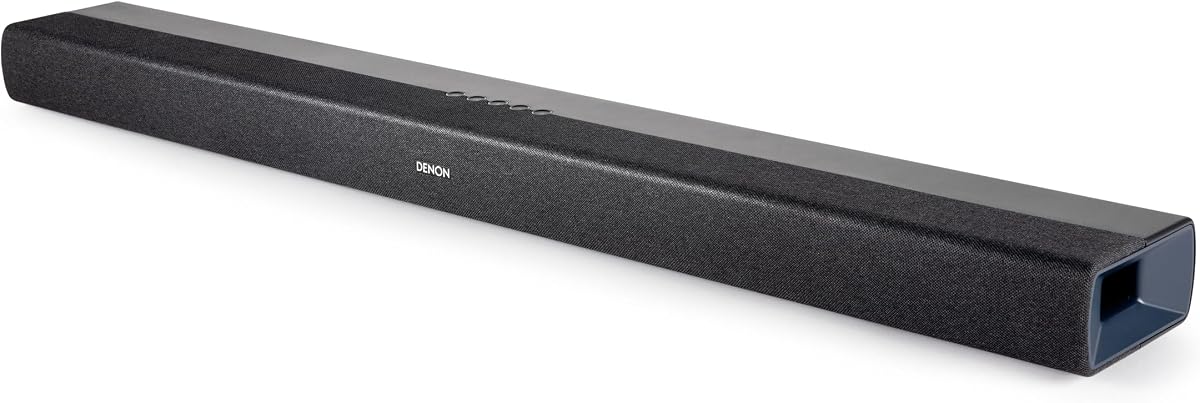
The Denon DHT-S218 earns the highest customer rating in this group at 4.5. Its two built-in, down-firing subwoofers, dual midrange drivers, and tweeters are designed to deliver a cinematic 2.1-channel presentation while preserving the convenience of a single soundbar.
We may earn a commission when you buy through this link, at no additional cost to you.
Dolby Atmos support adds spatial audio when compatible content is available, while the included HDMI cable supports 4K HDMI eARC television connections. Denon's Dialog Enhancer is designed to sharpen voices without requiring the overall level to be raised, and Pure, Movie, Music, and Night modes provide distinct choices for different listening situations.
For music, Pure mode removes surround processing and other adjusted characteristics, allowing listeners to hear a more direct presentation. Bluetooth LE Audio and multi-point pairing support streaming from phones, tablets, and laptops. The trade-offs are that no automatic room calibration is listed, and the down-firing woofers need enough space below the cabinet to operate effectively without obstruction.
The DHT-S218 is a strong all-in-one choice for buyers who want two integrated woofers, Atmos, and flexible listening modes. It is especially attractive to music listeners because the Pure mode directly addresses the desire for less processed sound. It also suits users who want strong bass without a freestanding subwoofer but do not need the deeper smart-home integration offered by the Samsung S60D.
Two down-firing subwoofers provide substantial low-end output from the single enclosure. Because the drivers face downward, the cabinet should be placed on a stable surface with room for the sound duct to operate.
Pure, Movie, Music, and Night modes make it easier to adapt the system to different content. The inclusion of a dedicated music mode is especially useful for listeners who do not want cinematic processing applied to every album.
We may earn a commission when you buy through this link, at no additional cost to you.
The Samsung S60D is the most feature-rich soundbar in this roundup and our Best Premium pick. Its 4.4 rating reflects a 5.0-channel all-in-one design that combines built-in subwoofers, wireless Dolby Atmos, room calibration, adaptive audio, gaming tools, and smart-home integration in a single compact enclosure.
We may earn a commission when you buy through this link, at no additional cost to you.
SpaceFit Sound Pro analyzes the environment and automatically optimizes the output for the room. Adaptive Sound examines scenes in real time and adjusts the audio presentation to emphasize important details, while Active Voice Analyzer helps separate onscreen voices from room noise. For gaming, up-firing speakers, an acoustic beam, strong woofers, and Game Mode Pro create an optimized three-dimensional presentation.
Q-Symphony allows a compatible Samsung television and soundbar to work together as a unified system. Wireless Dolby Atmos reduces cable requirements, while built-in Alexa, Chromecast, and Airplay 2 broaden the smart-device options. The trade-off is complexity: some benefits are most meaningful within a compatible Samsung ecosystem, and buyers should investigate television compatibility before relying on a particular feature.
The S60D is recommended for enthusiasts who want advanced room correction, content-aware processing, strong bass, gaming support, and smart functions without a separate subwoofer. It is less ideal for a minimal setup where only basic television sound and Bluetooth playback are needed, but for a feature-focused living room it is the most complete all-in-one choice here.
SpaceFit Sound Pro analyzes the environment and adjusts the output automatically. This reduces the need to guess at equalizer settings after placing the soundbar in its final position.
Game Mode Pro uses up-firing speakers, an acoustic beam, and strong woofers to create a more dimensional gaming presentation. Automatic activation in sync with a compatible television makes the mode convenient during play.
We may earn a commission when you buy through this link, at no additional cost to you.
The Samsung HW-B550F combines a 2.1-channel soundbar with an included wireless subwoofer, making it a strong option for buyers who want impact rather than a strictly one-piece installation. Its 4.3 rating reflects a capable system with virtual surround, bass enhancement, automatic sound optimization, and clear dialogue tools.
We may earn a commission when you buy through this link, at no additional cost to you.
DTS Virtual:X adds movement around the listening area, while Adaptive Sound identifies the type of content and adjusts the settings for clearer voices and more detailed sound. Voice Enhance Mode gives dialogue additional prominence, and a dedicated Bass Boost control lets listeners increase the impact of movie scenes, music, and other bass-heavy content.
Its most important trade-off is that the subwoofer must be positioned separately, although the wireless connection avoids a long cable between the two pieces. The system can also be expanded with optional Samsung rear speakers, adding another route toward true surround sound. Native Dolby Atmos is not listed in the supplied specifications, so buyers prioritizing that format should look at the SR-B30A, DHT-S218, or S60D.
The HW-B550F is ideal for a medium room in which deep bass and optional rear-speaker expansion matter more than a minimal visual footprint. It also fits buyers who want flexible sound controls and clear speech without paying for the S60D's more advanced smart and room-optimization features.
Optional rear speakers can connect wirelessly to the soundbar for a more conventional surround arrangement. This makes the system adaptable for buyers who may want to expand beyond 2.1 channels later.
The included subwoofer supplies low-frequency impact, while Bass Boost provides an additional level of emphasis. Adaptive Sound works alongside these controls by optimizing the overall presentation for the content being watched.
We may earn a commission when you buy through this link, at no additional cost to you.
The Samsung HW-C400 is a simple 2.0-channel soundbar built around two integrated woofers and a sound duct. Its 4.0 rating makes it a practical option for improving television audio and adding bass without the complication of a separate subwoofer or extensive home-theater controls.
We may earn a commission when you buy through this link, at no additional cost to you.
Dolby Audio and DTS processing expand the presentation beyond basic left-right sound. The built-in woofers use air vibration through the sound duct to intensify bass, while Bluetooth supports wireless music streaming. Near Field Communication offers another way to initiate a compatible mobile connection, and the integrated USB 2.0 port can play music from a compatible memory device.
The system is less advanced than the competition because it lacks dedicated surround channels, listed Atmos support, room calibration, and detailed content modes. The included remote provides basic control, and the 110-240 volt power specification supports use across a wide range of compatible regions. It is therefore best evaluated as a straightforward upgrade over television speakers.
This soundbar suits viewers seeking clearer, fuller sound in a bedroom, office, or compact living area without another subwoofer box. It is also a sensible choice for direct music playback because it supports both Bluetooth and USB. Buyers wanting more sophisticated spatial audio or automatic sound adjustment should choose one of the newer Yamaha, Denon, Hisense, or Samsung models.
Two built-in woofers and a sound duct deliver low-frequency impact without requiring a separate unit. The design keeps the television area visually clean while improving the weight of music and action.
Bluetooth handles convenient wireless streaming, while USB playback provides a direct route for compatible stored music. Together, they make the soundbar useful beyond television viewing.
We may earn a commission when you buy through this link, at no additional cost to you.
The right choice depends on the room, the television, the content you watch, and how much equipment you want to manage. Bass architecture, surround processing, dialogue clarity, connections, dimensions, and smart features should all be considered before making a selection.
Choose an integrated design for a compact, all-in-one installation. Choose an included wireless subwoofer when deeper impact and separate placement are the priority.
More channels can improve spatial separation, but compatible content and suitable placement still matter. Verify Atmos support rather than assuming every surround label is equivalent.
Look for a dedicated dialogue or voice mode, especially if you regularly watch news, sports, or subtitled films. Test it with challenging soundtracks when possible.
Measure before ordering and leave clearance around down-firing drivers. Room calibration helps, but it cannot overcome a poor location or an overly crowded setup.
Prioritize HDMI eARC or ARC for a modern television, then confirm Bluetooth, optical, or AUX support for secondary devices. Check the box contents before buying extra cables.
Choose smart features when your television and everyday devices are compatible. Otherwise, prioritize bass, dialogue, and reliable connections over platform-specific extras.
Check cabinet width, height, depth, and mounting support, not just the screen size. Include the subwoofer's position in your planning when one is supplied.
For regular music listening, prioritize Bluetooth convenience and a music or pure preset. For films, look more closely at surround formats, dialogue processing, and bass placement.
Begin by placing the soundbar where it will not obstruct the television or a wall-mounted panel. For an integrated-woofer model, leave the cabinet's underside and front clear. For a system with a wireless subwoofer, position the bass unit near an exterior wall or corner if the room allows, then connect it to the soundbar and power it on. Follow the supplied pairing instructions before making extensive changes to sound modes or connection settings.
Connect the soundbar to the television using the preferred digital audio connection, normally HDMI eARC or ARC when available, and select the matching television input. Optical and AUX can serve as alternatives. Use the included remote to set the volume, choose a listening profile, and enable dialogue or night features when needed. If a mobile app is required for room calibration, complete that process before judging the final balance, and make any placement adjustment only after calibration has finished.
Keep the cabinet vents and exposed drivers free from dust, and do not place objects against a down-firing woofer. Use a soft, dry cloth rather than harsh cleaners or liquids. Review television and soundbar firmware updates through the manufacturer's official process when available. For wireless models, reconnect the subwoofer after a power outage, and avoid placing a soundbar beside a heat source or in a closed cabinet that restricts airflow.
Not necessarily. A separate subwoofer can often produce deeper and louder bass because it has a larger enclosure and driver arrangement. An integrated woofer is convenient and can still provide a major improvement over television speakers. The Yamaha SR-B30A and Denon DHT-S218 use two built-in subwoofers, which helps them deliver fuller low end without requiring separate boxes.
A built-in subwoofer is housed inside the soundbar cabinet, so the system remains a single main component. A wireless subwoofer is a separate speaker that communicates with the soundbar without a long connecting cable. The TCL S55H and Samsung HW-B550F include wireless subwoofers, offering flexible bass placement but requiring another device in the room.
No, but Atmos can provide a more dimensional presentation when the television, soundbar, and source content all support it. The Yamaha SR-B30A, Denon DHT-S218, and Samsung S60D list Dolby Atmos support, while the Hisense A620 can use a compatible television's decoding capability in TV mode. Virtual surround options such as DTS Virtual:X provide a different form of spatial expansion.
Usually, yes. Larger drivers and dedicated dialogue tools can make voices clearer and more present than small television speakers. Yamaha Clear Voice, Denon Dialog Enhancer, Samsung Voice Enhance, and the Bose dialogue mode all target speech intelligibility. Results depend on room acoustics, content, and correct placement, so dialogue mode should be compared with the normal sound setting.
Only if the manufacturer supports it and the correct hardware is used. The Yamaha SR-B30A has built-in keyholes for wall mounting, while the TCL S55H package includes a wall-mount kit. Confirm the dimensions, weight, and included hardware before drilling. Down-firing drivers such as those in the Denon DHT-S218 also need sufficient clearance beneath the cabinet.
HDMI is generally the primary connection for television audio because it can carry digital surround formats and may support television control. Bluetooth is useful for music, podcasts, and occasional playback from a phone or tablet. Optical and AUX inputs add compatibility with other equipment. The best choice includes the connections required by your television and secondary devices without adding features you will never use.
All-in-one models generally require fewer components than systems with a wireless subwoofer. The Samsung HW B400F and Yamaha SR-B30A emphasize simple television connections, while the Hisense A620 includes EzPlay control for compatible televisions. The simplest setup also depends on the ports available on your television and whether your preferred control method uses the television remote, the included remote, or an app.
A small room can make a powerful subwoofer feel excessive, especially at low viewing hours. An integrated woofer or a compact wireless subwoofer may be more appropriate than a large independent bass system. Start with moderate volume, use any bass adjustment controls, and use a night mode when needed. The goal is impact that supports the picture without overwhelming speech or disturbing the rest of the household.
The Samsung S60D stands out as the most advanced all-in-one option, combining five channels, built-in subwoofers, wireless Dolby Atmos, room calibration, adaptive sound, gaming features, and smart-device integration. The Yamaha SR-B30A offers a more focused balance of two integrated woofers, Atmos, Clear Voice, and useful presets, making it a strong all-around alternative. The Hisense A620 represents the budget end of the range with an integrated 75 millimeter woofer, Dolby Digital Plus, DTS Virtual:X, and convenient television integration.
Prioritize the features you will actually use. Choose a one-piece model for a clean setup, a wireless subwoofer for stronger and more flexible bass, and room calibration if your furnishings or dimensions make placement unpredictable. Dialogue tools are essential for speech-heavy content, while music presets and clean Bluetooth streaming matter more for listeners who treat the soundbar as an everyday audio system.
Before buying, confirm the television connections, room space, mounting options, and compatibility of any advanced features. Product prices, availability, promotions, and model configurations can change, so check the current listing and manufacturer information before making a final purchase. The linked product pages provide the most current availability and offer details for the selected model.