
Westinghouse 2.0 Soundbar
4.2Editor score
Compact 2.0 channel design
Dolby Atmos and DTS support
HDMI ARC television control
Bluetooth and multiple inputs
Discover the best soundbar for Westinghouse TV, with ten expert picks compared for channels, connectivity, dialogue, bass, design, and features.
A Westinghouse television may deliver a sharp picture, but the built-in speakers can still make dialogue sound thin, music feel flat, and effects seem detached from the action. A compatible soundbar adds more output, wider sound, stronger bass, and dedicated processing without requiring a complicated home-theater installation.
This guide compares ten soundbars suitable for a Westinghouse TV, concentrating on the factors that affect everyday use: channel configuration, wireless subwoofers, surround and height processing, dialogue features, television connectivity, control options, and physical dimensions. It covers two Westinghouse models and several alternatives from Bose, TCL, Samsung, Polk Audio, LG, and Sony.
The selections range from compact all-in-one speakers to systems with subwoofers, surround speakers, room calibration, and voice-assistant integration. Each review explains the strongest benefits, practical limitations, and ideal owner, while ratings and specifications reflect the supplied product information. Availability and prices can change, so confirm current details before buying.
4.2Editor score

4.6Editor score

4.2Editor score
This side-by-side comparison highlights each soundbar's channel layout, bass hardware, surround processing, and practical connections, making it easier to match a model to a Westinghouse television and the available space.



The Westinghouse 2.0 Soundbar is a straightforward television-audio upgrade with a 4.2 rating. It uses a compact two-channel configuration and a 120-watt system to improve clarity, output, and immersion compared with the down-firing speakers found in a thin television. Its most attractive feature for Westinghouse owners is Roku TV Ready certification, which simplifies setup and access to sound settings.
We may earn a commission when you buy through this link, at no additional cost to you.
The soundbar supports Dolby Atmos and Dolby Digital Plus, adding directionality and a sense of depth to compatible films, shows, and games. HDMI connectivity allows the television remote to handle basic power and volume functions, while Bluetooth, optical, USB, and 3.5mm AUX connections cover music and other source devices. That variety makes the model useful even when the primary source is not a streaming television.
The trade-offs are inherent in a compact 2.0 design. There is no separate subwoofer, so deep bass is less substantial than that of the 2.1, 3.1, 5.1, and 5.0 systems in this guide. It also does not create rear-speaker separation or provide the height cues associated with a dedicated surround installation. Buyers seeking cinematic low-frequency impact may need to spend more.
This is the most convenient choice for a Westinghouse Roku TV when the priority is a clean, uncomplicated upgrade without another large component in the room. It offers stronger dialogue, flexible connections, and useful processing at a comparatively restrained level of complexity. Choose it for small spaces, simpler entertainment systems, and users who value quick television integration over maximum cinematic scale.
Roku TV Ready certification means compatible Westinghouse owners can access sound settings through the familiar television interface and use the Roku remote for key commands. HDMI also supports convenient television-remote control, reducing the need to switch between devices.
The low-profile bar suits apartments, bedrooms, and smaller living rooms, while Bluetooth, optical, USB, and AUX inputs expand its use beyond the television. It is a flexible choice for casual music and streaming as well as everyday dialogue.
We may earn a commission when you buy through this link, at no additional cost to you.
The Westinghouse 2.1 Soundbar with Subwoofer earns a 4.6 rating, the highest among the ten options, and stands out as the most balanced recommendation for a Westinghouse television. Its 2.1 arrangement combines a soundbar with a 60-watt wireless subwoofer, providing stronger dialogue and more impactful bass without introducing separate rear speakers.
We may earn a commission when you buy through this link, at no additional cost to you.
Output is listed at 120W RMS and 240W peak, enough to create a fuller presentation for television, games, and music. Dolby Atmos 1.8, DTS:X, Dolby Digital Plus, and Dolby Digital decoding provide a broad collection of surround formats. The included subwoofer can be positioned away from the bar, which makes it easier to improve bass distribution in different room layouts.
Its limitations are mostly about scale rather than basic performance. A 2.1 system cannot reproduce the broad rear field or discrete height effects of the TCL S65K, Samsung S60D, or Sony Theater Bar 5. Roku TV Ready control simplifies operation with compatible televisions, but the system is still primarily a home-brand upgrade rather than a full multi-speaker home theater.
For most viewers, this model offers the ideal balance of strong features, manageable size, and straightforward Westinghouse/Roku integration. It is particularly suitable for apartments, bedrooms, and medium-size living rooms where movies and sports benefit from a dedicated subwoofer but rear-speaker placement is impractical. It is the strongest all-around choice in this guide.
The wireless subwoofer can be moved to optimize low-frequency performance in a room rather than being forced beside the soundbar. Its 60-watt design gives films and music more weight while leaving the main bar responsible for dialogue and higher frequencies.
Support for Dolby Atmos, DTS:X, Dolby Digital Plus, and Dolby Digital makes this system adaptable to different streaming and broadcast content. The result is greater depth and directional movement than a basic stereo upgrade.
We may earn a commission when you buy through this link, at no additional cost to you.
The Bose TV Speaker receives a 4.3 rating and prioritizes one objective above all else: making television content easier to hear. Its all-in-one body houses two angled full-range drivers, with a design specifically intended to clarify speech, vocals, and pronunciation. For viewers who struggle with dialogue on a Westinghouse television, that focus is more meaningful than a long specification list.
We may earn a commission when you buy through this link, at no additional cost to you.
The speaker is just over two inches tall and measures 23.38 inches wide, making it easy to place in front of a television or mount on a wall. Optical and HDMI connections are supported, while Bluetooth adds a convenient way to stream music and podcasts. The included remote provides a dedicated dialogue mode and a bass boost, giving users direct control without navigating deeper menus.
This compact Bose model does not include a subwoofer, and its all-in-one architecture cannot provide the distinct rear and height effects of a 5.1 system. Bass Module 500 and 700 units can be added separately with the required connection cable, but those are optional purchases. Owners who want the simplest possible upgrade should consider the included-box experience rather than planning a larger system.
The Bose TV Speaker is ideal for news, talk shows, cooking shows, and conventional television viewing where intelligibility matters most. It also suits renters or anyone unable to place a subwoofer and surround speakers. Choose it for compact placement, focused dialogue, and brand-specific optional bass expansion rather than maximum channel count.
Angled full-range drivers project sound outward, while the dialogue mode gives viewers an easy way to emphasize vocals. The result is a refined upgrade for programs where missing words can be more distracting than insufficient bass.
The low-profile enclosure can sit beneath a television or be wall-mounted without taking up much space. Owners can later add a compatible Bose Bass Module if deeper low-end output becomes important.
We may earn a commission when you buy through this link, at no additional cost to you.
The TCL S55H 2.1 Sound Bar has a 4.4 rating and stands out for combining substantial power with automatic room calibration. Its soundbar and wireless subwoofer support Dolby Atmos and DTS Virtual:X, while AI Sonic technology adjusts the output to the room and listening position. The result is particularly useful for owners who do not want to manually dial in a complex soundbar.
We may earn a commission when you buy through this link, at no additional cost to you.
The system is rated for up to 220 watts and is designed to produce detailed sound in apartments, bedrooms, and small-to-medium rooms. The subwoofer handles low rumble and punchy bass, leaving the bar to deliver dialogue and midrange detail. HDMI eARC or ARC, optical, Bluetooth, and AUX connections make it broadly compatible with a Westinghouse television and other entertainment devices.
Its principal limitation is the absence of separate rear speakers. Virtual processing can create a convincing sense of width, but it cannot equal the physical rear effects produced by the TCL S65K. The calibration process also depends on setup through the TCL app and the availability of a compatible phone, which may be less convenient than simply using HDMI and television-remote controls.
This is a strong recommendation for buyers who want more control than a basic soundbar offers without moving into a full surround system. Apartment residents, bedroom viewers, and owners of complex room shapes can benefit from automatic tuning. It is also a good general upgrade for a Westinghouse TV, particularly when clearer dialogue and stronger bass are the main goals.
AI Sonic Auto Room Calibration adjusts the system through the TCL app based on the listening environment. This can produce more balanced playback in rooms with unusual furniture, wall shapes, or placement constraints.
The wireless subwoofer and up-to-220-watt system can provide a noticeable upgrade in small and medium rooms. Low-frequency effects and music gain weight without requiring a larger central speaker array.
We may earn a commission when you buy through this link, at no additional cost to you.
The Samsung B-Series Soundbar HW B400F has a 4.0 rating and combines a 2.0-channel speaker array with a built-in subwoofer. That architecture makes it a practical middle ground between a slim all-in-one bar and a system requiring a separate bass cabinet. It is aimed at viewers who want fuller television sound without a complicated installation.
We may earn a commission when you buy through this link, at no additional cost to you.
Surround Sound Expansion projects audio more broadly across the room, while Voice Enhance Mode automatically raises dialogue so that voices are easier to understand. For compatible Samsung televisions, the television remote can control power, volume, and sound effects. A useful nighttime feature also reduces volume and minimizes bass, which is considerate in a shared home.
The built-in woofer cannot deliver the deep, room-filling low end of a dedicated wireless subwoofer, and there is no rear-speaker array. It also lacks the advanced object-based processing and room analysis found in more expensive systems. The supplied 4.0 rating is the lowest in the group, reflecting a model that prioritizes simplicity and useful features over flagship sophistication.
The HW B400F is best for smaller rooms, renters, and anyone who dislikes loose subwoofer cables or a second floor-standing component. Westinghouse owners seeking one simple unit, clear speech, and modest bass should find it practical. Those wanting deep cinema effects should move toward a dedicated-subwoofer model instead.
The integrated woofer adds low-end weight while preserving the simplicity of a single soundbar. This makes placement easier and keeps the entertainment area visually uncluttered.
Voice Enhance Mode helps bring forward important dialogue, while the nighttime mode lowers output and minimizes bass. Together they make the system practical for both busy and shared living spaces.
We may earn a commission when you buy through this link, at no additional cost to you.
The TCL S65K S Series has a 4.4 rating and is the most complete conventional surround package in this comparison. Its 5.1-channel system includes wireless rear speakers, a wireless subwoofer, a built-in center channel, and a built-in tweeter. For a Westinghouse television in a dedicated media room, that physical surround coverage offers a convincing step up from a compact bar.
We may earn a commission when you buy through this link, at no additional cost to you.
Dolby Atmos and DTS:X aim to place sound above and behind the listener, while Ray Danz Technology expands the front soundstage. The center channel supports dialogue, and the tweeter adds high-frequency detail. A 6.5-inch wireless subwoofer with Bass Boost handles low frequencies, giving action scenes, music, and games more authority than an all-in-one design.
The main disadvantage is physical complexity and room footprint. Two wireless surround speakers and a large subwoofer need appropriate placement, and calibration is performed through AI Sonic Auto Room Calibration. In a small apartment, these advantages may be difficult to exploit. The system also has more cables to manage during initial setup even though the rear speakers and subwoofer operate wirelessly.
This model is ideal for viewers who regularly watch films and want sound to extend behind the seating position. It offers a more convincing home-theater experience than any 2.0 or 2.1 option here without reaching the complexity of a full receiver and separate speaker system. Choose it when room space and placement flexibility are not constraints.
The included wireless surround speakers create dedicated left and right rear channels. This physical separation gives action, ambience, and directional effects a more convincing sense of space than virtual height or surround processing alone.
A built-in center channel keeps voices clear, the tweeter reveals fine detail, and the 6.5-inch subwoofer adds deep impact. Automatic room calibration helps those elements work together in the intended space.
We may earn a commission when you buy through this link, at no additional cost to you.
The Samsung S60D carries a 4.4 rating and offers a sophisticated all-in-one alternative to systems with separate surround speakers. Its five-channel design, built-in subwoofers, and up-firing drivers create a broad presentation, while wireless Dolby Atmos can add height effects without the cable clutter normally associated with that feature.
We may earn a commission when you buy through this link, at no additional cost to you.
Q-Symphony allows the speakers in a compatible Samsung television and soundbar to work together as a unified audio system. SpaceFit Sound Pro analyzes the room and optimizes the output, while Adaptive Sound evaluates scenes in real time to prioritize important details. Game Mode Pro can activate automatically alongside a compatible television, providing up-firing and directional effects for gaming.
The product's strongest functions are optimized around Samsung televisions, and Q-Symphony naturally offers no advantage with a Westinghouse set. It also uses an all-in-one design rather than physical rear speakers, so its surround presentation is less expansive than the TCL S65K in a suitably sized room. Smart features add complexity that some buyers may not need.
The S60D suits Samsung owners or viewers interested in wireless Dolby Atmos, voice control, and automatic content-aware processing. For a Westinghouse television, it remains a capable HDMI-connected system with Bluetooth and smart services, but buyers should focus on the basic Dolby Atmos and 5.0-channel benefits rather than ecosystem-specific features.
Five channels, built-in subwoofers, and up-firing drivers provide a wide soundstage from a single cabinet. Wireless Dolby Atmos adds overhead presentation while keeping the physical setup relatively uncluttered.
Adaptive Sound analyzes content and foregrounds important audio, while Active Voice Analyzer helps separate dialogue from room noise. Game Mode Pro adds another layer by optimizing the presentation for compatible televisions and games.
We may earn a commission when you buy through this link, at no additional cost to you.
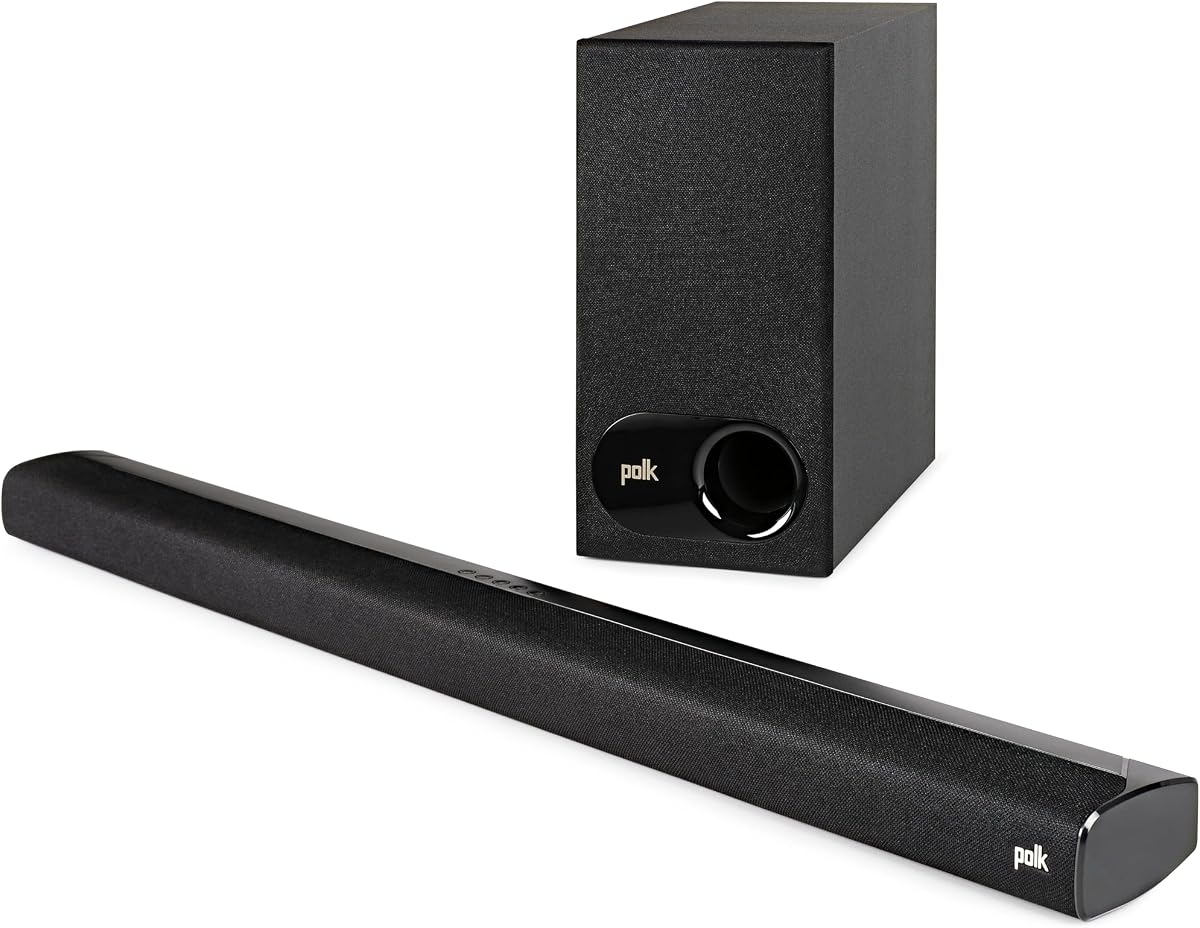
The Polk Audio Signa S2 has a 4.4 rating and combines a slim main bar with an included wireless subwoofer. Five full-range drivers handle the central output, while VoiceAdjust technology and Dolby Digital decoding focus on intelligibility and clear playback. It is especially appealing to owners who want more bass without a bulky central cabinet.
We may earn a commission when you buy through this link, at no additional cost to you.
At just over two inches tall, the bar can sit in front of a television without blocking the screen's lower edge or infrared remote sensor. It can also be wall-mounted. HDMI, optical, and AUX inputs support a range of source equipment, while Bluetooth enables convenient wireless music streaming from a phone, tablet, or another compatible device.
Compared with the TCL S55H or Westinghouse 2.1, the Signa S2 offers less advanced height or room-calibration functionality. It has no dedicated rear speakers and does not claim the broad object-based processing of the TCL S65K, Samsung S60D, or Sony Theater Bar 5. Its included subwoofer still needs to be positioned within the room rather than integrated into the bar.
The Signa S2 is best for viewers who want a slim, understated central speaker and meaningful bass from a separate wireless cabinet. It works particularly well with a wall-mounted television because its low profile does not occupy the cabinet space beneath a large screen. Choose it for understated design and dialogue-focused improvements over elaborate surround effects.
The slim enclosure can sit below the screen or be mounted on the wall. Its shallow height reduces visual clutter and helps prevent blocking the television's lower edge or remote sensor.
The wireless subwoofer supplies low-end impact without cluttering the main speaker area. VoiceAdjust and five full-range drivers support balanced output and clearer spoken content.
We may earn a commission when you buy through this link, at no additional cost to you.
The LG S60T receives a 4.5 rating, making it one of the strongest-rated models in the guide. Its 3.1-channel configuration separates right, left, and center channels while adding a wireless subwoofer. That center channel is particularly useful for dialogue, while Dolby Audio processing and AI Sound Pro adapt the presentation for different content.
We may earn a commission when you buy through this link, at no additional cost to you.
LG describes the system as suited to voices, live sports, music, and action scenes. The included subwoofer supplies bass, and its wireless design allows placement away from the soundbar. The LG Soundbar App provides three-band equalizer control for the main unit and rear speakers, although the supplied information does not indicate that a rear-speaker pair is included.
WOW Orchestra and WOW Interface create the most compelling experience when paired with an LG television, so a Westinghouse owner will not benefit from all of the brand-specific integration. The system also has no dedicated surround speaker pair, making it less spatially expansive than the TCL S65K. It does, however, offer a useful middle ground between compact 2.1 designs and larger surround packages.
The S60T is a strong all-around choice for anyone who prioritizes dialogue, a dedicated center channel, and app-based tuning. It should also appeal to Westinghouse owners who want a wireless subwoofer and polished design without adding rear speakers. Those seeking the broadest home-theater soundfield should look instead to the TCL S65K or Sony Theater Bar 5.
A dedicated center channel gives dialogue its own role in the mix. Combined with AI Sound Pro, it can improve intelligibility in shows, news, sports, and films with wide-ranging effects.
The included wireless subwoofer can be placed to suit the room, while app controls let users adjust tonal balance. This makes the S60T flexible even though its WOW features are primarily designed for LG televisions.
We may earn a commission when you buy through this link, at no additional cost to you.
The Sony BRAVIA Theater Bar 5 is the premium selection in this guide, with a 4.2 rating and a feature set focused on cinematic presentation. Its 3.1-channel configuration includes a dedicated center speaker and a wireless subwoofer with a large 160mm driver. Dolby Atmos and DTS:X create the foundation for immersive, multidimensional sound.
We may earn a commission when you buy through this link, at no additional cost to you.
Sony's Vertical Surround Engine is designed to position audio overhead without requiring in-ceiling or physically up-firing speakers, while S-Force Pro generates a wider field from the front speakers. The system can also upmix stereo content into a surround-style presentation. A dedicated center channel keeps voices clear, and the included remote provides quick access to volume, bass, and sound-mode settings.
The lack of separate rear speakers limits true physical surround coverage compared with the TCL S65K. Some premium integrations also focus on compatible BRAVIA televisions, including Voice Zoom 3 for dialogue enhancement. The BRAVIA CONNECT app adds guided setup, control, troubleshooting, and updates, but the system's processing remains the primary attraction rather than ecosystem-specific synchronization.
This model is best for dedicated movie viewers who want advanced height and surround processing from a relatively compact system. It suits living rooms where a large subwoofer and soundbar can be placed well but additional rear speakers are undesirable. Among the options here, it represents the strongest premium expression of cinema-focused sound.
The Vertical Surround Engine creates an elevated sound field using the main system rather than requiring dedicated in-ceiling speakers. This offers a practical way to add height effects to a conventional living room.
Dolby Atmos, DTS:X, S-Force Pro, and stereo upmixing support several content types and viewing preferences. The included remote and BRAVIA CONNECT app provide both immediate and detailed control.
We may earn a commission when you buy through this link, at no additional cost to you.
Choosing a soundbar for a Westinghouse television starts with the television's capabilities, the room's available space, and the kinds of content you watch. Channel count, bass, dialogue processing, connectivity, and ease of control should be weighed together rather than focusing on a single headline specification.
Begin with the output options on the specific Westinghouse television model. A soundbar with HDMI ARC or HDMI eARC is the most convenient choice because audio and basic control functions can travel through the same cable. Optical is a widely available fallback that can carry standard television audio, while Bluetooth is useful for music but normally introduces more delay when acting as the primary television connection. USB and AUX inputs add flexibility but are less central to a modern television setup.
A 2.0-channel model can make dialogue and general television audio clearer without filling the room with a multi-component system. A 2.1 or 3.1 setup adds a subwoofer for deeper bass and a better sense of scale. A 5.0 or 5.1 configuration is more meaningful in a medium or large room, especially when it includes physically separate rear speakers. Larger channel counts are not automatically better in a compact apartment, where the speakers may be too close together to create convincing separation.
Built-in woofers are convenient and can add enough weight for dialogue-led television and casual streaming. A dedicated wireless subwoofer provides deeper, more controlled low frequencies and is preferable for action films, concerts, and games. Wireless models offer placement flexibility, although low bass still interacts with walls and furniture. Do not place a subwoofer in a corner simply because it is available; experiment with positions that reduce boominess while preserving impact.
A dedicated center channel, dialogue mode, or voice-enhancement setting can make a large difference during news, interviews, and films with dense sound effects. Features such as VoiceAdjust, Voice Enhance, Adaptive Sound, and Active Voice Analyzer serve similar purposes, though their implementation varies. Westinghouse owners should also confirm that a soundbar does not rely on a competing television brand for its most useful controls. Standard HDMI operation should remain the foundation.
Dolby Atmos and DTS:X indicate support for immersive formats, but processing alone does not guarantee convincing overhead or rear effects. Virtual height engines can produce a spacious presentation from a compact bar, while dedicated surround speakers provide real directional separation. Consider whether the television actually outputs these formats, whether the chosen content supports them, and whether the room allows the system to create a believable soundstage without overwhelming nearby seating.
Some soundbars are explicitly certified for particular television platforms. The two Westinghouse models are Roku TV Ready, which can simplify menus and remote operation on compatible sets. Samsung Q-Symphony, LG WOW features, and Sony voice features can be beneficial within their respective ecosystems but add less to a Westinghouse television. Always verify the exact television model and its supported audio functions rather than assuming all smart televisions behave identically.
The ideal soundbar should be easy to operate after initial setup. HDMI television-remote control reduces remote clutter, while a physical remote can provide quicker access to bass, dialogue, and sound modes. App control is useful for deep adjustment, but it should not be the only way to perform basic tasks. Confirm that the product includes the necessary remote, batteries, cables, and wall-mounting accessories required for your preferred installation.
A soundbar should fit beneath the television without blocking the screen or infrared sensor. Low-profile models can accommodate large displays on a media console, while wall mounting can save space but requires secure placement. Also consider the depth and height of the subwoofer, the location of power outlets, and cable reach. An attractive design is less important if the speakers cannot be positioned correctly for the available space.
Start by identifying the correct audio output on the Westinghouse television and connecting the soundbar with HDMI ARC or eARC whenever possible. Connect the television to the appropriate HDMI port, plug in the soundbar and subwoofer, and power both units on. Select the matching HDMI input, then use the television remote to adjust basic volume or enable soundbar control. Optical and AUX connections can be used when HDMI is unavailable, while Bluetooth is best reserved for music and other non-television sources.
After the basic connection works, use the included remote or official app to adjust bass, dialogue, sound effects, and room-related settings. Test several movie scenes, sports broadcasts, and dialogue-heavy programs at your normal listening level. If a subwoofer is included, move it gradually to find a position that delivers full impact without excessive boom. Wireless surround speakers should be placed behind and to the sides of the main seating area, with cables secured so they cannot become a trip hazard.
For care, keep the soundbar and subwoofer away from moisture, direct heat, and crowded areas where cables could be pulled. Dust the grille gently with a soft, dry cloth, and avoid sprays or abrasive materials. Do not block rear ports or place components tightly against walls if that prevents ventilation. Review firmware updates through the manufacturer's app when available, and check wireless connections periodically if a device begins producing intermittent sound.
Most soundbars can connect through HDMI ARC, optical audio, or an analog input if the Westinghouse television offers a compatible output. HDMI ARC or eARC is generally the easiest choice because it can carry television audio and basic control commands through one cable. Always compare the soundbar's inputs with the television's available outputs before purchasing.
A soundbar is optional, but it can significantly improve dialogue clarity, perceived output, and bass over typical built-in television speakers. Roku TV Ready models provide a particularly simple experience by exposing sound settings and supporting the Roku remote. If the television is used mainly for news and talk programs, a compact model may be sufficient; movies and games benefit more from a subwoofer or surround processing.
A 2.1-channel system is enough for many living rooms, particularly when the goal is clearer speech and stronger bass without separate rear speakers. Its effectiveness depends on room size, television size, and the subwoofer's placement. A 3.1, 5.0, or 5.1 system offers more directional and height information, but those advantages require adequate space and careful setup.
HDMI ARC is designed to send television audio back through an HDMI connection and supports some control functions. HDMI eARC expands that role with support for additional audio formats and bi-directional communication, which can benefit compatible soundbars and televisions. Either can work well for a Westinghouse TV, but the exact supported features depend on the television and soundbar models involved.
Bluetooth is convenient for music from a phone, tablet, or computer, but it is usually not the best primary connection for television audio because wireless compression and latency can affect synchronization. Use HDMI ARC or eARC for movies, live television, and games whenever possible. Reserve Bluetooth for casual music playback and sources that do not require exact lip synchronization.
Begin near the front of the listening area, then try several positions around the room. Corners can increase low-frequency output but may also create boominess, while placing the subwoofer behind a sofa can weaken the perceived effect. The best position delivers full impact, remains clear at low volume, and does not disturb neighbors more than necessary.
The listed Westinghouse soundbars support HDMI ARC, optical, USB, and AUX connectivity, so they can provide audio from many television types. Roku TV Ready certification offers the smoothest setup on compatible Roku televisions, but it does not mean other televisions are excluded. Simply use the best common connection and configure television-remote control if the equipment supports it.
Higher wattage can help the system achieve greater output without distortion, particularly when a subwoofer is included. It does not alone determine clarity, channel separation, or sound quality. Placement, speaker design, room acoustics, source processing, and the television's output can affect the final result just as much as the stated power figure.
The Westinghouse 2.0 Soundbar is the simplest recommendation for compatible Roku TV owners who want a compact improvement with HDMI control and flexible connections. The Westinghouse 2.1 Soundbar with Subwoofer is the strongest all-around choice because it adds meaningful bass and extensive surround decoding. The Sony BRAVIA Theater Bar 5 represents the premium option for viewers who prioritize cinematic height processing and refined virtual surround.
Prioritize the upgrade that matches your actual viewing habits. Clear dialogue and compact placement may justify a 2.0 model, while a wireless subwoofer will make a larger difference in films and music. Dedicated rear speakers are worth considering for a medium or large media room, whereas virtual processing is more practical in apartments. Also avoid overvaluing brand-specific features unless your Westinghouse television can use them.
Before ordering, confirm the television's audio outputs, measure the available space, and verify the soundbar's connection options and included accessories. Availability, promotions, and prices can change, so check current product details at the time of purchase. With those checks complete, the right choice is the system that delivers your preferred balance of dialogue, bass, and surround scale in the room where you watch.