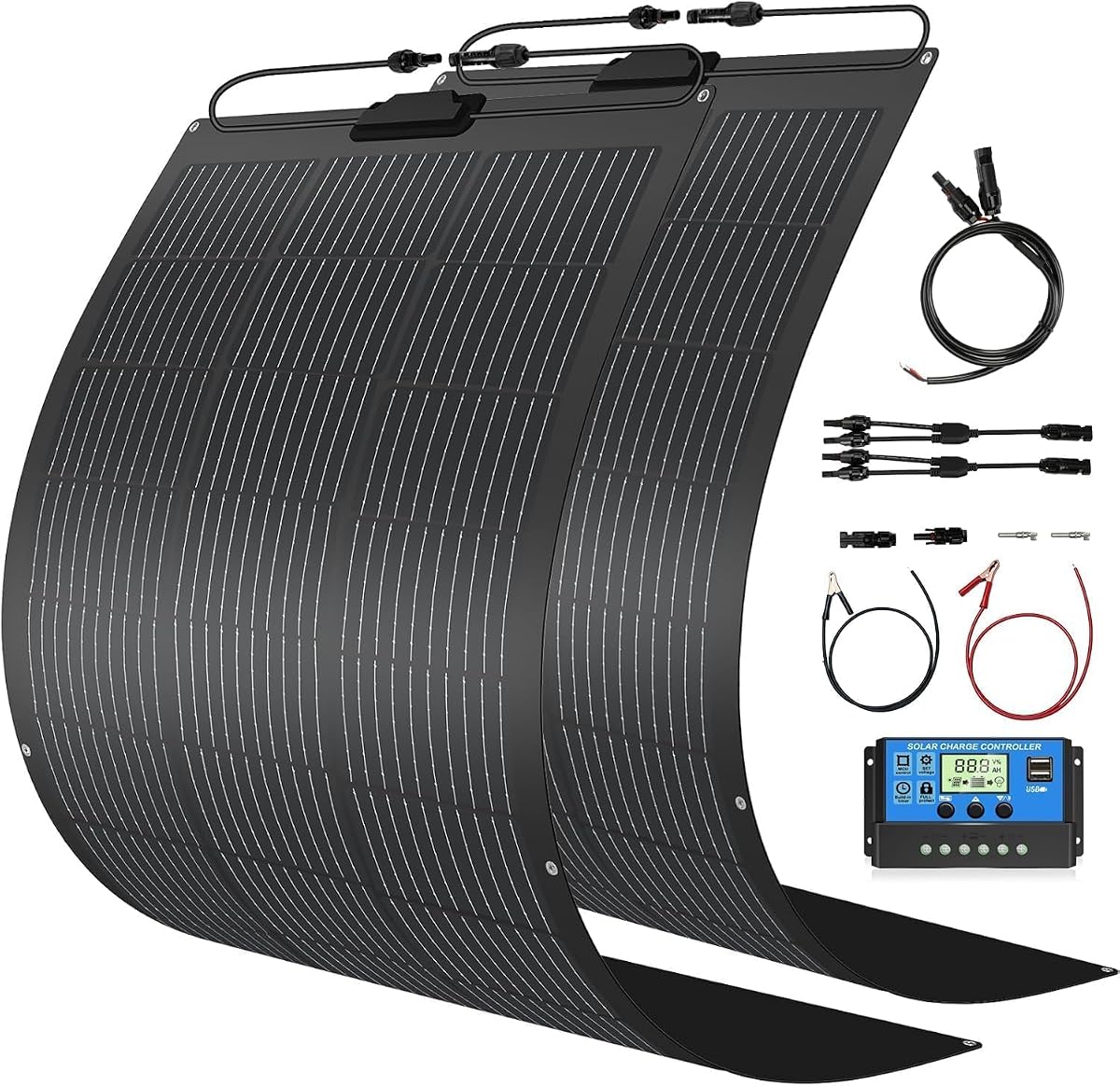
800W Flexible Monocrystalline RV Solar Panel
5.0Editor score
Two flexible 400W panels
ETFE weather-resistant construction
Bends up to 30 degrees
Supports 12V and 24V
Our 800W solar panel guide compares ten rigid, flexible, bifacial, and portable systems for RV, marine, backup, and off-grid use.
An 800W solar panel system offers a substantial upgrade for RVs, boats, cabins, backup power setups, and other off-grid installations, but the right configuration depends on portability, mounting style, and electrical design. The best options balance usable output, durable construction, practical connectors, and compatibility with the equipment already in your system.
We compared the supplied ten products by examining their power configurations, cell technologies, physical construction, mounting options, weather resistance, wiring details, intended applications, and customer ratings. The list covers rigid 400W panel pairs, flexible modules, bifacial systems, portable folding panels, and kits that include charge controllers, helping distinguish options for different installation needs.
Each review identifies the product's most useful strengths and practical limitations, while the comparison table makes the major differences easier to scan. The top picks highlight strong choices for flexible, premium, and efficient installations, but current prices, availability, controller requirements, and installation conditions should always be checked before making a final purchase.
5.0Editor score

4.3Editor score

4.5Editor score
This side-by-side comparison covers rigid, flexible, bifacial, portable, and controller-equipped 800W solar panel options, with attention to output, construction, wiring, mounting, and the environments each set is designed to serve.
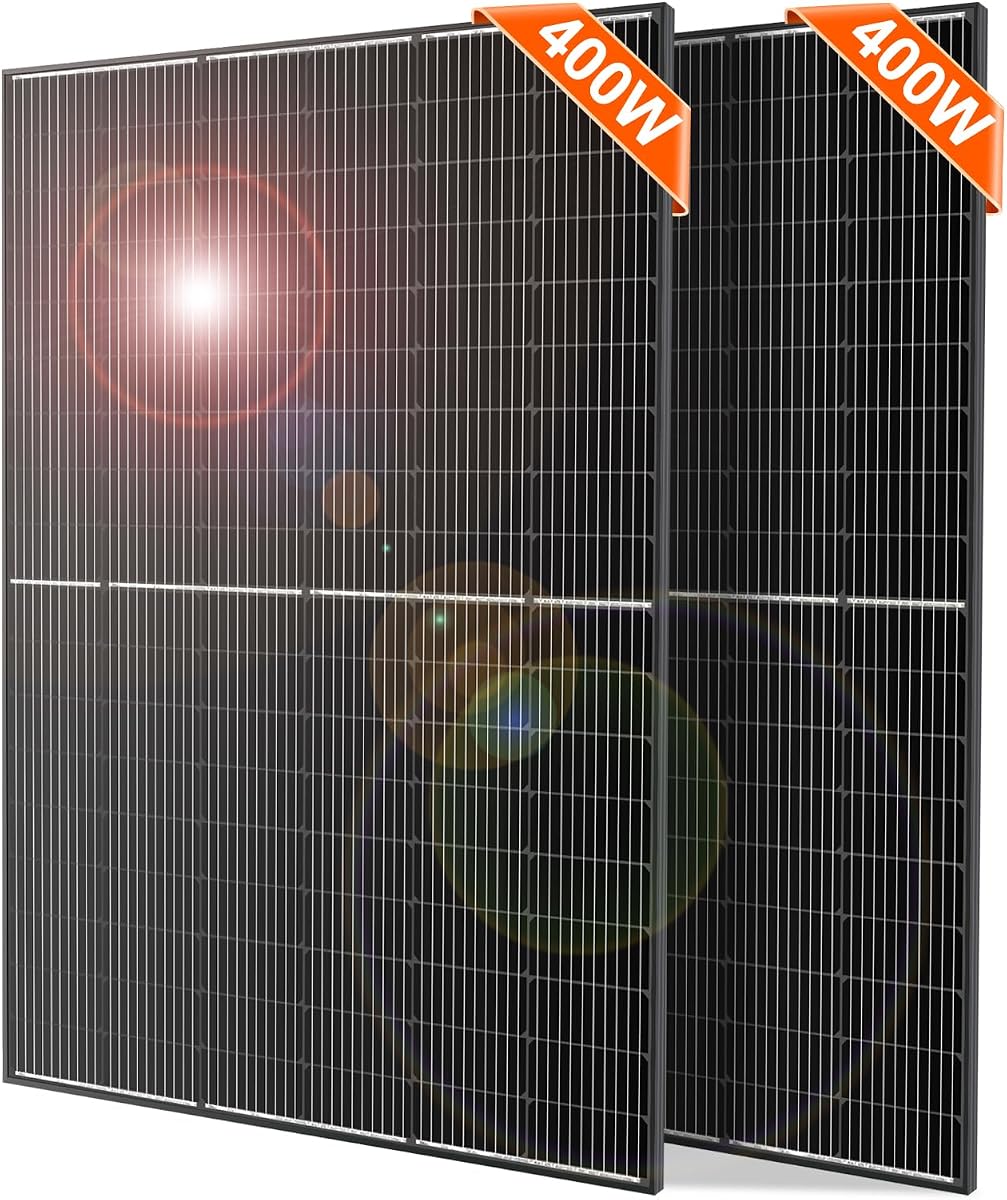


The DOKIO 800W Solar Panels set combines two rigid 400W panels into a straightforward high-output array for 12V or 24V installations. Its 4.1 customer rating reflects a practical package built around recognizable construction and uncomplicated wiring. Tempered glass, an aluminum frame, and sealed junction boxes make it especially relevant to fixed outdoor installations where a flexible or folding format is unnecessary.
We may earn a commission when you buy through this link, at no additional cost to you.
One of the most useful details is the inclusion of approximately 3-meter MC4 leads on every panel. Those longer leads can reduce the need for extension cables when panels are mounted farther from a combiner or controller, which also limits additional connection points. The two-panel format offers another practical advantage over a larger collection of smaller panels: fewer branch connectors and fewer joints to inspect, secure, and protect from moisture.
The electrical design still demands careful planning. The manufacturer recommends parallel wiring as the default for a 12V bank, while series configuration should only be used with a suitable controller that can accept the higher input voltage. Because two 400W panels can deliver substantial current, the controller and inverter must be sized for the combined output, and MPPT control is advised for more efficient charging. The set does not include those external components.
This DOKIO configuration is best for homeowners, cabin owners, and mobile users who want substantial charging capacity without deploying eight separate panels. It is particularly attractive when longer panel leads simplify the cable route. Buyers should first confirm their battery bank's voltage, calculate the expected array current, inspect the available mounting area, and ensure the charge controller can manage both the selected wiring method and the full array output.
Using two 400W modules reduces the number of branches and connectors associated with an equivalent group of eight smaller panels. Fewer joints mean less installation time and fewer places where wiring can be strained or exposed to moisture.
The panel pair can generate substantial current, so controller capacity and input-voltage limits should be checked before wiring. Parallel operation is the safer default for a 12V system, while series wiring requires appropriate controller support.
We may earn a commission when you buy through this link, at no additional cost to you.
The DOKIO 800W Solar Panel Set is designed around two 400W, 31V panels for off-grid installations that benefit from more output than a single portable module can provide. It carries the same 4.1 rating as the other DOKIO set and shares a rigid, permanent-installation format. Its strongest selling point is not exotic construction but an efficient panel count combined with generous preattached wiring.
We may earn a commission when you buy through this link, at no additional cost to you.
Each panel includes a 3-meter MC4 lead, allowing a more direct route toward a combiner or charge controller. The manufacturer notes that this arrangement can reduce the need for immediate extensions, making the overall installation tidier. Compared with an eight-panel array using 100W modules, the two-panel design also involves far fewer branch connectors and wire junctions. That simplicity can be valuable on a crowded RV roof, cabin roof, yard structure, or compact ground-mount site.
Its limitations are largely electrical rather than physical. The pair delivers 800W under standard test conditions, so the selected controller and inverter need to tolerate the combined current. For a 12V battery bank, parallel wiring is recommended to maintain appropriate voltage and steadier charging. Series wiring should be limited to controllers with an appropriate maximum input voltage. The panels themselves do not supply a controller, battery, inverter, or mounting hardware.
The DOKIO set suits buyers who want a scalable-looking but relatively simple high-power array. It works especially well for off-grid cabins, mobile installations, and supplemental solar systems where two panel positions are easier to secure than numerous small modules. The deciding question is whether the site provides adequate unshaded exposure and whether the rest of the system can accept the current generated by the full pair.
Rigid glass-and-aluminum panels are well suited to fixed rooftops and ground-mounted arrays. Once securely mounted, they avoid the folding and repeated setup associated with portable equipment.
Factory-attached 3-meter MC4 leads can shorten the distance between the panels and controller. This can reduce extension use, although installers should still protect exposed cable from abrasion and moisture.
We may earn a commission when you buy through this link, at no additional cost to you.
The Renogy Bifacial Solar Panel 800W set combines two 400W modules using 16BB N-Type cells and offers up to 25% cell efficiency. Its 4.3 customer rating places it among the stronger-rated choices in this guide. The pair is aimed at homeowners, RV users, boaters, and off-grid installers who want meaningful output from a relatively compact number of panels.
We may earn a commission when you buy through this link, at no additional cost to you.
Bifacial construction allows each module to collect direct light from the front and reflected light from the rear. According to the supplied product information, that can add as much as 30% more energy in reflective settings such as snow, sand, concrete, pale gravel, and light-colored roofs. The actual gain depends on mounting height, spacing, surface reflectivity, and how freely air can circulate around the rear of each panel.
The dual-module design also introduces two independently operating power zones, which can reduce the effect of partial shade. If branches, vents, leaves, or another obstruction covers one section, the other may continue producing power. That feature does not eliminate shading losses, but it can make a partially obstructed installation more dependable than a comparable layout without separated operating zones.
This Renogy pair is a compelling choice when roof area is limited or the installation environment can reflect useful light onto the rear surfaces. Buyers should review the panel dimensions and mounting requirements, verify battery-bank compatibility, and select an appropriately sized controller and inverter. It is less compelling when there is abundant roof space and no reflective surface available, because the additional bifacial benefit would be correspondingly smaller.
Bifacial performance improves when the rear face receives reflected light and is not blocked from airflow. Mounting height, panel spacing, and the reflectivity of the surrounding surface can materially affect the additional energy produced.
The divided operating zones can help one section continue generating when another is shaded. Proper placement remains essential, since obstructions affecting both zones or the entire array will still reduce system output.
We may earn a commission when you buy through this link, at no additional cost to you.
The 800W Flexible RV Solar Panel Kit pairs two flexible 400W monocrystalline modules and holds the highest customer rating in this selection at 5.0. Its most attractive qualities are low weight, adaptability, and a straightforward installation approach. The product is intended for RV roofs, camper vans, boats, cabins, and remote work sites where a rigid panel could add unnecessary load or fail to conform to the available surface.
We may earn a commission when you buy through this link, at no additional cost to you.
The panels use an ETFE surface rather than a conventional PET layer, providing strong light transmission and UV resistance. Each can bend to a curvature of up to 30 degrees, with a stated thermal tolerance of 248°F. Their combined weight is only 4.4 pounds per panel according to the product information, making them considerably easier to position than rigid modules. Pre-drilled holes allow mounting without separate frames or drilling when adhesive or suitable fasteners can provide a secure attachment.
Environmental protection is another strength. The product has an IP68 waterproof rating and a salt-spray-resistant design intended for marine use. It supports 12V and 24V systems with lead-acid and LiFePO4 batteries, and the supplied information notes compatibility with Renogy and Victron controllers. That broad support does not mean the controller can be assumed to be included; system components still need to be selected and sized correctly.
This kit is best for mobile users who value low weight and a minimally invasive installation over the long-term service profile commonly associated with rigid glass panels. Flexing must stay within the stated limit, and the mounting surface must be clean, smooth, and firmly supported. With a suitable charge controller and careful adherence, it offers an unusually attractive combination of capacity, portability, and installation convenience.
At 4.4 pounds per panel, the flexible format can reduce added roof load and avoid the drilling associated with rigid brackets. Secure adhesion or suitable fasteners remain necessary to prevent wind lift.
The ETFE surface, sealed construction, and IP68 rating support outdoor use in rain, snow, and marine environments. Proper sealing around cables and junctions is still essential for long-term reliability.
We may earn a commission when you buy through this link, at no additional cost to you.
The 800W Portable Solar Panel set consists of two folding 400W modules rated at 39V, with 23% efficiency cells and a 4.2 customer rating. It targets campers, RV travelers, and mobile power users who need useful charging capacity without permanently occupying roof space. The two-panel format balances higher output with a package that can still be carried and deployed away from the vehicle.
We may earn a commission when you buy through this link, at no additional cost to you.
At approximately 20 pounds for the pair, the set remains manageable for portable use. Each panel has an ETFE-coated surface for durability and impact resistance, while the stated IP67 rating supports outdoor deployment. Four adjustable kickstand positions—30, 40, 50, and 80 degrees—allow the user to change the panel angle as the sun moves or the setup location changes.
The biggest limitation is inherent to portable solar: performance depends heavily on direct, unshaded sunlight and correct orientation. A folding panel placed on the ground, under trees, or at a poor angle will not match its rated output under ideal test conditions. The portable format is also less appropriate for a permanent RV installation than rigid or low-profile flexible modules that can be securely mounted above the roof.
This set works well for campsite charging, a portable power station, or supplemental generation during travel. Users should verify the power station or controller's input voltage and current limits, avoid placing panels under partial shade, and reposition them as sun angles change. For travelers who value portability and fast setup more than permanent integration, it is one of the clearest options in the guide.
Four kickstand positions let the panels remain angled toward available sunlight as conditions change. Regular repositioning can produce better results than leaving a portable set at one fixed orientation.
The folding format is convenient to deploy, but output still depends on direct illumination. Clear placement away from tents, vehicles, trees, and buildings is important when charging a power station or battery.
We may earn a commission when you buy through this link, at no additional cost to you.
The 800W kit pairs two 400W monocrystalline panels with a 30A MPPT charge controller for a 12-volt battery system. Its central benefit is integration: buyers receive a major system component alongside the panels rather than needing to source one separately. However, the product's 1.0 customer rating is notably below the rest of the field, and only a single rating appears in the supplied data.
We may earn a commission when you buy through this link, at no additional cost to you.
The panels use 10BB cells with stated efficiency of up to 25% and are described as using N-Type monocrystalline silicon technology. Built-in MC4 connectors simplify panel-to-controller connections, while pre-drilled holes allow mounting on racks, RV roofs, or other suitable structures. The kit is positioned for RVs, campers, yachts, residential storage, camping, and commercial applications.
Because the supplied rating is based on so little customer feedback, it should not be treated as definitive evidence of poor performance. At the same time, it offers less demonstrated customer consensus than the higher-rated options. The included 30A MPPT controller also reduces configuration flexibility. Buyers should confirm that its input limits, battery chemistry settings, load outputs, and wiring requirements align with the intended battery bank and any inverter.
The kit may suit a first-time 12V installer who values a preassembled collection of core components. More experienced users may prefer independently selecting a controller with the exact voltage, current, and battery features needed. Before purchasing, compare the enclosure, terminal quality, controller protections, physical dimensions, warranty information, and warranty terms against other complete systems.
Including a 30A MPPT controller reduces the number of separate components required for a basic 12V installation. It can simplify initial setup, provided the controller specifications match the battery bank and array.
A rating based on one customer conveys very limited consensus. Buyers should examine the controller specifications, physical construction, warranty terms, and support resources rather than relying on the rating alone.
We may earn a commission when you buy through this link, at no additional cost to you.
The 800 watt N-Type 400W panel pair uses 16BB half-cell technology and has a 4.4 customer rating, making it one of the better-reviewed selections here. It is designed for fixed systems on homes, cabins, RVs, boats, and other off-grid installations. Tempered glass, a corrosion-resistant aluminum frame, and IP68-rated connectors support long-term outdoor use.
We may earn a commission when you buy through this link, at no additional cost to you.
The N-Type cell design is intended to reduce recombination losses and improve conversion performance. The manufacturer also highlights better low-light response, which can help generation during mornings, evenings, and cloudy periods, although actual production still depends on weather and orientation. A stated 2400Pa wind-load rating and 5400Pa snow-load rating add useful information for installers assessing site conditions.
Installation is made easier by preinstalled MC4 connectors, bypass diodes, and approximately 3.6-foot cables. Pre-drilled mounting holes work with Z-brackets, side mounts, grounding mounts, and tilt brackets. The shorter cable length compared with some 3-meter options may require an extension in certain layouts, but it can also make cable management neater when the panels are mounted close to the controller.
This pair is well suited to buyers who want a conventional rigid array with modern cell technology and detailed environmental specifications. It works especially well where roof or ground space is fixed and long-term mounted performance matters more than portability. The system still requires an appropriately sized charge controller, battery bank, inverter where applicable, and suitable mounting hardware selected for the actual site.
The stated wind and snow load figures help indicate the panel's intended structural capability. Installers should still follow local requirements and use brackets, anchors, and torque procedures appropriate for the mounting surface.
N-Type cells with 16BB half-cell construction aim to reduce internal losses and maintain output across changing light conditions. High-light and cloudy-day production still depends on placement and system configuration.
We may earn a commission when you buy through this link, at no additional cost to you.
This 800W flexible kit combines two 400W monocrystalline photovoltaic modules with a 40A solar charge controller. No customer rating is available in the supplied listing data, so its value proposition must be evaluated primarily from its specifications and intended use. It is positioned for RV, boat, camper, truck, cabin, and remote off-grid charging where curved or irregular surfaces make rigid panels difficult to mount.
We may earn a commission when you buy through this link, at no additional cost to you.
The flexible construction is the kit's defining advantage. It can follow curved roofs and contours without creating gaps, and the panels include six grommet mounting holes for fasteners. Silicone or adhesive tape can also be used where appropriate. The junction box is described as sealed and waterproof, and the panel surface is presented as more durable than traditional glass-and-aluminum construction.
Unlike the other 800W set with a 40A controller, this listing supplies no customer rating. That makes independent verification especially important. Buyers should investigate the controller's battery compatibility, maximum panel input voltage, current handling, terminal design, protections, and enclosure quality. They should also learn the recommended adhesive or fastening method for their specific roof material and confirm whether the panels require adequate airflow beneath them.
The kit is most appropriate for mobile installers who want flexible panels and a charge controller in one coordinated package. It may be especially useful on boats, camper vans, and older vehicles with curved roofs. The absence of customer feedback does not automatically make it a poor choice, but it justifies more careful scrutiny of the included electronics, warranty terms, and installation instructions before committing to a full installation.
Flexible modules can conform to curved roofs and compact body panels that are difficult to cover with rigid glass modules. Their lower profile can also reduce visual bulk and avoid roof penetration.
The included 40A controller should be checked for supported battery chemistries, input-voltage limits, current ratings, and wiring requirements. Matching it to the intended battery bank is essential for safe charging.
We may earn a commission when you buy through this link, at no additional cost to you.
The second 800W flexible 40A kit uses two 400W monocrystalline modules and includes a 40A charge controller. Like the similarly named kit in the previous rank, it has no customer rating in the supplied data, making specification review especially important. It is aimed at mobile and off-grid charging applications including campers, boats, RVs, trailers, trucks, cabins, and remote work locations.
We may earn a commission when you buy through this link, at no additional cost to you.
The two flexible panels offer several installation advantages. They can conform to curved or irregular surfaces, include six grommet holes for mechanical fasteners, and can be installed with silicone or adhesive tape where suitable. High-efficiency monocrystalline silicon cells are specified to provide good performance even under low-light conditions, while the sealed, waterproof junction box helps protect electrical connections from environmental exposure.
The included controller gives this package a more complete starting point than a panel-only purchase. Still, the lack of customer feedback and a clearly stated output warranty means buyers should examine the fine print closely. Important questions include the controller's supported battery types, maximum input voltage, load capability, terminal quality, temperature behavior, and protections. The mounting surface must also be prepared properly for the chosen adhesive or fastening method.
This kit makes sense for mobile users who prioritize flexibility, straightforward component selection, and low-profile installation. It may be a practical choice for an RV or boat where drilling is undesirable and space is irregular. Compare the controller documentation, physical dimensions, included accessories, warranty coverage, and mounting instructions with the alternative flexible controller kit before selecting between them.
The ability to bend around a curved or irregular surface makes these modules useful on boats, camper vans, trailers, and older vehicles. A flat, clean bonding surface is essential when using adhesive.
Rated output under ideal test conditions does not guarantee the same production in the field. Controller behavior, wiring losses, temperature, shade, orientation, and mounting quality all influence real-world energy harvest.
We may earn a commission when you buy through this link, at no additional cost to you.
The EPOCH 860W set is the highest-capacity product in the guide, using two 430W bifacial panels rather than two 400W units. Its 4.5 customer rating is also the highest among the rigid panel selections. The product uses Grade A+ N-Type monocrystalline cells, a 16BB design, half-cut cells, and bypass diodes, creating a premium-looking option for serious RV, marine, rooftop, cabin, and off-grid installations.
We may earn a commission when you buy through this link, at no additional cost to you.
The bifacial format can collect direct sunlight from the front and reflected light from the back. The listing reports light transparency of up to 91.5% and conversion efficiency of up to 25%. As with any bifacial panel, the benefit depends on the mounting environment. Pale roofs, concrete, sand, snow, and other reflective surroundings can improve rear-side production, while close mounting or heavy obstruction can limit it.
Durability is a major selling point. The panels are rated to tolerate snow loads of up to 5400Pa and wind loads of up to 2400Pa. Their junction box has IP68 protection, and the MC4 connectors have IP67 protection against dirt, dust, debris, and low-pressure water jets. Each panel also receives 100% electroluminescence testing to check for microcracks. The stated warranty covers panel quality for 12 years and linear power output for 25 years.
Installation is straightforward for experienced solar users because the panels include a junction box, solar connectors, and pre-drilled mounting holes. They are compatible with many ground mounts, Z-brackets, corner brackets, pole mounts, and tilt mounts. The EPOCH pair is best for buyers willing to plan the bifacial mounting geometry carefully and wanting the strongest stated capacity and warranty package among these choices. A suitably rated controller and battery system remain necessary.
The two 430W modules provide 860W under standard test conditions. That slightly higher nominal capacity can reduce the number of separate panels needed for a given installation footprint.
Electroluminescence testing helps reveal microscopic cracks before installation. Combined with the stated quality and output warranties, it supports confidence in long-term panel performance.
We may earn a commission when you buy through this link, at no additional cost to you.
Selecting an 800W solar panel system requires matching the physical format to the installation site while ensuring that panel voltage, current, wiring method, controller, and battery system are electrically compatible.
Rigid glass-and-aluminum modules generally suit fixed rooftop and ground-mounted systems because they are straightforward to mount and commonly used in permanent arrays. Flexible panels are better for curved RV, van, boat, and trailer roofs where low weight and limited drilling matter. Portable folding sets prioritize mobility and quick setup rather than permanent integration. Choose the format based on where the equipment will live, how often it must move, and whether the mounting surface is flat or curved.
In short, select rigid panels for fixed installations, flexible modules for constrained mobile roofs, and folding panels for portable use.
Most products in this guide combine two 400W modules, while the EPOCH pair combines two 430W panels for an 860W stated capacity. Rated wattage is measured under standard test conditions and does not represent continuous output throughout the day. Temperature, sunlight angle, shading, dust, wiring losses, and controller efficiency all affect real energy production. A panel pair may also require a controller with enough current capacity and, for a 24V bank, an appropriate maximum input voltage.
In short, treat rated watts as a controlled comparison point rather than a promise of around-the-clock output, and size the rest of the system for peak current.
Panel operating voltage, battery-bank voltage, and controller limits must work together. A 31V or 39V panel designation cannot be evaluated independently of the intended battery system. Parallel wiring is commonly recommended for 12V installations, while series wiring raises array voltage and should only be used with a controller designed for that input. Battery chemistry also matters because charging profiles for lead-acid, AGM, gel, and LiFePO4 are not identical.
In short, verify panel voltage, battery chemistry, battery-bank voltage, and controller limits before selecting a wiring method.
N-Type monocrystalline cells, half-cut designs, 16BB construction, and bifacial rear-side collection can improve output or reduce the effect of partial shade. Bifacial panels require suitable rear-side exposure and reflective surroundings to realize their advertised additional energy. The Renogy pair's independently operating zones can help when an obstruction affects only one section, but no panel can fully overcome shade that covers the entire array.
In short, prioritize modern cells and partial-shade features for fixed sites, while expecting bifacial gains only when mounting conditions support rear-side illumination.
Outdoor solar equipment must tolerate rain, dust, snow, wind, salt, and temperature changes. Look for tempered glass, sealed junction boxes, corrosion-resistant frames, waterproof connectors, and published wind or snow load ratings where structural exposure is relevant. IP ratings apply to specific components and test conditions rather than guaranteeing that every exposed part of a complete installation has the same level of protection. Cable entries, mounting points, and controller enclosures still need proper sealing.
In short, compare component IP ratings, frame corrosion resistance, and environmental load specifications, then protect every cable entry and electrical junction.
Flexible panels need smooth, clean surfaces and secure adhesive or mechanical attachment to prevent wind lift. Rigid panels require compatible brackets and correctly torqued fasteners, whether mounted on a roof, pole, or ground frame. Longer factory-attached leads can simplify some routes, while shorter leads may encourage more compact wiring. Include cable strain relief, drip loops, UV-resistant insulation, and protection from moving roof components or sharp edges in the installation plan.
In short, design the full attachment and cable path before drilling, gluing, or connecting anything, and include strain relief and weather protection.
Some listings include a charge controller, while others provide only the panels. A controller-equipped package can simplify an initial 12V installation, but the included model may not support the battery chemistry, voltage, loads, or expansion plans you have. Panel-only sets often provide more freedom to select a controller with suitable MPPT or PWM features. No controller replaces the need to size cables, fuses, disconnects, grounding equipment, and an inverter for the complete system.
In short, include a controller only when its battery profile, input limits, current rating, and expansion capabilities fit the intended system.
Long-term solar purchases should be supported by clear workmanship and output warranties. The EPOCH set states 12 years of quality coverage and 25 years of linear output coverage, while the flexible RV kit lists a two-year materials and craftsmanship warranty alongside a 25-year output claim. Warranty terms vary, so buyers should check exclusions, transferability, required installation practices, and the process for documenting damage. Manufacturer support and replacement procedures are also important for permanently mounted systems.
In short, compare warranty duration and exclusions, confirm the claim process, and retain receipts and installation documentation for the life of the system.
Before installation, identify the battery-system voltage and chemistry, select an appropriately rated controller and inverter, and plan the array voltage and current. For a 12V bank, follow the manufacturer's parallel-first guidance where applicable. For series configurations, verify the controller's maximum photovoltaic input voltage. Use compatible MC4 connections, add appropriate overcurrent protection, and complete required grounding before energizing the system.
Mount rigid panels on rated brackets or frames, tighten fasteners to the manufacturer's requirements, and position them where obstructions are unlikely. Flexible modules should be attached to clean, smooth surfaces without exceeding their bend limit; adhesive systems need careful preparation and curing, while grommet fasteners require support around each hole. Portable panels should be unfolded completely, aimed directly at the sun, and placed on stable, ventilated ground.
Maintenance is simple but not optional. Clean glass or ETFE surfaces with a soft cloth and mild, manufacturer-approved cleaner, avoiding sharp tools and harsh chemicals. Inspect cables, connectors, seals, mounting points, and adhesive edges for cracking, corrosion, water ingress, or movement. Keep the charge controller's indicators in view, confirm that the battery is receiving expected charge, and remove portable panels during severe winds or storms when leaving them unattended.
An 800W array can suit an RV when roof area, controller capacity, battery condition, and expected travel conditions are appropriate. Flexible or portable panels may be preferable on curved roofs or when the system must remain removable. Check the battery bank's usable capacity and ensure the charge controller supports the panel voltage and battery chemistry. Also account for shading from roof accessories and the substantial current the pair can produce.
The correct method depends on the battery bank and charge controller. Parallel wiring is commonly recommended for a 12V system because it keeps panel voltage within a familiar range and helps maintain charging stability. Series wiring raises the array voltage and should only be used when the controller has a sufficiently high maximum input voltage. Review the panel instructions and controller specifications before connecting either configuration.
The controller must handle the array's maximum current, input voltage, and intended battery chemistry while leaving room for expansion if needed. MPPT control is generally preferable for many 12V and 24V off-grid systems because it can optimize charging from a higher-voltage panel arrangement. A kit with a 30A or 40A controller may be convenient, but its specifications should be confirmed against the panels and batteries rather than selected from the label alone.
Bifacial panels can collect reflected light on their rear side in addition to direct sunlight on the front. The added output varies with mounting height, panel spacing, surrounding reflectivity, and rear-side airflow. Pale roofs, concrete, sand, gravel, and snow may improve the result, while close mounting or heavy obstruction can reduce it. A standard panel with better placement may outperform a poorly positioned bifacial installation.
Flexible panels can be a practical alternative when low weight, a low profile, and avoiding roof drilling are priorities. They are especially useful on curved or irregular surfaces, but they must be mounted with suitable adhesive or mechanical fasteners and should not be bent beyond the stated limit. Rigid panels generally remain advantageous for fixed installations where long-term mounting and conventional bracket support are preferred.
Real output is usually lower than the nameplate figure except when sunlight closely matches standard test conditions. Panel temperature, time of day, weather, orientation, shading, dirt, wiring losses, and controller efficiency all influence production. A nominal 800W array may charge a battery bank gradually rather than delivering 800W continuously. Estimate output using local solar resource data and realistic peak-sun hours for the intended location.
The best battery bank depends on the system voltage, available space, weight limits, power demands, and charging profile. Lead-acid, AGM, gel, and LiFePO4 batteries can work with suitable equipment, but the controller must support the chosen chemistry. For mobile installations, weight and usable capacity deserve particular attention. For stationary systems, battery autonomy and safe ventilation or temperature management may be more important.
Use compatible waterproof connectors, protect cable entries, provide strain relief and drip loops, and avoid exposing unsealed junction boxes. Check mounting hardware for looseness or corrosion and inspect flexible-panel adhesive or grommet attachments for edge lifting. Portable panels should be lowered or stored before severe winds. Cleaning the surface with a soft cloth also helps preserve output, but harsh chemicals and abrasive tools should be avoided.
The 800W Flexible RV Solar Panel Kit stands out for its five-star customer rating, low weight, ETFE construction, and ability to follow curved roofs. The Renogy Bifacial 800W Pair is a strong all-around choice for fixed systems seeking efficient N-Type cells, partial-shade resilience, and possible bifacial gains. For buyers wanting the highest stated capacity and strongest warranty details, the EPOCH 860W Bifacial Panel Pair stands apart.
Prioritize electrical compatibility before appearance. Confirm the battery-bank voltage, controller input limits, current requirements, wiring configuration, and inverter needs. Then match the physical format to the site: flexible panels for constrained curved mobile roofs, rigid panels for permanent arrays, and folding panels for portable energy. Shade, orientation, cable routing, mounting security, and local weather deserve equal attention.
Finally, check current prices, availability, warranty terms, included accessories, and retailer support at the time of purchase. Solar performance depends on the complete system rather than the wattage printed on a panel, so a modest change in controller quality, mounting location, or cable losses can materially change the result.