
SNAP CIRCUITS Pro SC-500
4.8Editor score
500+ guided projects
75 included components
Radio and recording projects
Ages eight and up
Explore best Snap Circuits Kits for Kids, comparing 10 STEM electronics kits by age range, project count, included parts, ease of assembly, and learning value.
Snap Circuits Kits for Kids turn basic electronics into a hands-on learning experience that feels more like play than homework. A strong kit offers manageable parts, clear instructions, satisfying project variety, and enough challenge to keep children interested while teaching foundational STEM concepts.
This guide compares ten Snap Circuits kits based on their stated age ranges, project counts, component selection, assembly system, and learning focus. It covers beginner-friendly sets, general-purpose electronics collections, arcade and light-focused options, a home-automation kit, and a compact flight-themed activity kit.
Each review highlights the most useful features, practical limitations, and ideal buyers for that particular model. Product listings and availability can change, so readers should confirm the current contents, age guidance, and included accessories before making a final selection for their child.
4.8Editor score
4.8Editor score

4.8Editor score
The table below compares the ten kits by age range, project variety, component count, and primary learning focus, making it easier to identify the right balance of guidance, creativity, and challenge for a child.




The SNAP CIRCUITS Jr. SC-100 is a 4.8-rated introduction to Snap Circuits for children ages eight and up. Its 29 components support more than 100 guided projects, giving young builders enough variety to explore while keeping the collection focused rather than overwhelming. The flying saucer example adds an immediate sense of reward to the learning experience.
We may earn a commission when you buy through this link, at no additional cost to you.
Its greatest strength is accessibility. Numbered, color-coded components connect to a plastic grid without soldering or additional tools, and the included instruction book provides a structured path through each build. This makes the kit useful for children learning what a closed circuit is, how switches change current flow, and how small electronic systems can produce visible or audible results.
The main limitation is its relatively compact component selection. A child who quickly works through the included projects may eventually want motors, advanced sensors, more sound modules, or the wider selection found in the Classic, Pro, and Extreme sets. Batteries are also required, so a parent should check whether the needed cells are already available.
This is a strong choice for a first Snap Circuits experience, a birthday gift for an eight-year-old who enjoys construction toys, or a beginner who benefits from guided projects. Its combination of approachable instructions, numerous builds, and a memorable flying saucer makes it one of the most sensible ways to begin exploring Snap Circuits.
The Jr. set introduces children through concrete projects rather than abstract explanations. Working with switches, lights, sounds, and the flying saucer provides visible evidence that arranging components correctly creates a functioning system, which is an effective foundation for later STEM learning.
With 100-plus projects, the set is not limited to one demonstration. Children can revisit familiar components in different combinations, helping them see that the same parts can be rearranged to produce different outcomes while gradually improving their planning and troubleshooting skills.
We may earn a commission when you buy through this link, at no additional cost to you.
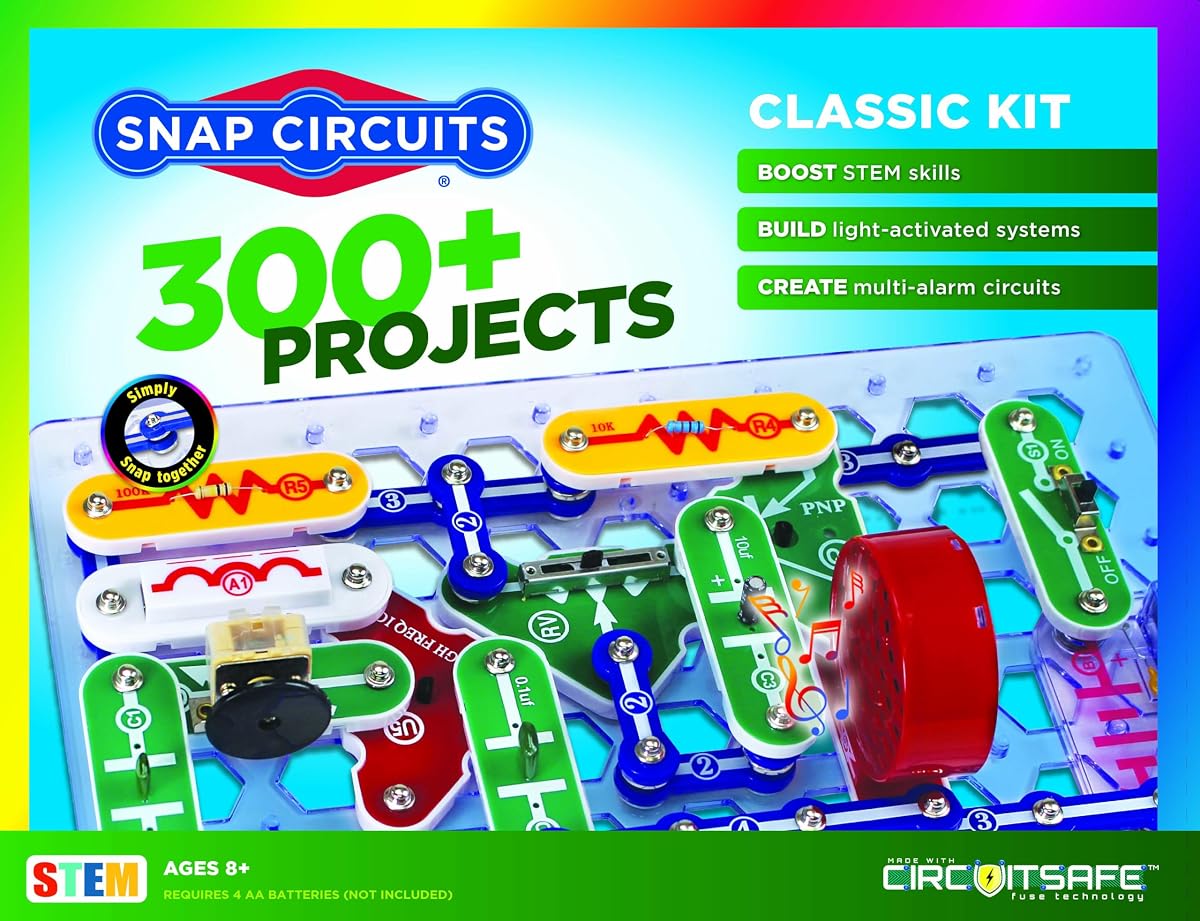
The SNAP CIRCUITS Classic SC-300 carries a 4.8 rating and is arguably the most balanced kit in this collection. It offers more than 300 projects with 60-plus components, combining a substantial learning library with a component count that still feels approachable for children ages eight and up.
We may earn a commission when you buy through this link, at no additional cost to you.
Project variety is the defining advantage. The stated builds include AM radios, burglar alarms, doorbells, and electronic games, allowing a child to move among sound, light, switching, and alarm concepts. The snap-together grid eliminates soldering and special tools, while numbered and color-coded pieces make it easier to follow diagrams and understand how a circuit is arranged.
A larger set inevitably asks more of a child than a beginner kit. Some intricate constructions may require patience, and younger builders may benefit from an adult helping interpret the manual. Batteries must also be supplied separately. Despite these considerations, the breadth of parts helps prevent the common problem of reaching the end of a project book too quickly.
The Classic SC-300 suits families seeking a comprehensive first system without moving directly to the most advanced models. It is also a strong gift for an older child who wants to make alarms, radios, games, and practical electronic gadgets. For most buyers, its balance of guidance, variety, and accessible construction makes it the strongest overall choice.
A project count above 300 gives children opportunities to revisit components in new configurations. That repetition is useful because each build can reinforce familiar ideas while introducing a new arrangement, challenge, or practical application of electricity.
With more than 60 components, the Classic kit supports a wide mix of sound, lighting, switching, and game-related builds. It offers enough variety for sustained solo play while remaining less specialized than kits centered on flight, lighting, or home systems.
We may earn a commission when you buy through this link, at no additional cost to you.
The SNAP CIRCUITS Pro SC-500 is a 4.8-rated option for children who want a large and varied electronics library. Its 75 parts support more than 500 projects, giving it substantially more long-term potential than a starter set and making it one of the most complete choices in the roundup.
We may earn a commission when you buy through this link, at no additional cost to you.
The stated projects include a radio built by the child, a voice recorder, and an LED display. These examples extend beyond simple light-and-switch demonstrations and give older builders recognizable electronic outcomes. As with the other Snap Circuits systems, the pieces connect to a plastic grid without soldering, and color and number markings help children follow the illustrated instructions.
The trade-off is size and complexity. More components mean more pieces to sort, store, and potentially lose, while 500-plus projects may feel ambitious for a child with limited attention. Batteries are required as well. Families should consider whether their child will use the manual steadily or if a smaller, more focused kit would be a better introduction.
The Pro SC-500 is ideal for a child who has already shown interest in electronics, wants a gift capable of supporting ongoing projects, or prefers a broad collection over a specialized theme. It is our premium pick because it combines a generous parts inventory, a deep project library, and recognizable advanced builds without requiring a separate computer interface.
More than 500 projects create a long sequence of build opportunities. That depth is valuable for children who tend to master a small kit quickly, since new configurations can continue developing circuit-reading, planning, and troubleshooting skills.
The radio, voice recorder, and LED display examples make the kit appealing beyond basic switches. Seeing a child operate an electronics project they assembled provides a meaningful connection between abstract circuit behavior and an engaging final result.
We may earn a commission when you buy through this link, at no additional cost to you.
The SNAP CIRCUITS Extreme SC-750 is the most advanced set in this guide, carrying a 4.8 rating and offering more than 750 experiments with 80 parts. It is designed for children ages eight and up who want to move beyond guided toy builds toward a deeper study of electronics.
We may earn a commission when you buy through this link, at no additional cost to you.
The component selection goes notably beyond a basic classroom kit. It includes a photo resistor, power amplifier, variable capacitor, analog meter, solar cell, and computer interface. The included software and PC-interface cable allow children to view waveforms and frequencies, providing a more analytical way to examine signals created by the circuits.
That sophistication comes with a steeper learning curve. The full-color manual, 750-plus experiments, and larger component inventory can feel demanding, particularly for a child with little prior interest in electronics. Families without access to a compatible computer will also miss part of the kit's intended value, even though many conventional Snap Circuits projects remain available.
The Extreme SC-750 is best for an enthusiastic older child, a learner who benefits from measurement and experimentation, or a family ready to support a long-term electronics hobby. It is the pick for parents seeking the most advanced educational experience, but the Classic or Pro sets remain easier starting points for a typical first purchase.
The analog meter, computer interface, and waveform software allow children to observe more than whether a project lights up or makes a sound. These additions support a more systematic investigation of how electrical signals behave.
The kit includes sophisticated parts while preserving the tool-free snap system. That combination makes complex circuits more accessible to younger builders and reduces the practical barriers associated with conventional electronics construction sets.
We may earn a commission when you buy through this link, at no additional cost to you.
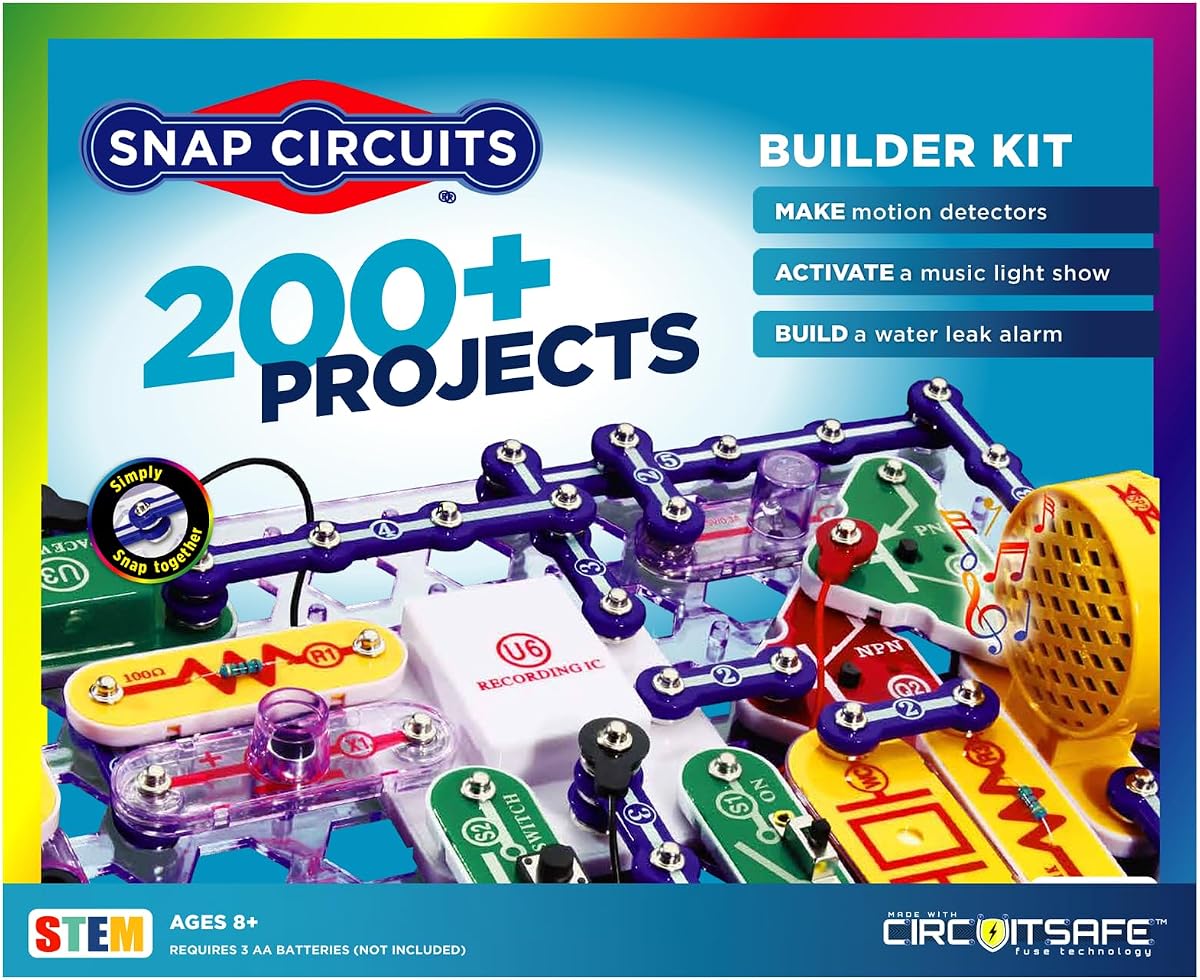
The SNAP CIRCUITS 203 is a 4.7-rated kit that offers more than 200 projects with 40-plus pieces. It fills the space between the Jr. starter model and the larger Classic set, giving children a substantial guided library without turning the kit into an advanced engineering system.
We may earn a commission when you buy through this link, at no additional cost to you.
Its project examples include burglar alarms, doorbells, and electronic games. These builds provide a useful mix of sound, switching, and play while showing that circuits can serve practical purposes as well as entertainment. The familiar Snap Circuits base grid allows numbered, color-coded pieces to connect without extra tools or glue.
Compared with the Classic SC-300, this model has fewer parts and fewer total projects, so children seeking a very large collection may eventually move to a more extensive kit. It is also described as an Amazon-exclusive educational STEM toy, which may make it less convenient to find elsewhere. Batteries should be confirmed as a separate requirement.
This kit is a good fit for a child who seems ready for more than a starter set but does not need the largest component collection. It offers a clear progression through familiar projects, manageable instructions, and enough variety to sustain regular play, making it a practical alternative for families comparing Snap Circuits models.
More than 200 projects provide a meaningful step up from a basic introduction, while 40-plus components remain relatively easy for a child to organize. The balance can be especially helpful when parents are uncertain whether a child will want to continue with electronics.
Doorbells, alarms, and games show that a circuit can be both useful and entertaining. That range helps sustain interest while children learn how switching and component placement affect the final result.
We may earn a commission when you buy through this link, at no additional cost to you.
The SNAP CIRCUITS Arcade SCA-200 is a 4.8-rated option built around electronic games, sounds, and lights. Although the 36-piece set supports more than 200 projects, its defining attraction is a collection of 20-plus arcade-style games that can make basic circuit learning feel immediately entertaining.
We may earn a commission when you buy through this link, at no additional cost to you.
One highlighted project lets a child write a spinning LED message powered by a circuit they engineered. That feature adds a strong creative element and demonstrates how electrical input can become both text and motion. The broader project library ensures the kit is not limited to a single novelty and can also support more conventional Snap Circuits learning.
The tradeoff is thematic focus. A child primarily interested in radios, meters, sensors, or home-style systems may find a general or advanced kit more useful over time. The set also requires batteries, which are not included according to the supplied information. As with the rest of the line, the parts are numbered and color-coded for easier construction.
The Arcade SCA-200 works well for children who are more motivated by games than by traditional electronics exercises. It is also a strong entry-level option because the playful outcome keeps attention focused while still demonstrating cause and effect. For families seeking an engaging first system or a gift with immediate appeal, it is one of the most approachable choices.
Each game gives a child a clear reason to test connections, switches, timing, and signals. The entertainment theme makes repeated experimentation feel rewarding while preserving the underlying circuit concepts.
The spinning LED message project extends the gaming focus into design and communication. It provides a visually engaging result that children can personalize, encouraging them to think beyond simply reproducing the manual.
We may earn a commission when you buy through this link, at no additional cost to you.
The SNAP CIRCUITS Beginner SCB-20 is a 4.7-rated kit made specifically for children ages five through nine. Unlike the age-eight-and-up models in this guide, it emphasizes child-friendly components, simpler instructions, and extra safety features for smaller hands and developing attention spans.
We may earn a commission when you buy through this link, at no additional cost to you.
Its 21 unique projects introduce children to real working circuits while gradually encouraging problem-solving, troubleshooting, and planning. The included lighted, color-changing fan adds a particularly visible reward, and the colorful manual uses age-appropriate diagrams and language to make each instruction easier to interpret without requiring an adult to translate every step.
The main limitation is depth. A child who completes 21 projects may want the much larger project catalogs offered by the Classic, Pro, and Extreme kits. The set is also better suited to learning fundamentals than advanced measurement, and its simpler scope may not hold the attention of an older child who already understands basic circuit behavior.
This is the ideal choice for a younger child, siblings of different ages, or adults who want an approachable introduction to Snap Circuits. The age-specific design is meaningful: it does not merely place a standard kit in front of a child, but adapts the instructions and component safety features to the intended user.
Extra childproofing features and simpler components make the kit more suitable for early builders. These design choices can reduce frustration and help a child experience a successful circuit build with greater confidence.
The 21-project sequence introduces more than assembly. Children encounter situations in which a circuit does not work as expected and learn to inspect connections, revisit instructions, and solve problems methodically.
We may earn a commission when you buy through this link, at no additional cost to you.
The SNAP CIRCUITS Light is a 4.8-rated collection of more than 175 projects using 55 components. It gives children ages eight and up a focused path into lighting effects, with projects such as fiber optic displays, a strobe light, a color organ, and lights that change with music.
We may earn a commission when you buy through this link, at no additional cost to you.
The distinguishing feature is its emphasis on visible output. Fiber optics can create striking patterns, the strobe offers a different kind of motion and brightness, and the color organ can be controlled by an iPod or another MP3 player, as well as by voice or finger input. Those variations make the kit appealing to children who may find conventional circuit diagrams less visually motivating.
Its specialized focus is also its limitation. With 175-plus projects, it offers fewer total ideas than the Classic or Pro kits, although each theme may feel more dramatic. Some music-oriented functions require an appropriate external source. Batteries are needed for the kit, and the supplied information does not indicate that they are included.
The Light kit is best for a child with an artistic interest, a fascination with glowing displays, or a preference for dramatic sound-and-light effects. It may be the most memorable choice for creative builders, while the general-purpose Classic set is better for broad instruction-following and conventional electronics practice.
Fiber optics, strobes, and changing light patterns provide immediate visual feedback. This can be especially motivating for children who connect circuit behavior more readily when they can see a dramatic result.
The color organ and music-responsive lighting demonstrate that circuits can respond to external input. This gives children a creative way to explore how sensors and signals can control visible output.
We may earn a commission when you buy through this link, at no additional cost to you.
The SNAP CIRCUITS My Home is a 4.8-rated kit for children ages eight and up, concentrating on 34 projects related to circuits in the home. Its themes include electrical circuits, home security, overhead lighting, and an infrared-controlled lighting system, giving the collection a clear and cohesive purpose.
We may earn a commission when you buy through this link, at no additional cost to you.
The parts inventory is unusually detailed for a focused kit. It includes a base grid, slide and press switches, vertical, snap, and jumper wires, a battery holder, resistors, a capacitor, LEDs, a lamp, a sound module, transistors, a meter, a motor, and detailed instructions. That mix allows children to work with both simple and more advanced circuit concepts.
With 34 projects, the set is smaller than broad kits that offer hundreds of builds. Its value therefore depends on whether the home-automation theme matches the child's interests. The kit requires three AA alkaline batteries, sold separately, and assembly needs no glue or tools, although complex projects may still benefit from adult assistance.
This kit is a strong fit for a child interested in smart-home concepts, household security, lighting, and practical electronics. It can also serve as a thematic extension to a larger Snap Circuits collection because the projects are tightly connected rather than broadly miscellaneous. For those interests, the focus is an advantage rather than a limitation.
Security systems, overhead lights, and infrared control translate basic electronics into recognizable household functions. This practical framing helps children understand why switches, sensors, and circuits are useful outside the classroom.
Transistors, a capacitor, resistors, a meter, a motor, and multiple wire types provide a substantial range of circuit roles. The collection supports more technical experimentation than a basic beginner kit while retaining easy grid-based assembly.
We may earn a commission when you buy through this link, at no additional cost to you.
The SNAP CIRCUITS Flight Deck is a 4.5-rated compact STEM kit for children ages eight and up. Instead of offering a large catalog of circuits, it concentrates on five projects involving a paper airplane launcher, flying saucers, balls, a spinning pattern wheel, and levitation over a fan.
We may earn a commission when you buy through this link, at no additional cost to you.
The compact concept makes the kit appealing for children who prefer one focused activity to an extensive instruction book. Its projects connect electricity with flight and physics, allowing children to investigate why a paper airplane launches, how electricity powers movement, and how moving air can affect a lightweight object.
Five projects are a clear limitation for a child seeking a long sequence of circuit challenges. The kit also requires batteries that are not included. Even so, each activity appears designed to deliver a distinct result, which can provide a satisfying introduction to building rather than the repetitive feeling of working through near-identical exercises.
Flight Deck is a good choice for a child who loves aircraft, launchers, and physical experiments, particularly as a compact gift or weekend activity. It may also serve as a themed supplement to a broader Snap Circuits collection. For families seeking a long-term electronics library, a larger kit is more appropriate, but for focused curiosity this model is engaging and accessible.
The launcher and flying-saucer projects connect a circuit to a visible mechanical outcome. Children can explore how electrical components contribute to motion while considering the physical behavior of the objects they launch.
The spinning wheel and ball-levitation activities broaden the theme beyond aircraft. By combining electrical circuits with air pressure and visual patterns, the kit offers several ways to investigate basic physics concepts.
We may earn a commission when you buy through this link, at no additional cost to you.
The right Snap Circuits kit depends on age, interests, project depth, and how much guidance a child needs. Consider the available component types, project count, storage demands, and required accessories before choosing a model.
Age guidance matters because a child must be able to follow illustrated assembly steps, understand basic instructions, and persist when a project does not work on the first attempt. Most of the listed kits are intended for ages eight and up, while the SCB-20 Beginner is designed for ages five through nine with simpler projects, childproofing features, and age-appropriate diagrams and language.
Choose the model that matches the child's current ability rather than their interest in a more advanced subject. A younger child may benefit from the Beginner set, while a child who reads comfortably and has handled construction toys can start with Jr., 203, or Arcade.
Project count is one of the clearest ways to estimate how much structured play a kit provides. The Flight Deck offers five focused activities, the Beginner set includes 21 projects, the Light kit supports more than 175, and the Jr. model offers more than 100. Larger collections include 200-plus projects in the 203 and Arcade kits, 300-plus in Classic, 500-plus in Pro, and 750-plus in Extreme.
More projects usually mean more sustained use, but variety alone does not guarantee better learning. A smaller themed kit may deliver a more memorable experience if its projects closely match a child's interests. Match the project library to persistence rather than choosing by number alone.
The included parts determine the range of experiments a child can complete. Basic sets emphasize switches, lights, sounds, and simple powered projects, while larger kits may add motors, meters, transistors, capacitors, sensors, solar cells, and computer interfaces. The My Home set provides a particularly detailed list of household-oriented components, and the Extreme set supports analytical measurement.
Check which components matter for your child's interests. A radio enthusiast may value audio parts, a young artist may prefer the Light kit's fiber optics, and a future engineer may appreciate the meters and interface hardware in the Extreme model.
Snap Circuits kits can be organized by theme as well as by difficulty. The Arcade set emphasizes games, the Light set focuses on fiber optics and music-responsive effects, Flight Deck explores flight and air pressure, and My Home centers on household circuits and lighting. General kits such as Jr., Classic, Pro, and 203 cover a broader mixture of alarms, games, radios, and gadgets.
A strong theme can improve motivation because the final result feels specific and entertaining. For a child who quickly loses interest in instruction-based projects, a focused set may be more approachable than a very large general collection.
All ten products use the recognizable Snap Circuits approach of numbered, color-coded pieces that connect to a plastic base grid. The supplied information repeatedly emphasizes that soldering, glue, and special tools are not required. This is a major advantage for children, parents, classrooms, and anyone who wants electronics learning without a workshop setup.
Even though tools are unnecessary, the workspace should still be organized because smaller parts can be easy to lose. Choose a location where the child can spread out the instructions and keep unused components in a container or their original packaging.
Batteries are required for many of the listed kits but are generally not included, so families should check the package contents before use. The My Home model specifically requires three AA alkaline batteries, while the Flight Deck states that batteries are not included. The Extreme kit also includes a PC-interface cable and software, which can be relevant only when a compatible computer is available.
Keep fresh batteries on hand and note the correct size listed for the chosen model. A child may become frustrated if a project cannot be tested because the necessary cells are unavailable, so this simple preparation step can prevent a disappointing first session.
The beginner model emphasizes simpler instructions and projects for younger children, while the Flight Deck states that its directions are designed to help kids work independently. Larger kits provide more elaborate challenges, and some children benefit from an adult helping them interpret diagrams or diagnose a failed connection without taking over the build.
Consider the child's temperament. Independent builders may enjoy working from the manual, while younger or less patient children may succeed more often with short, supervised sessions. The best result comes from support that encourages problem-solving rather than immediately supplying the answer.
Larger component inventories support more advanced projects but take more space to organize. The Jr. set has 29 parts, the Beginner and Arcade sets offer distinct child-friendly collections, and kits such as Pro, Extreme, and My Home include increasingly varied components. Selecting a container with compartments can make it easier to locate small parts and complete a build without repeatedly searching the box.
Teach children to return components after each project. Good organization protects the set, reduces assembly time, and helps a child visually understand the difference between similar components.
Begin by sorting the components and reading the relevant section of the instruction manual before placing anything on the grid. Identify the numbered and color-coded pieces listed for the first project, then connect them in the illustrated order. The base grid should remain flat and stable, with each component snapped securely into place.
Install the correct batteries only after the circuit has been assembled and checked. Turn the project on and observe the result. If it does not work, disconnect the batteries, check that every component is seated correctly, confirm the connections match the diagram, and verify the switch position before trying again.
After the session, switch off the project and remove the batteries if they will not be used for an extended period. Return small components to a labeled organizer, keep the manual with the kit, and avoid liquids around the base grid. Regular care and organized storage make it easier to begin the next project and help prevent missing pieces.
Most of the listed kits are intended for children ages eight and up, although the SCB-20 Beginner is designed for ages five through nine. Younger children benefit from simplified instructions and child-friendly components, while older builders can handle more complex projects and components. Choose a kit that matches the child's ability to follow diagrams and remain engaged with the activity.
No. The listed Snap Circuits products use numbered, color-coded components that snap onto a plastic grid. The kits do not require soldering, glue, or conventional electronics tools, which makes assembly easier for children and more convenient for adults. Some advanced computer-based functions still require a compatible computer, as with the Extreme SC-750.
The supplied product information indicates that batteries are required for several kits but are not included. The Flight Deck explicitly states that batteries are not included, while the My Home kit requires three AA alkaline batteries. Check the package contents and have the correct battery size ready before beginning a build.
The Extreme SC-750 leads the listed collection with more than 750 experiments, followed by the Pro SC-500 with more than 500 projects. The Classic SC-300 offers more than 300 projects. The largest project count is not automatically the right choice, however, because a younger child may benefit more from a smaller, age-appropriate or specially themed kit.
The Arcade SCA-200 is designed specifically around electronic games, sounds, and lights. It includes more than 20 arcade-style games, a spinning LED message project, and a total library of more than 200 projects. It is especially attractive for children who need a fun and immediately interactive introduction to circuits.
The SCB-20 Beginner is specifically made for ages five through nine. It includes 21 guided projects, simpler instructions, childproofing features, age-appropriate diagrams and language, and a lighted color-changing fan. These adaptations make it more suitable for small hands and children who are just beginning to understand how circuits work.
Many children can begin independently, especially with the Jr., 203, Classic, and Flight Deck sets because they provide illustrated instructions and familiar assemblies. Younger children may need help reading diagrams or checking connections, while advanced Extreme projects may require more guidance. Adults should encourage troubleshooting rather than immediately completing the circuit for them.
The product information notes that Snap Circuits kits can be combined for additional projects. Because the line uses the same general snap-together grid and color-coded component approach, children can draw on a larger pool of parts. Confirm the instructions and current component compatibility before mixing kits, and keep components organized by set.
The SNAP CIRCUITS Classic SC-300 is the strongest all-around option because it combines more than 300 projects, 60-plus components, familiar electronics themes, and an approachable assembly system. The Pro SC-500 provides the strongest premium library for sustained projects, while the Arcade SCA-200 is an engaging, game-centered option for children who need a playful reason to explore circuits.
The right match for a younger child is the SCB-20 Beginner, while the Light kit suits creative interests in fiber optics and music-responsive effects. My Home is ideal for household electronics themes, and Flight Deck offers a compact exploration of flight and air pressure. Prioritize age fit, component interest, and the child's ability to stay engaged rather than selecting only by project count.
Before purchasing, confirm the current package contents, required battery type, age guidance, and any computer requirements. Product availability and set contents can change, so reviewing the latest listing helps ensure that the chosen kit provides the intended level of guidance, creativity, and technical challenge.
