
Ballu Convection Smart Space Heater for Large Room With WiFi APP Control
4.3Editor score
Freestanding or wall-mounted
Heats within 30 seconds
Up to 37% cost savings
Two-year warranty included
Smart Wall Heater guide comparing ten connected heaters for temperature control, heating coverage, installation, safety, quiet operation, and room fit.
Smart wall heaters combine space-saving wall mounting with connected controls, precise temperature regulation, and programmable heating routines. The best models suit bedrooms, offices, bathrooms, and other indoor spaces where consistent warmth matters without sacrificing floor space or adding frequent trips to a physical control panel.
This guide compares ten wall heaters on heating technology, room coverage, thermostat range, oscillation, installation, safety features, noise, app support, and voice-platform compatibility. It includes dedicated bathroom units, bedroom-focused models, flexible freestanding or wall-mounted heaters, and products that use app-based scheduling to fit different routines.
Each review explains the product's strongest qualities, practical trade-offs, and ideal installation environment. Ratings reflect the supplied customer feedback, while specifications are limited to listed features. Product availability and prices can change, so compare the current listing, room requirements, and safety guidance before purchasing.
4.3Editor score

4.5Editor score

4.5Editor score
The table below compares all ten heaters by heating approach, connected controls, installation flexibility, and room-heating coverage. It highlights meaningful differences among dedicated wall units, bathroom-rated models, infrared panels, and heaters that can move between freestanding and mounted configurations.
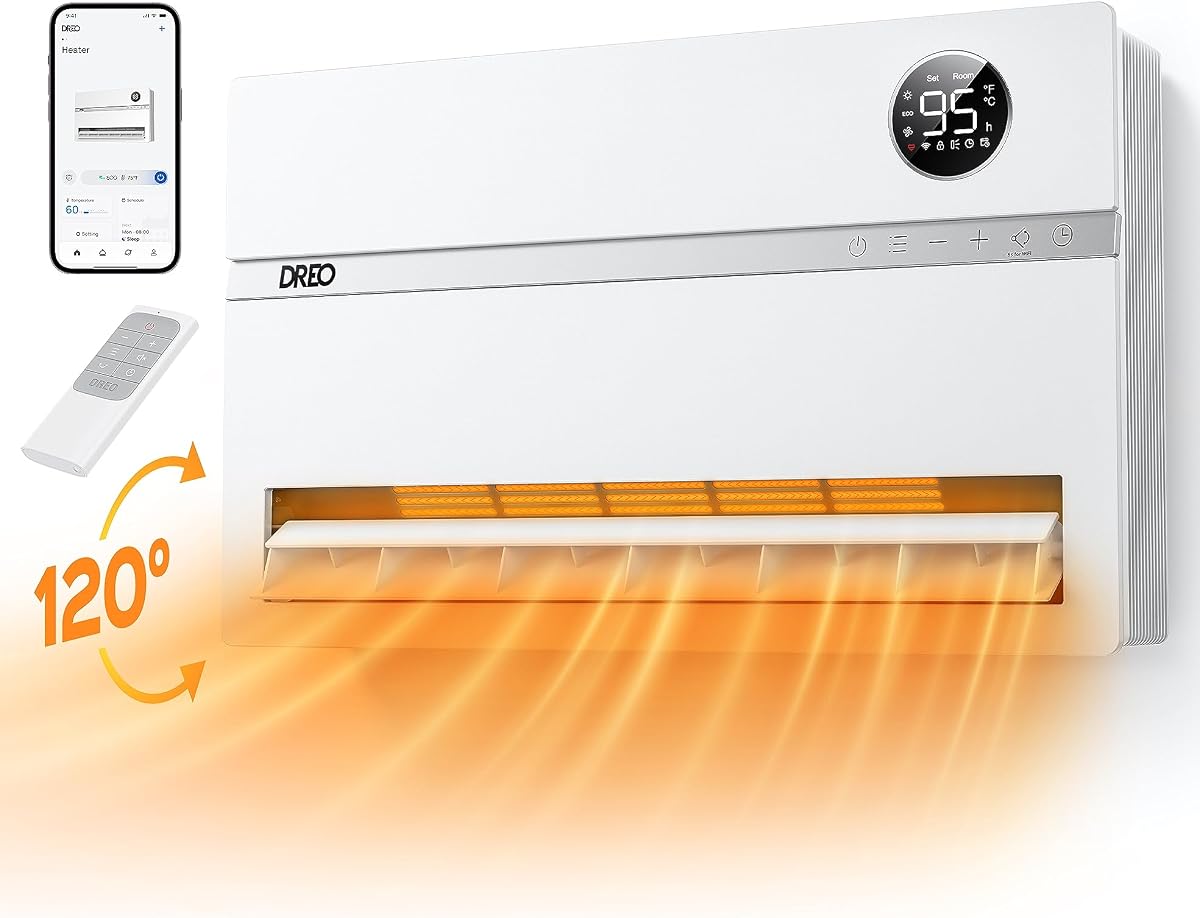


The DREO Smart Wall Heater is a 1500W bedroom-oriented unit rated 4.4 by customers. Its standout feature is the combination of 120-degree oscillation, fast PTC ceramic heating, and connected scheduling. The heater can be controlled through the DREO app, Alexa, or Google Home, making it a practical choice for people who want bedroom warmth to begin automatically.
We may earn a commission when you buy through this link, at no additional cost to you.
Wide air distribution is the model's primary strength. Rather than sending heat in one fixed direction, the unit oscillates to help spread warm air from top to bottom and toward more corners. Its thermostat spans 41 to 95°F and is advertised as accurate to 1°F, allowing users to set a narrow comfort target. PTC ceramic elements support steady heating, while the automatic low-light adjustment reduces LED panel brightness at night.
The wall-mounted format also frees floor space, which is useful in compact bedrooms where a floor heater would occupy valuable walking or furniture space. Installation is presented as straightforward, and the package includes a drilling guide and mounting accessories. The main trade-off is that this standard version does not list the ALCI plug or IP24 waterproof rating found on DREO's bathroom-oriented model, making it less obviously suited to damp environments.
This heater is best for bedrooms, offices, and other dry indoor spaces where quiet, automated warming matters. Buyers who want broad oscillation, detailed scheduling, voice integration, and bedroom-friendly lighting will appreciate its feature set. Verify the location meets the product's safety requirements before installation, especially in bathrooms or other areas with elevated moisture.
The 120-degree oscillation is especially useful in bedrooms and offices where one fixed direction may leave parts of the room cold. Combined with PTC heating, it creates a practical balance between rapid warmth and even air movement.
App scheduling and compatibility with Alexa and Google Home make it possible to warm a room around waking, working, or sleeping periods. Automatic display dimming also reduces visual distraction at night.
We may earn a commission when you buy through this link, at no additional cost to you.
The DREO Smart Electric Wall Heater earns a 4.5 rating and stands out for balanced airflow, quiet operation, and flexible control. It combines a PTC heating system with an optimized airflow design that produces 11.5 ft/s airflow at a listed 28 dB. That combination makes it a compelling option for bedrooms and offices where noticeable fan noise would undermine comfort.
We may earn a commission when you buy through this link, at no additional cost to you.
The heater offers three ways to operate: the included remote, the DREO app, and Alexa voice commands. Its 30-degree manual oscillation lets the user direct heat toward a selected area, while ECO mode and app-based temperature calibration support steadier operation. The product also has a touch display, and the listed safety package includes flame-retardant materials, overheat protection, and an IP24 waterproof rating.
DREO provides unusually helpful room-size guidance. The heater can serve as a primary heat source for approximately 150 square feet or supplement heat in rooms up to 750 square feet when insulation is appropriate. That distinction matters because heating performance depends on room construction and insulation, not merely square footage. A 70.8-inch power cord and supplied drilling template simplify installation planning.
This is our top overall recommendation for users who want a strong balance of heating performance, low noise, smart controls, and a clearly stated room-heating approach. It is especially suitable for well-insulated bedrooms and offices. Less suitable buyers are those needing flexible freestanding placement, extensive oscillation, or a more advanced heating schedule.
The listed 11.5 ft/s airflow and 28 dB noise level demonstrate an emphasis on moving heat effectively without making fan noise the room's dominant feature. This balance is valuable in offices and sleeping spaces.
ECO mode, app calibration, manual airflow direction, and three control methods allow users to refine comfort rather than relying on a single fixed setting. The result is a heater suited to changing room routines.
We may earn a commission when you buy through this link, at no additional cost to you.
The DREO 1500W ALCI Wall Heater is a 4.4-rated model distinguished by its wide selection of oscillation angles and enhanced electrical safety features. It is especially relevant to buyers who want to direct heat toward different parts of a room while retaining app scheduling and voice control.
We may earn a commission when you buy through this link, at no additional cost to you.
Its horizontal impeller and PTC ceramic system are designed for rapid heating, while adjustable oscillation offers 60-, 90-, and 120-degree positions. That gives the user more directional choice than models with only manual or fixed movement. A dedicated thermal sensor and thermostat support a 41 to 95°F range, and a 24-hour timer and dimming function help tailor operation to daily schedules and nighttime use.
Safety is a major selling point. The ALCI anti-leakage plug automatically cuts power in the event of a leak, while internal and environmental overheat protection reduce fire hazards. The air outlet self-correction system is also intended to avoid certain malfunctions. These protections do not replace safe placement, but they make the unit's safety design more clearly defined for bathroom consideration.
This model is a good match for large bedrooms, offices, garages, and other dry indoor spaces where varied air direction is useful. Its streamlined wall design includes a recessed power cord to reduce exposed cable clutter. Buyers should still verify all installation and electrical requirements for the intended room, especially if moisture is present.
The 60-, 90-, and 120-degree settings allow the heater to adapt to different room layouts. This is useful when seating, workstations, or sleeping areas are not directly in front of the mounted unit.
An ALCI plug, overheat protections, and an outlet self-correction system create several layers of safety. These features are most attractive to households prioritizing electrical protection in an indoor installation.
We may earn a commission when you buy through this link, at no additional cost to you.
The DREO Bathroom Wall Heater is built for one of the category's most demanding indoor environments. It carries a 4.5 rating and combines a 1500W PTC system with an IP24 waterproof rating, an ALCI plug, flame-retardant materials, and overheat protection. Those specifications make it the most explicitly bathroom-oriented heater in this roundup.
We may earn a commission when you buy through this link, at no additional cost to you.
Its upgraded PTC system is paired with an airflow design that supports 30-degree manual adjustment, including movement 15 degrees up and down. Three operating modes, including ECO mode, let users maintain a target between 41 and 95°F with a listed temperature fluctuation of only 2°F. A touch panel, remote, DREO app, and Alexa compatibility provide several ways to operate the unit.
The installation process uses a drilling template and instructional video, while the 70.8-inch power cord gives some flexibility in locating the heater. The bathroom positioning also means users should pay close attention to local electrical requirements and the manufacturer's placement guidance. A waterproof rating does not mean the unit can be splashed directly or installed without appropriate electrical protection.
This is the top choice in the group for a bathroom, RV, bedroom, or similar indoor location where moisture resistance is a priority and users want connected controls. It is less suitable for people who need portable placement or wide automatic oscillation. Confirm that its safety specifications and installation instructions align with the electrical setup in the room.
The ALCI plug and IP24 rating distinguish this model from standard bedroom heaters. These protections support safer use in damp locations when the unit is installed exactly as directed.
A touch panel, remote, app, and Alexa support make it convenient to adjust the heater from different positions. ECO mode and degree-by-degree settings also support precise comfort control.
We may earn a commission when you buy through this link, at no additional cost to you.
The DREO FortPlug Wall Heater combines the same broad heating and smart-control foundation as DREO's standard wall model with a distinctive protected-plug design. Its 4.4 rating reflects a well-rounded feature set, and the 1500W PTC heater is aimed primarily at bedrooms and other dry indoor spaces.
We may earn a commission when you buy through this link, at no additional cost to you.
The patented FortPlug includes built-in overheat protection that cuts power if the area around the plug becomes too hot. This adds a targeted layer of protection around a common electrical point without replacing careful placement. Heating performance comes from 120-degree oscillation, while the thermostat covers 41 to 95°F with advertised 1°F accuracy.
Smart functions are a major strength. Users can schedule heating through the DREO app, access settings remotely, or issue commands through Alexa and Google Home. Automatic LED brightness adjustment in low-light conditions makes the heater particularly suitable for nighttime use. The trade-off is that the supplied feature list does not mention a remote control, so wall-panel or connected controls become more important.
This heater is a strong fit for smart-home users who prioritize plug protection, scheduling, and wide air distribution. It is less compelling for buyers who specifically need bathroom waterproofing or desire direct physical remote access. Confirm that the location is dry and that wall-mounted placement will not obstruct circulation or access.
FortPlug's built-in overheat response adds protection at the plug itself. It is a meaningful differentiator for households that want visible attention to electrical safety.
Scheduling, voice control, wide oscillation, and automatic display dimming create a heater designed around sleep and departure routines rather than manual operation alone.
We may earn a commission when you buy through this link, at no additional cost to you.
The Ballu Convection Smart Space Heater is the most flexible premium option because it can operate on casters or be mounted on a wall with included hardware. It has a 4.3 rating and a durable all-metal body backed by a two-year warranty, giving it a distinct emphasis on construction and long-term use.
We may earn a commission when you buy through this link, at no additional cost to you.
Its patented Hedgehog heating element uses all-aluminum construction and has a 36% larger air-contact surface than a conventional element. The heater is advertised to produce noticeable warmth in as little as 30 seconds through natural convection. It is designed for primary heating in rooms up to 250 square feet and supplemental use in larger spaces over 500 square feet, depending on insulation.
Smart features include Wi-Fi app control, Alexa voice control, a remote, a digital panel, an exposed temperature sensor, and an adjustable thermostat. Ballu claims the combined system can deliver up to 37% energy-cost savings by avoiding unnecessary full-power operation. The design also emphasizes quiet convection without direct blowing, which may appeal to people sensitive to harsh fan airflow.
This is an excellent choice when a household wants one heater that can move between rooms, serve as supplemental heat, and become a permanent wall installation. The main limitation is that its flexibility makes it less specialized than a dedicated bathroom or narrow bedroom model. Choose it when placement versatility and durable construction outweigh the need for extensive oscillation.
Portable casters and included wall-mounting hardware let users move the unit when needed or reclaim floor space later. That flexibility is unusual among dedicated connected wall heaters.
The enlarged aluminum element's air-contact surface supports rapid heat transfer, while the thermostat and exposed sensor help the heater respond to room conditions. The design targets steady, indirect warmth.
We may earn a commission when you buy through this link, at no additional cost to you.
The Heat Storm HS-1500-PHX-WIFI is a compact 1500W infrared heater built around wall mounting and connected temperature control. It has a 4.4 rating and is listed at 5200 BTU, with phone control over Wi-Fi, a digital thermostat, touch controls, and an included remote.
We may earn a commission when you buy through this link, at no additional cost to you.
Its defining benefit is the combination of infrared heating and a space-saving wall format. Infrared heaters are suited to warming people and nearby surfaces rather than rapidly heating all of the air in a room, so this model works best for personal comfort zones, seating areas, and compact rooms. The cool-touch grill and the claim that the wall stays cool add to its suitability for close indoor placement.
When installed over an outlet, the heater can conceal the power cord inside the body. Tip-over safety shutoff is included even though this is the wall-mounted version, and the touch screen gives direct access to settings. A clear drawback is that feet are not included, making this a dedicated wall heater rather than a flexible freestanding product.
This heater is best for someone seeking a small, unobtrusive connected zone heater and comfortable infrared warmth without a full convection system's air movement. It is less suitable as the sole heat source for a drafty, poorly insulated, or large room. Pairing it with a central heating system is generally more practical when comprehensive room heating is needed.
Infrared heating is effective for warming occupants in its direction. Positioning the unit near a sofa, desk, or bedside area can therefore provide practical comfort without heating unused parts of a home.
The low-profile mounted design preserves floor space and can hide the cord when placed above an outlet. A cool-touch grill also helps with close-range use.
We may earn a commission when you buy through this link, at no additional cost to you.
The DREO Smart Wall-Mounted Heater delivers a focused combination of strong airflow, quiet operation, and connected convenience. It carries a 4.5 rating and uses a PTC heating system with optimized airflow to produce 11.5 ft/s airflow at a listed 28 dB. That performance profile is well suited to bedrooms and offices.
We may earn a commission when you buy through this link, at no additional cost to you.
Users can operate it with the included remote, the DREO app, or Alexa. ECO mode supports energy-conscious temperature management, while a 30-degree manual oscillation positions the airflow toward the area where heat is most useful. The wall-mounted format avoids the instability and floor-space demands of a portable unit.
The safety package includes flame-retardant materials, overheat protection, and an IP24 waterproof rating. A supplied drilling template and instructions simplify installation, and the 70.8-inch power cord offers placement flexibility. The principal limitation is its 30-degree manual adjustment, which offers less directional reach than the standard DREO model's 120-degree oscillation.
This is a strong budget-focused choice for anyone who wants a quiet wall heater, app access, and Alexa control without prioritizing wide oscillation. Its listed safety features also make it worth considering for appropriate indoor environments beyond a bedroom. As always, placement, electrical requirements, and the manufacturer's guidance determine safe use.
A listed 28 dB operating level and 11.5 ft/s airflow suggest an emphasis on effective heat movement with minimal fan noise. This is especially useful in sleeping and working spaces.
The remote, app, and Alexa compatibility make common adjustments accessible from several places. ECO mode adds a simple way to balance comfort with energy-conscious operation.
We may earn a commission when you buy through this link, at no additional cost to you.
The Ballu Mica Infrared Heater is a large-room panel heater that combines 180-degree infrared coverage with smart scheduling and flexible placement. Its 4.4 rating reflects a product focused on broad, gentle warmth, with mica panels designed for long-lasting far-infrared heat.
We may earn a commission when you buy through this link, at no additional cost to you.
The heater reaches its advertised heat-up point in 10 seconds and is designed to distribute warmth from floor to ceiling and across multiple corners. That panoramic approach differs from the fixed-direction comfort of many infrared heaters. It can run on portable casters or be wall-mounted, allowing users to adapt it to bedrooms, offices, living rooms, apartments, or greenhouses.
Control options include a remote, digital panel, app scheduling, and Alexa. An exposed temperature sensor, adjustable thermostat, and efficient aluminum heating element support the claimed potential for up to 37% energy-cost savings. Whisper-quiet heating and reduced dryness add to the comfort proposition, although the unit still needs adequate clearance according to its instructions.
This model is a good fit for large rooms and households wanting strong smart controls with broad infrared coverage. Its size is the clearest compromise: mounted, it occupies a substantial portion of the wall, while freestanding, it takes up floor space. It is better for radiating personal comfort around a broad area than for rapidly raising the air temperature throughout a cold room.
The 180-degree design spreads warmth across a wider area than a narrow infrared panel. It can make group seating zones and open-plan living spaces feel more comfortable without direct hot-air blowing.
App-based routines and Alexa support pair with a remote and digital panel for convenient adjustment. Portable casters and wall-mount capability make the same unit useful in multiple rooms.
We may earn a commission when you buy through this link, at no additional cost to you.
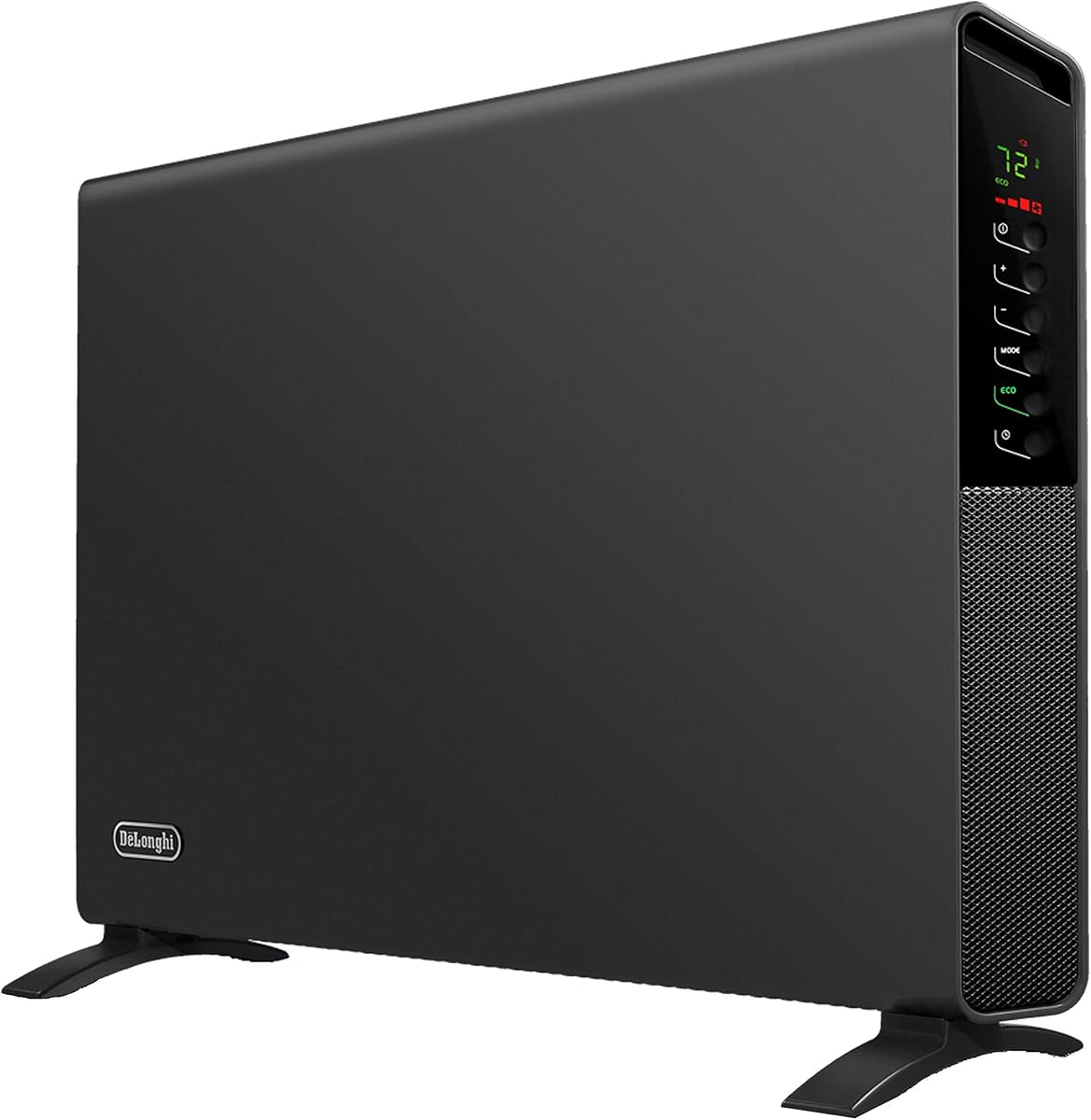
The DeLonghi Convection Panel Heater is a 1500W room heater that can stand on the floor or be mounted to a wall. Its 4.1 rating is the lowest in this group, but its strengths include simple controls, fast heat distribution, and an anti-freeze function that distinguishes it from most connected competitors.
We may earn a commission when you buy through this link, at no additional cost to you.
A dual lateral fan system improves air distribution and is designed to warm the room faster. ECO PLUS automatically adjusts heat and power for more economical operation, while an adjustable thermostat, multiple heat settings, and a delayed 24-hour timer provide precise daily control. Cool-touch integrated controls make the unit easy to operate and reposition.
The anti-freeze setting activates when the temperature falls below 41°F and can help protect pipes in basements or vacation homes. Safety features include thermal shutoff and an internal tip-over switch. These protections are valuable in a portable configuration, although they do not turn the heater into a Wi-Fi-enabled smart device.
This heater is best for buyers who prioritize physical controls, reliable timers, flexible placement, and freeze protection over app or voice connectivity. It works well in basements, bedrooms, offices, and vacation properties where an automatic low-temperature safeguard is useful. Those seeking a genuinely connected model should favor one of the DREO, Ballu, or Heat Storm alternatives.
Automatic activation below 41°F can help maintain a minimum temperature and reduce the risk of frozen pipes. This makes the heater especially relevant to basements and intermittently occupied homes.
The dual lateral fans promote more even heat movement, while the supplied kit supports both floor-standing and wall-mounted use. That flexibility makes it easy to adapt as room layouts change.
We may earn a commission when you buy through this link, at no additional cost to you.
The right smart wall heater depends on the room, heating style, installation constraints, and level of automation. Compare safety ratings, room coverage, thermostat precision, control options, and mounting requirements before choosing.
Compare the manufacturer's primary and supplemental heating estimates rather than relying on wattage alone. A well-insulated room may be effectively heated by a smaller listed area, while drafts, poor insulation, high ceilings, and exterior walls increase the heat needed. Several DREO models specify approximately 150 square feet for primary use and up to 750 square feet as supplemental heat. Ballu's convection model lists up to 250 square feet for primary heating and larger spaces for supplemental warmth.
Choose primary coverage for rooms that rely on the heater itself, and supplemental coverage when a building's central system remains the main source. Insulation, climate, window area, and heat loss can make real-world performance differ from published estimates.
PTC ceramic systems, conventional convection, and infrared panels create different comfort experiences. PTC and convection heaters move air through the unit and are generally more appropriate when warming the air around a room. Infrared heaters radiate heat toward people and surfaces, making them effective for a defined comfort zone but less suitable for rapidly changing the temperature of an entire space.
Match the technology to the goal: choose moving-air heating for broad room comfort and infrared heating for targeted warmth. Consider whether direct airflow, quiet convection, or radiant comfort matters most in the intended location.
Smart controls range from Wi-Fi phone access and programmable schedules to voice-command compatibility. App scheduling is particularly useful for waking a bedroom before use or activating a home office during working hours. Alexa and Google Home support can make routine adjustments hands-free, while a physical remote remains valuable when network access is unavailable.
Check which platforms the exact model supports rather than assuming every smart heater works with every service. A thermostat, display, app, and remote can also provide different levels of control within the same product.
A narrow thermostat range and accurate temperature regulation can prevent a heater from cycling excessively or leaving a room noticeably uncomfortable. DREO models use thermal sensors, and their listed set-point range extends from 41 to 95°F. Some specify one-degree accuracy, while others list a two-degree fluctuation. Those numbers describe control precision, not a guarantee that every corner of a room will maintain the same temperature.
Look for an exposed or dedicated room sensor, ECO behavior, and calibration controls. Placement also matters because a heater mounted near a draft, window, or direct sun can measure conditions differently from the occupied area.
Important protections include overheat shutoff, tip-over detection, flame-retardant construction, leakage-resistant plugs, and suitable moisture ratings. A bathroom-rated model should carry explicit water-resistance protection, such as the DREO bathroom model's IP24 rating and ALCI plug. Other DREO versions use FortPlug or ALCI technology to address different electrical protection concerns.
Safety features supplement but do not replace correct installation. Follow clearance, mounting, electrical, and outlet instructions, and never treat a product's water resistance as permission for direct splashing or unrestricted damp-room placement.
Oscillation changes where heated air is directed and can be helpful in rooms with seating or sleeping areas away from the unit. The standard DREO wall heater offers 120-degree oscillation, while the ALCI model offers 60-, 90-, and 120-degree positions. Other DREO models use a narrower 30-degree manual adjustment, which can still be effective when the intended target area is known.
Infrared coverage is a different consideration because it radiates toward people and surfaces. Ballu's mica model advertises 180-degree coverage, while the Heat Storm unit is designed more as a directional comfort heater. Consider furniture placement and where occupants spend time before selecting an airflow pattern.
A permanently mounted heater frees floor space and suits bedrooms and offices, but moving it later requires another installation. Flexible models such as the two Ballu heaters and DeLonghi panel can run on the floor or use included mounting hardware. This is valuable for renters, seasonal spaces, and homes where the heated room changes. Check the location of outlets, power cords, and any hidden cord-storage features before drilling.
Use the supplied template and instructions where provided. Confirm wall construction, mounting height, clearance, and electrical requirements. A freestanding heater should never be placed where its stability could be compromised, and a wall unit should not obstruct required airflow.
Fan noise can matter more than heating power in bedrooms, nurseries, and quiet offices. Several DREO models list a low 28 dB operating level, while the Ballu products emphasize quiet convection or infrared warmth without direct blowing. Display illumination also affects nighttime comfort; automatic LED dimming on the bedroom-oriented DREO models is a useful distinction.
Consider both audible fan noise and light from the display. A model that is quiet may still be distracting if it produces bright indicators or frequent mechanical movement, so examine the display behavior and bedroom-specific features.
Begin by confirming that the room size, insulation, electrical supply, outlet location, and mounting clearances meet the heater's instructions. For a wall-mounted unit, use the supplied drilling template, install the required mounting hardware, and allow the product to sit or hang in the prescribed orientation. Do not install a heater above an outlet unless the manufacturer specifically supports that arrangement.
Connect the heater to the DREO, Ballu, or Heat Storm app as directed, then set the desired temperature, schedule, and operating mode. Test the physical controls before relying entirely on voice commands. Begin with a moderate setting, observe how the room warms, and adjust airflow direction or oscillation to reduce drafts and avoid unnecessary operation.
For care, switch off and unplug the heater before cleaning it. Keep vents and grilles free of dust and avoid spraying liquid into the unit. Inspect the plug, cord, and wall connection periodically, and never operate a heater with visible damage. Follow the manual for cleaning and maintenance intervals, especially in dusty or humid environments.
Convection heaters pull room air through a heating element and circulate the warmed air around the space. Infrared heaters use radiant panels to warm nearby people and surfaces directly. Convection is generally more useful for raising overall room temperature, while infrared can be highly effective for a defined comfort zone.
Only use a model whose listed safety features and instructions support the intended bathroom location. The DREO bathroom wall heater has an IP24 waterproof rating, an ALCI plug, overheat protection, and flame-retardant materials. Even with those protections, correct placement and suitable electrical installation remain essential.
Most models provide physical controls such as a remote, touch panel, or thermostat, although the full smart feature set depends on app connectivity. Voice control and remote scheduling require the relevant app and network setup. Keep the physical controls available as a practical alternative when connectivity is interrupted.
Coverage depends on the model, room insulation, climate, and whether the heater is a primary or supplemental source. Listed guidance ranges from about 150 square feet for primary use with some DREO models to 250 square feet with the Ballu convection heater. Supplemental coverage can extend to much larger areas under suitable conditions.
A mounted heater avoids floor obstruction and tip-over risks in busy spaces, but it still requires correct installation, clearance, and electrical protection. Freestanding models commonly include tip-over shutoff, while wall models emphasize overheat, flame-retardant, plug, or moisture protections. Neither format is safe if placed or installed improperly.
Alexa is supported by the DREO wall heaters, the Heat Storm Wi-Fi model, and both listed Ballu smart heaters. The standard DREO and FortPlug bedroom models also list Google Home compatibility. Confirm the exact listing because connected platforms can differ between models in the same product family.
They can be well suited to both because they conserve floor space and can operate on schedules. Low-noise operation, automatic display dimming, app control, and precise thermostats are particularly useful in sleeping spaces. For offices, consider directional airflow that can be adjusted toward occupied workstations.
Choose infrared heating when the goal is direct comfort for people sitting or sleeping nearby. Choose convection or PTC heating when you want to warm the surrounding air and support more even room-wide comfort. A hybrid approach can be useful when one room needs both individual warmth and broader air circulation.
The DREO Smart Electric Wall Heater in the large-room configuration is the strongest all-around choice because it combines 4.5-rated customer feedback, 11.5 ft/s airflow, 28 dB operation, and multiple control methods. The Ballu Convection Smart Heater stands out for premium construction, flexible freestanding or mounted placement, and a two-year warranty, while the DREO Smart Wall-Mounted Heater offers a focused and budget-conscious connected option.
Prioritize the environment before the feature list. Bathroom buyers should focus on appropriate moisture and electrical protections, bedroom users should consider quiet operation and display dimming, and large-room shoppers should review both primary and supplemental coverage guidance. Wall mounting is ideal for permanent, space-conscious installations, while portable-and-mountable heaters suit changing spaces.
Finally, check the current product listing, installation requirements, platform compatibility, and available features before ordering. Ratings and specifications can evolve as models change, and prices fluctuate over time. Comparing the current listing with the room's heating needs will help ensure the selected smart wall heater is both practical and safe.