
H&G Lifestyles 24,000-Grain Water Softener
4.1Editor score
24,000-grain whole-home capacity
Removes 99.3% calcium
Removes 99.5% magnesium
10% crosslink softening resin
Cheap water softener shopping is easier with this guide comparing capacity, control features, filtration, installation needs, and whole-home coverage.
A water softener can make a substantial difference in a hard-water home by reducing scale, improving the feel of water, and helping protect plumbing and appliances. Choosing an affordable model still requires attention to capacity, regeneration controls, installation requirements, and the contaminants your household actually needs to address.
This guide compares ten whole-house water softeners using their published specifications, stated features, customer ratings, warranties, and installation details. The list covers budget-oriented models, compact integrated systems, high-capacity resin tanks, digital metered controls, and options with additional sediment or carbon filtration.
Each review explains who benefits most from the system and where its compromises appear. The leading picks range from a lower-cost compact option to feature-rich digital models and premium resin configurations. Product details and retail terms can change, so readers should confirm current specifications, compatibility, and support terms before purchasing.
4.1Editor score

4.6Editor score

4.8Editor score
The comparison below highlights treatment capacity, control style, resin configuration, and installation considerations across all ten systems, helping readers identify the option that best fits their household and plumbing.




The Aquasure Harmony Series 32,000 Grains is a straightforward whole-house softener aimed at homes with one or two bathrooms. It carries a 4.4 customer rating and combines a 32,000-grain capacity with an automatic digital metered control head. Its appeal lies in offering modern monitoring and programmable operation without moving to the largest resin tanks or the most integrated cabinet designs.
We may earn a commission when you buy through this link, at no additional cost to you.
The metered head calculates regeneration according to actual use, while the backlit display lets owners adjust automatic flush intervals and monitor maintenance needs. A high-strength, corrosion-resistant, fiberglass-lined polyethylene tank and durable bypass valve form the core of the system. Prefilled premium-grade resin reduces one setup task, and the stated five-year extended manufacturer warranty applies when the product is activated online within 60 days.
The main limitation is scale. A 32,000-grain system may have less reserve than 40,000-, 45,000-, and 48,000-grain alternatives, particularly when several people use water simultaneously or the incoming hardness is severe. The product also has no stated prefilled carbon or sediment stage, so households with chlorinated municipal water, sediment concerns, or well water may need to consider pretreatment.
This is a sensible choice for buyers who want straightforward metered softening, flexible control settings, and a smaller treatment capacity than the largest systems. It is especially appropriate for one- to two-bathroom homes with moderate use. Confirm the hardness level, available installation space, drainage requirements, and activation terms before making it part of a whole-home plumbing plan.
The digital metered head provides the practical middle ground between a basic timed valve and a more elaborate control system. Users can review usage, change flush intervals, and tailor regeneration behavior to local water quality without relying entirely on a fixed schedule.
The corrosion-resistant tank and prefilled resin support dependable whole-house use, while the stated suitability for one or two bathrooms gives shoppers a practical capacity guide. A water test remains important because household labels do not replace measuring actual hardness.
We may earn a commission when you buy through this link, at no additional cost to you.
The iSpring WCSTB45KG combines a 45,000-grain treatment capacity with automatic operation and a digital display. Its 4.2 rating places it among the more broadly endorsed systems in this guide, although it does not lead the group. The product targets households, schools, businesses, and light commercial settings that need substantial softening capacity without moving to a very large dedicated cabinet.
We may earn a commission when you buy through this link, at no additional cost to you.
According to the supplied details, third-party testing found the system reduced hardness by 99.71% through calcium and magnesium removal. Its programmable valve calculates regeneration cycles from water quality and household use, while the display allows hardness adjustments and monitoring. Automatic backwash and regeneration are intended to maintain resin performance, and the listed construction includes premium ion exchange resin, a corrosion-resistant fiberglass tank, and a durable automatic valve.
The central tradeoff is the coverage package. The standard warranty is one year, although optional extended protection can be purchased online for as long as three years. Buyers comparing warranty length with similarly capable systems should notice that some alternatives include longer stated tank or electronics coverage. Installation is also not entirely hands-off; the system needs proper plumbing, drain routing, salt supply, and periodic upkeep.
This model fits buyers who prioritize treatment capacity, automatic metering, and flexibility across city or well water. It is less compelling for someone seeking the longest base warranty or a fully integrated compact cabinet. Nevertheless, the 45,000-grain rating, clean digital interface, and broad compatibility make it a credible high-capacity option for hard-water homes.
A 45,000-grain capacity gives the system more reserve than several compact picks. That makes it a stronger candidate for larger households or homes where measured hardness and consumption both run high, provided the unit is sized and maintained correctly.
The programmable valve adjusts regeneration to actual use rather than relying entirely on a fixed clock. Digital monitoring and adjustable hardness settings simplify routine operation, while automatic backwash helps preserve consistent resin performance.
We may earn a commission when you buy through this link, at no additional cost to you.
The Kenmore 350 is a 32,000-grain whole-house system designed for households of one to four people. It has a 4.3 rating and differentiates itself through IntelliSoft Technology, which is described as learning household water use and regenerating only when needed. The system also monitors salt levels and uses that information to reduce waste.
We may earn a commission when you buy through this link, at no additional cost to you.
Its digital display provides flow-rate and salt-level information, and the compact housing is intended for utility areas where space is limited. A high-flow three-quarter-inch valve helps maintain water pressure. The built-in sediment shield adds protection for plumbing and appliances, while the softener targets calcium, magnesium, and clear water iron to reduce scale, stains, soap scum, and mineral buildup.
The stated coverage is attractive for a compact system: one full year, three years for electronics, and ten years for the tank. However, the three-quarter-inch flow assembly may be less attractive to buyers seeking maximum throughput or future expansion. It is also important not to treat the iron claim as comprehensive filtration; the product is specifically described as helping reduce clear water iron.
Kenmore buyers likely value familiar branding, adaptive control, and a compact installation. The product makes more sense for a one-to-four-person home with moderate space and moderate-to-high hardness than for a very large household with simultaneous heavy demand. A hardness test and realistic flow check should guide the final decision.
IntelliSoft Technology is the system's defining advantage. By adapting to water use and monitoring salt consumption, it aims to avoid unnecessary regeneration, helping households control salt use without sacrificing whole-home soft water.
The small installation footprint suits mechanical closets and utility rooms, and the three-quarter-inch valve balances household flow with space efficiency. Longer stated tank coverage adds reassurance, although buyers should confirm which component each warranty period covers.
We may earn a commission when you buy through this link, at no additional cost to you.
The CS21H 2026 is a 34,000-grain, whole-house softener for homes with one to five people. Its 4.6 rating is among the strongest in the group, and the system pairs a digital control system with Gen2 up-flow regeneration. That combination makes it the most balanced choice in this guide for shoppers who value efficient operation, clear monitoring, and a compact installation.
We may earn a commission when you buy through this link, at no additional cost to you.
According to the product information, Gen2 up-flow regeneration uses up to 40% less salt and up to 36% less water than conventional down-flow regeneration. The digital display shows real-time water use and system status, while Vacation Mode helps manage consumption while the household is away. Power Failure Memory Backup retains configured settings after an outage. A push-open lid and enlarged salt opening make refilling less cumbersome.
The integrated cabinet measures 20.52 inches deep by 10.63 inches wide by 40.93 inches high, and the internal salt tank holds up to 128 pounds. One-inch NPT inlet and outlet connections plus a three-quarter-inch straight connector support common residential layouts. Those dimensions and connections must still be checked against the available space and plumbing layout before installation.
There is an important filtration limitation: the softener removes calcium and magnesium ions but not iron. The maker strongly recommends a pre-filter for well water or sediment concerns. With that caveat, this is an excellent match for households seeking digital convenience, efficient regeneration, and an integrated design without moving to a premium resin-tank system.
The up-flow process is designed to reduce salt and water consumption compared with conventional down-flow regeneration. Those efficiency gains can make routine operation more economical and reduce unnecessary wear on the system.
Combining the mineral tank, controls, and a 128-pound salt tank in one cabinet simplifies space planning. Wide salt access, real-time monitoring, Vacation Mode, and outage memory make the unit approachable for everyday household use.
We may earn a commission when you buy through this link, at no additional cost to you.
The Aquasure Harmony Series 40,000 Grains is designed for homes with three or four bathrooms and carries a 4.7 rating. It combines a 40,000-grain softener with an automatic digital metered control valve and a triple-purpose sediment, GAC, and zinc pre-filter, making it more versatile than a standard hardness-only system.
We may earn a commission when you buy through this link, at no additional cost to you.
The pre-filter is stated to remove 99% of a long list of contaminants, including chlorine, VOCs, PFAs, odors, taste, soil, silt, sand, rust, and sediment. The softener itself targets calcium and magnesium to reduce scale and protect plumbing, washing machines, dishwashers, and water heaters. Its programmable backlit display supports customized flush intervals, usage monitoring, and maintenance management.
The construction includes a high-strength, corrosion-resistant tank, a stainless steel bypass valve, and prefilled premium-grade resin. The five-year extended manufacturer warranty requires online activation within 60 days. Buyers should still confirm the exact certification status, replacement schedule, and intended service conditions for the included pre-filter rather than assuming every contaminant claim applies equally to every water source.
This is a strong choice for a household with three to four bathrooms that wants more than basic ion exchange. Its extra filtration makes it particularly appealing when chlorinated water, sediment, or taste and odor are concerns. It remains essential to test the incoming water and ensure that well-water conditions are compatible with the manufacturer's recommendations.
The integrated sediment, GAC, and zinc pre-filter sets this model apart from conventional softeners. It offers a broader treatment approach for households concerned about chlorine, particulates, odors, and taste alongside hardness.
A 40,000-grain system targets homes with three or four bathrooms, offering more reserve than the 24,000- and 32,000-grain picks. Accurate hardness and usage data remain essential for determining whether that capacity will suit the household.
We may earn a commission when you buy through this link, at no additional cost to you.
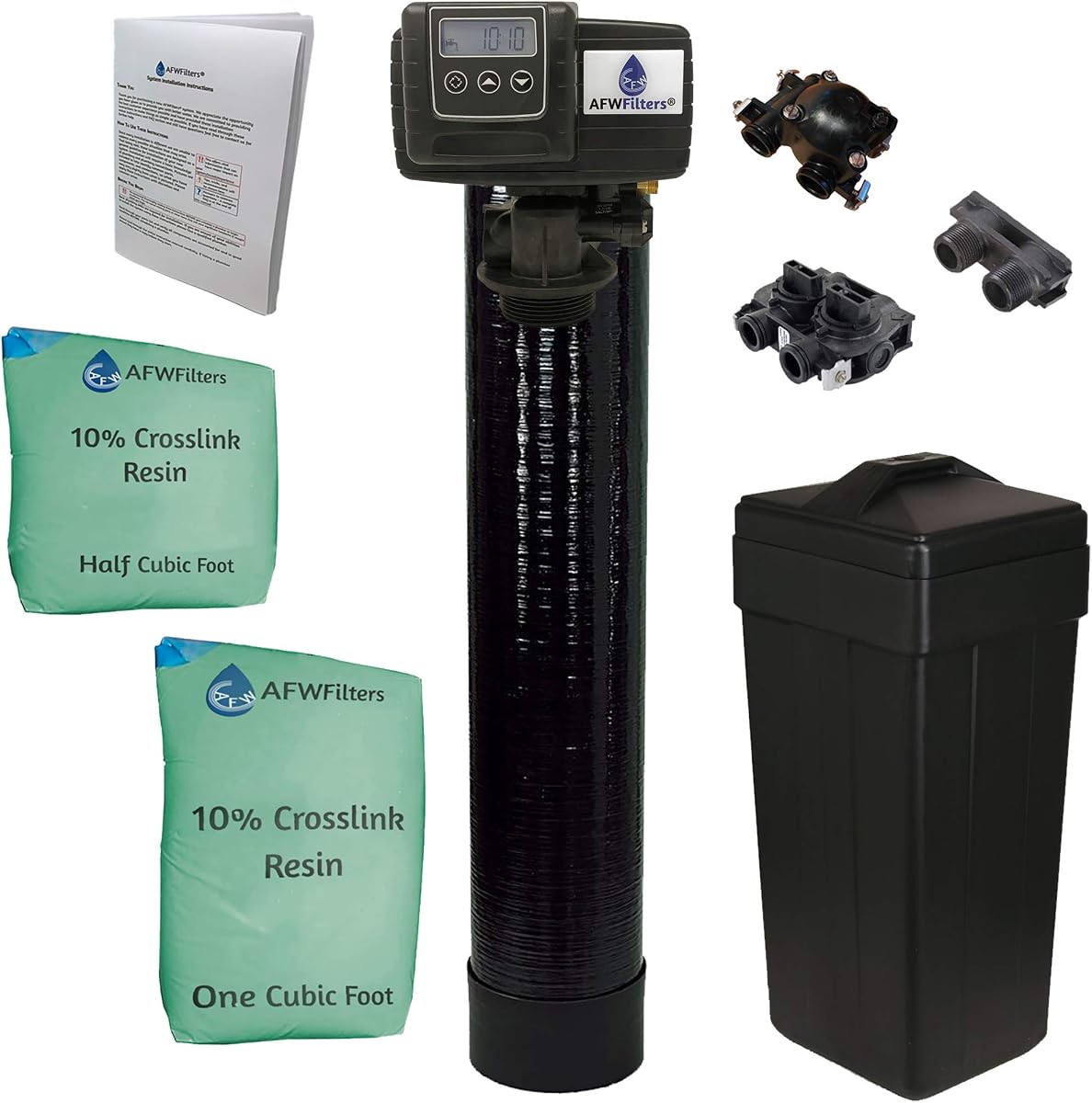
The AFWFilters 48K Grain system leads this guide with a 4.8 rating. It combines a 48,000-grain capacity, a Fleck 5600SXT control valve, and 1.5 cubic feet of upgraded 10% crosslink resin. That configuration makes it the strongest premium pick for buyers who prioritize established control hardware, substantial media capacity, and a system built around standard residential plumbing dimensions.
We may earn a commission when you buy through this link, at no additional cost to you.
The 10-inch by 54-inch mineral tank contains 1.5 cubic feet of chlorine-resistant 10% crosslink media. The separate 14-inch by 36-inch brine tank holds up to 250 pounds of salt. One-inch NPT inlet and outlet connections, bypass components, and drain fittings are included. Installation instructions and product support are also listed, helping buyers understand setup before the system reaches the home.
The separate tanks require more floor space than the CS21H integrated cabinet, and installation still depends on drain access, valve placement, and household plumbing. The Fleck 5600SXT is the premium focal point: a recognized, serviceable digital control platform that suits buyers comfortable with standard water-treatment components. The product also draws on AFWFilters' stated experience in water treatment and USA assembly.
For households seeking maximum capacity and a premium control valve, this is the most compelling option here. It is particularly appropriate when measured hardness is high, usage is substantial, and there is room for a dedicated mineral tank and brine tank. It is less attractive for buyers wanting a compact all-in-one unit or the lowest initial outlay.
The 1.5 cubic foot load of 10% crosslink resin is intended to withstand chlorinated municipal water better than conventional 8% media. Its generous resin volume supports substantial treatment capacity and long-term softening performance.
The Fleck 5600SXT valve, large brine tank, bypass, and drain fittings provide a conventional setup familiar to experienced installers. Separate tanks also offer flexibility in placement when utility-room space is plentiful.
We may earn a commission when you buy through this link, at no additional cost to you.
The AFWFilters Fleck 5600 SXT is built around the same capable digital valve and 1.5 cubic foot 10% crosslink resin configuration as the premium 48K model. Its 4.6 rating is strong, although the supplied listing does not state a grain capacity. That distinction matters for shoppers who use grain ratings to compare whole-home treatment output.
We may earn a commission when you buy through this link, at no additional cost to you.
The mineral tank measures 10 inches in diameter by 54 inches, with a 62-inch total installed height. A separate 14-inch by 36-inch brine tank can hold 250 pounds of salt. The Fleck 5600SXT valve uses one-inch NPT inlet and outlet connections, and bypass and drain fittings are included. This arrangement follows a common residential layout that many installers and service technicians recognize.
The chief drawback is the lack of a stated grain figure in the supplied product information. Resin volume alone does not provide a complete sizing recommendation because water hardness, daily demand, efficiency, and service flow all influence performance. Buyers should ask the seller for an appropriate capacity estimate rather than assuming the unit will fit every home.
This system is a good choice for buyers who want the Fleck 5600SXT platform and 10% crosslink media without the 48K grain rating of the related pick. It is especially attractive to households with enough room for separate tanks and a preference for large resin and salt capacities. Confirm sizing, installation requirements, and current warranty terms before purchase.
The Fleck 5600SXT serves as the operational core, providing a digital, metered approach to household softening. Its widespread use can also make replacement parts and general service knowledge easier for installers to find.
The system pairs a 1.5 cubic foot resin load with a brine tank capable of holding 250 pounds of salt. Those figures support substantial household use, although actual capacity still depends on measured hardness and consumption.
We may earn a commission when you buy through this link, at no additional cost to you.
The Aquasana SimplySoft 40K is a base-tank and cabinet system intended for homes with up to five people and four bathrooms. It has a 4.4 rating and distinguishes itself through certification language and metered efficiency controls. IAPMO certification to NSF/ANSI Standard 44 for hardness reduction and CSA B483.1 gives buyers a clear third-party standards reference.
We may earn a commission when you buy through this link, at no additional cost to you.
The system reduces the minerals responsible for hardness and scale, helping protect pipes and appliances while improving the feel of skin and hair and reducing spots on glassware, dishes, and shower doors. Its user-friendly LCD can be configured to use 50% less salt and 28% less water in metered mode than standard time-based regenerated softeners, according to the supplied information.
One important distinction is that the recommended pre-filter is optional and sold separately as part of an Aquasana softener installation kit. Buyers who need sediment, chlorine, taste, or odor treatment should account for that separate component. The product is suitable for city or well water, but local water testing and proper pretreatment remain important for well installations.
SimplySoft is a strong fit for buyers who prioritize certified performance, efficient metered operation, and a 40,000-grain capacity. The cabinet format helps organize the system, while the five- and ten-year limited warranty options add flexibility. It is especially appealing to households that want standards-based softening without paying for every filtration function in one package.
IAPMO certification to NSF/ANSI Standard 44 and CSA B483.1 provides useful verification for buyers focused on certified hardness reduction. These standards help distinguish the product from systems whose listings provide little independent performance information.
The metered mode can reduce salt and water consumption compared with conventional time-based regeneration. A separate pre-filter may be necessary for sediment or broader contaminant concerns, so complete system planning should include that possible addition.
We may earn a commission when you buy through this link, at no additional cost to you.
The H&G Lifestyles 24,000-Grain system is the most budget-oriented option in this guide. Its 4.1 rating is the lowest among the products with numerical ratings, but the core specifications remain practical for smaller homes. It provides whole-house softening, a stated seven-gallon-per-minute flow rating, and a 10% crosslink resin configuration intended for chlorinated municipal water.
We may earn a commission when you buy through this link, at no additional cost to you.
According to the supplied details, the system removes 99.3% of calcium and 99.5% of magnesium. It uses NSF-certified food-grade resin and is designed to reduce existing scale while limiting new buildup. The listing also describes silver-enhanced material intended to support filtration efficiency and resist unwanted buildup over time.
Its 24,000-grain capacity is the smallest here, so it is less suitable for large households, several high-flow appliances, or unusually severe hardness. The one-inch PVC piping and two control valves are designed for main-line installation and a secure connection, but proper plumbing work remains essential. Buyers should not interpret a seven-gallon-per-minute figure as guaranteed performance in every real-world plumbing arrangement.
This model makes the most sense for a smaller household seeking effective hardness reduction without paying for the largest capacity or most elaborate cabinet. It also offers a useful 700,000-gallon stated treatment figure, although actual service life depends on hardness, consumption, regeneration efficiency, and maintenance. A water test should confirm that the smaller capacity matches the home's demand.
The 24,000-grain capacity is best matched to homes with modest water consumption. For those households, it can provide whole-home softening without carrying the larger media load required by 40,000- to 48,000-grain systems.
The 10% crosslink cation resin is designed for better chlorine resistance than conventional 8% media. Its stated mineral-removal rates and food-grade certification make it a compelling budget choice for chlorinated municipal water.
We may earn a commission when you buy through this link, at no additional cost to you.
The VEVOR 48,000-Grain system offers substantial whole-home treatment capacity, automatic controls, and separate resin and salt tanks. Unlike most entries in the guide, it has no numerical customer rating in the supplied data, so it cannot be ranked based on a verified rating. Its appeal comes from its 1.59 cubic foot resin load and digital operating system.
We may earn a commission when you buy through this link, at no additional cost to you.
The system states that it reduces more than 90% of calcium and magnesium ions, helping limit scale on plumbing and appliances. It uses high-purity salt blocks for regeneration and says the cycle occurs every eight to 30 days depending on local water quality and consumption. The digital head automatically manages softening, backwash, brine draw, and refill, while a bypass valve allows quick switching between softened and untreated water.
The tanks are made from high-strength polyethylene and are intended to resist leaks and routine wear. A practical purchasing consideration is that the resin and salt tanks may ship in separate packages, so delivery timing and installation planning should be considered. As with any air-filled brine tank, the salt level must be checked periodically.
VEVOR is a viable high-capacity option for a home with three or four bathrooms, particularly one that prioritizes automatic operation and substantial resin volume. It may appeal to buyers comparing it with other 48,000-grain systems, although the lack of a numerical rating makes customer feedback less measurable. Confirm warranty, included fittings, dimensions, and local compatibility before installation.
A 48,000-grain rating and 1.59 cubic foot resin load place the system among the largest picks. That reserve is useful for hard water and higher household consumption, provided a professional sizing assessment supports the choice.
The digital control head coordinates softening, backwash, brine draw, and refill automatically. The included bypass provides a practical way to isolate the unit or access untreated water without dismantling the installation.
We may earn a commission when you buy through this link, at no additional cost to you.
Choosing an affordable water softener requires balancing measured hardness, household consumption, available space, control preferences, water source, and installation requirements rather than comparing grain capacity alone.
Hardness is measured in grains per gallon, and it provides the foundation for nearly every other sizing decision. A household with moderately hard water and steady consumption may be served by a smaller system, while severe hardness or high consumption can require more resin capacity than the headline number suggests. Test the water before buying, using a reputable test method, and note whether the reading reflects both the incoming supply and the desired hardness at the outlet.
The treatment capacity printed on a softener is not a universal promise for every household. It expresses how much hardness the resin can remove under specified conditions, while actual performance depends on regeneration frequency, water demand, and service flow. Buyers should also consider fluctuations in seasonal water use and any future household changes.
Choose capacity from measured data, not just household size. A larger tank may regenerate less frequently, while an undersized tank can work harder, consume more salt, and provide less reserve during periods of heavy use.
Products in this guide range from a 24,000-grain system to models listed at 45,000 or 48,000 grains. Smaller homes may be well served by a compact capacity, while families with multiple bathrooms, frequent laundry, or high hot-water demand generally benefit from more reserve. The listed household and bathroom targets provide a starting point, but they do not replace a usage calculation.
Consider how many people use the home, whether water-using appliances are added or replaced, and whether the household plans to grow. Vacation Mode and other demand-responsive controls can help avoid wasting capacity while nobody is home. The best inexpensive system is not necessarily the one with the lowest acquisition cost; it is the one that comfortably meets demand without constant regeneration.
Match the product's stated capacity with your measured hardness and daily consumption. If the sizing is close, favor a little additional reserve rather than operating the system at its limit every day.
A digital metered control measures water use and schedules regeneration according to demand, rather than regenerating only on a clock. That approach can conserve salt and water and reduce unnecessary wear. Several choices in this guide also add adjustable hardness settings, flow displays, salt monitoring, Vacation Mode, or power-failure memory.
Efficiency claims should still be compared carefully. Some describe water and salt reductions relative to conventional down-flow regeneration, while others compare metered operation with standard time-based systems. The exact percentage depends on incoming hardness, settings, household use, and maintenance. Buyers should also consider whether the interface is easy to understand and whether parts and service information are available.
Prefer controls that provide understandable usage information and practical settings. A sophisticated screen is less valuable if it cannot be configured properly or if the owner cannot tell when salt or maintenance is due.
Ion-exchange resin is the core material in a conventional softener. Products here use 8% or upgraded 10% crosslink media, with the latter described as more resistant to chlorine exposure. This matters particularly for chlorinated municipal water because the resin must withstand repeated contact with treated supply while continuing to soften effectively.
A softening resin is not a substitute for every filtration need. The Aquasure Harmony 40K includes a stated sediment, GAC, and zinc pre-filter, while Aquasana recommends an optional separate pre-filter. For well water, sediment protection is particularly important. Chlorine, taste, odor, iron, sediment, and other contaminants should each be evaluated separately rather than grouped under a vague filtration label.
Use 10% crosslink resin for chlorinated municipal water when available, and add pretreatment for sediment or unsupported contaminants. Always verify certifications and filter replacement requirements rather than relying solely on broad contaminant lists.
Every whole-house softener needs a suitable location near the main water line, access to a drain, room for salt delivery, and enough clearance for routine service. Integrated cabinets simplify layout, while separate mineral and brine tanks offer placement flexibility but require more floor space. The CS21H lists exact cabinet dimensions, and the AFWFilters models list tank diameters and total installed heights.
Connection size also matters. Several products use one-inch NPT connections, while the Kenmore 350 uses a three-quarter-inch valve. Existing plumbing may require adapters that are not obvious from the product title. Confirm shutoff and bypass requirements, drain routing, household flow needs, and whether the site allows any connection or placement specified by local rules.
Plan the installation before ordering. Measure the area, identify a suitable drain, inspect the main shutoff, and verify all connection sizes. Professional installation can help avoid leaks, restricted flow, and warranty complications.
A softener must not choke the home's water supply. Flow capacity depends on the control valve, plumbing, pressure, pipe diameter, and simultaneous demand, not merely the resin tank size. The H&G model states support up to seven gallons per minute, while the CS21H uses one-inch connections intended to support normal whole-home flow when correctly installed.
For households with multiple high-flow fixtures, a washing machine, a dishwasher, a shower, and other appliances running together, valve capacity deserves careful attention. Installers can calculate available pressure and identify restrictions in older homes. The safest approach is to choose a valve and connection configuration that comfortably exceeds the home's realistic peak demand.
Do not treat a manufacturer's maximum flow figure as a promise for every installation. Actual performance depends on incoming pressure and plumbing, so measure the site and evaluate all household demand.
Warranty length can be an important differentiator among similarly capable systems. The Aquasure products state a five-year extended manufacturer warranty when activated online within 60 days, Kenmore lists one full year, three years for electronics, and ten years for the tank, and Aquasana offers five- and ten-year limited warranty options.
Read the component coverage and activation requirements rather than comparing only the largest number. Technical support availability, replacement-part sourcing, and clear instructions are also valuable. Fleck control valves are familiar to many installers and service technicians, which can be helpful, but warranty terms should still be confirmed directly with the seller.
Choose the option with the clearest component coverage and support pathway. Registration deadlines and exclusions matter, so save documentation and complete any required activation promptly after purchase.
The purchase is only part of the ownership cost. Salt, water used during regeneration, filters where included or recommended, routine servicing, and possible repairs all affect long-term expense. Metered controls and efficient regeneration methods can reduce salt and water consumption, while a correctly sized tank can avoid excessively frequent cycles.
Consider local salt availability, replenishment frequency, and the time required to monitor the system. Do not buy an undersized model solely to reduce acquisition cost, because frequent regeneration can consume more salt and water and place unnecessary stress on the resin and valve.
Include salt, filters, maintenance, and replacement parts in the total ownership plan. Efficiency claims are most useful when they reduce real operating demand rather than simply appearing on a feature list.
Begin with a professional water-hardness test and a careful review of the installation instructions. Confirm that the selected capacity matches the measured hardness and household demand, then check the control-valve settings before placing the unit in service. Installation generally involves shutting off the main water, connecting the mineral tank and bypass to the main line, routing the drain line, and adding salt to the brine tank. Local plumbing requirements and the manufacturer's procedures should take priority.
Fill the brine tank with the appropriate type and quantity of salt, then follow the control valve's startup and purge instructions. Do not assume that a full-looking salt tank is correctly prepared; many valves require a specific level and additional water. Monitor the digital display for flow, system status, salt warnings, and error codes when the valve includes those features. Set hardness, capacity, regeneration timing, and any vacation or outage functions according to actual conditions.
Routine care includes checking the salt level, inspecting the brine tank for salt bridges, confirming that the drain line flows freely, and cleaning or replacing any pre-filter as directed. Salt bridges can form above the salt, so break them down carefully when necessary and avoid damaging the brine grid. Keep the area dry and unobstructed, avoid storing incompatible chemicals near the unit, and arrange service when leaks, unusual noise, persistent error messages, or declining water pressure appear. Never cut into pressurized plumbing without first shutting off and relieving the system correctly.
The correct capacity depends on measured water hardness and household consumption, not just the number of people in the home. A 24,000-grain model may suit smaller or moderately hard households, while 40,000- to 48,000-grain options provide more reserve for severe hardness and heavier use. Test the water and compare daily demand with the manufacturer's sizing guidance before choosing.
Metered systems generally regenerate according to measured water use rather than on a fixed schedule. This can reduce unnecessary salt and water consumption and may extend resin life. The advantage depends on correct hardness settings and routine maintenance, so buyers should still salt the system and inspect it regularly.
Several models in this guide are compatible with city and well water, but well water often requires pretreatment. Sediment, iron, bacteria, and other contaminants can foul resin or affect controls. A professional test and appropriate pre-filter are especially important for well installations, and local health or code requirements should also be reviewed.
A standard ion-exchange softener primarily targets hardness minerals such as calcium and magnesium. Some products claim limited clear-water iron reduction, but that is not the same as comprehensive iron filtration. Sediment generally requires a dedicated pre-filter, and systems claiming broad contaminant removal should be evaluated for specific certifications and replacement requirements.
The correct level depends on the control valve's instructions and the tank's water-to-salt ratio. Keep enough salt to create a proper brine, but overfilling can cause valve damage or excessive consumption. Consult the manual for the startup level, then monitor the salt and water balance according to the manufacturer's guidance.
Maintenance is usually focused on checking and replenishing salt, keeping the drain line clear, monitoring usage and errors, and servicing any pre-filter. The exact schedule depends on hardness, consumption, and water quality. A system that regenerates unusually often, displays persistent faults, or develops leaks should be inspected rather than maintained blindly.
It depends on the model's layout. Integrated cabinet systems require less floor space, while separate mineral and brine tanks need room for both components and service access. Measure the available area, including height for lid removal and salt delivery, and confirm plumbing, drain, and bypass requirements before installation.
The Fleck 5600SXT is the central feature in two of the premium systems and provides a mature, recognizable digital platform with metered operation. It is especially attractive to buyers who want separate, serviceable components and have adequate installation space. Warranty terms, included fittings, and current seller support should be reviewed along with the valve.
The H&G Lifestyles 24K stands out as the budget-focused choice, combining 24,000 grains of capacity, a seven-gallon flow claim, 10% crosslink resin, and whole-house installation hardware. The CS21H 34K is the most balanced overall pick because its digital controls, up-flow efficiency, Vacation Mode, power-failure memory, and integrated 128-pound salt tank make it convenient for everyday households.
For buyers willing to prioritize premium components, the AFWFilters 48K Fleck leads through its 4.8 rating, 1.5 cubic feet of 10% crosslink resin, Fleck 5600SXT valve, and one-inch connections. The Aquasure Harmony 40K is another strong option when a built-in pre-filter adds value, while Aquasana SimplySoft appeals to those who prefer certification and efficient metered operation.
Whatever option appears most attractive, the final decision should begin with measured hardness and realistic water demand. Check installation space, connection size, drainage, certification, warranty terms, and ongoing salt requirements before ordering. Current specifications, availability, support policies, and retail terms can change, so confirm the latest details directly with the seller and manufacturer.