
Martin Yale P7500
3.9Editor score
4,000 sheets per hour
50-sheet feed tray
Multiple standard fold options
Tabletop automatic operation
A paper folding machine can turn time-consuming stacks of loose documents into neatly folded letters, invoices, mailers, forms, and presentations. The right model balances speed, fold versatility, paper capacity, accuracy, and straightforward operation while fitting the space and workflow of an office, school, church, mailroom, or craft studio.
We compared ten machines and manual scoring tools based on the supplied specifications, including throughput, supported paper sizes, fold styles, tray capacity, feed method, controls, and finished-document handling. The list covers both automatic production folders and hand-operated creasers for cards, invitations, brochures, and specialty paper.
Each review explains the machine's strongest features, practical limitations, and ideal user so you can narrow the field confidently. Ratings and availability can change over time, and current prices should be checked before purchasing, but the operating details and documented capabilities provide a solid basis for comparison.
3.9Editor score

4.1Editor score

4.1Editor score
As an Amazon Associate we earn from qualifying purchases.
This side-by-side comparison highlights each machine's feed method, production capacity, fold versatility, and best-fit use so buyers can quickly distinguish high-volume automatic folders from compact manual creasers.


The Martin Yale P7500 is a budget-oriented automatic paper folder designed for offices, mailrooms, churches, and other settings that routinely prepare standard business documents. It carries a 3.9 rating and stands out for delivering up to 4,000 folded sheets per hour from a relatively compact tabletop format. Its practical mix of automatic feeding, multiple fold choices, and simple setup makes it accessible to users without extensive technical experience.
We may earn a commission when you buy through this link, at no additional cost to you.
The machine accepts letter and legal paper, including 8.5-by-11-inch and 8.5-by-14-inch 20-pound bond paper. Letter, half, Z-fold, and double-parallel configurations cover many routine mailing and document-preparation tasks. Its feed tray accepts up to 50 sheets, and the stacking tray collects the completed documents for convenient removal. These specifications make the P7500 particularly useful for steady moderate-volume work rather than an extreme production environment.
The main compromise is throughput and batch size compared with the more advanced automatic folders in this guide. The documented 4,000-sheet-per-hour rate and 50-sheet tray require more frequent loading than models rated for 7,400 or 10,300 sheets per hour. Its 3.9 rating also suggests that buyers should examine current customer feedback carefully, particularly regarding consistency, ease of adjustments, and long-term reliability.
Despite those limitations, the P7500 is a compelling choice for a small office that wants faster and more uniform folding without moving to a large premium machine. It is also better suited than manual folders to routine bulk processing. For users who prioritize essential folds, automatic operation, and a smaller workspace over maximum capacity, this model offers the most approachable balance in the list.
Letter, half, Z, and double-parallel folds cover several common document formats. That versatility makes the P7500 useful for letters, notices, forms, and other materials that need to fit different envelopes or presentation folders.
A 4,000-sheet hourly rate and 50-sheet feed tray suit recurring office batches without requiring a dedicated production floor. Users should still consider whether regular jobs are large enough to justify a higher-capacity model.
We may earn a commission when you buy through this link, at no additional cost to you.
The Formax FD 300 is the strongest all-around automatic folder in this comparison, combining a 4.1 rating with a documented throughput of up to 7,400 sheets per hour. It is designed for offices that need dependable, repeatable folding without moving to a much larger production system. The LCD panel, resettable three-digit counter, and AutoBatch function make it especially useful for users who need controlled batches rather than simply feeding one continuous stack.
We may earn a commission when you buy through this link, at no additional cost to you.
Its drop-in top-feed system eliminates the need to fan paper, reducing preparation time and making the machine more approachable. A single load can hold up to 200 sheets of 20-pound paper, and the machine handles paper from 4-by-5 inches through 8.5-by-14 inches, with a weight limit of 30 pounds. Pre-marked guides provide quick access to C, Z, V, and double-parallel folds, while the output conveyor uses adjustable stacker wheels to produce orderly piles.
Its primary limitation is that it is not designed for heavy stock or unusually large media. The stated 30-pound, or 112-gram, ceiling means users working with cardstock, covers, or large-format presentation folders may need another device. It also commands more than a basic desktop folder, although its desktop form and four standard folds keep it practical for many small and midsize operations.
The FD 300 is our Editor's Choice because it balances speed, capacity, controls, and useful fold options without becoming unwieldy. It suits offices, mailrooms, schools, churches, and print-oriented teams that regularly process mixed stacks. For buyers seeking the most versatile mid-volume automatic folder in this guide, its counter, conveyor, and no-fanning feed make it especially attractive.
The resettable three-digit counter and AutoBatch mode let operators set a target quantity and process it in controlled groups. This is useful for recurring mailings, billing runs, and internal distribution work.
An output conveyor and adjustable stacker wheels help finished documents remain sequential and aligned. The result is easier handling when many individual pieces are gathered after folding.
We may earn a commission when you buy through this link, at no additional cost to you.
The Martin Yale P6500 is a compact desktop folder intended for small offices, schools, mailrooms, and other environments where letter-size folding is needed but a large production machine is unnecessary. Its 2.9 rating is the lowest in the lineup, so buyers should assess the available customer feedback and warranty terms carefully. Even so, the documented capability to process up to 1,800 sheets per hour is useful for many routine tasks.
We may earn a commission when you buy through this link, at no additional cost to you.
This model takes a different approach from the fully automatic folders. Sheets are fed by hand, after which the machine performs the fold. It supports half and tri-fold formats for standard letter documents, including stapled or unstapled materials. That makes it a potential fit for preparing letters for envelopes, organizing handouts, and handling recurring document-folder assignments without relying on a large stacker.
Its limitations are significant compared with the automatic models. The 1,800-sheet-per-hour figure assumes a steady manual-feed workflow, and the 50-sheet tray is much smaller than the trays or hoppers on higher-volume machines. It also offers fewer fold choices. These constraints make it less attractive for large mail runs, complex document sets, or users who want to select among several standardized folding styles.
The P6500 makes the most sense for a light-duty, space-conscious buyer who values simplicity and direct letter-size folding. It can improve consistency over folding documents by hand while remaining less complex than an automatic feeder. Given its lower rating and modest feature set, it is best treated as a focused solution for occasional work rather than a high-volume production investment.
Its desktop format reduces the space required compared with full production folders. That makes it easier to place beside a packing station, office printer, or shared worktable where every inch of counter space matters.
Half and tri folds cover common letter formats, while hand feeding allows stapled pieces to be handled. The approach is practical for brief batches where loading a large automatic hopper would provide little benefit.
We may earn a commission when you buy through this link, at no additional cost to you.
This 13.78-inch foldable manual paper creaser is built for straight, controlled scores rather than high-volume document folding. It carries a 4.1 rating and is positioned for cardstock, invitations, brochures, book covers, greeting cards, and menus. Its appeal lies in the combination of a 13.78-inch working width, an alignment scale, an extended positioning block, and a foldable panel that can be stored away when it is not needed.
We may earn a commission when you buy through this link, at no additional cost to you.
The upgraded alloy blade is stated to create clean fold lines with minimal deviation of 0.1 millimeters. A grooved platform supports the sheet as it moves through the scoring area, while the clear scale and positioning block help keep the fold line consistent. The widened handle rebounds automatically after each press, improving workflow rhythm and reducing the amount of force the operator must keep in the handle.
This is still a single-sheet manual tool, so it cannot match an automatic folder's throughput. It also serves a different purpose: scoring creates a defined crease for folding later, while an automatic folder generally folds and dispenses the document in one process. That distinction makes this machine most useful when appearance, alignment, and repeatability matter more than processing thousands of pages.
The model is a strong fit for home offices, DIY studios, and small print shops that need professional-looking results on specialty paper without electricity. It is also a good portable option for workshops where worktables must remain clear. Buyers who produce modest quantities of carefully finished pieces will appreciate its precision, while high-volume offices should select an automatic folder instead.
The extended positioning block, grooved bed, and visible scale work together to reduce shifting and establish a dependable fold position. This is especially helpful for greeting cards, menus, and multi-panel craft pieces.
The working panel folds down after use, making the creaser easier to store in a drawer, cabinet, or shared workspace. Its manual design also avoids power cords and setup complexity.
We may earn a commission when you buy through this link, at no additional cost to you.
The black Formax FD 300 shares the core capability of the standard FD 300 while providing a different visual option for workspaces where a black finish is preferred. It earns a 4.1 rating and is built for administrators who process large recurring batches. Its top feed accepts up to 200 sheets, and the machine can fold as many as 7,400 sheets per hour across C, Z, V, and double-parallel styles.
We may earn a commission when you buy through this link, at no additional cost to you.
A no-fanning top-feed design keeps loading simple: the stack is squared and placed into the feed system without manually separating sheets. The LCD panel includes a resettable three-digit counter and AutoBatch capability, allowing a job to stop after a selected number of documents. An adjustable output conveyor and stacker wheels collect the pieces sequentially, which is valuable when the folded output will be inserted into envelopes or bundled for distribution.
The primary technical limit is its media range. It supports paper from 4-by-5 inches to 8.5-by-14 inches and up to 30-pound weight, so it is intended for standard office documents rather than heavy cardstock or oversized presentation material. The relatively substantial investment also makes it difficult to justify for occasional folding, although repeated use can make that cost more manageable.
This model is ideal for mid-volume offices, schools, churches, and mailrooms that value speed and batch control. It suits users who want the same documented performance as the original FD 300 but prefer the black finish. For high-volume jobs, it is a more compelling choice than a small manual folder; for unusual substrates, a dedicated scoring or specialty finishing machine remains preferable.
The 7,400-sheet hourly rate and 200-sheet feed capacity reduce interruptions during substantial document runs. This is particularly beneficial for invoices, statements, school materials, and bulk notices.
AutoBatch works with the three-digit counter to set quantity-based runs. Operators can organize paper preparation and output handling around predictable batch sizes rather than monitoring every sheet continuously.
We may earn a commission when you buy through this link, at no additional cost to you.
The Portable Style manual paper creaser is a heavy-duty scoring tool aimed at workshop, technical, and model-making tasks. It has a 5.0 rating, the highest stated rating among the products, and offers a detailed material specification: sheets up to 350 millimeters wide, cardstock below 300 grams per cubic meter, and corrugated board under 5 millimeters. These figures distinguish it as a workshop tool rather than a routine office folder.
We may earn a commission when you buy through this link, at no additional cost to you.
Its heavy-duty alloy blades are described as providing precise 0.1-millimeter indentation alignment, while the built-in structural guide adds stability. The extended positioning block secures the full paper edge, and a grooved platform helps prevent thin sheets from slipping into gaps. That combination is especially relevant when working with unusual materials that are difficult to control in a standard automatic feeder.
The wider mechanical handle uses an automatic rebound or homing function after each press. Operators receive immediate mechanical feedback and can repeat the stroke efficiently. The documented single-sheet indentation depth reaches 0.8 millimeters, giving users a defined result for model craft and other precision work. As a manual device, however, its production pace is naturally limited compared with powered folders.
This creaser is best for studios, training environments, technical workshops, and makers who repeatedly score one sheet at a time and value repeatable positioning. It is less appropriate for offices that need to fold large quantities of standard business documents. Its 5.0 rating and broad material support make it compelling within its niche, provided the buyer values scoring precision over automated throughput.
The extended block covers the paper edge while the grooved platform supports the sheet along its path. These features help maintain a consistent line when working with thin or specialty stock.
A stated 0.8-millimeter indentation depth and mechanical rebound support repeatable scoring. That makes the tool well suited to controlled model-making and workshop exercises requiring consistent reference lines.
We may earn a commission when you buy through this link, at no additional cost to you.
The United Office Products F100A is an automatic folder designed for offices, schools, churches, and mailrooms that handle substantial letter and legal-size workloads. It can process up to 156 sheets per minute and includes a 200-sheet hopper. Although no customer rating is provided, the documented production figures, fold selection, and output handling make it a notable high-speed option for the environments named by the manufacturer.
We may earn a commission when you buy through this link, at no additional cost to you.
Clearly marked fold settings allow users to select C, Z, half, or double-parallel folds, while the machine accommodates both 8.5-by-11-inch letter paper and 8.5-by-14-inch legal paper. An intuitive LCD panel and resettable three-digit counter simplify setup and help track output. The integrated outfeed conveyor gathers completed documents in sequence, keeping finished stacks organized and easy to remove.
Because no rating is supplied, this product requires more careful evaluation than the better-reviewed options. Buyers should consider the available customer feedback, warranty terms, support quality, and the manufacturer's guidance for their specific paper mix. It is also an electrical machine, unlike the manual creasers in this guide, and users must place it near a suitable power outlet with enough workspace for the hopper and conveyor.
The F100A is a strong candidate for organizations folding hundreds of documents on a regular basis. Its speed and 200-sheet hopper can reduce interruptions compared with smaller desktop folders. It is especially relevant for schools preparing large sets of papers, churches producing bulletins, and offices handling recurring mailings. Confirming that the paper weight and fold style fit the job is the key step before choosing it over a similarly capable alternative.
At up to 156 sheets per minute, the F100A is designed for short bursts of substantial output. The large hopper further reduces the number of pauses required to reload standard stacks.
Clearly marked settings make the four documented fold styles accessible to routine users. The LCD panel and counter add visibility without requiring advanced controls.
We may earn a commission when you buy through this link, at no additional cost to you.
The 13.78-inch home paper creaser is designed for craft users, hobbyists, small studios, and compact workspaces that need professional fold lines without a powered machine. It handles cardstock up to 300 grams per square meter and is intended for invitation paper, art paper, menus, brochures, book covers, and similar projects. No customer rating is supplied, so the stated features and warranty should be considered alongside current buyer feedback.
We may earn a commission when you buy through this link, at no additional cost to you.
Interlocking adjustable guide rails and an extended precision ruler help establish repeatable fold positions and prevent the sheet from shifting. The upgraded alloy blade is listed as producing smooth, even lines with deviation no greater than 0.1 millimeters. A widened auto-return handle is designed to reduce hand fatigue during extended work, while the machine's power-free operation makes it convenient in apartments, small offices, and shared tables.
Its foldable working panel enables compact storage, and the reinforced metal frame and base are intended to resist wobbling during repeated scoring. The product information states that it is ready for use without complicated adjustment and that each unit receives factory inspection. It is also backed by a two-year warranty, offering a clearer support commitment than some competing listings provide.
This model is a good choice for home-based businesses and crafters producing invitation suites, greeting cards, menus, and presentation covers. It can deliver more defined results than pressing folds by hand, especially across heavier cardstock. It is not the right solution for high-volume office mailings, but for small batches that reward a polished finish, its guide system and no-power design are highly relevant.
The positioning ruler and guide rails support consistent placement, while the alloy blade is intended to create clean lines without tearing or cracking. This helps preserve the appearance of finished cards and covers.
Because it requires no power, the creaser can be set up in temporary workspaces with minimal preparation. Its foldable panel and reinforced base balance portability with stability during use.
We may earn a commission when you buy through this link, at no additional cost to you.
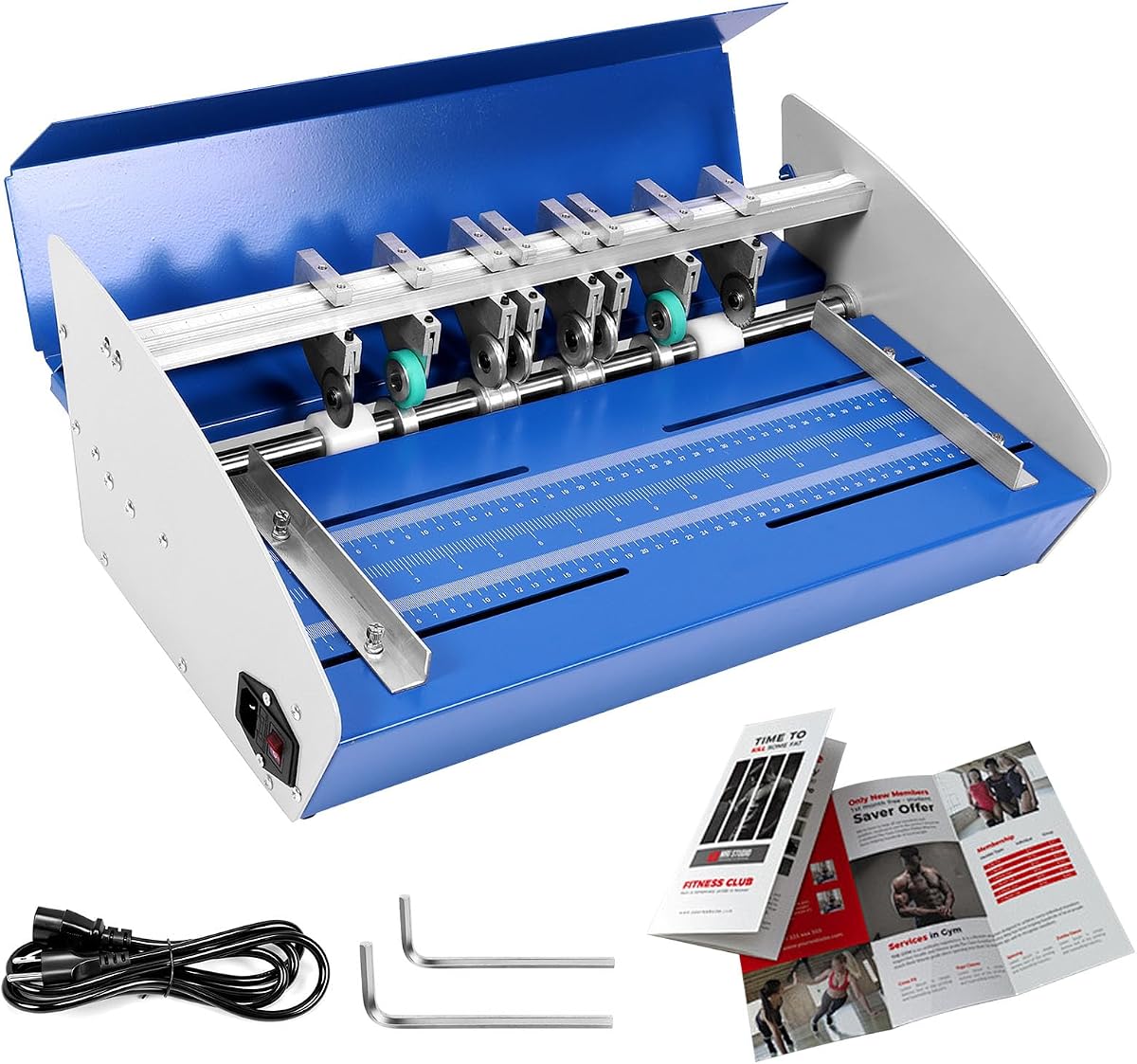
The 3-in-1 electric paper creasing machine is a finishing tool for users who need creasing, scoring, and perforating in one device. It carries a 5.0 rating and is especially relevant to offices, print shops, and professional craft rooms that produce menus, cards, invitations, tickets, envelopes, and bound documents. Its three-in-one design can replace several separate finishing tools on a busy workbench.
We may earn a commission when you buy through this link, at no additional cost to you.
Multifunctional rollers create clean folds and tear-off lines without cracking the material. The sturdy metal frame is intended to withstand frequent use and maintain a stable base during operation. A scale ruler helps position the material, while the 460-millimeter, approximately 18-inch, feeding width accommodates standard documents, extended menus, and larger book covers. The device operates on a standard 110-volt system.
The main distinction is that this is not a conventional letter folder with letter, half, Z, and double-parallel settings. Its value lies in broader finishing versatility rather than high-speed sorting of standard office correspondence. It also requires access to electrical power, making it less suitable for mobile work than a manual creaser. The listing repeats its application description, so buyers may want to confirm the included accessories and exact operating procedure before ordering.
This is a good choice for print finishing, invitation production, menu preparation, and craft work involving tears or scores. Its wide format gives it value in professional studios that regularly work beyond standard letter size. For basic mail folding, however, a dedicated automatic folder will be more direct; for this multi-function niche, the machine offers a capable and space-conscious solution.
Combining creasing, scoring, and perforation reduces tool changes during production. This is valuable when a single project needs a defined fold line, a clean tear, or both.
The approximately 18-inch width provides room for extended menus, book covers, and other large pieces. The integrated scale ruler helps operators position these materials consistently.
We may earn a commission when you buy through this link, at no additional cost to you.
The Martin Yale 1217A is the premium high-volume choice in this guide, combining a 4.1 rating with an exceptional documented capacity of 10,300 sheets per hour. It automatically feeds, folds, and collects documents, making it suited to offices, schools, mailrooms, and churches that process large quantities on a regular basis. Its 250-sheet capacity and seven fold types provide more operating flexibility than most competing models.
We may earn a commission when you buy through this link, at no additional cost to you.
Paper can range from 4-by-4 inches to 12-by-18 inches, giving the machine a wider media envelope than the standard letter and legal folders listed here. Two adjustable fold tables support customized folds, and large rubber folding rollers are intended to provide consistent results. A simplified folding chart helps users make changes quickly, while a conveyor-belt exit keeps the flow of completed documents organized.
The machine also includes a manual bypass for stapled or unstapled documents of up to five sheets. This is useful for pieces that are difficult to automate because of staples, unusual thickness, or mixed stacking. That flexibility is a meaningful advantage over a basic model, although the premium price, large footprint, and greater mechanical complexity may be unnecessary for low-volume users.
The 1217A is best recommended to organizations that routinely handle large document runs and value multiple folds more than compact size. It is also appropriate for institutions that need to process mixed paper sizes or occasionally handle stapled materials. For smaller teams, the Formax FD 300 may deliver sufficient speed at a lower investment. For serious high-volume production, however, the 1217A is the clear premium selection here.
A 250-sheet feed capacity and 10,300-sheet hourly rate minimize loading interruptions. These figures make the machine well suited to recurring mailings, school distribution, and large administrative batches.
Seven fold types and two adjustable tables offer broad formatting options, while the manual bypass handles stapled or unstapled sets of up to five sheets that may be awkward to feed automatically.
We may earn a commission when you buy through this link, at no additional cost to you.
The right paper folding machine depends on the volume, media, fold style, and level of automation your work requires. Compare throughput and paper limits alongside control features, output handling, physical space, and the type of finish you need.
Automatic folders feed, fold, and collect standard documents with minimal intervention, making them better for recurring office, school, church, and mailroom work. Manual models and creasers are more appropriate for small batches, specialty stock, craft projects, or locations where power and production speed do not justify an automated machine. An automatic folder also demands more attention to stack alignment, while a manual creaser offers more direct control over individual pieces.
Throughput indicates how quickly a machine can process sheets, but the most useful figure is one that matches your actual workload. A 4,000-sheet-per-hour model may be more than adequate for a small office, while 7,400 to 10,300 sheets per hour serves busy operations. Feed capacity is equally important because a fast machine can still be interrupted repeatedly if its hopper is too small for your stack size.
Standard office folders commonly handle letter and legal sizes, while premium models may accept paper as large as 12-by-18 inches. Weight limits also separate general-purpose machines from tools capable of handling heavier stock. Creasing tools may specify cardstock in grams per square meter or grams per cubic meter, while folders commonly use pound weights. Check both dimensions and material weight before committing to a model.
C, Z, half, and double-parallel folds cover many standard mailing formats, while some premium folders offer seven configurations and adjustable fold tables. Craft users may need precise scoring rather than several document folds. Consider the finished shape, envelope size, and downstream handling requirements of your project. A model with easy selection and clear guides can be more useful than one offering many styles that are rarely used.
LCD panels, resettable counters, and AutoBatch functions are valuable for organizations that need predictable quantities and accountability. A counter can prevent underproduction or overproduction, while batch settings can create pauses at useful intervals for sorting, checking, or packaging. For casual use, a straightforward panel may be preferable to a complex interface with settings that have little practical value.
An output conveyor helps maintain a steady flow and can keep documents sequential for envelope insertion or bundling. Adjustable stacker wheels are useful when different jobs produce different dimensions. Manual creasers instead focus on a clean score line, sometimes using a scale, guide rails, and a positioning block. Decide whether the primary need is finished document organization or professional crease quality on individual craft pieces.
Automatic folders require room for a feed tray, mechanism, and output conveyor, along with a nearby electrical outlet. Manual creasers are easier to store and can work in temporary spaces because they need no power. A foldable working panel makes a compact creaser especially attractive for shared desks. Before buying, measure the available surface and leave enough clearance to load paper and remove finished pieces comfortably.
Standard business paper, cardstock, corrugated board, bound documents, invitations, and large covers place different demands on a folder or creaser. An 18-inch electric scorer-perforator can handle broad finishing tasks, while a precision manual creaser may suit thin specialty sheets that need controlled alignment. Check the supported media specifications carefully and avoid assuming that a general-purpose letter folder can manage heavy or unusual materials.
Begin by placing the machine on a stable, level surface with adequate space around the feed and output areas. Read the included operating instructions, install paper guides and fold plates for the chosen format, and connect electrical power only when the model requires it. Select the fold or scoring position using the marked guides, scale, and positioning system before loading a test sheet. Running a few representative pages first helps verify alignment, depth, and final dimensions.
For automatic folders, square the paper stack and load it squarely into the feed tray without fanning it when the manufacturer advises against fanning. Remove staples, clips, or obstructions from problematic pieces, and use the manual bypass for the small stapled or unusually layered documents that the machine is designed to handle. For manual creasers, align the sheet against the positioning block, hold the material firmly, and press the handle through a smooth, complete stroke. Do not force the paper sideways while the blade or rollers are engaged.
After each job, allow the machine to stop before removing the final sheets, then collect the output from the tray or conveyor in order. Use a soft, dry cloth to wipe dust and paper residue from accessible surfaces, and keep the mechanism away from loose debris. Do not use excessive liquid around electrical controls, rollers, or bearings. Store a foldable manual creaser with its panel closed, and consult the manual for recommended lubrication, inspection, and service intervals for powered models.
A paper folder feeds sheets through a mechanism that creates a defined document fold and often stacks the result automatically. A paper creaser usually scores one sheet at a time with a manual or electric blade, creating a guide line that can be folded afterward. Folders are best for routine business documents, while creasers are generally more appropriate for cards, invitations, covers, and other specialty pieces.
The Martin Yale P7500 is a budget-oriented automatic option for moderate recurring work, while the Formax FD 300 offers faster output, a larger feed capacity, and programmable batches. A small office that folds only a few pieces occasionally may need no machine, but once consistency and time savings become important, one of these automatic models can justify the investment.
The correct figure depends on the size and frequency of each job, not simply the number of pages handled in a day. Models rated from 4,000 to 10,300 sheets per hour cover very different production levels. High-volume operations should also consider reload frequency, output stacking, paper compatibility, and whether the machine can reduce downstream manual work.
Many of the automatic folders in this guide support both 8.5-by-11-inch letter paper and 8.5-by-14-inch legal paper. Always adjust the guides and fold table to the loaded dimensions, and verify the weight limit. A fold intended for letter paper may not create the correct finished size for legal documents.
Standard office folders commonly support 20-pound bond paper, while some models accept up to 30 pounds. Heavier cardstock and specialty materials may require a dedicated creaser or scoring machine. Test the actual paper stock because coatings, folds, and environmental conditions can affect how a sheet feeds even when its nominal weight falls within the stated range.
The manual models featured here do not require electricity, making them portable and suitable for temporary workspaces. Their trade-off is that each sheet is positioned and scored by hand. The 3-in-1 electric machine is an exception because its powered rollers provide motorized creasing, scoring, and perforating across a wider working area.
C or letter folds, Z or accordion folds, half folds, and double-parallel folds are common because each serves a different document layout. Double-parallel folds are frequently used for letters that need to fit a business envelope, while Z folds are useful for information displayed on multiple panels. The correct choice depends on the envelope, document order, and presentation.
Consistency begins with a firm, stable base and accurate alignment against the guide rails or positioning block. The sheet should sit flat with its edge fully supported, and the tool should be adjusted to the intended fold position before work begins. Use a smooth, complete press rather than several partial strokes, and check the first few pieces to confirm that the score line is centered.
The Martin Yale P7500 is a budget-conscious automatic choice for moderate daily folding, while the Formax FD 300 is the most balanced overall option for offices that want speed, four standard folds, a 200-sheet feed, and useful batch controls. The Martin Yale 1217A is the premium selection for organizations needing 10,300 sheets per hour, seven folds, larger paper support, and a bypass for special documents.
Choose according to workload rather than output specification alone. Manual creasers are best for small craft batches and precisely scored specialty paper, while automatic folders justify themselves through repeatability and volume. Check paper dimensions, weight limits, available space, fold styles, and output handling before purchasing. For mixed craft finishing, the electric 3-in-1 machine adds scoring and perforation alongside creasing.
Customer ratings, manufacturer information, and current prices can change, so review the latest listing and support terms before ordering. Compare the final cost against the labor time saved, the consistency gained, and the space required. The most capable machine is not automatically the right one; the best choice is the model that matches your documents, volume, and workflow without unnecessary features or complications.


