LHKNL Headlamp Flashlight
4.5Editor score
1500mAh rechargeable battery
Eight practical lighting modes
Motion sensor operation
Waterproof to IPX4
Discover the best headlamp for hiking and camping in 2026, with expert comparisons of brightness, battery options, comfort, durability, and water resistance.
A headlamp for hiking and camping should deliver dependable hands-free illumination without adding unnecessary weight to your pack. Brightness matters, but comfort, runtime, weather resistance, controls, and a secure fit can make an even bigger difference during long trails, technical campsites, and nighttime emergencies.
This guide compares ten headlamps based on the specifications and features supplied for each model. It covers rechargeable and disposable-battery designs, beam flexibility, red-light and emergency modes, adjustability, water resistance, and practical features such as motion sensing and zoom. The list includes budget models as well as premium lights suited to demanding outdoor use.
Each review highlights where a model fits most naturally, along with its meaningful trade-offs. Ratings reflect the supplied customer feedback, while availability and prices can change, so readers should compare current listings before buying. The best choice ultimately depends on the trail, campsite, and duration of illumination required.
4.5Editor score

4.8Editor score

4.4Editor score
The comparison below places all ten lights side by side, emphasizing maximum output, power source, major lighting controls, and environmental protection so hikers and campers can quickly narrow the field to the option that best matches their routines.


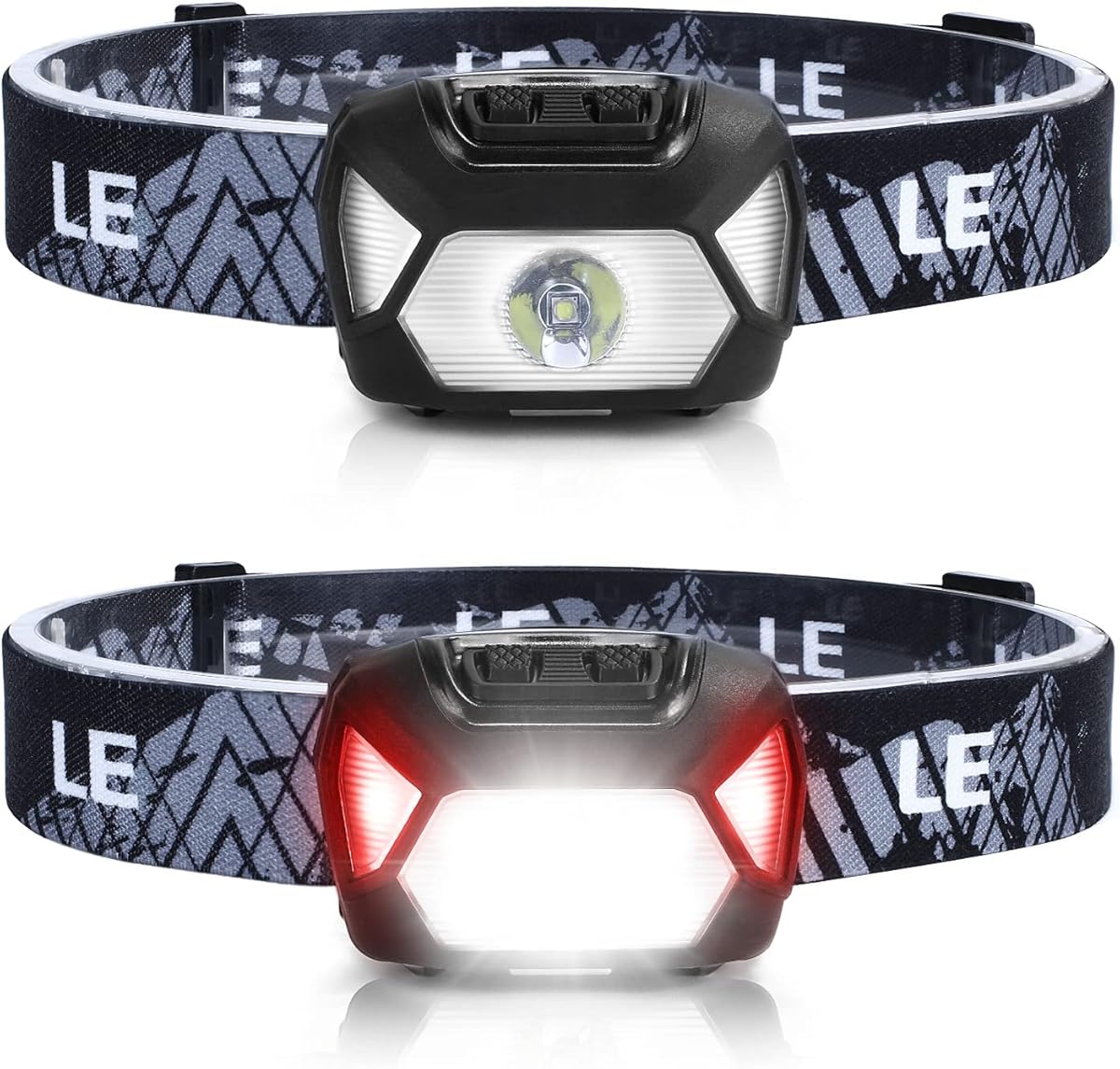
The LHKNL Headlamp Flashlight offers a balanced combination of output, controls, comfort, and affordability for ordinary hiking and camping trips. Its listed rating is 4.5, and the supplied specifications place it among the most versatile designs in the group. It provides a 1500mAh rechargeable battery, multiple beam configurations, and a motion sensor that can be especially useful when both hands are occupied.
We may earn a commission when you buy through this link, at no additional cost to you.
Its eight-mode system includes main and side white beams at different brightness levels, a red beam, and an SOS red strobe. Motion mode provides quick access to the two strongest white outputs. The long-press function allows the light to be switched off from any regular mode without cycling through the complete menu, while a battery indicator helps the user monitor remaining power.
The claimed four-to-ten-hour runtime is mode-dependent, so it is better to treat that range as a guide than a promise. IPX4 protection is suitable for ordinary rain and snow but does not represent the same level of submersion protection offered by the Black Diamond models. Nevertheless, the sealed housing, adjustable elastic strap, 60-degree lamp rotation, and 1.87-ounce weight create a practical package for backpacking and campsite tasks.
This is a strong recommendation for campers and hikers who want a rechargeable light with more controls than a simple three-mode model. It is particularly appealing for families, since the product is supplied as a two-pack, but the motion sensor and broad mode selection may also make it useful for runners, dog walkers, and emergency kits. Buyers prioritizing deeper waterproofing can choose a more rugged alternative.
Main, side, red, and emergency outputs let one headlamp handle trail navigation, tent work, close-range inspection, and signaling. The motion sensor reduces button handling when gloves, packs, or dirty hands make switches inconvenient.
The 1.87-ounce weight and adjustable elastic band help reduce pressure on long walks. A 60-degree tilting lamp keeps the beam directed where needed without requiring the wearer to crane the neck.
We may earn a commission when you buy through this link, at no additional cost to you.
The Blukar 2000L Rechargeable is a value-focused option for campers who want several lighting choices and simple recharging. Its listed rating is 4.5. The headlamp combines XPG and COB LED technology, stepless brightness adjustment, a motion sensor, and eight modes while remaining substantially more affordable than many premium trail lights.
We may earn a commission when you buy through this link, at no additional cost to you.
Five regular modes cover XPG white, COB white, combined white, COB red, and red strobe. Three additional sensor modes allow the lamp to be switched on or off with a wave of the hand. Holding the button lowers brightness continuously from 100 to 30 percent, which is useful for conserving power or reducing glare in a tent.
Its 1200mAh built-in battery charges through USB-C, and a cable is included. The light weighs 2.96 ounces, which remains practical for hiking but is noticeably heavier than the 1.34-ounce Nitecore. IPX5 protection is appropriate for rain, snow, and splashes, while the removable, washable, breathable band can be adjusted for different head sizes. The lamp head tilts up to 45 degrees.
This model makes sense for general campers, hikers, runners, and cyclists who prioritize mode variety and adjustable brightness over an ultralight profile. The integrated battery means there are no disposable cells to carry, although users who prefer flexibility may prefer an AAA-powered model. Overall, it offers a useful feature set for routine outdoor trips.
Stepless dimming makes it easier to match brightness to the task, from a low ambient glow inside a tent to a stronger beam on a trail. This is more nuanced than the fixed low and high settings found on simpler headlamps.
USB-C charging simplifies topping up at camp or before a trip. The included cable, removable washable strap, and 45-degree adjustment improve everyday convenience and long-term maintenance.
We may earn a commission when you buy through this link, at no additional cost to you.
The BLACK DIAMOND Cosmo 350 combines a 350-lumen maximum output with unusually strong environmental protection. Its listed rating is 4.6. This makes it a compelling choice for wet-weather hikers and campers who want the flexibility of standard AAA batteries without giving up the ability to use a rechargeable battery system.
We may earn a commission when you buy through this link, at no additional cost to you.
Dual-fuel compatibility is its most notable feature. Three AAA batteries are included, while compatible users can add the rechargeable BD 1500 lithium-ion battery. Dimming, strobe, and red night-vision modes offer the basic controls expected from a capable trail headlamp, all accessible through a simple button interface.
The IP67 rating means the light is protected against dust and temporary submersion up to one meter for 30 minutes, although it should be dried after wet use. That protection is a meaningful step above splash-rated budget models. Its low-profile body, adjustable band, and balanced construction should remain stable during hiking, climbing, or running.
This headlamp suits hikers who cross exposed ridges, encounter persistent rain, or camp in damp locations. Those who prefer disposable batteries will value the ability to carry spare cells, while rechargeable users can reduce waste after adding the appropriate battery and charger. It is a well-balanced premium choice without the larger output of the Storm 500-R.
IP67 protection gives the Cosmo 350 a stronger case in rain, snow, and dusty terrain than models carrying only IPX4 or IPX5 ratings. The supplied note recommends fully drying the light after wet use.
Using AAA batteries keeps the model straightforward for occasional campers, while compatibility with the BD 1500 offers a rechargeable path for regular hikers. This dual-fuel design provides valuable flexibility.
We may earn a commission when you buy through this link, at no additional cost to you.
The BLACK DIAMOND Storm 500-R is the premium choice in this group, delivering up to 500 lumens from a rechargeable 2400mAh lithium-ion battery. Its listed rating is 4.4. The specification makes it well suited to technical trails, large campsites, night activities, and situations where dependable broad visibility matters.
We may earn a commission when you buy through this link, at no additional cost to you.
Full-strength, dimming, strobe, and red night-vision modes let the user adapt the output to distance, proximity, signaling, or the need to preserve dark adaptation. The integrated battery can be recharged through micro-USB, reducing the need to carry disposable cells during repeated trips.
Its durable housing is designed for heavy rain, snow, and challenging outdoor conditions. The compact, low-profile form and adjustable headband help keep the light stable without excessive bulk. One trade-off is the use of micro-USB instead of the increasingly common USB-C format, which may be inconvenient for travelers who carry one modern cable for several devices.
Buyers seeking the strongest stated output and a large rechargeable capacity will find this model compelling. It is best for serious hikers, climbers, trail runners, and campers who prefer one durable light that can handle both campsite tasks and navigation. Those prioritizing minimal weight should compare it with the Nitecore NU20 Classic.
A 500-lumen maximum output provides useful illumination for trails, campsites, and emergency situations. Dimming and red modes allow the same light to serve close-range tasks without always using full output.
The integrated 2400mAh battery and rugged housing are well aligned with regular outdoor use. A secure adjustable fit helps maintain stability during active pursuits such as climbing, hiking, and trail running.
We may earn a commission when you buy through this link, at no additional cost to you.
The Foxelli MX20 is built around endurance and simplicity. It carries a listed rating of 4.7 and provides up to 45 hours of runtime from three AAA batteries. That makes it attractive for campers who need emergency illumination to remain available for extended periods or hikers who prefer not to depend on access to a charging point.
We may earn a commission when you buy through this link, at no additional cost to you.
Its five-mode system includes white and red options, plus SOS and strobe functions. A single glove-friendly button controls the light, while the body tilts 45 degrees. The stated 165-foot beam and 3.2-ounce weight indicate a useful balance between reach and packability, although it is heavier than sub-two-ounce options.
IPX5 protection handles splashing and spraying water from any angle, making it suitable for ordinary rain and snow. The adjustable elastic headband is designed for comfort over long periods, which is important for runners and hikers. Unlike rechargeable models, the Foxelli does not require charging before use, and the supplied Energizer batteries allow immediate operation.
This is a strong recommendation for family camping, backpacking, night running, and emergency kits where long standby time matters more than low weight. Campers who travel lightly and recharge nightly may prefer a USB-C model, while those who value certainty and replaceable cells will appreciate the MX20.
The 45-hour stated runtime is the model's defining advantage. Three included AAA batteries make it immediately usable and provide a straightforward way to carry spare power during multi-day trips.
A glove-friendly single button reduces the difficulty of changing modes outdoors. The 45-degree tilt also allows the beam to be aimed down the trail or toward a task without forcing the wearer to adjust body position.
We may earn a commission when you buy through this link, at no additional cost to you.
The Blukar Rechargeable Three-Light stands out for its combination of a main lamp, side lamp, and rear red light. Its listed rating is 4.6. Rather than focusing solely on raw output, this model emphasizes beam shaping and visibility from several directions, making it useful for group movement, campsite organization, and hands-free outdoor work.
We may earn a commission when you buy through this link, at no additional cost to you.
Five modes include main white, side white, all white, flashing white, and main red. Rotating the main lens changes the focal length, allowing a narrower spotlight or broader flood. The rear red light remains visible to others, which can improve awareness when a hiker or cyclist is moving through a dark area.
Its integrated USB-C-rechargeable battery takes approximately five hours to fill. Because the battery is sealed inside the housing, it cannot be replaced independently, but that also reduces exposure to water and impacts. IPX6 protection, a sealed battery compartment, and a 90-degree tilting head support use in wet conditions and on helmets. The breathable, non-slip band adjusts to different head shapes.
This model is a good choice for campers who want a visible rear light or for users who frequently switch between wide area lighting and focused beams. It is less compelling for travelers who prioritize replaceable batteries, but its charging simplicity, broad adjustment, and multi-light layout make it versatile for hiking, cycling, dog walking, and campsite repairs.
The rotating lens gives users more control than a fixed-beam headlamp. A narrow spotlight can reach farther along a trail, while a flood pattern illuminates a wider campsite or work area.
The rear red light adds a safety-oriented element that is unusual at this level. It can help other people notice the wearer, while the side light expands close-range illumination.
We may earn a commission when you buy through this link, at no additional cost to you.
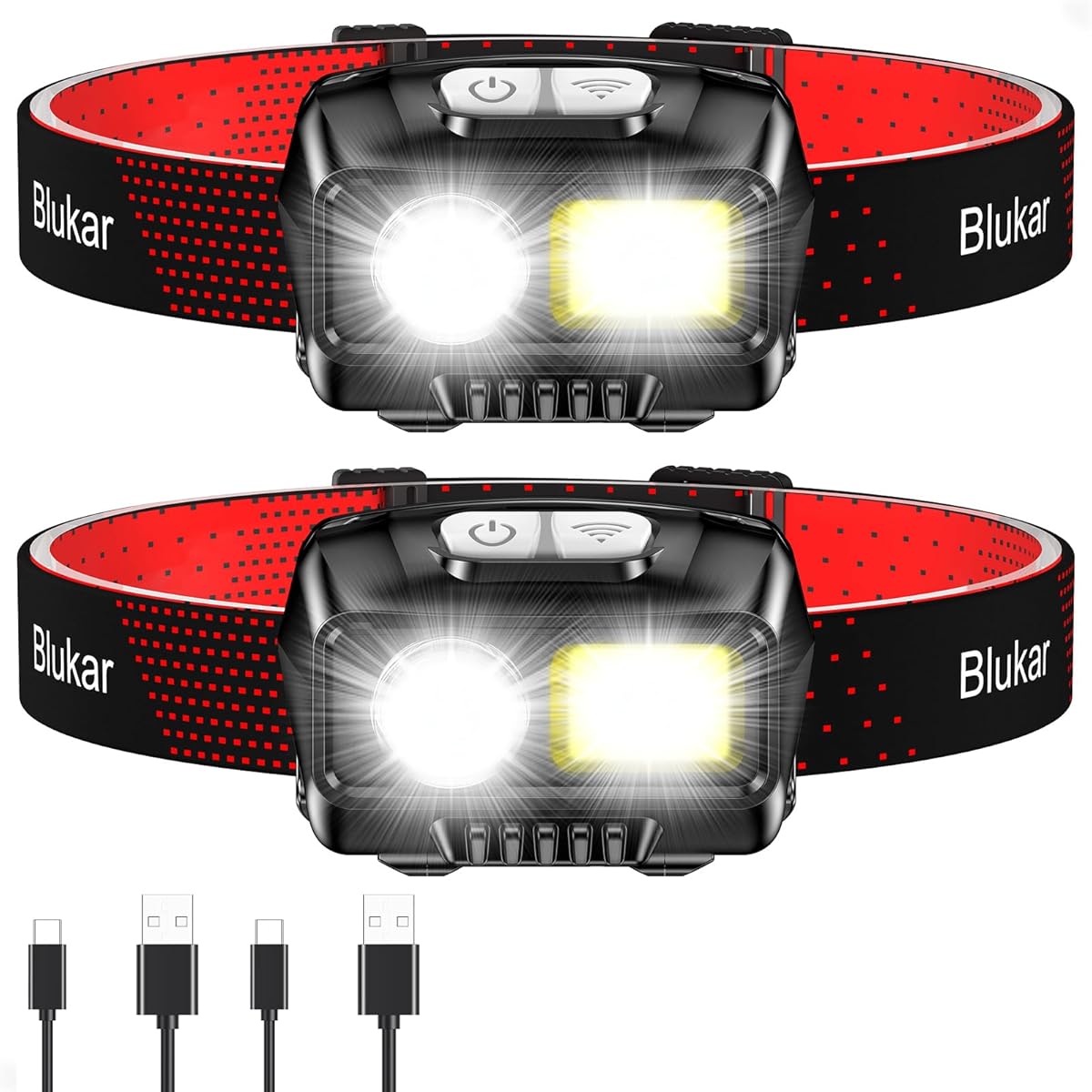
The Blukar 2000L Two-Pack includes two matching rechargeable headlamps, making it a practical choice for couples, families, or a trail group. Its listed rating is 4.6. Each light combines COB and XPG LEDs, stepless dimming, eight lighting modes, and a motion sensor within a compact design.
We may earn a commission when you buy through this link, at no additional cost to you.
Five regular modes cover XPG white, COB white, combined white, red, and red SOS. Three sensor modes provide XPG, COB, or combined white output. A hand wave within approximately 15 centimeters activates the sensor, allowing quick control when the wearer has dirty hands or is wearing gloves. Brightness can be continuously adjusted from 100 down to 30 percent.
The 1200mAh battery charges by USB-C in roughly two to three hours. Supplied runtime figures range from about 3.5 hours in combined XPG and COB operation to around five hours in COB or XPG mode. IPX5 water resistance and dust protection suit rain, snow, and variable trail conditions. The detachable, washable band and 45-degree tilt improve comfort and positioning.
This two-pack is ideal when a household or group wants duplicate lights without managing different models or battery systems. One unit can remain as a vehicle or emergency spare, or each person can carry one. Solo buyers who do not need a duplicate may find the single Blukar alternative more streamlined, but the shared charging standard remains convenient.
Two matching lights are useful for families, partners, and hiking groups because everyone can use the same controls and charging routine. The spare also works naturally as an emergency or vehicle light.
The combination of stepless dimming, multiple white and red modes, and close-range motion sensing provides quick control in changing conditions. It is particularly convenient when stopping to adjust packs or handling wet gear.
We may earn a commission when you buy through this link, at no additional cost to you.
The Lepro Waterproof Two-Pack offers a light, replaceable-battery format for hikers and campers who want two functional headlamps without charging. Its listed rating is 4.6. Each unit uses an XPG2 LED and provides a stated 1300 lux with a range of up to 400 feet or 120 meters.
We may earn a commission when you buy through this link, at no additional cost to you.
Six modes cover high and low spot beams, high and low flood beams, red steady illumination, and red flashing. This range lets users choose between distance and area lighting while preserving a red option for nighttime campsite activity. The lamp also supports combined spot and flood operation for broader coverage.
The removable, washable elastic band accommodates adults and children and can fit hard hats or helmets. Each light weighs 1.94 ounces without batteries, or 3.5 ounces with them, which remains practical for hiking. A 45-degree tilt positions the beam without neck strain and helps prevent shaking or sliding while running. The housing resists splashing, spraying, cold, heat, and drops.
This pair is well suited to families, shared emergency kits, and users who prefer carrying spare AAA cells rather than managing a built-in rechargeable battery. Batteries are not included, so purchasers must add them. Overall, the Lepro offers broad lighting choices, a light design, and useful helmet compatibility at a practical entry level.
Dedicated high and low spot and flood modes give the user more control than a simple fixed beam. This is useful when moving along a trail and then working around a campsite or tent.
The 1.94-ounce weight excluding batteries keeps the model comfortable for long walks. A removable washable band and 45-degree tilt also make the light suitable for helmets and repeated adjustment.
We may earn a commission when you buy through this link, at no additional cost to you.
The BLACK DIAMOND Spot 400 delivers up to 400 lumens and offers a flexible combination of power options, multiple brightness settings, and red night-vision illumination. Its listed rating is 4.6. The Spot naming emphasizes a useful focused output, while the broader mode selection also accommodates close-range campsite work.
We may earn a commission when you buy through this link, at no additional cost to you.
Three included AAA batteries make the lamp immediately usable. Compatible users may upgrade to the rechargeable BD 1500 lithium-ion battery and charger, although that accessory is sold separately. This dual-fuel arrangement lets occasional campers keep the simple disposable format while regular hikers can transition to rechargeable power.
The rugged housing and waterproof construction are intended for rain, snow, and demanding outdoor environments. A simple button interface makes the light straightforward to operate, and the adjustable headband supports a stable, low-profile fit. Red mode is useful when preserving night vision matters around camp or during early-morning movement.
This is an excellent choice for hikers who want a strong spot-oriented beam without moving to a larger premium model. It also works for night running, cycling, vehicle kits, reading, and household repairs. The separate rechargeable accessory is the main consideration for users who want fewer loose batteries in their pack.
The 400-lumen maximum output is useful for trails and dark outdoor spaces, while lower proximity modes offer softer illumination for maps, cooking, and campsite tasks. This range helps the light serve several parts of a trip.
A dedicated red mode can preserve night vision and reduce glare for nearby companions. It is particularly useful around camp, during pre-dawn starts, and when observing wildlife.
We may earn a commission when you buy through this link, at no additional cost to you.
The Nitecore NU20 Classic is the ultralight choice, weighing just 1.34 ounces while producing up to 360 lumens. It has the highest listed rating in the group at 4.8. That combination makes it particularly attractive to hikers, backpackers, runners, and campers who want strong output without carrying a bulky lamp.
We may earn a commission when you buy through this link, at no additional cost to you.
The main white LED offers three brightness levels, supplemented by SOS and beacon functions, a soft reading light, and an auxiliary red mode for night vision. This range covers trail navigation, campsite tasks, signaling, and close-range reading without requiring several separate devices.
Its low setting can run for up to 97 hours, while USB-C recharging takes just over an hour. A battery indicator helps prevent an unexpected loss of power. The rugged PC housing carries an IP66 waterproof rating and one-meter impact resistance, offering useful protection against rain, dust, and rough terrain.
This headlamp is a top recommendation for ultralight hikers, fast hikers, and campers who value comfortable all-day wear. It may be less compelling for users who need many separate output patterns, but its compactness, fast charging, long low-mode runtime, and 360-lumen ceiling compensate. The included headband, USB-C cable, and sticker make it ready for use.
At only 1.34 ounces, the NU20 Classic places minimal pressure on the forehead and neck. It is a strong fit for speed hiking, backpacking, running, and any situation where every carried gram is relevant.
A charge of just over an hour supports regular use between trips, and the battery indicator helps users judge when charging is needed. IP66 protection adds confidence during wet hikes and dusty campsites.
We may earn a commission when you buy through this link, at no additional cost to you.
The most useful headlamp is one that balances adequate light, dependable power, secure comfort, and dependable protection for the conditions you expect. The following factors help narrow the options before you compare detailed specifications or current listings.
Maximum lumens indicate the brightest output a headlamp can produce, but the number alone does not reveal beam shape, consistency, or useful runtime. For ordinary hiking and campsite work, a moderate high setting may be more practical than using maximum output continuously. Brighter models can help on technical trails, during night running, or when illuminating a larger area, while dim settings are valuable for preserving battery life and avoiding glare near other people.
Choose enough brightness for the hardest expected task without automatically prioritizing the largest number. A focused beam helps identify trail markers farther ahead, whereas a wide flood is more suitable for cooking, organizing gear, and moving around a campsite.
Rechargeable headlamps reduce the need to carry spare batteries and are convenient for trips near a vehicle or campsite power source. Models with integrated batteries are generally compact and sealed, though the battery cannot be replaced if it fails. AAA-powered lights accept familiar disposable cells, which can be useful in remote areas, but extra batteries add weight and require planning.
For multi-day trips, compare stated runtime at the brightness level you expect to use rather than relying on a maximum figure. A low setting lasting many hours may be more useful than a short burst at full output, particularly when the lamp doubles as an emergency light.
A versatile headlamp should offer at least one focused mode, one broad mode, a dim setting, and red light. Strobe and SOS functions can provide signaling value in emergencies, while motion sensing offers quick activation when gloves, packs, or dirty hands make small buttons difficult to operate. Too many modes can also make operation less intuitive, so the menu should remain easy to learn.
Look for intuitive short-press and long-press behavior. It should be possible to change brightness, select red or emergency output, and turn the lamp off without cycling through a long sequence. Test the controls before a trip and learn the selected patterns while daylight remains.
Hiking and camping expose lights to rain, snow, mud, and accidental drops. A model with IPX5 protection is suited to splashing and spraying water, while an IP66 or IP67 model provides a higher level of protection against dust and moisture. Ratings do not guarantee every real-world condition, so the housing should still be dried after exposure and protected from severe impacts.
Match the rating to the environment rather than assuming every light is equally waterproof. For frequent wet-weather hiking, backpacking, kayaking, or climbing, stronger water protection and a rugged housing are worthwhile. Dry campsites and indoor tasks place less emphasis on that feature.
Weight, strap construction, balance, and adjustability determine whether a headlamp remains comfortable over a long hike. Lightweight designs reduce pressure, while a soft or breathable band can prevent heat buildup. The lamp should remain stable when walking downhill, climbing, or running and should not slide when the head is tilted.
Consider head size, helmet compatibility, and whether the strap can be removed or washed. A tilted lamp housing is important because it lets the beam follow the line of sight without bending the neck. Try the fit over the hat or hood you expect to wear.
Spot, flood, and combined patterns serve different outdoor needs. A focused spot reaches farther and is useful for trail navigation, while a flood illuminates a broad campsite, tent interior, map, or repair area. Zoom lenses, tiltable housings, and adjustable brightness add further control, allowing the user to direct light without moving the entire headlamp.
A model with both patterns is generally more adaptable than one with a single fixed beam. Pay particular attention to red and dim settings if you share a tent, cross wildlife areas, or want to preserve night vision during early-morning activities.
USB-C charging is increasingly convenient because the same cable often powers phones, power banks, and other accessories. Micro-USB models remain perfectly usable, but travelers may need to carry an additional cable. Check the stated charge time and whether a cable is included, as well as the presence of a battery indicator that shows remaining power at a glance.
Recharge before overnight trips rather than relying on the light being ready in the morning. For a rechargeable model, occasionally check that the charging port remains dry and clean. Disposable-battery users should carry spare cells in a protected container rather than loose among damp clothing.
Before leaving for a trip, charge a rechargeable headlamp fully and confirm that every lighting mode works. Fit it over the hat or hood you intend to wear, adjust the strap evenly, and tilt the lamp until the beam points where your eyes naturally look. Learn the controls in daylight, particularly long-press shutdown, red-light selection, motion sensing, and emergency modes.
On the trail, use the lowest setting that still provides the required visibility. A dim white beam usually preserves battery life and reduces glare near companions, while a brighter mode is better for obstacles, junctions, and unfamiliar terrain. Red light can be useful around camp or during nighttime wildlife observation, and strobe or SOS functions should be reserved primarily for signaling emergencies.
After use, turn the lamp off, wipe away dirt and moisture, and allow the housing to dry fully. Clean removable straps according to the manufacturer's guidance and remove any grit that could affect adjustment. Recharge the unit before storage, keep spare batteries dry, and store the headlamp in a place where its button cannot be pressed or its lens cannot be damaged.
For ordinary trails and campsite tasks, a model with several brightness levels is often more useful than focusing exclusively on the maximum lumen figure. Around 300 to 400 lumens provides ample capability for hiking, running, and general outdoor use, while higher output can help on technical trails or during emergencies. Low and red modes matter more for preserving runtime, reducing glare, and maintaining night vision.
A rechargeable headlamp is convenient for repeated trips and reduces the need to carry spare cells. A battery-powered model can be advantageous in remote locations because common disposable batteries can be replaced. Consider charging access, trip length, cold-weather performance, and whether you prefer the lower pack weight of an integrated rechargeable design or the flexibility of carrying spares.
IPX5 indicates protection against splashing and spraying water from multiple directions, which generally suits rain and snow encountered during hiking or camping. It is not the same as full submersion protection. Models rated IP66 or IP67 offer stronger environmental safeguards, and every headlamp should be dried thoroughly after use regardless of its stated rating.
Red light is less disruptive to dark adaptation than bright white light, making it useful around camp, during pre-dawn departures, and when viewing wildlife. It can also reduce the glare experienced by nearby companions. A red mode does not replace a white beam for trail navigation, so it should be treated as a supplementary lighting option.
Motion sensing can be convenient because users do not need to locate a small button while wearing gloves or handling equipment. However, it may respond unexpectedly if the wearer moves their head or hands near the sensor. Users should learn the activation distance and confirm that the mode can be disabled before relying on it in severe weather or emergency situations.
Most adjustable headbands can accommodate a hat, but bulky winter clothing may make the fit less stable. Helmet users should look for compatible headbands or a low-profile lamp that does not interfere with the helmet shell. Adjusting the strap over the intended layers and checking the beam after every major clothing change helps prevent movement or slipping.
Carry the headlamp in an accessible pocket or the top compartment of a pack rather than burying it in deep storage. If it uses disposable batteries, keep spare cells in a dry container and protect the contacts from moisture. For a rechargeable model, start with a full charge and carry a cable if no charging point will be available during the trip.
Turn the lamp off and remove any external moisture, but do not attempt to open a sealed housing unless the manufacturer specifically permits it. Allow the unit to dry completely in a ventilated place before charging or operating it again. After a significant drop or immersion, stop relying on it as the only emergency light and carry a backup.
The LHKNL Headlamp Flashlight is the most well-rounded budget-oriented recommendation, offering rechargeable power, motion sensing, eight modes, a comfortable fit, and a two-pack arrangement. The Nitecore NU20 Classic stands out for exceptionally low weight, fast USB-C charging, useful 360-lumen output, and strong customer feedback. For buyers seeking premium power and durability, the BLACK DIAMOND Storm 500-R provides 500 lumens and a large integrated rechargeable battery.
Prioritize the features that affect your trip rather than the largest specification alone. Runtime at a realistic setting, a secure fit over your usual hat, the availability of a broad beam for the campsite, and enough water resistance for the forecast can matter more than maximum output. Battery format should also match the trip: rechargeable for convenience, replaceable cells for remote flexibility, or dual-fuel compatibility when uncertainty is highest.
Ratings, product availability, and prices can change, so check the current listing and confirm the exact specifications before making a final decision. A complete setup may also benefit from a backup light, spare batteries, and a protected charging cable. With the right mix of illumination, endurance, comfort, and weather resistance, a headlamp can become one of the most useful pieces of outdoor equipment you carry.