
MOFEEZ 250A Bus Bar
4.8Editor score
Four 5/16-inch studs
Six #8 screw terminals
Removable insulated cover
A bus bar power distribution block provides a central, organized connection point for batteries, accessories, chargers, inverters, and grounding cables. A quality model should offer suitable electrical ratings, secure terminals, corrosion-resistant conductors, effective insulation, and enough clearance for the cables in your installation.
We compared ten bus bars using the information supplied for each product, focusing on current and voltage ratings, stud sizes, conductor materials, terminal layouts, included accessories, protective features, mounting design, and stated suitability for automotive, marine, RV, and solar systems.
The list shows why the most highly rated model is not automatically the right choice for every project: some emphasize compact mounting, others provide larger studs or higher current ratings, and others focus on convenience. Ratings and availability can change, so readers should verify current product details and prices before purchasing.
4.8Editor score

4.7Editor score

4.8Editor score
As an Amazon Associate we earn from qualifying purchases.
This side-by-side comparison highlights each bus bar's principal electrical ratings, connection options, construction, and stated use cases, making it easier to match a block to the cable, space, and current demands of an automotive, marine, RV, or solar installation.




The Joinfworld 250A Bus Bar combines a substantial current rating with a flexible mix of large studs and smaller screw terminals. Its 4.7 rating reflects broad buyer appeal, while the four 3/8-inch studs give it an immediate advantage for projects using heavy battery cables. The set includes separate red and black blocks for positive and negative distribution.
We may earn a commission when you buy through this link, at no additional cost to you.
One of its most useful features is the combination of four main studs and three #8 screw terminals on each block. That allows a builder to establish a primary battery connection, create dedicated feeds for high-demand accessories, and add smaller circuits without making every load rely on a single attachment point. The stated 250A rating applies in a 12V circuit, and the product can handle voltages up to 48V.
The copper bus plates are described as four millimeters thicker than conventional plates, while the nylon base is secured by an M10 post intended to resist stripping. Protective covers and nuts help reduce accidental contact with exposed conductive areas. These details improve organization and safety, although the bus bar still needs correct fusing, sound cable termination, and careful installation to perform as intended.
This is a strong general recommendation for a boat, car, truck, RV, or solar wiring project that needs both heavy cable connections and smaller accessory feeds. Buyers should confirm that their cable lugs and wiring configuration suit the four 3/8-inch studs. For those seeking a balanced distribution block rather than the most compact option, the Joinfworld set offers a particularly versatile connection mix.
The combination of four 3/8-inch studs and three #8 screw terminals on each bar supports both major battery cables and smaller accessory circuits. This flexibility makes the pair useful for organizing several loads in one location.
The included protective covers help shield exposed areas, while the reinforced nylon base and M10 securing post are intended to keep the assembly stable. These features are useful in vibration-prone automotive and marine installations.
We may earn a commission when you buy through this link, at no additional cost to you.
The RVBOATPAT 150A Bus Bar is built for installations that need many smaller electrical connections rather than several oversized main studs. It receives a 4.7 rating and includes a positive block, a ground block, two covers, two 1/4-inch copper lugs, and twenty-four terminals. The broad accessory count is its defining characteristic.
We may earn a commission when you buy through this link, at no additional cost to you.
Each bar uses one 1/4-inch M6 terminal stud alongside twelve stainless steel M4 terminal screws. This arrangement can help consolidate lighting, controls, instruments, and other secondary circuits while leaving a dedicated main connection. Its stated maximum continuous current is 150A, with a maximum operating voltage of 48V DC, placing it in a different performance class from the 250A and 300A options.
The conductor is a thick tinned copper plate, while the base is made from ABS described as mechanically strong, insulated, heat resistant, and flame resistant. Including two copper lugs is helpful for creating the primary connections, and the protective covers add another layer of separation around conductive surfaces. As with every distribution block, the correct cable size, lug type, and circuit protection remain essential.
This pair is a practical choice for a car, caravan, boat, yacht, or solar system where numerous small loads need a tidy central collection point. It may be less suitable as the only connection for a cluster of very heavy cables because there is only one large stud per bar. For projects built around accessory circuits, however, the twelve-terminal layout offers useful flexibility in a relatively accessible format.
Twelve M4 screw terminals on each block provide ample opportunities to organize smaller wires. The result is useful for accessory-heavy systems where every circuit would otherwise occupy a separate battery connection.
The package includes two 1/4-inch copper lugs and twenty-four terminals. These additions can reduce separate purchases when assembling the primary and auxiliary connections.
We may earn a commission when you buy through this link, at no additional cost to you.
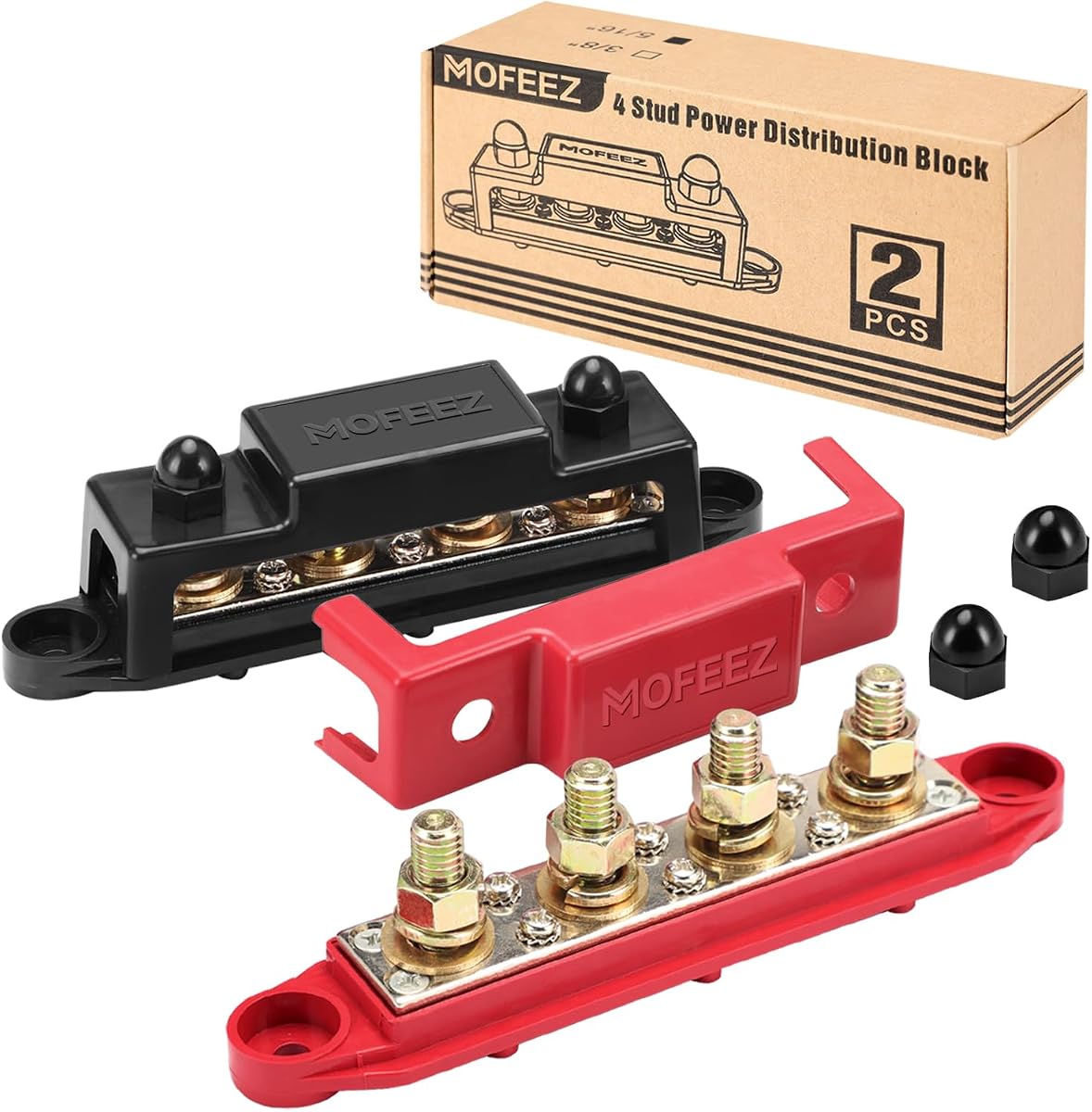
The MOFEEZ 250A bus bar combines a 4.8 rating with a connection layout that suits both battery cables and auxiliary wiring. Each of the red and black blocks has four 5/16-inch studs and six #8 screw terminals. The entire connection is stated to support up to 250A continuously at voltages as high as 48V DC.
We may earn a commission when you buy through this link, at no additional cost to you.
Nickel-plated brass plates are used for the bus bars, providing a stated combination of low resistance, conductivity, and corrosion protection. Nylon nuts are used to connect two external studs, helping prevent accidental short circuits, and a removable nylon cover shields the metal components. The insulated base is described as flame retardant, which is especially relevant in tightly packed electrical compartments.
A key consideration is the difference between stud sizes. The 5/16-inch posts in this version accept 5/16-inch ring terminals, but they are not interchangeable with the larger 3/8-inch studs offered by the related MOFEEZ listing. Buyers should check their existing lugs before choosing. Within its stated rating and layout, the block offers an effective way to run a dedicated ground and several smaller low-voltage connections.
This MOFEEZ model is a strong all-around selection for cars, RVs, yachts, caravans, and other low-voltage systems. Its 4.8 rating, removable cover, corrosion-resistant plates, and mixture of stud and screw connections make it especially useful for a clean, flexible installation. It is best for builders who can work with 5/16-inch hardware and want a high-capacity block without moving to the most heavy-duty configuration.
Four 5/16-inch studs support heavier feeds, while six #8 screws accommodate smaller circuits. This mixed layout makes the block useful for consolidating an entire subsystem rather than merely splitting one cable.
Nickel-plated brass plates are specified for conductivity and corrosion resistance. Nylon hardware and a removable cover add separation between exposed components and nearby surfaces.
We may earn a commission when you buy through this link, at no additional cost to you.
The RVMARINEPAT 250A Bus Bar stands out for its six 5/16-inch M8 studs on each block. That gives it more main cable positions than most products in the group while retaining a stated 250A maximum current and 48V DC operating limit. Its 4.8 rating reinforces its position among the strongest choices for multi-connection installations.
We may earn a commission when you buy through this link, at no additional cost to you.
The cover is designed to permit 180-degree wire lug installation, which is valuable when a cable or terminal must approach from a direction that a conventional low-profile cover would obstruct. The package also includes twelve copper ring lugs and twelve heat-shrink tubes. These parts support proper cable termination and help organize the connection points after installation.
A rounded-corner base is intended to improve stability and visual presentation. Copper plates and stainless steel terminals form the conducting and fastening structure, while the product is marketed for automotive, marine, solar, and similarly demanding environments. The 250A rating describes the bus bar's capacity, but the actual system performance still depends on suitable cables, secure torque, appropriate fusing, and correct conductor sizing.
Choose this set when a project requires several independent heavy connections rather than only one or two. It is well suited to marine and vehicle systems that can accommodate a larger base and need flexible lug orientation. For compact installations, a model with fewer studs may be easier to place, but for broad distribution and useful included termination hardware, the RVMARINEPAT pair is a compelling option.
Six M8 studs on each block provide more main connection points than the four-stud designs in the group. This is advantageous for systems with several high-current accessory feeds.
The open-area cover supports 180-degree lug installation. That flexibility can simplify routing in a crowded engine compartment, battery compartment, or marine electrical panel.
We may earn a commission when you buy through this link, at no additional cost to you.
The DAIERTEK Mini 150A Bus Bar prioritizes a compact connection format without giving up four 5/16-inch M8 posts. It carries a 4.7 rating and is described as smaller than normal 150A bus bars, making it worth considering where mounting space is limited. The pair includes positive and negative blocks with protective covers.
We may earn a commission when you buy through this link, at no additional cost to you.
A notable specification is the stated compatibility with circuits up to 300V AC or 48V DC. The conductor uses tin-plated copper, while the hardware is stainless steel. Its base is nylon and the cover is polycarbonate, producing a combination intended to provide reliable insulation and physical protection. The product is marketed for automotive, marine, and solar systems.
The side posts can accept wire lugs from up to 180 degrees, which helps installers work around nearby brackets, cables, or enclosure walls. Unlike several alternatives in this list, it does not advertise a bank of smaller #8 screw terminals. Users must therefore plan around the four main posts on each bar and bring separate connection hardware for those positions as needed.
The DAIERTEK mini is a sensible pick when available area is more constrained than expected, particularly for a boat, car, or solar installation with several medium-to-heavy feeds. Its 150A rating is lower than the 250A and 300A selections, so it is better suited to appropriately sized circuits than a bank of high-load accessories. The compact format, broad voltage statement, and flexible post access compensate for that limitation.
The stated dimensions are smaller than conventional 150A bus bars, yet four 5/16-inch posts remain available. It offers a practical way to preserve multiple cable connections in a restricted installation area.
A stated maximum of 300V AC and 48V DC makes this model more broadly specified than many blocks listed only for 48V DC use. Appropriate system design remains essential regardless of the stated limit.
We may earn a commission when you buy through this link, at no additional cost to you.
This MOFEEZ version delivers the same general 250A and 48V DC capability as the 5/16-inch model, but it uses four larger 3/8-inch posts. That makes it the more relevant option for heavy battery cables fitted with larger ring terminals. It also includes six #8 screw terminals for smaller accessory wiring.
We may earn a commission when you buy through this link, at no additional cost to you.
The design uses nickel-plated brass plates intended to offer low resistance, good conductivity, and corrosion protection. Nylon nuts attach two external studs to help prevent accidental contact, and the removable nylon cover shields metal components from surrounding objects. The insulated base is described as flame retardant, adding a useful material specification for compact electrical installations.
The stated maximum continuous amperage of 250A applies to the entire connection, while maximum intermittent current is listed as 20A for each connection for less than one minute. These conditions should be considered during circuit planning, especially for accessories that draw surge current. The extra stud size changes cable compatibility but does not increase the overall stated continuous rating beyond 250A.
This model is a logical selection for a vehicle, boat, yacht, or RV where 3/8-inch ring lugs are already used and several accessory circuits need a central location. It provides more flexibility than a single-stud block and larger lug compatibility than the related 5/16-inch MOFEEZ option. Buyers should confirm mounting clearance because the larger hardware and covers require adequate space around the assembly.
The four 3/8-inch studs accept larger ring terminals than 5/16-inch posts. This is valuable for heavy feeder cables and lets users avoid changing established terminal sizes.
Six #8 terminals allow accessory leads to be grouped on the same block as the main battery feeds. The result is a cleaner installation and easier circuit identification.
We may earn a commission when you buy through this link, at no additional cost to you.
The DaierTek 300A Bus Bar is the premium high-capacity option in this group, with a stated continuous rating of 300A, a 4.8 buyer rating, and six 3/8-inch M10 studs on each block. It includes one positive and one ground bus bar, giving installers a matched pair for a complete low-voltage distribution installation.
We may earn a commission when you buy through this link, at no additional cost to you.
The product can be used in circuits up to 300V AC or 48V DC according to the supplied information. Six large studs per bar provide considerable routing flexibility, while the special cover leaves exposed areas at the sides for 180-degree wire lug installation. This makes it easier to fit cables that need to enter from a side or nearby obstacle.
A round-corner base is intended to improve stability and distinguish the unit from conventional rectangular bus bars. The design is specifically presented for high-current systems, including automotive and marine installations. Although the 300A headline rating is substantial, safe performance depends on the entire electrical path: cable gauges, lugs, terminations, protection, and the source circuit must all be appropriate for the load.
This DaierTek pair is the most convincing choice here for builders who need a high stated current capacity, multiple large cable connections, and flexible terminal direction. It offers more main posts than most 250A alternatives and a larger rating than the 150A models. The tradeoff is a bulkier assembly and the need to design carefully around the requirements of a genuinely high-current system.
Each bar has six 3/8-inch M10 studs, allowing several large ring-lug connections. This extensive post count supports broad distribution in demanding automotive and marine circuits.
The stated 300A continuous rating gives designers more capacity than the 150A and 250A products in the list. It should be treated as a system-design specification, not a substitute for correctly sized conductors and protection.
We may earn a commission when you buy through this link, at no additional cost to you.
The 150A Two-Pack Bus Bar is designed around compact dimensions and a straightforward 150A rating. It holds a 4.6 rating and is supplied as a two-pack for use in positive and ground distribution. The block is intended for 12V through 48V DC circuits, covering many common automotive, RV, boat, and solar applications.
We may earn a commission when you buy through this link, at no additional cost to you.
Its solid tinned copper bus bar is paired with a rigid base for low-resistance battery cable connections. The stated measurements are approximately 5.4 inches long with the cover, 4.7 inches for the base length, 0.9 inches wide, and 0.5 inches high. These figures are useful for checking a battery compartment before installation, particularly where larger six-stud designs would be inconvenient.
Each block uses 1/4-inch studs and includes twelve terminals. Snap-lock covers are designed to resist vibration, reduce accidental contact, and keep terminals covered during service or transport. The product is also presented as a way to reduce clutter around battery posts, simplify troubleshooting, and organize circuits for fuse blocks, lighting, winches, and audio systems.
This bus bar is a good candidate for a compact RV, truck, UTV, off-road, marine, or smaller automotive distribution setup. Its 1/4-inch studs are the main limitation for very heavy cable applications, while the 150A rating requires appropriately designed circuits. In return, it provides a tidy, vibration-conscious design with clear dimensions and included connection terminals.
The stated height and width make this easier to fit into a tight battery compartment. Checking the exact dimensions against available mounting space remains important before ordering.
Snap-lock covers are intended to stay closed during vehicle and marine use. They help shield terminals and reduce accidental contact while the installation is being serviced or transported.
We may earn a commission when you buy through this link, at no additional cost to you.
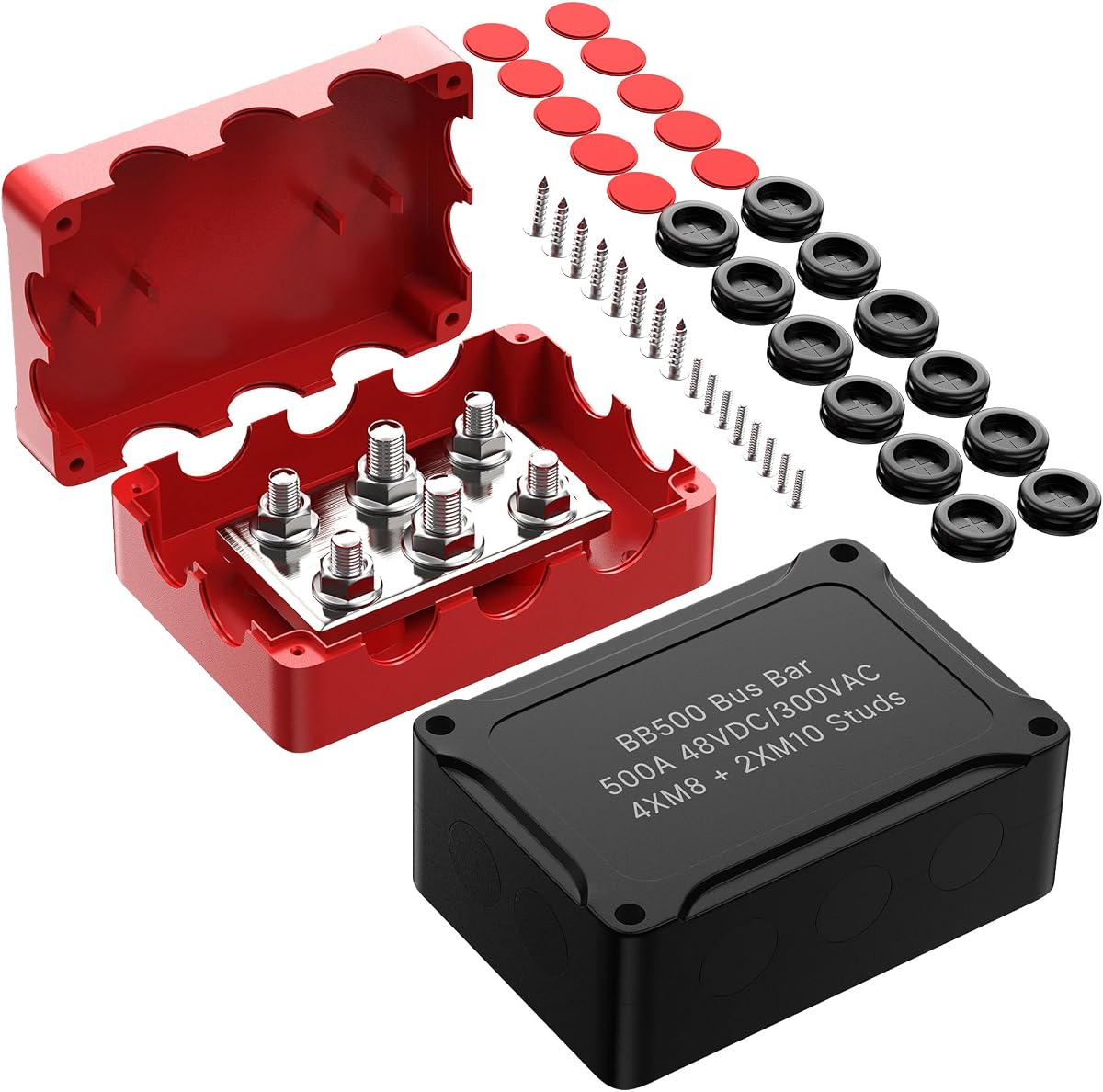
The Joinfworld 500A Bus Bar has the highest stated current capacity in the selection and is clearly aimed at heavy-duty systems. It includes a red positive block and a black negative block, with thicker copper plates designed to accept a wider range of cables. Unlike most products here, no customer rating was supplied, so its reputation cannot be compared directly through a numerical score.
We may earn a commission when you buy through this link, at no additional cost to you.
Each bar has four 5/16-inch M8 studs and two 3/8-inch M10 posts. The mixed sizes are useful because a builder can reserve the larger posts for the heaviest feeders and use the smaller ones for secondary high-current branches. The blocks are stated to operate up to 48V DC or 300V AC and carry a 500A rating.
Waterproof rings are included to provide sealing around the connections, and removable plates allow wires and terminals to pass through more easily. The goal is to improve installation flexibility and help reduce short-circuit risk. As with other blocks, covers and seals are not substitutes for sound strain relief, proper conductor placement, corrosion control, or circuit protection.
This is the most specialized product in the guide, suited to demanding automotive, truck, RV, boat, or solar systems that have been designed around a very high capacity. Its mixed post sizes give it unusual connection flexibility, but the 500A headline should never be treated as permission to undersize cables or omit protection. It is best suited to informed installers who can match every component to the planned load.
Two 3/8-inch M10 posts can accept primary heavy feeds, while four 5/16-inch M8 studs provide additional high-current branches. This mix offers more choice than blocks with one uniform post size.
Waterproof rings and removable plates support installation in demanding environments. The plates make cable routing easier while helping shield the conductive areas from accidental contact.
We may earn a commission when you buy through this link, at no additional cost to you.
The RVBOATPAT 250A Bus Bar offers a deliberately simple alternative to the bus bars with four, six, or more large connection posts. It carries a 4.6 rating and includes a positive and ground block. Each bar has two 3/8-inch M10 studs, making it suitable when the wiring design needs only a main feed and a limited number of branches.
We may earn a commission when you buy through this link, at no additional cost to you.
The studs are made from 304 stainless steel to resist corrosion, an important material consideration in boats, vehicles, and outdoor solar installations. The stated continuous current rating is 250A, with a maximum operating voltage of 48V DC. The package includes two 1/0 AWG copper lugs and four 6 AWG copper lugs, providing hardware for several connections.
A protective cover made from tough polycarbonate is included for each bar. Its stated purpose is to reduce the chance of short circuits by shielding conductive components. Compared with complex distribution blocks, the small number of terminals also makes circuit tracing and troubleshooting more straightforward, provided the user does not need to combine many separate accessory feeds in one location.
This model suits a car, caravan, boat, yacht, or solar system where a clean two-point connection is sufficient. It offers a 250A rating and larger studs without the footprint of the six-stud alternatives. The trade-off is limited expansion capacity, so installers with numerous circuits may prefer a block that includes additional screw terminals or additional main posts.
Two large studs per bar keep the distribution scheme simple. This can make wiring easier to understand and reduces the number of junctions that need inspection during troubleshooting.
The 304 stainless steel studs and polycarbonate covers are practical material choices for marine and outdoor use. The included copper lugs cover several common connection sizes.
We may earn a commission when you buy through this link, at no additional cost to you.
The right bus bar depends on more than its headline current rating. Cable size, terminal style, available space, environmental exposure, and the number of circuits being organized should all influence the selection.
Begin with the largest current expected in the connected circuit, but do not use the bus bar rating as the only consideration. A block marketed at 150A, 250A, 300A, or 500A must be paired with correctly rated cables, terminals, protection, and upstream equipment. The conductor path is only as strong as its weakest connection. A higher-rated block may provide useful design headroom, but oversized capacity cannot compensate for undersized wiring.
Choose a current rating that comfortably accommodates the intended load, and verify whether the stated figure applies continuously, intermittently, or to the whole assembly. Treat the rating as an upper limit under proper conditions, not a guarantee of output. Match all components as a system.
Stud size determines which ring terminals and cables can be used. Options in this guide include 1/4-inch, 5/16-inch, and 3/8-inch posts, with some products combining M8 and M10 sizes. The 3/8-inch studs suit larger lugs, while 1/4-inch studs can be easier to fit in compact spaces. Smaller #8 screw terminals provide additional attachment points for lower-current accessory wires.
Inspect the existing cables and lugs before ordering. A bus bar with an otherwise attractive layout is inconvenient if its posts do not match the terminals already installed. Account for the hardware's outside diameter and cable bend radius as well as the nominal stud size.
Count the circuits that genuinely need a shared distribution point. A two-stud pair is streamlined but offers limited branching, while four- and six-stud models can accommodate more high-current feeds. Products with twelve M4 screws are more appropriate for numerous small accessory circuits. The best design is the one that matches the actual wiring plan without creating unnecessary junctions.
List primary feeds, secondary branches, grounds, and accessory circuits before selecting. Avoid using extra capacity merely because it is available. A clearer layout with the appropriate number of connections is usually easier to install, inspect, and troubleshoot.
Most low-voltage automotive, marine, RV, and solar installations use 12V DC, and many bus bars are rated to 48V DC. Two products in the list also state a 300V AC maximum, while the 500A Joinfworld model lists both 300V AC and 48V DC. These broader statements do not automatically make a block appropriate for every AC arrangement; terminal spacing, insulation, fusing, and code requirements still apply.
Confirm the voltage and current of the actual circuit. For DC systems, pay particular attention to the stated maximum DC voltage and use the block only within those limits. Do not infer suitability for mains electricity from an AC voltage statement alone.
The products use copper, tinned copper, brass, or nickel-plated brass conductor plates, along with stainless steel or plated hardware. These materials are intended to balance conductivity, corrosion resistance, and mechanical strength. Tinned copper can provide a plated contact surface, while stainless steel terminals are useful in damp or exposed environments. The base and cover materials determine insulation and physical protection.
Prioritize a solid conductor plate, corrosion-resistant fasteners, an insulated base, and a cover that fits securely. Material quality matters most in marine, automotive, and outdoor installations where heat, moisture, vibration, and changing temperatures are routine.
Bus bars must fit not only in the nominal mounting area but also among nearby brackets, cables, enclosure walls, and service access points. The compact two-pack is about 0.9 inches wide and 0.5 inches high according to its listed dimensions, while six-stud models generally have broader bases. A rounded or compact shape may help in tight areas, but the cable bend radius and lug rotation remain important.
Measure the available space before purchasing, including room for the cover and fasteners. Check whether a side-entry cable would collide with a wall. If the cover restricts terminal orientation, look for a design that supports 180-degree lug installation.
Removable or locking covers reduce accidental contact with conductive parts during servicing, transport, and everyday vibration. The 150A two-pack uses snap-lock covers, several other products have removable covers, and the 500A Joinfworld includes waterproof sealing rings. These features are useful, but they cannot replace proper fusing, insulation, cable support, or safe work practices.
Choose a cover that holds securely and permits the intended cable-entry angle. For exposed marine or outdoor installations, consider whether grommets, seals, and corrosion-resistant hardware address the specific moisture risks in the location.
All ten products are aimed at low-voltage power organization, but their layouts suit different systems. Marine installations may benefit from corrosion-resistant hardware, compact housings, and open lug access. Vehicles and trucks may need large studs for winches, audio, or auxiliary batteries. Solar and RV systems often reward multiple smaller terminals and clear positive-versus-ground identification.
Read the stated application list alongside the physical design. The best bus bar is not merely capable of carrying current; it should also fit the environment, support the conductor sizes you use, and make the completed wiring easier to understand and maintain.
Before installation, disconnect the battery or otherwise de-energize the circuit according to safe automotive and electrical procedures. Identify the positive, negative, ground, and accessory circuits, then plan the cable paths and fuse locations. Mount the bus bar on a clean, rigid, nonconductive surface with enough clearance for covers, terminals, and service access. Do not position it where sharp edges, moving parts, heat sources, or standing water can damage the wiring.
Install the correct main cable first, using lugs that match the post diameter and the cable's current requirement. Tighten fasteners to the appropriate specification for the hardware, making sure the conductor is seated properly and no stray strands are trapped beneath the lug. Connect accessory circuits to the screw terminals or additional studs, maintain clear separation between positive and ground conductors, and use proper fusing for each protected branch. Avoid placing the protective cover on before every conductor has been inspected.
After installation, check the layout for movement, chafing, loose hardware, and accidental contact points. Keep the area clean and dry, inspect covers and seals periodically, and recheck terminations if the system is exposed to substantial vibration. Replace damaged covers, corroded hardware, or discolored cables rather than relying on the bus bar's rating to compensate for degraded components.
A bus bar power distribution block provides a central organized location for connecting battery, ground, charger, inverter, and accessory wiring. Instead of crowding several leads onto battery posts, conductors can terminate on labeled studs or screw terminals. This can simplify circuit routing and troubleshooting while keeping the installation tidy. The block still requires correctly sized cables and appropriate circuit protection.
No. A higher rating can be beneficial when the system genuinely needs more capacity, but it does not make undersized wiring safe. The bus bar, cables, lugs, fuse protection, and source circuit must all be suitable for the load. A simpler block with an appropriate rating may also be easier to fit and less costly than an oversized alternative.
The correct stud size depends on the ring terminals and cable gauges in your installation. Larger studs generally accommodate larger lugs and heavier conductors, while smaller studs can help with compact layouts. Match the lug hole exactly, confirm that the cable suits the intended current, and allow sufficient room for the hardware and cable bend.
Many sets in this guide include one positive and one ground bar, commonly distinguished by red and black components. Either side can be used for power or ground depending on the system design, provided polarity is handled correctly and the connections remain properly separated. Follow the wiring plan and avoid placing positive and negative conductors where they can contact each other.
Yes. A bus bar distributes power but does not protect individual cables or circuits from overload or short circuits. Each branch should have suitable circuit protection selected according to the conductor, load, and applicable electrical requirements. The upstream battery feed and any shared distribution conductors must also be protected appropriately.
A model described as waterproof or supplied with sealing rings may be better suited to damp environments, but the rating alone does not determine suitability. Consider the base material, terminal corrosion resistance, cover design, mounting location, and cable entry method. Even in a boat, conductors should be supported, sealed where appropriate, and protected from chafing and standing water.
Measure the available mounting area and compare it with the product dimensions, including the base, cover, studs, and cable clearance. Check the direction from which each lug must be installed and make sure the cover can be fitted afterward. For compact installations, also verify that a large cable can bend without being forced against a sharp edge.
Periodic visual inspection is the main requirement. Look for loose fasteners, corrosion, damaged insulation, discolored conductors, water intrusion, and cover damage. In high-vibration environments, rechecking connections may be appropriate after the first period of use. Do not work on an energized circuit, and replace damaged or corroded components as needed.
The Joinfworld 250A pair is the most balanced general choice, combining four 3/8-inch studs with three #8 screw terminals on each block. The MOFEEZ 250A model stands out for its 4.8 rating, removable cover, and similarly versatile connection layout, while the DaierTek 300A set offers the premium combination of a higher stated current rating and six large studs per bar.
For a smaller or simpler system, the RVBOATPAT 150A model with twelve M4 screw terminals may be more useful than a block dominated by large studs. Conversely, projects with several heavy feeds should examine the six-stud MOFEEZ, RVMARINEPAT, and DaierTek options or the mixed-size 500A Joinfworld. Prioritize matching the terminals to existing lugs and sizing the complete electrical system, not just the bus bar.
Product ratings, availability, and prices can change, so check the current listing and technical details before buying. Confirm the current and voltage requirements, physical dimensions, included hardware, and application suitability. With those checks completed, the guide's shortlist provides a strong starting point for a cleaner, safer, and easier-to-service power distribution system.