ANENG AN9002
4.3Editor score
Bluetooth phone connectivity
6000-count True RMS display
Extensive accessory package
Discover the best Bluetooth Smart Multimeter options, comparing accuracy, connectivity, safety, logging, displays, and practical electrical testing features.
A Bluetooth Smart Multimeter combines familiar electrical testing with wireless monitoring, remote viewing, and digital data capture. The most useful models go beyond basic voltage checks, offering auto-ranging, True RMS, non-contact voltage detection, temperature measurement, and phone compatibility in a dependable jobsite instrument.
The products in this guide were compared using their published specifications, measurement ranges, display features, safety protections, power options, and connectivity capabilities. The list covers handheld multimeters and clamp meters for household troubleshooting, automotive work, HVAC maintenance, industrial service, and professional electrical testing.
Each review explains where the meter excels, identifies practical limitations, and clarifies which type of user is most likely to benefit. Product ratings and availability can change, as can promotional pricing, so verify the current listing and accessories before making a final purchasing decision.
4.3Editor score

4.8Editor score

4.6Editor score
The table below compares all ten meters by format, core measurement capability, connectivity, and practical usability. It highlights the major difference between general-purpose handheld models, feature-rich clamp meters, and professional instruments designed for connected HVAC or industrial workflows.



The Klein Tools MM460S is a smart, feature-rich digital multimeter built for technicians who want efficient measurements without constantly turning a selector. Its 4.8 rating is the highest among the non-clamp models in this guide. The standout feature is Smart Mode, which automatically switches among continuity, voltage, and resistance tasks while leaving more advanced functions available through manual selection.
We may earn a commission when you buy through this link, at no additional cost to you.
Measurement versatility is another major strength. The meter handles AC and DC voltage up to 600 volts, AC and DC current up to 10 amps, and resistance to 50 megohms. It also includes capacitance, frequency, duty cycle, temperature, and diode testing. True RMS and automatic ranging make it a more credible choice for modern loads than a basic inexpensive meter, while the large reverse-contrast LCD is designed to remain readable in direct sunlight or dim workspaces.
The practical design deserves attention too. Integrated test lead holders, a kickstand, and compatibility with an optional magnetic hanger support one-handed work. The slim housing is easier to carry than a large clamp meter, although users who require true Bluetooth phone monitoring may find the lack of stated wireless connectivity in the supplied specifications worth clarifying before buying. Similarly, 10-amp current support is sufficient for many household and service tasks but not specialized high-current work.
This is the strongest general-purpose choice for electricians, facilities personnel, advanced DIY users, and anyone who values automatic mode, professional measurement functions, and excellent readability. It is less suited to high-current branch-circuit diagnostics or jobs that require remote phone-based logging. For most users seeking a capable smart meter without the bulk of a clamp, the MM460S offers the most balanced specification set.
Automatic function selection is particularly helpful when carrying one meter for many kinds of work. It reduces setup time during continuity checks and basic voltage or resistance measurements, while manual access preserves control for specialized diagnostics.
The reverse-contrast screen, integrated lead holders, and kickstand improve usability at panels, under vehicles, and on service benches. These details can make a meter feel considerably more professional during extended work.
We may earn a commission when you buy through this link, at no additional cost to you.
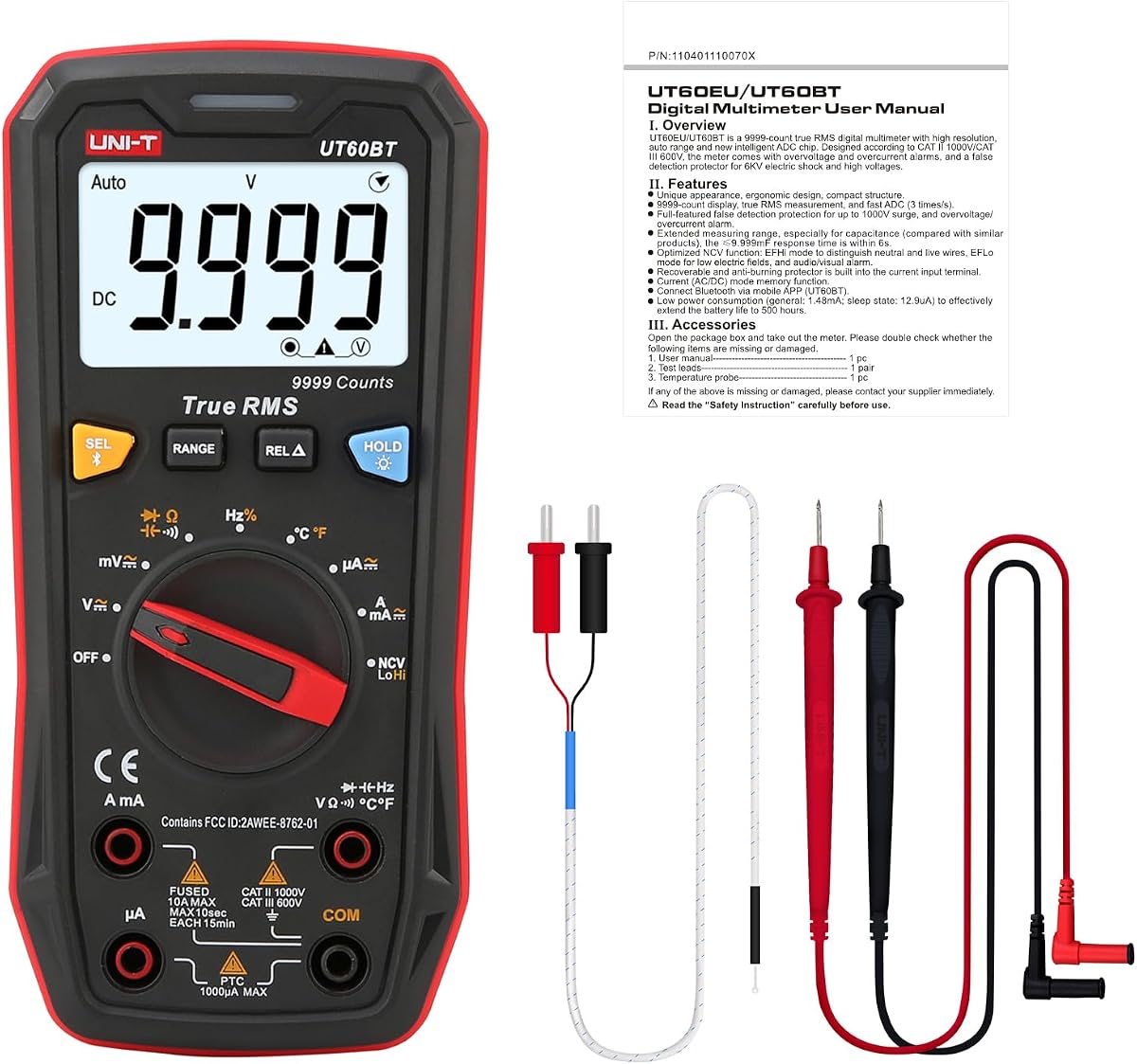
The UNI-T UT60BT is a conventional handheld smart multimeter whose main attraction is direct Bluetooth monitoring from a smartphone. It has a 4.6 rating and combines 1000-volt AC and DC measurement capability with True RMS performance, a 9999-count display, and a fast ADC that updates roughly three times per second. That makes it appealing for technicians who need to monitor or record values away from the meter.
We may earn a commission when you buy through this link, at no additional cost to you.
Its measurement list is extensive. Voltage, current, resistance, capacitance, frequency, duty cycle, diode check, continuity, temperature, and non-contact voltage detection cover most electrical troubleshooting needs. The data hold function freezes a reading for later review, while Bluetooth allows remote viewing and logging without manually copying values. That workflow is valuable during intermittent fault diagnosis, thermal checks, and long monitoring sessions.
The stated false-detection protection is designed for up to 1000-volt surge and overvoltage conditions, although users should still follow the manual, wear appropriate protective equipment, and select a measurement category with the correct connection. Low power consumption is advertised to extend battery life to as much as 500 hours, making it suitable for long deployments. The tradeoff is that it is still a probe-based meter, so current measurement requires opening the circuit rather than clamping around a conductor.
Choose the UT60BT when remote visibility, recorded results, and a broad measurement set matter more than clamp convenience. It is especially well suited to maintenance personnel, educators, and field technicians who can keep a phone nearby while observing data remotely. Buyers primarily seeking an instrument for safe branch-circuit current checks should consider one of the clamp meters later in this guide.
Remote viewing can make a changing measurement easier to monitor while keeping the test leads stable. Logged results also create a more reliable record than manually transcribing values from a moving display.
Temperature, NCV, duty cycle, frequency, capacitance, and diode testing extend the instrument beyond basic voltage checks. The 1000-volt range provides additional headroom for industrial and building electrical work.
We may earn a commission when you buy through this link, at no additional cost to you.
The ANENG AN9002 is a compact Bluetooth multimeter for users who want wireless data transfer and a broad accessory package without moving into premium instrument pricing. Its 4.3 rating is lower than the rest of the list, but the supplied specifications indicate a capable 6000-count, True RMS, auto-ranging meter. It measures up to 600 volts AC or DC, 10 amps of current, and 60 megohms of resistance.
We may earn a commission when you buy through this link, at no additional cost to you.
Beyond the basics, the AN9002 handles temperature, capacitance, frequency, duty cycle, continuity, diode testing, and wire checks. Bluetooth phone connectivity allows the display to be viewed remotely, while data hold, a backlit LCD, auto shutoff, and an adjustable kickstand support everyday use. The auto-ranging feature means users can focus on the conductors rather than learning range selection, and illuminated jack indicators help reduce incorrect probe placement.
The package is unusually extensive for this class, including combination test leads, pointed probes, alligator clips, a U-shaped insert, batteries, a separate temperature line, an instruction manual, and a storage bag. Those extras make it useful for household, automotive, and garage projects. On the other hand, the rating suggests that long-term reliability or overall customer satisfaction may not be as consistently strong as with more established professional choices.
The AN9002 makes the most sense for DIY users, students, and mobile technicians who want a pocketable Bluetooth meter and useful accessories at a budget-oriented level. It is less compelling for regulated industrial environments or users who need traceable professional records. For those requirements, the UNI-T models or a Fluke clamp meter may offer more confidence.
The lightweight housing is slightly smaller than a typical phone and supports one-handed use. The included probes, clips, insert, temperature line, and case make the package ready for varied diagnostic tasks.
Auto-ranging removes much of the guesswork associated with manual range selection. A large backlit display and data hold improve readability, especially when the result needs to remain visible while probes are repositioned.
We may earn a commission when you buy through this link, at no additional cost to you.
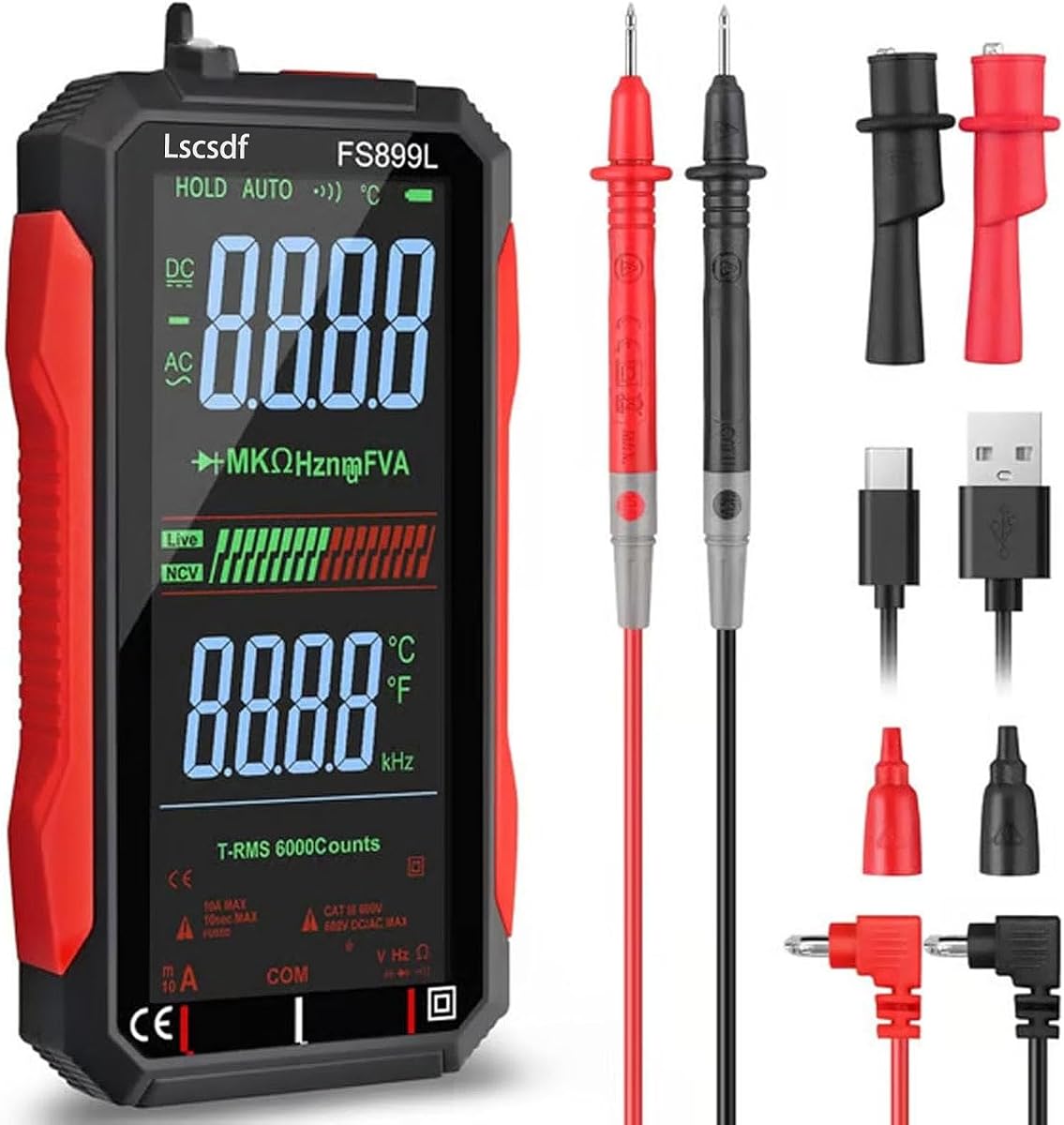
The Lscsdf FS899L differentiates itself with a 4.8-inch color LCD, a large screen that is unusual among handheld multimeters. Its 4.5 rating reflects a generally solid feature set, while the visual interface should be particularly attractive to users who want easier reading during automotive, household, or industrial troubleshooting. The screen can show real-time temperature and provides a backlight for dim conditions.
We may earn a commission when you buy through this link, at no additional cost to you.
The meter supports AC and DC voltage and current, resistance, capacitance, NCV, temperature, diode, and continuity measurements. Its 6000-count display, automatic ranging, and True RMS capability make it more versatile than a basic continuity tester. A protective cover and seismic protection function add durability for mobile use, and an integrated flashlight helps illuminate cramped engine bays, wall cavities, and equipment rooms.
Its internal 200mAh battery can be recharged through the included micro data cable, avoiding routine replacement of disposable cells. That is convenient for regular users, although a smaller battery capacity than some rechargeable competitors may mean less runtime between charges. More importantly for this guide, the supplied product information does not expressly identify Bluetooth connectivity, so buyers should not assume wireless logging merely from the use of the word smart.
The FS899L is best for users who prioritize a large, colorful, easy-to-read screen and rechargeable convenience. It also works well as a general-purpose meter for vehicle and household diagnostics. If remote viewing, recorded datasets, or verified Bluetooth pairing is essential, choose a model whose listing explicitly documents those features.
The 4.8-inch color screen gives readings greater visual presence than conventional monochrome LCDs. It is useful for users who need quick interpretation, share screens with another person, or work in bright and dim environments.
A built-in rechargeable battery removes the need to keep spare cells on hand. The included charging cable and reusable power supply make the meter convenient for regular workshop, garage, or field use.
We may earn a commission when you buy through this link, at no additional cost to you.
The KAIWEETS KM602 combines a 6000-count True RMS display with a useful smart mode that identifies whether it is measuring voltage, resistance, or continuity. Its 4.4 rating places it among the stronger midrange choices, and the extensive feature set makes it appealing for electricians, automotive technicians, and serious DIY users. Manual mode preserves access to current, capacitance, frequency, diode, duty cycle, temperature, NCV, and live-wire functions.
We may earn a commission when you buy through this link, at no additional cost to you.
Its 1200mAh rechargeable battery offers a meaningful capacity advantage over the FS899L, reducing interruptions during long workdays. The package includes a charging cable, thermocouples, test leads, batteries, a manual, and a storage case. Min, max, and average recording captures signal fluctuations, while the analog bar display, real-time temperature readout, low-battery warning, and data hold improve interpretation during extended diagnostics.
Safety is a key selling point. The listed CAT III 1000V and CAT IV 600V ratings make the KM602 more purpose-built for demanding electrical environments, and double-fuse anti-burn and overload protection add layers of defense. The large full-screen color display and built-in flashlight aid use in poorly lit areas. As with the FS899L, however, the provided product data does not explicitly verify Bluetooth connectivity, despite the product's smart designation.
This meter is a good fit for technicians who want rechargeable power, category-rated protection, automatic measurements, and recording functions in one package. It may be less attractive for users whose primary requirement is remote phone monitoring. Verify the current product page and manual if wireless data transfer is essential to your workflow.
Smart mode handles common voltage, resistance, and continuity checks with minimal input. Manual mode provides direct access to specialist functions, giving users speed and control in the same instrument.
Published CAT III 1000V and CAT IV 600V ratings are more relevant to professional electrical work than marketing terms alone. Fuse protection, overload handling, and a large rechargeable battery complement that safety positioning.
We may earn a commission when you buy through this link, at no additional cost to you.
The testo 770-3 is a professional clamp meter set designed around HVAC, electrical maintenance, and connected field documentation. Its 4.6 rating reflects a capable instrument with True RMS voltage and current measurement up to 1000 volts and 600 amps. A retractable pincer arm helps reach tightly grouped conductors without forcing the full jaw into a crowded enclosure.
We may earn a commission when you buy through this link, at no additional cost to you.
The clamp has 0.01-amp resolution in lower current ranges, which is valuable for diagnosing small loads and current changes. Automatic AC and DC detection reduces setup, while automatic selection of resistance, continuity, diode, and capacitance further simplifies operation. A two-line LCD balances several readings and test information without requiring constant cycling through menus.
Bluetooth connectivity through the Testo Smart App adds real-time monitoring, measurement curves, and report generation on compatible iOS or Android devices. The delivery scope reflects professional use, including measuring leads, crocodile clips, micro clips, a Type K thermocouple, magnetic holder, carrying case, batteries, and a test report. Temperature measurement also makes the kit suitable for HVAC diagnostics rather than only electrical inspection.
The testo 770-3 is an excellent choice for HVAC contractors, building-service teams, industrial electricians, and technicians who need traceable app-supported records. It is less compelling for occasional users who only need basic voltage checks. In return for a more specialized premium purchase, it provides a rare combination of fine current resolution, confined-space access, and connected reporting.
Fine 0.01-amp resolution in lower ranges makes small current variations easier to identify. Temperature support, true RMS measurements, and automatic parameter detection align the meter closely with real HVAC service work.
The app can display live readings, plot measurement curves, and create reports. This reduces transcription errors and creates a more professional record when a technician needs to explain a fault or document a test.
We may earn a commission when you buy through this link, at no additional cost to you.
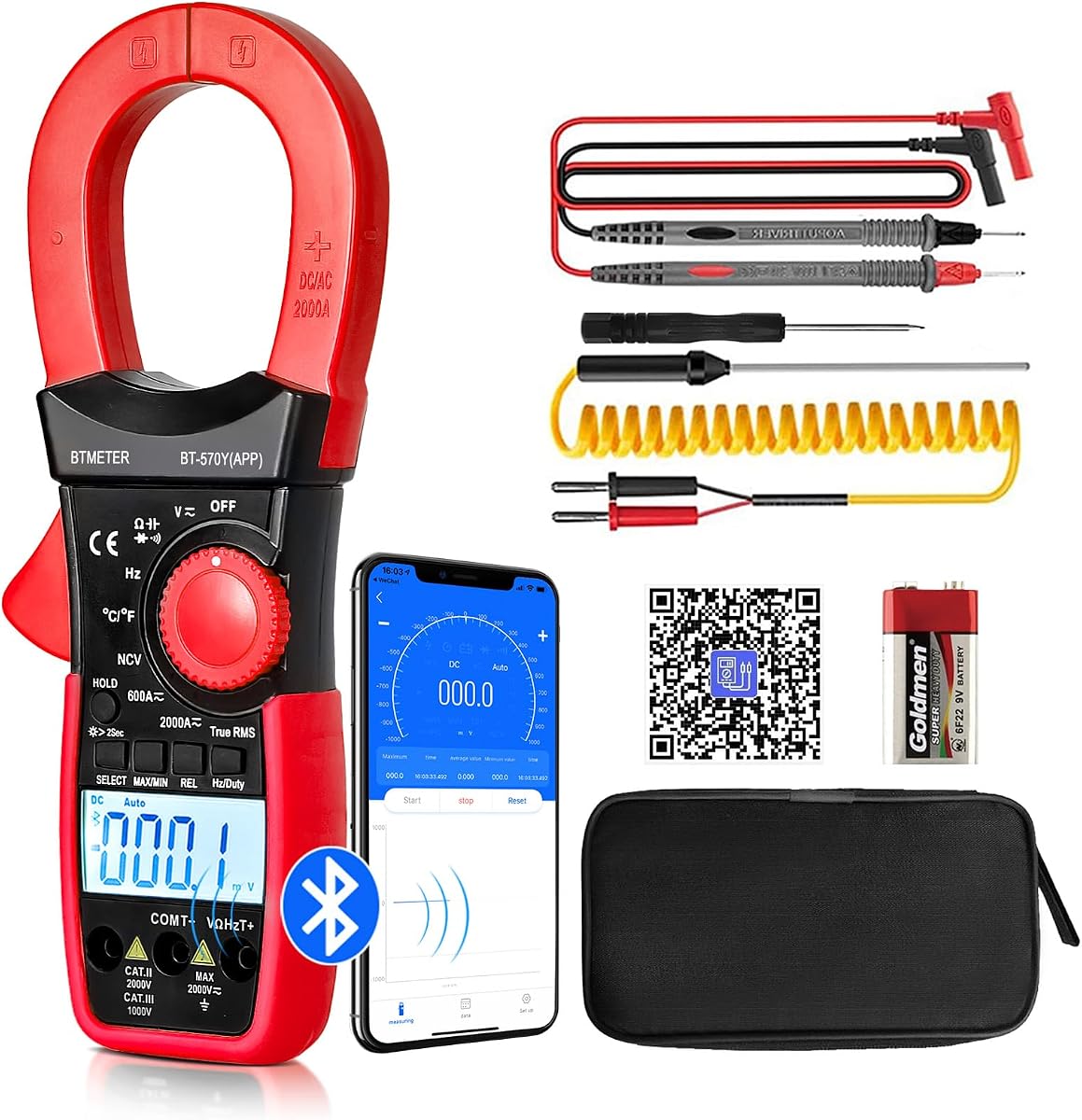
The BTMETER 570Y-APP is a feature-heavy Bluetooth clamp meter with a 5.0 rating, the highest numerical rating in this guide. It is designed for users who need to measure high current without disconnecting a conductor. The 54-millimeter jaw accommodates substantial cables, while the stated current capacity reaches 2000 amps for AC and DC applications.
We may earn a commission when you buy through this link, at no additional cost to you.
Beyond current, the meter covers 6000-count True RMS voltage, resistance to 60 megohms, capacitance to 60 millifarads, frequency from 9.999 hertz to 9.999 megahertz, and temperature from -4 to 1832 degrees Fahrenheit. Test leads add conventional voltage, resistance, diode, and continuity measurements, while a K-type thermocouple handles temperature. NCV detection covers 90 to 1000 volts AC.
Bluetooth syncing with the Intelligent Meter App provides live monitoring, historical recording, and TXT or Excel export. Timestamped maximum, minimum, and average values support trend analysis, and the listed wireless distance of roughly 33 to 50 feet is useful for viewing a load from outside an arc-flash zone. Compatibility with older iPhone and Android versions broadens its potential audience.
The 570Y-APP is especially attractive for industrial maintenance, automotive diagnostics, HVAC work, and large electrical systems where high-current or trend data matters. Its 54-mm jaw and extensive measurement set may feel oversized for household work, and a very large clamp can be difficult to position around tightly packed conductors. Within high-capacity connected diagnostics, however, it is an unusually capable option.
The clamp format allows current to be measured while the circuit remains energized. Its large jaw and 2000-amp ceiling are useful for machinery, service panels, vehicle systems, and three-phase equipment.
Timestamped maximum, minimum, and average values make changes easier to identify than a single instantaneous reading. TXT and Excel export support later analysis, sharing, and formal maintenance records.
We may earn a commission when you buy through this link, at no additional cost to you.
The Fluke 902 FC is a purpose-built HVAC clamp meter with a 4.7 rating and a strong professional identity. Rather than trying to maximize every possible measurement range, it concentrates on common heating and cooling diagnostics. Its Bluetooth connection through Fluke Connect allows readings to be viewed on a phone, helping technicians keep hands near a furnace while obtaining remote data.
We may earn a commission when you buy through this link, at no additional cost to you.
Its standout HVAC capability is 200-microamp DC current measurement, which is low enough to test flame-rod currents. The extended resistance range reaches 60 kiloohms, allowing measurement of thermistors commonly found in temperature-control systems. Flue-gas temperature capture adds another service-oriented function when the appropriate probe is used, while True RMS voltage and current help produce dependable readings on nonlinear electronic loads.
This focused feature set makes the 902 FC attractive to HVAC service technicians who do not need a large general-purpose display or extensive recording functions. Its simplicity can be an advantage: essential diagnostics are accessible without navigating a dense interface. The limitation is that its narrower specialization may not satisfy users seeking extensive capacitance, logging, specialty temperature, or high-current clamp functions available in some competing models.
For professionals repeatedly servicing residential or commercial heating systems, the Fluke 902 FC is a compelling dedicated tool. It is particularly well matched to flame-sensor, thermistor, and flue-gas troubleshooting. A general electrician or broad-spectrum hobbyist may prefer a meter with more functions, but for HVAC-focused work, its specialized low-current measurement is a meaningful advantage.
The ability to resolve 200-microamp DC current makes the meter suitable for flame-rod tests that many general meters cannot perform reliably. The extended thermistor range further supports common furnace and HVAC diagnostics.
Bluetooth links the meter to a phone for wireless viewing and documentation. This is useful around equipment where keeping eyes on a conventional display would be inconvenient or unsafe.
We may earn a commission when you buy through this link, at no additional cost to you.
The BTMETER BT-7200APP is a connected clamp meter focused on showing how electrical values change over time. Its 4.1 rating is the lowest among the listed products, but the feature set is unusually practical for live troubleshooting. AC and DC current, voltage, resistance, capacitance, frequency, duty cycle, NCV, diode, continuity, and temperature are all represented.
We may earn a commission when you buy through this link, at no additional cost to you.
The Bluetooth app can view and log data from approximately 15 meters away, keeping the user away from the immediate measurement area. A timing-based curve graph provides a visual representation of current or voltage changes, and maximum, minimum, and average values appear on the same interface. Adjustable logging rates allow users to choose how frequently data is captured for a particular diagnostic session.
True RMS performance and stated current resolution of 0.1 amp from 0.1 to 60 amps, followed by 1-amp resolution up to 400 amps, support common maintenance tasks. The clamp can also test motor, boat-battery, and household-appliance circuits. A major operational point is that AC and DC clamp readings require isolating the correct conductor; clamping hot and neutral together can cancel the reading and produce zero.
The BT-7200APP is a good option for users who want visual trend monitoring without moving to a high-end specialist system. It is less compelling for regulated work where measurement traceability, construction quality, or brand support are primary concerns, and its lower rating warrants more careful owner feedback review. For vehicle, motor, and appliance diagnostics, it remains a capable connected tool.
A curve graph can expose fluctuations that are difficult to recognize from a single numerical display. It is particularly useful when diagnosing intermittent loads, motors, compressors, and changing battery or charging behavior.
Adjustable logging rates let the user balance resolution against memory and battery demands. Saving measurements for later analysis is valuable for recurring faults that cannot be judged from one brief reading.
We may earn a commission when you buy through this link, at no additional cost to you.
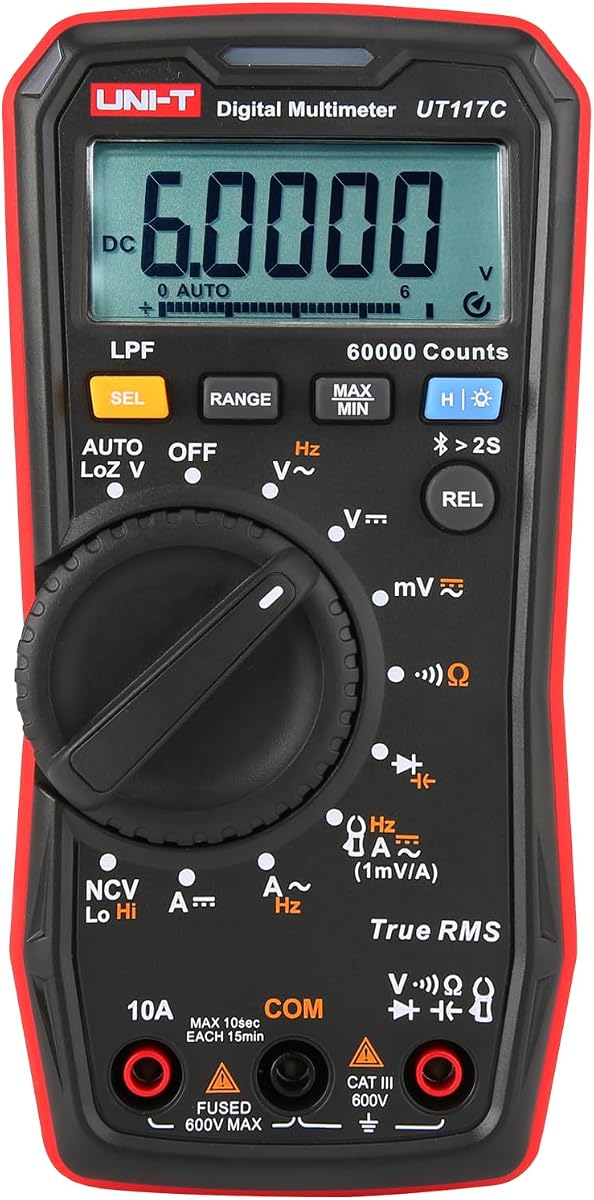
The UNI-T UT117C is a high-resolution digital multimeter built for professional measurements, connected documentation, and industrial troubleshooting. Its 4.6 rating reflects a capable instrument with a 60000-count display, high-resolution analog-to-digital conversion, and True RMS measurement. The Bluetooth 5.0 connection supports real-time recording, report generation, remote monitoring, and historical trend analysis through the UNI-T Smart App.
We may earn a commission when you buy through this link, at no additional cost to you.
One of its most distinctive features is the Low Pass Filter, which reduces high-frequency noise for more stable industrial readings. The 60000-count resolution provides finer display increments, while True RMS performance handles nonlinear loads such as those associated with variable-speed drives. Low-input-impedance LoZ mode can reduce false readings caused by ghost voltages, making the meter more dependable in high-resistance circuit conditions.
Safety and ergonomics are handled with full-range overload protection, a CAT III 600V rating, NCV detection, and a white LED backlight. The included magnetic buckle attaches the meter to metal panels, solar combiner boxes, or vehicle surfaces for hands-free work. External current probes, including the UT-CS06A, can expand AC current measurement to 400 amps.
The UT117C is a strong choice for engineers, industrial technicians, educators, and serious electrical troubleshooters who need more resolution and reporting depth than ordinary consumer meters provide. It is not the right choice for someone who primarily needs a clamp jaw. Users should also understand the purpose of LPF and LoZ settings, because those features provide the most value when matched to the diagnostic task.
A 60000-count display and high-resolution converter reveal smaller changes than lower-count instruments. This is useful for calibration-style comparisons, stable signal analysis, and work involving variable-speed drives or other noisy systems.
The app supports remote monitoring, recording, reports, and historical analysis. LPF and LoZ modes help control noise and ghost voltages, giving engineers more control over the conditions in which readings are collected.
We may earn a commission when you buy through this link, at no additional cost to you.
Choosing the right connected multimeter means balancing measurement needs, electrical safety, display usability, power management, and the value of wireless data. The right instrument for a household repair may differ substantially from one used for industrial maintenance or formal test documentation.
A standard handheld meter uses two probes and is best for voltage, resistance, continuity, diode, and many general electrical checks. It is compact and versatile, although current testing normally requires opening the circuit. A clamp meter surrounds a single conductor to measure current without disconnecting it, making it safer and faster for motors, HVAC equipment, branch circuits, and live-system diagnostics. Choose a handheld model for broad electronics and low-voltage work, or a clamp meter when current is the main focus.
Smart does not always mean Bluetooth. Some products in this category prominently describe automatic modes, rechargeable batteries, or large displays without confirming wireless pairing. For genuine remote use, look for explicit Bluetooth language, a named compatible app, supported operating-system versions, and the ability to view, record, or export readings. Also distinguish simple remote viewing from full data logging, trend curves, timestamped records, and report generation.
Voltage and current ranges determine whether a meter can handle residential circuits, industrial systems, motors, or service equipment. A 600-volt meter suits many routine applications, while a 1000-volt meter provides more headroom for building and industrial work. Current capability is equally important: 10 amps may be enough for general testing, whereas 400 to 2000 amps supports larger motors and service equipment. Consider resistance, capacitance, frequency, duty cycle, temperature, diode, continuity, and NCV functions as well.
True RMS is valuable on modern electronic loads because it is designed to measure non-sinusoidal waveforms more reliably than basic average-response meters. Display count indicates how finely the meter can resolve a value, with 6000 counts typical for general instruments and 60000 counts providing finer increments. Neither feature replaces correct range selection or sound test technique, so they should support, rather than define, the purchase decision.
Look for a clearly stated safety category such as CAT II, CAT III, or CAT IV, along with overload protection, input fuses, and appropriate probe ratings. Category ratings describe particular installation conditions, so the category alone is not a guarantee of universal safety. Verify maximum voltage, current input limits, connector arrangement, and the manual instructions. A multimeter should supplement, never replace, appropriate protective equipment and an approved work procedure.
Replaceable cells are familiar and can be convenient for infrequent users, while a rechargeable battery reduces ongoing battery expense. Rechargeable capacity matters: a larger internal battery is more likely to last through a full workday. Check charging connector type, whether a cable is included, battery alerts, and auto shutoff. For extended field studies, compare advertised battery life and consider keeping conventional cells as a backup if the meter uses them.
A large backlit display improves readability, particularly in panels, vehicles, and dim mechanical rooms. Reverse-contrast screens can remain visible in direct sunlight, while color screens may make menus and trend information easier to interpret. Consider digit count, hold, Min/Max/Average recording, analog bars, flashlight placement, selector clarity, jack illumination, and whether the case supports hands-free positioning. A great display is not enough if the interface is confusing in the field.
A complete kit may include test leads, alligator clips, sharp probes, thermocouples, batteries, charging cables, storage cases, magnetic straps, and manuals. These accessories can add real value, but compatibility and build quality matter. For professional work, consider warranty coverage, technical support, calibration information, and whether app reports provide the traceability required by your organization. Confirm that the phone, tablet, and operating system support the intended application.
Before testing, inspect the meter, probes, leads, batteries, and Bluetooth connection for visible damage. Select the required measurement function and confirm the input jack matches that function. Verify the displayed value makes sense before touching an unknown circuit, and never exceed the meter's published voltage, current, or category limits. Wear appropriate eye and hand protection for energized work.
Connect and pair the Bluetooth device in an area with clear wireless reception, then confirm the app can display live values before approaching a live test. Use data hold for stable readings and recording for changing values. For a clamp meter, place the jaw around only one conductor; clamping both live and neutral conductors together can cause their magnetic fields to cancel and produce a misleading zero.
After use, disconnect test leads safely, power the meter off or allow auto shutoff to conserve energy, and return it to its case. Keep the device away from excessive heat, moisture, dust, and impact. Charge rechargeable models as directed, remove batteries from prolonged storage if the manufacturer recommends it, and update the companion app when updates improve compatibility or reporting.
A Bluetooth multimeter lets you view measurements on a phone, tablet, or dedicated app instead of relying only on the onboard display. Some models can also record, timestamp, graph, export, and report data. This can reduce manual transcription errors and allow remote monitoring, although not every smart multimeter provides full Bluetooth functionality.
A clamp meter is generally safer and more convenient for measuring current because it can measure AC or DC current around a conductor without opening the circuit. It still presents electrical hazards and must be used within its rating. For voltage, resistance, continuity, and many other tests, a standard probe-based meter remains necessary.
No. Some smart meters only provide automatic range selection, smart modes, or rechargeable operation. To confirm wireless logging, check for explicit Bluetooth support, a named app, operating-system requirements, recording controls, and export formats. A product title alone may not tell the complete connectivity story.
True RMS meters calculate the effective value of an AC signal across both sinusoidal and non-sinusoidal waveforms. This makes them more dependable for modern equipment containing power electronics, variable-speed drives, LED drivers, and other nonlinear loads. The technology is beneficial, but correct range, probe placement, and test technique remain essential.
It can handle many routine electrical tests, but connectivity is only one feature of the instrument. A standard meter is still needed when Bluetooth adds no practical value or when a lower-cost probe-based instrument meets the task. For comprehensive work, consider measurement ranges, clamp capability, safety category, accessories, and display design alongside wireless functions.
The distance depends on the meter and the supplied product information. The BTMETER 570Y-APP lists approximately 33 to 50 feet, while the BT-7200APP lists about 15 meters. Walls, equipment, body position, and wireless interference can reduce practical range, so confirm compatibility and test the connection in the intended work area before relying on remote monitoring.
Confirm that the meter and probes are rated for the expected voltage, current, installation category, and measurement type. Inspect insulation and connectors, select the proper function and range, and verify the input jack. Use the correct technique, including clamping only one conductor, and follow the manufacturer's safety instructions.
Rechargeable models are convenient for frequent users because they reduce disposable battery purchases and can be ready between jobs. Their practical advantage depends on battery capacity, charging time, and access to a suitable cable. Users doing occasional work may prefer familiar replaceable cells, while frequent field technicians often benefit more from a larger built-in rechargeable battery.
The Klein Tools MM460S is the most balanced general-purpose selection, with automatic Smart Mode, True RMS, a highly readable display, broad functions, and thoughtful hands-free features. The ANENG AN9002 stands out as the budget-oriented connected option, while the testo 770-3 set is the premium recommendation for HVAC professionals who value app-based reports, fine current resolution, and confined-space access.
Prioritize the instrument that fits the actual job rather than wireless features alone. Clamp capability matters for motors and energized circuits, high resolution helps with subtle changes, safety categories matter in professional environments, and a comfortable display reduces errors. The UNI-T UT60BT, UT117C, and the connected BTMETER models also deserve consideration for specific logging, industrial, or high-current workflows.
Before purchasing, verify the current product listing, app compatibility, measurement limits, included accessories, and certification or safety information. Ratings, promotional offers, and availability can change over time, so compare the final listing against the priorities identified in this guide before choosing your Bluetooth Smart Multimeter.