
Athena Rocket-Building Kit
4.5Editor score
Fully assembled rocket
No model construction required
Bright 12-inch parachute
Discover the best Estes Rocket Launch Kit options for beginners and advanced builders, comparing rockets, launch systems, assembly, altitude, and recovery.
Estes model rocket kits turn STEM learning into an outdoor experience, combining hands-on assembly, propulsion, recovery, and launch-day excitement. A strong kit should be approachable for a first-time builder, include a reliable launch system, and provide enough challenge to remain engaging after the inaugural flight.
This guide compares ten Estes Rocket Launch Kit options spanning prebuilt rockets, beginner construction sets, dual-rocket bundles, and advanced two-stage models. We evaluated the supplied specifications for assembly requirements, included equipment, age guidance, engine compatibility, projected altitude, launch-system requirements, and intended level of rocketry experience.
Each review shows who a kit is best suited for, along with its standout features, practical trade-offs, and the extra equipment or preparation it may require. Ratings and specifications reflect the supplied product information, while pricing and availability can change, so readers should confirm current listings before purchasing.
4.5Editor score

4.5Editor score
4.2Editor score
The table below compares the ten kits by build style, launch system, skill level, and performance, making it easier to distinguish immediate-flight options from beginner and advanced construction projects.



The Estes 1469 Tandem X Rocket-Building Kit receives a 4.5 rating and stands out as the most versatile option in this collection. It includes two different beginner rockets, parachutes, a Porta Pad II Launch Pad, and an Electron Beam Launch Controller, giving a new rocketeer the chance to compare a large 30-inch Amazon model with a streamlined 15.6-inch Crossfire ISX.
We may earn a commission when you buy through this link, at no additional cost to you.
Its strongest feature is variety without making the set overly complicated. The precolored Amazon rocket uses plastic fins and self-stick graphics and can be assembled in about an hour. The Crossfire ISX has laser-cut wood fins, self-stick decals, and aerodynamic parts. Projected altitude reaches 600 feet for Amazon with a C6-5 and 1,150 feet for Crossfire ISX with a C6-7.
The trade-off is that the kit remains incomplete for actual launch day. Engines, starters, recovery wadding, and four AA alkaline batteries must be obtained separately, and users must select an appropriate engine for each rocket. Some buyers may also prefer the simplicity of a single prebuilt model, while others will appreciate the broader learning experience provided by two different designs.
This is a strong recommendation for families with children ages 10 and older who want more than one launch and value variety. It also suits adults beginning a model-rocketry hobby or educators seeking a hands-on STEM activity with more than one construction path. The supplied launch system eliminates the need to assemble a basic launch setup from scratch.
The Amazon and Crossfire ISX models offer different sizes, fin materials, and flight characteristics. Comparing them helps a beginner see how design changes influence a rocket while providing two distinct assembly projects.
Including the Porta Pad II and Electron Beam controller makes the set easier to start. It also provides a reusable foundation for other Estes beginner models that use compatible equipment.
We may earn a commission when you buy through this link, at no additional cost to you.
The Estes 2222 Porta-Pad II Launch Pad and Electron Beam Launch Controller has a 4.4 rating and is the only accessory-focused product in the list. Rather than supplying a rocket, it gives builders the central equipment needed to launch many compatible mini, standard A-through-C, and D engine models.
We may earn a commission when you buy through this link, at no additional cost to you.
The system is designed for quick assembly without glue or tools, making it practical for a new hobbyist. The Porta Pad II and Electron Beam controller form a coordinated launch solution, while the separately sold 3/16-inch Maxi Launch Rod expands compatibility with larger models. Its reusable nature makes it useful beyond a single kit purchase.
Its limitations are equally clear. There is no rocket, parachute, engine, starter, recovery wadding, or battery included, and a suitable launch rod is not part of the standard bundle. Buyers who want an all-in-one introduction should choose a set that includes a rocket and launch system; experienced hobbyists may already own compatible launch equipment.
The Estes 2222 system is best for buyers who already own a model rocket or plan to purchase one separately. It is also a practical way to replace or supplement a basic launch setup, provided the chosen rocket, launch rod, engine class, and controller are compatible.
Support for mini through D engine rockets makes this a versatile foundation. The optional Maxi rod extends that usefulness when owners add a larger model to their collection.
Tool-free assembly reduces friction at the start of the hobby. A buyer can focus on preparing the rocket and selecting a safe launch site rather than building a launch platform.
We may earn a commission when you buy through this link, at no additional cost to you.
The Estes 1499 Rascal and Hijinks Rocket Launch Set carries a 4.5 rating and offers the clearest path to launching without construction. Both the 1499 Rascal and Hijinks models arrive fully assembled, with parachutes and a launch pad system included for an uncomplicated first experience.
We may earn a commission when you buy through this link, at no additional cost to you.
The set is particularly useful for children ages 10 and older, families seeking a ready-to-go activity, and beginners who want two flights before committing to rocket construction. Each rocket has a projected altitude of 1,100 feet when paired with a C6-7 engine and is also compatible with A8-3, B4-4, B6-4, C6-5, and A10-3T engines.
The principal drawback is that it provides less hands-on STEM engagement than a build-to-launch set. Engines, starters, recovery wadding, and four AA alkaline batteries remain separate purchases. Someone interested in learning how fins, nose cones, and internal components fit together may find the package less satisfying.
This launch set is an excellent recommendation for anyone prioritizing immediate outdoor fun, a low-friction introduction, or two ready-made models. It is less suited to builders seeking a construction project, but it remains a strong option for testing the launch experience before purchasing a more advanced kit.
Fully assembled rockets remove the construction step entirely. Once compatible consumables and batteries are obtained, preparation can focus on the launch site, weather, and safety routine.
Two prebuilt rockets provide immediate variety and can create a shared launch-day activity. The set also includes the basic equipment needed to begin flying.
We may earn a commission when you buy through this link, at no additional cost to you.
The Estes 1441 Journey Rocket-Building Kit has a 4.5 rating and provides a balanced introduction to building and flying a model rocket. The package contains rocket parts, decals, a parachute, a Porta-Pad II Launch Pad, and an Electron Beam Launch Controller, while remaining approachable for ages 10 and older.
We may earn a commission when you buy through this link, at no additional cost to you.
The kit can be assembled in approximately one hour, making it suitable for a weekend project that culminates in a launch. With a C6-7 engine, the Journey model has a projected altitude of 1,100 feet. Compatibility with A8-3, B4-4, B6-4, and C6-5 engines allows owners to select an appropriate motor for their launch environment.
Compared with a dual-rocket set, Journey offers a more focused build but still provides meaningful construction. Launch consumables are not included, so engines, starters, recovery wadding, and four AA alkaline batteries must be sourced separately. Buyers should also account for the outdoor launch setup, weather, and responsible adult supervision when involving younger children.
Journey is a good recommendation for a first-time builder who wants to assemble one model rather than choose between multiple designs. It suits families looking for a manageable STEM project, as well as educators who want a clear build-and-launch sequence. The included launch equipment makes it more complete than a basic construction-only kit.
The approximately one-hour assembly time gives beginners a realistic project without requiring extensive tools or advanced techniques. Decals and the parachute are included, helping keep the build organized.
Compatibility with several A, B, and C engines gives new owners flexibility. Engine selection should match the launch conditions, the model, and the kit's instructions.
We may earn a commission when you buy through this link, at no additional cost to you.
The Estes 1427 Alpha III Rocket-Building Kit holds a 4.4 rating and delivers a traditional beginner-rocket experience. It includes rocket parts, an engine mount, decals, a parachute, instructions, a launch pad system, and the Electron Beam controller, offering most of the essential components in one package.
We may earn a commission when you buy through this link, at no additional cost to you.
The Alpha III is described as an Estes classic that can be prepared in about an hour. It has a projected maximum altitude of 1,150 feet with a C6-7 engine and supports 1/2A6-2, A8-3, A8-5, B4-4, B6-4, B6-6, C6-5, and C6-7 engines. That engine range offers flexibility for different launch conditions and experience levels.
As with most construction kits, engines, starters, recovery wadding, and four AA alkaline batteries must be purchased separately. A buyer focused on comparing two rockets or building a larger collection immediately may prefer a dual-model set. The included launch system does, however, reduce the number of separate components needed for the first launch.
Alpha III is a strong recommendation for first-time builders who want an established beginner design, compatible motor options, and a complete basic launch setup. It suits ages 10 and older and is well suited to a family activity that combines careful construction with an outdoor launch.
The Alpha III is specifically positioned as an Estes classic for new builders. Its familiar layout and straightforward assembly make it a logical first kit for learning standard model-rocket construction.
Compatibility ranges from small 1/2A and A motors through C engines. That selection allows launchers to follow the instruction manual and match motor selection to field conditions.
We may earn a commission when you buy through this link, at no additional cost to you.
The Estes 3238 Pathfinder Beginner Model-Rocket Kit earns a 4.3 rating and gives beginners two models to build. The package includes two rockets, design decals, recovery parachutes, a launch pad system, and instructions, combining a construction activity with multiple opportunities to fly.
We may earn a commission when you buy through this link, at no additional cost to you.
Both rockets can reach a projected altitude of 1,000 feet when launched with a C6-5 engine and are also compatible with A8-3 and B6-4 motors. The complete set can be assembled in approximately one hour or less, which makes it practical for families that want a shared project without an extended build.
The package requires engines, starters, recovery wadding, and four AA alkaline batteries separately. Its stated maximum altitude is lower than the 1,100- to 1,150-foot figures associated with several other beginner sets. However, altitude alone does not determine enjoyment, and dual models can be more valuable to a builder than a slightly higher single-rocket option.
Pathfinder is a good fit for buyers seeking two beginner rockets and the basic equipment for launch day. It is especially appropriate for a family with more than one interested child, one adult and child building together, or a new rocketeer who wants to compare two designs. The included system makes the overall package more complete than a construction-only purchase.
The dual-rocket format provides a longer activity than a single build and allows shared launch-day entertainment. Each rocket also has its own recovery parachute.
An assembly target of one hour or less keeps the experience approachable. Buyers still need to follow the supplied instructions carefully to create stable, properly prepared models.
We may earn a commission when you buy through this link, at no additional cost to you.
The Estes 2452 Athena Rocket-Building Kit receives a 4.5 rating and is the most convenient single-rocket option. Despite the kit terminology in its full name, the Athena is supplied fully assembled with a parachute, allowing young beginners and families to reach launch preparation without completing a model-building project.
We may earn a commission when you buy through this link, at no additional cost to you.
Its preparation requirement is only about 15 minutes, and the rocket has a projected altitude of 1,125 feet when used with a C6-7 engine. A bright 12-inch parachute supports recovery, while compatibility with A8-3, B4-4, B6-4, and C6-5 engines gives owners several motor options. The blue model is also visually distinct and easy to identify after flight.
The main drawback is that the launch system is not included. Buyers need a compatible Porta Pad II and Electron Beam controller, along with engines, starters, recovery wadding, and four AA alkaline batteries. The prebuilt format also offers little insight into how a rocket is assembled, making it less compelling for a hobbyist focused on construction.
Athena is a strong recommendation for a beginner who prioritizes convenience, a short setup, and a capable single rocket. It works well for parents seeking a simple launch-day experience, provided they already own or separately obtain a suitable launch system. It is less suitable for builders who want to learn assembly techniques.
With the rocket already assembled, the main preparation involves checking the model, installing compatible hardware, and following the launch procedure. The listed 15-minute setup keeps the experience accessible.
The 12-inch parachute provides a clear recovery component and a bright visual feature. Recovery materials still need to be added according to the instructions, and every flight should follow the safety code.
We may earn a commission when you buy through this link, at no additional cost to you.
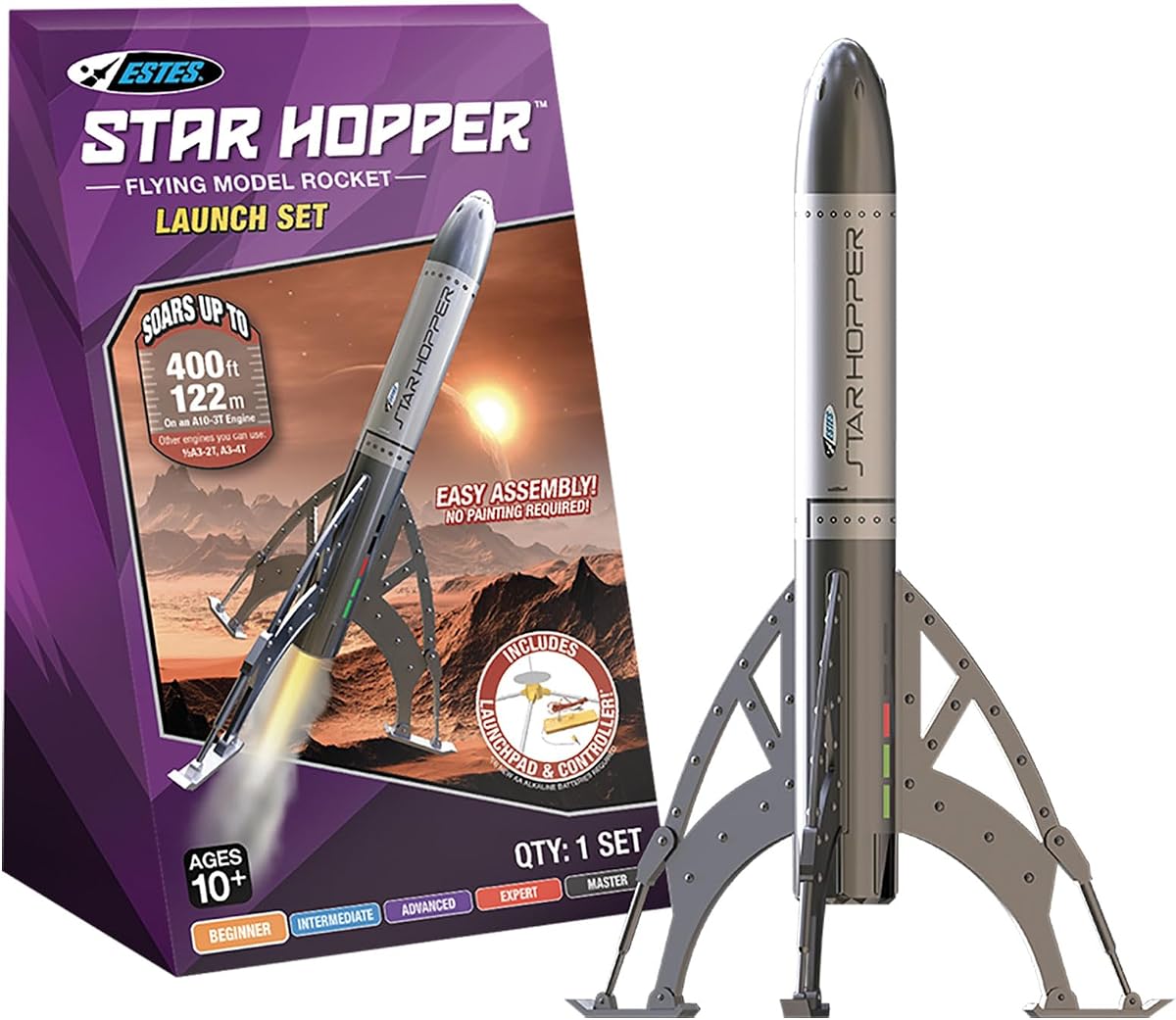
The Estes Rockets 002427 Star Hopper Launch Set has a 5.0 rating and is presented as an easy-assembly, beginner-friendly launch bundle. Its defining advantage is simplicity: the package includes a Star Hopper Rocket Kit, a Mini Launch Pad, and a Mini Launch Controller in one coordinated set.
We may earn a commission when you buy through this link, at no additional cost to you.
The included mini system creates a compact entry point for a new rocketeer. Buyers do not need to assemble a separate basic launch platform before building the rocket, which reduces the number of initial decisions. The straightforward design also appears well suited to children and adults looking for an uncomplicated first model-rocketry activity.
The supplied product information is concise and does not provide detailed altitude figures, engine compatibility, exact dimensions, or a full parts inventory. Those details should be confirmed in the current listing and instructions before purchase. The mini pad and controller may also not be interchangeable with the standard Porta-Pad II system used by several other kits in this guide.
Star Hopper is a good recommendation for buyers who prioritize an all-in-one beginner package and a compact launch setup. It is less suitable for anyone who needs a standard launch rod for larger models or wants to compare detailed performance specifications before buying. The included equipment nevertheless makes it a convenient, approachable place to begin.
The Mini Launch Pad and Mini Launch Controller keep the setup compact. Their inclusion makes the package convenient for beginners who do not yet want to assemble a larger standard system.
Easy assembly is the central design goal. The package is best suited to first-time builders who value a simple introduction and a coordinated collection of launch equipment.
We may earn a commission when you buy through this link, at no additional cost to you.
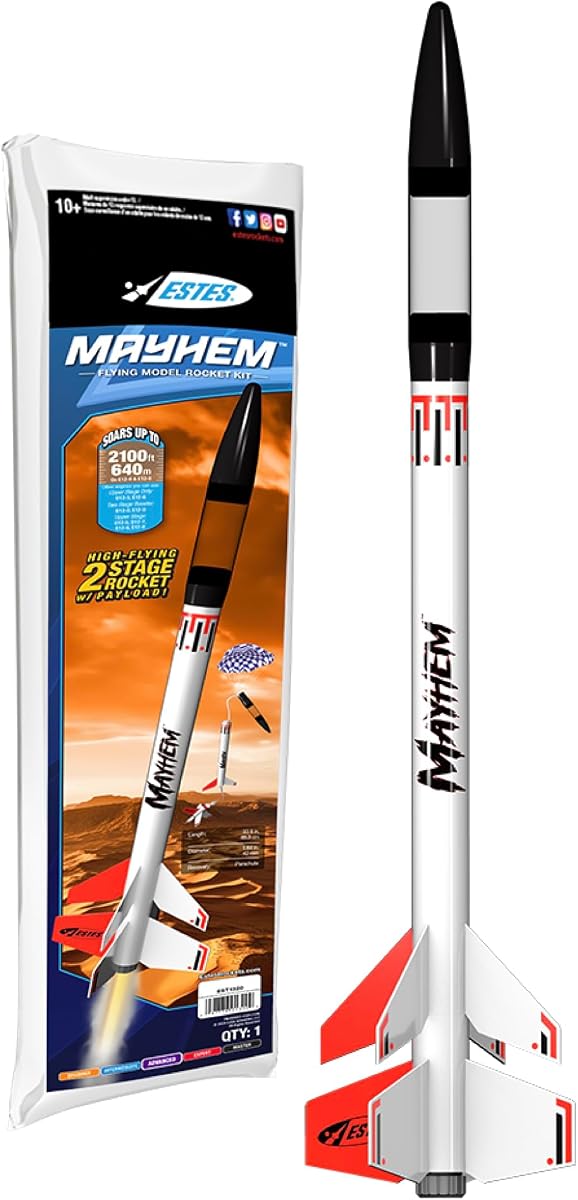
The Estes 1320 Mayhem Advanced Model-Rocket Kit has a 4.2 rating and is the most demanding kit in the collection. It offers a two-stage rocket-building project with a 33.6-inch height, precision-cut fins, and a projected altitude of up to 2,100 feet, making it suited to experienced beginners and advanced enthusiasts rather than casual first-time builders.
We may earn a commission when you buy through this link, at no additional cost to you.
The kit includes rocket parts, design decals, a recovery parachute, and instructions. Assembly takes three hours or more and requires more advanced building skills. Engine options are assigned by stage: D12-5 and E12-6 for the single-stage option, D12-0 and E12-0 for the boost stage, and D12-5, D12-7, E12-6, and E12-8 for the upper stage.
The requirements are substantial. Engines, starters, recovery wadding, a launch system with a 3/16-inch Maxi launch rod, and four AA alkaline batteries are all sold separately. A larger or higher-powered model also demands careful attention to instructions, recovery preparation, launch-site suitability, and the safety code, so this is not the most convenient package for a young child launching without experienced guidance.
Mayhem is a strong recommendation for hobbyists ready to move beyond a simple beginner kit and interested in staged flight. It offers a rewarding construction challenge, multiple propulsion options, and the highest projected altitude in this comparison. Buyers should assess their experience and launch equipment before committing to this advanced option.
Separate boost and upper-stage engine choices make Mayhem more complex than a conventional single-stage model. This staged design provides the clearest sense of advanced model-rocketry within the supplied group.
The projected 2,100-foot altitude comes with a longer build and more demanding equipment requirements. Safe operation depends on following the instructions, using a compatible Maxi launch rod, and applying the NAR safety code.
We may earn a commission when you buy through this link, at no additional cost to you.
The Estes 7320 Laser X2 Advanced Model-Rocket Kit has a 5.0 rating and combines advanced building with a distinctive science-fiction theme inspired by 1960s models. Designed by Lee Piester, it includes rocket parts, design decals, a recovery parachute, and instructions for a sleek single-stage rocket.
We may earn a commission when you buy through this link, at no additional cost to you.
Construction takes three hours or more and calls for advanced building skills. The design uses a boat tail, a blow-molded nose cone, and aerodynamic laser-cut balsa fins. With a C6-3 engine, it has a projected altitude of 450 feet and is also compatible with a C5-3, making it a more specialized advanced build.
The rocket does not include a launch system, engines, starters, recovery wadding, or four AA alkaline batteries. A Porta-Pad II and Electron Beam controller are sold separately. Its lower listed altitude means it is not designed to compete with the much larger Mayhem, but the attractive design and detailed construction offer a different kind of challenge.
Laser X2 is a strong recommendation for experienced builders attracted to a polished retro appearance and the craft of constructing a carefully shaped single-stage model. It is less appropriate for a first kit or for buyers focused on maximum altitude. Those considering it should confirm the required launch equipment and be comfortable with detailed advanced assembly.
The science-fiction styling gives the kit strong visual appeal. A blow-molded nose cone, boat tail, and laser-cut balsa fins make the finished model particularly distinctive on display.
The three-plus-hour build rewards careful work and familiarity with model-rocket construction. New owners should not mistake the advanced label for a quick beginner project.
We may earn a commission when you buy through this link, at no additional cost to you.
The right Estes kit depends on whether you want immediate launch readiness, a manageable construction project, multiple flying models, or an advanced staged build. Consider the included equipment, motor requirements, skill level, and safety expectations before choosing.
Prebuilt models such as Athena and Rascal and Hijinks minimize the barrier to launch day because no model assembly is required. Their shorter preparation is valuable for children, gift-givers, and anyone who wants to focus on flying rather than construction. By contrast, Journey, Alpha III, Pathfinder, and Tandem X ask buyers to assemble rockets, providing a more active STEM exercise while remaining suitable for beginners. Mayhem and Laser X2 require three-plus hours of advanced work.
A launch pad and controller are essential for actually flying the model, but they are not included in every package. Tandem X, Rascal and Hijinks, Journey, Alpha III, and Pathfinder include a Porta-Pad II and Electron Beam controller. Athena, Mayhem, and Laser X2 require a compatible system to be purchased separately. Star Hopper includes a Mini Launch Pad and Mini Launch Controller rather than the standard system used by most full-size beginner kits.
Most listed kits do not include the consumables needed for flight. Engines, starters, recovery wadding, and four AA alkaline batteries are commonly required, with suitable engine choices determined by the model and stage. The launch system, the maximum launch rod, and any model-specific parts may also need to be bought separately. Reading the current kit instructions before ordering accessories helps prevent mismatched engines, missing recovery items, or an inadequate launch rod.
Beginner kits offer broad compatibility with A, B, and C engine families, and some also accept a small 1/2A engine. Advanced kits use D and E engines distributed between stages. The compatibility list is not a suggestion to use every motor: follow the instructions, select an engine appropriate for the launch location and field conditions, and never substitute an incompatible motor simply because it is available.
Projected altitudes range from 450 feet for Laser X2 to 2,100 feet for Mayhem. Most beginner kits fall between 1,000 and 1,150 feet, with Alpha III and Tandem's Crossfire ISX reaching the upper end of that range. A higher number does not automatically make a kit better: a prebuilt model may be more useful to a family, while a lower-altitude advanced design may provide the construction experience a hobbyist actually wants.
Recovery equipment is an essential part of a model-rocket launch, even though wadding and parachutes may not always be included in the same bundle. Athena is specifically noted for a bright 12-inch parachute, while other kits include parachutes in various configurations. Buyers should inspect the supplied recovery system, follow the manual, and choose a motor that supports a safe and dependable recovery under the conditions in which the rocket will fly.
Most products in the guide are labeled for ages 10 and older, but age labeling is only one part of launch-day readiness. Younger children benefit from adult assistance, careful supervision, and a clear division between construction and launching. Advanced models are better handled by an experienced builder or under knowledgeable adult guidance. The launch site, weather, engine selection, and safety briefing should be managed by a responsible adult.
A suitable outdoor launch site is as important as the kit itself. The supplied guidance calls for following the NAR model-rocket safety code, standing at least 15 feet away, inserting the safety key, issuing a countdown, and using an appropriate launch site. Larger advanced models may need more open space than a standard beginner flight. Checking conditions before assembly can prevent wasted effort and help ensure a safer, more successful outing.
Begin by reading the complete instructions for the exact model, inspecting every included component, and confirming that the engine, launch system, launch rod, batteries, starters, recovery wadding, and parachute are compatible. Construct the rocket in a clean, dry workspace, following the stated sequence and avoiding changes to the fin alignment, motor mount, or recovery system that could affect stability.
Prepare an appropriate outdoor launch site in accordance with the NAR model-rocket safety code. Keep spectators at a safe distance, use a clear countdown, insert the safety key only when the launch area is secure, and maintain the required minimum distance from the pad. The person operating the controller should remain in position until the rocket has launched and the area is safe to approach.
After flight, allow the rocket to descend under its recovery system, locate it carefully, and inspect the airframe, parachute, motor mount, and fins before another launch. Pack components in a protective container, keep electronics and motors dry, and follow local storage and disposal guidance. Reassemble the launch system after each use and check the controller and batteries before every flight.
Athena and Rascal and Hijinks are the easiest options for someone who wants to minimize construction. Both are supplied ready to fly, and Rascal and Hijinks includes two rockets. Their launch consumables and compatible launch equipment must still be obtained where not included. Journey, Alpha III, Pathfinder, and Tandem X are more educational when the goal is to learn assembly.
No. The supplied descriptions generally list rocket engines, starters, recovery wadding, and four AA alkaline batteries as sold separately. Always use the engine specified in the kit instructions and check the product listing for the exact contents. Advanced kits may also require a launch system with a larger Maxi launch rod.
Most beginner kits in this guide use the Porta-Pad II Launch Pad and Electron Beam Launch Controller. Tandem X, Rascal and Hijinks, Journey, Alpha III, and Pathfinder include that system. Athena requires a compatible system, while Star Hopper comes with a Mini Launch Pad and Mini Launch Controller. Mayhem and Laser X2 need compatible launch equipment, with Mayhem requiring a 3/16-inch Maxi launch rod.
A prebuilt kit arrives assembled and focuses on launch preparation rather than construction. Athena, Rascal and Hijinks, and the two models in the Rascal and Hijinks set follow this approach. Building kits include separate rocket components for assembly, making them better for learning how nose cones, fins, internal components, and recovery systems fit together.
Most beginner models have projected altitudes around 1,000 to 1,150 feet when used with an appropriate C engine. Alpha III, Tandem X's Crossfire ISX, and Journey are among the higher listed beginner options. Rascal and Hijinks, Athena, and Pathfinder each have a projected maximum of about 1,000 to 1,125 feet. Actual results depend on the engine, conditions, and preparation.
The listed beginner products are generally marked for ages 10 and older, while Mayhem and Laser X2 also identify ages 10 and older but require advanced construction skills. Children should have responsible adult supervision, especially when handling engines, installing igniters, operating the controller, and recovering the rocket. The launch site and weather must be suitable for everyone present.
Use an appropriate launch site and follow the NAR model-rocket safety code. Stand at least 15 feet away, keep the launch area clear, insert the safety key only when everyone is in a safe position, issue a countdown, and operate the launch system as directed. Also follow local laws and the manufacturer's instructions for the specific model and engine.
Mayhem is a 33.6-inch two-stage advanced rocket with a projected altitude up to 2,100 feet and stage-specific D or E engine options. Laser X2 is a single-stage retro-styled rocket with a projected altitude of 450 feet using a C6-3 or C5-3 engine. Mayhem offers the more complex staged experience, while Laser X2 emphasizes detailed construction and distinctive styling.
The Estes 1469 Tandem X is the strongest all-around choice because it combines two construction options, multiple engine configurations, and a complete basic launch system. The Estes 2452 Athena suits buyers who want a prebuilt model with minimal preparation, while the Estes 1320 Mayhem is the premier advanced option for builders interested in staged flight and higher projected altitude.
Prioritize the launch experience that fits the learner. Choose a prebuilt set for immediate fun, a one-hour beginner kit for balanced STEM activity, a dual-rocket package for shared adventures, or an advanced model for a longer and more technically demanding project. Confirm that the kit includes the launch hardware you need and that any additional components match the model's instructions.
Current listings can change in contents, availability, and pricing, so check the final product details before ordering. Read the instructions, select the correct engine, inspect all recovery components, and prepare a safe launch site. With those steps in place, the right Estes kit can provide a memorable introduction to model rocketry and a hobby with room to grow.