
TiFFCOFiO Indoor Mechanical Outlet Timer
4.4Editor score
48 daily setting combinations
Compact three-prong design
Simple mechanical pin controls
Best Timer for Light Socket options for indoor and outdoor lights, compared for scheduling, weather resistance, control, outlet capacity, and ease of setup.
A timer for a light socket can automate lamps, holiday strings, porch lighting, and other connected decorations without requiring a permanent rewiring project. The most useful model depends on whether you need a simple daily schedule, dusk-to-dawn behavior, remote control, smart-home integration, or an outlet timer with multiple connections.
This guide compares ten indoor and outdoor options across control method, scheduling flexibility, outlet count, weather resistance, safety listings, installation needs, and everyday convenience. Mechanical timers are considered alongside digital models, light-sensor sockets, and Wi-Fi-enabled plugs so readers can match a timer to a specific lighting routine.
Each pick highlights the product's strongest practical use, along with limitations that may matter for your setup. Ratings and product details reflect the supplied listings, while product availability and pricing can change over time, so confirm current specifications before making a final purchase.
4.4Editor score

4.4Editor score

4.5Editor score
The table below compares all ten timers by location, control style, scheduling system, and connection capacity, making it easier to identify the right option for lamps, seasonal lights, outdoor fixtures, and connected smart devices.



The BN-LINK Outdoor 24-Hour Mechanical Timer Outlet is a practical all-around choice for holiday strings, porch lights, yard decorations, and other outdoor loads. Its supplied rating is 4.4 out of 5. The strongest feature is the combination of a straightforward 48-pin daily schedule and two grounded outlets, allowing multiple connected devices to operate from one timer.
We may earn a commission when you buy through this link, at no additional cost to you.
Scheduling is handled through 30-minute pin intervals, so the timer can accommodate lights that need to turn on in the evening and off later at night or at a selected morning time. Once configured, the unit repeats the cycle automatically. The listing also states that the mechanical timer retains its pin settings if power is lost, which is useful for avoiding a complete reprogram after an interruption.
The weatherproof casing and outdoor orientation make this more appropriate than a basic indoor plug timer for exposed installations. The instructions recommend mounting it upright and at least two feet above the ground. That positioning matters: although the housing is designed for outdoor use, correct placement helps limit its exposure to standing water and severe weather.
This is a strong recommendation for someone who wants dependable outdoor automation without managing an app or complicated digital controls. It is less suitable for minute-by-minute schedules, temporary remote changes, or indoor placements where a compact wall-friendly design would be preferable. For most seasonal and landscape lighting routines, however, its straightforward operation and dual outlets make it particularly versatile.
Pulling and pressing the mechanical pins makes the schedule visible and repeatable without navigating menus. The 30-minute resolution is sufficient for most outdoor lighting, while a master override can make manual testing more convenient.
Two grounded outlets let a homeowner automate more than one string of lights or combine a light with another suitable device. This reduces the need for a second timer in many installations.
We may earn a commission when you buy through this link, at no additional cost to you.
The TiFFCOFiO Indoor Mechanical Outlet Timer is a budget-conscious option for readers who want dependable indoor automation for lamps, Christmas lights, or other appropriate plugged-in devices. It carries a supplied rating of 4.4 out of 5 and includes two timers, making it useful for controlling separate schedules in different rooms or on different circuits.
We may earn a commission when you buy through this link, at no additional cost to you.
Its mechanical system offers 48 on or off choices across a 24-hour day. Each pin represents a 30-minute interval, and the selected pattern repeats every day. This is easy to understand after one setup, particularly for users who would rather avoid Wi-Fi configuration, smartphone apps, or electronic menus.
The compact design places the output ports underneath the timer, which can preserve access to a neighboring outlet. The three-prong configuration is suitable for modern grounded plugs. The ETL listing adds a recognized point of safety, while the after-sales support described in the listing provides additional support if setup questions arise.
This timer is an excellent choice for simple, repeatable indoor lighting schedules, particularly for a lamp or seasonal display that should run every evening. It cannot provide minute-level control, remote operation, or light sensing, and it should not be treated as an outdoor model. Even with those boundaries, the two-pack configuration and uncomplicated setup make it a compelling budget pick.
The pin-based interface is easy to adjust and does not depend on network stability. Once the daily pattern is selected, the timer handles the routine automatically, making it practical for anyone who prefers a traditional plug-in device.
The two-pack supports separate lighting zones or devices with different routines. It can also provide a spare for a new holiday installation without requiring another separate purchase.
We may earn a commission when you buy through this link, at no additional cost to you.
The DEWENWILS Indoor 24 Hour Programmable Digital Timer Outlet is the most feature-rich digital option in this guide. Its supplied rating is 4.5 out of 5, and it stands out for three distinct daily schedule groups, minute-level accuracy, and a large display that makes programmed periods easier to review.
We may earn a commission when you buy through this link, at no additional cost to you.
Users can select from Always On, Auto, or Always Off for each of the three schedule groups. This allows the same outlet to support different routines through the day, such as early activation, a daytime period, and an evening shutdown. The timer operates silently, which is especially useful in bedrooms, offices, and other spaces where audible relay clicks could be distracting.
Its memory function can preserve programmed settings for up to three months if the power is interrupted or the unit is disconnected. That convenience is meaningful for people who travel or do not want to reconstruct a complex schedule after a brief outage. The compact frosted-front design also avoids the visual bulk of a large mechanical timer.
The primary limitation is that each unit offers only one outlet, although the product comes in a two-pack. It is also intended for indoor lighting and electronics rather than exposed outdoor installations. For someone who values precision, quiet operation, and multiple daily programs more than two outlets per housing, this is the strongest premium-style selection.
Minute-level settings make this timer more flexible than a 30-minute mechanical model. Three program groups can create several on and off periods during one day without relying on multiple devices.
Retaining settings after a power interruption reduces setup inconvenience. Silent switching also makes the timer more suitable for sleeping spaces and quiet indoor environments.
We may earn a commission when you buy through this link, at no additional cost to you.
The GHome Smart Plug is the leading connected option for readers who want to control a light away from home or integrate it into a broader smart-home routine. It has a supplied rating of 4.4 out of 5 and supports both Wi-Fi and Bluetooth-assisted connection methods, with the primary smart-home operation requiring a stable 2.4GHz network.
We may earn a commission when you buy through this link, at no additional cost to you.
Once connected through the GHome app, users can turn a linked device on or off remotely, create recurring or randomized schedules, and monitor connected equipment. The listing also notes compatibility with the Smart Life and Tuya apps, giving the setup a degree of flexibility beyond a single control interface.
Voice control is available through Alexa and Google Assistant, but the product cannot be linked directly without first connecting it to the network and GHome app. Group controls and sharing features are useful for households with several compatible plugs, allowing connected devices to be managed together or handed to family members.
This plug is a strong fit for indoor lamps, fans, humidifiers, and Christmas lights when remote access and voice operation matter. Its dependence on network configuration, compatible apps, and a 2.4GHz connection makes it less suitable for a user who wants a completely standalone timer. It also requires more setup than any of the mechanical models.
App access allows a light to be switched on before arriving home or turned off after leaving, which adds flexibility beyond a fixed daily schedule. The same connectivity also supports monitoring of connected equipment.
Recurring and randomized schedules make it possible to automate everyday devices or create a less predictable lighting pattern. Group controls can simplify management of several compatible plugs.
We may earn a commission when you buy through this link, at no additional cost to you.
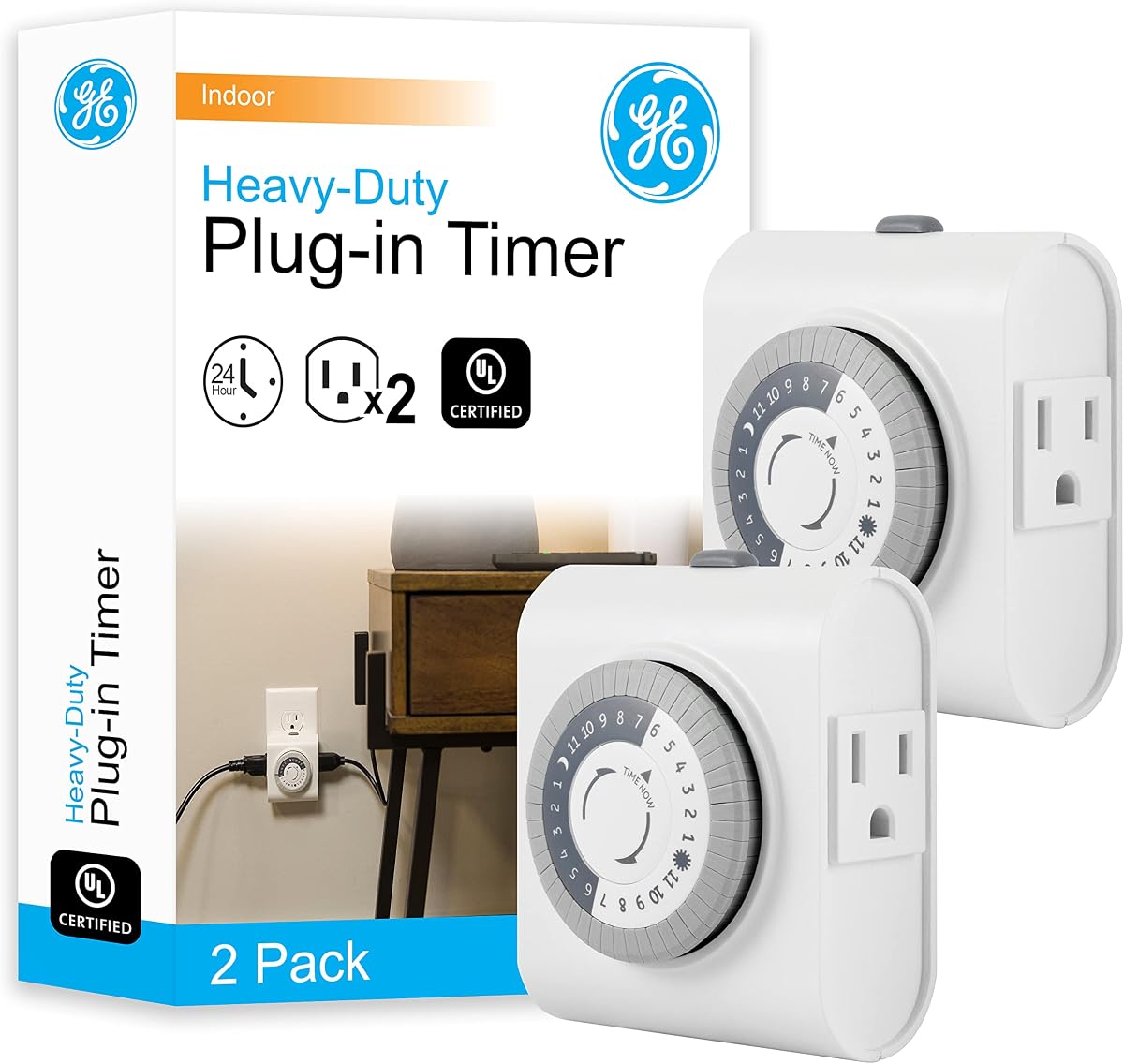
The GE 24-Hour Plug-in Mechanical Timer Outlet is a well-rounded indoor model for holiday lighting, seasonal decorations, fans, and small appliances. Its supplied rating is 4.5 out of 5. The two-unit package offers an extra timer, while each timer provides two grounded outlets for controlling multiple compatible three-prong devices.
We may earn a commission when you buy through this link, at no additional cost to you.
The push-pin schedule provides 30-minute intervals, familiar for mechanical outlet timers. It creates a repeatable daily on and off cycle without requiring an app, wireless network, or digital programming. A convenient override switch pauses the timer cycle when manual control is needed, which is particularly helpful during setup or when a light needs to stay on.
Its compact white finish is designed to blend into indoor spaces. Because both outlets are controlled on the same schedule, this product works best for devices that should operate together. A second unit can handle a different room or lighting group if separate schedules are required.
The GE timer is a good fit for users who value straightforward operation and multiple outlets more than precise programming. It cannot match the minute-level adjustments of a digital timer, and its indoor design makes it unsuitable for exposed yard or patio use. For dependable everyday indoor automation, the simplicity is a genuine advantage.
The dual grounded outlets are useful when multiple lights or another suitable device should share a schedule. This can reduce clutter around a wall receptacle.
The top override switch makes temporary manual control easy. It also helps when testing a new arrangement before relying on the programmed cycle.
We may earn a commission when you buy through this link, at no additional cost to you.
The DEWENWILS Outdoor Timer for Lights is especially useful when operating outdoor decorations from indoors. It has the highest supplied rating in the group at 4.6 out of 5. Its remote control and stated 100-foot radio-frequency range reduce the need to walk outside in darkness, rain, or cold to change a setting.
We may earn a commission when you buy through this link, at no additional cost to you.
The timer supports several operating patterns, including on or off, dusk to dawn, and turning on at dusk followed by an automatic shutdown after 2, 4, 6, or 8 hours. It can also repeat the selected schedule daily. These options cover both complete nighttime operation and a limited evening window, allowing users to avoid leaving lights on longer than intended.
The outdoor unit has two outlets and a six-foot grounded cord. Its PBT construction is described as waterproof, with compatibility for many electrical appliances and a stated load rating of 15 amps. The included CR2032 battery powers the remote, and setup requires only connecting the battery and plugging the timer into a suitable outlet.
This model is an attractive choice for holiday displays, yard lights, fountains, and pool pumps where remote access is the priority. Its controls are less flexible than a minute-based digital timer, and radio performance depends on placement and environmental interference. Even so, the combination of remote range, light sensing, and selectable countdowns makes it unusually practical for outdoor lighting.
The remote makes it convenient to activate or change a connected display from indoors. A stated 100-foot line-of-sight range offers useful flexibility for many homes.
Dusk-to-dawn operation, daily repetition, and several countdown durations cover different outdoor routines. A timed cutoff can be especially useful when full-night operation is unnecessary.
We may earn a commission when you buy through this link, at no additional cost to you.
The G-Homa 24-Hour Mechanical Timer Outlet is a practical choice for lamps and holiday lights that need a repeatable daily schedule. It carries a supplied rating of 4.4 out of 5 and offers two grounded outlets, allowing a user to control multiple devices from a single indoor receptacle.
We may earn a commission when you buy through this link, at no additional cost to you.
Its 48-pin system divides the day into 30-minute intervals. Users configure on and off periods by positioning the pins, then let the timer repeat the sequence every day. A master switch provides a convenient override, and the mechanical design avoids any need for an app, wireless network, or account.
The supplied specifications list a 125-volt, 60-hertz, 15-amp capacity, along with separate resistive and tungsten wattages and a one-half-horsepower motor rating. Because the product is intended for indoor outlets, it is better suited to lamps and indoor holiday decorations than to exposed exterior installations.
This timer will appeal to buyers who want dependable automation without advanced controls. It cannot be adjusted from a phone, cannot react to ambient light, and does not offer schedules shorter than 30 minutes. For a regular lamp routine or a coordinated display, though, its two outlets and simple mechanical operation make it a sensible everyday option.
The mechanical dial and pin system make the schedule easy to understand and repeat. There is no software to update and no network condition that can prevent the timer from operating.
The listed electrical ratings cover several common indoor lighting loads, while the two grounded outlets support more than one connected device. Checking the connected equipment against the specifications remains important.
We may earn a commission when you buy through this link, at no additional cost to you.
The Light Sensor Socket Dusk to Dawn with Timer is designed to turn an existing compatible light fixture into automatic nighttime illumination. Its supplied rating is 4.6 out of 5. Unlike an outlet timer, this product screws directly into a standard E26 or E27 socket and uses a built-in photocell to respond to darkness.
We may earn a commission when you buy through this link, at no additional cost to you.
The light turns on automatically at night and off around sunrise. A 12-hour timer-off function adds a secondary safeguard, ensuring the fixture shuts off even when cloud cover or another light interferes with the sensor. That combination is useful in locations where a purely daylight-based response might remain active too long.
The sensor rotates through 300 degrees, allowing users to direct detection away from porch lights, streetlights, or shadows. The socket accepts LED, incandescent, and CFL bulbs up to 150 watts. Installation is straightforward: the unit screws into the existing socket and a compatible bulb is added.
This is an excellent option for a porch, garage, patio, entryway, or exterior wall fixture that uses a standard socket. The two-pack can cover two fixtures, and no outlet or wiring changes are needed. It is not appropriate for frosted or opaque shades that obstruct the sensor, nor for outdoor floodlight fixtures. The most important requirement is a compatible E26 or E27 socket.
The photocell changes behavior according to ambient darkness, so users do not need to program evening and morning times. This is convenient where sunset and sunrise times shift through the year.
The 12-hour cutoff provides a backup when the sensor remains triggered by cloud cover, reflections, or nearby lighting. It helps prevent a fixture from operating indefinitely.
We may earn a commission when you buy through this link, at no additional cost to you.
The TiFFCOFiO Outdoor Timer Outlet is built for readers who want a mechanical schedule in a heavy-duty outdoor format. It carries a supplied rating of 4.4 out of 5 and is marketed for pool pumps, outdoor lights, Christmas decorations, and garden equipment, with two grounded outlets and a stated 15-amp, one-half-horsepower rating.
We may earn a commission when you buy through this link, at no additional cost to you.
The timer provides 48 on and off settings over a 24-hour period, with each pin representing 30 minutes. Pulling pins up selects off periods, while pushing them down selects on periods. The arrangement repeats daily and requires no app or digital programming, keeping the setup accessible in garages, sheds, and other areas where network access is unnecessary.
Its six-inch heavy dual cord makes connection to compatible outdoor equipment more flexible. Waterproof materials and a new housing structure are intended to resist severe weather and cold. The listing specifically recommends mounting the timer vertically at least two feet above the ground to preserve its weather-resistant performance.
The CSA listing and high stated capacity make this a credible choice for appropriately rated outdoor equipment. It is less flexible than digital models because the schedule is limited to half-hour blocks, and it lacks remote or sensor-based operation. For a pump, landscape lighting, or seasonal display that follows a consistent daily routine, it offers a useful balance of capacity and simple control.
The listed 15-amp, one-half-horsepower rating makes the timer more relevant to demanding outdoor equipment than a basic lighting plug. Users should still confirm that every connected device falls within the stated limits.
The housing uses waterproof materials for outdoor resilience. Mounting it vertically and at least two feet above the ground is a central part of maintaining that performance.
We may earn a commission when you buy through this link, at no additional cost to you.
The BN-LINK Indoor 7-Day Programmable Digital Timer Outlet is ideal when a lighting routine differs from one day to the next. Its supplied rating is 4.3 out of 5, and its weeklong programming distinguishes it from the 24-hour mechanical and digital timers in this roundup.
We may earn a commission when you buy through this link, at no additional cost to you.
Up to eight on and off programs can be created for the timer's two grounded outlets. Programs may be assigned to individual days or convenient day combinations, and the shortest schedule can be one minute. A dedicated daylight-saving mode can be enabled with a button, while a long-lasting backup battery preserves settings during a power outage.
The random vacation mode changes the operation of programmed lights to create a less predictable pattern. This feature is intended to make an occupied home appear lived in while the owner is away. Both outlets operate simultaneously, so the timer is most useful when both connected devices should follow the same pattern.
With a stated rating of 120 volts, 60 hertz, and 15 amps or 1,725 watts, the unit is intended for indoor lights and other suitable small loads. It is a particularly strong choice for weekday versus weekend lighting or multiple daily programs. Its more complex setup makes it less attractive than a mechanical timer for the simplest possible routine.
Seven-day programming allows separate schedules for individual weekdays or selected combinations of days. This is useful for home offices, stores, or homes where routines vary throughout the week.
One-minute programming and up to eight cycles offer greater precision than a mechanical timer. The backup battery reduces the chance of losing a carefully configured schedule after an outage.
We may earn a commission when you buy through this link, at no additional cost to you.
The best timer depends on the lighting location, the need for a fixed schedule, the importance of remote or voice control, and the type of fixture involved. Comparing these factors before shopping prevents an indoor outlet timer from being placed outdoors or a smart plug from being selected for a setup without reliable network access.
Mechanical outlet timers are best for predictable daily schedules and simple plug-in lights. They require no network, are easy to program with pins, and usually offer 30-minute intervals. Digital outlet timers provide more precise schedules, separate daily programs, and convenient displays. Light-sensor socket timers are different again: they install in a compatible bulb socket and respond to ambient darkness rather than a fixed time.
Choose based on the control you need. Use mechanical timing for uncomplicated evening routines, digital timing for precision and weekday variation, sensor timing for a standard light fixture, and a smart plug when remote or voice access is valuable.
An indoor plug timer should never be treated as a weatherproof outdoor device. Outdoor models in this guide feature water-resistant or waterproof housings, grounded cords, and mounting guidance intended for exterior use. The TiFFCOFiO and BN-LINK outdoor mechanical models specifically call for upright mounting at least two feet above the ground.
Check the fixture location, cord routing, and local electrical conditions before buying. A weather-resistant enclosure does not eliminate the need to protect connections from standing water or to follow the manufacturer's placement instructions.
A 30-minute interval is often sufficient for holiday strings, porch lights, and garden displays that follow a broad evening schedule. Minute-level control becomes more valuable for lamps, signs, accent lighting, and equipment that needs brief activation periods. Seven-day programmability matters when a routine changes on different days rather than repeating identically every 24 hours.
Do not pay for more precision than the installation requires, but avoid a half-hour model if the lighting needs a short or carefully timed interval. Also consider whether the schedule must repeat daily or remain attached to particular weekdays.
Two-outlet timers can control more than one compatible device from a single wall receptacle. This is helpful for coordinated string lights or a light and another appropriately rated device. Single-outlet digital models may be more compact and easier to program, while a two-pack can provide separate timers for different rooms.
Remember that outlets on one timer usually share the same schedule. If two devices need independent timing, use two complete timers rather than expecting dual outlets to operate separately.
The GHome smart plug requires a stable 2.4GHz Wi-Fi network, compatible app setup, and network configuration before linking Alexa or Google Assistant. It offers remote operation, recurring schedules, group controls, and sharing, but it is not a good fit for a remote location without reliable wireless service.
For users who want dependable automation with no network dependency, a mechanical or digital outlet timer is simpler. For indoor devices where mobile access and voice control are priorities, the added setup may be worthwhile.
A dusk-to-dawn sensor adjusts to changing darkness rather than relying on a particular clock time. This works well for standalone fixtures with compatible E26 or E27 sockets, particularly when seasonal sunset changes make a fixed schedule inconvenient. Adjustable sensor direction can reduce accidental triggering from nearby lights, though opaque shades and enclosed floodlights may impede detection.
Remote-controlled outdoor timers take a different approach. The DEWENWILS remote model lets users change outdoor settings from indoors, with a stated 100-foot radio range. Compare that convenience with the need to install and maintain the remote battery.
Timer capacity is not limited by appearance. Review voltage, amperage, wattage, motor horsepower, and grounded-plug requirements against the equipment being connected. Lights with many bulbs can consume more power than expected, while pumps and motors can have different startup demands. The outdoor models in this guide provide two grounded outlets, and one lists a 15-amp, one-half-horsepower capacity.
Do not exceed the listed specifications or connect unsuitable high-draw devices. When uncertain, consult the timer's instructions and the documentation for the connected equipment before installation.
Mechanical timers expose their schedule through the dial and pins, which makes daily programming visible. Digital timers add a display for reviewing the configuration. Light-sensor socket timers must have a clear view of changing ambient light and are not recommended for frosted, opaque, or enclosed fixtures. Outdoor mechanical timers need elevated, upright placement to preserve weather performance.
Choose a design that you can reach, read, and maintain. A timer that is difficult to access may remain in AUTO mode, defeating the purpose of the manual override or schedule controls.
Before programming, confirm that the timer is suitable for the intended location and connected equipment. Read the instructions, compare the load ratings, and inspect the device and plug for damage. For outdoor mechanical models, follow the stated recommendation to mount the unit vertically and at least two feet above the ground.
Mechanical timers are programmed by moving pins to represent on and off periods, while digital models use their buttons and display. Set the current time correctly, select the needed days or programs, and then switch the timer into its automatic operating mode. Test the schedule before leaving the installation unattended.
For a sensor-based socket, screw the unit into the compatible socket, add an eligible bulb, and adjust the sensor toward open darkness rather than nearby light sources. Clean the lens gently and keep indoor timer faces free of dust. Do not immerse outlet timers or expose indoor models to rain, and check the schedule periodically after a power interruption.
Only if the timer's product information specifically states that it is designed for outdoor use. Outdoor models generally include weather-resistant housings, grounded cords, and installation guidance such as upright placement above the ground. An indoor timer can fail when exposed to moisture, so choose one of the outdoor-rated options for holiday strings, yard lights, fountains, or other exterior equipment.
A mechanical timer uses moving pins to represent 30-minute on and off intervals and usually repeats the same 24-hour pattern. A digital timer can set more precise times, create several daily programs, assign schedules to different weekdays, and retain settings through a power outage. Mechanical models are simpler, while digital models are better when timing precision or schedule variety matters.
A mechanical outlet timer is a simple choice for indoor Christmas lights, while an outdoor-rated model is preferable for lights exposed to weather. A remote or light-sensor timer can reduce the need to visit the display after dark. The DEWENWILS remote model offers several countdown options, and the BN-LINK outdoor mechanical model provides a repeatable daily schedule with two outlets.
Yes, if the timer has multiple outlets and each connected device remains within the stated electrical limits. The BN-LINK outdoor timer, GE timer, G-Homa timer, TiFFCOFiO outdoor timer, and BN-LINK seven-day digital timer each list two outlets. In most of these models, the outlets operate on the same schedule rather than independently.
No. Mechanical timers and most digital outlet timers operate independently of WiFi. The GHome smart plug is the connected exception: it needs connection to a stable 2.4GHz network and app setup for remote and voice control. It is best suited to indoor lights where network reliability and remote access are desired.
No. The light sensor socket in this guide requires a compatible E26 or E27 bulb socket and works best with a clear or open cover. It is not recommended for frosted or opaque shades, and the listing states that it is not intended for outdoor floodlight fixtures. The adjustable sensor can also need careful positioning to avoid nearby lights and shadows.
First check that the device is in its automatic operating mode and that the current-time indicator is aligned correctly. The G-Homa listing specifically notes that a pin should not be pressed down at the Time Now position; if it is, rotate the dial to restore normal operation. Also confirm that the connected light works without the timer and that the pin pattern is not preventing the expected cycle.
Check whether the model is designed to preserve settings. The BN-LINK outdoor mechanical timer retains its pin settings, the DEWENWILS digital timer can preserve programmed settings for up to three months, and the BN-LINK seven-day digital timer uses a backup battery. For any model, recheck the current time and test the next scheduled transition after an outage.
The BN-LINK Outdoor 24-Hour Mechanical Timer is the most versatile overall pick because it combines daily pin scheduling, two grounded outlets, and an outdoor-oriented housing. The TiFFCOFiO Indoor Mechanical Timer is a budget-friendly two-pack for straightforward indoor routines, while the DEWENWILS Digital Timer is the strongest option for precise scheduling, multiple daily groups, quiet operation, and memory retention.
Prioritize the type of control your setup actually requires. A simple 30-minute daily cycle may be enough for seasonal lights, but minute-level timing, weekday schedules, remote access, voice control, or automatic dusk-to-dawn behavior can justify a digital, smart, or sensor-based design. Also verify outdoor suitability, outlet count, grounding, electrical capacity, and physical placement before purchasing.
Ratings, feature availability, product listings, and prices can change, so check the current product page and manufacturer instructions before ordering. Compare the final selection with the connected light or device, make sure the installation follows all guidance, and choose the timer that offers the required controls without adding unnecessary complexity.