
PRGR HS 130-A
4.2Editor score
Doppler radar measurement
Club speed without a ball
Stored swing history
AAA battery operation
Mobile Golf Launch Monitor guide comparing portable radar, camera, speed, display, app, battery, and indoor-outdoor training features.
A mobile golf launch monitor turns swing feedback into portable, repeatable practice. The right unit can reveal club speed, ball speed, smash factor, launch direction, spin, and distance, helping golfers compare techniques with greater confidence. Because capabilities vary from simple radar meters to complete simulator systems, the most useful model depends on your budget, training goals, and preferred practice environment.
This guide compares ten portable golf launch monitors using the supplied specifications, including measurement technology, displayed metrics, app compatibility, power, storage, weather resistance, and simulator functions. It covers instruments suited to speed training, range sessions, indoor practice, video analysis, and virtual rounds, without assuming that every buyer needs the same level of technical detail or connected features.
Each review explains what the monitor can measure, where it fits into a practice routine, and which compromises may affect your choice. Rankings reflect the information available for this November 2026 guide and should be considered alongside your own swing goals and space. Product prices and promotions can change, so verify current availability and terms before purchasing.
4.2Editor score

4.4Editor score

4.3Editor score
This side-by-side comparison highlights each portable launch monitor's core measurement approach, major outputs, connectivity, power, and practical strengths so golfers can identify the model that matches their training environment and technical priorities.




The PlayBetter Garmin Approach R10 Golf Launch Monitor & Simulator Stand Bundle combines portable radar measurement with a phone-based analysis experience. Its 4.4 rating reflects a strong balance of useful metrics, video capture, virtual-course access, and easy transport. The bundle also includes an alignment stand, tripod, phone mount, carry case, and USB cable, making it particularly attractive for golfers building a flexible practice setup.
We may earn a commission when you buy through this link, at no additional cost to you.
The R10 tracks club head speed, ball speed, swing tempo, ball spin, launch angle, and additional metrics when paired with a compatible smartphone and the Garmin Golf app. It can automatically record video clips, organize club statistics, and display shot dispersion based on estimated ball flight. A particularly useful training mode makes it possible to compare performance by club rather than treating every swing as an isolated event.
The principal limitation is dependence on a compatible phone and Garmin's connected platform. Virtual rounds and the expanded Home Tee Hero experience require an active membership, while the standard approach depends on the Garmin Golf app for much of its deeper analysis. Phone placement and stable alignment also affect how consistently you can review swing video. These considerations matter if you prefer a completely self-contained device.
This is our top connected choice for golfers who want measurements, video, and virtual play in a portable package. The included alignment stand is a meaningful addition because consistent placement helps produce more trustworthy sessions. Choose the R10 bundle if you already use a compatible smartphone, want immediate visual feedback, and plan to practice both indoors and at the range.
Club and ball speed are valuable, but seeing the movement that produced those numbers can make patterns easier to recognize. Automatically recorded clips give you a visual reference for tempo, balance, delivery, and strike location without requiring someone else to film every repetition.
The alignment stand, tripod, and phone mount work together to create a repeatable hitting position. That consistency matters because small changes in unit placement can add noise to a session and make meaningful comparisons harder.
We may earn a commission when you buy through this link, at no additional cost to you.
The Voice Caddie Portable Golf Launch Monitor and Swing Analyzer is centered on accessible swing-speed training. Its 4.2 rating reflects a straightforward package that combines Doppler radar, an LCD display, voice output, and an unusual ability to practice swing speed indoors without hitting a ball. The SC200Plus is especially appealing to golfers refining tempo and speed in limited space.
We may earn a commission when you buy through this link, at no additional cost to you.
Swing speed mode allows club swings without ball contact, which removes the need for a net, balls, or access to a range. The unit also provides real-time shot feedback, adjustable loft angles, and conditions that simulate different clubs. Atmospheric-pressure sensors are incorporated into data collection, while stored shot data and club statistics help reveal average distances over time.
The trade-off is that the SC200Plus is a traditional training tool rather than a full multimedia simulator. It does not offer the built-in touchscreen, automatic impact video, or extensive virtual-course ecosystem associated with premium camera systems. If your main aim is to understand launch direction, spin axis, and ball flight in detail, a more advanced connected monitor may serve you better.
Pick the Voice Caddie if indoor speed work, audible prompts, and straightforward radar feedback matter most. It is particularly useful for golfers who want to rehearse a motion away from the course without making full swings at a ball. For beginners building basic speed awareness or experienced players checking tempo consistency, it provides a focused and approachable package.
The dedicated swing speed mode is the defining feature. By training without a ball, golfers can work on tempo and speed in a living room, garage, or other suitable area while reducing the space required for a full shot.
Spoken feedback lets the player hear results without repeatedly looking at the LCD. That can support a natural practice rhythm and make the unit useful when the player is focused on movement rather than screen navigation.
We may earn a commission when you buy through this link, at no additional cost to you.
The PRGR HS 130-A is a compact Doppler radar monitor that concentrates on the fundamentals: club head speed, ball speed, smash factor, carry distance, and total distance. Its 4.2 rating and no-app design make it a practical option for golfers who want reliable practice feedback without managing a phone, wireless connection, or subscription. It also fits neatly into a golf bag.
We may earn a commission when you buy through this link, at no additional cost to you.
A particularly valuable capability is club-speed measurement without a ball. That makes the HS 130-A useful for tempo work, weighted clubs, speed sticks, and range sessions where the focus is repeatable movement. With a ball, it calculates smash factor and distance information, allowing a player to examine the efficiency and outcome of each strike.
Its simplicity is the main advantage and the main limitation. There is no sophisticated built-in display, spin analysis, launch-angle reporting, or automatic video library. Nevertheless, the monitor retains 500 past swings, which is enough history to compare sessions without requiring an app. AAA batteries also remove charging from the setup equation.
Choose the PRGR if you want a portable, uncomplicated speed tool that can function without a smartphone or Wi-Fi connection. It is an especially strong fit for golfers whose training priorities are swing speed, ball speed, smash factor, and distance rather than virtual rounds or cinematic shot review.
Because the HS 130-A does not depend on Wi-Fi, Bluetooth, or a compatible phone, it can move directly from the range to the garage or gym. That simplicity reduces setup time and avoids connectivity problems during focused practice.
Club speed alone cannot show how efficiently the ball left the club. Smash factor bridges that gap by relating club speed and ball speed, helping golfers understand whether changes in delivery are producing a more efficient strike.
We may earn a commission when you buy through this link, at no additional cost to you.
The Garmin Approach R10 is a portable radar launch monitor designed to work with a compatible smartphone and the Garmin Golf app. It carries a 4.1 rating and supplies an unusually broad set of metrics for a portable unit, including club speed, ball speed, swing tempo, ball spin, launch angle, and launch direction. Its IPX7 rating also makes it suitable for wet outdoor conditions.
We may earn a commission when you buy through this link, at no additional cost to you.
The stated accuracy specifications are plus or minus 3 mph for club head speed, plus or minus 1 mph for ball speed, plus or minus 1 degree for launch angle, and plus or minus 1 degree for launch direction. Training mode tracks statistics by club and creates a shot-dispersion chart based on estimated ball flight, while automatic video recording links each clip with its metrics.
Connected features are its strength and its dependency. Virtual rounds across more than 42,000 courses and weekly tournaments require an active Garmin Golf subscription. A compatible smartphone and the app are also central to the deeper analysis experience, so buyers who want a completely independent device should account for that before choosing.
The R10 remains a strong choice for golfers who want Garmin's connected ecosystem, video review, and detailed training reports in a portable format. It is best suited to players who already use compatible Garmin devices or are comfortable using their phone as the primary interface during practice.
Recording statistics for each club makes it easier to distinguish a general swing problem from a club-specific inconsistency. Dispersion charts add another layer by showing the distribution of results instead of presenting each shot in isolation.
An IPX7 rating is valuable for golfers practicing outdoors because light rain or accidental splashes are less likely to interrupt a session. It complements the R10's portability without changing the need for stable placement and a clear hitting area.
We may earn a commission when you buy through this link, at no additional cost to you.
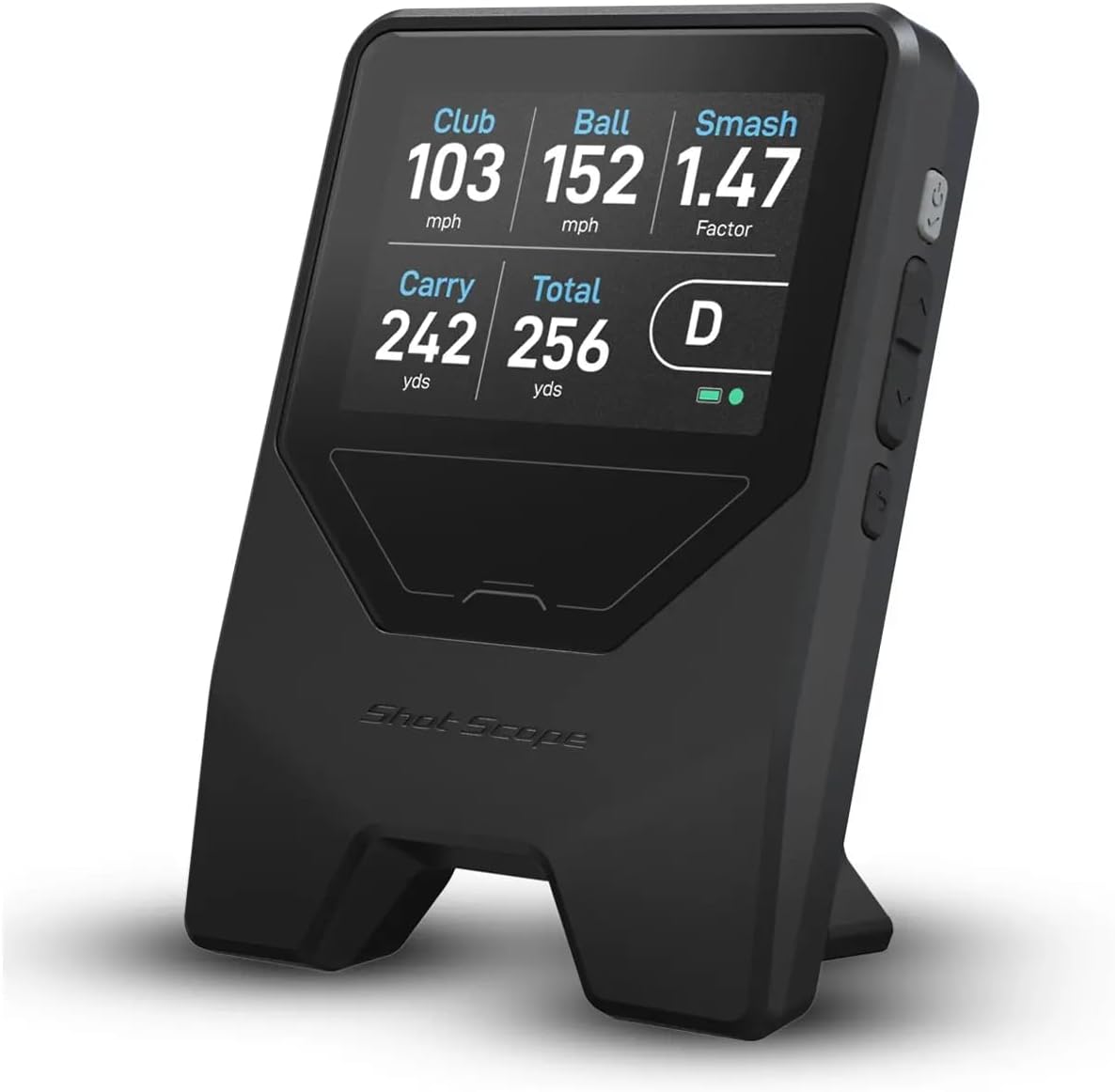
The Shot Scope LM1 Launch Monitor offers core launch measurements and session storage without a monthly app fee. Its 3.8 rating is lower than several competitors in this roundup, but the supplied feature set is attractive for golfers who want club speed, ball speed, smash factor, carry distance, and total distance without paying for continuing access to their history.
We may earn a commission when you buy through this link, at no additional cost to you.
Doppler radar provides instant feedback after each shot, and a dedicated speed-training mode works with clubs and speed sticks. Session types include On-Course, Practice Range, and Speed Training, allowing the same device to support different routines. The included Golf GPS app provides lifetime session history without subscription fees.
This model does not approach the R50 or Launch Pro in camera-based detail, video review, or spin visualization. Its five-plus-hour battery is shorter than the ten-hour figures advertised by several competitors. The IPX3 rating offers some weather resistance, but it should be used thoughtfully around rain.
The LM1 is a sensible selection for golfers who prioritize essential speed and distance data, no recurring fees, and flexible unit settings. It suits a practice area where a compact screen and immediate numbers are more valuable than high-end imaging. Its lifetime history requirement makes it particularly appealing for users building a long-term training record.
Keeping session history without a subscription allows golfers to compare progress across many visits. This can be more valuable than a subscription offering extra media if your main goal is tracking speed, smash factor, and distance over time.
On-Course, Practice Range, and Speed Training modes make it easier to organize sessions around different outcomes. A dedicated speed mode also helps avoid measuring a training swing as though it were a normal ball strike.
We may earn a commission when you buy through this link, at no additional cost to you.
The Shot Scope LM1 Portable Golf Launch Monitor PlayBetter Power Bundle builds on the core LM1 experience with a portable 5,000mAh charger, wall adapter, protective case, cleaning cloth, USB-C charging cable, and user manual. Its 4.2 rating is among the stronger scores in the group, and the package is especially practical for golfers who want the monitor and charging solution kept together.
We may earn a commission when you buy through this link, at no additional cost to you.
The monitor uses Doppler radar to report club speed, ball speed, and smash factor, while carry and total distance provide context for performance. A free lifetime app subscription is included for session history, with no monthly fee required. The IPX3-rated body is designed for indoor and outdoor use and is positioned five feet behind the ball during operation.
The bundle does not add camera-based spin analysis, a large touchscreen, or impact video. It remains a focused radar instrument. Its power-bank format may also be unnecessary for users who already travel with a suitable charging system and prefer to carry less equipment.
Choose this version if you want a ready-to-use portable package with charging and protection included. It suits golfers who value uncomplicated metrics, no subscription fee, and a coordinated kit for range or indoor sessions without committing to a full premium simulator system.
The included power bank, wall adapter, USB-C cable, and case reduce the chance of leaving a key component behind. That convenience is meaningful for golfers who move regularly between a home practice area, gym, and driving range.
Club speed, ball speed, smash factor, and distance form a useful baseline without a recurring fee. Including lifetime session history helps turn individual repetitions into a record that can reveal consistency over time.
We may earn a commission when you buy through this link, at no additional cost to you.
The Garmin Approach R50 is the most feature-rich premium mobile simulator in this guide, combining a three-camera measurement system with a built-in 10-inch color touchscreen. Its 4.3 rating reflects a broad set of capabilities: ball speed, launch angle, face-to-path, improved spin rate, spin axis, impact video, shot dispersion, barometer-assisted distance, and virtual rounds for as many as four players.
We may earn a commission when you buy through this link, at no additional cost to you.
The built-in display reduces reliance on a phone and makes it easier to move through course selection, insights, impact footage, and simulated play from one device. A built-in barometer accounts for atmospheric pressure when estimating carry distance, while the three-camera system supports more granular analysis than conventional single-source radar measurements.
It is not a minimal practice gadget. Face-to-path tracking requires an included tracking sticker, and virtual courses, enhanced features, and Home Tee Hero access require an active Garmin Golf membership. The carrying case helps with transport, but the R50 still represents a much larger commitment in equipment, setup, and learning curve than a pocket radar meter.
Buy the R50 when you want a premium portable simulator with a self-contained screen, high-speed impact video, and advanced spin-related insights. It is best for serious golfers who want to alternate between indoor instruction, range work, and virtual play rather than merely check swing speed.
A large built-in touchscreen makes the R50 easier to use as a standalone simulator. Golfers can review metrics, inspect impact videos, select courses, and play virtual rounds without navigating a smaller phone screen in the middle of a session.
High-speed impact footage shows the strike in context, while spin rate and spin axis help explain why two shots with similar speed can curve differently. Those combined views can make a practice adjustment easier to understand and repeat.
We may earn a commission when you buy through this link, at no additional cost to you.
The GOLFBUDDY Shot Mate combines Doppler radar measurement with a full-color TFT LCD and a generous 1,000-shot storage capacity. Its 3.8 rating is shared with the standard Shot Scope LM1, although this model takes a different approach: it places a bright, auto-adjusting screen directly in front of the golfer and offers dedicated practice and target modes.
We may earn a commission when you buy through this link, at no additional cost to you.
Club speed, ball speed, smash factor, and carry distance provide the central data set. The display is designed for visibility in varying light, while the rechargeable lithium-polymer battery is advertised for up to 10 hours of continuous use. Ball flight can be tracked for distances up to 320 yards, giving the monitor relevance across a wide range of practice scenarios.
Compared with connected systems, the Shot Mate lacks video capture, virtual courses, and advanced spin visualization. The supplied information does not describe a companion app, so golfers who want automatic shot categorization or remote analysis should verify their workflow needs. Its primary appeal is immediate, standalone feedback.
Choose the Shot Mate for golfers who prefer a clear built-in color screen and large shot memory without relying on a phone. It is well suited to range and indoor practice where real-time speed, smash factor, and carry distance are the main objectives, particularly for players building consistency through repeated target work.
A color screen that adapts to lighting can be easier to read than a small monochrome display. It also puts club speed, ball speed, smash factor, and carry information in one consistent interface without requiring a separate phone.
Keeping up to 1,000 shots allows a golfer to preserve a large sample and automatically revisit the last 10 swings. That makes it easier to compare a fatigue-related change or identify whether a recent technique adjustment produced a different result.
We may earn a commission when you buy through this link, at no additional cost to you.
The FlightScope Mevo is a lightweight, portable unit built around three-dimensional Doppler radar. Its 4.2 rating reflects a focused feature set that combines eight full-swing performance parameters, direct spin measurements, and video on every shot. It is designed for golfers who want more dimensional feedback than a basic speed meter without moving to a full desktop simulator.
We may earn a commission when you buy through this link, at no additional cost to you.
The supplied information lists full-swing performance data and direct spin measurement, while video allows each repetition to be examined visually. Practice is not limited to open-ended hitting: Mevo Skills Challenges include PGA and LPGA challenges, a Long Drive Competition, and a Range Competition. These formats can add structure to a session and create a clearer reason to repeat each motion.
The Mevo reports eight parameters rather than the broad metric set found in premium three-camera systems, so buyers should consider which outputs matter most. Like every radar launch monitor, its results also depend on correct placement, adequate space, and a clean swing path. The listed features do not specify phone-free operation for every analysis function.
Choose the Mevo if direct spin data, compact portability, and per-shot video are your priorities. It is a practical middle ground for range, course, and home practice, particularly for golfers who enjoy structured challenges and want a repeatable way to compare swing performance over time.
Speed and distance show how far a shot traveled, but spin helps explain how it behaved in flight. Direct spin information can make it easier to investigate excessive curvature, weak or strong sidespin, and changes between practice swings.
PGA and LPGA challenges, long-drive events, and range competitions turn measurement into a structured exercise. A defined target can be more engaging than watching a screen update indefinitely, especially when practicing consistency.
We may earn a commission when you buy through this link, at no additional cost to you.
The Bushnell Golf Launch Pro – Circle B Edition uses a proprietary three-camera imaging system with infrared rather than relying primarily on radar algorithms. Its 3.4 rating is the lowest supplied score among these products, but its camera-based approach provides a different measurement philosophy and a notable set of carry, launch, spin, and club-head-speed outputs.
We may earn a commission when you buy through this link, at no additional cost to you.
The Launch Pro is intended for indoor and outdoor use, including a range, course, garage, or simulator room. Its complete data package includes exact carry distance, launch information, spin, and club head speed. A partnership with Foresight Sports also allows compatible laser rangefinder users to receive personalized club recommendations from their launch data.
Club data requires an active subscription, while the included membership trial is limited to 30 days and depends on the selected membership level. The rangefinder is also sold separately. These extras should be evaluated against the core metrics rather than treated as automatically included benefits of the hardware.
Choose the Launch Pro if camera-based measurement, spin information, and flexible indoor-outdoor use are your priorities. It may appeal to golfers interested in the Foresight ecosystem or those who prefer imaging technology over radar. Review the subscription and accessory requirements carefully before deciding whether its club recommendations will add meaningful value to your practice.
The three-camera infrared system observes the impact area rather than estimating every outcome solely through radar-based algorithms. This design supports carry, launch, spin, and speed information in both indoor and outdoor environments.
Personalized club recommendations can be useful, but they depend on a compatible separately sold rangefinder and the appropriate membership. Consider those requirements alongside the launch monitor's core measurements rather than assuming every feature is immediately available.
We may earn a commission when you buy through this link, at no additional cost to you.
The most useful launch monitor is not necessarily the one with the most features. Start with the measurements you want to improve, then consider space, power, connectivity, display, durability, and the type of practice you will actually perform.
Radar and camera-based systems use different ways to evaluate a swing. Doppler radar devices are generally portable and can support club-speed work without a ball, which is useful in tight spaces. Three-camera systems can capture the impact event directly and may provide detailed visual feedback, although they generally involve a larger setup. The Garmin R50 and Bushnell Launch Pro use camera systems, while the Voice Caddie, PRGR, Shot Scope, GOLFBUDDY, and Mevo use radar-based measurement.
Choose based on practice environment and learning style. Radar is convenient for speed repetition, while camera systems suit golfers who want to connect numerical data with an image of the strike. Confirm that the technology can measure the metrics you need rather than assuming every monitor provides the same information.
A golfer focused on tempo may need only club speed, while others want ball speed, smash factor, launch direction, spin, carry distance, and total distance. The PRGR, Shot Scope LM1, and GOLFBUDDY Shot Mate concentrate on speed, efficiency, and distance. Garmin's R10 adds swing tempo, launch data, and video. The R50 and Bushnell Launch Pro emphasize spin, launch information, and impact-level analysis.
List your top three training questions before shopping. Avoid paying for advanced features you will never use, but do not choose an underspecified model if its limited data cannot answer the questions that matter to your practice.
Portable does not always mean equally convenient in every location. The PRGR is pocket-sized, the Voice Caddie supports no-ball indoor work, and Garmin's R10 weighs less than the R50 while offering a carry case. Camera systems may require more alignment and a suitable flight or impact area. Check whether your intended indoor space can accommodate the recommended position and ball flight.
For frequent travel, favor a compact body, protective case, and simple power requirements. For a fixed indoor bay, a built-in screen and simulator functions may matter more than minimum weight. Portability should mean the device can be used where you practice without creating setup friction.
Some monitors work independently, while others rely on a compatible phone, an app, or an active membership for deeper features. The Shot Scope LM1 is notable for offering its app and session history without subscription fees. Garmin devices provide extensive connected and virtual-course features, although some require active Garmin Golf memberships. Bushnell club data and Foresight-linked recommendations also depend on subscription access.
Budget for both hardware and ongoing access if the connected ecosystem is central to your goals. If you only need immediate numbers, an app-free radar monitor can offer a simpler experience. Read the current product listing carefully because included trials, membership levels, and feature access can change.
Displays range from a basic LCD with voice output to the Shot Mate's full-color TFT screen and the R50's 10-inch color touchscreen. Garmin's R10 and FlightScope Mevo can associate recorded video with shot data. The R50 provides high-speed impact video directly on its display. These differences matter most if you learn visually or intend to study delivery after every repetition.
A large screen is useful for multimedia analysis, but immediate numeric feedback may be enough for speed training. Consider whether you want to watch footage, save clips, or simply glance at the latest result. A device that matches your actual review habits will be more useful than one with features you rarely open.
Battery life ranges from roughly four hours on the R50 to advertised runs of 20 hours for the Voice Caddie and 10 hours for the Garmin R10 and GOLFBUDDY Shot Mate. The Shot Scope LM1 promises more than five hours, while the PRGR uses readily available AAA batteries. Some bundles include USB-C charging equipment or a portable power bank.
Consider session length rather than only the headline figure. A full practice session plus travel can consume more power than expected, particularly when a display or wireless connection remains active. Carry a charging solution when the device uses an internal rechargeable battery, and note whether replacement batteries are easy to find.
The PRGR stores 500 swings, the GOLFBUDDY stores as many as 1,000 and automatically keeps the latest 10 for quick review, while Shot Scope emphasizes lifetime session history. Weather ratings range from IPX3 on the LM1 to IPX7 on Garmin's R10. These features affect how easily you can compare progress and whether outdoor practice can continue after a shower.
More stored data is useful only if you review it, so choose based on your habits. For outdoor use, water resistance adds resilience but does not make improper placement or exposure safe. Always follow the manufacturer's setup and care instructions.
Virtual rounds transform a launch monitor into a broader entertainment and training platform. Garmin's R10 supports virtual courses and recorded swing clips, while the R50 adds a large touchscreen, high-speed video, putting, and multiplayer virtual play. Shot Scope and the PRGR concentrate on training data rather than simulated courses.
Simulator functionality is most valuable when you cannot access a course regularly or enjoy structured challenges. If your priority is repeatable swing feedback, a smaller training monitor may deliver a better routine. If you want visual analysis and course play, choose the ecosystem that best matches your devices and membership preferences.
Start by reading the setup instructions and choosing a clear, level hitting area. Place the unit exactly where the manufacturer recommends, often behind the ball for radar systems or in a defined camera position for imaging systems. Consistency in placement is essential because moving the monitor between shots can introduce error and make comparisons unreliable.
Warm up with a few controlled swings before collecting your working data. For speed training, confirm whether the device is in club-speed mode and use the intended club or speed stick. For ball measurements, take a representative sample rather than relying on one unusually favorable strike. Review club-by-club results, use video where available, and record one adjustment to test during the next set.
After the session, power down the unit, remove any visible dirt gently, and protect the sensors or camera lenses from impact. Store it in its case, keep charging contacts clean, and replace batteries or recharge the battery according to the instructions. Review the current manual for model-specific calibration, placement, firmware, and weather precautions before each new practice environment.
Yes, but the model and available space matter. The Voice Caddie SC200Plus can train swing speed without hitting a ball, making it especially practical indoors. Other monitors can provide indoor data when placed according to their instructions with adequate clearance and an appropriate hitting area. Camera-based systems may need more room, stable alignment, and protection from struck balls.
It depends on the launch monitor. The Voice Caddie SC200Plus has a dedicated swing-speed mode that works without a ball, and the PRGR HS 130-A can measure club head speed without one. These capabilities are useful for indoor tempo work and training with speed sticks. Devices measuring ball speed, smash factor, or distance naturally require a struck ball.
Club speed is the speed of the club head at impact, while ball speed is the speed of the ball after contact. Comparing the two helps reveal smash factor, which indicates how efficiently the club transfers energy to the ball. A monitor that supplies both can show whether a swing change improved efficiency, not merely raw speed.
Some do, and some do not. Garmin's R10 uses a compatible smartphone with the Garmin Golf app for key metrics, video, and analysis, while the PRGR operates without Wi-Fi, Bluetooth, or an app. The Shot Scope LM1 uses its included app for session history without subscription fees. Check the app, phone, and membership requirements before purchasing.
Neither approach is universally better. Radar devices are often convenient for speed training and portable setups, while camera systems can provide detailed impact imagery and advanced launch or spin information. Your best option depends on the metrics you need, your available space, and how you prefer to review your swing.
Accuracy varies by model, setup, technology, and the metric being measured. Garmin lists specific tolerances for the R10, including plus or minus 3 mph for club head speed and plus or minus 1 mph for ball speed. Stable placement, correct calibration, and consistent swings help you obtain more useful and repeatable results.
Choose one if practice variety and simulated play are important to you. Garmin's R10 and R50 offer virtual-course experiences, although advanced membership access may apply. If your priority is straightforward speed, distance, and consistency data, a simpler radar monitor may provide a more focused and potentially less demanding practice routine.
Keep it in its supplied case or another protective location away from excessive heat, moisture, and impact. Clean the exterior and sensor or lens area with a soft, lightly dampened cloth rather than spraying cleaner directly onto the device. Charge the internal battery as directed or remove stored batteries during long periods of inactivity.
The Garmin Approach R10 Bundle stands out as the most connected all-around option, combining detailed metrics, automatic video, dispersion analysis, virtual play, and an alignment setup. The Garmin Approach R50 is the premium choice for golfers who want a built-in touchscreen, three-camera measurement, impact video, and advanced spin information. For a focused, uncomplicated radar tool, the PRGR HS 130-A delivers speed, smash factor, distance, and no-ball measurement without requiring an app.
Before choosing, decide whether you want a pocket-sized speed trainer, a standalone unit with a large display, a camera-based simulator, or a phone-centered analysis system. Prioritize the metrics that match a repeatable practice goal, then confirm placement requirements, battery needs, weather resistance, and subscription terms. A simpler model used consistently is generally more useful than an advanced system whose features you never learn to interpret.
Product prices, promotions, memberships, and included accessories can change, so check the current listing before ordering. Also verify the monitor's accuracy specifications and setup instructions rather than assuming every model is equally suitable for your indoor area, practice environment, or mobile workflow.