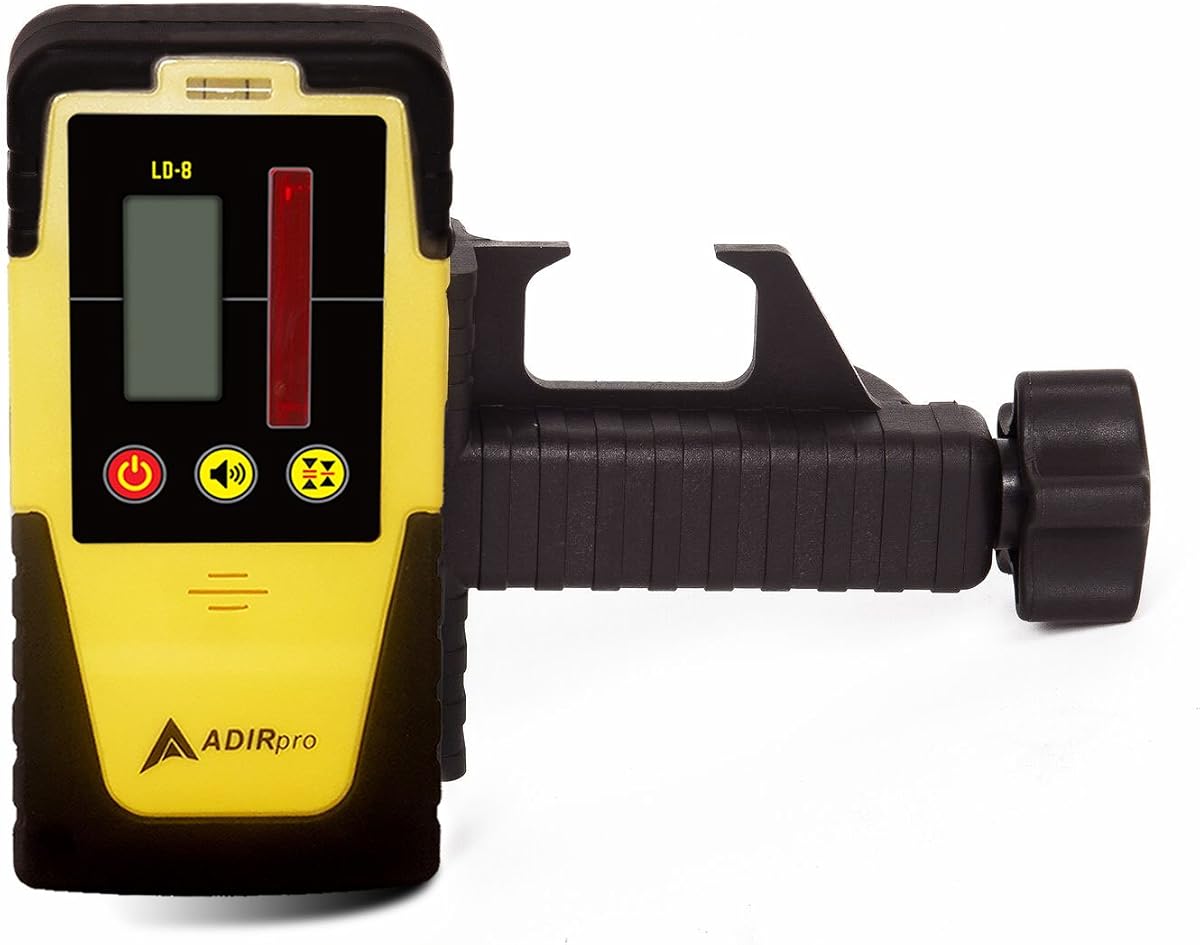
AdirPro LD-8
4.2Editor score
Dual-sided clear LCD display
Selectable precision modes
Includes threaded rod clamp
IP55 dust and water resistance
Compare 10 of the best laser level receiver options for outdoor work, rotary lasers, long-distance layouts, accuracy, displays, and rugged construction.
A laser level receiver turns a visible beam into a practical elevation-reading tool, making it easier to transfer reference lines across rooms, foundations, floors, and large outdoor sites. The best unit should detect the intended beam reliably, communicate clearly, mount securely, and withstand dust, moisture, transport, and daily construction use.
This guide compares ten receivers and receiver-equipped laser level kits across working range, accuracy, display visibility, operating mode, mounting options, battery behavior, weather protection, and compatibility. It includes dedicated receivers for pulse and rotary systems as well as complete line-laser packages designed for outdoor layouts and long-distance positioning.
Each review explains the most useful capabilities, practical limitations, and likely buyer profile. Ratings and specifications reflect the supplied product information, while prices and availability can change, so readers should verify current listing details before purchasing. The comparison also distinguishes standalone receivers from full laser level kits.
4.2Editor score

4.3Editor score

5.0Editor score
The table below compares receiver-focused features and included systems, helping buyers separate standalone pulse receivers, rotary detectors, and complete outdoor laser level kits.


The DOVOH H3-360G-KIT combines a 360-degree self-leveling green laser with a receiver built for outdoor positioning. Its 4.3 rating reflects a generally capable package, while the most notable feature is the stated 400-foot working range when the receiver is paired with the included H3 laser. That range refers to detection with the receiver rather than direct visibility of the beam, an important distinction on bright job sites.
We may earn a commission when you buy through this link, at no additional cost to you.
The kit's high-power green beam is designed to remain useful beyond the range at which sunlight makes the line difficult to see. A target plate and green glasses help users locate the beam, and the receiver provides the more dependable solution when working across large areas. Two 2600mAh batteries are included, reducing interruptions during extended setups, while the self-leveling design simplifies alignment on uneven surfaces.
Durability is another meaningful strength. The H3 uses a double shockproof assembly with two layers of cushioning rubber around the core, a design intended to protect the tool from the knocks and vibrations associated with construction sites. DOVOH also backs the laser with a five-year accuracy warranty and a two-year quality warranty, adding long-term reassurance for professional users. One practical limitation is that the grade rod is not included.
This is a strong choice for contractors who want a complete outdoor line-laser package rather than only a receiver. It is especially appealing for foundation work, grading, exterior layouts, fencing, and general construction where the beam may be too faint to follow directly in sunlight. Buyers should choose it for the integrated H3 system and may need to obtain a separate rod if their workflow depends on one.
The receiver-centered approach is more useful than relying on visual beam detection alone in direct sunlight. The included target and glasses improve the early stages of beam acquisition, while the H3 and receiver work together to transfer the reference across the stated outdoor range.
Dual rechargeable batteries and the double shockproof core address two common jobsite concerns: downtime and damage. The included accessories also reduce the number of separate purchases needed for basic outdoor alignment.
We may earn a commission when you buy through this link, at no additional cost to you.
The Huepar Pro ZK04CG-LR300 is a feature-rich 4D green laser kit with a high-precision receiver rated for working distances up to 660 feet in pulse mode. Its 4.4 rating and broad feature set make it a serious option for contractors who need both long-distance transfer and complete room coverage. Two horizontal and two vertical 360-degree planes support walls, floors, ceilings, and corners.
We may earn a commission when you buy through this link, at no additional cost to you.
A key strength is the receiver's selectable accuracy. It offers a fine setting of ±1/13 inch at 33 feet and a standard setting of ±1/8 inch at 33 feet, allowing users to favor precision or easier acquisition depending on the task. The laser itself has the same ±1/13-inch stated accuracy at 33 feet and self-levels in three seconds. Line selection, manual mode, and remote control reduce unnecessary movement around the workspace.
The mounting system is also thoughtfully arranged. A magnetic bracket supports attachment to metal, with fine adjustment for vertical and horizontal positioning, while 1/4-inch-20 and 5/8-inch-11 threads accommodate tripods and pole mounts. The rechargeable battery lasts up to eight hours and includes a USB output function. Metal window covers, rubber casing, IP54 protection, and a hard case support frequent transport, though this level of equipment may be more than a small indoor project requires.
This kit is best suited to professional framing, concrete, grading, exterior installation, and large renovation work where one tool must serve several reference-plane tasks. It is a particularly compelling option for buyers who value remote operation and long receiver range. Confirm that the complete package and mounting accessories align with your existing tripod or pole setup before buying.
Switching between fine and standard receiver modes makes it possible to balance measurement precision against practical beam acquisition. Fine mode is useful for demanding layouts, while the standard setting can be easier when working rapidly across a broad site.
Two horizontal and two vertical planes reduce the need to reposition the tool for different layout orientations. Independent line selection helps keep the visual field uncluttered, especially during interior installation work.
We may earn a commission when you buy through this link, at no additional cost to you.
The Huepar Pro 660FT Kit is designed for large outdoor jobs and interior trades that benefit from remote control. It pairs a receiver with a green 3×360-degree laser capable of one horizontal and two vertical planes. The receiver's stated working range reaches 660 feet in pulse mode, making the package relevant to foundation layout, fencing, decks, utility positioning, and exterior alignment.
We may earn a commission when you buy through this link, at no additional cost to you.
Its fixed-point pivot adjustment is the distinguishing construction feature. Side pivot knobs provide a 10-degree micro-rotation range while the intersection of the two vertical lines remains fixed. That design is particularly useful for drywall, partition, and ceiling layouts because the installer can refine the reference without repeatedly losing the original intersection. The unit also self-levels in three seconds and warns when tilt exceeds ±3 degrees.
Bluetooth app control adds another layer of convenience. Users can switch lines, enable or disable pulse mode, create line combinations, and activate sleep mode from a smartphone. The kit claims more than 30 hours of runtime with a single line, while the battery can also serve compatible devices. A magnetic bracket, threaded base, and hard case support positioning and transport, and IP54 protection helps handle dust and moisture.
This is a good fit for contractors who routinely move between drywall, electrical, plumbing, and exterior tasks and want one long-range system. It may be less compelling for buyers seeking four complete planes because it projects three. Even so, the fixed-point adjustment, app control, and extended runtime form a persuasive package for multi-trade work.
Keeping the vertical-line intersection fixed during micro-adjustment helps preserve an established reference. That makes the feature particularly valuable when framing partitions or aligning ceiling and wall layouts over repeated fine corrections.
App-based line selection can save trips between the laser and the work face. Custom line combinations also help users create a cleaner projection pattern for a specific installation rather than leaving every plane visible.
We may earn a commission when you buy through this link, at no additional cost to you.
The AdirPro LD-8 is a dedicated universal detector for most standard red rotary lasers. Its 4.2 rating reflects a practical, well-equipped option, and the receiver fills an important gap for buyers who already own a compatible rotary transmitter. It displays elevation, grade sensitivity, audio status, and battery status on clear LCD screens.
We may earn a commission when you buy through this link, at no additional cost to you.
Two accuracy settings provide useful flexibility. The finer ±1/16-inch, or 1 mm, mode suits higher-precision leveling, while ±1/8-inch, or 2.5 mm, offers a more standard working mode. A built-in bubble level helps the user mount the receiver vertically on a grade rod without relying only on the digital signal. The hard-plastic housing and rubber casing provide physical protection for regular site use.
Battery management is straightforward. A standard 9V battery provides approximately 40 working hours, and automatic shutoff after ten minutes of inactivity helps preserve power during short breaks. The included rod clamp uses 1/4-inch threading for compatible hardware. The stated working range can reach 2,000 feet depending on the laser, meaning transmitter power and conditions remain essential parts of the result.
The LD-8 is a cost-conscious choice for survey, grading, excavation, and general construction users with a compatible red rotary laser. It offers more measurement feedback than a simple visual beam target while avoiding the expense of a complete laser kit. Confirm red-beam rotary compatibility and rod-clamp dimensions before purchasing.
The dual-sided display makes the receiver easier to read from different working positions. Numeric elevation feedback and selectable sensitivity make it useful for grade checks rather than merely indicating when a beam is present.
This receiver is intended to pair with a compatible red rotary laser rather than a pulse line laser. Its potential long range depends heavily on the transmitter, beam conditions, and line of sight.
We may earn a commission when you buy through this link, at no additional cost to you.
The Huepar LR-6RG is a dedicated pulse receiver for owners of compatible Huepar and Huepar Pro laser levels. It carries a 4.2 rating and stands out for its ability to detect both green and red pulse beams. The stated range reaches 200 feet, making it more useful outdoors than relying on the visible beam, though compatibility is the decisive consideration.
We may earn a commission when you buy through this link, at no additional cost to you.
The receiver uses LED and acoustic signals to help users find the laser plane. Its display appears on the front, side, and back, allowing readings to be checked from several positions. A dual-sided bubble arrangement places vials on the front and top for more accurate rod mounting. The heavy-duty clamp accepts a rod or similar target point and keeps the unit in a working position.
A 9V battery supplies approximately 70 working hours, and automatic shutoff occurs after about eight minutes of inactivity. The important operating condition is that pulse mode must be switched on and remain available while using the receiver. The supplied information lists many compatible Huepar models and explicitly excludes several non-pulse and rotary models, so buyers should check the compatibility list carefully.
This is a sensible dedicated receiver for existing Huepar users who need extra detection range without replacing their laser. It is less suitable for someone seeking a universal receiver or a rotary detector. Its strongest advantages are the long battery life, easy multi-sided visibility, and dependable fit within the supported Huepar ecosystem.
Combining LEDs with audible beeps helps users acquire the beam without staring continuously at the receiver. The multi-sided layout improves visibility when the rod is placed in a position that makes one face difficult to see.
The receiver supports numerous listed Huepar line lasers, but exclusions include models without pulse mode and several rotary systems. Confirm the exact model and its pulse capability before ordering.
We may earn a commission when you buy through this link, at no additional cost to you.
The Huepar Pro 4D LCD Kit combines a full 4×360-degree laser with a digital receiver and an unusually informative top-mounted display. Its 5.0 rating reflects the strongest rating in this group, while the receiver extends outdoor working range to 230 feet in pulse mode. The receiver indicates distance from the laser line and movement direction to help users align more quickly.
We may earn a commission when you buy through this link, at no additional cost to you.
The laser itself has a top LCD that shows X- and Y-axis angles, leveling status, manual mode, and lock status. This information is useful when the unit is mounted on a tripod, bracket, or elevated surface. The close-to-wall design places the laser outlet about 5/32 inch from the edge, helping reduce blind spots in tight corners and improving cabinet, tile, flooring, and drywall layouts.
Construction features include IP54 protection, a multifunction magnetic bracket, a tripod-compatible bottom thread, and a rechargeable battery that can also charge compatible devices. Bluetooth app control allows line changes, pulse control, custom combinations, and sleep mode. Self-leveling and manual modes cover standard horizontal and vertical layouts as well as angled work such as stairs, slopes, and railings.
This system is well suited to contractors who value both receiver guidance and detailed laser status information. It can handle interior finishing, concrete, foundations, landscaping, decks, fences, electrical, and plumbing layouts. Some buyers may prefer a longer-range receiver-only kit, but this model offers one of the most integrated combinations of display data, line control, and mounting flexibility.
Showing the distance to the laser line and the direction of movement gives the receiver more authority than a simple arrow-only detector. That feedback can reduce trial-and-error positioning when establishing an outdoor elevation.
The top display keeps axis angles and operating modes visible without crouching beside the tool. It is particularly useful when the laser is mounted where the housing's side controls are inconvenient to reach.
We may earn a commission when you buy through this link, at no additional cost to you.
The Universal Digital Rotary Laser Receiver is a rugged detector for most standard red-beam rotary lasers. Its 5.0 rating makes it one of the strongest-rated options in the guide, and the stated 2,000-foot detection range is particularly suited to large construction and survey environments. The receiver is designed as a companion rather than a complete laser system.
We may earn a commission when you buy through this link, at no additional cost to you.
Front and rear backlit LCD screens provide clear digital readouts in low-light or dark conditions. The product information highlights reliable detection across lighting conditions, while the hard-plastic housing and protective rubber over-mold are intended to withstand impact, rain, dust, and harsh weather. Its IP66 rating provides a stronger environmental specification than the IP55 rating of the AdirPro LD-8.
A standard 9V battery provides up to 40 hours of continuous operation, and automatic shutoff after ten minutes of inactivity preserves power. The included mounting bracket uses 1/4-inch threading, allowing straightforward setup on a compatible rod. As with other universal rotary receivers, the maximum range depends on the laser's output and the conditions of the beam, so the advertised figure should not be treated as guaranteed under every environment.
This receiver is a strong fit for contractors already using a compatible red rotary transmitter and prioritizing weather resistance. It works particularly well for survey, grading, excavation, and large-site elevation work. Verify the rotary beam color and transmitter compatibility before purchase, as it is not presented as a universal receiver for every line-laser category.
The IP66 rating and rubber over-mold provide useful protection in dusty or wet environments. That makes the receiver suitable for outdoor work where exposed tools encounter rain, grit, and repeated handling.
Backlit screens on both the front and rear improve visibility without forcing the user to approach from one exact angle. This helps during early starts, interior work, and shaded site conditions.
We may earn a commission when you buy through this link, at no additional cost to you.
The DOVOH DR1 is a high-accuracy pulse receiver designed to improve laser detection in bright sunlight. It carries a 4.4 rating and can reach a stated 400-foot working range when paired with the DOVOH H3 high-power laser. The receiver offers selectable accuracy of ±1 mm in fine mode and ±3 mm in coarse mode, giving users a choice between precision and easier target acquisition.
We may earn a commission when you buy through this link, at no additional cost to you.
Its 97 mm reception area is one of the more distinctive physical specifications. A larger detection surface can make it easier to capture the beam quickly, particularly while the operator is moving a rod or adjusting a tripod. Two LCDs allow readings from both sides, reducing the need to walk around the rod to interpret the display.
Compatibility is the most important qualification. The DR1 does not work with rotary laser levels. A non-DOVOH laser must operate in pulse mode with a 10 KHz pulse frequency, so users should verify those details before assuming it will pair with an existing line laser. Accuracy also changes with distance because the projected line becomes wider and less sharply defined farther from the source.
The DR1 is an excellent choice for DOVOH H3 owners who want a dedicated receiver for outdoor work. It is also technically usable with qualifying pulse lasers from other brands, provided the frequency and mode requirements are met. For users who need rotary detection or prefer a complete matched kit, one of the dedicated rotary or bundled alternatives may be easier.
The fine and coarse settings let the user adapt the receiver to the demands of the task. Fine mode is appropriate when millimeter-level positioning matters, while coarse mode can make beam acquisition less demanding.
The required pulse frequency is essential because visual similarity does not guarantee receiver compatibility. Checking the source laser's mode and frequency prevents wasted setup time.
We may earn a commission when you buy through this link, at no additional cost to you.
The VEVOR 1650FT Rotary Kit is a complete red-beam rotary laser package with a receiver, heavy-duty tripod, grade rod, laser glasses, remote control, and hard case. Its 4.0 rating is the lowest among the listed products, but the package offers a straightforward way to establish a rotary reference without sourcing each component separately.
We may earn a commission when you buy through this link, at no additional cost to you.
The laser rotates through 360 degrees and supports five speed settings from zero to 600 rpm along with several scan angles. That flexibility helps users choose a broad continuous reference for general leveling or a faster targeted scan for a particular point. The receiver extends the stated working distance to 1,650 feet, making the kit suitable for large remodels and construction sites where the rotating beam must be detected at a distance.
Power comes from four 1.2V NiMH cells, giving eight to 12 hours of operation per charge, and a charger is included. The housing has an IP54 rating and an impact-resistant design. A 5/8-inch mounting thread fits common rotary laser accessories, while the remote control operates from up to 65 feet, reducing the need to return to the laser for routine adjustments.
This is a practical all-in-one option for users entering rotary leveling rather than adding a receiver to an existing system. The included tripod and case simplify transport and setup, and the included glasses can help during setup in bright conditions. Buyers who already own compatible rotary equipment may get more value from a standalone receiver, while this bundle favors convenience and completeness.
Variable rotation speeds and scan angles let the operator control how quickly and broadly the beam moves. This is useful when a task needs a focused point reference rather than a full rotating plane.
The receiver, tripod, rod, glasses, charger, and case create a ready-to-use package. It reduces the need to research separate accessory compatibility before beginning a rotary layout.
We may earn a commission when you buy through this link, at no additional cost to you.
The Topcon RL-H5A Kit pairs a professional self-leveling construction laser with an LS-80 receiver, sensor holder, and carrying case. Its 4.5 rating is the second-highest score in this guide, and the instrument is aimed at grading, excavating, and general construction applications that demand dependable elevation transfer over substantial distances.
We may earn a commission when you buy through this link, at no additional cost to you.
The RL-H5A uses electronic self-leveling, allowing the operator to power it on and begin work quickly. If the instrument is disturbed, it automatically relevels itself, reducing the need for repeated manual adjustment. The self-leveling motors are stated to be accurate to ±10 arc seconds, and the system can shoot elevations across an 800-meter diameter job site.
Environmental durability is a major strength. The IP66 rating allows the laser to withstand dust, a sudden shower, and even torrential rainfall, an important consideration for equipment used outdoors. The included sensor holder and receiver support the transfer process, while the carrying case helps protect the instrument and accessories during transport between work areas.
This is the premium choice for professional contractors, survey teams, and earthmoving operations that need a dedicated rotary instrument rather than a multi-plane line laser. Its strengths are fast setup, automatic recovery, precise leveling, and long site coverage. It is less versatile for interior wall and ceiling layouts, where a line-laser kit would be more appropriate.
Electronic releveling helps the instrument return to its operating condition after a bump or shift. That automation is valuable on active sites where wind, vibration, or accidental contact can otherwise interrupt a reference.
The stated 800-meter diameter makes the RL-H5A suitable for earthmoving and grading across large properties. Its high accuracy and durable enclosure support professional workflows where measurement consistency is a priority.
We may earn a commission when you buy through this link, at no additional cost to you.
The right receiver depends on the laser type, job-site range, required accuracy, display needs, mounting method, and environmental exposure. Start with the transmitter you already own or intend to buy, because pulse line lasers and red rotary lasers use fundamentally different detection systems.
Compatibility is the first filter because a receiver cannot exceed the capabilities of the signal it detects. Pulse line-laser receivers require a compatible pulse frequency and operating mode, while universal rotary detectors are designed to receive the rotating beam from compatible red rotary instruments. The DOVOH DR1, for example, is not compatible with rotary lasers and requires a 10 KHz pulse frequency when paired with a non-DOVOH source. The Huepar LR-6RG supports many listed Huepar models but excludes certain non-pulse and rotary products.
Choose the receiver by matching the exact laser model, beam color, pulse behavior, and operating mode. If no compatible receiver exists, buying a complete matched kit may be more dependable than forcing an uncertain connection.
Range is most useful when it reflects the environment rather than appearing as a headline number. A 660-foot receiver range may be appropriate for a foundation or exterior layout, while a smaller indoor system may be sufficient for cabinetry and drywall. Rotary receivers can advertise very long ranges, but the transmitter's output, atmospheric conditions, obstruction, and beam quality all influence the result. The listed working range for the DOVOH H3 and DR1 also applies specifically when those compatible components are used together.
Compare the receiver's rated range with the dimensions of your normal worksite and leave room for realistic beam acquisition. Do not assume every listed maximum will be reached in direct sunlight or through construction clutter.
Accuracy is critical when the receiver transfers an elevation to a rod, stake, or grade reference. Fine modes around 1 mm can support demanding work, while a coarser setting may be easier to acquire and sufficiently precise for routine leveling. Some products change sensitivity based on distance because the projected laser line widens as it travels from the source. Digital readouts, arrow indicators, and audible signals also influence how precisely a user can center the beam.
For precision work, check the receiver's specified tolerance and the distance at which that tolerance applies. For fast site work, a selectable coarse mode may produce a better overall workflow than using the finest setting at all times.
A receiver must communicate clearly when it is mounted on a rod, carried by an assistant, or used in bright or dark surroundings. Dual-sided LCDs allow readings from either side, while three-sided LED layouts make it easier to see the direction of correction. Bubble vials are also valuable because they help orient the receiver vertically on a grade rod. The Huepar Pro 4D LCD Kit goes further by showing the distance to the laser line and movement direction.
Prioritize displays that can be read from your normal working position. Audible alerts are valuable when visual access is limited, but the strongest systems provide both visual and acoustic guidance.
A secure mount prevents the receiver from shifting while it is used as the measurement reference. Rod clamps with 1/4-inch threading are common on rotary receivers, while complete line-laser kits may include magnetic brackets, fine-adjustment knobs, and 1/4-inch-20 or 5/8-inch-11 laser threads. The latter sizes allow use with tripods, pole mounts, and other accessories already common on construction sites. Adjustability matters because it is often harder to move the entire rod than to make a small correction.
Match the receiver or kit to your existing rods, tripods, and brackets. If the kit includes only a receiver, verify that a suitable rod clamp is included; if it includes a laser, confirm that its mounting threads fit the equipment you plan to use.
Receivers are exposed to rain, dust, mud, vibration, and accidental impacts. IP54 offers protection against dust and water exposure, IP55 adds resistance to water jets, and IP66 provides stronger dust and water protection. These ratings are helpful indicators, but they do not eliminate the need for sensible storage. The Topcon RL-H5A's IP66 laser body and the universal digital rotary receiver's IP66 housing are especially relevant for exposed outdoor work.
Choose the level of protection that matches the weather and handling conditions. A rubberized housing, rugged plastic body, and secure clamp complement the ingress rating and can improve durability during transport.
Runtime affects how often work must pause for battery changes or charging. Dedicated rotary receivers commonly use standard 9V batteries, with supplied runtimes ranging from about 40 to 70 hours and automatic shutoff protecting the battery during idle periods. Rechargeable laser kits eliminate disposable battery logistics, and some can also charge compatible devices through a USB output. Published runtime figures may refer to a single line or a particular operating mode rather than continuous use at full output.
Estimate runtime based on your longest normal workday and carry a spare battery when the receiver uses a standard cell. For rechargeable systems, understand whether the stated duration applies with every laser line active.
A standalone receiver is economical when you already own a compatible laser, tripod, rod, and accessories. A complete kit offers better coordination among components and is often easier for a new user to start with. The DOVOH H3-360G-KIT combines receiver-equipped outdoor capability with batteries and targeting accessories, while the Topcon RL-H5A provides a professional rotary system, receiver, sensor holder, and case. At the other end of the spectrum, the AdirPro LD-8 and DOVOH DR1 are designed to complement existing equipment.
Choose a kit for convenience, coordinated range, and fewer compatibility problems. Choose a standalone receiver when expanding an established system is more economical and you have confirmed exact compatibility.
Begin by confirming the receiver is compatible with the laser model, beam color, and required operating mode. For pulse receivers, activate pulse mode before searching for the beam; for rotary receivers, verify that the rotating red beam is active. Install the battery with the correct polarity, turn on the receiver, and check its display, indicators, and automatic shutoff behavior before mounting it.
Set the laser on a stable tripod or suitable surface, allow it to self-level, and use the receiver to locate the beam. Mount the receiver on a level rod, hold it near the expected line, and move it slowly until the directional signal or digital reading indicates the correct position. Fine adjustments should be made with the mount or clamp rather than by twisting the receiver. Record the elevation after the signal stabilizes and repeat the check from another point when accuracy is critical.
Remove the battery before long-term storage, keep the reception window clean, and avoid scraping or pressing against it. Protect the receiver from impacts even when its housing is rugged, and do not immerse any unit beyond its stated rating. Store the laser and receiver in a dry case, recharge rechargeable batteries according to the manufacturer's guidance, and have the system recalibrated or checked if it is dropped, exposed to severe moisture, or begins producing inconsistent readings.
A laser level receiver detects the laser beam and helps a user transfer its height or position to a rod, stake, wall, or other work surface. It is especially useful outdoors, in bright light, or across distances where the visible beam is difficult to follow. Some receivers provide a numeric elevation, while others use arrows, LEDs, and audible signals to guide alignment.
No, compatibility depends on the receiver's detection system and the laser's signal. Pulse line-laser receivers may require a specific pulse frequency, and rotary detectors are intended for compatible red rotating beams. Check the receiver's supported models, beam color, frequency, and operating mode before purchasing, particularly with an aftermarket receiver.
A pulse receiver detects brief pulses from a line laser and is commonly used for indoor and outdoor layout work. A rotary receiver detects the continuously rotating or scanning beam of a rotary laser, making it especially useful for grading, excavation, and large-site elevation transfer. They generally are not interchangeable.
It extends usable positioning range rather than making the visible beam brighter or longer. The receiver detects the signal that the eye may struggle to follow, especially in sunlight. Maximum working range can still vary with beam brightness, weather, obstructions, operating mode, and the laser paired with the receiver.
The appropriate accuracy depends on the work and the measurement distance. Fine settings near 1 mm can suit precise installation and grading, while a coarser mode may be sufficient for general construction. Always review the stated tolerance at the distance where the receiver will be used, because beam width and sensitivity can affect the result.
Some models are specifically rated for exposure. IP54, IP55, and IP66 indicate increasing levels of dust and water protection, but the rating applies to the stated housing and should not be treated as permission to submerge the device. Use a protective case and keep the optical window clean during prolonged outdoor work.
A standalone receiver is usually the better value when you already own a compatible laser and the necessary rod or mounting hardware. A complete kit is more convenient for beginners and ensures that the receiver, signal mode, and advertised range are designed to work together. It can also reduce uncertainty about accessories and compatibility.
Fine mode uses a narrower detection tolerance, which can improve positioning precision but may be harder to acquire or hold. Coarse mode widens the acceptable signal zone, making it faster to find and easier to use for routine layouts. Switching modes lets the operator match sensitivity to the task and conditions.
The DOVOH H3-360G-KIT is the strongest all-around choice for buyers who want a receiver-equipped 360-degree green laser ready for outdoor work. The AdirPro LD-8 stands out as a cost-conscious dedicated rotary detector, while the Huepar Pro 4D LCD Kit offers the most sophisticated combination of digital receiver guidance, laser status information, and four-plane coverage in this selection.
Prioritize exact compatibility before range. Confirm whether the source laser is a pulse line model or a red rotary model, verify the required frequency and operating mode, and check the receiver's rod-clamp or laser-mounting requirements. After that, consider the working distance, selectable accuracy, display orientation, battery duration, and the ingress protection needed for the usual site conditions.
Ratings, product configurations, and availability can change, and current listing details should be checked before purchase. Comparing the complete package rather than one headline specification will help you select a receiver that works with your existing laser, rod, tripod, and typical construction environment.