
Honeywell Home RTH9585WF1004 Wi-Fi Smart Color Thermostat
4.3Editor score
Wi-Fi and app control
Color touchscreen display
Energy usage reports
Our expert guide compares the best thermostats for wall AC units, including programmable, smart, non-programmable, and budget-friendly options for your home.
Thermostats for wall AC units should make temperature control intuitive while matching the electrical and control capabilities of the cooling system. The right choice may be a conventional non-programmable model, a programmable thermostat, or a connected device with remote access and energy-use reports.
We compared all ten products by examining supported HVAC stages, heating and cooling capability, wiring requirements, programming options, displays, installation details, smart features, and manufacturer support. The guide also separates basic units from Wi-Fi models and highlights important limitations involving packaged terminal systems.
Each review shows who benefits most from a particular thermostat, what compromises to expect, and which installation details deserve attention. Product availability and prices can change, so compare the current listing and verify compatibility with your wall AC before making a final purchase.
The best thermostat is the one that supports the actual equipment, offers the controls you will use, and can be installed correctly without unnecessary complexity. Compatibility is especially important for wall AC units because many packaged terminal and mini-split systems use controls that differ from conventional 24-volt HVAC wiring.
4.3Editor score

4.5Editor score

4.5Editor score
This side-by-side comparison highlights programming level, HVAC compatibility, power requirements, connectivity, and the most important installation limitations across the ten shortlisted thermostats.




The Honeywell Home X2P Programmable Thermostat combines approachable operation with a flexible five-two-day schedule and a highly legible display. Its 4.5 rating reflects a strong balance of useful scheduling, straightforward controls, and convenient installation features, making it the most well-rounded option in this guide for a compatible conventional HVAC system.
We may earn a commission when you buy through this link, at no additional cost to you.
Its strongest qualities are practical rather than decorative. Users can personalize weekday and weekend programs, select display settings, receive change-air-filter reminders, and operate the unit without a common wire because it runs on two AA batteries. The included Honeywell Home UWP wall plate is also designed to simplify installation and future equipment upgrades, while the large screen and clear font help reduce the learning curve.
The thermostat supports one heat and one cool stage and is intended for 750 mV, hot-water, and conventional forced-air systems. It does not support 120-240V electric baseboard heat, and users should confirm that their existing wall AC uses conventional low-voltage controls rather than a proprietary packaged-terminal interface. It is not a smart model, so remote access and usage reports are unavailable.
This is the best overall choice for someone who wants more structure than a manual thermostat without the complexity of a connected device. Choose the X2P when the system supports a single heating and cooling stage and the installation needs only standard low-voltage wiring. For a PTAC or mini-split unit, verify the control system before buying rather than assuming the familiar wall-plate format guarantees compatibility.
Five-two-day programming lets you set a normal weekday routine and a separate weekend schedule, with an option for non-programmable use. This makes the thermostat adaptable to occupants with different schedules while keeping temperature changes on the device rather than requiring an app.
The UWP wall plate and large backlit display focus on a familiar, serviceable installation. The battery-powered design also means many systems can be upgraded without running a new common wire, provided the existing wiring matches the thermostat's supported configuration.
We may earn a commission when you buy through this link, at no additional cost to you.
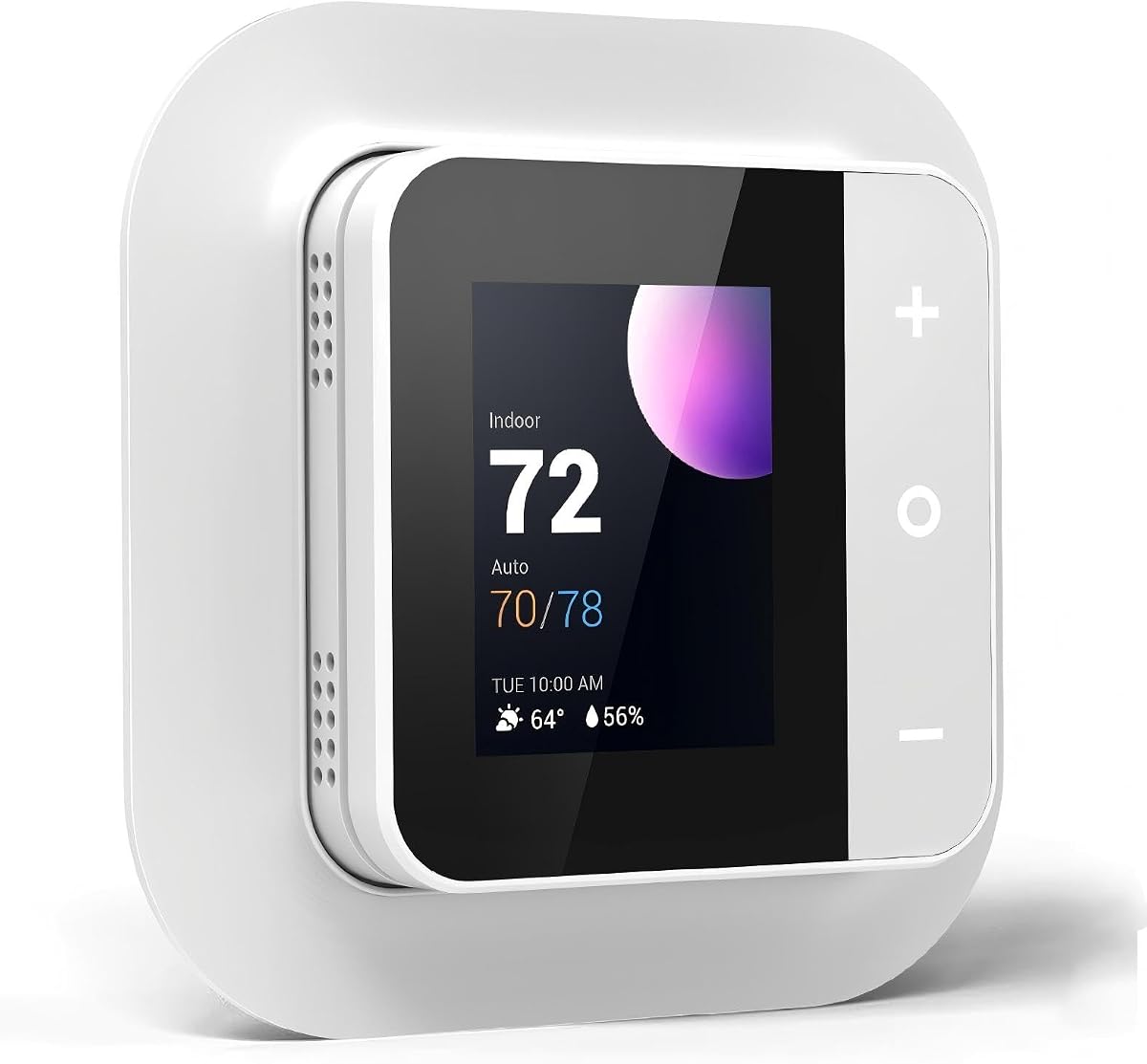
The Honeywell Home RTH9585WF1004 Wi-Fi Smart Color Thermostat is the most feature-rich product in this roundup. Its 4.3 rating, bright touchscreen, flexible seven-day programming, and compatibility with the Honeywell mobile app, Amazon Alexa, and Google Home make it a strong premium option for compatible conventional heating and cooling equipment.
We may earn a commission when you buy through this link, at no additional cost to you.
Remote control is the central advantage. Users can adjust the temperature from anywhere with the app, monitor cooling and heating use, and review monthly energy reports. The thermostat also supports programming for personal schedules or peak-rate pricing, while a Circulate fan option can run the fan at varied intervals. Demand-response eligibility may also create utility rewards in participating locations.
Installation and compatibility deserve careful attention. A C-wire is required, and the unit supports forced-air gas, oil, or electric systems, hot-water and steam heat, and heat pumps with electric backup. It does not support electric baseboard heat, heating-only oil systems without a C-wire, or multistage equipment. A compatible wall AC must also use the necessary conventional control wiring.
The RTH9585WF1004 suits homeowners who want temperature access beyond the room, detailed energy information, and integration with a smart-home ecosystem. It is less appropriate when a common wire is unavailable, when the wall AC uses a proprietary controller, or when a simple mechanical-style thermostat would meet all household needs. Its added capabilities justify the premium position for compatible systems.
Monthly reports and personalized efficiency tips make this more than a remote temperature dial. They give users a clearer view of system operation, while demand-response enrollment in eligible utility areas can add another layer of energy management.
The color touchscreen is bright and easy to interpret, while the app and voice-platform support extend control to mobile and hands-free routines. It is a polished option for homes already invested in connected-home equipment.
We may earn a commission when you buy through this link, at no additional cost to you.
This NonProgrammable Thermostat for Home delivers a 4.5-rated combination of simple operation and broad compatibility with conventional single-stage equipment. It is a practical budget selection for users who mainly need reliable setpoint changes, cooling-stage operation, and a readable display without spending attention on setup routines.
We may earn a commission when you buy through this link, at no additional cost to you.
Large terminal blocks, a universal sub-base, and a backlit LCD support straightforward installation and daily use. The thermostat can operate from 24VAC power or two AAA batteries, and a common wire is unnecessary on most systems. Users can adjust the temperature differential, calibrate the displayed temperature, switch between Celsius and Fahrenheit, and enable compressor delay protection.
Its compatibility covers forced-air systems, electric furnaces, hot-water steam, gravity radiant heat, heat-only systems, heat pumps without auxiliary or emergency heat, millivolt equipment, 24V gas fireplaces, floor or wall furnaces, and cool-only systems. It is explicitly incompatible with auxiliary or emergency heat pumps, dual-fuel systems, electric baseboard heat, line voltage, certain radiant ceiling systems, mini-splits, and 12V RV systems.
This is a good fit for a basic central or conventional wall-mounted cooling setup, particularly when a household does not need a schedule or smartphone access. Its limitations are straightforward: there is no programming, remote control, or energy-use reporting. Most importantly, buyers should identify the wall AC's wiring and control system before ordering because mini-split and some packaged-terminal units are not supported.
Although there is no schedule, the adjustable swing, calibration, unit conversion, and compressor delay protection provide useful control beneath the straightforward interface. These settings make the thermostat more adaptable than a purely manual model.
The ability to use existing 24VAC power or two AAA batteries simplifies upgrades in many conventional installations. A C-wire is needed only in certain heat-only and cool-only arrangements, according to the supplied product information.
We may earn a commission when you buy through this link, at no additional cost to you.
The NonProgrammable Thermostat S3001-White offers clear digital temperature control for conventional single-stage systems and carries a 4.5 rating. Its emphasis is readable operation, adjustable cycling behavior, and a relatively approachable sub-base, rather than programming or smart-home functionality.
We may earn a commission when you buy through this link, at no additional cost to you.
The backlit LCD, large terminal blocks, and universal sub-base make the device easy to understand and install for a conventional replacement. Separate heating and cooling swing settings let users alter how long the system remains active after reaching a setpoint. It also provides stated temperature accuracy of plus or minus one degree Fahrenheit, a room display range of 41 to 95 degrees Fahrenheit, and a control range of 44 to 90 degrees Fahrenheit.
The most important caveat is wiring. The product information warns that the base supports a maximum of two to five wires and is not suitable for connections with six to eight wires. It also excludes multistage heating and cooling, three-wire hydronic systems, heat pumps with or without auxiliary heating, dual-fuel or hybrid multistage systems, mini-splits, RV thermostats, convectors, radiant ceiling heat, and 120-240V electric baseboard heat.
Choose this unit when the existing installation is a simple single-stage system with a compatible number of wires and the household wants manual setpoint control. Its two-year warranty and responsive after-sales service add reassurance, but they do not overcome equipment incompatibility. Check the old thermostat, count the wires, and identify the system type before buying.
Separate heating and cooling swing values give users more influence over system run time than a single shared control. Adjusting these values can help balance steady comfort against unnecessary cycling.
This thermostat is aimed at standard single-stage applications rather than sophisticated systems. Its large terminal blocks and familiar heat-off-cool layout help make a direct replacement more approachable for a basic installation.
We may earn a commission when you buy through this link, at no additional cost to you.
The Non-Programmable Thermostat for Home with Blue Backlight is a straightforward digital controller with a 4.5 rating and broad support for conventional single-stage equipment. It is suited to users who want a readable thermostat, manual temperature changes, and flexible power options without a more involved smart device.
We may earn a commission when you buy through this link, at no additional cost to you.
The interface uses a clear backlit LCD and simple controls, while a front-load battery compartment makes routine maintenance more convenient. Adjustable differential control supports energy optimization and system life, and the unit can calibrate the temperature reading, convert between Celsius and Fahrenheit, and enable compressor delay protection.
Compatibility includes forced-air systems, electric furnaces, steam, gravity radiant heat, heat-only equipment, heat pumps without auxiliary or emergency heat, millivolt systems, 24V gas fireplaces, floor or wall furnaces, and cool-only systems. It does not support dual-fuel or hybrid heating, 120-240V electric baseboard heat, line-voltage systems, convectors, radiant ceiling heat, mini-splits, or 12V RV equipment.
This is a sensible choice for a compatible conventional wall AC when a schedule is unnecessary. The blue display is especially helpful in dim rooms, and battery power can simplify installations without an available common wire. However, homeowners should not interpret the term wall AC as proof of compatibility; the actual HVAC type and low-voltage control wiring must be confirmed first.
Temperature calibration, unit conversion, adjustable swing, and selectable compressor delay add useful depth. These options let users tailor the basic thermostat without moving into app-based or scheduled control.
A front-load battery compartment reduces the inconvenience of changing power cells. Combined with 24VAC operation, it offers flexibility for homes where the existing thermostat power arrangement differs.
We may earn a commission when you buy through this link, at no additional cost to you.
The Aowel AW701 is a non-programmable 1H/1C thermostat distinguished by an indoor humidity display. Its 4.4 rating and blue-backlit interface make it a useful basic option for a compatible conventional system where seeing the room's humidity adds information beyond the temperature setpoint.
We may earn a commission when you buy through this link, at no additional cost to you.
The display shows room temperatures from 32 to 99 degrees Fahrenheit, while the control range is 44 to 90 degrees Fahrenheit. Stated temperature accuracy is plus or minus two degrees Fahrenheit. Separate heat and cool swing settings range from 0.2 to 2 degrees, and users can calibrate the reading, convert units, enable compressor delay protection, and rely on a battery replacement reminder.
Its 24V conventional applications include gas, oil, or electric furnaces, ventilation, and air conditioning with up to one heat and one cool stage. It is expressly unsuitable for multistage systems, several heat-pump configurations, three-wire hydronic systems, dual-fuel systems, line-voltage electric baseboards, mini-splits, and RV air conditioners. The listed exclusions also include PTAC units, making an existing terminal air conditioner's controller type a decisive consideration.
Choose the AW701 when humidity awareness and a clear screen matter but scheduling does not. Its two-year warranty and stated customer support are helpful additions, although the installation remains the homeowner's responsibility. If the wall AC is a packaged terminal unit, do not purchase based on the general shape of the thermostat; confirm that the equipment uses a compatible conventional control interface.
The integrated humidity readout is the defining feature, providing context for comfort that a temperature display alone cannot. It is especially useful for monitoring seasonal changes in indoor moisture.
Independent heat and cool swing adjustments allow users to tune how long the system continues operating after reaching a setpoint. The result is a more configurable manual thermostat without scheduling complexity.
We may earn a commission when you buy through this link, at no additional cost to you.
The Vine Smart Thermostat offers Wi-Fi control, voice-assistant support, and detailed scheduling in a 4.0-rated package. Its compatibility check and broad list of conventional and multistage heating configurations make it worth considering for users who want more advanced control than a basic thermostat offers.
We may earn a commission when you buy through this link, at no additional cost to you.
Users can manage the unit through the Vine Thermostat app or Smart Life app, with additional hands-free operation through Alexa and Google Home. The thermostat supports seven days with eight periods per day, automatically scheduled home and away modes, temperature alerts, filter reminders, automatic time-and-date synchronization, and a child lock.
The main installation requirement is non-negotiable: a common wire is required for every Vine thermostat installation. The supplied information says it is compatible with 90% of 24V AC systems, including conventional two-stage gas, oil, or electric systems, boilers, heat pumps with two heating and cooling stages plus auxiliary or emergency heat, and heating-only or cooling-only systems. Buyers should scan the supplied QR code and complete the compatibility check before ordering.
This model is a good smart-thermostat candidate when a C-wire is available and multiple household routines need to be represented. It is less convenient for older wiring arrangements and should not be assumed to support a PTAC or mini-split simply because the enclosure resembles a conventional thermostat. Its lower rating also makes careful review of system requirements especially important.
Automatic home-away modes reduce the need to change the setpoint every time an occupant leaves or returns. The schedule can therefore support both comfort and energy-saving goals without constant manual intervention.
Temperature alerts, filter reminders, automatic clock synchronization, and a child lock cover routine household needs. Mobile and voice control add further flexibility once the thermostat is configured.
We may earn a commission when you buy through this link, at no additional cost to you.
The Sensi Smart Thermostat ST55 combines Wi-Fi convenience with a familiar physical design and an approachable installation process. Its 4.4 rating, ENERGY STAR certification, and mix of remote access, usage reports, and maintenance alerts make it a strong smart option for a compatible conventional HVAC installation.
We may earn a commission when you buy through this link, at no additional cost to you.
The built-in level and step-by-step app instructions help with positioning and setup, while the thermostat retains buttons and fits the space of a traditional unit. Flexible scheduling, remote access, and usage reports support energy management. Alerts about equipment performance and filter-replacement reminders add practical value between temperature changes.
A common wire is not required in most applications, which can make this a more practical connected upgrade than models that always require one. However, the unit is intended for the HVAC equipment found in most homes using standard low-voltage control. A proprietary PTAC controller or mini-split interface may not work even if the wall placement and physical dimensions are similar.
The ST55 is well suited to homeowners who want app-based control without replacing a wall-mounted thermostat with a conspicuous touchscreen. It also suits people who appreciate installation guidance and want energy-use information without a premium color display. Choose it after confirming equipment compatibility, and use the app to set schedules and review reports after installation.
Usage reports, equipment alerts, and filter reminders extend the thermostat beyond immediate setpoint control. These features can help homeowners understand usage patterns and stay attentive to routine maintenance.
Buttons and a traditional-style enclosure make the ST55 less intimidating than a screen-led device. It preserves the feel of a conventional thermostat while adding the reach of the app.
We may earn a commission when you buy through this link, at no additional cost to you.
The Heagstat H701 is a manual, non-programmable thermostat designed for conventional 24V single-stage heating and cooling. Its 4.5 rating reflects a simple and readable design, with precise temperature control, adjustable swing, compressor delay protection, and useful installation flexibility.
We may earn a commission when you buy through this link, at no additional cost to you.
A heat-off-cool selector and uncomplicated controls make the H701 approachable for users of different experience levels. The backlit LCD remains visible in varied lighting, and the listed accuracy is plus or minus one degree Fahrenheit. Users can adjust swing from 0.2 to 2 degrees, calibrate the reading from minus four to plus four degrees, and set adjustable five-minute compressor delay protection.
The thermostat runs on 24VAC or two AAA batteries and does not require a common wire. It uses standard RH, RC, W, Y, G, and C terminals with 18-22 gauge wire. It does not support W2, Y2, O/B, E, L, AUX, ACC+, ACC-, S, X, or X2 terminals. It is also explicitly incompatible with multistage systems, heat pumps, PTAC units, three-wire hydronic systems, dual-fuel systems, line-voltage systems, mini-splits, and RV air conditioners.
Choose the H701 for a basic, reliable thermostat in a clearly compatible 24V system. It is particularly useful for anyone who prefers physical controls and has no interest in scheduling or connectivity. The decisive issue remains the wall AC's controller: a packaged terminal unit explicitly falls outside the supported applications, so buyers should inspect the equipment before purchasing.
The heat-off-cool mode selector avoids menus and programming. That simplicity makes the H701 easy to explain to guests, older occupants, or anyone who prefers a direct mechanical-style workflow.
Adjustable compressor delay helps manage short cycling, while broad calibration and swing ranges support fine control. These protections make the simple interface more practical in everyday use.
We may earn a commission when you buy through this link, at no additional cost to you.
The Upgraded Digital Non-Programmable Thermostat for Home receives a 4.6 rating, the highest among the products listed, and stands out for its large blue display and combined temperature-and-humidity monitoring. It offers a capable basic interface for conventional single-stage systems without introducing network complexity.
We may earn a commission when you buy through this link, at no additional cost to you.
Large characters, a blue backlight, and separate setpoint buttons make the thermostat easy to read and adjust. The humidity display covers 10% to 99% relative humidity, with stated accuracy of plus or minus 5% between 30% and 80% relative humidity and plus or minus 8% outside that range. Users can turn the humidity function on or off through the manual's advanced settings.
Temperature control is stated at plus or minus one degree Fahrenheit, and the thermostat can use 24VAC power or two AAA batteries without requiring a common wire. It also includes a low-battery reminder and compressor delay protection. Its 2-year warranty and stated round-the-clock customer service add useful support for installation or product concerns.
This model is best for a compatible conventional 1H/1C installation where a large display and humidity information matter. It does not support multistage systems, central air conditioner heat-pump systems with auxiliary or emergency heat, three-wire hydronic systems, dual-fuel systems, mini-splits, RV thermostats, line-voltage electric baseboards, convectors, or radiant ceiling heat. As with the other basic models, it should not be assumed to work with a PTAC controller.
Showing both values on a large screen gives users a more complete view of indoor conditions. The selectable humidity function also allows the display to focus on temperature for households that do not need the extra reading.
Separate temperature buttons and a large backlit display reduce the effort required for common adjustments. The layout is particularly approachable for users who prefer straightforward controls over menus and touchscreens.
We may earn a commission when you buy through this link, at no additional cost to you.
The most important buying factors are the wall AC's control system, supported HVAC stages, power configuration, programming needs, display readability, and desired connectivity. Compatibility must be confirmed before aesthetics or convenience features.
In short, verify the actual equipment type first. If the wall AC uses a proprietary controller, choose a thermostat specifically documented for that controller rather than one designed for standard low-voltage HVAC wiring.
Choose a thermostat that exactly matches the stages and functions already present. More advanced equipment does not need a thermostat that is merely more complicated; it needs one that supports the required control signals.
A missing C-wire can determine the shortlist. Favor a power-flexible model for an older installation, but only if the voltage, equipment type, and wiring method are fully compatible.
Do not pay for scheduling complexity you will not use. Choose manual control for simplicity, or a programmed model when consistent weekday and weekend changes genuinely improve comfort and efficiency.
Choose connectivity when you will use it regularly. If remote changes and energy reports do not solve a real problem, a dependable local display is usually simpler and sufficient.
Select the easiest interface to read at a glance. A large, backlit screen with physical controls is often more practical than a colorful display that demands more interaction.
Prioritize the maintenance features that match your habits. Smart reports are valuable for engaged users, while local filter reminders and delay protection may provide more benefit in a simple installation.
Check the warranty and support terms along with compatibility. A long warranty cannot make an incompatible thermostat usable, while solid support is valuable for resolving installation questions.
Before installation, record the existing thermostat's model, note every wire and terminal label, and identify the AC system's type, stages, and power source. Turn off the HVAC system and appropriate power supply before touching wiring. Compare the new base with the old base, confirm that the wall opening and wire count are suitable, and follow the product-specific installation manual rather than assuming every low-voltage terminal has the same function.
Set the thermostat to its correct operating mode and establish a comfortable cooling setpoint. If the system is heating and cooling, set both heat and cool targets, and allow a small temperature difference between them to prevent simultaneous heating and cooling. Programmable and smart models should be configured with realistic schedules, while users can adjust swing, calibration, compressor delay, and display settings according to the manual.
For care, replace batteries promptly when a low-battery reminder appears, clean the thermostat gently with a dry or lightly damp cloth, and keep the vents unobstructed. Schedule filter changes and inspect wiring for heat, corrosion, or loose connections. Review smart thermostat alerts and energy reports periodically, and contact qualified HVAC help if the system cycles unusually, displays an error, or fails to respond after installation.
Most of the listed products explicitly exclude PTAC units, so they should not be assumed to work with one. A PTAC may use a proprietary control board or terminal arrangement different from conventional 24V HVAC systems. Identify the exact air-conditioner model and consult its documentation before purchasing any replacement thermostat.
A non-programmable thermostat uses a setpoint that you adjust manually and generally remains unchanged. A programmable thermostat stores different temperature periods for weekdays and weekends. A Wi-Fi model adds remote access and sometimes automatic home-away behavior, which can be useful for households with changing routines.
It depends on the model and installation. The Honeywell RTH9585WF1004 and Vine Smart Thermostat require a C-wire, while the Sensi ST55 usually does not need one. Several basic thermostats can use 24VAC power or batteries. Check the wiring and power supply before ordering rather than assuming a common wire is available.
Only if the wall unit uses compatible low-voltage control wiring, stages, and terminals. Physical fit and appearance are not enough because PTACs and mini-splits often use proprietary controls. Verify the equipment model, wiring diagram, voltage, and heating or cooling stage before installing any conventional HVAC thermostat.
They are most valuable for users who want remote temperature changes, energy-use reports, alerts, or voice control. If the household mainly changes a setpoint occasionally, a non-programmable model can provide a simpler and less distracting experience. The right choice depends on how much value you place on remote functions and scheduling.
Cooling swing determines how far the room temperature must deviate from the cooling setpoint before the system starts, while heating swing performs the corresponding function for heat. Adjustable swing can influence comfort and cycling, but a larger differential may save energy while a smaller differential can maintain a more consistent temperature.
Start with the system's type, voltage, heat and cool stages, terminal designations, power source, and existing wire count. Then compare those details with the manufacturer's compatibility list and installation guide. If the documentation is unavailable or the equipment uses unusual wiring, ask a qualified HVAC professional to identify it before purchase.
No. A humidity display on a thermostat is a monitoring feature rather than humidifier or dehumidifier control. The thermostat may show the measured indoor relative humidity, but whole-home moisture control requires a separate humidifier, dehumidifier, or HVAC system designed for that purpose.
The Honeywell Home X2P is the strongest overall choice for a compatible conventional system because it combines a large display, useful five-two-day scheduling, filter reminders, and flexible battery power. The Honeywell RTH9585WF1004 is the premium pick for remote control, voice integration, color-screen convenience, and energy reports, while the NonProgrammable White Backlight model provides a strong budget-oriented balance of compatibility and simple control.
Prioritize the actual wall AC control system before any other feature. Confirm stage count, voltage, C-wire availability, terminal labels, and whether the unit is a PTAC or mini-split. After compatibility is settled, choose manual control for simplicity, programming for predictable schedules, or Wi-Fi for remote access and automated routines. Display readability, swing adjustment, delay protection, and support should then refine the decision.
Product listings and prices change, so review the current specification sheet, installation instructions, compatibility statement, and seller information before buying. Use the links in this guide to check the latest availability, but treat the supplied product information and the actual equipment documentation as the final basis for compatibility and installation decisions.