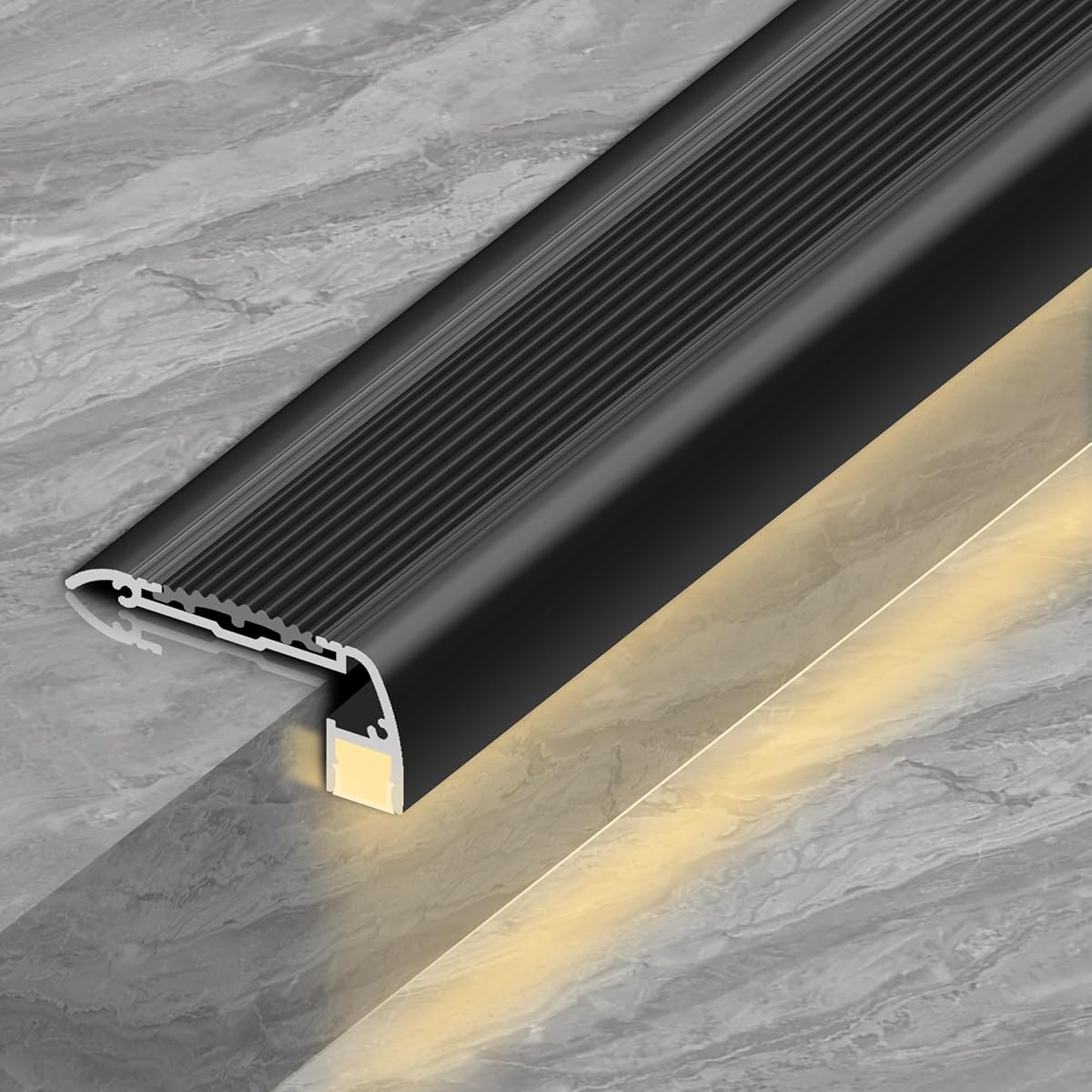
Bikykose Round Edge Stair Nosing
5.0Editor score
Six-pack aluminum stair profiles
Round anti-slip edge design
Surface-mounted installation
LED stair nosing lighting combines edge protection or anti-slip trim with illumination that makes each step easier to identify. The right system should suit your staircase dimensions, installation preferences, traffic level, and desired atmosphere, whether you need simple aluminum profiles, flexible COB strips, or automatically controlled motion-activated kits.
We compared all 10 products by examining their construction, lighting method, stair coverage, color temperature, sensor capabilities, installation requirements, and stated compatibility. The list includes both standalone aluminum nosing profiles with optional LED channels and complete smart stair-lighting systems, so readers can compare integrated hardware with flexible strip-based alternatives.
Each review explains the product's strongest benefits, important limitations, and best-fit installation. Pay attention to whether bulbs or strips are included, because several aluminum profiles provide only a channel. Product availability, included accessories, and pricing can change, so confirm the current listing and package contents before purchasing.
5.0Editor score

4.9Editor score

5.0Editor score
As an Amazon Associate we earn from qualifying purchases.
This side-by-side overview compares the ten products by product type, lighting method, stair capacity, color temperature, and installation model. It also highlights important differences between aluminum nosing channels and complete motion-activated strip systems.


This six-pack of round-edge aluminum stair nosing profiles is a straightforward way to protect and visually define a staircase. Its 5.0 rating reflects strong buyer satisfaction, while the rounded profile and anti-slip track distinguish it from ordinary metal edge trim. The product is particularly relevant for tiled and flush stair installations where a discrete, surface-mounted light channel can complement the finished surface.
We may earn a commission when you buy through this link, at no additional cost to you.
The main appeal is its combination of physical edge protection and a route for downward-facing stair lighting. Aluminum is well suited to areas that experience repeated foot traffic because it is durable and easy to maintain. With six pieces in a pack, the product can cover multiple visible edges or provide spare profiles for a more consistent treatment, depending on the dimensions of the staircase.
Its limitations are important for shoppers comparing it with complete lighting kits. The supplied information identifies an LED channel and profile-light design, but it does not clearly confirm that LED strips or a light source are included. That means buyers may need compatible strips separately and may need to confirm channel dimensions before ordering. The surface-mounted design is also less concealed than an under-tread installation.
This is a sensible pick for anyone who primarily wants a durable aluminum nosing profile with integrated lighting potential rather than an intelligent lighting system. It is especially attractive for tile stairs, theaters, and modern interiors where a round aluminum edge can become part of the visual design. Confirm strip compatibility, included fasteners, and the profile length before committing.
The rounded aluminum profile creates a clean visual boundary at the stair edge while adding a channel for step illumination. Its surface-mounted format makes it useful when recessing a channel into the tread or riser would be difficult.
Beyond appearance, the anti-slip track helps provide a more secure walking surface. Aluminum also withstands routine wear better than many basic plastic trims, making the profile useful in frequently traveled areas.
We may earn a commission when you buy through this link, at no additional cost to you.
This 39.3-inch aluminum stair nosing combines an anti-slip walking surface with a recessed channel for an LED light strip. It carries a 5.0 rating and is designed for tile, wood, and other common stair materials. The long profile can be shortened as needed, giving installers more freedom than a rigid, fixed-size molding.
We may earn a commission when you buy through this link, at no additional cost to you.
The thickened aluminum construction is intended to resist everyday wear and rust, while the integrated channel addresses two recurring stair problems at once: poor visibility at the step edge and an exposed nosing that can become slippery. Installation can use screws or adhesive, giving homeowners a choice based on the substrate and the degree of permanence desired.
The crucial trade-off is that the light strip is not included. Adhesive for a no-screw installation is also excluded, so the final component list depends on what the buyer already owns. The included package contains the aluminum nosing, end caps, and mounting screws, which provides a useful starting point but does not create a fully finished illuminated installation by itself.
Choose this profile when you want a long, adaptable aluminum edge with a dedicated lighting channel and prefer to select your own compatible LED strip. It is appropriate for renovations involving multiple materials and for projects that need a custom length. Compare the channel opening with the selected strip before installation, and add suitable outdoor-rated lighting when the stairs are exposed.
The 39.3-inch section can be cut to match the available edge, which is useful when a staircase contains multiple widths or requires a shorter accent segment. A hacksaw and careful measurement will help produce a clean fit.
Screws provide a mechanical attachment, while compatible construction adhesive can avoid visible fasteners. Because the listed glue is not included, users should select an adhesive appropriate for the stair material and environment.
We may earn a commission when you buy through this link, at no additional cost to you.
The JARBIH profile is a more refined aluminum option for people who want the nosing, anti-slip surface, and lighting channel to function as one coordinated detail. Its 4.6 rating indicates broadly positive feedback, and the 6063-T5 aluminum body is described as thickened, hardened, and anodized for durability and resistance to fading.
We may earn a commission when you buy through this link, at no additional cost to you.
A key feature is its compatibility with LED belts less than 12 millimeters wide. A milky polycarbonate cover helps diffuse the source, producing a softer appearance than an exposed, pinpoint LED. The channel can add understated illumination to wooden, laminated, or ceramic tile stairs while protecting the edge from wear.
Users should note that LED lights are not included. The narrow strip requirement also means the profile is less forgiving than a broad, open channel when choosing lighting components. Installation is flexible: the aluminum can be cut with a hacksaw and secured using screws or floor glue, allowing it to suit both permanent and adhesive-based projects.
This is a strong choice for a refined interior installation where visual softness matters and the buyer is comfortable sourcing a separate narrow LED belt. It works especially well when the stair edge needs both a protective finish and a concealed light source. Match the strip width carefully and verify all included accessories before ordering.
The milky polycarbonate cover helps spread LED light across the channel rather than exposing a concentrated source. That creates a cleaner profile that can complement contemporary residential and commercial interiors.
The hardened 6063-T5 aluminum and anodized finish are designed to handle wear while protecting wood, laminate, or tile edges. The profile provides a useful combination of finishing trim and lighting infrastructure.
We may earn a commission when you buy through this link, at no additional cost to you.
This black aluminum stair nosing is designed to be both a protective edge trim and a support for LED strip lighting. It has no current customer rating, so buyers should not treat its feedback level as established. Its standout specification is the claimed ability to withstand up to 400 pounds without damage, supported by a reinforced aluminum-alloy construction.
We may earn a commission when you buy through this link, at no additional cost to you.
The serrated face adds friction, while the L-shaped form protects the stair edge and incorporates a trough for a downward-facing decorative light. It is listed for marble, tile, concrete, wood, and carpet, and the stated applications extend from homes and offices to schools, hospitals, hotels, theaters, and other commercial spaces.
Several necessary items are not included. The product requires separate LED lighting, glue, and screws, and a black profile may show dust, scuffs, or installation marks more readily than a lighter finish. Although the load figure suggests substantial strength, actual performance depends on secure mounting and the condition of the underlying stair.
This option is best for buyers seeking a visually substantial nosing with a high stated load capacity and broad material compatibility. It is particularly relevant to decks, theaters, schools, and other busy environments where edge protection matters. Ensure that the mounting method is suitable for the surface and that the selected LED strip fits the trough.
The stated 400-pound capacity and reinforced aluminum construction make this profile relevant to busy stairs. Secure fastening remains essential, especially on outdoor decks or surfaces affected by weather and movement.
The black finish gives stair edges a pronounced, modern outline. When paired with a concealed downward light, it can create a clean visual rhythm that works especially well in theaters and contemporary commercial interiors.
We may earn a commission when you buy through this link, at no additional cost to you.
The KMG-3233 is a complete motion-activated lighting system for indoor stairs, combining a 42-inch cuttable strip, high-density COB LEDs, a wall switch, and controls for up to 16 steps. Its 4.9 rating makes it one of the strongest-reviewed products in this group, and the warm 3000K color is especially well suited to residential interiors.
We may earn a commission when you buy through this link, at no additional cost to you.
The defining benefit is sequential illumination. As a person steps onto the staircase, the lights activate in sequence, and they shut down step by step after the stairs are vacated. Users can adjust step count, brightness, lighting speed, and delay time, or switch from motion-triggered behavior to a continuous stay-on mode for a different operating pattern.
Installation is based on a flexible strip with adhesive backing and one-inch cutting units. The stated 42-inch length is suitable for 36-inch or 42-inch-wide treads, but custom cutting allows it to fit other layouts more closely. The system does require a power connection, sensor positioning, and configuration, so it is less plug-and-play than a simple decorative profile.
This kit is an excellent all-around recommendation for homeowners who want automated step lighting and a warm, comfortable atmosphere. It is particularly suitable for open risers, dark stairwells, and stairs where an always-on appearance is not desired. For outdoor projects, choose a product explicitly rated for damp locations instead.
The 3000K warm white output creates a gentler atmosphere than a stark cool-white installation. It works well for evening use, wood finishes, and homes where the staircase is part of the living space rather than a hidden utility route.
Adjustable brightness, delay, speed, and step settings let the system respond differently to nighttime use and continuous illumination. The wall switch adds a familiar manual option for users who do not want to rely entirely on motion activation.
We may earn a commission when you buy through this link, at no additional cost to you.
This cool-white version of the KMG-3233 provides automated, sequential illumination for indoor stairs. Its 4.3 rating is solid, though lower than the ratings of the warmer 3000K and 2700K kits. The 6000K color produces a crisp, daylight-like appearance that emphasizes tread edges and supports clear visual orientation.
We may earn a commission when you buy through this link, at no additional cost to you.
The system uses 320 high-density COB LEDs distributed across a cuttable 40-inch flexible strip. It supports stair layouts with up to 16 steps and offers adjustable brightness, animation speed, delay time, and step count. Motion Trigger Mode creates the sequential effect, while Stay On Mode provides continuous illumination when desired.
The strip uses adhesive backing and one-inch cutting units, making it adaptable to 36-inch or 42-inch-wide treads. It can be tucked under a tread without occupying walking space, but the installation still involves a power supply, sensors, and controller. The supplied information limits the application to indoor stairs.
This is a good fit for modern homes, offices, or shared buildings where a bright, modern light color is preferred. It may be less atmospheric than warm-white alternatives, and some users may find 6000K too clinical for a cozy living area. Its stronger selling point is practical visibility rather than residential warmth.
The cool 6000K color creates a crisp contrast against most stair finishes. That makes the system useful for contemporary interiors where strong visual definition and a clean appearance take priority over a warm glow.
The slim, flexible strip can be concealed beneath a stair nose. Cutting units allow each run to follow the width of its tread while keeping the light source out of the walking area.
We may earn a commission when you buy through this link, at no additional cost to you.
This motion-sensor kit stands out for its dual-sensor arrangement, allowing the staircase to detect movement approaching from either the top or bottom. It has a 5.0 rating and includes a complete 16-step configuration. Warm 2700K light creates a particularly soft, welcoming atmosphere that is well suited to residential staircases.
We may earn a commission when you buy through this link, at no additional cost to you.
The 320 high-density COB LEDs produce uniform, dot-free illumination, while settings for step count, brightness, speed, and delay allow the behavior to be tailored. Motion Trigger Mode provides the sequential effect, and Stay On Mode offers continuous light for users who prefer a permanent architectural glow.
The flexible 40-inch strip uses adhesive backing and one-inch cutting units, allowing installation on 36-inch or 42-inch-wide treads. Although the kit is configured for 16 steps, cuttable sections make it adaptable to different layouts. It is still an indoor system with electrical and sensor components, so proper placement and secure adhesion are essential.
This is the premium recommendation for anyone who values two-direction detection and especially warm residential lighting. It is a particularly good match for long staircases, split-level homes, and dark interiors where the lights should activate regardless of the user's approach direction. Verify the layout, power access, and strip length before installation.
The dual sensor system is the key differentiator. Detecting motion at both the upper and lower ends reduces the chance that a user approaches an unlit staircase, supporting more convenient everyday use.
The 2700K output is softer and more amber than the 3000K and 6000K alternatives. That makes the kit appealing for living rooms, lofts, and other spaces where the staircase should feel inviting rather than institutional.
We may earn a commission when you buy through this link, at no additional cost to you.
The 20-Step PIR kit is designed for larger indoor staircases, with a stated capacity of up to 20 steps and a 4.5 rating. Its compact COB strips measure only 0.31 inches wide and 0.1 inches thick, allowing them to hide beneath treads without reducing usable walking space. The kit also supports fewer-step installations through adjustment.
We may earn a commission when you buy through this link, at no additional cost to you.
Its cool-white 6000K lighting is specified at CRI 90+, intended to produce clear, natural-looking color reproduction. Four lighting modes cover one-by-one activation, group activation, one-by-one shutdown, and all-on or all-off behavior. A daylight sensor adds another layer of automation, while threaded PIR sensors handle movement detection.
The stated installation is plug-and-play: attach the strips, position two sensors, connect them to the ES32 controller with quick connectors, and plug the included 200-watt UL-listed Mean Well power supply into a standard outlet. Although that avoids complex programming, the controller and multiple components still require careful placement and cable management.
The kit includes monochrome stair strips only. Optional addressable strips for handrails or stair sides are sold separately, so buyers should not expect flowing multicolor effects out of the box. This is an excellent choice for long staircases that need flexible lighting behavior, higher stair capacity, and a compact concealed profile.
With support for as many as 20 steps, this kit accommodates larger installations better than most 12- and 16-step alternatives. The strip count and controller settings can be reduced for smaller stairs.
The stated CRI 90+ specification makes the 6000K output more useful where visual clarity matters. Its slim strip profile also preserves the clean appearance of modern stair treads.
We may earn a commission when you buy through this link, at no additional cost to you.
The KMG-4233 provides motion-responsive stair lighting for indoor installations with up to 12 steps. Its 4.8 rating is among the strongest in the group. The system uses a 40-inch cuttable strip and a switch panel, combining automatic sequential activation with a familiar manual control option.
We may earn a commission when you buy through this link, at no additional cost to you.
Its 320 high-density COB LEDs are described as producing soft, uniform light without visible spots. Users can adjust the number of steps, brightness, lighting speed, and delay time. Sequential activation starts when someone reaches the top or bottom of the stairs and turns the lights off one by one after the area is vacated.
A daylight sensor adds energy-conscious behavior, while quick connectors simplify the electrical connections. The stated 20- to 50-inch tread-width range offers flexibility, although the 12-step limit makes it less appropriate for very long staircases. The listed 40-inch strip length must also be checked against the intended tread dimensions.
This is a strong option for a medium-sized indoor staircase that benefits from automatic control but does not need more than 12 illuminated steps. It is particularly convenient for users who want a switch panel rather than relying only on automatic sensors. Its quick connectors and included components reduce the complexity of the core installation.
The switch panel gives users direct control while motion and daylight sensors provide automatic operation. This combination is useful for households that want a permanent setting but still appreciate the option to override it.
With support for up to 12 steps, the system suits many residential staircases without the complexity of a larger multi-sensor configuration. The cuttable strip makes it easier to match individual tread widths.
We may earn a commission when you buy through this link, at no additional cost to you.
The SSL-5616 is a motion-activated indoor stair-lighting kit with a 4.0 rating. It supports up to 16 steps and supplies 59 feet of cuttable 3000K COB strip in total. Its most notable feature is a selection of seven lighting modes, giving users more ways to adjust the appearance and activation behavior.
We may earn a commission when you buy through this link, at no additional cost to you.
The kit can activate when someone reaches the top or bottom step and turn off after the staircase is vacated. Mode, step number, brightness, speed, delay time, and daylight lux can be adjusted. The warm 3000K output offers a comfortable residential color, while the high-density COB strip is designed to remain evenly illuminated.
The package is described as containing all necessary installation parts, and adhesive-backed strips can be cut to match tread widths. Nevertheless, users should plan for a power supply, sensor placement, controller configuration, and cable routing. The total strip quantity may be more than a short flight requires, so a careful measurement is important.
This kit is most appealing to users who enjoy experimenting with several lighting patterns or need a long staircase with many steps. Its rating is the lowest among the listed products, so buyers should assess the complete package carefully. It remains a versatile option for domestic or commercial indoor stairs where warm light and extensive mode control are priorities.
The broad mode selection is useful for changing the staircase from a subtle accent into a more noticeable visual feature. Adjustable timing and speed make it possible to tune the sequence for the household's routine.
The 40-inch cuttable sections can be resized to match individual treads, and the stated 59-foot total offers ample material. Extra length is useful for longer flights but should be planned so the included components and step count remain appropriate.
We may earn a commission when you buy through this link, at no additional cost to you.
The right choice depends on whether you want a finished aluminum edge profile, a flexible under-tread strip, or a fully automated lighting system. Measure the stairs, identify the installation surface, and compare included components before choosing.
In short, select a profile for architectural trim and select a motion kit for automated illumination. Do not assume that either category includes every part required for a complete installation.
Measure before ordering, and verify whether the advertised length is per strip or the total included. A long kit can be useful for many steps but wasteful on a compact staircase.
Make a checklist of strips, sensors, controller, power supply, connectors, end caps, screws, adhesive, and diffuser before buying. Missing a small accessory can delay a full installation.
Choose 2700K for cozy ambience, 3000K for flexible warm lighting, and 6000K for clean task-oriented visibility. If possible, view samples in the room before committing.
Prioritize reliable detection and intuitive controls over effects you may rarely use. A correctly positioned sensor is more valuable than a long list of sophisticated modes.
Use mechanical fasteners where permanence matters and adhesive attachment is uncertain. Clean the surface thoroughly and confirm that the chosen method is suitable for the specific stair material.
Conceal or diffuse the source where possible, then adjust brightness to the room. The goal is clear edge definition without harsh glare or an overpowering decorative effect.
Do not assume an indoor strip becomes safe outdoors when placed in an aluminum channel. Verify the light's environmental rating and use suitable exterior fixings.
Begin by measuring the staircase and marking the intended light position on every tread. For aluminum profiles, cut the section to length, test-fit it, and keep the LED channel clear of debris. For flexible strip systems, cut only at the stated cutting points, test the strip before mounting, and confirm that the controller recognizes the selected number of steps. Work from one end of the staircase to the other to keep spacing and alignment consistent.
Install the mechanical nosing or adhesive-mounted strip firmly according to the surface and the manufacturer's instructions. Clean the substrate before applying adhesive, avoid bridging uneven joints, and route cables away from walking areas and pinch points. Position motion sensors where they can detect someone approaching from the intended direction without being triggered constantly by nearby activity. For automatic systems, complete the power connections with the supplied connectors, then configure step count, brightness, speed, and delay.
After installation, test the system from both the top and bottom of the stairs when possible. Check that each step illuminates in the intended sequence and that the lights switch off after the selected delay. Clean the diffuser and LED surfaces with a soft dry cloth, keep the channels free of dust and grit, and inspect adhesive or fasteners periodically. Do not expose indoor components to water unless their instructions explicitly permit it.
It depends on the product. The 39.3-inch aluminum nosing, JARBIH profile, and black aluminum profile do not include LED strips according to their supplied details, while the motion-activated kits include LED strip components. Always check the package contents because a channel or profile does not necessarily contain a compatible bulb or strip.
Some aluminum nosing profiles are described for both indoor and outdoor tile or wood stairs, but the lighting inserted into them must also be suitable for exposure. Most complete motion kits listed here are intended for indoor use. Outdoor installations require moisture-rated lighting, suitable adhesive or fasteners, and safe protected connections.
A nosing profile is an aluminum edge trim with an anti-slip surface and a channel for a light strip. A motion-activated kit provides strips, sensors, controls, and power components for automated under-tread lighting. Profiles are chosen for edge finishing, while kits are chosen for control, sequencing, and concealed illumination.
Capacity varies from 12 to 20 steps among the complete smart kits. The KMG-4233 supports up to 12 stairs, several KMG-3233 and SSL-5616 systems support up to 16, and the 20-Step PIR kit supports as many as 20. Each controller can generally be adjusted for fewer steps, provided the strip length and included components are sufficient.
Warm white 2700K creates the softest residential atmosphere, 3000K offers a balanced warm appearance, and 6000K provides crisp, cool illumination. The best choice depends on the décor and whether the priority is cozy ambiance or strong edge visibility. Dark finishes often pair well with warmer light, while modern interiors can suit either warm or cool options.
Most complete kits use cuttable COB strips with marked cutting intervals, allowing sections to match common tread widths. Aluminum nosing profiles may also be cut to length. Do not cut outside the manufacturer's marked sections, and confirm the required strip width, profile dimensions, and controller capacity before installation.
Most of the complete kits use a plug-in power supply and quick-connect wiring, reducing the need for complex in-wall wiring. The product descriptions still require attention to cable routing, connections, and local electrical rules. The standalone aluminum profiles do not solve the electrical side of the installation, so compatible lighting and power components must be sourced separately.
Use a soft, dry cloth to remove dust from the aluminum and diffuser, and vacuum loose debris without forcing it into the channel. Avoid abrasive pads, harsh chemicals, and water around non-water-rated LEDs. Check that the surface is dry before operating the lighting and inspect loose strips or fasteners periodically.
The top selections cover different needs. The Bikykose six-pack is the most budget-minded aluminum profile option, while the KMG-3233 warm-white kit offers the strongest balance of motion control, customization, and residential atmosphere. The dual-sensor 2700K system takes the premium position for two-direction detection and especially warm illumination.
Before buying, prioritize the lighting format that matches the project. Choose a cuttable aluminum channel when edge protection and architectural trim are central, and choose a complete sensor kit when sequential motion response is the main goal. Confirm strip length, step capacity, mounting method, power requirements, color temperature, and whether the light source is included.
Finally, check the current listing, package contents, compatibility information, and price before purchase. Product configurations and seller details can change, and the information in this guide is intended to help you compare the options rather than replace the final package check. With the right measurements and installation plan, LED stair nosing lighting can improve visibility while giving the staircase a polished, deliberate appearance.