
SYLPHID Microphone Isolation Shield
4.7Editor score
26dB claimed noise isolation
Phone clip and storage tray
UL-certified flame-retardant materials
A studio mic stand with an integrated isolation shield can make a home recording setup feel more controlled by reducing reflections, echo, plosives, and distracting ambient sound. The right combination should also fit your room, microphone, mounting hardware, and preferred seated or standing workflow.
We compared all ten products using their supplied specifications, focusing on acoustic construction, shield panel design, stand stability, height adjustment, mounting options, included accessories, and suitability for vocals, podcasts, voice-over, streaming, and music recording.
Each review explains the strongest feature, practical limitations, and best-fit creator, while the comparison table highlights the most important differences. Product ratings and availability can change, and current prices should always be confirmed before buying.
4.7Editor score

4.7Editor score
4.7Editor score
As an Amazon Associate we earn from qualifying purchases.
The table below compares the ten sets by acoustic design, physical configuration, stand adjustability, and useful included accessories. It is designed to clarify which product is most appropriate for compact desks, dedicated studios, standing performances, and all-in-one recording packages.
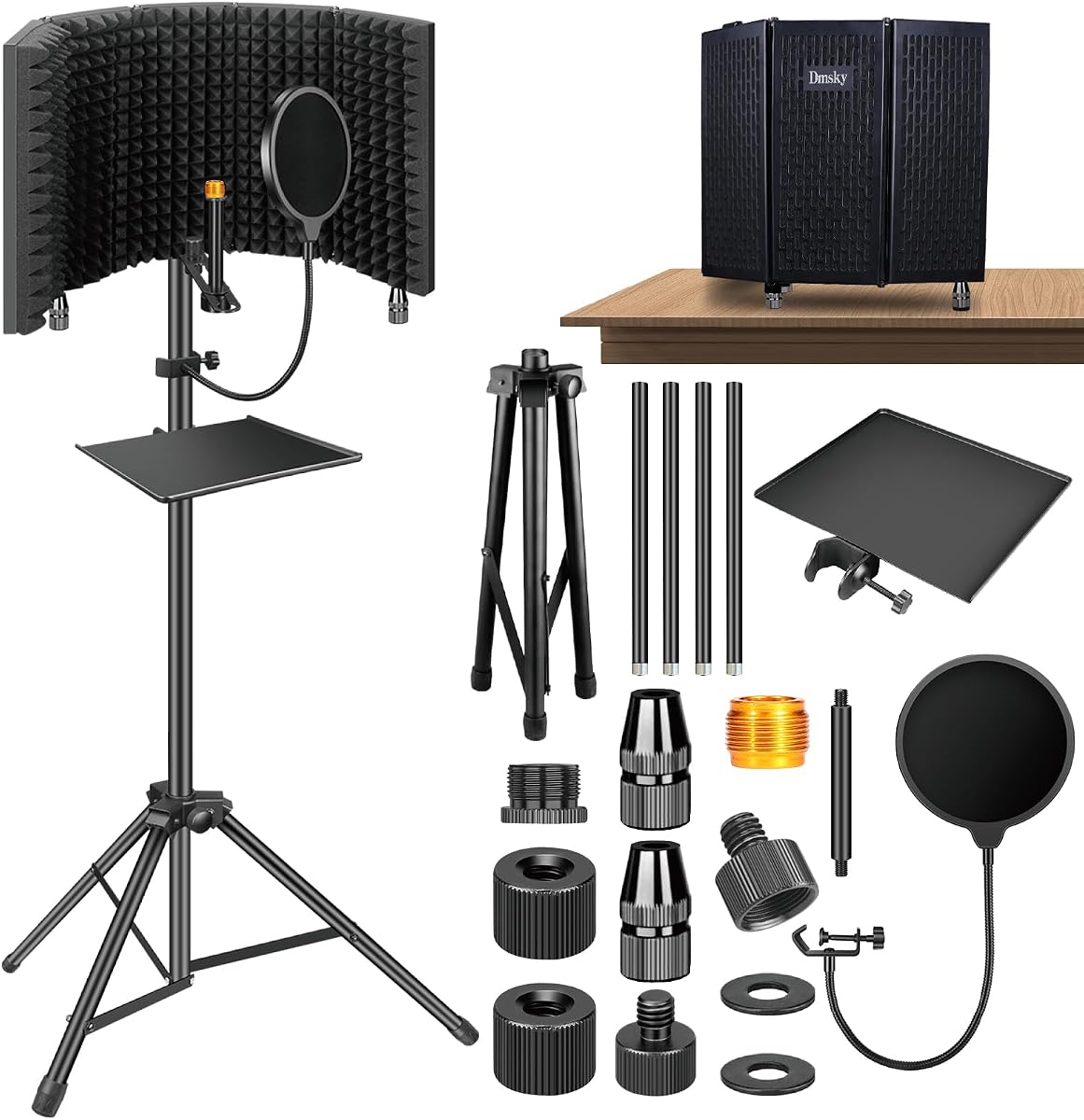


The Dmsky Microphone Isolation Shield with Pop Filter & Tripod Stand is the most feature-rich option in this guide, carrying a 4.6 rating while combining an acoustic enclosure, adjustable steel stand, pop filter, adapters, and a storage tray. It is designed for creators who want to improve vocal isolation without assembling every component separately.
We may earn a commission when you buy through this link, at no additional cost to you.
Its five folding panels use a three-part acoustic approach comprising a reflective layer, filter layer, and absorption layer. High-density acoustic foam helps control reflections and interference, while the adjustable panel angles allow the shield to form a more enclosed area around the microphone. The shield can be mounted on the included stand or placed on a desktop, making the same system useful for seated narration and standing vocal work.
The included stand reaches 78.7 inches overall and provides a stated shield adjustment range of 42 to 71.5 inches. A heavy-duty tripod, anti-slip support points, steel screws, and a reinforced back panel support stability and durability. The pop filter and 3/8-to-5/8-inch adapters make the package practical for common studio microphones, while the tray can hold a mobile phone, external sound card, or similar accessory.
The main trade-off is footprint. A folding five-panel shield occupies more desk space than a simple fixed screen, and the updated stand tube may look different from the product photograph. Even so, this is a strong recommendation for podcasters, singers, streamers, and home-studio users who prioritize a complete and adaptable setup over a minimal one-piece stand.
The reflective, filtering, and absorbing layers give the microphone a more controlled acoustic environment. This setup is especially useful in untreated rooms where hard surfaces send reflections back toward the capsule.
Desktop placement, stand mounting, and a height-adjustable shield let the same equipment support narration, podcasting, live streaming, and standing performances without requiring a separate support for every scenario.
We may earn a commission when you buy through this link, at no additional cost to you.
This Microphone Stand With Isolation Shield earns a 4.4 rating and emphasizes measurable acoustic performance, including a claimed 26dB reduction and claimed 87% ambient-noise reduction. Those figures should be treated as product specifications rather than guaranteed outcomes, but the construction suggests a serious approach to controlling room reflections and interference.
We may earn a commission when you buy through this link, at no additional cost to you.
The foldable 17.1-inch shield uses a reflective layer, precision filter layer, and absorption layer. Its front incorporates high-density acoustic foam with a lightweight ABS back, providing a rigid enclosure that can be used as a desktop screen or attached to the steel stand. The package includes two universal thread adapters for compatibility with 3/8- and 5/8-inch microphone threads.
The stand measures 72.8 inches in total and offers a 42-to-71.5-inch adjustment range. A weighted three-leg base, steel clamp, and screw-locking mechanism are intended to prevent movement, while quick-release adapters simplify repositioning. The shield can also be configured for boom-arm attachment, expanding its usefulness for creators who already own part of their stand system.
One limitation is that the listed package does not include a pop filter, so an additional accessory may be needed for close vocals. It is nevertheless a compelling option for voice-over, podcasting, and streaming users who prioritize isolation structure, stable support, and flexible mounting over the broadest possible collection of extras.
Each layer addresses a different part of the reflection problem: the outer surface reflects some energy, the filter layer breaks it up, and the absorption layer helps dissipate what reaches the foam. The result is more controlled capture than an uncovered microphone in a reflective room.
The same shield can sit on a table, mount on the included stand, or connect to a boom arm. That versatility is valuable for creators who alternate between seated editing and standing performance positions.
We may earn a commission when you buy through this link, at no additional cost to you.
The Microphone Isolation Shield Foam Kit has a 4.7 rating and offers a refreshingly straightforward combination of a folding foam shield, double-layer pop filter, and adjustable tripod stand. It appeals to new podcasters, streamers, and vocalists who want the core parts of a controlled recording setup in one package.
We may earn a commission when you buy through this link, at no additional cost to you.
High-density foam panels are intended to reduce unwanted room noise and echo, creating a more defined recording area around the microphone. The foldable construction allows the panels to compress for storage or transport, while the adjustable tripod supports changes in microphone height and angle. That makes the kit practical for creators who record in different rooms or move between locations.
The included double-layer mesh pop filter is designed to soften harsh consonant sounds and reduce breath noise. It addresses a different problem from the isolation shield: the shield helps manage environmental reflections, while the pop filter controls bursts of air close to the microphone. Using both can produce a more polished vocal recording without requiring separate purchases.
The supplied information does not specify a numerical noise-reduction claim, detailed panel diameter, or particular stand dimensions. Nevertheless, its 4.7 rating, useful included accessories, and uncomplicated design make it an attractive budget choice for desktop and mobile creators. It is best suited to users who want a practical acoustic package rather than an elaborate studio furniture system.
The foam enclosure gives the microphone a more defined acoustic area without requiring permanent room treatment. It can help soften reflections and reduce the echo that commonly makes untreated home recordings sound thin or reverberant.
Folding panels make the shield easier to put away when it is not in use. This is particularly beneficial for creators with limited desk space or those who move their recording equipment between rooms.
We may earn a commission when you buy through this link, at no additional cost to you.
The Microphone Isolation Shield with Tripod Stand & Pop Filter has a 4.4 rating and is built around flexibility. Its shield combines reflective, filtering, and absorbing layers, while the steel stand supports an especially broad stated height range of 15 to 71.5 inches.
We may earn a commission when you buy through this link, at no additional cost to you.
The foldable 17.1-inch shield has a high-quality acoustic foam front and lightweight ABS rear plate. It can function as a desktop recording screen or mount to the supplied stand, while a steel clamp and locking screw secure the assembly. Two universal adapters allow compatibility with standard 3/8- and 5/8-inch microphone threads.
A weighted triple-leg base is designed to resist tipping during long sessions, and rubber foot contact helps maintain a stable footprint. The product also supports boom-arm installation, making it suitable for users who want to transition between a freestanding arrangement and an existing suspended microphone system.
The product title mentions a pop filter, but the listed package description specifies the shield, adapters, and installation manual rather than detailing the filter as a separate included component. Buyers should therefore verify the package contents. Even with that ambiguity, the wide adjustment range, stable base, and mounting options make this a versatile choice for home studios and mobile creators.
The unusually broad 15-to-71.5-inch range accommodates close desk narration, conventional seated podcasting, and standing vocal performance. A wide range also makes it easier to reuse the stand with different microphones and input chains.
The anti-tip tripod provides stability for extended sessions, while desktop and boom-arm configurations let the shield adapt to different recording spaces. The result is a setup-oriented package rather than a simple fixed accessory.
We may earn a commission when you buy through this link, at no additional cost to you.
The Microphone Stand With Isolation Shield, Recording Studio Equipment has a 3.8 rating, the lowest listed score among these ten products, but it includes a compact base and a well-described acoustic shield. It may suit creators who prioritize a smaller footprint and stable tabletop foundation.
We may earn a commission when you buy through this link, at no additional cost to you.
Its foldable 17.1-inch shield uses a reflective layer, precision filter, and absorption layer, with high-density acoustic foam intended to reduce reflections and interference. The supplied information also states 26dB reduction and 87% ambient-noise reduction, although these should be understood as manufacturer claims rather than guaranteed results in every room.
The steel clamp and locking screw provide a secure connection, and two universal adapters fit common 3/8- and 5/8-inch stands. The most distinctive support component is the 2.2-pound metal base. A sponge pad on the bottom is intended to prevent sliding, while the weighted design helps reduce movement and tipping during lighter contact.
The main compromises are its narrower 17.7-to-22.8-inch height-adjustment range and the absence of a listed pop filter. Its 3.8 rating also suggests less uniformly positive customer feedback than the leaders. It is best considered for close-range desktop recording, studios with a restricted footprint, and users who prefer a low, stable base.
The weighted metal base and padded underside create a practical desktop foundation. This design is especially helpful when the microphone needs to remain close to the surface rather than elevated on a tall floor stand.
Although the acoustic enclosure is larger than the base, the compact support lets it work in spaces where a full-height tripod may be inconvenient. It offers a middle ground between a bare desktop stand and a full studio installation.
We may earn a commission when you buy through this link, at no additional cost to you.
The GLEAM Microphone Isolation Shield holds a 4.3 rating and is distinguished by its two-inch-thick high-density pyramid foam. Its five-panel format and heavy-duty tripod target professional vocal, acoustic, and podcast recording while also supporting desktop use.
We may earn a commission when you buy through this link, at no additional cost to you.
Unlike many competitors, the supplied information concentrates on the physical foam profile and panel count rather than presenting a numerical noise-reduction claim. The deep pyramid foam is designed to absorb sound and reduce reflections, while the surrounding panels help shield the microphone from direct environmental noise. This simple acoustic approach is easy to understand and can be effective in rooms with noticeable echo.
The included stand adjusts from 2 feet 6 inches to 5 feet 10 inches, providing enough range for both seated and standing work. Its heavy-duty tripod should offer a stable base, and the five-panel enclosure can be folded when not required. The product is also named as compatible with popular Blue Yeti, AT2020, AKG, and Rode microphones, though the support mechanism still depends on the selected hardware.
The limited package information is the main reason this model does not rank higher. No pop filter or universal adapters are clearly listed, and the product does not provide a specific isolation measurement. It remains a straightforward choice for creators who want thick absorptive foam, a recognizable multi-panel format, and a dependable adjustable tripod.
The two-inch pyramid foam creates a substantial absorptive surface around the microphone. Its primary strength is controlling reflections and echo in rooms that sound acoustically lively or hard.
Five folding panels make it possible to create a partial enclosure and adjust its shape around the microphone. The format balances a relatively open setup with the acoustic separation needed for clearer speech.
We may earn a commission when you buy through this link, at no additional cost to you.
The TONOR Isolation Shield Pack for Mic is a 4.4-rated all-in-one option centered on quick setup. The T65 combines a three-layer shield, steel tripod, metal tray, pop filter, and small hardware, allowing a creator with a compatible microphone to assemble a functional recording station in about five minutes.
We may earn a commission when you buy through this link, at no additional cost to you.
The acoustic construction consists of a reflecting layer, filtering layer, and sound-absorbing layer. High-density foam on the inner side helps eliminate reflected waves and interference, while separate reflecting and absorbing areas are intended to reduce external environmental noise. This layered approach makes the package relevant to untreated rooms where clean speech is the priority.
A reinforced tripod made from thickened steel lowers the center of gravity and is designed to resist light contact. The stand adjusts from 19.69 to 59.06 inches, covering common seated positions and many standing applications. The shield can also sit directly on a desktop, and the metal tray provides a place for a phone, sound card, or other small accessory.
The maximum stated stand height is lower than several competing systems, so taller performers may need to reconsider positioning. The pop filter must also be installed and aligned correctly, although that is a minor trade-off for cleaner vocals. This is a strong recommendation for new podcasters, singers, and home-studio creators who value a clearly defined, rapid assembly process.
The supplied instructions describe a clear sequence: unfold the stand, attach the shield, add the microphone and pop filter, and position the tray. Simple assembly reduces the chance of placing the acoustic panels incorrectly.
The metal tray keeps small recording accessories within reach while the pop filter addresses plosives and breath noise. Together, these additions make the T65 feel like a complete workstation rather than a bare shield and tripod.
We may earn a commission when you buy through this link, at no additional cost to you.
The Moukey Microphone Isolation Shield with Pop Filter & Tripod Stand earns a 4.7 rating and is the strongest all-around choice in this guide. It combines a detailed three-layer acoustic design, five adjustable panels, a 72.8-inch steel stand, and a pop filter in a package suitable for vocals, podcasts, broadcasting, and streaming.
We may earn a commission when you buy through this link, at no additional cost to you.
The shield includes reflective, filter, and absorbing layers backed by high-density acoustic foam. Its five panels rotate through 180 degrees, allowing the user to shape the enclosure around the microphone instead of using a fixed screen. A lightweight ABS rear plate combines with the foam front for a structure described as durable and suitable for either desktop placement or direct stand mounting.
Steel clips connect the shield to the stand, and the included adapter and screw permit straightforward height and tension adjustment. The stated shield range is 42 to 71.5 inches, while the full stand measures 185 centimeters, or 72.8 inches. A heavy-duty tripod lowers the center of gravity, and the assembly can also be used with a boom arm for more flexible positioning.
Its strongest tradeoff is physical footprint. A five-panel enclosure requires enough desk or floor space to open properly, and the shield should not be pressed tightly against nearby reflective walls. Subject to that need for breathing room, the combination of construction, adjustability, accessories, and strong rating makes Moukey the best overall recommendation for a versatile home studio.
The 180-degree panel adjustment is more useful than a fixed screen because it lets creators respond to room geometry and microphone direction. Wider coverage can help reject more sound, while selective positioning can preserve openness where needed.
The heavy-duty tripod is engineered to resist tipping during normal contact, which is important when the microphone is enclosed and the user may lean toward it. A reinforced structure supports confident placement on a desk or floor stand.
We may earn a commission when you buy through this link, at no additional cost to you.
The 5-Sided Isolation Shield Microphone Stand with Pop Filter has a 4.2 rating and distinguishes itself with a tall 65.3-to-81.5-inch adjustment range. That makes it especially appealing to standing singers and performers who want the microphone and shield elevated well above a desk.
We may earn a commission when you buy through this link, at no additional cost to you.
The shield uses reflective, filter, and absorbing layers with high-density foam, accompanied by a stated claim of 87% ambient-noise reduction. Five foldable sides can create a partial vocal booth, and the product is designed to be installed in about three minutes. Desktop and stand configurations are both supported, while universal adapter screws broaden compatibility with common studio microphones.
A weighted steel tripod, rubber foot pads, and a listed 40-pound capacity are intended to provide a stable base. The package also includes a 360 pop filter, adapters, and a tray, giving the user the main components needed for a functional vocal station. The 360-degree filter is especially useful for creators who reposition their speaking angle while remaining close to the microphone.
The major drawback is size. A five-sided shield and tall stand occupy considerable room, and the same dimensions may be excessive for desk-based narration. It is best for performers, rehearsal rooms, and dedicated recording spaces where vertical adjustability and a substantial enclosure are more important than compactness.
The extended adjustment range lets a singer bring the shield to a natural standing height. This avoids working around a short stand and can make vocal technique and microphone distance easier to maintain.
The pop filter, adapters, and tray transform the stand into a more complete workstation. These additions help manage airflow, microphone compatibility, and accessory storage without requiring separate purchases.
We may earn a commission when you buy through this link, at no additional cost to you.
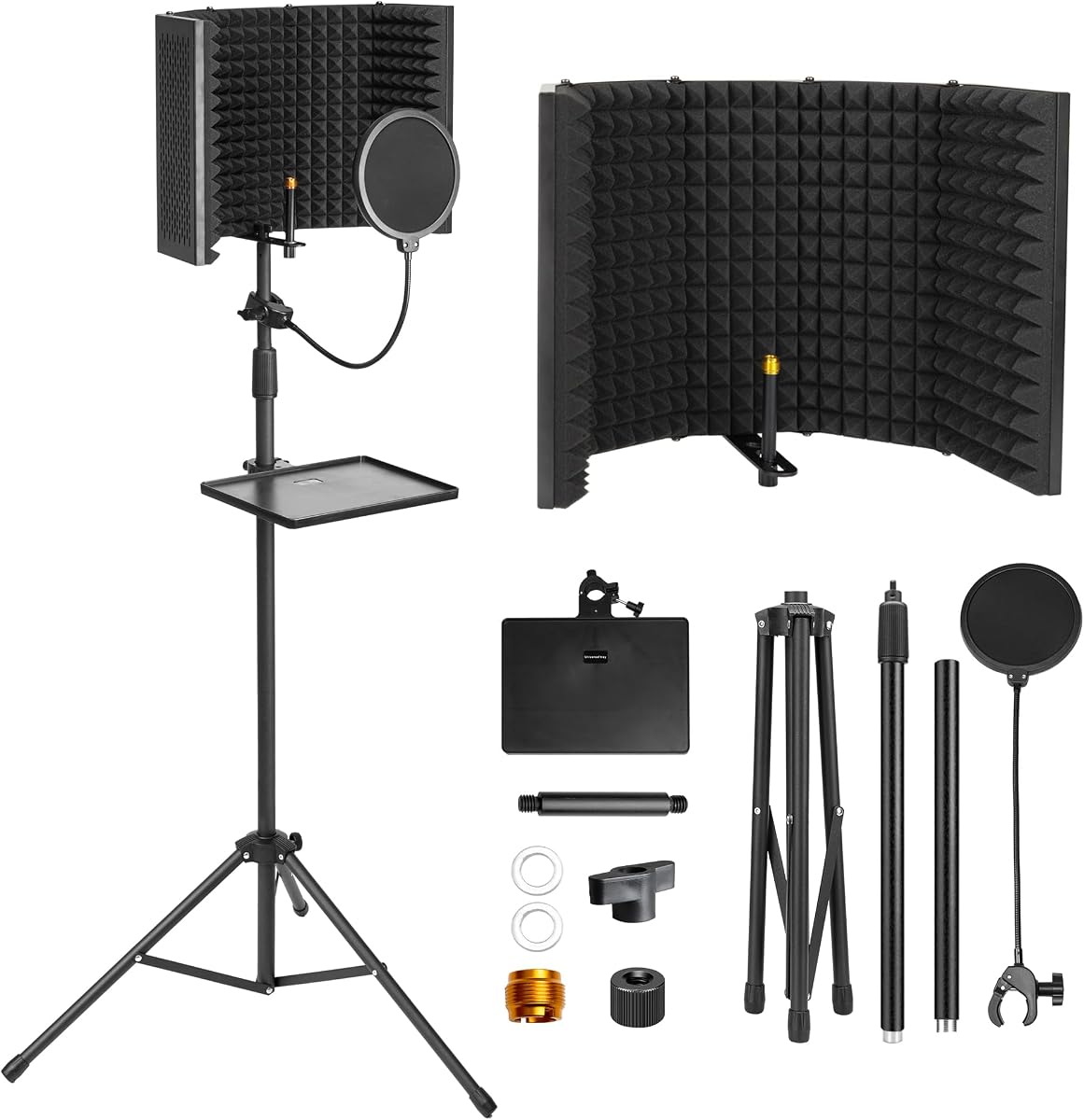
The SYLPHID Microphone Isolation Shield with Pop Filter & Stand and Phone Clip has a 4.7 rating and offers the most premium-featured bundle in the guide. Its three-layer acoustic sandwich, weighted stand, pop filter, phone clip, storage tray, and universal adapters create a ready-to-configure recording station.
We may earn a commission when you buy through this link, at no additional cost to you.
The panel structure combines a sound-reflective surface, precision filter core, and deep absorption base. The product information states 87% ambient-noise blocking and 26dB professional-grade isolation. As with any stated decibel figure, real results depend on microphone placement, room acoustics, the speaker's voice, and how closely the shield is adjusted around the performer.
The industrial-strength steel stand adjusts from 27.5 to 71 inches and sits on a weighted three-leg base intended to resist tipping. Panels rotate through 180 degrees, while quick-release adapters make position changes easier. The shield can operate as a desktop recording screen or be attached to the included boom arm for standing work.
Both 3/8- and 5/8-inch adapters are included for compatibility with popular microphones, and the dedicated pop filter controls plosive airflow. The phone clip is useful for reviewing recordings or monitoring content without adding another support, while the tray keeps accessories organized. Although the stand does not reach the same maximum height as the 5-Sided model, it is a particularly complete and polished recommendation for podcasters, streamers, singers, and YouTube creators.
The phone clip and storage tray are especially useful for creators who monitor content and keep small recording devices close at hand. They add workflow value without changing the core acoustic design.
Premium steel, high-density acoustic foam, and UL-certified flame-retardant materials support a professional appearance and thoughtful construction. The finish and accessory integration also suit permanent home-studio installations.
We may earn a commission when you buy through this link, at no additional cost to you.
The most useful product is the one that controls the reflections in your specific room while fitting your microphone, available space, and recording posture. Compare the shield construction, stand geometry, included accessories, and mounting system rather than focusing on a single noise-reduction number.
A strong isolation shield usually combines a reflective surface, a middle filtering layer, and an absorptive layer. The reflective portion redirects some incoming energy, the filter disrupts what remains, and the foam absorbs residual sound. This layered arrangement is more purposeful than a thin decorative screen, particularly in rooms with hard floors, glass, bare walls, or reflective furniture.
Look for clear descriptions of both the panel materials and the number of layers. Also consider the amount of foam facing the microphone, because a heavily foam-lined interior is better suited to controlling high-frequency reflections, hiss, and reverberant room tone.
Five panels allow the enclosure to be opened or closed according to the recording environment, while a smaller fixed screen may be easier to use in confined spaces. A larger shield can provide more separation, but it also takes up more desk or floor area and may reflect sound back into the sides if positioned too close to a wall.
Compare the stated panel diameter, the number of sides, and the folding mechanism. Check that the shield can surround the microphone without interfering with the pop filter, stand, headphones, or the creator's arms.
Height adjustment should match your normal recording posture. Seated podcasters and voice-over artists generally need less vertical range, while standing singers benefit from a tall stand that keeps the microphone at mouth level. A weighted tripod, rubber feet, and a low center of gravity help prevent movement on hard floors or carpet.
Review both the full stand length and the shield's actual adjustment range, since some products use different values. Confirm that the base is wide enough for the shield and that it will not crowd adjacent furniture.
Most common studio microphones use 3/8- or 5/8-inch threads, so including both adapters is valuable. Desktop placement, freestanding tripod use, and boom-arm attachment each provide different levels of positioning control. A product supporting all three can move easily between narration, podcasting, and performance setups.
Check whether the supplied adapters fit your existing stand before buying. Also verify that any boom-arm connection includes the appropriate clutch or screw adapter, since a standard microphone thread alone may not be enough for every arm.
A pop filter is particularly valuable for close-miked speech and vocals because it reduces the bursts of air caused by plosives and breathing. Some bundles include a double-layer filter, adapters, a phone holder, a storage tray, or a small equipment shelf. These accessories can improve workflow, but a longer included list does not automatically indicate better acoustic performance.
Compare the actual package contents and check whether the product title's accessories are confirmed in the detailed description. It is also worth considering how easily a pop filter can be moved when changing the microphone angle.
A folding shield and collapsible stand are valuable in shared rooms, small apartments, and mobile recording situations. If the equipment is mostly stationary, a larger rigid enclosure may be more appropriate. Leave enough space around the shield for the panels to open fully and for airflow to reach the microphone.
For travel, prioritize a compact folded size, a manageable weight, and a clear packing method. For a permanent studio, consider the stand footprint, available desk area, and whether the system can be moved aside when the microphone is not in use.
Some products publish a decibel reduction or ambient-noise percentage, while others provide only construction details. Manufacturer figures can be useful for comparison, but they are not always directly comparable because test methods, microphone placement, and room conditions can differ.
Treat the strongest evidence as the combination of layered construction, dense foam, panel coverage, and real-world customer feedback. No portable shield can fully replace proper room treatment, sealing control, and thoughtful microphone placement, so realistic expectations produce better purchasing decisions.
Begin by assembling the tripod on a level surface, tightening its locking hardware, and checking that all legs are evenly loaded. Attach the shield using the supplied clamp, clips, or screw adapter, then place the microphone at the center of the enclosure with its grille positioned within the foam-lined area. Do not overtighten screws, as excess force can deform the mounting point.
Position the pop filter a short distance in front of the microphone grille and keep it centered across the spoken or sung axis. Adjust the stand so the microphone sits naturally in front of the mouth rather than forcing the creator to lean around the shield. Leave space between the outer panels and nearby walls, and open or close panels gradually while listening for changes in reflections and room tone.
For care, wipe foam and mesh gently with a dry or lightly damp cloth, and avoid sprays, solvents, and excessive moisture. Clean metal hardware with a soft cloth, inspect screws periodically, and let the stand collapse only after the microphone and shield have been removed. Store the folded unit in a dry area with the panels protected from sharp impacts.
No. An isolation shield mainly reduces reflections and noise that arrive directly from nearby surfaces around the microphone, and it can make a noticeable difference in a simple room. It cannot control every reflection in a large space, isolate an entire vocal booth, or correct problems arising from traffic, HVAC, or electrical noise. Broadband room panels and bass traps remain useful complements.
Most support common 3/8- and 5/8-inch threaded microphones, and many bundles include adapters for both sizes. Compatibility also depends on the microphone's physical size and whether its body can fit inside the shield without touching the foam. Check the shield dimensions, the included adapters, and the manufacturer's compatibility list before purchase.
A boom arm offers precise positioning and keeps the stand base out of the recording area, while a tripod is easier to reposition, often more portable, and sometimes more stable. Many shields in this guide support both arrangements. Choose a boom arm when suspension and precise angle control matter most, or a tripod when frequent movement and straightforward setup are priorities.
The microphone should sit near mouth level so the creator can speak naturally without leaning or raising the shoulders. For seated recording, this is often around the height of the seated mouth, while standing performers need a taller adjustment range. The exact measurement varies with the chair, performer, and microphone dimensions, so adjust by comfort rather than a single number.
No. A pop filter addresses airborne plosives and breath noise close to the microphone, whereas an isolation shield helps reduce reflections and environmental sound arriving from the room. Using both is common because they solve different problems and can improve vocal recordings in complementary ways.
A five-panel shield needs enough room to open into its intended shape without contacting the microphone or nearby walls. The exact footprint depends on the stated diameter, but a broad enclosure will occupy substantially more space than a single-panel screen. Measure the available desk or floor area and leave clearance around the stand legs and accessory tray.
No. A stated percentage or decibel figure is generally a manufacturer specification based on particular conditions and should not be treated as a guarantee in every room. Results vary with panel position, microphone placement, speaker characteristics, room dimensions, reflections, and the frequency of the unwanted sound. Construction, coverage, and customer feedback are more useful for a broad comparison.
Remove the microphone and any attached pop filter or accessory first, then collapse the stand and fold the panels inward. Protect the foam from sharp objects, avoid compressing it with heavy equipment, and carry the stand separately if it is too long for the case. Regular inspection of the screws and hinges helps prevent instability during future setups.
The Moukey Microphone Isolation Shield stands out as the best overall choice because its 4.7 rating, three-layer construction, adjustable five-panel enclosure, and flexible stand system cover the core needs of most home-studio creators. The SYLPHID model is the strongest premium option, particularly for users who value its phone clip, tray, and flame-retardant construction, while the compact Foam Kit offers the best streamlined starting package.
Prioritize adequate panel coverage, dense internal foam, a stable base, and the correct height for your recording position. Accessories are helpful, but they should not outweigh acoustic design or compatibility. Also account for the physical footprint and leave enough space around the shield for it to work as intended rather than creating unwanted reflections.
Ratings, configurations, availability, and prices can change over time, so verify the current product listing and included accessories before ordering. Checking those details ensures that the chosen stand, shield, adapters, and pop filter work together with your microphone and room.