
Audio Effects Processor
5.0Editor score
199 programmable effect presets
Dual-channel parallel processing
19-inch rackmount chassis
24-bit digital signal processing
Our guide compares 10 hardware reverb units, including rack processors, guitar pedals, and desktop controllers, to help musicians find the right reverb sound.
Hardware reverb units can add depth, dimension, and atmosphere to a signal without relying entirely on software effects. The right model depends on your setup: some excel in studios, others are built for live guitar performance, and desktop controllers provide tactile control over software reverbs.
We compared all ten products by examining their format, control options, effect variety, connectivity, and practical appeal for musicians, producers, and live performers. The list covers rackmount processors, compact guitar pedals, a spring-reverb module, and a desktop-controlled plug-in.
Each review explains what the product data highlights, where it may fit best, and which trade-offs deserve consideration. Ratings reflect the supplied customer feedback, while recommendations consider usability, versatility, and sonic character. Prices and availability can change, so confirm current details before buying.
5.0Editor score

4.9Editor score

4.8Editor score
The table below compares every included unit by product type, major controls, processing approach, and practical feature set, making it easier to identify the right category for a studio, stage, or hybrid workflow.
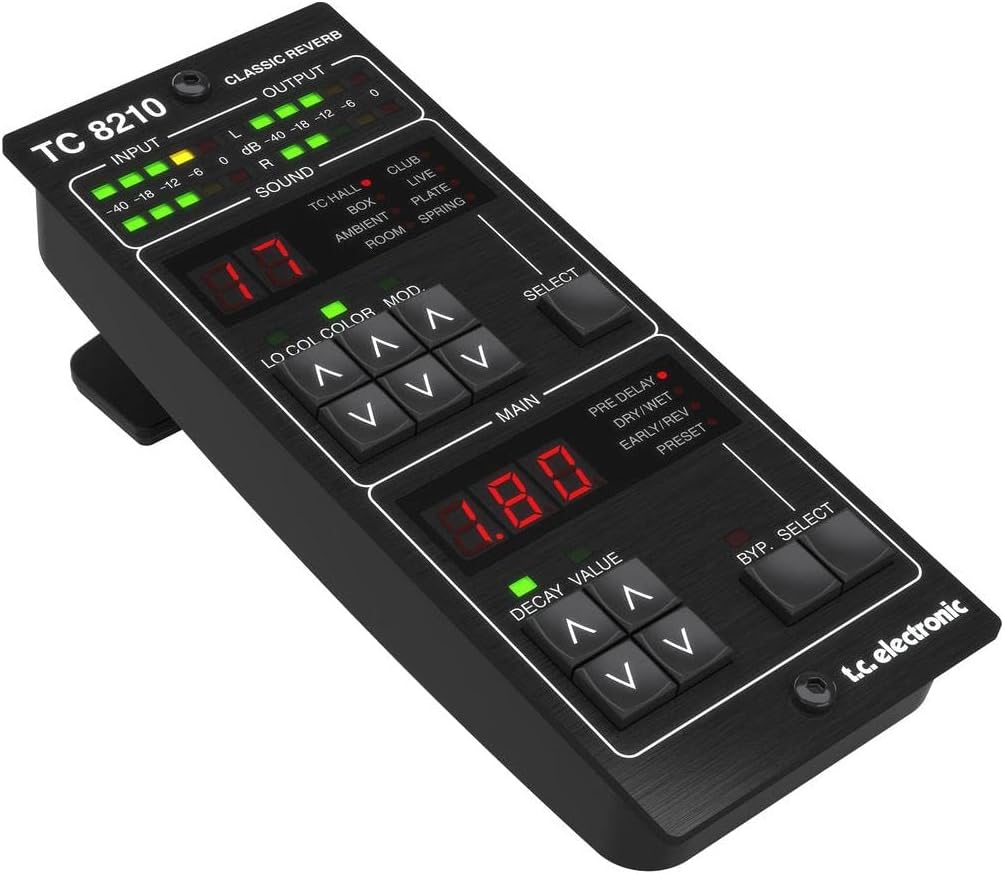




The TC Electronic TC8210-DT is a desktop-controlled plug-in that brings a classic-style mixing reverb into a digital audio workstation. Its 4.7 rating reflects strong customer reception, while the dedicated interface gives users a more tactile way to adjust important settings. It is especially compelling for musicians who want the immediacy of hardware control without giving up the flexibility of a software plug-in.
We may earn a commission when you buy through this link, at no additional cost to you.
The platform's strongest selling point is the combination of a familiar desktop interface with a large variety of reverb environments. The supplied information specifically highlights intuitive hands-on control, broad suitability for material ranging from vocals to drums, and preservation of the source's natural characteristics. Custom-built signature presets from participating artists also provide ready-made starting points for listeners who may not know how to construct a convincing space from scratch.
The primary trade-off is workflow dependence. This is not a self-contained rack unit that accepts line-level signals and processes them without a computer; it is a software-based reverb paired with an optional physical controller. That requirement may discourage live performers who need a completely independent device, but it is manageable for home-studio owners, project producers, and anyone who already works primarily inside a DAW.
This is a strong all-around recommendation for a musician who wants expressive hardware control within a modern production setup. Rather than choosing it solely for the largest number of controls, consider it for the bridge it creates between a tactile interface and the versatility of a plug-in. Confirm that your computer and DAW setup are compatible, and use the signature presets as a practical way to learn which environments suit different parts of a mix.
The desktop controller makes common reverb adjustments feel more immediate, while the underlying plug-in retains the flexibility of a software environment. That combination is useful for tracking, mixing, and auditioning variations without relying entirely on mouse-driven editing.
Signature presets offer a convenient route into the soundset, and the stated support for vocals, drums, and other material suggests broad applicability. Users can begin with an artist-inspired sound, then refine it with the physical controller.
We may earn a commission when you buy through this link, at no additional cost to you.
The Behringer 66 Spring Reverb Module is a substantial analog hardware option for musicians seeking the lively, dimensional character associated with a spring tank. It has a 4.0 rating, and its most compelling feature is the specified 72HP analog design with a dual-spring reverb circuit. Unlike software approximations or multifunction digital pedals, it offers a focused route to a recognizable mechanical reverb family.
We may earn a commission when you buy through this link, at no additional cost to you.
Its connection options make it adaptable to several stages of a signal chain. The module includes two unbalanced line outputs, two unbalanced microphone inputs, and two high-level auxiliary inputs. Two mute footswitch jacks add a degree of performance control, although the footswitches themselves are not listed among the included components. The variety of input options could suit a guitar, direct instrument feed, or another preamp source, depending on the surrounding setup.
Its specialized nature is both an advantage and a limitation. Buyers looking for room, hall, plate, delay, chorus, and other effects from one device may find the Behringer too focused. Unbalanced connections can also require extra thought in a modern studio, especially when integrating it with balanced equipment. A 4.0 rating is solid but trails the strongest customer feedback in this list, so the sound and compatibility should drive the decision.
The module makes most sense for a guitarist, producer, or recording artist who deliberately wants spring reverb rather than a broad menu of digital effects. It can provide a distinctive alternative to polished algorithmic spaces and add tactile hardware character to a recording chain. Confirm your cable and routing requirements before purchase, and make sure you understand which footswitch accessories, if any, are needed for live switching.
The dual-spring analog configuration makes this a specialist instrument for a recognizable tone family. A musician can center an entire sound around that character rather than navigating dozens of unrelated algorithms.
Separate microphone, line, and high-level auxiliary inputs allow the module to sit in several common signal paths. This range supports experimentation, although unbalanced outputs should be considered in a detailed studio plan.
We may earn a commission when you buy through this link, at no additional cost to you.
This 24-bit rackmount audio effects processor delivers a broad collection of reverb, delay, chorus, pitch-shift, and multi-effect programs. It carries a 5.0 rating in the supplied data, making it one of the strongest customer-rated options here. Its most immediately useful feature is the bank of 199 preset modes, which gives users many starting points for vocals, instruments, karaoke, live performance, and studio work.
We may earn a commission when you buy through this link, at no additional cost to you.
The dual-channel design supports parallel processing, so different sources can receive different effects or related effects can be combined. Dedicated knobs for input, mix, and output levels make basic balancing straightforward, while two edit controls provide access to parameters such as decay, delay time, and depth. The standard 19-inch chassis fits common professional racks, and the stated metal construction is reassuring for an instrument intended for regular use.
The trade-off is specialization. A multifunction processor cannot be assumed to offer the nuanced character or streamlined workflow of a device designed solely around one classic reverb model. It also requires rack space and suitable connections, and the supplied information does not describe the exact physical input or output formats. Buyers should therefore verify its full connection panel and compatibility rather than relying on the broad format category alone.
For a musician building a compact studio, mobile rack, or karaoke system, this processor is an unusually capable value-oriented choice. The 199 presets reduce setup time, and dual-channel processing expands the possibilities for live and recorded sources. It is the best budget recommendation in this guide when breadth, customer feedback, and rack-ready construction matter more than replicating one specific vintage machine.
A 199-program library gives users a large palette for testing different textures and time-based effects. This is valuable for quick setup, unfamiliar equipment, and projects where many source types may need processing.
Parallel processing can separate two sources, or combine effects across the available channels. That capability makes the unit relevant to singers, instrumentalists, live performers, and producers working with more than one audio path.
We may earn a commission when you buy through this link, at no additional cost to you.
The Donner Verb Square is a compact digital guitar pedal designed for musicians who want several recognizable reverb spaces in one stompbox. Its 4.3 rating indicates solid customer reception, and the seven modes cover room, hall, church, spring, plate, studio, and modulation effects. That range is useful for moving from restrained plate-style ambience to larger architectural spaces without carrying multiple pedals.
We may earn a commission when you buy through this link, at no additional cost to you.
The true bypass design helps preserve the instrument's original signal when the effect is switched off. A full aluminum-alloy housing supports durability, while the small enclosure is explicitly designed to fit comfortably on a pedal board. An LED indicator provides a simple visual confirmation that the unit is operating, reducing uncertainty during a live change.
The principal practical drawback is that the power supply is not included. The pedal requires DC 9V, so a musician should account for a compatible supply and its cable in the total setup. Its mode-based design also offers less internal variety than premium units with deep parameter menus and preset storage, which means users may find that the included categories suit their needs but do not fully cover every desired adjustment.
The Donner is a practical choice for a guitarist who wants a simple, durable way to explore classic reverb categories on a pedal board. Its value comes from clear mode selection, true bypass, and a manageable physical size rather than elaborate programming. It works especially well for players who need dependable broad coverage and would rather change spaces quickly than navigate a complex editing workflow.
Room, hall, church, spring, plate, studio, and modulation modes cover a useful cross-section of familiar reverbs. This makes the pedal practical for song changes, improvisation, and live performances.
The mini enclosure and aluminum construction address two common stage concerns: limited board space and repeated handling. True bypass further integrates the pedal into a conventional guitar signal chain.
We may earn a commission when you buy through this link, at no additional cost to you.
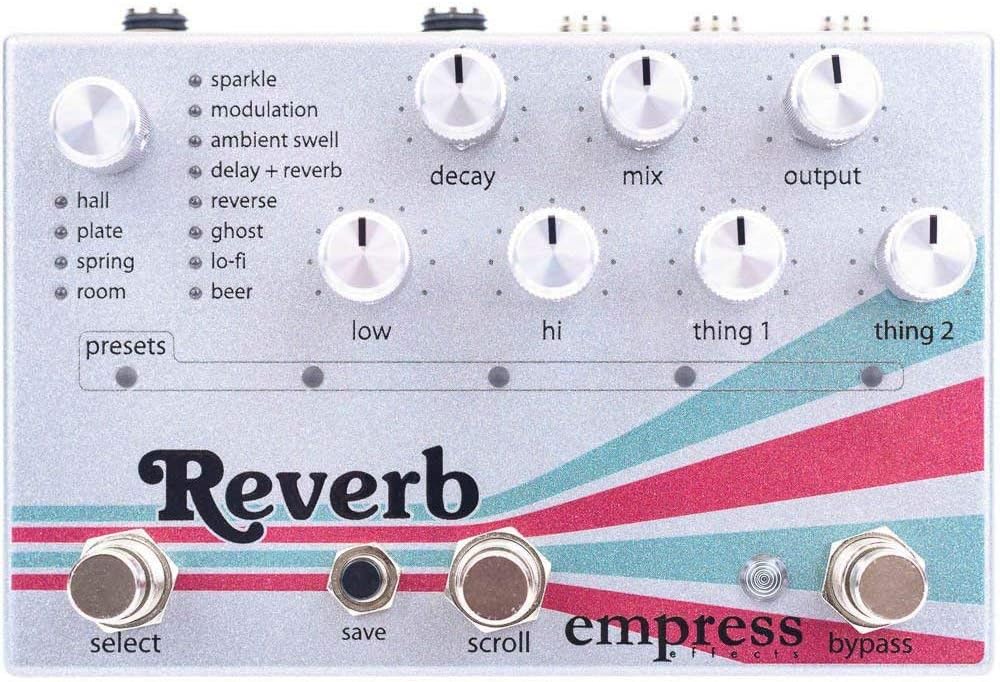
The Empress Effects Reverb is a guitar-focused stompbox built around 24 studio-quality algorithms. Its 4.4 rating places it comfortably among the stronger customer-rated products in the guide, while the algorithm count provides a meaningful range of options. Unlike a pedal with only three or four broad modes, this unit can serve as a more comprehensive source of reverb characters.
We may earn a commission when you buy through this link, at no additional cost to you.
The included descriptions highlight pristine classic sounds and ambient sounds, suggesting a deliberate balance between familiar studio spaces and expansive atmospheric textures. Fast adjustment is another stated priority, which matters for musicians who need to respond to a performance or a mix decision without becoming distracted by a long editing process. Tap functions are included, adding a performance-oriented tool for timing-related effects.
A large selection can also be a disadvantage to someone who wants one predictable sound and little interaction. The supplied information does not detail the exact controls, preset capacity, enclosure dimensions, or connection configuration, so those details require verification. It is also important not to infer sonic qualities beyond the confirmed categories of classic and ambient sounds.
This reverb is a strong fit for a guitarist who wants a deep selection of studio-style algorithms but values quick operation. The balance of classic and ambient categories makes it useful for both polished recordings and more experimental pedal-board arrangements. Begin by identifying the type of space you need, then use the algorithm list as a menu of possibilities rather than assuming every mode has the same musical role.
A catalog of 24 algorithms offers substantially more choice than a small mode selector. It gives performers and recordists multiple starting points for changing size, density, and atmosphere.
The emphasis on quick dialing is valuable in sessions where an artist needs to audition several spaces immediately. Tap functions add another layer of control for musicians who work with rhythmic or time-based elements.
We may earn a commission when you buy through this link, at no additional cost to you.
The Strymon BigSky is a premium multidimensional reverb pedal with a 4.8 rating, making it one of the most favorably reviewed products in this collection. Its defining feature is the promise of multidimensional reverb: a design intended to move beyond a single basic space and provide a broad range of atmospheric possibilities for guitarists.
We may earn a commission when you buy through this link, at no additional cost to you.
The supplied product information is concise, so it confirms the product identity, format, and customer rating without detailing the exact algorithm count or individual control names. Even with that limitation, the dedicated pedal form is meaningful. It is built to sit in a guitar signal path and respond to physical switching, making it relevant to recording sessions, rehearsals, and performances rather than only software-based mixing.
As a premium option, the BigSky should be considered on sound quality, build, control, and longevity rather than simply on the number of included modes. Exact specifications should be confirmed with the manufacturer or retailer before purchase, especially if compatibility, power, or control behavior is central to the decision. The available 4.8 rating is a strong indicator of customer satisfaction, though ratings alone cannot guarantee a fit for every playing style.
For a guitarist who wants a serious dedicated reverb pedal and values a multidimensional approach, the BigSky is a leading recommendation. It is particularly attractive when the instrument is the main source and the effect must be dependable in a physical performance setup. The final purchase should be informed by current manufacturer details and a clear understanding of the sounds you want from a premium pedal.
Because the BigSky is built specifically as a reverb pedal, it can serve as the centerpiece of a guitar effects chain. That specialization is attractive when consistent, tactile control matters.
A 4.8 rating gives the BigSky one of the strongest customer-response profiles in the guide. It is a meaningful endorsement, although buyers should still compare the pedal's actual control set with their preferred workflow.
We may earn a commission when you buy through this link, at no additional cost to you.
The Strymon blueSky V2 is a digital stereo reverb pedal with a 4.9 rating, the highest customer score in the supplied list. It combines several clearly identified creative tools, including reverb modulation, decay, shimmer, pre-delay, and separate high- and low-frequency shaping. That combination gives it a strong identity as a versatile modern pedal rather than a simple fixed-space reverb.
We may earn a commission when you buy through this link, at no additional cost to you.
Stereo operation is particularly useful for a guitar pedal because it can create width and depth instead of presenting the reverb entirely in the center. The decay control establishes the length of the tail, while modulation adds movement to that tail. Shimmer introduces an upper-register harmonic dimension, and pre-delay changes how quickly the reverb enters after the direct signal, which can help a player maintain definition in a dense arrangement.
The depth of these controls may be more than a beginner needs, but it also means the pedal can grow with a player's skills. Exact control positions and additional modes are not included in the supplied information, so prospective owners should verify the current manual. A stereo pedal also deserves consideration in a rig where a narrow signal chain or a mono input to the amplifier could limit the audible benefit.
The blueSky V2 is the editor's choice because it combines exceptional customer feedback with a clearly versatile control set. It is well suited to a guitarist who wants to shape both the physical space and character of the reverb, from short and controlled to lush and expressive. It also makes sense for a producer looking for a stereo hardware reverb that can be recorded directly and auditioned in context.
Stereo output can place reverb elements across the field, creating a sense of space that a single-channel effect may not reproduce. That makes the pedal especially interesting for spacious arrangements and detailed recordings.
Decay, modulation, shimmer, and pre-delay affect different aspects of the effect. Working with these controls together can produce a more personal result than choosing only one predefined ambience.
We may earn a commission when you buy through this link, at no additional cost to you.
The Walrus Audio Mako Series MKII R1 is a high-fidelity reverb pedal built around six revamped programs and a substantial collection of onboard memory. Its 4.3 rating indicates a positive customer response, while features such as 128 presets, program-specific controls, and a menu display position it as a detailed instrument for players who want to keep multiple sounds ready.
We may earn a commission when you buy through this link, at no additional cost to you.
Every one of the six programs has been rebuilt with the stated goal of improving tone. Each also includes controls for size and diffusion, allowing a user to adjust the perceived dimensions and smoothness of the effect rather than accepting a fixed character. A dedicated feedback equalization control adds another layer of refinement, useful for shaping how the reverb behaves over time.
The most distinctive addition is a ducking and swelling feature. Ducking can reduce the reverb when the direct signal is present, while swelling can emphasize it; that dynamic behavior can make the effect more integrated with a performance. The trade-off is complexity. Secondary controls are handled through a menu screen, which may feel less immediate than dedicated front-panel knobs, especially for a musician performing unfamiliar changes live.
The Mako R1 is a good choice for a guitarist or producer who values preset recall and deeper control over a conventional set of mode switches. Its ability to store many variations is particularly attractive for studio work, live sets, and artists moving between different guitars or song parts. Learn the menu structure before a performance and confirm the pedal's control layout and connections in the current documentation.
Ducking and swelling changes the relationship between the direct source and the reverb tail. This can make the effect respond more organically to a performance instead of remaining a fixed layer.
With 128 onboard preset locations, a player can keep many variations close at hand. That is valuable for organized live sets, comparison sessions, and producers who want to preserve distinct sounds for different parts.
We may earn a commission when you buy through this link, at no additional cost to you.
The Universal Audio Galaxy '74 is a richly modeled delay and reverb pedal inspired by a classic mid-1970s Japanese ambience device. Its 4.3 rating shows solid customer reception, and the product's appeal rests on detailed emulation: a multi-head tape delay mechanism, spring reverb circuit, and analog preamp section are all modeled to evoke the original hardware.
We may earn a commission when you buy through this link, at no additional cost to you.
The pedal does more than reproduce a static vintage tone. It includes doubled delay times that extend beyond the referenced hardware, while the UAFX Control app lets users adjust footswitch functions, modify real-time effects, and customize unique oscillation sounds. Silent switching, buffered bypass, analog dry-through, spillover or trails, and stereo or dual-mono operation add practical tools for both recording and performance.
That depth introduces a real learning curve. A guitarist interested primarily in a simple ambience pedal may not need the modeled tape mechanism or app-based configuration, and the pedal requires an isolated center-negative 9VDC supply rated for at least 400 mA, sold separately. Exact behavior of every control should be checked in current documentation before relying on it in a live set.
The Galaxy '74 is a compelling recommendation for musicians who specifically want the character and flexibility associated with a classic tape ambience unit. It is especially relevant to guitarists, experimental players, and producers who enjoy combining spring reverb with multi-head delay. Its combination of authentic modeling, modern routing options, and app control makes it more specialized and potentially more expressive than a standard one-effect pedal.
The Galaxy '74 models a classic Japanese ambience device while allowing delay times beyond the original limits. That gives users a period-inspired starting point with room for contemporary experimentation.
The UAFX Control app can adjust real-time effects, footswitch behavior, and oscillation characters. This deepens the pedal's potential for customized workflows, though it may take practice to configure and use effectively.
We may earn a commission when you buy through this link, at no additional cost to you.
The JHS Pedals 3 Series Reverb is a versatile stompbox designed to cover everything from small room impressions to nearly endless ambient washes. It has a 4.7 rating, putting it among the better customer-rated products in the guide, and its broad design is supported by two particularly useful dedicated controls: an equalizer for the overall reverb tone and a pre-delay knob for the time before the effect begins.
We may earn a commission when you buy through this link, at no additional cost to you.
That pre-delay control expands the practical range considerably. A short setting can create a close, slap-like impression, while a longer setting separates the direct guitar from the reverb and supports more spacious, spring-like results. The EQ permits the user to move between a brighter, more present texture and a darker character. Together, these controls make the pedal more than a one-knob ambience box.
The main trade-off is that its ability to create expansive washes may be more than required for clean, single-voice guitar parts. The supplied information also does not detail the algorithm count, control layout, or exact enclosure format, so those aspects should be verified. It requires 9V DC negative-center power and consumes 74mA, giving the player a clear power requirement to consider.
The JHS 3 Series is a strong recommendation for a guitarist who wants to move fluidly between close spaces and expansive ambience using physical controls. Its strong customer rating and explicit tone shaping make it an attractive middle ground between simple multi-mode pedals and highly complex premium units. It suits songwriters, performers, and players who value a direct connection between a pre-delay adjustment and the perceived size of the space.
Changing the delay before the reverb begins determines how closely the effect follows the dry signal. Short values add immediacy, while longer values can create greater perceived distance and definition.
The dedicated EQ lets a player balance the overall reverb from bright to dark. That control can help the effect sit naturally beneath a dry guitar or become a more prominent part of the arrangement.
We may earn a commission when you buy through this link, at no additional cost to you.
The most useful hardware reverb is the one that matches your source, signal path, and performance habits. Format, sound variety, controls, connectivity, preset storage, and power requirements should be considered together rather than in isolation.
A guitar pedal belongs directly in a pedal board, a rack processor is designed for a studio or live rack, an analog module can add a specific mechanical character, and a desktop controller is intended to shape software inside a DAW. Begin by identifying where the unit will live and what source it must process. This prevents a visually attractive pedal from being chosen for a project that actually requires balanced rack-level routing, or a rack unit from being purchased for a mobile guitar setup.
In summary, match the physical format to the signal chain before comparing individual sound features.
A large preset bank is valuable when quick changes, broad genre coverage, or recalling familiar sounds matter. Deep controls are better for musicians who want to refine decay, tone, diffusion, modulation, and other parameters continuously. The ideal balance depends on experience and use: beginners often benefit from recognizable starting points, while experienced players may want the ability to depart from them.
In summary, choose extensive presets for speed or deep controls for precision rather than expecting both to be equally important in every workflow.
Classic rooms, halls, plates, spring sounds, ambient washes, and modeled historical effects create very different results. Read the listed algorithm or mode information carefully and decide which categories suit your music. A pedal offering only a handful of modes may be ideal for a narrow stylistic purpose, while a broad processor may be better when serving vocals, instruments, karaoke, and live sound.
In summary, select character categories that match the source material instead of choosing solely by preset count.
Hardware can use quarter-inch, unbalanced line connections, microphone inputs, high-level auxiliary inputs, USB, or computer-based control. Check every connection required by your setup, including whether adapters or separate power supplies are needed. The Behringer 66, for example, uses unbalanced connections, while the Galaxy '74 requires a separately sold power supply. The rack processor's exact panel connectors should be verified directly.
In summary, map the unit's inputs and outputs to the rest of the chain and include required accessories in the purchase plan.
Stereo reverb can create a wider sense of space than a mono effect, while dual-channel processing lets two sources receive different treatments or related effects be combined. These features are especially useful for instrument rigs, stereo recording, live performance, and projects involving more than one performer. They may be less important for a single-source user working in a mono chain.
In summary, value stereo and parallel routing when it improves the real signal path, not simply because it appears on a feature list.
Onboard memory becomes essential if you want to keep settings for different songs, guitars, rooms, or performers. Consider both the number of preset locations and how quickly each can be recalled. A menu-driven unit may be highly capable but less convenient for spontaneous live changes, whereas direct switches and clearly labeled modes can be easier to operate under pressure.
In summary, favor sufficient storage and quick recall for stage use, and learn the selection process before relying on it live.
A stompbox needs a suitable power source, and some products do not include one. Rack processors require chassis space, ventilation, and compatible signal connections. A desktop controller depends on a computer and DAW, while an analog module still needs a place and power in the signal chain. These operational details often determine whether an otherwise suitable reverb will be convenient in real use.
In summary, include power, rack space, computer requirements, and portability when calculating the true fit of a unit.
Customer ratings can reveal broad satisfaction, but they do not describe every sonic preference or confirm compatibility with your equipment. A 5.0 product may serve one workflow exceptionally well, while a 4.7 product with a more suitable control layout may be the better personal choice. Use ratings alongside the documented features, your required connections, and the type of space you need.
In summary, treat ratings as useful evidence, then make the final decision around documented fit and musical purpose.
Begin with a clear idea of how much reverb the source needs. Set the effect as a subtle layer first, keep the dry signal audible, and make one adjustment at a time. Listen in the same context where the final performance or mix will be heard, since a sound that works through headphones may interact differently with an amplifier, room, or stereo monitoring system.
Match the reverb's size, decay, tone, and pre-delay to the source. Short, dense settings often suit percussive sounds, while longer spaces can support sustained passages and ambient textures. Save a new preset whenever the result feels right, particularly when using menus or deep parameter controls, and document the signal path and power configuration for future sessions.
Protect the device by using the specified power supply, checking connector compatibility, and allowing ventilation around a rack unit. Keep footswitches and controls free of excessive force, and avoid placing a pedal where moisture, stage liquids, or heavy impact may reach it. Periodic cleaning with a dry cloth and a routine inspection of cables and connections can help maintain reliable operation.
A hardware reverb pedal is usually designed for a guitar signal path and controlled with footswitches. A rack processor is built for a studio rack or live equipment enclosure and may support multiple channels, larger preset libraries, and more complex routing. The right choice depends primarily on where the effect will be used and how the source is connected.
It provides physical controls for a software reverb, so it combines hardware interaction with a computer-based signal path. It is especially useful for producers who want tactile control in a DAW, but it is not a standalone processor for situations where a computer is unavailable.
The best choice depends on the available format and the vocal's role in the mix. A dual-channel rack processor can be useful for flexible routing, while a stereo pedal may be practical for a singer-guitarist. Start with a restrained room or plate sound so the voice remains intelligible.
No, not every pedal requires a separate supply because some bundles include one or draw from a shared pedalboard power system. However, the Donner Square explicitly does not include a power supply, and the Galaxy '74 requires a suitable center-negative 9VDC supply rated for at least 400mA. Always check the product specifications.
An analog spring module generates its effect through a physical spring-and-transducer system, while a modeled pedal recreates the behavior digitally. The analog unit offers a genuine mechanical signal path, whereas the modeled option can provide presets, bypass, stereo, and other conveniences in a compact pedal format.
Decay, modulation, pre-delay, and tone shaping have a direct effect on how a reverb interacts with the guitar. Decay establishes the tail length, modulation adds movement, pre-delay changes the separation from the direct signal, and high or low controls determine whether the effect feels bright or dark. The most useful combination depends on the playing style and arrangement.
The useful number depends on how often sounds must change and how much information the user can manage. A large bank helps live performers and producers, while a smaller selection of well-understood modes may be preferable for straightforward operation. Preset quality and ease of recall matter more than a large count by itself.
Stereo reverb can produce greater width and depth, but it requires compatible inputs, outputs, amplifiers, and recording paths. If the rig or recording chain is mono, the benefit may be reduced. If the equipment supports stereo throughout, it can make the effect more immersive and detailed.
The Strymon blueSky V2 stands out for its 4.9 rating, stereo format, and expressive combination of decay, modulation, shimmer, pre-delay, and tone controls. The Strymon BigSky is the premium recommendation for a dedicated multidimensional guitar pedal, while the Audio Effects Processor offers the strongest budget-oriented package with 199 presets, dual-channel routing, and a 4.0 rating.
Prioritize the unit that fits your actual signal chain. Guitarists should compare pedal controls, stereo capability, and power needs; studio owners should examine rack construction, input formats, channel routing, and preset storage. A focused analog module or desktop controller may be more appropriate when one specific character or tactile software workflow is the main goal.
Customer ratings, features, and availability can change, and current product details should always be confirmed before purchasing. Compare the documented specifications with the equipment you already own, check what accessories are included, and review the latest seller information. That final check helps ensure the chosen hardware reverb integrates smoothly and suits the music you actually want to make.