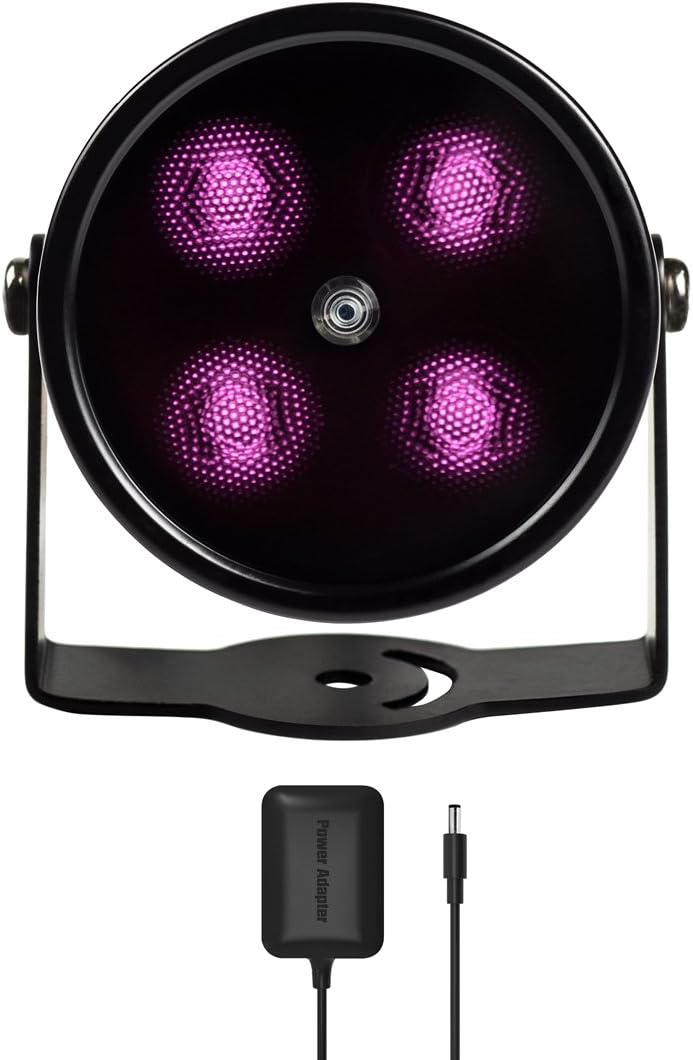
AI4 850nm Infrared Light
4.4Editor score
Up to 80-foot range
Ninety-degree flood spread
IP65 outdoor rating
Automatic photocell switching
Our IR Illuminator for Security Cameras guide compares range, beam angle, weatherproofing, mounting, power, and compatibility to help you choose confidently.
An IR illuminator for security cameras adds invisible infrared lighting so compatible cameras can capture clearer images after dark. The right unit should match your camera’s wavelength, cover its viewing area without creating hotspots, and provide enough power for the distance you need to monitor.
We compared all ten options by range, LED arrangement, beam width, weather resistance, automatic day-night operation, mounting hardware, power requirements, and camera compatibility. The list includes compact models for close-range use, wide-angle units for broad coverage, and higher-output lights for yards, driveways, warehouses, and other dark areas.
Each pick demonstrates a different practical balance, from simple supplemental lighting to long-range coverage and refined heat management. Ratings and specifications reflect the supplied product information, while product availability and prices can change, so readers should confirm the current listing and camera requirements before ordering.
4.4Editor score

4.4Editor score

4.2Editor score
The table below compares all ten illuminators by their rated range, coverage, wavelength, weather protection, and control features, making it easier to match a light to a particular camera and installation site.


The Tendelux DI20B is a compact infrared floodlight designed for long-range security camera applications, and it carries a 4.2 rating. Its defining feature is the tailored integrated lens, which spreads illumination more evenly across a camera’s field of view. That design is especially useful for reducing harsh hotspots and washed-out foreground detail.
We may earn a commission when you buy through this link, at no additional cost to you.
Mounting flexibility is another major strength. The supplied bracket provides 360-degree swivel movement and 90-degree tilting, making it easier to align the light with cameras positioned above, below, or beside an entry point. The aluminum unibody housing combines a modern appearance with an integrated cooling approach intended to support stable operation.
The trade-offs are that the product information does not provide a precise effective-range figure, and it uses a 110-to-240V AC to 24V DC adapter rather than the common 12V arrangement. It also includes a full set of installation accessories, an 18-month warranty, and lifetime support, making it a polished package despite the lack of a numerical distance claim.
This is the premium choice for installers who want long-range capability in a relatively small housing without sacrificing precise aiming or even light distribution. It suits a camera covering a gate, side path, driveway entrance, or other area where a broad, controlled pool of infrared light is more useful than a simple low-cost supplement.
The tailored lens is designed to distribute the infrared output across the camera’s viewing area. This helps avoid the bright center and dim edges that can make ordinary security footage uneven, particularly when a close foreground object would otherwise be overexposed.
A 360-degree swivel and 90-degree tilt provide practical control over placement. These adjustments are valuable on walls, poles, eaves, and other mounting points where the camera and illuminator cannot share exactly the same angle.
We may earn a commission when you buy through this link, at no additional cost to you.
The Tendelux AI4 is a compact four-LED illuminator with a 4.4 rating and a stated effective range of up to 80 feet. It operates at 850nm, a common infrared wavelength supported by many security cameras, and its 90-degree flood spread is intended for cameras using 2.8mm, 3.6mm, or 4mm lenses.
We may earn a commission when you buy through this link, at no additional cost to you.
An IR band-pass filter is one of the most useful design details. According to the product information, it reduces hot spots and helps prevent foreground objects from becoming overexposed. The built-in CdS photocell also removes the need to switch the light manually, turning it on in darkness and off during brighter conditions.
Its main limitation is range. An 80-foot claim is adequate for porches, small yards, gates, and close approaches, but it may not illuminate distant property boundaries as effectively as the 120-foot BI8, 210-foot JCHENG, or 263-foot DMetric. It is also supplied with a 12V DC adapter, making the power arrangement familiar and convenient.
For buyers who want a dependable small-area supplement without overcomplicating the installation, the AI4 is a strong budget-focused recommendation. It is particularly well suited to a compatible camera that needs extra light in darkness, with a simple U-bracket-style installation, included power supply, installation screws, manual, and a two-year warranty.
The added IR band-pass filter targets uneven illumination, a common problem when a security light creates a bright patch in the center of the frame. That makes the AI4 useful when both nearby and farther subjects need to remain visible.
The integrated CdS photocell switches the illuminator on and off according to ambient light. This reduces routine maintenance and avoids leaving the unit operating unnecessarily during brighter daytime hours.
We may earn a commission when you buy through this link, at no additional cost to you.
The JCHENG 20-LED illuminator combines a 4.4 rating with a stated effective range of 150 to 240 feet, giving it one of the strongest coverage claims in this guide. Twenty high-power EPISTAR LEDs and a 90-degree field of view make it a practical choice for broad outdoor areas where darkness extends beyond a camera’s built-in lighting.
We may earn a commission when you buy through this link, at no additional cost to you.
Its construction is designed for demanding installations. The die-cast aluminum housing, black rubber filling, thickened waterproof ring, and IP66 rating provide outdoor protection, while air-convection heat dissipation and a constant-current and voltage drive circuit support extended operation. A secondary optical-angle design works with the wide output to improve coverage.
The trade-off is power consumption and the need for deliberate positioning. A broad 90-degree beam can still leave uneven areas if the fixture is mounted too close to the camera or pointed away from the target scene. The photosensitive control uses a night-on value of 15 lux or less, a day-off value above 30 lux, and a 15-second delay to reduce flickering.
The JCHENG earns the Editor’s Choice position because it balances reach, wide coverage, outdoor protection, heat management, and flexible use. It is well suited to backyards, farms, warehouses, museums, vehicle installations, wildlife cameras, and infrared-equipped VR systems, although installers should confirm wavelength and power requirements before connecting any sensitive equipment.
With twenty LEDs and a 150-to-240-foot stated range, the unit is intended for properties and commercial spaces that exceed the practical reach of small supplemental lights. Its 90-degree field helps cover a substantial area from a single mounting point.
The air-convection cooling method and dedicated constant-current and voltage drive circuit distinguish this model from basic lights. These features are especially relevant when a higher-output fixture must operate outdoors for long periods.
We may earn a commission when you buy through this link, at no additional cost to you.
The Tendelux BI8 provides a stated range of up to 120 feet and carries a 4.3 rating. Its eight one-watt 850nm LEDs create a 90-degree flood spread intended for compatible CCTV cameras with 2.8mm, 3.6mm, or 4mm lenses, placing it between the smaller AI4 and higher-output long-range units.
We may earn a commission when you buy through this link, at no additional cost to you.
The anti-UV IR pass filter is designed to reduce hot spots and limit overexposure of nearby subjects. A rotatable U-bracket makes directional adjustment straightforward, while the IP66 weatherproof rating supports both indoor and outdoor installations. Automatic operation comes from a built-in CdS photocell.
Compared with the JCHENG or DMetric, its maximum reach is more modest, so it may not satisfy someone trying to illuminate a very deep property. The listed package is otherwise complete, including a 12V DC 1A adapter, screws, manual, two-year warranty, and lifetime support.
The BI8 is a balanced recommendation for a medium-sized yard, driveway, loading area, or warehouse aisle. It offers enough reach to improve distant subjects without the larger scale of a 20- or 96-LED fixture, and its filter and adjustable bracket make it especially useful when foreground overexposure is a concern.
The IP66 enclosure and robust bracket make the BI8 useful in exposed locations. Its eight-LED configuration offers a middle ground between very short supplemental reach and high-output property-wide coverage.
The anti-UV IR pass filter helps the projected light spread more evenly through the frame. This is valuable when the camera must recognize both nearby activity and subjects farther down a path.
We may earn a commission when you buy through this link, at no additional cost to you.
The Tendelux DI10 is a mid-range 850nm IR floodlight with a 4.0 rating. It is designed for users who want more illumination than a small four-LED light without moving to a much larger fixture. Its tailored integrated lens aims to distribute infrared light evenly and reduce hot spots and washed-out areas.
We may earn a commission when you buy through this link, at no additional cost to you.
Installation is straightforward because the bracket allows 360-degree swivel and 90-degree tilt movement. The premium aluminum housing is intended to age better under sunlight than plastic constructions, while the unibody design combines a modern appearance with an integrated cooling system for stability and tightness.
The included power supply changed from earlier 12V configurations to a 110-to-240V AC to 24V DC 1A adapter. According to the product information, this update was intended to avoid pressure drop and brightness loss after using a long extension cable. It does, however, require more setup attention than a conventional 12V plug-in arrangement.
The DI10 is a good option for medium-range cameras in entrances, corridors, small yards, and commercial spaces where a compact form matters. Its limitations are the lack of a published numerical range and the need to ensure an appropriate 24V DC power source, particularly for outdoor runs or concealed installations.
The small body is easier to conceal and position close to a camera. A full swivel and tilt range allows the installer to match the light to the camera’s angle even when wall geometry is restrictive.
The updated 24V DC adapter is intended to maintain brightness over longer cable runs. Buyers should still follow the supplied instructions and account for local electrical requirements and safe outdoor routing.
We may earn a commission when you buy through this link, at no additional cost to you.
The Univivi 8-LED illuminator is an 850nm night light with a 4.1 rating and a 90-degree wide-angle output. It is intended to supplement the night-vision performance of a compatible security camera, filling its viewing range without requiring a separate visible-light source.
We may earn a commission when you buy through this link, at no additional cost to you.
The physical design is built for longevity in exposed locations. EPISTAR LED sources, a heavy-duty aluminum housing, thick heat sink, reinforced glass window, and stainless-steel screws support durability, while the IP67 rating provides strong waterproof protection for both indoor and outdoor use.
A built-in photocell automatically activates the light at dusk and deactivates it at dawn. The 850nm output is invisible to the naked eye but produces a red glow, which can help indicate that the unit is operating. No numerical effective range is listed, so buyers must base expectations on camera sensitivity, lens angle, and site conditions.
This illuminator suits users who prioritize wide-angle coverage and rugged construction over a published distance claim. It can be mounted beside a camera and pointed in the same direction, making it a practical choice for driveways, entrances, patios, and other locations where a compact, weatherproof infrared source is needed.
The IP67 housing, aluminum heat sink, reinforced glass, and stainless-steel hardware create a robust package for outdoor installations. These material choices help the fixture withstand weather while supporting stable output.
The 90-degree flood is well suited to cameras with broad viewing angles. Installing the illuminator near the camera and aligning it with the lens can help distribute supplemental light across the scene.
We may earn a commission when you buy through this link, at no additional cost to you.
The Six-LED Camera Illuminator is a compact 12V infrared light with a 4.0 rating. It is designed for a straightforward role: improving the night-vision performance of a compatible CCTV camera in areas where the camera’s built-in infrared output is insufficient.
We may earn a commission when you buy through this link, at no additional cost to you.
Its six high-power LEDs are paired with a built-in light sensor that turns the unit on at night and off during the day. A metal shell and tempered glass window support rainproof protection for indoor or outdoor use, while the compact body should be easier to integrate near a camera housing.
The product information is less detailed than that of several competing models. It does not provide a numerical range, a specific beam angle, an ingress-protection rating, or a clearly stated infrared wavelength. Those omissions make compatibility and expected coverage harder to evaluate before installation.
It remains a practical option for a straightforward CCTV upgrade, especially where a small, automatically controlled add-on light is all that is needed. Buyers should verify night-vision and infrared compatibility, confirm the power arrangement, and inspect the supplied hardware before choosing it for a demanding outdoor location.
The integrated light sensor removes the need to operate the illuminator manually. It can begin supplying infrared illumination after dark and switch off when daylight returns.
Its relatively compact format is useful when there is little space for a larger floodlight. Mounting it close to the camera can also make the added light appear more consistent with the camera’s infrared viewing capability.
We may earn a commission when you buy through this link, at no additional cost to you.
The Univivi 20-LED is a white-bodied 850nm IR floodlight with a 4.4 rating. Twenty high-power LEDs provide a 90-degree wide-angle output, positioning it as a higher-output option for compatible security cameras that need substantial supplemental illumination.
We may earn a commission when you buy through this link, at no additional cost to you.
Thermal performance is a central selling point. The thick aluminum housing and large heat sink are designed to keep the surface temperature below 120 degrees Fahrenheit even during 24-hour operation, with the goal of supporting a longer service life. Reinforced glass, stainless-steel screws, and an IP67 waterproof rating add outdoor durability.
A photocell automatically switches the light on at dusk and off at dawn. The package includes a 12V 2A adapter, screws, and a manual. The installation guidance recommends keeping the sensor head down to avoid direct sun exposure and confirms that the camera must work with 850nm infrared light.
This is a compelling option for a larger camera view where the AI4 or eight-LED Univivi may be insufficient. The absence of a published effective range and the need for accurate alignment prevent a more specific distance recommendation, but its output, wide angle, and cooling design make it suitable for yards, driveways, garages, and commercial exteriors.
The large aluminum heat sink and thick housing are engineered to dissipate heat from the twenty LEDs. The stated lower surface temperature is intended to reduce thermal stress and support a longer operating life.
Twenty LEDs and a 90-degree beam allow the fixture to cover more of a camera’s scene than a small supplemental lamp. Care is still needed to align the light with the lens and avoid pointing it directly into the sensor.
We may earn a commission when you buy through this link, at no additional cost to you.
The DMetric 96-LED is a high-count infrared fixture with a stated 80-meter, or 263-foot, range and a 3.9 rating. It is the only product in this guide with a 60-degree field of view, giving it a more directed pattern than the many 90- and 100-degree options.
We may earn a commission when you buy through this link, at no additional cost to you.
Its 850nm output is designed to improve night-vision images from IP and CCTV cameras. The aluminum case and reinforced glass structure support IP65 protection, while a U-shaped stand provides installation on rods or other mounting surfaces. Power comes directly from 110V to 220V AC rather than a low-voltage adapter.
The direct mains connection may simplify long cable runs but also places more responsibility on the installer for safe, code-appropriate electrical work. Its lower rating and narrower beam also make it less universally attractive than the four-point-four-rated JCHENG and Univivi products, despite their impressive reach.
The DMetric is best for a long driveway, field, perimeter, or other area where reaching farther matters more than flooding a very broad scene. Buyers should plan the angle carefully, use appropriate electrical installation practices, and confirm that their camera can detect 850nm infrared light.
The stated 263-foot range makes this one of the strongest options for deep outdoor scenes. It can help a sensitive camera identify subjects across long driveways, fields, or perimeter approaches when positioned correctly.
Direct 110-to-220V AC power can make long installations more straightforward by eliminating a low-voltage adapter in the signal path. Safe electrical connection and suitable local permitting remain essential.
We may earn a commission when you buy through this link, at no additional cost to you.
The OOSSXX 2026 Upgrade is an 845nm IR illuminator with a 4.5 rating, the highest numeric rating in this group. It claims an operating distance of up to 100 feet and uses a 100-degree illumination angle, making it the widest beam among the listed products.
We may earn a commission when you buy through this link, at no additional cost to you.
The broad angle can reduce dark corners and cover a larger camera field than a narrow fixture. An IP66 weatherproof housing is designed to withstand rain, snow, dust, and other outdoor conditions, while the aluminum alloy body promotes heat dissipation for stable long-term use.
Automatic operation is handled by a built-in photocell that turns the unit on at dusk and off at dawn. A 12V 1A adapter is included for straightforward setup. The key compatibility concern is 845nm: unlike the many 850nm products in this guide, it should only be used with cameras specified to work with that wavelength.
The OOSSXX is a good choice for users who want maximum scene width and a high customer rating, particularly in yards, driveways, garages, and warehouses. Its wide beam must be positioned away from the camera lens, and camera compatibility should be confirmed before installation to avoid disappointing results.
The 100-degree angle is wider than the 90-degree output of most competitors in the guide. That makes the unit appealing for wide security camera views where multiple edges of the frame need supplemental infrared light.
The IP66 housing supports exposed use, and the photocell removes the need for manual day-night switching. Together, they reduce the routine attention required from a permanently installed security light.
We may earn a commission when you buy through this link, at no additional cost to you.
The right illuminator depends on camera sensitivity, infrared wavelength, scene width, and distance. These factors determine whether a light improves footage or creates glare, hotspots, and unnecessary installation complexity.
An illuminator only helps if the security camera can detect the wavelength it emits. Most products listed here use 850nm, while the OOSSXX model uses 845nm. Check the camera specifications or manufacturer documentation rather than assuming that every IR source is interchangeable, especially if the camera uses a filter that removes visible light or is designed for a specific infrared band.
Match the wavelength exactly and also verify whether the camera has night-vision capability. An external IR illuminator supplements a compatible sensor; it does not make an incompatible camera sensitive to infrared light.
Published range figures provide a useful starting point, but actual performance depends on camera sensitivity, lens, environmental reflections, and the placement of the light. Choose a model that reaches the farthest important part of the monitored area without relying on a marginal specification. The AI4 reaches up to 80 feet, the BI8 up to 120 feet, the JCHENG 150 to 240 feet, and the DMetric up to 263 feet.
Treat range claims as comparative guidance rather than a guarantee. Wider fields, transparent surfaces, foliage, rain, and reflective backgrounds can all change the result in practice.
A narrow beam concentrates light over a longer distance, while a broad beam fills more of a close or wide scene. Most options use a 90-degree spread, while the DMetric uses 60 degrees and the OOSSXX uses 100 degrees. Match the illuminator to the camera lens rather than selecting the widest angle available.
A broad beam can create glare when mounted too close to the lens or pointed at reflective surfaces. A narrow beam may leave the sides of the frame dark. Positioning the light beside the camera and directing it toward the same scene is usually the best starting point.
Some cameras switch to a monochrome mode when their IR illuminator activates, while others retain limited color. External lighting can also reveal how an automatic day-night filter behaves. This is particularly important for identifying clothing, vehicles, or license plates when a visible-light source would otherwise be more effective.
Test the camera during the day, at dusk, and in full darkness after installation. A separate visible-light fixture may be needed for color evidence, but the products in this guide are designed specifically as infrared supplements.
An IP rating describes protection against solids and water, with higher numbers indicating stronger resistance. Options range from IP65 to IP67, and the six-LED model is described as rainproof without a formal rating. For exposed fixtures, a clearly stated IP rating provides a better basis for comparison.
Weather resistance does not eliminate the need for correct installation. Keep cable entries protected, avoid directing the sensor toward direct sunlight, and use the supplied hardware as intended. Aluminum housings also offer better heat dissipation than plastic alternatives.
Most products include a low-voltage adapter, generally 12V, while the DI10 and DI20B use 24V DC power and the DMetric accepts 110V to 220V AC directly. Low-voltage lighting can simplify integration with existing camera power arrangements, but long cable runs can reduce voltage and brightness if the wiring and supply are not appropriately specified.
Do not substitute an arbitrary power supply. Follow the included adapter requirements, account for the total cable length, and use outdoor-rated wiring where appropriate. Direct mains-powered installations should be handled with appropriate electrical care.
Infrared LEDs produce heat even though the beam is invisible to the naked eye. A substantial aluminum heat sink, unibody construction, or convection-based cooling helps dissipate that heat and can support a longer working life. The Univivi 20-LED makes cooling a central feature, while the DI20B and DI10 also use integrated housing designs.
Higher LED counts do not automatically mean a better product, but they usually require stronger thermal management. Ensure the fixture is not enclosed in a tight space and that air can circulate around its housing.
A useful bracket should allow the light to be rotated or tilted after installation. U-brackets, swivel stands, and multi-axis mounts are common in this group. Automatic photocells or light sensors also improve convenience by turning the fixture off in daylight and on at dusk, although exact thresholds and delays vary.
Install the illuminator so its sensor is not repeatedly exposed to direct sun, moving shadows, or bright reflected light. Test the switching behavior after positioning because a poorly aimed sensor can cause unwanted daytime activation.
Begin by confirming the camera’s infrared wavelength, night-vision capability, lens angle, and power requirements. Position the illuminator near the camera and point it in the same direction as the lens rather than toward the camera itself. Secure it to a stable wall, pole, bracket, or other surface using the supplied screws and alignment method.
Connect the specified power adapter or mains supply with the system powered off, then allow the photocell-controlled light to activate in darkness. Check the camera image at dusk and after full dark. Look for dark corners, a bright central hotspot, reflected glare, or silhouettes that remain too dark, and adjust the angle or distance accordingly.
Clean the glass with a soft, lint-free cloth and avoid abrasive or ammonia-based cleaners that could damage coatings. Keep the cooling surfaces free of dust, leaves, and dense obstructions. Periodically check the bracket, cable connections, protective seals, and automatic day-night behavior, especially after severe weather or maintenance around the installation.
No. The camera must detect the illuminator’s infrared wavelength and have suitable night-vision capability. Most options in this guide use 850nm, while the OOSSXX uses 845nm, so checking the camera specifications is essential. Some cameras also use filters that block infrared or switch image color behavior when IR light is detected.
Neither wavelength is universally better because camera support matters more than the small numerical difference. Most security cameras are designed around 850nm because that illumination is generally less visible to the human eye and often carries farther. A high-quality 845nm illuminator can still perform well, but only when the camera explicitly supports it.
A hotspot usually means the infrared source is too close, too powerful for the scene, or not aligned with the camera. Moving the light farther away, reducing its angle toward the lens, and directing it across the monitored area can help. Filters and tailored lenses may reduce foreground overexposure, but correct placement remains the primary fix.
The infrared beam itself is invisible to the naked eye, but many fixtures show a faint red glow from the LEDs. That glow is normal and can also provide a simple indication that the unit is operating. A red appearance through a camera does not mean the camera is recording normal visible light.
There is no universal distance, because the correct placement depends on the camera lens, sensor sensitivity, field of view, illuminator beam, and target area. A common starting point is to mount the unit close enough to share the camera’s viewing direction while keeping it out of the lens. Wider cameras generally benefit from a broader and more carefully diffused source.
Models with an IP65 or IP67 rating are designed to provide water-resistant protection for outdoor use, but installation quality still matters. Keep connectors and cable entry points protected, avoid blocking drainage paths, and verify that any exposed power equipment is rated for the location. No enclosure rating makes every part of an installation completely maintenance-free.
That depends on the camera. Some switch to monochrome when infrared is detected, while others can retain color under certain IR-sensitive or visible-light-assisted configurations. If color is essential for identification, test the camera with the illuminator installed and consider a separate white-light solution where appropriate.
The photocell may be receiving direct sunlight, reflected light, or a changing shadow, all of which can confuse automatic switching. Some products specify that the sensor head should point downward. If the behavior persists, confirm that the unit is operating within its specified light threshold and that the lens is not covered or obstructed.
The Tendelux AI4 is the best budget-focused option for close-to-medium coverage, offering 850nm output, an 80-foot stated range, and automatic operation in an easy-to-install package. The JCHENG 20-LED is the strongest all-around choice for large outdoor areas, combining a 150-to-240-foot stated range, broad 90-degree coverage, and IP66 protection, while the Tendelux DI20B stands out as the premium compact option with tailored illumination and refined mounting.
Prioritize compatibility before output. Verify the camera’s wavelength, night-vision mode, lens angle, and power availability, then choose an illuminator whose range reaches the farthest important part of the scene. Beam placement, heat dissipation, weather protection, and automatic switching can matter as much as the headline distance, especially for permanent outdoor installations.
Finally, check the current listing, included accessories, adapter details, warranty, and availability before purchasing. Product configurations and seller information can change, and current prices vary. Comparing the latest specifications against the intended camera and installation site is the safest way to choose an illuminator that delivers useful nighttime coverage.
