
GE Portable HD TV Antenna
4.2Editor score
Compact magnetic monopole design
Supports HDTV VHF and UHF
Compatible with ATSC 3.0 broadcasts
Portable TV antennas for camping can transform a remote campsite into a practical entertainment center, but reception quality depends heavily on location, terrain, tower distance, and antenna placement. The best options balance compact construction, flexible positioning, broad broadcast compatibility, and simple setup while fitting comfortably into an RV, tent, vehicle, or lakeside campsite.
We compared ten products comprising compact indoor antennas, amplified and non-amplified designs, magnetic-base models, and complete portable televisions. Our evaluation focuses on stated reception features, portability, included cables and accessories, supported broadcast formats, installation requirements, and practical suitability for camping rather than asserting firsthand performance results.
The list includes a GE magnetic antenna for the strongest budget-oriented balance, a feature-rich portable television for campers who want an all-in-one system, and a larger NORTHING television for those who prioritize screen size. Product details and availability can change, so readers should confirm current specifications, compatibility, and channel coverage before purchasing.
4.2Editor score
4.7Editor score
4.3Editor score
As an Amazon Associate we earn from qualifying purchases.
This side-by-side overview compares the ten featured options by product type, reception approach, portability, connection method, and intended camping use. It highlights the practical differences between standalone antennas and complete portable televisions without suggesting that every listed channel or advertised range will be available at every campsite.


The GE Portable HD TV Antenna is a compact standalone option rated 4.2 stars among the products considered. Its monopole form stands under seven inches tall and uses a magnetic base, making it easy to carry in an RV, boat, vehicle glove box, or camping drawer. The product is explicitly positioned for home, camping, boating, and tailgating use.
We may earn a commission when you buy through this link, at no additional cost to you.
Its strongest camping-related qualities are portability and flexible placement. The magnetic base can sit on a suitable metal surface without taking up much table or counter space, while the 360-degree reception design is intended to capture HDTV, VHF, and UHF signals from multiple directions. The listing also states support for 1080p, 4K, and 8K-ready broadcasts and compatibility with the NEXTGEN TV ATSC 3.0 standard when available locally.
The main compromise is that the compact design does not include the long coaxial cable found with several competing antennas. A shorter lead can make it harder to place the unit near a window while keeping the television or RV electronics in a more convenient location. Advertised picture formats also depend on the broadcaster's feed, the television, and the strength of the signal received at the campsite.
This is an excellent recommendation for campers who already own a compatible television and want the smallest useful antenna in the group. It is particularly attractive for vehicles, boats, and tailgating setups where a magnetic, low-profile antenna is easier to deploy than a large powered unit. It is our budget pick because its compact design, broad band support, and travel-oriented construction solve more camping problems than a basic indoor antenna with a longer wire.
The magnetic base gives this antenna a practical advantage in cars, RVs, and boats, where a conventional indoor antenna may be awkward to position. Because the unit is less than seven inches tall, it can be moved between campsites without occupying meaningful storage space.
Support for HDTV, VHF, UHF, and ATSC 3.0 makes the GE antenna relevant to both current and next-generation broadcast systems. Channel availability still depends on the coverage map, terrain, weather, and campsite obstructions.
We may earn a commission when you buy through this link, at no additional cost to you.
The HIDB TV Antenna is a slim indoor model rated 3.8 stars, placing it among the more modest choices in this guide. It is designed for smart televisions and local over-the-air channels, with a low-profile housing that can sit on a TV stand, table, or nearby surface without dominating the available space.
We may earn a commission when you buy through this link, at no additional cost to you.
Its dual PC soft construction is described as flame-retardant, moisture-resistant, and equipped for protection against lightning. The product information also identifies omni-directional reception and support for HD digital broadcasts. These characteristics can be useful inside a camper or tent, where a smaller profile reduces visual clutter and makes the antenna easier to reposition as conditions change.
The antenna is not an ideal standalone solution for every outdoor setup because it is primarily presented as an indoor device. Its performance may be limited by a tent's fabric, vehicle walls, nearby trees, or other obstructions. The listed guidance emphasizes mounting the antenna high, placing it near a window, orienting it toward local towers, and rescanning whenever its position changes.
This product makes sense for campers who value a small, lightweight indoor antenna more than long-range amplification or a lengthy cable. It is also a reasonable option for travelers who plan to place the television close to a window and frequently move between indoor accommodations. The lower rating and indoor emphasis mean it is not our first recommendation for remote campsites, but it remains a straightforward choice for accessible local broadcasts.
The soft, slim housing is easy to overlook beside a television or on a camper shelf. Its low weight also makes repositioning simple when the television, window, or antenna cable needs to be moved.
The supplied guidance correctly emphasizes high placement, a window-facing position, and regular rescanning. In real camping conditions, a clear line toward broadcast towers can matter more than a headline range figure.
We may earn a commission when you buy through this link, at no additional cost to you.
This Indoor Smart TV Antenna earns a 4.1-star rating and stands out for its selectable short-range and long-range modes. The short-range setting is intended for locations within 35 miles of broadcast towers, while the long-range mode is marketed for areas from 35 to 250 miles away. Selecting the appropriate mode can be more useful than relying on one generic amplification setting.
We may earn a commission when you buy through this link, at no additional cost to you.
A 16.5-foot cable provides better positioning freedom than a permanently attached short lead. The antenna can therefore sit near a window or on a higher surface while remaining connected to a television elsewhere in the camper. Its upgraded Smart IC chip is intended to filter cellular and FM interference, and the listing states support for 4K, UHD, and 1080p broadcast signals where available.
There are important limitations. Some low-VHF channels, specifically channels 2 through 6, may require a separate compatible antenna, and the manufacturer notes that amplification may not noticeably improve reception in genuinely weak-signal areas. The range modes are also guidance, not a guarantee of channel availability; terrain, weather, tower direction, and campsite obstructions remain decisive.
Camping buyers who want control over their reception setup will appreciate the selectable modes and included cable. It is a better fit than a minimal antenna for a camper with a movable television or for travelers who expect to try several positions around a site. The additional troubleshooting requirements make it less convenient than the GE model, but it offers a more structured approach to signal optimization.
The two-mode design gives users a clear starting point based on their distance from broadcast towers. Switching modes and rescanning is recommended whenever the antenna is moved or fewer channels are found.
The included 16.5-foot lead allows the antenna to move toward a window while the television stays in a comfortable viewing position. This is especially helpful in RVs, where the best signal position may differ from the best screen position.
We may earn a commission when you buy through this link, at no additional cost to you.
The 2026 Long Range TV Antenna is rated 4.2 stars and is built around a 33-foot coaxial cable. That generous lead is one of its most useful camping traits because it allows the round antenna to be placed near a window, rooftop-adjacent metal surface, or other favorable position while the television remains inside a vehicle.
We may earn a commission when you buy through this link, at no additional cost to you.
The antenna includes a Smart IC chip for optimized signal transmission and interference prevention, along with 360-degree reception positioning. Its stated support includes HD, 1080p, 4K, and 8K HDR broadcasts. It can connect directly to a compatible television's antenna input or to a digital tuner or converter box, which broadens its usefulness for campers using different equipment.
The product listing makes exceptionally large reception claims, but those figures should be treated as marketing claims rather than guaranteed results. Available channels vary by region, and terrain, trees, hills, buildings, and weather can make a dramatic difference. A 33-foot cable also needs thoughtful management in a campsite to avoid creating a trip hazard or leaving the connector strained.
This antenna is best for RVs and larger campsites where the television and antenna cannot be placed next to one another. The long cable and stated compatibility with older digital television equipment make it particularly useful for varied setups. For tent campers or anyone seeking a minimal pack, a shorter magnetic option will usually be more convenient, but this model maximizes placement flexibility.
The 33-foot coaxial cable is the defining feature for vehicle-based camping. It provides enough separation to test an exterior or upper position without requiring the television to be moved outside.
The antenna can work with modern smart televisions and older sets that include a compatible digital tuner. A separate converter box may still be necessary for legacy analog-only equipment.
We may earn a commission when you buy through this link, at no additional cost to you.
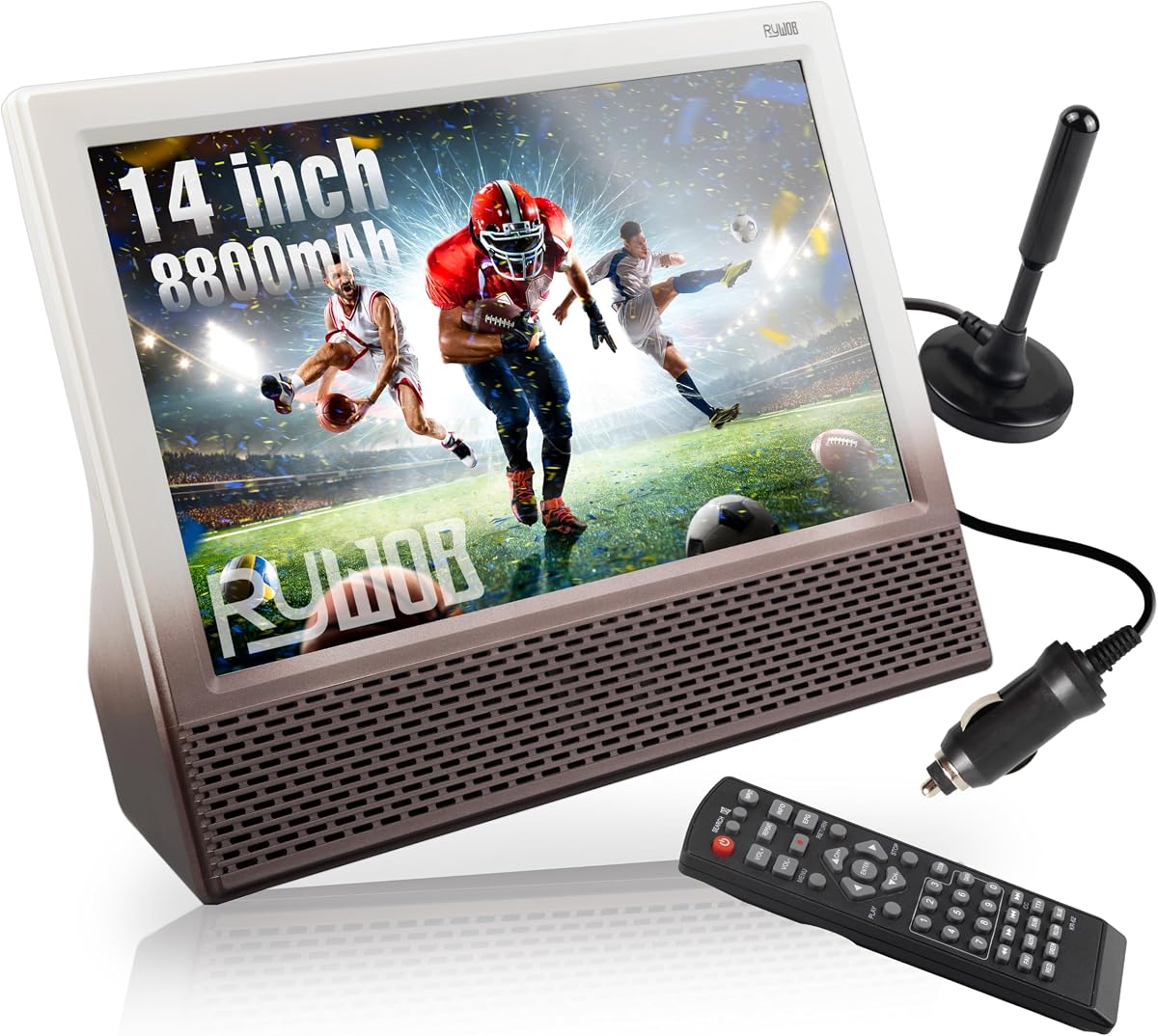
The 14-Inch Portable TV with Antenna carries a 4.7-star rating, the highest among the ten products reviewed. It is a complete entertainment package rather than a simple antenna, combining a portable television, built-in ATSC tuner, rechargeable battery, amplifier antenna, remote, and several connection options in one camping-friendly unit.
We may earn a commission when you buy through this link, at no additional cost to you.
Its 8800mAh rechargeable battery is stated to provide approximately four to six hours of use, making it practical for evening viewing when vehicle power is inconvenient or unavailable. The television also includes HDMI, USB, TF card, and AV inputs, allowing it to serve as a media display for external devices as well as a receiver for local over-the-air broadcasts.
The 14-inch display is the main limitation for groups, although its portability makes it easier to carry than a full-size television. The product information states that the speaker system reaches 20 watts of peak power, which may help audio remain intelligible in an outdoor environment, although actual sound quality will also depend on ambient noise. Reception still depends on nearby tower strength and antenna placement.
This is the strongest all-in-one recommendation for campers who do not already own a compatible television. The included battery, tuner, antenna, remote, and power adapter reduce the number of separate items needed for a functional mobile entertainment setup. It is especially suitable for tent campers, tailgaters, and travelers who want local news, sports, or other broadcasts away from a stable power source.
The built-in rechargeable battery removes the need to stay near an outlet or generator for several hours of viewing. For evening use, charging the unit during the day offers a practical way to preserve battery capacity.
HDMI, USB, TF card, and AV inputs make the television useful beyond live broadcasts. Campers can play locally stored media or connect compatible streaming and gaming devices without relying on the antenna for every viewing option.
We may earn a commission when you buy through this link, at no additional cost to you.
The DAANT Indoor Long Range Antenna has a 4.0-star rating and emphasizes a straightforward combination of Smart IC signal processing, a 16-foot coaxial cable, and flexible positioning. It is designed for local digital broadcasts on smart televisions and digital sets, making it relevant for campers who already have compatible equipment.
We may earn a commission when you buy through this link, at no additional cost to you.
The coaxial cable uses a solid center conductor, dielectric insulation, three aluminum shielding layers, and a durable outer jacket. That construction may be useful around RV electronics or other sources of interference. The supplied instructions recommend placing the antenna near a window, testing both vertical and horizontal orientations, aiming it toward local towers, and running a channel scan.
A notable limitation is that it is not suitable for older analog televisions. It also does not feature the magnetic mounting base offered by several competing designs, so a stable surface may be needed. Like every broadcast antenna, it cannot guarantee reception in every terrain or weather condition, regardless of the long-range positioning in its name.
This antenna is a sensible option for campers who already own a digital television and value a long, shielded cable without a complicated mode switch. It is less suitable for people who need a magnetic base or want to use an older analog set. Its clear setup process and included 16-foot lead make it a practical middle ground for indoor and sheltered camping setups.
The three-layer aluminum shielding described in the product information can help maintain signal integrity in a camper containing several electronic systems. Secure the cable along a wall or vehicle edge to reduce clutter and accidental damage.
The antenna connects to the antenna input of a modern digital or smart television and then uses the television's channel scan. Campers with analog-only sets will need different equipment.
We may earn a commission when you buy through this link, at no additional cost to you.
The WUTAER Cylinder TV Antenna is rated 4.2 stars and uses a compact aluminum cylinder measuring 5.1 by 1.8 inches. Its modern appearance, durable metal base, and strong magnetic mount make it a visually discreet option for a camper, RV, or outdoor viewing area where equipment should blend into the surroundings.
We may earn a commission when you buy through this link, at no additional cost to you.
Unlike many competing products, this antenna uses a passive, non-amplified design. The manufacturer presents that as a way to provide clear reception without adding signal noise. It supports VHF and UHF digital signals and is listed as compatible with 4K Ultra HD, 1080p, and 720p broadcasts, provided those formats are transmitted and the receiving equipment supports them.
The absence of amplification is the key trade-off. In areas with a strong local signal, a passive antenna can perform cleanly, but it may offer less help in locations with substantial interference or a very weak over-the-air signal. The magnetic base also requires a suitable metal surface, and the included 16.4-foot coax cable needs to be routed without creating a hazard.
This is a good match for campers who value a clean, compact design and have access to a reasonably strong broadcast signal. It combines a non-amplified approach, a flexible cable, and tool-free magnetic placement in a polished package. It is not the most reassuring choice for a campsite far from towers, but it is well suited to populated camping regions, tailgating areas, and travel stops.
The non-amplified design can be advantageous when a nearby signal is already strong and clear. It also eliminates the need for a powered amplifier, simplifying packing and setup.
The 5.1-inch aluminum cylinder takes up little visual space, while the included 16.4-foot cable allows meaningful separation between the antenna and television. That combination suits compact but carefully arranged camping setups.
We may earn a commission when you buy through this link, at no additional cost to you.
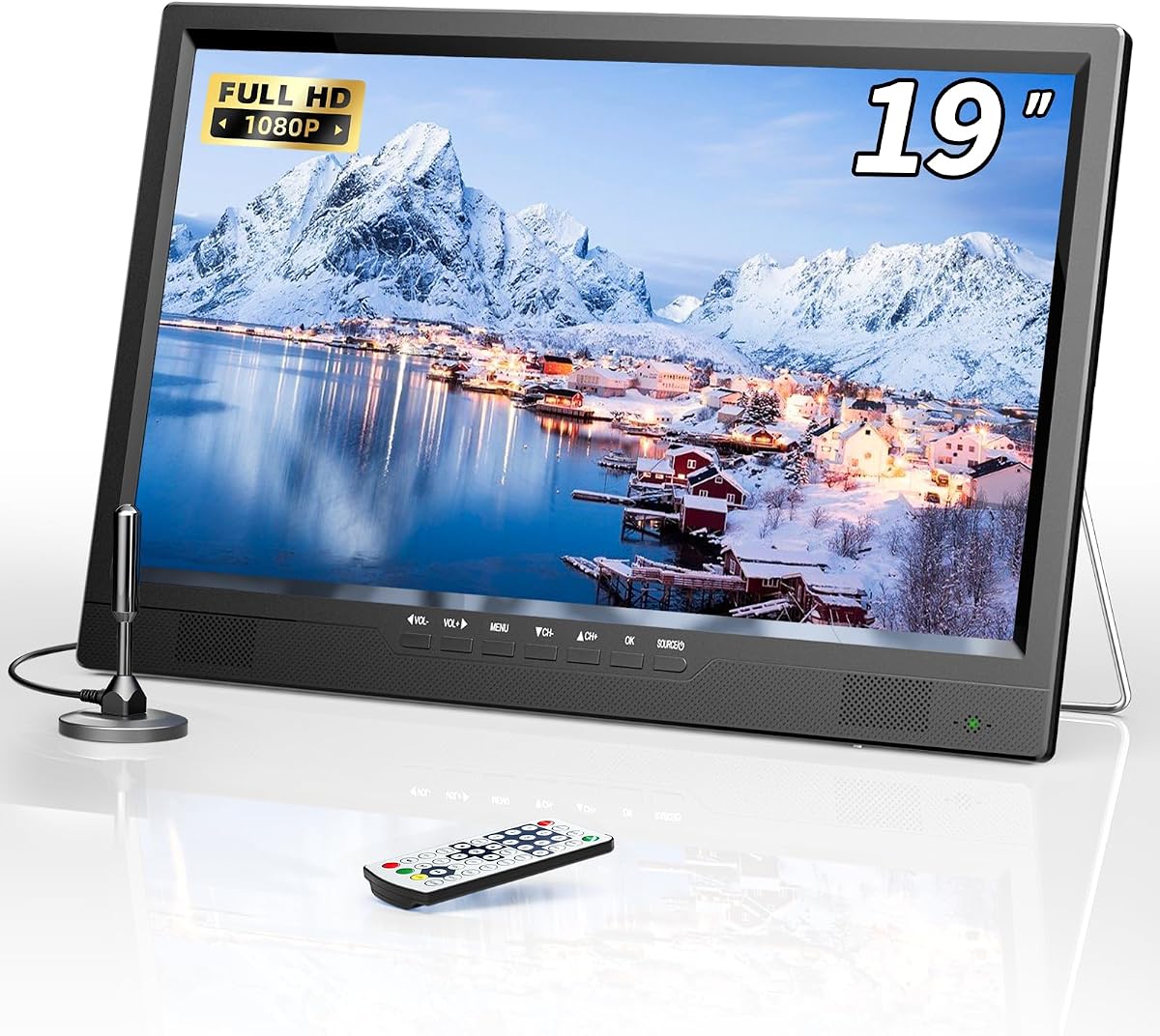
The NORTHING 19.2-Inch Portable TV is rated 4.3 stars and offers the largest screen among the complete portable televisions in the guide. Its 19.2-inch 1080p LED display is better suited than a 14-inch model to shared viewing, sports, movies, and campsite use where several people may watch at once.
We may earn a commission when you buy through this link, at no additional cost to you.
A built-in digital tuner and included antenna make the package ready for over-the-air local channels without a separate set-top box. The built-in stand adjusts through 180 degrees, helping users set the screen on a table, countertop, or desk. Dual speakers, a remote control, and image adjustments for color temperature, contrast, and noise add convenience beyond basic reception.
The television supports HDMI and AV inputs, making it compatible with phones, computers, TV sticks, Raspberry Pi, game consoles, and other suitable media sources. USB playback covers numerous movie, music, photo, and text formats. These features broaden its usefulness, although the 19.2-inch footprint makes it less convenient than the 14-inch model for backpackers and small tents.
This is our premium camping television pick for buyers who prioritize a large, sharp display and complete tuner functionality over minimal weight. The lack of a stated rechargeable battery means campers should plan on external power or a suitable power solution. In exchange, they get a more screen-focused package that can function as a television and a flexible media display.
The 19.2-inch display gives a family or group more room to watch from separate chairs. It is especially useful for weekend campsites where the television can remain set up on a stable table.
The built-in tuner handles local broadcasts, while HDMI, AV, and USB connections support compatible external media. That makes the unit useful on days when broadcast coverage is poor but downloaded content is available.
We may earn a commission when you buy through this link, at no additional cost to you.
The 2026 Magnetic Base TV Antenna is a lightweight, tool-free option rated 3.8 stars. Its magnetic base attaches to a suitable metal surface, while the compact body and 10-foot coaxial cable make it simple to carry and position in a tent, RV, bedroom, vehicle, or temporary campsite entertainment area.
We may earn a commission when you buy through this link, at no additional cost to you.
The product information describes 360-degree omnidirectional reception, VHF and UHF capture, Smart IC filtering, and automatic amplification of weak signals. It also states support for 4K and 1080p pictures. The scratch-resistant metal shell is intended to suit travel use, and the magnetic base avoids requiring tools or a separate power source.
Its 10-foot lead is the shortest among the antennas here, limiting the distance between the antenna and television. The claimed 120-mile range should also be understood as a maximum marketing statement, with actual reception varying by location, terrain, and weather. As with other products in the category, the user should consult a local coverage map and rescan after every movement.
This antenna is a useful low-complexity option for campers who can position a metal surface near the television or want a compact antenna that requires no power. It may work well in areas with strong nearby broadcasts, but travelers visiting remote regions may benefit more from the GE antenna's stronger rating or the long cable provided by the 2026 Long Range model.
The magnetic base reduces setup to placing the unit and scanning the television. It is particularly convenient in RVs and vehicles where metal roof, cabinet, or exterior surfaces may provide several mounting choices.
Without a separate power connection, the antenna can be deployed quickly and moved as needed. The included cable provides some flexibility, although it is shorter than the leads offered by several alternatives.
We may earn a commission when you buy through this link, at no additional cost to you.
The UltraPro Portable HD TV Antenna is a compact magnetic model rated 4.2 stars. It shares a similar travel-oriented design concept with the GE antenna, emphasizing a small monopole body that can be stored in an RV, boat, vehicle glove box, or drawer between outings.
We may earn a commission when you buy through this link, at no additional cost to you.
Its listed capabilities include enhanced HDTV reception, VHF and UHF signal support, and 360-degree reception positioning. It is also described as 1080p capable, 4K and 8K Ultra HD-ready, and compatible with ATSC 3.0 when that broadcast standard is available in the user's area. The magnetic base keeps the unit stable on many metal surfaces without permanent mounting.
As a standalone antenna, it requires a television or digital tuner with a compatible antenna input. The short built-in connection may not provide enough separation to place the antenna at a window while keeping the screen in a comfortable position. Actual channel availability and picture quality remain dependent on tower distance, terrain, campsite obstructions, and the source broadcast.
This antenna is a practical recommendation for travelers who want an inexpensive, compact unit that can be deployed in seconds. It works well when the television is near a stable metal surface or when broadcast coverage is strong. For greater positioning freedom, one of the antennas with a longer included cable may be the better camping companion.
The small monopole profile makes the UltraPro easy to pack with camping gear or keep in a vehicle. It is particularly useful for campers who move between sites and do not want to carry a large powered antenna.
Compatibility with ATSC 3.0 makes the product forward-looking for areas where the newer broadcast standard operates. The television must also support the received format, and local availability will vary.
We may earn a commission when you buy through this link, at no additional cost to you.
Choosing a camping television or antenna requires balancing reception needs with power, portability, screen size, and the physical layout of your campsite. The following factors explain what to check before choosing equipment and why each consideration matters in outdoor viewing environments.
Start by checking which over-the-air stations are available where you plan to camp. Federal and local digital-TV maps can show tower locations and help identify the direction from which signals should arrive. Distance alone does not determine success: terrain, ridgelines, dense trees, buildings, weather, and nearby structures can all affect reception. An area with a clear view toward a tower may work better with a modest antenna than a distant site served by a weaker or obstructed signal.
Choose an antenna or portable television that covers the relevant broadcast bands and formats used in your travel region. ATSC compatibility is important in the United States, while campers crossing international borders may need a television capable of the local broadcast standard. Always verify the station list after arriving rather than assuming the same channels work at every campsite.
Passive antennas use the signal arriving at the antenna without adding powered gain, while amplified designs include circuitry intended to strengthen weak signals. Amplification can help in some marginal locations, but it cannot create a usable signal that is absent, and an aggressive amplifier may also increase noise or distortion. Several listings in this guide note that a powered amplifier may not noticeably improve reception in areas where the underlying signal is very weak.
For strong-signal urban or suburban campsites, a compact passive model may be cleaner and simpler. A long-range or switched amplifier can be worth considering near the edge of coverage, provided the antenna has a clear direction toward a tower. Use a separate amplifier only when necessary and follow the manufacturer's scanning and mode instructions.
A camping antenna should be small enough to store without occupying valuable table or cabinet space. Magnetic monopole models are particularly convenient for vehicles because they can be deployed quickly and placed on metal surfaces. Cylinder antennas offer a similarly compact profile, while flat or round designs with longer cables may be more noticeable but easier to position. Complete portable televisions naturally require more room than a standalone antenna.
Prioritize the entire setup rather than the antenna alone. Include the television, cable, power adapter, converter box, and any mounting supplies when considering what the television must bring. A smaller screen and shorter lead can make a setup substantially easier to carry, while a large display may be more appropriate for a vehicle-based or stationary campsite.
Cable length determines how far the antenna can be separated from the television. A longer cable allows the antenna to move toward a window, above an obstruction, or onto a more favorable metal surface while the screen remains in a comfortable position. The featured products include leads ranging from a short integrated connection to approximately 33 feet, with many models including approximately 16 feet.
Longer is not automatically better. Excess cable creates clutter, can be damaged by movement, and may become a trip hazard at a campsite. Secure it along walls or vehicle edges, avoid pinching connectors, and leave enough slack to change positions without pulling the antenna off its mount.
A standalone antenna generally needs less power than a complete portable television, although some models include an amplifier that requires a connection. The Rywob portable television in this guide has an 8800mAh rechargeable battery stated to run for four to six hours, while the NORTHING model does not list a rechargeable battery. Choose the power arrangement that matches your campsite and viewing duration.
Campers watching primarily at night should consider how the battery will be charged during the day. Users of a mains-powered television should plan for a suitable campsite power source. A battery-equipped model adds convenience but also more weight, and an all-day viewing session may exceed the stated battery duration under certain settings.
Screen size should reflect who will watch and where it will be placed. The 14-inch Rywob model prioritizes portability for one or two campers, while the 19.2-inch NORTHING display offers a more comfortable shared viewing area. A larger screen is easier for a family or group but requires a stable surface and takes up more vehicle or tent space.
Resolution should also be considered. The NORTHING television offers 1080p, and the broadcast formats supported by the standalone antennas include 4K or 8K-ready claims on several models. Higher advertised resolution does not create additional channels, and the final picture will depend on the broadcaster's feed, signal strength, and television processing.
An antenna is only one part of the system. Most modern smart televisions include a digital tuner, while older analog sets may require a converter box. Several products in this guide explicitly support digital or smart televisions, and the longer-cable 2026 model can also connect to a digital tuner or set-top box. Verify the television's input and supported broadcast standard before purchasing.
Campers should also check the included accessories. Some portable televisions arrive with an antenna and remote, while standalone antenna packages may include only a cable and manual. Having a converter box available provides more flexibility, but it also adds another device, connection, and power requirement to organize.
Most products in this category are designed primarily for indoor or sheltered use, even when they are portable. Look for a stable base, manageable cable, and a housing that can be moved without being damaged by tent fabric or vehicle surfaces. A magnetic base is quick and tool-free, but it requires compatible metal and may be less useful on plastic camper furniture.
Weather, moisture, dust, and direct sunlight can affect electronics even when an antenna is labeled portable. Keep the unit and connections dry, elevate it from damp ground, and avoid leaving it unattended in severe weather unless its construction specifically permits outdoor exposure. A soft case or dedicated storage pouch can also prevent scratches during transport.
Before leaving home, identify the available local channels with a digital-TV coverage map and confirm that your television or converter box supports the required broadcast standard. At the campsite, place the antenna as high as practical and as close as possible to a window with a clear view toward the broadcast towers. For magnetic models, choose a stable metal surface and keep the unit away from other electronics that may interfere.
Connect the antenna to the ANT IN, ANTENNA, or CABLE IN port on the television, then use the television's menu to select an antenna or over-the-air input and perform a channel scan. If reception is weak, move the antenna only a few inches or change its orientation, then scan again. With dual-mode antennas, verify the distance range and use the corresponding setting; with passive antennas, test both vertical and horizontal positions.
For complete portable televisions, charge the battery before departure, carry the correct adapter, and keep the screen out of direct sun when possible. Route long cables securely so they cannot be pinched or tripped over, and close ports when the equipment is not in use. After the trip, disconnect power, remove moisture or debris, inspect the antenna and cable for damage, and store the unit in a dry, padded location.
There is no single reliable distance because terrain, tower power, antenna design, weather, and campsite obstructions can change results dramatically. Some products advertise ranges extending from tens of miles to much greater distances, but those figures are not guarantees. Check a local coverage map, place the antenna high with a clear tower view, and expect to rescan at each new site.
It may work, but tent fabric and surrounding trees can weaken reception. Positioning the antenna near an opening or outside a sheltered vehicle can improve access to broadcast signals. A long cable is useful because it lets the antenna sit outside while the television remains inside, provided the cable is protected and routed safely.
Not always. A passive antenna can perform well in a strong-signal area, while amplification may help near the edge of a station's coverage. Amplification cannot recover a completely unavailable signal and may sometimes increase noise. Start with a good placement, scan, and then change position or mode before assuming a stronger amplifier is necessary.
No. An over-the-air antenna receives only broadcast stations available in your location, while many cable packages include networks that do not transmit over the air. Local broadcast reception may also be more limited in remote areas. You can supplement a portable antenna with compatible streaming devices or downloaded media when supported by the television.
A smart television is convenient but not always required. Any television with a compatible digital tuner can generally receive over-the-air channels, and many older sets can use a digital converter box. Confirm the required tuner or converter before purchasing, particularly when traveling across regions that use different broadcast standards.
Start high, near a window, and point the antenna toward the broadcast towers. For a directional or adjustable model, test both vertical and horizontal orientations. A clear view of the horizon is more valuable than proximity to the television, so a longer cable often allows the antenna to be placed in a better location.
Rescan whenever you move the antenna, change its orientation, switch amplification modes, or arrive at a new campsite. Small position changes can make a meaningful difference in a marginal signal area. Save the available station list after a successful scan to help identify which channels are missing if the setup changes later.
Most of the listed antennas are primarily marketed for indoor or camping use rather than permanent outdoor exposure. Moisture can damage the antenna, television, connectors, and power equipment even if reception works temporarily. Keep them dry, use a protected campsite location, and avoid direct weather unless the manufacturer explicitly states that the product is weather-resistant.
The GE Portable HD TV Antenna is the most practical budget pick for campers who already own a compatible television and want a compact magnetic unit. The 14-Inch Portable TV with Antenna is the most complete mobile package, adding a rechargeable battery, tuner, antenna, remote, and useful media connections. For shared viewing, the NORTHING 19.2-Inch Portable TV offers the largest display and 1080p resolution.
Before purchasing, prioritize local channel availability, antenna placement, and the amount of cable needed to connect the equipment. A long-range claim cannot replace a clear path to a tower, and an amplifier may not rescue an extremely weak signal. Match the screen and power system to the size of your group and campsite, then confirm compatibility with your television or converter box.
Finally, check the current product listing, included accessories, broadcast compatibility, and availability before buying. Product features and package contents can change, and current pricing and offers also vary. With the correct equipment and realistic expectations, a portable television setup can provide local news, sports, entertainment, and familiar programming while camping.
