
VIVO Gray 500ft Bulk Cat6 Ethernet Cable
4.3Editor score
Connector-free 500-foot roll
23 AWG solid CCA conductors
Indoor easy-pull spool box
Discover the best 500 Foot Ethernet Cable options by comparing copper type, shielding, bandwidth, outdoor ratings, PoE, and installation needs for homes and
A 500-foot Ethernet cable gives installers the freedom to connect rooms, buildings, access points, cameras, and network equipment across substantial distances. A worthwhile cable should match the route, environment, network speed, and power requirements rather than simply provide the longest possible run.
This guide compares ten bulk Ethernet cables using conductor material, category, shielding, bandwidth, jacket type, listing claims, PoE support, and intended installation setting. The selections include indoor riser cable, direct-burial cable, shielded bulk runs, Cat5e, Cat6, Cat6A, and Cat8 options.
Each review identifies the features that make a cable suitable for particular jobs while noting important limitations. Ratings and specifications reflect the supplied product information, and current prices and availability can change, so readers should verify both before ordering.
4.3Editor score

4.7Editor score

4.7Editor score
The table below places all ten bulk cables side by side, emphasizing category, conductor construction, bandwidth, shielding, outdoor suitability, and notable installation features. It is designed to make the differences between economical indoor runs and certified outdoor installations easy to identify.



The VIVO Gray 500ft Bulk Cat6 Ethernet Cable Wire, CABLE-V006 is a connector-free roll designed for installers who need length rather than a ready-made patch cable. Its 4.3 rating and straightforward spool-box presentation make it a practical option for indoor networking, patch cable creation, and crossover cable projects. The cable uses 23 AWG solid copper-clad aluminum conductors in a four-pair unshielded twisted-pair construction.
We may earn a commission when you buy through this link, at no additional cost to you.
The main advantage is installation flexibility. Because the roll has no preattached connectors, the installer can terminate it to suit the available keystone jacks, patch panels, modules, or custom patch-cable lengths. The easy spool box is especially useful for pulling through walls, across ceilings, or along other building routes. Its dark gray jacket is unobtrusive in many residential and commercial environments where visible cable needs to blend into a neutral background.
There are important trade-offs. The conductors are CCA rather than solid bare copper, and the supplied specifications do not claim PoE support. It is also a standard indoor-oriented bulk cable without a stated outdoor jacket rating, so it should not be treated as direct-burial cable merely because it comes on a large roll. The unshielded UTP design also offers fewer interference-management options than shielded alternatives.
This is a sensible budget choice for a standard indoor Cat6 installation where solid copper and outdoor exposure are not priorities. Users who plan to power cameras or access points through the cable should choose a product that explicitly supports the required PoE standard. Otherwise, the generous length, connector-free format, and simple spool packaging make it useful for cost-conscious home and office cabling.
The connector-free roll allows installers to create exactly the patch lengths required by each wall outlet or equipment rack. That flexibility makes the cable useful for both structured wiring and temporary network arrangements.
Its easy-pull box and unshielded construction fit indoor routes, but the product data does not identify it for direct burial or severe weather exposure. Keep it inside protected spaces.
We may earn a commission when you buy through this link, at no additional cost to you.
This Lysymixs 500-foot Cat6 cable combines a 4.5 rating with an easy-pull box and a stated 550 MHz bandwidth target. Its blue jacket distinguishes it from many neutral-colored alternatives. The product information describes 23 AWG solid CCA conductors, Cat6 channel testing, and compatibility with Cat6 keystones and patch panels, making it a broad choice for data-oriented installations.
We may earn a commission when you buy through this link, at no additional cost to you.
Ease of handling is one of its most useful characteristics. The manufacturer emphasizes smooth pulling without kinks, twists, snags, or tangles. A 500-foot cable can be difficult to feed through pathways if it repeatedly folds or catches, so the box design may reduce installation friction. It also supports termination with compatible keystone jacks and RJ45 plugs, allowing users to build custom patch leads from the bulk spool.
The most significant restriction is PoE. The stated reason is the higher electrical resistance and heat-generation tendency of CCA conductors. That makes the cable more appropriate for conventional data transfer than for IP cameras, VoIP phones, or access points that receive power over Ethernet. The 10G and 550 MHz statements are also cable capability claims, while real network performance depends on the complete installation and connected equipment.
Choose this cable when the route is long, the pull must be smooth, and the network relies on standard data rather than power over Ethernet. It can also serve temporary installations. For powered devices or a permanent structured cabling system where bare copper is preferred, a more specialized option will offer a better material and installation match.
The pull box and claims about reduced kinking and snagging address a practical problem with 500-foot runs. Easier handling can also reduce strain during installation.
The explicit lack of PoE support is important for security cameras, VoIP phones, and powered access points. Select a PoE-capable cable when those devices are part of the plan.
We may earn a commission when you buy through this link, at no additional cost to you.
The Cable Matters [UL Listed] 10Gbps 23AWG Cat 6 Bulk Cable, 500ft, Blue stands out as the strongest all-purpose indoor option in this guide. It has a 4.7 rating, uses solid bare copper conductors, and combines a 550 MHz bandwidth claim with support for 10-Gigabit Ethernet and backward compatibility with Cat5e networks. The UL Listing and CM rating add useful specification detail for structured cabling work.
We may earn a commission when you buy through this link, at no additional cost to you.
Bare copper is the central reason this option stands out. The supplied information says the conductors enhance performance and support PoE, PoE+, and PoE++, while also meeting or exceeding TIA/EIA 568-C.2 standards. That makes the cable more adaptable than CCA-only choices, especially when the installation includes powered network equipment or needs a conductor material associated with professional communications cabling.
A foot-marked jacket helps installers track remaining length, and the easy-pull box supports routing through larger projects. The blue jacket is easy to identify among multiple cable types. However, the product is identified as CM rated for indoor network wiring and does not claim the weather-resistant or direct-burial characteristics found in the outdoor selections.
This cable is a strong recommendation for a home or office structured network, especially when PoE or future performance matters. Buyers needing an outdoor or in-ground run should move to a cable with an explicit outdoor jacket. For protected indoor and in-wall installations, however, the combination of solid copper, a recognized listing, and PoE support makes this a balanced and dependable choice.
Solid bare copper gives this cable a stronger materials profile than CCA alternatives. It also aligns with the stated support for PoE, PoE+, and PoE++.
Sequential foot markings make it easier to monitor how much cable remains. That reduces avoidable overshooting and helps installers keep records accurate.
We may earn a commission when you buy through this link, at no additional cost to you.
The VOIETOLT outdoor Cat6 bundle is built for customers who want both a long cable and the accessories needed to terminate it. It includes a 500-foot roll, 30 RJ45 connectors, 150 cable ties, and a cropping tool. Its 4.6 rating reflects a generally favorable product profile, while the supplied information emphasizes a waterproof, UV-resistant LLDPE jacket for direct-burial use.
We may earn a commission when you buy through this link, at no additional cost to you.
This package simplifies procurement compared with buying a spool and termination accessories separately. The cable uses 24 AWG solid CCA conductors and is described as supporting speeds up to 10 Gbps and 550 MHz. Its single-stranded core and four-pair construction are intended to improve signal stability and reduce crosstalk relative to multi-stranded alternatives. Gold-plated 8P8C connectors are included for custom assemblies.
As with the other CCA selections, the absence of a stated PoE rating is a meaningful limitation. Users should not assume that IP cameras, powered access points, or other PoE devices can safely operate over this cable. The direct-burial claim also applies to the cable construction; local requirements, conduit, drainage, and installation depth should still be evaluated for the site.
This is a convenient outdoor package for courtyards, shops, homes, and small business networks where custom cable lengths and field termination are expected. The included accessories improve the overall value of the purchase. For high-power PoE or a professionally installed backbone, a solid bare copper cable with stronger listing information may be the more dependable route.
Thirty RJ45 plugs, cable ties, and a cropping tool accompany the spool. This reduces the need to source separate termination supplies.
The LLDPE jacket is described as abrasion-resistant, water-resistant, and UV-resistant. Those properties make the cable appropriate for exposed or buried outdoor routes.
We may earn a commission when you buy through this link, at no additional cost to you.
The VIVO White 500ft Bulk Cat5e Wire, CABLE-V002W is a basic networking option for projects centered on Gigabit Ethernet rather than newer high-bandwidth categories. It has a 4.4 rating and offers 500 feet of connector-free cable on an easy spool box. The white jacket is particularly convenient for visible indoor installations in offices and homes.
We may earn a commission when you buy through this link, at no additional cost to you.
The cable uses 24 AWG solid CCA conductors in a four-pair unshielded twisted-pair arrangement. As a bulk product, it can be terminated into patch cables or connected to compatible network components, giving installers control over the finished cable length. Its 500-foot capacity is useful when several wall locations or work areas need to be linked from one source.
Cat5e does not offer the higher bandwidth or future headroom associated with Cat6 and Cat6A. The product information also does not state PoE support, so powered devices should be checked against another cable option. Because the cable lacks a stated outdoor rating, it is best confined to protected indoor locations.
Choose this roll when the existing network is Cat5e, the devices require only basic wired connectivity, and the goal is an economical installation. For a new home or office network, a higher-category copper cable may be more useful if future equipment, power delivery, or faster data rates are likely. Within its intended role, it remains a straightforward bulk wiring solution.
Cat5e remains appropriate for many conventional Gigabit Ethernet connections. It is a practical choice when compatibility with the installed equipment matters more than future bandwidth.
The white outer jacket blends well with pale walls and trim. Its easy-pull packaging also supports efficient handling during larger indoor installations.
We may earn a commission when you buy through this link, at no additional cost to you.
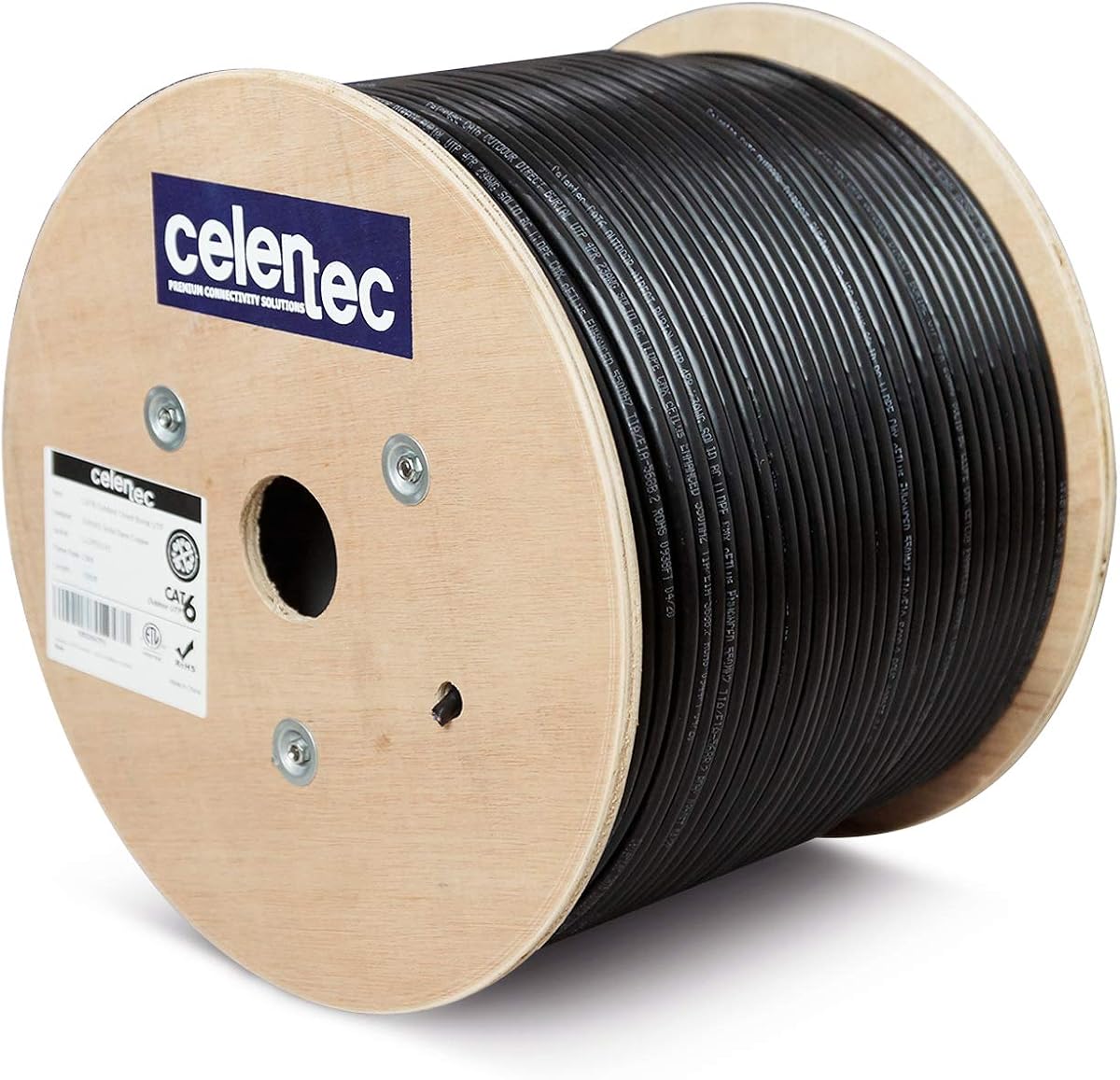
celertec's 500-foot outdoor Cat6 cable combines a 4.7 rating with solid bare copper and an ETL Listing. Designed for outdoor applications, it uses a weather-resistant LLDPE jacket intended to withstand UV exposure, rain, and temperature changes. Sequential foot markings and a wooden spool help installers manage a long run more effectively.
We may earn a commission when you buy through this link, at no additional cost to you.
The cable is tested to a stated 550 MHz bandwidth and is described as suitable for 1 Gigabit networks, 10 Gigabit service at shorter distances, PoE, and VoIP. Its solid bare copper construction distinguishes it from CCA-based budget cables. The product information also references ANSI/TIA-568.2-D compliance and RoHS compliance, adding a stronger certification profile for structured cabling work.
Its UTP construction does not provide the interference resistance of shielded cable. In an environment with heavy electrical noise, nearby power infrastructure, or unusually sensitive equipment, a shielded alternative may deserve closer consideration. The supplied data identifies it as outdoor-rated but does not specifically call it direct burial, so it should not automatically be installed underground without confirming the intended jacket rating and local requirements.
This is an excellent option for an exterior run connecting an outbuilding, access point, camera location, or business structure where solid copper and recognized testing are priorities. It is particularly relevant to PoE and VoIP installations because those applications are explicitly supported. Buyers seeking a trench-installed shielded design can compare it with the direct-burial selection in this guide.
Solid bare copper is specified for better conductivity and full communications-cable compliance. It also makes the cable suitable for the stated PoE and VoIP applications.
ETL Listing, ANSI/TIA-568.2-D compliance, and sequential jacket markings make this cable attractive to installers who value documented specifications.
We may earn a commission when you buy through this link, at no additional cost to you.
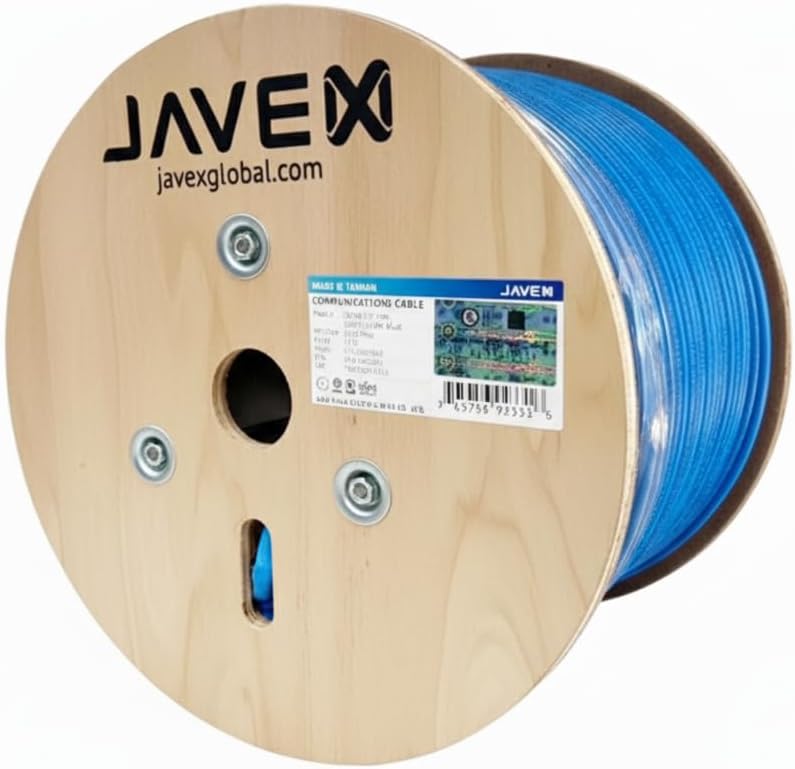
The JAVEX CAT 6A Riser CMR Ethernet Cable is the highest-rated product in this roundup, with a 4.8 rating. Its 500-foot shielded FTP roll is positioned for high-speed structured cabling, using 23 AWG solid bare copper and a stated performance target of up to 750 MHz. It supports IEEE 802.3af PoE and IEEE 802.3at PoE+ according to the supplied information.
We may earn a commission when you buy through this link, at no additional cost to you.
Shielding is the defining benefit. The FTP construction is intended to reduce electromagnetic interference and crosstalk, making it useful in walls, between floors, and near equipment that can create interference. Sequential foot markings improve installation precision, while the UL Riser-rated jacket is designed for in-wall installations, vertical routing between floors, and non-plenum spaces.
The standards and certification information is extensive: the product references UL Listing, ANSI/TIA, U.S. safety standards, ETL verification to TIA-568.2-D, and UL LP for PoE++. This makes the cable suitable for buyers who require documented performance. The tradeoff is that its capability and certification profile exceed what a basic home network may need, and it remains limited to riser-rated locations rather than plenum spaces.
Choose this cable for a professional in-wall or between-floor network backbone that benefits from Cat6A capacity, solid copper, and shielding. It is particularly appropriate when future bandwidth growth or higher-powered PoE applications are priorities. Simpler indoor networks can satisfy their needs with a standard Cat6 roll, but this model offers more expansion potential.
The stated 750 MHz target and Cat6A category provide more headroom than standard Cat6. That makes the cable appropriate for backbone roles and installations expected to evolve.
FTP shielding helps limit electromagnetic interference and crosstalk in walls and between floors. It is a useful feature in buildings with dense electrical systems.
We may earn a commission when you buy through this link, at no additional cost to you.
This Cat8 bulk Ethernet cable reaches the highest advertised bandwidth in the group, with a claimed 40 Gbps data rate and 2000 MHz performance. Its 4.7 rating, 26 AWG conductor, and double-shielded F/FTP structure distinguish it from the more conventional Cat6 selections. The 500-foot roll comes in an easy-pull box intended for both indoor and outdoor routing.
We may earn a commission when you buy through this link, at no additional cost to you.
The product lists compatibility with routers, switches, IP cameras, modems, patch panels, servers, network printers, NAS devices, smart televisions, game consoles, and other RJ45 equipment. It also states compatibility with Cat7, Cat5, Cat5e, Cat6, and Cat6e. A UV-resistant PVC jacket is described as suitable for sunlight and temperature variation, while double shielding is intended to reduce EMI and RFI.
Real-world performance will depend on compatible Cat8 equipment, topology, terminations, and installation standards; a cable's headline category cannot independently create faster throughput. The use of a composite conductor specification is also worth noting, as buyers may need to confirm compatibility with the exact network equipment and installers they intend to use. The broad equipment list is helpful but should not replace verification of standards support.
This cable is most compelling for specialized high-speed environments, including data center interconnections and small enterprise networks with appropriate Cat8 infrastructure. A normal home router or consumer switch will not benefit from the extra specification. For conventional Gigabit networks, a better-documented Cat6 or Cat6A cable may be the more sensible investment.
The advertised 40 Gbps and 2000 MHz figures place this cable at the high end of the guide. It is intended for installations with matching, advanced networking equipment.
Double shielding is designed to control interference, while the UV-resistant PVC jacket is stated to tolerate changing outdoor conditions.
We may earn a commission when you buy through this link, at no additional cost to you.
The TRUE CABLE Cat6 Direct Burial Outdoor Bulk Ethernet Cable is built for demanding outdoor installations and earns a 4.7 rating. It combines a shielded F/UTP design, 23 AWG solid bare copper, a 550 MHz bandwidth claim, and an OSP jacket intended for direct burial, conduit, or exposed outdoor use. The cable is supplied on a tangle-free reel for smoother handling.
We may earn a commission when you buy through this link, at no additional cost to you.
Its performance claims include support for 10 Gigabit Ethernet at distances up to 165 feet and 1 or 5 Gigabit Ethernet up to 328 feet. It supports PoE, PoE+, and PoE++ under IEEE 802.3af, 802.3at, and 802.3bt, with 4PPoE capability up to 100 watts. That makes it relevant to powered cameras, access points, and other network devices in outdoor locations.
The supplied information states that the cable was performance tested with a Fluke DSX-8000 Versiv CableAnalyzer and complies with ANSI/TIA 568.2-E. Shielding helps limit crosstalk and electromagnetic interference, while the UV-resistant OSP jacket is designed for sunlight, dirt, snow, and moisture. Actual throughput and power delivery remain dependent on installation conditions, distance, topology, and connected equipment.
This is the strongest choice in the guide for a long, buried, or exposed outdoor run where solid copper, shielding, and high-level PoE support all matter. It is also appropriate for contractors seeking a cable with documented field testing. For simpler protected indoor wiring, a CM-rated Cat6 roll is more economical and easier to justify.
The OSP jacket and stated waterproof, UV-resistant characteristics make this cable suitable for direct burial and exposed outdoor installations.
Support for PoE++ at up to 100 watts gives the cable a strong advantage for powered cameras and access points located away from conventional electrical outlets.
We may earn a commission when you buy through this link, at no additional cost to you.
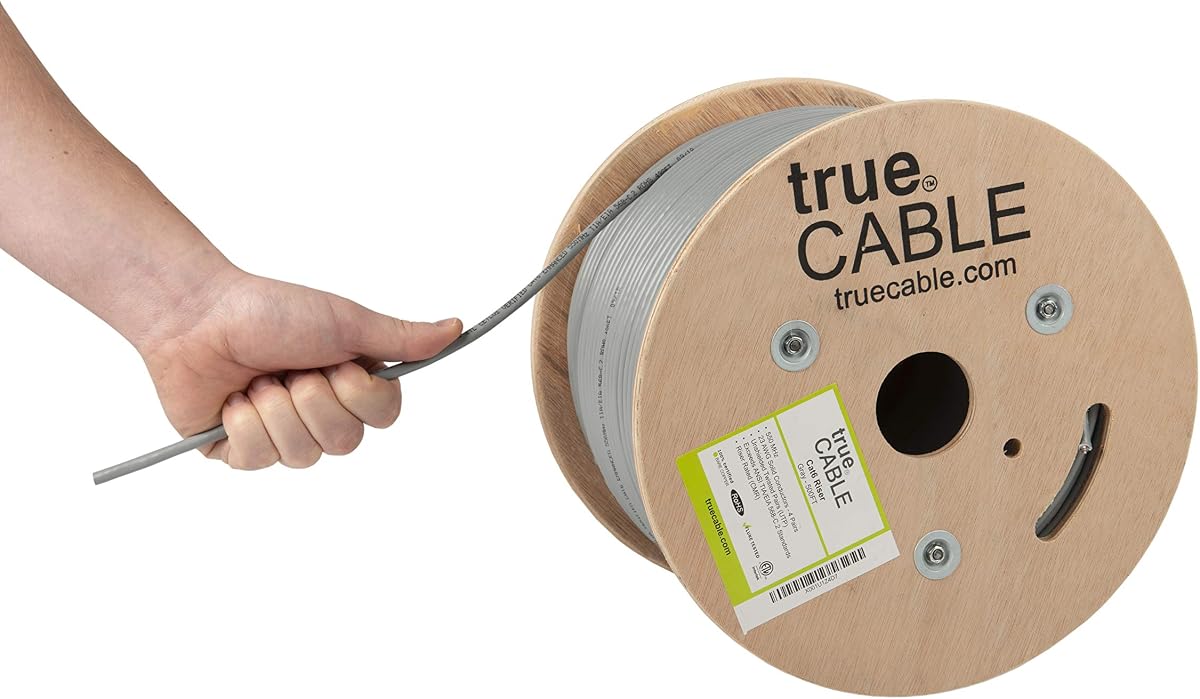
trueCABLE's 500-foot gray Cat6 Riser cable is a well-documented option for indoor vertical installations. It has a 4.7 rating, uses 23 AWG solid bare copper, and is ETL Listed for riser-rated use. The product information states that it was tested with a DSX-8000 Versiv CableAnalyzer and complies with ANSI/TIA 568.2-D, adding reassurance for professional cabling work.
We may earn a commission when you buy through this link, at no additional cost to you.
Its 550 MHz bandwidth and distance statements support Gigabit networks throughout the roll and 10 Gigabit service at shorter distances, subject to the installation environment. PoE, PoE+, and PoE++ are supported under IEEE 802.3af, 802.3at, and 802.3bt, including 4PPoE up to 100 watts. This makes it suitable for powered access points, phones, and cameras located on indoor wiring paths.
The gray CMR jacket is intended for walls, between floors, and other non-plenum spaces, with mild flame-retardant properties for vertical installations. It should not be substituted for outdoor-rated or plenum cable. Unshielded UTP can also be less resilient to interference than shielded alternatives in electrically noisy pathways, even though the solid copper construction and documented testing are strong.
This cable is a compelling choice for indoor riser projects, especially multi-level homes and offices needing PoE capability. Its reel packaging reduces tangles and makes a 500-foot run manageable. Choose a shielded cable for harsh interference or an outdoor-rated model for exposed routes, but for standard indoor riser work this is a balanced and specification-rich option.
The CMR jacket is designed for walls, between floors, and non-plenum spaces. It offers mild flame retardance for vertical building routes.
DSX-8000 testing, ANSI/TIA compliance, and ETL Listing make the cable appealing for professional installations. PoE++ support broadens its usefulness for powered devices.
We may earn a commission when you buy through this link, at no additional cost to you.
The right bulk cable depends on where it will be installed, what it must connect, which standards matter, and how much installation flexibility is needed. Comparing category, conductor material, jacket rating, shielding, PoE support, and termination format prevents an expensive mismatch.
In short, select the lowest category that comfortably supports the network today and its likely future.
In short, bare copper is the stronger choice for PoE and demanding installations, while CCA requires careful specification review.
In short, identify every environment along the path and choose the lowest-cost jacket that covers all of them.
In short, use UTP in ordinary routes and shielded cable when interference or crosstalk warrants stronger control.
In short, verify PoE standard, wattage, and run length before choosing a cable for powered endpoints.
In short, prefer documented listings and test standards when the installation is professional, inspected, or warranty-sensitive.
In short, confirm termination accessories, route length, and pulling method before the spool is opened.
Before installation, map the entire route, measure both endpoints, and add enough service slack for terminations and future changes. Check whether the route includes walls, exterior exposure, soil, or areas near strong electrical interference. Use the appropriate indoor, riser, outdoor, or direct-burial cable for those conditions rather than relying on the length alone.
Pull the cable gradually from its reel, keeping the jacket free of sharp edges, excessive bending, crushing, and twisting. Avoid pulling from a connector because most bulk rolls do not have one; secure the cable at intervals and follow the manufacturer's bend-radius and installation guidance. Maintain proper separation from parallel power wiring where practical and use listed couplings or raceways where required by local codes.
Terminate the run with components compatible with the cable category, shielding, and PoE requirements, then verify the installation before closing a wall or covering the pathway. Test each completed link for continuity, correct pin mapping, data performance, and power delivery where applicable. Keep connectors dry, protected from dust and sunlight, and avoid repeated flexing at the plug, because those points are especially vulnerable to intermittent faults.
It depends on the category, conductor, installation quality, and actual run length. The relevant Cat6 products state support for 10-Gigabit Ethernet, while some outdoor listings specify 10G only at shorter distances. Treat advertised bandwidth as a ceiling rather than a guarantee for every 500-foot route. Check device compatibility and test the finished installation before relying on it for a demanding network.
CCA can support ordinary data connections, and several economical rolls in this guide use it. Its limitations become more important for PoE, long runs, and installations requiring a clear compliance specification. Choose solid bare copper when powering devices, seeking consistent professional specifications, or building a system intended for long-term expansion.
Indoor cable is intended for protected environments, while riser cable is designed for walls, between floors, and non-plenum vertical paths with mild flame-retardant properties. Direct-burial cable has a heavier outdoor jacket intended for installation in soil. Each cable should be used according to its jacket classification and any applicable local codes.
Only use a cable specifically described and listed for direct burial. In this guide, the TRUE CABLE shielded Cat6 model and the VOIETOLT outdoor Cat6 kit carry direct-burial claims, but the VOIETOLT product uses CCA and does not support PoE. Site conditions, local regulations, conduit requirements, and the specific installation method should also be checked.
PoE support depends on the specific cable, and a cable's length alone does not determine it. Bare copper products in this guide state support for PoE, PoE+, or PoE++, while multiple CCA selections do not. Check the required standard and power level, and remember that greater resistance over a long run can reduce available power.
Shielding is not automatically necessary in every home. Standard UTP can work well in ordinary rooms and controlled pathways. Shielded FTP or F/UTP is more compelling near power equipment, in electrically noisy buildings, or on routes exposed to interference, provided the terminations and grounding plan are handled consistently.
Basic patch cables and simple straight runs can be manageable for a careful DIY installer, but proper termination, category testing, PoE verification, and code-sensitive in-wall work benefit from professional training. A qualified installer can also help select the correct jacket, shielding, and pathway for the building.
Most consumer routers and switches do not require Cat8. Its advertised 40 Gbps capability is intended for specialized equipment and high-speed interconnections. For ordinary Gigabit or multi-gigabit networks, a properly selected Cat6 or Cat6A cable usually offers a more practical balance of performance, installation ease, and compatibility.
The VIVO Gray Bulk Cat6 is the economical indoor choice for custom terminations, while the Cable Matters Cat6 is the most versatile all-purpose option thanks to solid copper, a 550 MHz claim, UL Listing, and stated PoE support. For a demanding exposed or buried route, the TRUE CABLE Direct Burial model provides the strongest premium combination of shielding, outdoor jacket construction, testing, and PoE++ capability.
Prioritize the complete route before focusing on headline bandwidth. Conductor material, jacket rating, shielding, PoE needs, listing claims, and termination method determine whether the cable is suitable in real-world use. A lower-category cable installed correctly in the right environment can be more dependable than an advanced cable used in the wrong location.
Current prices, availability, and product details can change, so confirm the latest listing before purchasing. Also verify the network equipment, power requirements, installation route, and applicable local standards. Those checks will help ensure the selected 500-foot cable provides a network that remains useful well beyond the installation day.
