
Cellular Temperature Monitor for RV Pet Safety
4.5Editor score
Built-in OLED local display
Thirty-second sensor readings
Flexible always-on or standby modes
Discover the best remote temperature sensor for pets, comparing cellular alerts, Wi-Fi access, battery life, displays, accuracy, and data storage.
A remote temperature sensor for pets helps owners monitor temperature, humidity, and power conditions when they cannot remain beside an animal. The right device is especially useful for RVs, cabins, travel vehicles, crates, and other spaces where climate changes can quickly become uncomfortable or dangerous.
We compared all ten products using the information provided, focusing on connectivity, alert methods, sensing range, battery performance, local displays, storage options, and intended use. The list includes cellular monitors for locations without reliable Wi-Fi, indoor Wi-Fi models, and a wireless display system for monitoring several areas.
Each review identifies the feature that makes a model most useful and any limitations worth considering. Ratings reflect the supplied customer feedback, while specifications and capabilities come from the product descriptions. Prices and subscription terms can change, so readers should confirm current details before purchasing.
4.5Editor score

4.7Editor score

4.3Editor score
The table below compares connectivity, power resilience, display options, and monitoring scope across all ten products, helping pet owners identify the model best suited to their home, vehicle, or remote environment.




The Necto Cellular Monitor combines temperature, humidity, and power-outage monitoring in one compact device designed for homes, RVs, cars, and pet spaces. Its 4.7 rating is among the strongest in this group, and its ability to operate independently of Wi-Fi makes it especially practical for travel, cabins, and other remote locations.
We may earn a commission when you buy through this link, at no additional cost to you.
The sensor takes readings every 10 seconds and updates the online portal every 10 minutes. Owners can establish separate upper and lower temperature and humidity thresholds, add as many as five contacts, and send unlimited text and email alerts. A rechargeable internal battery provides up to three days of operation when external power disappears, while low-battery and network-disconnection notifications help distinguish an emergency from a simple communication problem.
The main compromise is that cellular service must be renewed after the included two-year period, and the monitor depends on compatible network coverage. It also lacks a built-in local display in the description, so checking the current reading generally requires the app or online portal. Those limitations matter less for owners who want dependable remote notifications and do not need a visible screen inside the pet area.
This is the strongest all-around recommendation for owners seeking an easy cellular monitor with strong customer feedback, environmental alerts, outage detection, and historical data. It is particularly well suited to RV travel, vacation homes, and pet areas where Wi-Fi access may be unreliable, provided the user accepts the service model and verifies cellular coverage.
The built-in multi-network SIM allows the monitor to connect through 4G LTE, making it independent of a router, hotspot, or local internet service. That separation is valuable in an RV, cabin, car, or other location where a Wi-Fi outage could otherwise remove all visibility.
Custom thresholds and alerts for temperature, humidity, power loss, low battery, and disconnection let owners respond before a pet becomes distressed. Sharing readings with several contacts also makes the system useful for families, sitters, or caretakers who cannot all watch the same dashboard.
We may earn a commission when you buy through this link, at no additional cost to you.
The Frigga 4G Monitor stands out for flexible connectivity, allowing users to choose cellular monitoring in remote locations or connect it to a home Wi-Fi network. Its 4.2 rating is respectable, and the combination of a fast-refreshing screen, app and email alerts, and a rechargeable battery makes it a versatile option for pet owners.
We may earn a commission when you buy through this link, at no additional cost to you.
The always-on display refreshes every five seconds, while the app can receive the latest readings every 10 or 30 minutes. Alert options include app push, email, and an on-device voice alarm for temperature changes, humidity issues, power failures, freeze risk, and disconnections. The ability to use 2.4GHz or 5GHz Wi-Fi at home gives the product broader placement flexibility than models limited to one network band.
Its included service still has an expiration date, and cellular renewal is required afterward. The supplied rating of 4.2 is lower than that of several leading choices, and users who require a local numerical display may prefer the OLED model in third place. These are trade-offs rather than defects, particularly because dual connectivity and local voice alarms are meaningful benefits.
The Frigga monitor is best for owners who want one device to transition between home Wi-Fi and cellular operation. It suits RV travel, vacation homes, cabins, basements, warehouses, and other spaces that may alternate between connected and off-grid use, especially when a local audible warning is important.
Users can activate cellular service away from a router and switch to 2.4GHz or 5GHz Wi-Fi where preferred. This makes the monitor adaptable to homes, vehicles, and changing travel locations without requiring a separate device for each network type.
The on-device voice alarm is a meaningful safeguard when a caretaker is nearby but not looking at a phone. App push, email, and shared access extend the same visibility to people monitoring remotely, while historical CSV data helps identify longer climate patterns.
We may earn a commission when you buy through this link, at no additional cost to you.
The ALZUR Cellular Monitor is a premium-oriented choice for pet owners who want both remote access and a readable screen on the device. Its 4.5 rating, 4G operation, and built-in OLED display distinguish it from many app-only monitors, while the stated application for RV pet safety aligns closely with the needs of traveling owners.
We may earn a commission when you buy through this link, at no additional cost to you.
The Swiss industrial-grade sensing module supplies fresh readings every 30 seconds, and the OLED shows temperature, humidity, and signal strength locally. Owners receive app, email, and SMS notifications when readings exceed custom limits or when power, battery, and connectivity conditions change. Two operating modes improve flexibility: Always-On provides continuous real-time monitoring, while Standby can deliver up to 20 days of battery operation and is intended primarily for low-temperature and outage warnings.
The Standby mode does not provide the same full stream of information as Always-On, and the monitor depends on cellular coverage. A cellular renewal is also required after the included service period. Even so, the local OLED makes the device easier to check without an app, while the rechargeable battery and outage monitoring add meaningful resilience.
This model is a strong recommendation for owners who regularly travel with pets, want local readings without opening an app, and value a choice between continuous operation and long battery life. It is less suitable for someone requiring detailed live reporting in every standby scenario.
The OLED display gives immediate access to temperature, humidity, and cellular signal strength. This local visibility is especially helpful in an RV or pet area because a caretaker can confirm conditions before navigating an app or waiting for a remote update.
Always-On mode favors continuous awareness, while Standby trades detailed reporting for a potential 20 days of operation. The internal rechargeable battery continues collecting information and triggering alerts during an outage, making the monitor useful for travel and unattended properties.
We may earn a commission when you buy through this link, at no additional cost to you.
This second Necto option offers a focused 4G monitoring experience for RV and pet environments, earning a 4.7 rating. It combines temperature, humidity, and power-outage monitoring with app notifications, making it a natural fit for owners who need remote warnings without depending on a home internet connection.
We may earn a commission when you buy through this link, at no additional cost to you.
The device samples conditions every 10 seconds and refreshes its online portal every 10 minutes. Users can define high and low thresholds, add up to five contacts, and send unlimited text and email notifications. Its three-day rechargeable battery maintains monitoring when power is lost, and separate warnings for low battery and network disconnection help reveal whether conditions or communications need attention.
Like the first Necto model, it requires a cellular subscription after the included period, which is the primary ongoing cost. There is no local display mentioned in the product data, so the app and portal are essential for routine readings. Its 4.7 rating indicates a favorable customer response, but choosing between it and the first Necto model largely depends on current service terms and the availability of the newer RV-focused listing.
This is an excellent choice for RV travelers and pet owners who value simple setup, outage awareness, and direct text or email alerts. It is less attractive to households that want a local display or wish to avoid any future connectivity service.
Cellular operation keeps the monitor functional in an RV even when the vehicle is away from a dependable Wi-Fi network. Fast internal sampling and ten-minute portal updates offer a practical balance between current conditions and manageable data reporting.
The ability to add five contacts makes the monitor useful when family members, sitters, or travel companions share responsibility. Text and email notifications provide more than one route for receiving a warning when a pet area needs attention.
We may earn a commission when you buy through this link, at no additional cost to you.
The Govee WiFi Thermometer Hygrometer H5179 is an approachable indoor monitor for owners who want app visibility and threshold alerts without a cellular subscription. It carries a 4.3 rating, uses a Swiss-made sensor, and provides a compact solution for home, kennel, or other climate-controlled pet areas.
We may earn a commission when you buy through this link, at no additional cost to you.
Readings refresh every two seconds, with stated temperature accuracy of ±0.54°F and humidity accuracy of ±3% relative humidity. The Govee Home app works through Wi-Fi or Bluetooth, and the description notes that 5GHz Wi-Fi is unsupported. Owners can set alert ranges, view 20 days of online data, and export historical information covering as much as two years.
Its limitations are important: it depends on a compatible network, offers no power-outage battery backup, and is intended for indoor placement. Bluetooth can be used for settings according to the description, but remote alerts still depend on the appropriate app connection. Buyers seeking continuous cellular monitoring during travel will need a more specialized model.
This is the best budget-oriented option for a stable indoor pet area where a router is readily available. It suits crates, climate-controlled rooms, basements, and similar spaces, offering fast readings and clear app notifications without the complexity of 4G service or external probes.
Two-second refreshes make this a good fit for rooms where conditions can shift quickly and an owner wants nearly current information. The compact body and lanyard loop also make it straightforward to position near a pet's usual resting area.
The app can notify the owner when temperature or humidity leaves a preset range. This keeps the product simple for homes with stable Wi-Fi and avoids a separate cellular subscription, while historical graphs help reveal whether isolated changes are part of a recurring pattern.
We may earn a commission when you buy through this link, at no additional cost to you.
The Govee H5103 combines an easy-to-read electronic ink screen with Wi-Fi monitoring, giving pet owners both local and app-based visibility. Its 4.2 rating and approximately six-month battery life make it especially appealing for indoor locations where a visible display is preferred but frequent charging would be inconvenient.
We may earn a commission when you buy through this link, at no additional cost to you.
The Swiss-made sensing component refreshes every two seconds, with stated temperature accuracy of ±0.54°F and humidity accuracy of ±3% relative humidity. Users connect through the Govee Home app over 2.4GHz Wi-Fi or Bluetooth, set custom alert ranges, view 13 days of online graphs, and export up to two years of historical data.
The screen does not provide cellular monitoring, and the device has no stated power-outage battery protection. Support for 5GHz networks is also absent. These limitations mean it is better suited to a climate-controlled room with reliable 2.4GHz Wi-Fi than to an off-grid cabin, vehicle, or location that may lose internet access.
The H5103 is a strong recommendation for owners who want a readable screen, long battery life, and app alerts in one simple indoor package. It is especially useful near a crate, kennel, or pet bed where a glance at the display can confirm the room is comfortable.
The electronic ink screen presents current conditions without requiring a phone. It is useful when a caretaker is near the pet but wants to confirm the reading before deciding whether intervention is necessary.
An estimated six months of battery life reduces maintenance compared with devices that need frequent charging. Replaceable 1.5-volt AA batteries make the unit practical for a stable indoor area, although users should still monitor the battery indicator.
We may earn a commission when you buy through this link, at no additional cost to you.
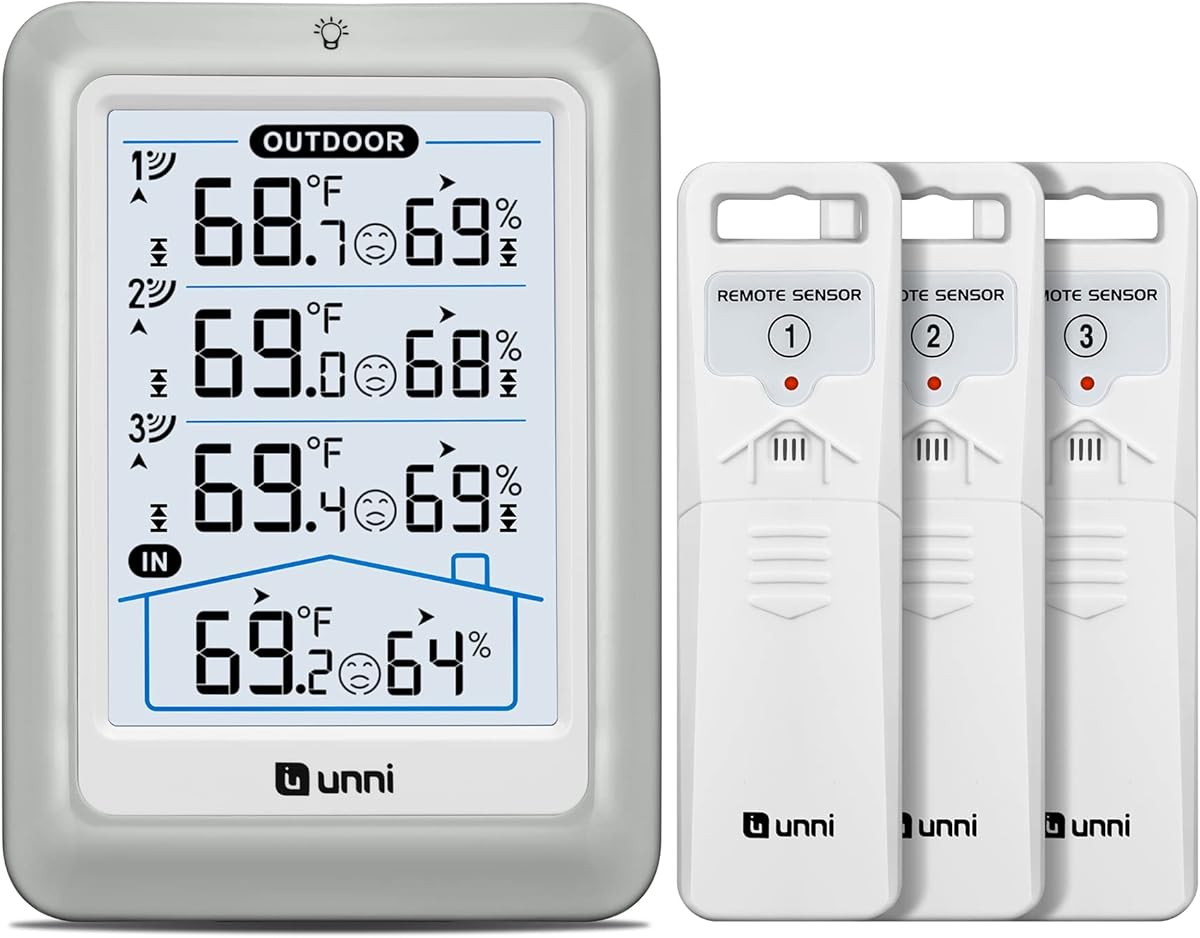
The Unni Wireless Thermometer is a different kind of remote monitor, using three external sensors to report conditions from locations up to 330 feet from a large display. Its 4.4 rating and multi-sensor design make it attractive for pet owners who need to compare several areas rather than rely on one connected device.
We may earn a commission when you buy through this link, at no additional cost to you.
The console refreshes each reading every 30 seconds and displays indoor and outdoor temperature, humidity, trends, daily maximum and minimum values, and low-battery warnings. The included wireless sensors provide indoor and outdoor measurement ranges stated as 14.2°F to 122°F indoors, minus 40°F to 158°F outdoors, and 20% to 95% humidity. Stated accuracy is ±2°F for temperature and ±5% for humidity.
The major drawback is that this is primarily a local display system rather than an app-based cloud monitor. It cannot send the same kind of remote phone notification to a caretaker who is away from the property. It also does not offer stated backup operation during a power loss, although the USB cable keeps the backlight active when power is available.
This monitor is best for owners who want one readable console showing several nearby areas, such as a pet room, kennel, garage, and outdoor shelter. It is less appropriate when the requirement is cellular alerts, historical cloud records, or monitoring from a distant location.
Three external sensors can be placed in separate locations while the main console displays their readings. This makes the system useful for comparing a pet room with a nearby garage, porch, or kennel without managing several individual displays.
The console shows trend indicators, comfort status, alerts, and daily high and low records. Automatic 24-hour resets keep the information relevant to daily routines, and the switchable Fahrenheit and Celsius display adds convenience for different households.
We may earn a commission when you buy through this link, at no additional cost to you.
The FALA 4G RV Pet Monitor is built around dependable cellular monitoring and exceptional battery endurance. Its 4.6 rating, 60-day rechargeable backup, and broad sensing range make it an attractive choice for owners who cannot regularly recharge a monitor in an RV, cabin, or remote pet area.
We may earn a commission when you buy through this link, at no additional cost to you.
The LCD refreshes every two seconds, while owners can select upload intervals from 3 to 160 minutes. Temperature is monitored from minus 4°F to 140°F with a stated accuracy of 0.6°F, and humidity is covered from 0% to 100% relative humidity with 3% accuracy in non-condensing environments. SMS, email, sound, and light alerts cover temperature, humidity, outages, low battery, and offline status.
Cloud and local data can be exported in CSV, Excel, or PDF, and unlimited contacts may share access. The included cellular service still expires, and compatibility with FALA external sensors depends on separately purchased probes. Condensation can affect the stated humidity accuracy, which matters if a device is placed in a rapidly changing environment.
This is a compelling option for travel, off-grid properties, and long periods between charging access. It is particularly useful for owners who value many reporting choices, local audible warnings, and long-duration battery protection more than a built-in numerical display on the remote unit.
A backup period of up to 60 days gives the monitor a substantial advantage when external power is unreliable. It can continue collecting information and sending outage or environmental warnings through extended interruptions, reducing the need for frequent physical checks.
The broad temperature range covers warm and cold environments, while the local LCD, adjustable uploads, and several alert channels provide a choice between immediate awareness and reduced communication frequency. External probe support can expand the system when additional measurement points are required.
We may earn a commission when you buy through this link, at no additional cost to you.
The FALA Wi-Fi Temperature and Humidity Sensor Data Logger is appealing for owners who want remote monitoring without a subscription. It holds a 4.3 rating and combines app-based alerts, cloud history, local warnings, and a four-month stated battery life in a sensor designed for homes, RVs, cellars, greenhouses, and pet spaces.
We may earn a commission when you buy through this link, at no additional cost to you.
The built-in sensor covers minus 4°F to 140°F with a stated accuracy of 0.6°F and 0% to 100% relative humidity with 3% accuracy. Data can be logged every 1 to 60 minutes, retained offline for more than 30 days, and kept in the cloud for up to one year depending on update frequency. Users can export reports in CSV, Excel, or PDF, while text, email, buzzer, and flashing LED alerts cover environmental changes, low battery, outages, and offline status.
It only supports 2.4GHz Wi-Fi, which can complicate setup if the router uses another band or combines bands under one network name. It also lacks cellular independence, making it less suitable for truly remote areas without a reliable network. External probe support is available, but the probes are sold separately.
This model is a good match for owners who dislike recurring monitoring fees and want both remote and local notifications. It works especially well in a connected RV, vacation home, kennel, or pet room where 2.4GHz Wi-Fi is available and the logger's flexible intervals suit the household's needs.
The absence of a monthly subscription is the clearest reason to consider this logger. Cloud history, remote access, and sharing features remain available without the cellular service model required by many travel-focused monitors.
The buzzer and flashing LED provide local warnings, while text and email deliver remote notifications. This combination is helpful when different people share responsibility and one caretaker is near the pet area while another is away.
We may earn a commission when you buy through this link, at no additional cost to you.
The Elitech Loget260 is the most data-oriented model in the group, combining a 4G cellular connection, local record retention, multiple sensing inputs, and cloud monitoring. Its 5.0 supplied rating is the highest in the list, although that figure should be considered alongside the device's more specialized feature set.
We may earn a commission when you buy through this link, at no additional cost to you.
The logger can store 100,000 offline record points and upload them after the network returns, while a shadow-data function supports continued recording in certain abrupt situations. Standard sensors cover temperature, humidity, light, shock, and LBS location, and optional sensors can add pH or carbon dioxide measurement. Uploads can be scheduled from one minute to 24 hours, and the Elitech iCold platform supports app, SMS, email, sound, screen, and indicator-light alarms.
Two years of cloud service and three years of data output storage are included, but continued service may require renewal. The broad sensor and compliance-oriented feature set is more complex than a basic pet thermometer, and optional external sensors may add cost. The product is not a simple turnkey substitute for a compact indoor hygrometer.
The Loget260 is best for technically minded owners, professional pet-care operations, or mobile setups where uninterrupted data logging and location context matter. It is the most compelling option here when preserving records through connectivity interruptions is a higher priority than having a simple consumer-style display.
The large local record capacity and post-reconnection upload behavior protect valuable monitoring history. For owners who cannot check a portal every day, this reduces the risk of losing temperature and humidity data during an extended network interruption.
Beyond temperature and humidity, the device can measure light, shock, and location, with additional probe options available. That broader data set can help an owner understand what is happening around a pet, although the feature set is more specialized than a basic household monitor.
We may earn a commission when you buy through this link, at no additional cost to you.
The right monitor depends on where the pet will be, how the owner expects to receive warnings, and how much uninterrupted data are needed. Connectivity, power resilience, display visibility, and alert flexibility deserve careful attention before purchase.
Wi-Fi monitors are generally straightforward in homes with a compatible router, but they lose remote visibility when the internet is down. Cellular monitors are better for RVs, cabins, vacation properties, and travel because they connect to 4G networks without a local router. Check that the service supports the countries and carriers where the pet will be located, and confirm whether 2.4GHz, 5GHz, or both are supported.
A temperature change during a power outage can be as important as the temperature itself. Rechargeable or replaceable batteries allow a monitor to continue reporting, but runtime varies substantially. The listed options range from several days to as much as 60 days, with the FALA 4G model offering the longest stated backup. Owners should match expected outage duration and charging access to the device's capabilities.
Useful alerts should reach an owner quickly and remain understandable. App push, email, SMS, local sound, and flashing LED each have advantages, so multi-channel devices offer redundancy. Look for adjustable temperature and humidity thresholds, separate power-outage warnings, low-battery notices, offline alerts, and the ability to add family members, sitters, or other responsible contacts.
A local display makes it possible to check conditions without opening an app, which is convenient near a crate, kennel, or RV interior. The ALZUR OLED offers temperature, humidity, and signal strength, while the FALA 4G uses an LCD and the Unni system uses a larger backlit screen. Wi-Fi models may emphasize app access instead, so owners should decide whether a glanceable display is genuinely necessary.
Accuracy figures do not guarantee comfort in every enclosure, but they provide a useful way to compare products. Stated temperature accuracy ranges from ±0.54°F to ±2°F, and several monitors cover both below-freezing and very warm conditions. Also consider the pet, enclosure size, direct sunlight, ventilation, and sensor placement, because a highly accurate sensor can still report a temperature that does not represent the animal's immediate experience.
Humidity can affect comfort, odor, condensation, and perceived warmth, making it a useful companion measurement to temperature. Stated humidity accuracy is generally ±3% relative humidity on the more precise devices, while the Unni system lists ±5%. Condensing environments can affect readings, and a sensor near a floor, exterior wall, drink bowl, or direct sun may not represent the pet's resting area.
Historical readings can reveal recurring hot periods, overnight humidity changes, and the timing of power interruptions. Storage ranges from roughly 20 days of online viewing in one Govee model to multi-year output retention in the Elitech logger. CSV export is common, while some products also offer Excel and PDF reports. Consider who needs access to the records and whether a caretaker, veterinarian, or family member should be able to review them.
Many cellular monitors include an initial service period, but continued operation depends on a subscription or renewal. Review the included duration, renewal structure, and coverage limitations before installing a device. A monitor with excellent hardware is less useful if its service cannot activate in the intended location. Wi-Fi devices avoid cellular renewal costs but require a dependable network and compatible router.
Begin by choosing a safe, representative location that allows air to circulate around the sensor. Avoid direct sunlight, heating vents, exterior walls, water bowls, and surfaces that can transfer heat quickly. For a pet crate or kennel, place the device where the animal cannot chew it while keeping it close enough to represent the occupied space.
Activate the device through the manufacturer or brand app, connect it to the specified network, and create separate upper and lower thresholds for temperature and humidity. Add reliable contacts, select the preferred alert channels, and test the notifications before relying on them. Cellular units should be checked for service coverage and Wi-Fi models should be confirmed on the required 2.4GHz band.
Review readings regularly, test the backup battery according to the manual, and clean the sensor with a dry or lightly damp cloth as directed. Replace or recharge the battery on schedule, check firmware and app updates, and confirm that data are still uploading. After travel or a major seasonal change, re-evaluate the thresholds so alerts remain meaningful rather than excessive.
A cellular monitor is most valuable when a pet stays somewhere without reliable Wi-Fi, such as an RV, cabin, vacation home, or remote property. For a normal home with stable 2.4GHz Wi-Fi, a less complex wireless model may be sufficient. Consider cellular monitoring if internet outages would prevent you from receiving an alert or if the pet's location changes frequently.
Safe conditions depend on the species, age, coat, health, and acclimation to the environment. No single temperature is appropriate for every pet, and sensor readings also differ from the animal's immediate experience. Use alerts to identify dangerous trends and consult a veterinarian for individual guidance rather than treating one universal temperature as a guarantee of safety.
It should be positioned where it can measure the environment the pet occupies without creating a chewing hazard or being damaged. Depending on the enclosure, a protected location near the pet's resting area may work better than the floor or a wall. Keep ventilation unblocked and test the readings against the conditions the animal actually experiences.
Only models with an internal or replaceable battery can continue monitoring after external power is lost. Runtime varies from several days to a much longer stated period, depending on the model and operating mode. Plugged-in-only Wi-Fi sensors may provide local readings but cannot notify an owner remotely if the router and internet are also offline.
A display is convenient for quick checks near the enclosure and can reduce the need to open an app. It is not essential if the owner is usually remote and relies on smartphone notifications. Some of the best cellular options offer either an OLED or LCD, while other products concentrate on remote access, data history, and alert delivery.
The appropriate interval depends on how quickly conditions can change and how often you want to receive information. Short intervals improve visibility but may use more power or cellular data, while longer intervals extend battery life. Travel monitors often offer adjustable scheduling, and pet owners can use immediate local readings alongside less frequent cloud uploads.
Wi-Fi data loggers generally do not require a cellular subscription, while most cellular monitors include service only for a stated initial period. A renewal may be necessary afterward. Review the current service terms, covered locations, and expected renewal structure before installation, especially for a device intended to protect animals during travel.
Combine remote sensor data with direct observation of the animal. Panting, restlessness, excessive thirst, weakness, lethargy, or unusual behavior can indicate heat stress, but a single sensor reading does not establish a diagnosis. Position the sensor in a representative area, set appropriate thresholds, and seek veterinary guidance for concerning symptoms or a pet with special medical needs.
The Necto Cellular Monitor is the most balanced overall pick because it combines 4G connectivity, power-outage alerts, a three-day battery, flexible thresholds, and one year of stored readings. The ALZUR model is especially attractive when a built-in OLED and two operating modes are priorities, while the Govee H5179 delivers the most approachable indoor monitoring without a cellular service.
The right choice for a pet in an RV or remote cabin will differ from one used in a stable home. Prioritize independent cellular coverage when Wi-Fi is unreliable, long battery runtime when charging is difficult, and immediate local alarms when someone is often near the enclosure. For indoor use, verify network-band compatibility and choose the display and data history that suit the household.
Before making a final purchase, confirm current product specifications, subscription terms, service coverage, and alert features on the listing. Ratings, software behavior, and service plans can change, and pet needs vary. A correctly positioned, properly configured monitor is more valuable than a model with an impressive specification list but unsuitable connectivity or alerts.