
ALD-200 Refrigerant Leak Detector
4.4Editor score
Heated diode sensor
Three-in-one gas detection
Peak mode and reset
Refrigerant leak detector guide comparing sensitivity, sensors, displays, probe reach, alarms, refrigerant compatibility, and field-ready features.
A refrigerant leak detector helps technicians identify escaped refrigerant around air-conditioning and refrigeration equipment without waiting for a visible failure. A useful model should balance sensitivity, fast response, clear alerts, probe flexibility, broad refrigerant compatibility, and dependable calibration rather than relying on one headline specification.
This guide compares ten refrigerant leak detectors across professional, portable, budget, and rechargeable designs. The evaluation focuses on sensor technology, stated sensitivity, display information, alarm options, warm-up and calibration behavior, supported refrigerants, probe length, power source, and practical features that matter during troubleshooting.
Each pick highlights the circumstances in which it stands out, while also noting meaningful limitations. Ratings and product details reflect the supplied information, and prices can change at any time, so shoppers should confirm current availability, specifications, warranty terms, and the cost of the complete tool before purchasing.
4.4Editor score

4.8Editor score

4.3Editor score
The comparison below places all ten detectors side by side, emphasizing sensor type, sensitivity, display capabilities, power, and the situations in which each model is best suited.





The Tadeto Rechargeable combines a compact handheld design, an 11-inch shape-retaining gooseneck probe, and a digital display in an appealing package for HVAC and automotive work. It carries a 4.8 rating, the highest among the listed products, and is positioned as a general-purpose detector for common CFC, HCFC, HFC, and HFO refrigerants.
We may earn a commission when you buy through this link, at no additional cost to you.
Its most useful features work together. A high-definition display provides real-time readings and a bar graph, while the audible alarm, light alert, and LCD give technicians multiple ways to recognize a leak. The Type-C rechargeable design removes recurring disposable-battery costs, and the flexible probe can reach around coils, hoses, valves, and obstructed fittings.
There is an important operating caveat. The detector generally needs about 30 seconds to warm up and automatically calibrate, and it should stabilize before work begins. The manufacturer specifically recommends steady, uniform movement rather than fast sweeps or abrupt pauses, since either can cause weak signals to be missed. Those practices are reasonable, but they make the tool less forgiving for hurried inspections.
This is the strongest general recommendation in the list for technicians, maintenance personnel, and serious do-it-yourself users who want rechargeable power, a long probe, and rich feedback without moving into the premium tier. Users should follow the calibration and scanning instructions closely and verify that the refrigerant in the serviced system appears on the supported list.
The universal Type-C charging port simplifies replenishing power between jobs. The included charging cable and carry bag make the detector easier to organize and transport, while the digital display helps reduce dependence on sound alone in noisy workspaces.
The 11-inch gooseneck probe bends around coils and hoses and holds its position. Its non-slip handle also supports steadier movement, which is particularly useful because controlled probe speed improves the chance of registering small leaks.
We may earn a commission when you buy through this link, at no additional cost to you.
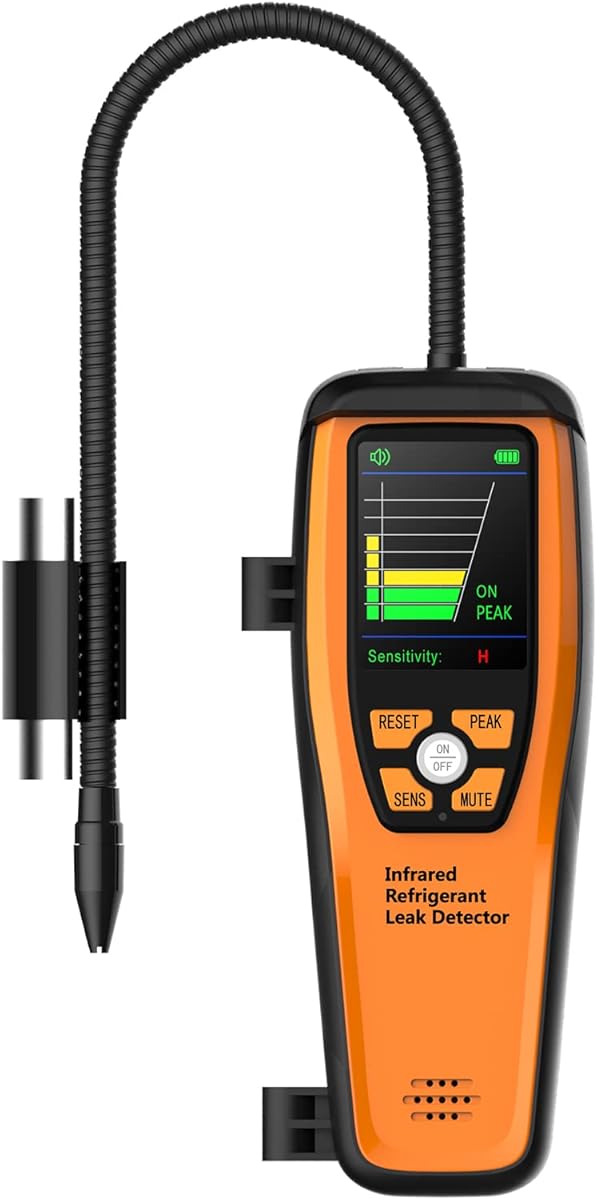
The Elitech ILD-200 is a professional-style detector built around infrared sensing, a technology the manufacturer describes as offering strong anti-interference, rapid response, accuracy, and a service life of up to ten years. It holds a 4.4 rating and supports a broad collection of CFC, HFC, HCFC, HC, HFO, and mixed refrigerants.
We may earn a commission when you buy through this link, at no additional cost to you.
The detector offers High, Medium, and Low sensitivity settings with maximum stated sensitivity of 0.14 ounce per year. Its large display shows peak information that can help indicate the direction of a leak, reducing the need to move the probe randomly when trying to pinpoint the source. The listed refrigerant coverage also includes common blends such as R404A, R410A, R600a, and R1234yf.
Compared with color TFT or graph-based models, the ILD-200 offers a simpler information hierarchy. That can be an advantage for users who want important readings without navigating complex screens, although the supplied information does not mention a rechargeable battery or a long list of alert modes. Support and sensor longevity are clear selling points, but buyers should still confirm battery configuration and included accessories.
Choose the ILD-200 when broad refrigerant compatibility, infrared sensing, and quick signal recognition are the priorities. It is especially relevant for automotive AC, residential HVAC, and commercial systems where a technician may encounter several refrigerant families rather than one specific gas.
The manufacturer emphasizes stronger anti-interference and faster response than conventional heated-diode designs. That makes the ILD-200 appealing for quick checks in busy service environments where clear, repeatable indications matter.
The large screen provides a peak display intended to show the orientation of the detected point. Technicians can use that information to refine probe position and narrow the search around fittings, coils, or service ports.
We may earn a commission when you buy through this link, at no additional cost to you.
The Japanese Sensor Detector stands out for combining a high-precision semiconductor sensor with a full-color TFT screen and advanced analysis views. It has a 4.7 rating, three adjustable sensitivity levels, and stated maximum sensitivity of 0.1 ounce per year, placing it among the most sensitive options presented.
We may earn a commission when you buy through this link, at no additional cost to you.
The dual display views are a major advantage. A funnel view gives an immediate visual sense of leak intensity, while the trend graph helps show how readings change over time. Real-time PPM information, three independently selectable alarm modes, vibration alerts, and a quick mute function allow technicians to adapt the instrument to noisy shops, quiet rooms, basements, garages, and commercial refrigeration environments.
The built-in 2000mAh lithium battery is specified for up to eight hours of continuous use, and USB-C charging simplifies recharging. A battery-status display and low-battery warning help prevent an interrupted job. The 14.5-inch flexible probe is the longest listed here, although the rugged handheld housing and feature-rich display make the unit more substantial than simple analog-style detectors.
This is a strong choice for technicians who want trend information and flexible alerts rather than only a beep. It suits advanced troubleshooting of coils, valves, fittings, service ports, and hard-to-reach connections, provided the user is willing to learn the display controls and confirm that the target refrigerant is supported.
Real-time PPM readings and two display modes make it possible to judge whether the probe is approaching or moving away from a leak. This can reduce guesswork and produce a more systematic search process.
Sound, indicator light, and vibration can each be enabled or disabled independently. Quick mute preserves visual or vibration warnings when silence is necessary, which is useful around occupied indoor spaces.
We may earn a commission when you buy through this link, at no additional cost to you.
The Elitech CLD-100 is an updated version of the WJL-6000 that uses a traditional corona sensor and revised analog circuitry. Its 4.3 rating and straightforward feature set make it a practical entry point for car HVAC, residential air conditioning, and other systems using common halogenated refrigerants.
We may earn a commission when you buy through this link, at no additional cost to you.
Its main advantages are speed and simplicity. The detector preheats in six seconds, responds quickly after activation, and offers six adjustable sensitivity levels with maximum stated sensitivity of 0.21 ounce per year. A flexible probe measuring about 8.26 inches reaches obstructed locations, while audible and visual indicators communicate the leak status.
The main drawback is power logistics. It uses four AAA batteries, which are not included, so a first-time buyer should add those to the purchase or keep a spare set available. It also lacks the richer display, peak tracking, and specialized alert controls found on premium models. The simplicity is nevertheless a legitimate benefit for users who want straightforward detection rather than extensive data.
Pick the CLD-100 when fast startup, low purchase cost, and uncomplicated controls are priorities. It is a sensible first detector for homeowners and mobile repair technicians, but professionals working daily may prefer a rechargeable model with a more informative screen.
A six-second preheating period helps users get started quickly. Fast response and simple sensitivity controls make the detector practical for repeated spot checks.
The flexible probe bends around coils, housings, and fittings that a rigid sensor cannot easily approach. This improves access without requiring a larger instrument.
We may earn a commission when you buy through this link, at no additional cost to you.
The Elitech ILD-100H uses a heated diode sensor to provide accurate detection across halogenated refrigerants. It has a 4.4 rating, maximum stated sensitivity of 0.1 ounce per year, and a response time listed as one second, making it a compelling option for fast professional troubleshooting.
We may earn a commission when you buy through this link, at no additional cost to you.
Its TFT screen displays sensitivity, leakage alerts, battery level, and other operating information. Two front-mounted buttons allow quick sensitivity changes and buzzer muting. The detector supports CFC, HFC, HCFC, HC, HFO, and mixed gases, including R11, R22, R404A, R410A, R600a, and R1234yf.
Compared with the CLD-100 and WJL-6000S, this model offers a more refined display, greater stated sensitivity, and a faster response. The heated-diode approach also provides a familiar technology used in many professional tools. However, the supplied information does not identify a rechargeable battery, and its one-year warranty claim should be verified with the seller at the time of purchase.
The ILD-100H fits technicians who value a fast, sensitive instrument and direct front-panel control. It is best for active HVAC service, automotive AC, and refrigeration work where the target refrigerant belongs to the supported halogenated-gas families.
The stated one-second response supports rapid inspections. A technician can move deliberately through likely leak areas without waiting long for the instrument to react.
The screen provides a clear view of sensitivity, alerts, and battery status. Direct front controls reduce menu navigation during time-sensitive work.
We may earn a commission when you buy through this link, at no additional cost to you.
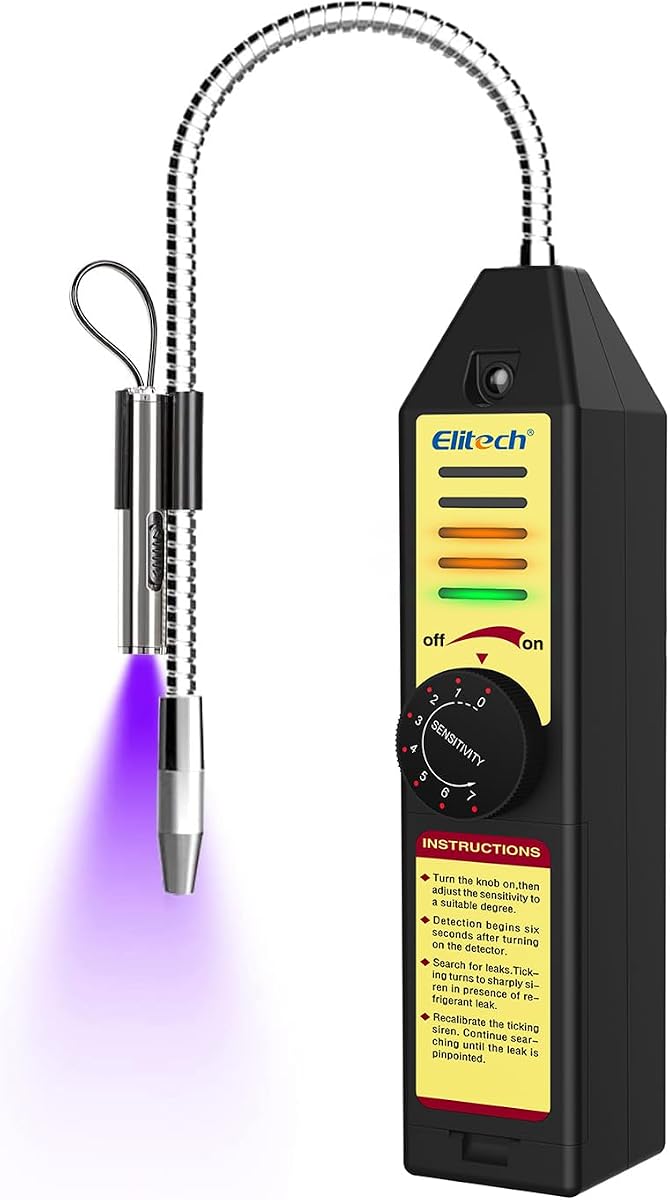
The Elitech WJL-6000S is a straightforward halogen refrigerant detector built for users who want uncomplicated controls. It has a 4.2 rating, a knob for choosing among seven sensitivity levels, and compatibility with R22, R134A, R404A, R410A, R1234YF, and other halogenated gases.
We may earn a commission when you buy through this link, at no additional cost to you.
The detector warms up in six seconds and responds within three seconds after being switched on. Audible and visual leakage indicators communicate the result, while dual battery indicators show operating status. Its 7.9-inch flexible probe provides enough reach for many automotive, residential, and light commercial applications.
This is not the most sophisticated choice because it offers fewer data and alert controls than the TFT-equipped models. It does not include real-time concentration trends, independent vibration alerts, or advanced peak modes. Conversely, the direct knob adjustment and compact format can be easier to learn than a menu-driven instrument.
Choose the WJL-6000S for basic leak checks, learning the process, or adding a straightforward detector to a toolkit. It is most attractive to users who value quick setup and clear indications over detailed diagnostic information.
Turning the knob to select sensitivity makes the device approachable. Users do not need to navigate complex menus to begin an inspection.
Short warmup and response times reduce setup delays. The flexible probe and visual alarm cover the core needs of routine automotive and residential checks.
We may earn a commission when you buy through this link, at no additional cost to you.
The ALD-200 is a premium, professional-grade detector aimed at technicians who work across modern refrigeration systems. It has a 4.4 rating and combines an upgraded heated diode sensor with a rechargeable battery, color display, peak mode, reset function, and a broad gas-detection platform.
We may earn a commission when you buy through this link, at no additional cost to you.
Its three-in-one detection capability is the defining feature. The unit handles A1, A2L, and A3 refrigerants, including R410A, R32, R454B, R290, and R600, as well as hydrogen-nitrogen tracer gas. Maximum stated sensitivity is 0.14 ounce per year, and the beep frequency increases as leak intensity grows.
The smart functions add practical control. Peak Mode captures the maximum leakage reading, while Reset recalibrates the sensor to help minimize false alarms. The 2.8-inch color TFT display remains readable in basements and outdoor work, and the oil- and impact-resistant housing is designed for demanding service conditions. Users must fully charge the unit, allow the sensor to warm up, and perform auto-zero calibration in clean air before beginning.
The ALD-200 is the most complete choice for a technician whose equipment includes newer refrigerants or tracer gas. Its capabilities justify a premium position, particularly for maintenance teams checking heat pumps, commercial refrigeration, air conditioners, and automotive systems.
Coverage extends from legacy CFC, HCFC, HFC, and HFO gases to A2L refrigerants and hydrocarbon refrigerants. Hydrogen-nitrogen tracer support broadens its role in controlled leak-location workflows.
Peak Mode preserves the highest reading encountered, helping technicians compare candidate locations. The reset function restores baseline calibration when environmental conditions shift.
We may earn a commission when you buy through this link, at no additional cost to you.
The POROMETISTO HLD01 combines halogen leak detection with an extended hose, multiple calibration modes, and two kinds of LED assistance. Its 4.5 rating reflects a feature set that is particularly useful in dark mechanical spaces and around congested equipment.
We may earn a commission when you buy through this link, at no additional cost to you.
The color-coded display provides an easy interpretation of concentration: red signals a warning above 85 PPM, yellow indicates caution from 16 to 85 PPM, and green represents the safe range from 0 to 16 PPM. Automatic and manual calibration offer flexibility across different environments, while one-button operation keeps the controls accessible.
The extended hose makes it easier to place the sensing point without holding the entire body close to coils or fittings. Standard and purple LED lights improve visibility in dark areas, and the purple light is intended to help locate leak points. Its stated measurement range is 16 to 200 PPM, which should not be confused with the annual leak-rate sensitivity figures used by many other manufacturers.
Choose the HLD01 when accessible lighting, flexible probe placement, and simple concentration color coding are priorities. It is well suited to maintenance inspection and refrigerant equipment testing, although users should read the manual carefully to understand the displayed measurement range.
Automatic and manual modes let technicians establish a suitable baseline under different conditions. This flexibility is helpful when moving between bright outdoor areas and enclosed rooms.
A standard auxiliary LED brightens dark spaces, while the purple mode is designed to assist leak-point location. Together they reduce the need for a separate flashlight during inspection.
We may earn a commission when you buy through this link, at no additional cost to you.
The GL77A is a portable halogen leak detector with a 3.8 rating, a semiconductor sensor, and a stated maximum sensitivity of 0.49 ounce per year. It supports common refrigerants including R134a, R1234yf, R410a, R22, R404a, R407c, R454b, and R32.
We may earn a commission when you buy through this link, at no additional cost to you.
Its practical features include a high-brightness backlit LCD, audible and visual alerts, reset calibration, automatic power-off, and a UV light for real-time leak visualization. The supplied guidance recommends holding the probe within roughly a quarter inch of the suspected area while moving no faster than three inches per second, emphasizing the need for deliberate close inspection.
The detector is powered by two included AAA batteries, a practical advantage over models that require users to supply cells. The trade-offs are its 30-second automatic warmup and the lowest customer rating in this list. It also uses a more basic control layout with SEL, APO, Celsius-Fahrenheit, and power buttons rather than a full-color analytical display.
The GL77A works best for owners, maintenance staff, and repair technicians who want a portable, immediately ready detector with a UV assist. Confirm that the refrigerant and leak size fall within the stated operating parameters before relying on it for a critical diagnosis.
Two AAA batteries are included, removing a common first-use inconvenience. The backlit screen and automatic shutdown help preserve usability and operating time.
The UV function provides another way to inspect suspected leak points. It complements the audible and visual gas alarms rather than replacing sensor-based readings.
We may earn a commission when you buy through this link, at no additional cost to you.
The Inficon 705-202-G1 is a professional refrigerant leak detector built around a proven heated diode sensor. It has a 4.4 rating, detects CFC, HCFC, HFC, and HFO refrigerants, and carries A2L certification for relevant modern systems.
We may earn a commission when you buy through this link, at no additional cost to you.
Its stated sensitivity is 0.25 ounce per year, while the sensor life is listed at 100 hours. Automatic background adjustment, commonly called zeroing, helps establish the environmental baseline. The product also claims immunity to false alarms from soap solutions, allowing it to be used without the uncertainty that liquid and bubbles can introduce around some components.
The detector runs on two D-cell alkaline batteries rather than a rechargeable system. That trades convenience for straightforward field power and gives the unit a defined replacement cycle for its sensor. The included rugged carrying case also helps protect and organize the detector during transport, while US technical support provides an additional point of contact for setup or service questions.
The Inficon is a strong choice for established service professionals who prefer a known heated-diode platform, broad refrigerant detection, and automatic baseline adjustment. It is less compelling for users prioritizing rechargeable convenience or long sensor life, but its 100-hour specification makes maintenance planning straightforward.
The heated diode design is intended to provide reliable leak checking across common halogenated refrigerants. Automatic background adjustment helps the instrument adapt before a survey begins.
The rugged carrying case supports storage between calls, and the one-hundred-hour sensor figure gives service departments a clear basis for replacement planning.
We may earn a commission when you buy through this link, at no additional cost to you.
The right detector depends on the refrigerants you service, the size of the leaks you need to find, and the information you want while inspecting. Sensor type, sensitivity, calibration, probe design, alerts, and power are more meaningful purchasing factors than feature count alone.
The three main approaches represented here are semiconductor sensors, heated diode sensors, and infrared sensing. The ALD-200, ILD-100H, and Inficon use heated diode technology, which is established for halogen detection and often includes automatic baseline behavior. The Japanese Sensor Detector and GL77A use semiconductor sensing, while the ILD-200 uses infrared technology. These methods are not automatically better or worse; they affect response, interference resistance, operating life, and how the detector is calibrated.
Sensitivity is often expressed as an estimated annual leak rate in ounces per year. The listed figures range from 0.1 ounce per year on the Tadeto, Japanese Sensor Detector, and ILD-100H to 0.49 ounce per year on the GL77A. Lower numerical values generally indicate the ability to register smaller leaks, but actual performance also depends on calibration, probe distance, movement speed, ambient conditions, and whether the refrigerant is supported. The POROMETISTO instead lists a PPM measurement range, which serves a different comparison purpose.
A detector is only useful if it responds to the refrigerant in the system. Common models list R22, R134a, R410A, R404A, and R1234yf, while broader units add R32, R454B, R290, R600a, hydrocarbons, HFOs, and tracer gas. Blends such as R404A, R407C, R448A, R449A, R452A, and R454B are also important. Check the exact list for the target gas rather than assuming that every refrigerant shares the same detection characteristics.
A basic leak alarm answers whether refrigerant is present, while a richer display can show real-time concentration, peak values, battery state, or a trend graph. The Japanese Sensor Detector offers funnel and trend views, and the ALD-200 includes peak mode. The ILD-200 uses a large display with peak orientation information. These additions can help compare candidate leak locations, but they also add interface complexity that may not be necessary for occasional checks.
Audible alarms are effective in normal workspaces but can be difficult to hear around compressors or fans. Visual indicators, backlights, and vibration alerts provide alternatives. The Tadeto combines sound and light with a screen, the Japanese Sensor Detector offers independently controlled sound, light, and vibration, and the ALD-200 uses increasing beep frequency with a mute option. POROMETISTO adds color-coded readings and auxiliary lights for dark areas.
A flexible probe helps technicians place the sensing point around coils, hoses, service ports, and fittings without moving the entire instrument. Probe lengths in this list range from about 7.9 inches on the WJL-6000S to 14.5 inches on the Japanese Sensor Detector, with the Tadeto at 11 inches and the ALD-200 and HLD01 offering extended or flexible positioning. Longer is not automatically better, because a long probe can also be easier to lose or control, so balance reach with maneuverability.
Rechargeable models reduce interruptions and recurring battery expense, while disposable cells can be useful as backups or in locations where charging is difficult. The Tadeto, Japanese Sensor Detector, ALD-200, and HLD01 use rechargeable power. The CLD-100 requires four AAA batteries that are not included, the GL77A includes two AAA batteries, the WJL-6000S relies on disposable cells, and the Inficon uses two D-cell batteries. Review battery life, charging connector, low-battery warnings, and included accessories together.
A clean baseline is essential for meaningful readings. Some models perform automatic calibration, while others provide manual, automatic, or reset options. Warmup times range from six seconds on the Elitech CLD-100 and WJL-6000S to 30 seconds on the Tadeto and GL77A. The ILD-100H states a one-second response after operation begins. Allow the full warmup period, zero the instrument in clean air, and use steady probe movement to avoid confusing rapid changes in concentration with actual leak strength.
Begin by reading the manual, confirming refrigerant compatibility, inspecting the probe and power system, and charging or installing fresh batteries. Work in an area with clean air for startup, switch on the detector, allow the stated warmup period, and wait for automatic calibration or perform the specified zeroing process before approaching equipment.
Begin the search near likely connection points such as valves, fittings, service ports, coils, hoses, and joints. Hold the probe close to the suspected area and move it slowly and uniformly. Pause briefly only when the unit indicates a meaningful change, and use peak readings, trend graphs, color indicators, or changing alert frequency to compare nearby positions rather than relying on a single alarm.
After the inspection, power down the detector and store it in a dry place with the probe protected from sharp bends or impact. Clean the housing and probe according to the manufacturer’s instructions, recharge the unit if it has a built-in battery, and replace the sensor when its specified service life ends. Do not calibrate the instrument in an area where refrigerant is already present, since a contaminated baseline can cause missed or misleading alarms.
A lower stated annual leak-rate specification generally indicates greater sensitivity, but sensor design, calibration, and technique also affect results. The Tadeto, Japanese Sensor Detector, and ILD-100H are listed at up to 0.1 ounce per year. Use the lowest practical sensitivity setting and move the probe slowly in clean air after the detector has stabilized.
No. Detectors are designed for specific refrigerant families, gases, and sometimes particular blends. Most of the listed models cover common CFCs, HCFCs, HFCs, and HFOs, but some also support hydrocarbons, tracer gas, or wider blend lists. Always compare the manufacturer’s supported list with the refrigerant name and blend designation found on the serviced equipment.
Warmup time varies considerably among these products. The Elitech CLD-100 and WJL-6000S specify six seconds, the Tadeto and GL77A require about 30 seconds, and the other models have their own startup procedures. Following the full warmup and clean-air calibration is essential because an unstable baseline can make the unit difficult to trust.
Yes, the sensing point should be close to the component being checked. The GL77A specifically recommends a probe distance of no more than about a quarter inch and a movement speed no greater than three inches per second. Other models provide similar general guidance, so work slowly and compare readings from adjacent locations.
No. A high setting may be useful for pinpointing a small leak, but it can also react more strongly to background contamination or nearby escaping refrigerant. Begin at a normal or lower setting, confirm that the area is clean, and increase sensitivity only when a more detailed search is required.
A figure such as 0.1 ounce per year expresses the detector’s stated capability to register a very small annual leak. A PPM reading expresses a measured concentration near the sensing probe. The two numbers are not directly interchangeable, so comparisons are most meaningful when they use the same measurement method and the same conditions.
Rechargeable power and sensor replacement are separate issues. A rechargeable battery may be reused many times, but the sensing element still has a service life. The Inficon lists a 100-hour sensor life, while the Elitech ILD-200 describes a ten-year infrared sensor life. Check both specifications when budgeting for long-term ownership.
No. A leak detector identifies and helps locate escaping refrigerant, but it does not measure system pressure, evacuate refrigerant, recover refrigerant, or certify the system after repair. Those tasks require the appropriate gauges, service ports, recovery equipment, and procedures. A detector is one diagnostic tool within a complete HVAC service kit.
The Tadeto Rechargeable is the strongest all-around option in this group, combining a 4.8 rating, rechargeable Type-C power, an 11-inch probe, and both digital and audible-visual alerts. The ALD-200 stands out as the premium selection with extensive refrigerant coverage, tracer-gas support, peak mode, and a rechargeable full-day battery, while the Elitech CLD-100 provides the most budget-friendly route into quick, straightforward detection.
Prioritize supported refrigerant types, credible sensitivity, reliable calibration, and the probe design needed for your equipment. Detailed displays, rechargeable batteries, peak tracking, and vibration alerts are valuable for frequent service work, but a simpler detector can be entirely adequate for occasional automotive, residential, or refrigeration checks. Also consider the manufacturer's prescribed warmup and scanning method because correct technique affects the result.
Ratings, availability, and prices can change over time, and the information for each listing may be updated. Before purchasing, confirm the current product title, exact refrigerant compatibility, sensor specification, battery requirements, warranty, included accessories, and current price. Those checks help ensure the chosen detector matches both the system being serviced and the way the tool will actually be used.