
LEILUO 6-Piece Diamond Grout Removal Set
4.5Editor score
Six-piece flat and curved set
Ultra-thin 2.0mm blade profiles
Universal quick-release fitting
Our oscillating tool for grout removal guide compares 10 diamond and carbide blades for fit, cutting width, durability, grout removal, and safer tile work.
Oscillating tool for grout removal is a specialized blade designed to work inside narrow joints without the wide swing of a rotary grinder. A useful blade balances fast material removal, precise control, clean edges, and compatibility with the oscillating multi-tool already in your workshop.
The products in this guide are compared using their stated blade materials, shapes, cutting widths, intended applications, and fitting systems. We cover diamond-grit and carbide options, including flat, crescent, and semicircular designs for damaged grout, mortar, plaster, concrete, and other household renovation materials.
Each review explains the blade's strongest features, limitations, and ideal working conditions. Ratings and product details reflect the supplied information, while compatibility, technique, and intended material should always be checked before use. Product availability and prices can change, so compare current listings before purchasing.
4.5Editor score

4.6Editor score

4.9Editor score
The table below compares all ten blades by abrasive type, set configuration, cutting profile, compatibility, and best use. These differences determine whether an option is better suited to precise joint cleaning, broader grinding, or a varied renovation toolkit.




The LEILUO six-piece diamond blade set is a versatile grout-removal option with a supplied rating of 4.5. It combines flat blades for straight grout lines with curved blades intended for corners and difficult angles. That mix makes it useful for anyone dealing with more than a single failed tile joint or a small patch of damaged grout.
We may earn a commission when you buy through this link, at no additional cost to you.
Its most notable feature is the ultra-thin 2.0mm profile. A narrow blade can enter a tight joint without requiring a wide gap between tiles, which is valuable when the goal is to remove damaged grout while protecting intact porcelain. The diamond grit is intended for controlled removal of old mortar, tile joints, dried thin-set adhesive, and residual wall adhesive rather than indiscriminate demolition.
The principal trade-off is the interface. The set works with major brands such as DeWalt, Makita, Milwaukee, Ryobi, and Porter Cable through a universal quick-release system, but it is not compatible with Bosch or Fein Starlock systems. Dremel tools also require the included C-clip adapters. Users should confirm the exact tool model before ordering rather than assuming that all oscillating tools accept the same fitting.
This set is a strong choice for homeowners undertaking bathroom refreshes, tile repairs, or flooring preparation, especially when several blade shapes would be useful. It also appeals to trade users who want controlled grout removal without committing to a single narrow profile. For a multi-purpose set with thin blades and straightforward diamond-grit cutting, it offers one of the most balanced configurations in this guide.
The thin 2.0mm design is particularly useful when grout is narrow or the damaged section lies close to a tile edge. Work with light pressure and a slight side-to-side motion so the diamond grit engages gradually. This approach helps control the cut and supports the stated goal of protecting surrounding porcelain surfaces.
Flat blades suit straight lines, while curved blades provide access around corners and irregular areas. Having both shapes available makes the set more adaptable than a single-blade option. It can move from selective grout removal to cleaning residual adhesive or preparing a floor substrate for replacement tile.
We may earn a commission when you buy through this link, at no additional cost to you.
The DEWALT DWA4220 is a single-blade, carbide-edged solution designed specifically for grout removal. Its supplied rating of 4.6 makes it one of the strongest-rated products in the guide, while its focused design is easy to understand: install it in a compatible oscillating tool and use it to work through deteriorated grout.
We may earn a commission when you buy through this link, at no additional cost to you.
The key advantage is its universal-fit interface. According to the supplied information, it fits major brands and requires no adapter. That removes a common source of purchasing friction. Instead of researching several fitting systems, buyers can focus on their tool's speed settings and the width and condition of the grout joint they need to clean.
Its limitations come from the simplicity of the package. There is only one blade, so the set does not provide the variety of flat, crescent, or semicircular profiles found in larger diamond-grit collections. Carbide edging is a practical choice for the stated grout-removal task, but this product is not presented as a general collection for aggressive grinding, soft-tile cutting, or wider renovation work.
Choose the DWA4220 when the task is straightforward grout removal and a simple, universally fitting accessory is preferable to a kit of specialty blades. It is also a logical option for buyers who already recognize the DEWALT accessory system. For a purpose-built blade with no adapter requirement, its focused design and strong supplied rating make it an especially confident selection.
An adapter-free universal interface can save time at the shelf and reduce uncertainty when the blade needs to be changed. It also makes the DWA4220 convenient for users with oscillating tools from several major manufacturers. Always check the tool manufacturer's current compatibility guidance before installation.
A dedicated grout blade is easier to select when the job involves renewing failed joints rather than a broad collection of household cutting tasks. The carbide edge is designed for that specific purpose, allowing the user to work directly on deteriorated grout without paying for shapes they may never use.
We may earn a commission when you buy through this link, at no additional cost to you.
The LEILUO six-piece combination set provides three flat diamond blades and three crescent blades. Its supplied rating is 4.4, and its biggest strength is the choice of two working profiles. The flat blades are ultra-thin at 1/16 inch, or 1.6mm, while the crescent blades measure 1/11 inch, or 2.2mm.
We may earn a commission when you buy through this link, at no additional cost to you.
That dimensional difference gives the set a practical decision structure. The thinner flat profile is suited to narrow gaps, while the thicker crescent shape is presented as more appropriate for general grout scraping. High-density diamond grit is intended for stubborn grout, excess concrete in wall pipes, plaster wall cuts, and other household renovation work.
Like the other LEILUO set in this guide, it does not support Starlock systems from Bosch or Fein. Dremel tools require the supplied C-clip adapters. That means the universal quick-release claim should be understood within those stated limits. It is also worth noting that a larger set can be less convenient if storage space is tight or if only one blade shape is needed for a small repair.
This combination set is well suited to DIY renovators who expect to move between narrow-joint cleaning and broader scraping. It can also suit a contractor maintaining a general-purpose multi-tool kit. The two thickness options and two geometries provide a more versatile package than a single-purpose blade while remaining more focused than a nine-piece collection.
The 1.6mm flat blade can reach into tighter spaces where a thicker crescent profile may struggle. The 2.2mm crescent blade offers a different engagement area for general scraping. This makes the set practical when the width of the grout line varies across a repair area.
The diamond grit and crescent geometry make the blades useful for listed masonry and plaster tasks, including cleaning excess concrete and cutting plaster for electrical box installation. These additional uses increase the value of the set for general household maintenance, provided the material falls within the stated applications.
We may earn a commission when you buy through this link, at no additional cost to you.
The XXGO XG3001S is a compact three-piece diamond blade set intended mainly for small grout-removal jobs. With a supplied rating of 4.4, it offers a straightforward option for replacing small areas of failed grout, cleaning joints, and handling light household masonry work.
We may earn a commission when you buy through this link, at no additional cost to you.
Its defining measurement is the approximately 2.3mm thickness. The product information says it works well with 1/8-inch grout lines but is not the best choice for 1/16-inch grout. That distinction is important because a slightly wider profile may be more appropriate in ordinary joints while lacking the clearance needed for very narrow grout lines.
Compatibility requires careful attention. The listing includes many compatible brands, but it specifically excludes several Bosch models, Dremel models, Black and Decker, Craftsman Bolt, DeWalt cordless tools, Fein Multimaster and Supercut systems, Makita Starlock, and other listed systems or uncertain models. Some require an adapter. The set is also not intended to cut tile, granite, hard wall material, or marble.
The XXGO set is most attractive to a user who knows the joint width and tool fitting before buying. It is a sensible compact choice for isolated repairs and small jobs rather than a full renovation package. Check the exclusion list carefully, and choose a thinner or more explicitly universal option if narrow grout, Starlock, or modern cordless-tool compatibility is essential.
The approximately 2.3mm profile performs best around the stated 1/8-inch grout width. It may be too wide for 1/16-inch joints, where a thinner blade can enter more easily. Measuring a representative joint before ordering is one of the most useful checks a buyer can make.
The long compatibility list includes many brands, but the exclusions are equally important. Users with excluded tools should confirm whether an appropriate adapter is available and whether the original manufacturer permits that configuration. This avoids discovering a fitting problem only after the package arrives.
We may earn a commission when you buy through this link, at no additional cost to you.
This three-piece diamond blade set has the highest supplied rating in the guide at 4.9. It includes a straight saw blade, curved saw blade, and semicircular saw blade, allowing one package to cover fine gap cleaning, more efficient grinding, and broader surface work.
We may earn a commission when you buy through this link, at no additional cost to you.
The straight blade is intended to enter narrow gaps and can also cut brick according to the supplied description. The semicircular blade presents a larger grinding area for flat surfaces, while the crescent blade is positioned for more efficient work on floor cement blocks. The product information also states that the embedded diamond grit offers six times longer service life than standard multi-tool blades.
The set is not recommended for Starlock interface systems, even though it otherwise uses a universal quick-release design. Claims of durability and extended service life should be treated as product specifications rather than guarantees, because abrasive life depends heavily on material hardness, pressure, speed, and cleaning habits.
This is a compelling pick when one oscillating tool needs to cover several renovation tasks. The three geometries are more versatile than a flat-only kit, while the package remains simpler than the largest multi-piece collections. It is especially relevant to bathroom renovation, flooring corrections, defective grout removal, mortar cleanup, porous concrete cleaning, and planked-deck joint work.
The straight blade concentrates on narrow access, the semicircular form increases contact with flat surfaces, and the crescent shape supports more efficient grinding. Rather than forcing one profile into every job, selecting the appropriate shape reduces unnecessary pressure and makes the tool easier to control.
The 4.9 supplied rating makes this set stand out in the comparison, but rating should not be confused with a guarantee of universal compatibility or equal life in every material. The Starlock warning should be checked before purchase, and the advertised durability is most relevant to appropriate working conditions.
We may earn a commission when you buy through this link, at no additional cost to you.
The EZARC three-pack uses diamond-grit oscillating saw blades designed for grout, mortar, plaster, porous concrete, and planked-deck joints. Its supplied rating is 4.3, placing it among the well-regarded products in this roundup without leading the category outright.
We may earn a commission when you buy through this link, at no additional cost to you.
The key technical feature is the narrow cutting width. The product information gives a kerf of approximately 1/16 inch, or 1.6mm, and emphasizes precise, clean cutting in corners and along edges. This makes the blades attractive for removing defective grout while keeping the working area narrow. The stated diamond grit is also advertised as lasting five times longer than carbide grit blades in tough applications.
The included adapters broaden the fit options. According to the listing, the set is compatible with many brands, including DeWalt, Dremel, Milwaukee, Fein, Bosch non-Starlock models, Makita, Genesis, Ridgid, Craftsman, Rockwell, Black & Decker, Porter-Cable, Worx, AEG, and Ryobi. The exact adapter for a given tool should still be identified before installation.
This three-pack is a good choice for precise joint work and edge corrections where a narrow blade is more valuable than aggressive grinding. It also suits homeowners who want a compact kit and a few adapters without purchasing a large collection. For users willing to change technique and maintain the blade, its narrow diamond-grit profile offers an appealing balance of control and material capability.
The approximately 1.6mm kerf allows the blade to enter a confined joint with less interference from the surrounding tile edge. That geometry is particularly useful for short cuts, localized grout failures, and areas where a wider aggressive blade would have less room to maneuver.
Two included adapters make the package usable with a broader group of oscillating multi-tools. They also require more care during installation because the correct adapter, orientation, and clamping position must be correct. Check both the tool and blade before tightening.
We may earn a commission when you buy through this link, at no additional cost to you.
The EZARC four-pack is built around a useful choice of three kerf widths: 0.06 inch, 0.07 inch, and 0.09 inch, equivalent to 1.6mm, 1.8mm, and 2.2mm. Its supplied rating is 4.3, while its combination of shapes and widths makes it more adaptable than a single-profile grout blade.
We may earn a commission when you buy through this link, at no additional cost to you.
The narrowest option supports precise work, while the wider choices allow more aggressive grinding without treating them as interchangeable. The listing says the range can remove tough grout between tiled surfaces and work on cement, grit, and mortar. It also describes the diamond-grit blades as lasting five times longer than carbide-grit blades in tough applications.
Compared with the other EZARC set in this guide, this package emphasizes variety through its three kerf choices. That makes it a better fit for users who expect differences between narrow joints and broader grinding tasks. The supplied information does not detail included adapters, so compatibility should be verified directly against the tool rather than inferred from the presence of an oscillating interface.
Choose this four-pack for a renovation kit that needs both controlled cutting and more substantial grinding. It can serve bathroom renovation, flooring work, trimming, corrections, mortar cleanup, and maintenance around the home. It is less attractive for someone who needs only one narrow grout blade, but the wider selection is a practical advantage when joint measurements and task types vary.
The 1.6mm profile is appropriate where clearance is limited, while the 1.8mm and 2.2mm profiles offer progressively greater material engagement. Keeping these widths separate allows the user to match the blade to the joint and task rather than using the most aggressive profile everywhere.
This set is designed to span both precise cutting and aggressive grinding. The range is useful when a project begins with narrow grout cleanup and continues into cement or mortar correction. A lower speed and light pressure remain important when moving from controlled work to heavier material removal.
We may earn a commission when you buy through this link, at no additional cost to you.
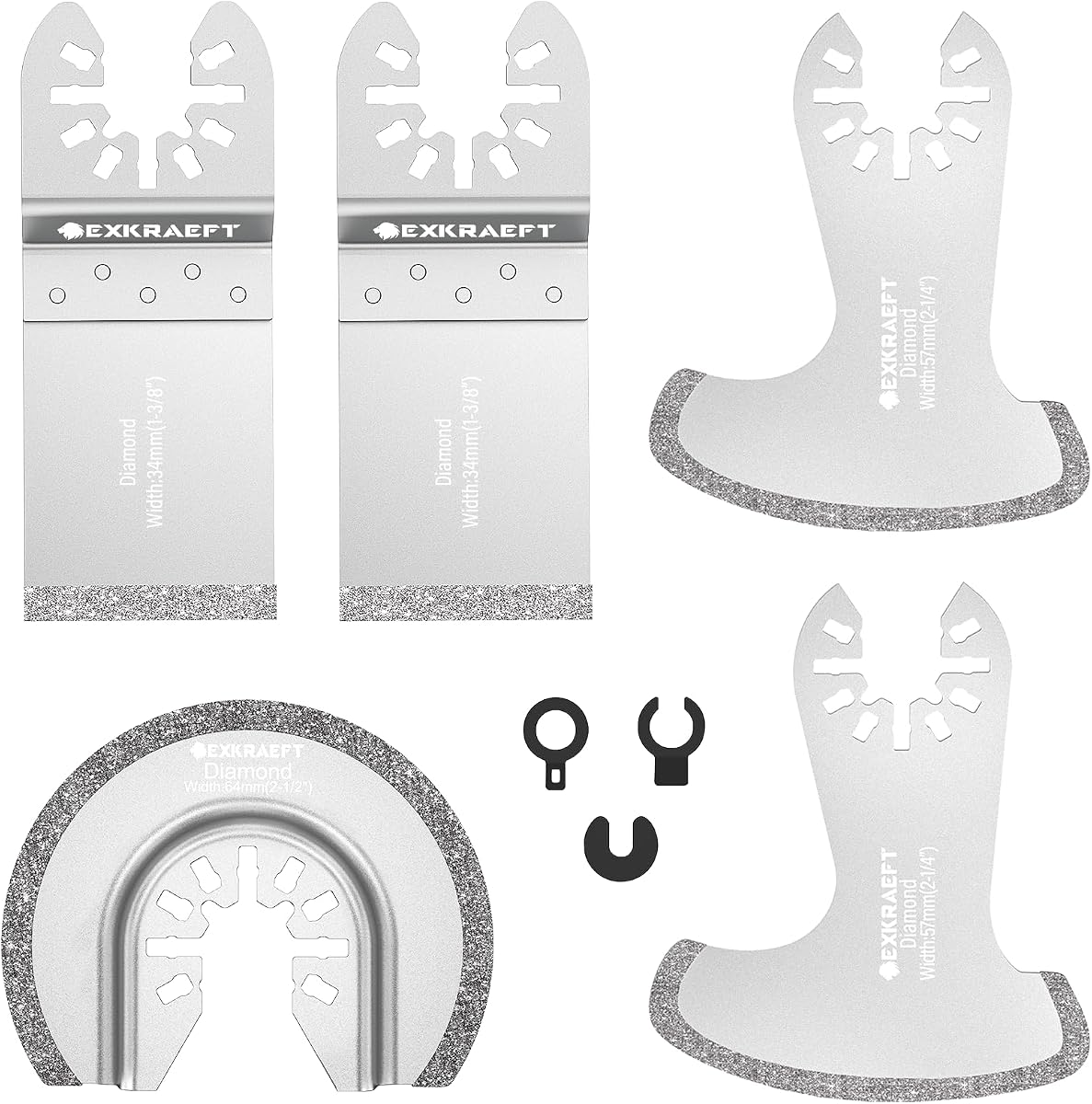
The EXKRAEFT five-piece set includes two flat diamond saw blades, one semicircular blade, and two crescent blades. With a supplied rating of 3.9, it is the lowest-rated option in this guide, but the package configuration gives it value for jobs that combine narrow-gap work with floor and concrete grinding.
We may earn a commission when you buy through this link, at no additional cost to you.
Flat blades are assigned to brick cutting and narrow-gap cleaning, the semicircular blade to sanding larger flat surfaces, and crescent blades to faster grinding of floor concrete. The product information also states that industrial-grade diamond grit is designed to outlast an ordinary oscillating blade by six times in suitable applications.
The fitting system is described as compatible with more than 98 percent of oscillating tools, with three adapter clips included for brands such as DeWalt, Bosch, Fein, Milwaukee, and Ryobi. This broad claim should still be checked against the user's exact model, especially when the tool uses a proprietary interface.
This set is best for a mixed renovation kit rather than a single delicate grout-cleaning task. It is useful for bathroom remodels, flooring, soft-tile work, plaster, porous concrete, and planked-deck joints. Its lower supplied rating warrants careful expectation-setting, but the five-piece arrangement and range of geometries can still deliver good utility when the correct blade is chosen for each material.
Flat blades address narrow gaps, crescent blades suit more efficient floor-concrete grinding, and the semicircular blade covers broader flat surfaces. This division of labor makes the set practical for a renovation that moves between joint cleanup, substrate correction, and general masonry work.
The three supplied clips are intended to support a wide range of tools, but the actual attachment method depends on the interface. Confirm the oscillating tool model, identify the correct clip, and ensure the blade is fully clamped before applying power. Compatibility should never be assumed from brand recognition alone.
We may earn a commission when you buy through this link, at no additional cost to you.
The nine-piece diamond blade set offers the broadest configuration in the guide. Its supplied rating is 4.5, and the assortment is built to cover precise cutting, short cuts, corner access, intensive cutting, grout removal, and soft-tile work. The package is therefore less of a single-purpose grout accessory and more of a general renovation blade collection.
We may earn a commission when you buy through this link, at no additional cost to you.
Its defining design feature is the flat-side swing profile. According to the product information, this construction helps the blade enter tight corners, which is important when the grout line meets a wall, cabinet, trim, or another obstruction. Semicircular blades are intended for intensive cutting, while the approximately 2mm kerf supports a controlled cut without being the narrowest option in the guide.
The stated applications include bathroom renovation, flooring, trimming, corrective work, grit and grout removal, mortar cleanup, and household maintenance. Diamond grit is advertised as lasting five times longer than carbide grit blades in tough applications, though real abrasive life varies with technique and material.
This is a strong choice for a well-equipped workshop, a contractor building a general-purpose oscillating-tool kit, or a homeowner with several planned projects. It may be excessive for one small grout repair because the number of blades creates more storage and selection decisions. Its strength is having the right specialized shape close at hand as the scope of the project changes.
The flat-side swing design is intended to let the blade work into corners where a conventional narrow edge would have limited access. This is valuable during bathroom work or tile corrections close to fixed surfaces. Slow, controlled passes and a clean section of grout make access easier to judge.
Nine blades make this set most useful when a project may include grout, mortar, soft tile, plaster, cement, and edge correction. Instead of repeatedly changing between separate accessory packs, the user can select a profile that matches the work. Buyers with only one small repair should weigh that flexibility against simpler sets.
We may earn a commission when you buy through this link, at no additional cost to you.
The DEWALT Dwa4219 is a single oscillating carbide blade created for grout removal. It carries a supplied rating of 4.6, placing it among the most highly rated products here, and its appeal is built on straightforward installation and a narrowly defined purpose.
We may earn a commission when you buy through this link, at no additional cost to you.
The universal-fit interface is designed for major brands and requires no adapter according to the supplied information. Carbide edging provides the cutting profile for removing failed grout, while the single-blade format makes the accessory easy to identify and store. It is a natural alternative for anyone who wants a dedicated grout blade rather than a kit with several profiles.
Because only one blade is included, the Dwa4219 does not provide the flexibility of the diamond-grit sets in this guide. It does not advertise narrow, medium, and wide choices, nor does it include a crescent or semicircular shape for broader grinding. Buyers should therefore confirm that grout removal is the main task before choosing this focused product.
The Dwa4219 is best for straightforward grout renewal with a compatible oscillating multi-tool. It may also serve as a convenient dedicated replacement or keep-in-the-toolbox accessory. For a single-purpose job, its simplicity can be more valuable than a larger set, and the 4.6 supplied rating supports its position as a solid focused choice.
A dedicated grout blade avoids the need to sort through multiple shapes and widths. That makes the Dwa4219 useful for a quick repair or as a separate accessory reserved for grout. Its straightforward specification also makes it easy to compare against other single-purpose carbide options.
The stated universal-fit design removes the need for a separate adapter on major brands. Users should still verify the exact tool model and follow the multi-tool manufacturer's attachment instructions. A correct fit and secure clamp are essential before the blade is powered.
We may earn a commission when you buy through this link, at no additional cost to you.
The most useful blade is the one that fits the tool, matches the grout width, and is designed for the material being removed. Compare interface systems, blade geometry, cutting width, abrasive type, and intended applications before making a selection.
Oscillating multi-tools use several mounting systems, and visual similarity does not guarantee a secure fit. The DEWALT products described here use a universal-fit interface and require no adapter, while many diamond-grit sets use quick release systems. The XXGO set lists numerous exclusions, and several LEILUO sets are not compatible with Bosch or Fein Starlock systems. Check the exact model, mounting method, and manufacturer guidance before ordering.
Choose only a blade that explicitly supports your tool or comes with the correct adapter. Confirm that the adapter fully secures the blade, and never force an uncertain fitting.
A blade that cannot enter the joint cannot remove the grout cleanly, and an overly wide blade may chip nearby tile. The LEILUO six-piece set uses an ultra-thin 2.0mm profile, the combination set includes 1.6mm and 2.2mm blades, and the XXGO set is described as best for 1/8-inch grout but not ideal for 1/16-inch grout. Measuring several points around the project gives a more useful picture than estimating from one location.
Use a narrow profile for restricted access and a wider one for more material engagement. Purchase a set with multiple widths when joint sizes vary.
Diamond-grit blades are presented in this guide for demanding grout, mortar, plaster, concrete, and related renovation work. They offer different profiles and can support both precision and grinding tasks. Carbide-edged blades such as the DEWALT DWA4220 and Dwa4219 are focused accessories designed for grout removal. The better choice depends on the material, the number of repairs, and the breadth of tasks expected.
Select carbide for a straightforward grout job and diamond grit for a varied renovation kit. Neither abrasive should be treated as suitable for every surface.
Flat blades are narrow and useful for entering joints. Curved or crescent blades provide a different working shape and can be more efficient in broader scraping or grinding. Semicircular blades expose a larger area for flat-surface work. The three-shape set and the larger multi-piece collections make it possible to change geometry as the job moves from one stage to another.
Flat blades suit conventional joint lines, while broader shapes help with exposed surfaces and hard-to-reach areas. Use the shape that provides access without forcing the blade against tile.
A grout blade may also encounter mortar, plaster, thin-set adhesive, cement, concrete, or soft tile. Some products explicitly exclude hard materials such as tile, granite, marble, and hard wall surfaces. The XXGO set, for example, is primarily for grout and is not intended to cut those harder materials. Selecting a broader diamond-grit blade can make a renovation easier when residue extends beyond the grout line.
List the likely materials before buying. Use a dedicated grout blade for grout and a multi-material diamond set when the project also involves plaster, mortar, concrete, or soft tile.
A single blade is convenient for one specific repair, while a set offers better readiness for changing tasks. The two DEWALT products contain one blade each, the XXGO and EZARC options offer three-piece configurations, and the larger sets contain five or nine pieces. More blades are not automatically better because unused shapes add storage and selection requirements. The ideal package contains the profiles needed for the actual work.
For one recurring grout task, a focused blade may be sufficient. For a contractor or multi-project homeowner, several shapes and widths provide better long-term versatility.
Several diamond blade descriptions recommend lower or medium speed, light pressure, and a side-to-side motion. This technique allows more of the diamond edge to contact the material without concentrating excessive force on one point. It can also reduce overheating and premature dulling. The correct speed still depends on the multi-tool and the material, so follow the tool manufacturer's guidance and the blade instructions.
Begin at a lower setting, keep the blade moving, and increase pressure only when necessary. Constant pressure is rarely the best way to improve cutting performance.
Several listings compare the life of diamond-grit blades with standard or carbide-grit blades, using claims such as five or six times longer service life. These are product-specific durability claims, not guarantees for every material or technique. Abrasive life depends on hardness, contact pressure, speed, cleaning, and whether the blade is allowed to cool.
Treat durability claims as relative guidance. A well-maintained blade used with the recommended technique is more likely to perform consistently than one forced aggressively through hard material.
Before starting, confirm that the blade and interface are compatible, inspect the blade for damage, and read the multi-tool manufacturer's operating instructions. Secure the tool, clear the work area, wear appropriate eye protection, and make sure the blade can enter the joint without touching the surrounding tile. Use a lower or medium speed for diamond-grit blades as recommended, and begin with light pressure.
Place the blade at a shallow angle in the damaged grout and allow the oscillation to engage the edge. Move slowly along the joint while using a slight side-to-side action, particularly with diamond-grit blades, so more cutting points contact the material. Work in short sections rather than trying to remove a long area at once. Keep fingers away from the moving blade, support the tool without forcing it, and maintain control around corners and edges.
After use, switch off the tool and allow the blade to stop before removing it. Clean accumulated dust and debris according to the blade and tool instructions, allowing hot components to cool where necessary. Inspect the edge for chipping or loss of grit, store the blade in a dry place, and replace it when it no longer cuts cleanly. Product availability, included accessories, and current prices can change, so verify the final listing before purchase.
The best blade depends on the joint width, tool interface, and amount of material. A narrow flat diamond blade offers precise access, while a broader crescent or semicircular shape handles more aggressive grinding. A dedicated carbide blade is also a practical choice for straightforward grout renewal. Match the profile to the joint and confirm compatibility before buying.
It can, but control matters more than force. Use a blade that fits comfortably within the joint, work at a low or moderate speed, and keep the blade moving with light pressure. Avoid pushing directly against a tile edge, and change to a thinner profile if the blade cannot enter freely. A wide blade is not suitable for a narrow joint simply because it cuts quickly.
Diamond-grit blades are generally presented as more versatile and durable for hard grout, mortar, plaster, and concrete, while carbide blades provide a focused and straightforward grout-removal option. The best choice depends on the material and the breadth of the project. A dedicated grout repair may not justify a large multi-blade diamond set.
No. Oscillating tools use different mounting interfaces, including universal-fit, quick-release, Starlock, and tool-specific arrangements. Some products include adapters, while others explicitly exclude certain brands or models. Identify the exact multi-tool model and verify the required attachment method before ordering or installing a blade.
A narrower blade is generally better for tight joints because it has more clearance between the tile edges. The LEILUO combination set includes a 1.6mm flat blade, and the EZARC three-pack also uses an approximately 1.6mm kerf. The XXGO set is not best for 1/16-inch grout, demonstrating why measuring the joint before purchasing is important.
Lower or medium speed is commonly recommended for the diamond-grit blades in this guide. It helps the user maintain control and allows the cutting edge to work without concentrating excessive force. Follow the multi-tool manufacturer's speed guidance, begin cautiously, and use light pressure. If the blade overheats, glazes, or chips, stop and reassess the technique.
Many diamond-grit sets are designed for mortar, plaster, concrete, cement, and related cleanup in addition to grout. Dedicated carbide blades are more narrowly focused on grout removal. Check each product's listed applications and exclusions, especially when working near hard tile, granite, marble, or structural wall surfaces.
Use light pressure, keep the blade moving, and clean accumulated material after each task according to the manufacturer's guidance. Let hot components cool, inspect the cutting edge for damage, and store the blade dry. Replace it when the edge no longer cuts cleanly or when the profile has chipped, because forcing a worn blade can endanger the tile and tool.
The LEILUO six-piece diamond set stands out for its combination of thin profiles, flat and curved geometries, and compatibility with many major multi-tool brands. The DEWALT DWA4220 is the most focused choice for straightforward grout removal, while the three-shape diamond set offers the highest supplied rating and broad geometry coverage. Each approach is valid, but the best pick depends on the width of the joint and the materials involved.
Prioritize interface compatibility first, then match the blade geometry and cutting width to the work. Diamond-grit sets are more versatile for hard grout, mortar, plaster, concrete, and soft-tile tasks. A dedicated carbide blade is simpler for a recurring grout job. If several joint sizes and surfaces are present, a mixed set is usually more practical than forcing one profile to handle every stage.
Before making a final purchase, verify the exact tool model, measure representative grout lines, and review the manufacturer's material exclusions. Ratings, product contents, availability, and prices can change, so check the current listing and compare it with the job ahead. The best blade is the one that fits securely, reaches the joint cleanly, and is used with a controlled, well-maintained technique.