
Kingston NV3 1TB
4.7Editor score
PCIe 4.0 Gen 4×4 interface
Up to 6000 MB/s reads
Includes Acronis cloning
Our NVME Ssds for Linux guide compares 10 fast M.2 drives for speed, capacity, thermals, Linux compatibility, and everyday value with confidence.
NVMe SSDs can transform a Linux system by reducing boot times, accelerating package installation, and making heavy multitasking feel more responsive. A capable drive also matters when compiling software, editing media, running virtual machines, or managing large development projects. The right M.2 drive balances throughput, thermal behavior, endurance, and compatibility.
This guide compares ten NVMe SSDs commonly considered for Linux desktops, workstations, and compatible laptops. The evaluation focuses on the supplied interface and speed specifications, capacity options, power characteristics, thermal features, management utilities, and likely workload fit. PCIe 4.0 models offer broad practicality, while PCIe 5.0 options target systems and software that can exploit their greater bandwidth.
Each pick highlights the qualities that distinguish it within the list, from practical everyday storage to enthusiast performance. Ratings and product details reflect the supplied marketplace information, while the analysis considers practical Linux use rather than claiming hands-on testing. Availability and prices change frequently, so verify the current listing and system requirements before purchasing.
4.7Editor score

4.7Editor score

4.7Editor score
The table below compares all ten drives by interface, headline speed, capacity, and the feature most likely to matter to a Linux buyer, making it easier to compare practical and enthusiast options.



The Kingston NV3 1TB is a straightforward and highly relevant choice for Linux users who want modern NVMe performance without moving to the newest interface generation. Its 4.7 rating reflects a strong marketplace reception, while the advertised Gen 4×4 connection and maximum sequential read speed of 6,000 MB/s place it comfortably within the mainstream high-performance category.
We may earn a commission when you buy through this link, at no additional cost to you.
Its most attractive features are practical rather than spectacular. Kingston describes the drive as optimized for high speed and low power, which makes it a sensible fit for desktop builds and compatible laptops that also need to balance responsiveness with energy use. The included Acronis cloning software helps when migrating an existing Linux installation, and the five-year limited warranty adds useful reassurance for a drive that may hold operating systems, applications, and personal files.
The tradeoff is that the NV3 does not reach the headline transfer rates of the fastest Gen4 models, nor does it offer the bandwidth of PCIe 5.0 drives. A Linux user is unlikely to see that difference during routine desktop use, although large sequential transfers and other specialized workloads may reveal it. Its position is strongest when broad compatibility and sensible throughput matter more than maximum benchmark results.
Choose the Kingston NV3 1TB for a mainstream Linux desktop, a development machine, or a laptop upgrade that supports M.2 2280 NVMe storage. It is a compelling practical recommendation when you want Gen4 performance, cloning assistance, and strong everyday speed without paying for a premium enthusiast drive.
The included Acronis cloning software can simplify moving an existing operating system and its data to the new drive. Compatibility should still be confirmed with the Linux distribution, partitioning tools, and the target computer before cloning.
The drive's advertised high-speed, low-power design is useful in systems where energy efficiency matters. Its Gen4x4 interface also avoids the compatibility complexity associated with early Gen5 platforms.
We may earn a commission when you buy through this link, at no additional cost to you.
The Samsung 9100 PRO 2TB represents the premium end of this Linux SSD guide, combining PCIe 5.0 x4 bandwidth with a 4.7 rating. Its headline sequential speeds reach 14,700 MB/s for reads and 13,400 MB/s for writes, giving Linux workstations a clear path to handling very large files and demanding multitasking workloads.
We may earn a commission when you buy through this link, at no additional cost to you.
Random performance is another major strength. Samsung lists up to 1,850K read IOPS and 2,600K write IOPS, alongside support for demanding game loads, AI applications, content creation, and video editing. The 2TB capacity is also more generous than many 1TB alternatives, reducing the need to move active projects to secondary storage. For users who regularly work with large datasets, the combination of bandwidth and capacity is particularly compelling.
Gen5 speed introduces important trade-offs. The drive needs compatible hardware, and its 5nm controller plus advanced thermal control are designed to sustain performance when heat becomes a factor. A motherboard with a suitable M.2 slot, adequate cooling, and a capable platform is needed to realize the full advertised potential. Linux users should also confirm that the chosen board, firmware, and kernel support the device as expected.
Samsung Magician Software rounds out the package with firmware updates, encryption, and ongoing health monitoring. The 9100 PRO 2TB is the recommendation for high-end Linux workstations, ambitious creators, and enthusiasts who can exploit the latest interface. For a standard workstation, a top-performing Gen4 drive may offer a more balanced experience.
Large sequential transfers and latency-sensitive tasks are where Gen5 bandwidth can have the clearest effect. The 2TB capacity also allows operating systems, applications, libraries, and project files to remain together without frequent cleanup.
Magician Software provides health monitoring, firmware updates, and encryption features. Samsung's advanced thermal control and efficient 5nm controller help the drive manage the heat generated by sustained high-bandwidth workloads.
We may earn a commission when you buy through this link, at no additional cost to you.
The Sandisk Optimus 5100 500GB is a compact option for Linux users who need a fast boot drive, scratch disk, or secondary working volume. Its 4.7 rating and PCIe 4.0 specification place it among well-regarded modern drives, while the 500GB capacity makes it better suited to focused installations than expansive media libraries.
We may earn a commission when you buy through this link, at no additional cost to you.
Sandisk advertises read speeds up to 7,100 MB/s for the larger capacities and write speeds up to 6,700 MB/s for 1TB through 4TB models. Because the reviewed unit is 500GB, buyers should not assume it delivers every headline figure shown for the range. The drive uses eighth-generation Sandisk BiCS QLC 3D CBA NAND, and its new power-efficient design is intended to support productive mobile workflows.
For creator applications, the stated endurance reaches as high as 1,200 TBW on the 4TB model, which reflects the range's broader endurance positioning. Downloadable Sandisk Dashboard software supports monitoring and updates. The main limitation is obvious capacity: 500GB can fill quickly under Linux with a desktop environment, several development environments, containers, and locally stored media.
This drive makes the most sense for a small Linux laptop, a lightweight build, or a dedicated cache and scratch-disk role. It is less suitable as the only drive in a creative workstation unless the user carefully manages storage. Its combination of efficiency, strong specifications, and manageable size gives it a distinct place in the list.
The 500GB format suits smaller laptops and secondary-drive installations where space is constrained. Its power-efficient design is particularly relevant to mobile Linux workflows that benefit from fast storage without excessive energy use.
Some maximum speed and endurance figures apply only to larger members of the product family. Linux buyers choosing the 500GB version should review its exact specifications rather than relying on the range's top-line numbers.
We may earn a commission when you buy through this link, at no additional cost to you.
The Samsung 990 PRO 2TB is a high-capacity Gen4 drive suited to Linux users who want mature interface support and near-maximum performance. It carries a 4.7 rating and advertises sequential read and write speeds of up to 7,450 MB/s and 6,900 MB/s, making it one of the fastest options that can work with a broad range of modern desktop platforms.
We may earn a commission when you buy through this link, at no additional cost to you.
The supplied product information highlights a more than 55% random-performance improvement over the 980 PRO. Samsung also claims up to 50% better performance per watt, which matters for laptops and power-conscious desktops. The drive supports workloads ranging from gaming and video editing to data analysis, and its 2TB capacity is useful for larger Linux installations, development repositories, and creative archives.
Compared with a PCIe 5.0 model, the 990 PRO does not offer the same peak bandwidth. It may also require a platform with a PCIe 4.0 M.2 slot, although its interface is generally more accessible than the newest generation. Thermal behavior and sustained performance depend on the host system, case airflow, and workload, so adequate cooling remains important.
This is an excellent recommendation for a Linux workstation that already has Gen4 infrastructure or does not need Gen5. It offers more room than 1TB alternatives while retaining the compatibility advantages of PCIe 4.0. Users building a new high-end system around Gen5 may prefer the 9100 PRO, but for many Linux professionals the 990 PRO 2TB provides the more balanced path.
Two terabytes is a useful size for local development repositories, virtual machine images, creative media, and installed applications. It reduces the frequency of moving less frequently used data to external or secondary storage.
The claimed performance-per-watt improvement makes this drive relevant to laptops and compact systems. Actual results still depend on the processor, power profile, workload, and thermal environment.
We may earn a commission when you buy through this link, at no additional cost to you.
The Crucial P310 2TB is a versatile PCIe 4.0 SSD for Linux desktops, laptops, and compatible handheld gaming devices. Its 4.7 rating is backed by straightforward specifications: up to 7,100 MB/s sequential reads and 6,000 MB/s writes. That performance is more than sufficient for quick Linux bootups, application launches, game loading, and general multitasking.
We may earn a commission when you buy through this link, at no additional cost to you.
Compatibility is one of the model's strongest selling points. Crucial states that the drive works in laptops and desktops, supports select gaming consoles such as the ROG Ally X, Lenovo Legion Go, and AYANEO Kun, and is backward compatible with PCIe 3.0 systems. That flexibility makes it a sensible option for a mixed hardware collection or an upgrade path that does not yet support newer interfaces.
The drive uses Micron G8 NAND and includes thermal control intended to support consistent Gen4 performance. Acronis data recovery software is also included, although users should understand its operating-system requirements and maintain current backups. Real-world application launches are rarely limited by the theoretical difference between this drive and the fastest Gen4 model, especially when the CPU or storage bus is the limiting factor.
For a home Linux user, casual gamer, or general productivity system, the P310 2TB offers a good capacity and compatibility balance. The two-terabyte capacity is valuable for operating systems, applications, game libraries, and personal files. It is less compelling for specialized high-bandwidth pipelines, but its broad platform support makes it an adaptable mainstream recommendation.
Backward compatibility with PCIe 3.0 systems gives the P310 a wider deployment range. Linux builders should still check the laptop or motherboard manual for physical size, mounting, and supported M.2 storage details.
The 2TB capacity provides room for a full Linux desktop, applications, and active project files. Included Acronis data recovery software adds a recovery option, provided its requirements are compatible with the intended operating system.
We may earn a commission when you buy through this link, at no additional cost to you.
The Samsung 9100 PRO 1TB delivers the same headline PCIe 5.0 performance as the larger model while offering a more compact 1TB capacity. Its 4.7 rating and advertised speeds of up to 14,700 MB/s read and 13,300 MB/s write make it a top choice for compatible Linux workstations designed around the newest storage standard.
We may earn a commission when you buy through this link, at no additional cost to you.
The drive's random performance reaches up to 1,850K read IOPS and 2,600K write IOPS. Those figures support responsive multitasking, large file access, AI applications, game loading, and content creation. A 5nm controller is claimed to improve power efficiency by as much as 49% over the 990 PRO, while advanced thermal control is intended to keep performance consistent during demanding activity.
The main limitation is 1TB capacity. While sufficient for the Linux operating system and many applications, it can become restrictive when storing large game libraries, high-resolution footage, container images, or virtual machines. Users should also budget for a Gen5-capable motherboard, processor platform, M.2 slot, and adequate cooling. Merely inserting the drive into a Gen4 slot will not unlock its full bandwidth.
This 1TB model is most attractive for builders who already own a modern Gen5 platform and need a fast primary operating-system drive. It is a better fit than the 2TB version when immediate responsiveness and throughput matter more than maximum local storage. Samsung Magician adds firmware updates, encryption, and drive-health monitoring for ongoing management.
A Gen5 motherboard and compatible processor are essential if the advertised peak performance is the objective. Check the board manual for slot generation, lane sharing, and cooling requirements before installation.
High sequential and random performance benefits Linux users who move large assets or run many concurrent applications. The 1TB capacity is best reserved for the operating system and frequently used tools rather than a large archive.
We may earn a commission when you buy through this link, at no additional cost to you.
The Acer Predator GM7 1TB combines strong Gen4 bandwidth with an enthusiast feature set. Its 4.7 rating and stated speeds of up to 7,400 MB/s read and 6,500 MB/s write place it close to the upper end of PCIe 4.0 performance, while its M.2 2280 and NVMe 2.0 design make it a natural fit for modern gaming and desktop platforms.
We may earn a commission when you buy through this link, at no additional cost to you.
Support for Host Memory Buffer and SLC cache is intended to improve responsiveness during everyday file operations. The drive also uses a modern controller and flash to balance performance with lower power and heat. For Linux, automatic thermal throttling and power management are useful because they allow the drive to regulate itself when a compact case or laptop limits cooling.
Biwin Intelligence provides performance testing, data migration, drive cloning, and other management functions. However, Linux users should verify current operating-system support for this utility before relying on it for routine management. Standard Linux disk tools remain important, and a drive can function correctly without vendor software even when a particular graphical utility is unavailable.
The GM7 is a good fit for a gaming-oriented Linux desktop, content workstation, or compatible laptop that supports M.2 2280 drives. It provides more specialized tools than many alternatives without requiring PCIe 5.0. Its 1TB capacity is modest for large libraries, but its speed, cache features, and thermal management make it an appealing enthusiast Gen4 choice.
HMB and SLC cache support are designed to improve responsiveness beyond simple sequential throughput. Thermal throttling and power management can also help maintain stability in systems with limited airflow.
Biwin Intelligence includes benchmarking, cloning, and migration tools. Linux buyers should confirm compatibility and available features before selecting the drive specifically for its software, because standard Linux tools provide broader day-to-day control.
We may earn a commission when you buy through this link, at no additional cost to you.
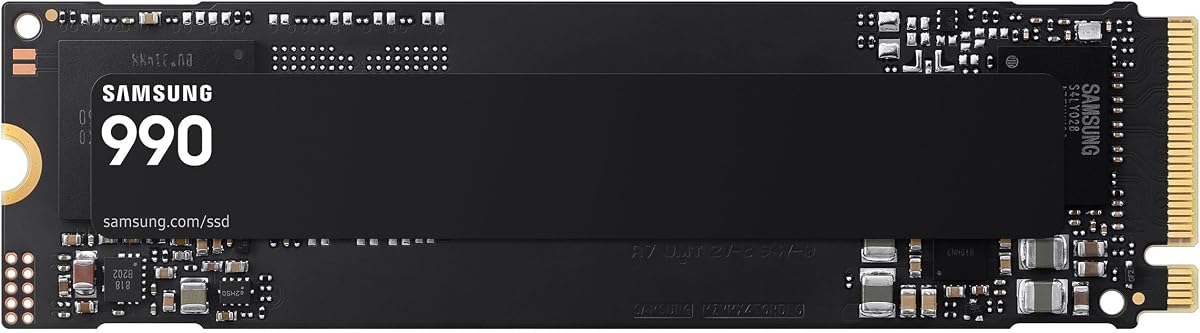
The Samsung 990 PRO 1TB is our editor's choice because it combines near-maximum PCIe 4.0 performance, established management features, and a capacity that works well for a primary Linux installation. The drive has a 4.7 rating and advertised sequential speeds of 7,450 MB/s read and 6,900 MB/s write, placing it among the fastest broadly compatible options in the guide.
We may earn a commission when you buy through this link, at no additional cost to you.
Random performance is also strong. Samsung specifies up to 1,400K read IOPS and 1,550K write IOPS, improvements of 40% and 55% over the 980 PRO in random workloads. The claimed performance-per-watt gain supports use in both desktops and laptops, while the nickel-coated controller and slim M.2 2280 format assist with thermal management and physical fit.
The main constraints are familiar: one terabyte may be insufficient for extensive game or media libraries, and a Gen5 drive can offer more bandwidth for specialized workloads. The product information also notes compatibility with the PCI-SIG D8 standard, so users should check the physical and electrical requirements of their laptop or motherboard before ordering.
Samsung Magician provides drive-health monitoring, optimization tools, and firmware updates, making the package more complete than that of many alternatives. For a capable Linux laptop, a modern gaming PC, or a workstation that values Gen4 efficiency without Gen5 complexity, this 1TB model offers an outstanding balance.
High sequential throughput accelerates large file transfers, while strong random performance helps application launches, package operations, and multitasking feel more immediate. Both characteristics matter in a Linux environment where many small operations may occur during normal use.
Samsung Magician supports health monitoring, optimization, and firmware updates. Linux users should confirm the current version's platform requirements and retain access to standard command-line tools for routine administration.
We may earn a commission when you buy through this link, at no additional cost to you.
The Samsung 990 1TB is a modern high-speed option with the highest listed rating in the comparison at 4.8. Its advertised sequential performance reaches 7,150 MB/s for reads and 6,450 MB/s for writes, providing ample speed for a Linux system that needs fast startup, application access, updates, and large-file workflows.
We may earn a commission when you buy through this link, at no additional cost to you.
Random read and write performance reaches up to 700K and 1,100K IOPS. The drive also claims up to 38% better performance per watt than the 990 PRO, an attractive figure for laptops and PCs where responsive storage and efficient power use both matter. Its one-terabyte capacity is appropriate for an operating system, essential applications, a selected game library, and personal projects.
The device is positioned for creation, gaming, and multitasking, but users should not expect the absolute bandwidth of a PCIe 5.0 model. The larger 2TB version of the range may better suit heavy media archives. Platform, connector, and operating-system requirements should still be verified because the supplied listing does not provide the same M.2 2280 detail as several other entries.
Samsung's management suite provides firmware updates, encryption, and continuous drive-health monitoring, giving users tools to maintain the device after installation. The 990 1TB is a strong recommendation for a new PC build, a Linux laptop upgrade, or a desktop seeking a balance of efficiency and speed without requiring Gen5 hardware.
The claimed performance-per-watt improvement makes the drive appealing in mobile and power-constrained systems. Linux power-management profiles can also influence how aggressively the SSD and host controller operate.
One terabyte provides a practical starting point for Linux and frequently used applications. The range extends to 2TB, so buyers with larger libraries should consider whether the additional capacity is more important than a compact primary drive.
We may earn a commission when you buy through this link, at no additional cost to you.
The Sandisk Optimus GX 7100 1TB is designed around fast Gen4 throughput and responsive game and application loading. It has a 4.6 rating, the lowest listed score in this comparison, but its specifications remain competitive: up to 7,250 MB/s sequential reads and 6,900 MB/s writes for the 1TB and 2TB models.
We may earn a commission when you buy through this link, at no additional cost to you.
Random performance reaches up to 1 million read IOPS and 1.4 million write IOPS, with integrated Sandisk nCache Technology intended to support responsive operations. The drive is also positioned for games using Microsoft DirectStorage. The product family uses eighth-generation Sandisk BiCS TLC 3D NAND and offers capacities up to 4TB, although the selected unit is 1TB.
A power-efficient architecture is a notable strength for laptops and other systems where battery life matters. The included Sandisk Dashboard supports updates and a Windows-only Game Mode. On Linux, users can still use the drive as standard NVMe storage, but the listed Windows-specific feature should not be treated as a Linux benefit.
Acronis True Image for Sandisk is included to assist with migration, subject to its software requirements. The Optimus GX 7100 is a strong option for a Linux gaming desktop, a general-purpose workstation, or a compatible laptop. Its 1TB capacity may require a second drive for extensive libraries, but the core storage performance is well suited to fast loading and system responsiveness.
Strong sequential and random performance is valuable when launching games and loading large assets. DirectStorage-capable titles can benefit from capable NVMe storage, although the complete benefit also depends on the graphics stack, file system, and game.
Sandisk Dashboard is available for drive maintenance, while the advertised Game Mode is Windows only. Linux users should rely on supported system utilities and confirm how any included Windows software can be used during migration.
We may earn a commission when you buy through this link, at no additional cost to you.
Choosing an NVMe SSD for Linux requires matching the interface, capacity, thermal design, and software features to your hardware and workload. The most important distinction is often between a broadly compatible PCIe 4.0 drive and a much faster PCIe 5.0 model.
Confirm that the Linux system exposes an M.2 2280 slot that supports NVMe and the PCIe generation you intend to use. PCIe 4.0 drives are broadly compatible with current desktop platforms, while PCIe 5.0 models require a motherboard and processor combination with suitable M.2 support. Some boards may provide Gen5 only on a selected slot, while others share lanes between the M.2 connector and other devices. Linux compatibility also depends on kernel and firmware support being current enough to recognize the drive correctly.
Choose PCIe 4.0 for broad, dependable platform support. Choose PCIe 5.0 only when the host hardware can realistically deliver the extra bandwidth.
Sequential read and write figures describe how quickly large, continuous files move. Random performance, often expressed in IOPS, indicates responsiveness when applications access many smaller files. Both matter in Linux: a large project archive benefits from sequential throughput, while boot processes, package managers, application launches, virtual machines, and source repositories place a premium on random latency and throughput. CPU limits, memory pressure, and file-system overhead can also prevent an otherwise fast drive from reaching its advertised ceiling in ordinary workloads.
Prioritize strong random performance for everyday responsiveness and sequential speed for media or data workflows. Do not choose on one metric alone.
A 500GB drive is compact and inexpensive in principle, but a modern Linux installation can consume meaningful space once updates, applications, user files, containers, and development assets are included. A 1TB drive is a more comfortable primary-drive capacity, while 2TB is useful for large game libraries, high-resolution media, virtual machines, and local project archives. Choose enough room for active data, but avoid paying for unused capacity if a smaller drive comfortably fits the system.
At minimum, leave room for the operating system and future updates. Choose 2TB when your workload regularly involves large local datasets.
Fast SSDs generate heat, and Linux laptops and compact desktops often provide limited cooling. Look for low-power architectures, thermal throttling, power management, and a suitable heatsink or airflow path. Sustained workloads can slow a drive as temperatures rise, so the advertised peak figure may represent a short burst rather than a permanently maintained result. Mobile users should also consider battery impact, and server or workstation operators should think about the enclosure and any supplemental cooling solutions.
Treat cooling as part of the installation, not an optional refinement. Ensure that the M.2 area has airflow or a compatible heatsink.
Endurance ratings estimate how much data can be written before the drive's rated workload is exhausted. High-capacity creative storage, databases, virtual machines, and continuously updated systems can write more data than occasional desktop use. Review the endurance specification for the exact capacity, because ratings commonly scale upward with capacity. A backup strategy remains essential: endurance ratings do not protect against accidental deletion, filesystem damage, controller failure, or a failed system.
Choose a higher-endurance model for sustained write-heavy work. Keep independent backups regardless of the advertised rating.
An NVMe SSD can work through standard Linux tools such as filesystem utilities, SMART-capable monitoring tools, and kernel-supported administration commands. Vendor applications may add firmware updates, cloning, encryption, health monitoring, or performance tests, but their operating-system support is not guaranteed. Several products in this guide provide Samsung Magician, Sandisk Dashboard, Biwin Intelligence, or Acronis utilities with different platform limitations. Review current Linux compatibility before making the software suite a deciding factor, and avoid postponing a migration or drive setup until after installation.
Use vendor software when it supports Linux, but keep standard Linux tools ready for routine monitoring and recovery.
Most entries use the common M.2 2280 form factor, but a drive's physical dimensions do not guarantee installation. Laptops may use shorter M. 2 2230 drives, may have limited clearance for heatsinks, or may place components on the opposite side of the board. Some thin laptops support only one storage device or restrict the maximum supported capacity. Check the service manual, screw and spacer requirements, maximum capacity, supported generations, and whether the connector is physically accessible before ordering.
Verify dimensions, clearance, capacity limits, and slot generation. A fast drive cannot be used if the system cannot physically mount it.
The fastest specification is not automatically the most valuable choice for Linux. A well-matched PCIe 4.0 drive may deliver nearly all the responsiveness users notice while avoiding the platform cost and thermal demands of PCIe 5.0. Useful extras can include cloning software, firmware management, health monitoring, encryption support, a warranty, and power-efficient operation. Compare the complete package and expected workload rather than ranking drives on a single transfer-rate number.
Value comes from useful speed, adequate capacity, reliable management, and compatibility. The highest headline figure is only the best for a matching system.
Before installation, confirm the drive's M.2 size, interface generation, and physical clearance against the computer's service manual. Back up important data, shut the system down completely, disconnect power, and use appropriate anti-static precautions. Install the module according to the motherboard or laptop instructions, secure it with the correct screw or spacer, and reinstall any protective cover or heatsink that was removed.
After installing a new Linux drive, connect it to the storage controller and confirm that the system detects it. Use an appropriate partition tool to create the desired partition layout and file system, then mount it at a stable location with the necessary permissions. Updating the system and storage-related packages before a major installation can improve device recognition and management. If the drive is intended as the primary device, ensure the bootloader and root filesystem are installed correctly before relying on it.
Maintain the drive by enabling appropriate health monitoring, reviewing firmware notices, keeping free space available, and monitoring temperatures in systems that run sustained workloads. Update firmware only when the method and version are appropriate for the operating system, and use vendor or kernel tools that support Linux. Never treat an SSD as the only copy of irreplaceable data; maintain backups on separate media and test that the restoration process actually works.
Most modern M.2 NVMe drives work with Linux, but physical size and interface support must match the system. Linux also needs a sufficiently current kernel and firmware, while some vendor management applications are Windows-only. Check the computer's service manual and the drive specifications before installing a new module.
No. PCIe 4.0 is usually sufficient for fast boots, application loading, development, and general productivity, and it offers broader platform compatibility. PCIe 5.0 is more relevant for workloads involving sustained large-file transfers or specialized pipelines that can exploit the additional bandwidth. The host controller must also support Gen5 for its full potential to be available.
A 1TB drive is a practical starting point for many installations, while 2TB is more comfortable for large application libraries, game collections, virtual machines, and media projects. A 500GB model can work as a compact system or scratch drive, but it leaves less room for updates and active files. Plan for headroom rather than filling the filesystem completely.
No. Linux can use compatible NVMe drives through its normal block-device and filesystem tools, while kernel and firmware support handle many day-to-day functions. Vendor utilities can add health monitoring, firmware updates, cloning, or encryption features, but some are restricted to particular operating systems. Verify Linux support before choosing a drive solely for its application.
Yes, but the cloning process must preserve the partition layout, file systems, bootloader, and any encryption configuration. Several drives in this guide include Acronis-related software, although its Linux compatibility and feature set should be confirmed. A manual migration using Linux-native cloning tools is also possible, but a complete backup is essential before repartitioning the original drive.
It depends on the drive, workload, and cooling. Gen4 drives may run cool enough without one in a well-ventilated desktop, while Gen5 and sustained heavy workloads benefit from proper heat dissipation. Laptop manufacturers sometimes recommend a specific thermal pad or cover, so follow the system guidance and avoid blocking airflow around the M.2 area.
It can reduce load times and improve access to game assets, but graphics settings and processor performance usually have a greater effect on frame rates. A capable Gen4 drive is generally sufficient for most modern systems, while DirectStorage-compatible games may benefit from faster storage when the entire software and hardware stack supports it.
Linux exposes NVMe information through standard tools, including device health, error logs, firmware revision, and temperature where supported by the drive. SMART-capable utilities can also report wear and operational statistics. Check documentation for your distribution and use vendor software when necessary, but keep backups because monitoring detects trends rather than preventing every failure.
The Kingston NV3 1TB stands out as the practical budget-oriented selection, the Samsung 990 PRO 1TB provides the strongest balance of speed, efficiency, and mature PCIe 4.0 support, and the Samsung 9100 PRO 2TB leads the premium group with exceptional Gen5 throughput. Each serves a distinct need depending on platform, capacity, and workload.
For most Linux users, prioritize compatibility, adequate capacity, good random performance, and sensible thermal behavior before chasing the highest sequential number. A PCIe 4.0 drive should satisfy the needs of a typical desktop, laptop, or development system, while Gen5 is most compelling in a workstation built specifically around that interface.
Finally, check the current product listing, warranty terms, software compatibility, and system requirements before buying. Prices and availability change, and the best drive is the one that fits the machine, holds the required data, and delivers useful performance for the Linux workloads you actually run.