
Adult and Student Compound Microscope
3.7Editor score
40X-2000X magnification range
Adjustable dual LED illumination
Five-color contrast filter
Phone imaging adapter included
This Microscope for Soil Microbes guide compares magnification, lighting, stages, imaging, focus controls, and accessories for better results.
A microscope for soil microbes should make wet, irregular, low-contrast samples easier to examine while providing enough magnification to distinguish useful details. The most important features are controllable illumination, smooth focus, a stable specimen stage, compatible slides, and an imaging path for recording observations. A larger advertised magnification is useful, but image quality and practical control matter more.
The ten microscopes in this guide were compared using the supplied specifications, including optical systems, magnification ranges, lighting, focusing mechanisms, stage design, included accessories, trinocular camera support, and intended applications. The list includes compound, binocular, trinocular, and portable digital models, allowing learners, educators, home researchers, and adults with more demanding imaging needs to find an appropriate option.
Each review explains who the microscope is best suited for, what its strongest features contribute to soil-microscopy work, and where its limitations may matter. Product ratings are included for reference, but they do not replace careful consideration of sample preparation and microscope design. Prices, discounts, and availability can change, so compare the current listing before buying.
3.7Editor score
4.4Editor score

4.6Editor score
This side-by-side comparison covers the ten available microscopes by magnification, illumination, focusing, stage design, imaging support, and accessory package. It helps reveal which models suit introductory soil studies, classroom demonstrations, portable fieldwork, or more advanced digital documentation.


This compound light microscope offers a 100X to 2000X range through 4X, 10X, and 40X objective lenses, a WF25X eyepiece, and a 2X auxiliary lens. Its 4.3 rating and combination of clear glass optics, dual illumination, and a coaxial focusing system make it a balanced choice for introductory soil-microbe observations and educational projects.
We may earn a commission when you buy through this link, at no additional cost to you.
The adjustable upper and lower LED lights are particularly useful for soil preparations. Bottom illumination supports thin, translucent samples, while top light can reveal texture in thicker particles or opaque material. Coarse and fine focus knobs work together to bring layered soil specimens into clearer view, and the 28-slide package provides both prepared examples and blank slides for custom samples.
Its monocular design reduces complexity compared with binocular and trinocular models, but it also means one person views at a time. There is no integrated camera, although the included universal phone adapter and Bluetooth shutter can assist with documentation. The included 2X lens raises the stated maximum but should not be confused with additional optical resolution from a higher-grade objective.
Choose this model for students, homeschoolers, educators, and casual soil investigations that need dependable magnification, controlled lighting, and a broad accessory kit. It is a stronger general-purpose starter than a toy microscope without introducing the more complex controls found on laboratory-oriented trinocular systems.
Soil suspensions, plant fragments, and mineral particles do not all transmit light equally. The adjustable top and bottom LEDs let the user switch illumination strategies, helping reveal translucent organisms against a bright background or surface texture under directional light.
Ten prepared slides, 18 blank slides, a phone adapter, remote shutter, and power adapter create a useful kit for immediate experiments. The included components also reduce the need to purchase basic slide accessories separately.
We may earn a commission when you buy through this link, at no additional cost to you.
This binocular compound microscope covers 40X to 2500X and comes with WF10x and WF25x eyepieces. Its stated 4.4 rating, wide-angle optical design, mechanical stage, and coaxial coarse and fine controls make it a strong option for viewers who expect long examination sessions and repeated movement through soil samples.
We may earn a commission when you buy through this link, at no additional cost to you.
The binocular arrangement is a meaningful advantage over monocular designs because users do not have to keep one eye closed while inspecting specimens. Wide-field eyepieces are intended to provide a larger viewing area, while the two-layer stage provides a larger support surface and movable scale for tracking small specimens. Telescopic protection helps reduce accidental lens-to-slide contact.
Its 2500X figure comes from combining optical components, so users should judge lower objective settings more carefully than the headline number. The supplied description does not identify an integrated camera, which makes this model less convenient for immediate digital records than the trinocular choices. A separate imaging solution would be needed for routine documentation.
This microscope best suits adults, students, amateur scientists, and hobbyists who value comfortable viewing and stage control more than built-in photography. For soil work involving a suspension, temporary coverslip, or small translucent organisms, it provides the most balanced combination of binocular comfort, adjustment controls, and magnification in this list.
Binocular viewing allows both eyes to remain open, reducing the strain associated with repeatedly closing one eye. Wide-angle eyepieces broaden the visible field, making it easier to scan a prepared slide and locate organisms before increasing magnification.
A two-layer mechanical stage with a spiral moving scale gives users more precise positioning than a simple clipped stage. This is helpful when a tiny soil organism appears near the edge of the field and needs to be centered without disturbing the preparation.
We may earn a commission when you buy through this link, at no additional cost to you.
This binocular compound microscope uses 4X, 10X, and 40X objectives with a WF25X eyepiece and 2X Barlow lens to provide a stated 100X to 2000X range. Its 4.2 rating, complete laboratory accessory set, and dual illumination make it attractive for learners who want to prepare and examine soil samples rather than only view prepared slides.
We may earn a commission when you buy through this link, at no additional cost to you.
The kit includes 10 prepared slides, 18 blank slides, four collection bottles, a hatching box, a dissecting needle, ring cutter, scissors, tweezers, and a dropper. A phone clip and Bluetooth remote shutter support photos, while dual LEDs can illuminate either translucent or opaque material. Coarse and fine focus controls support precise adjustment of uneven soil deposits.
This is not a dedicated professional laboratory instrument, and the accessory-heavy presentation should not be confused with validated clinical or research-grade measurement. A binocular head is useful, but users who need an always-available camera connection will find the dedicated trinocular options more suitable. Added magnification accessories can also reveal that resolution is limited by the underlying objective.
It is a good match for students, teens with supervision, educators, and home researchers who value a ready-to-use collection of preparation tools. The package is particularly useful for collecting soil, water, or small specimens, then creating slides without assembling a large accessory inventory from separate items.
Collection bottles, a dropper, tweezers, a dissecting needle, and blank slides support a more organized workflow. These tools help separate debris, transfer a small amount of material, and build a preparation suitable for classroom or hobby observation.
The universal phone clip and Bluetooth shutter allow basic documentation through a phone. That is enough for learning notes and sharing observations, though a dedicated trinocular camera generally provides a more integrated recording path.
We may earn a commission when you buy through this link, at no additional cost to you.
This trinocular microscope combines 40X to 5000X claimed magnification, a 195 achromatic objective, infinity optical components, multiple wide-field eyepieces, and an HD electronic eyepiece. Its 4.2 rating and extensive accessory package position it as an advanced option for adults who want both visual examination and digital capture of soil specimens.
We may earn a commission when you buy through this link, at no additional cost to you.
The trinocular head allows two people to use the eyepieces while the third port supports a camera or other imaging device. An infinity optical system is intended to improve resolution and color correction, while adjustable refractive index and interpupillary settings can improve comfort across users. The double mechanical stage, 306-degree swivel, and coaxial focus controls support systematic examination.
The supplied information does not establish performance for quantitative microbial identification, calibrated measurement, or regulated laboratory accreditation. Users should therefore treat the stated magnification and laboratory-grade terminology as equipment characteristics rather than proof of validated taxonomic results. The 5000X setting may also reveal optical limits and make preparation defects more visible.
Choose this microscope for experienced hobbyists, educators, or adult researchers who need simultaneous viewing, camera integration, and a broad accessory set. It is less appropriate for a first purchase intended solely for occasional slides because the additional controls and components add complexity without improving every basic observation.
A trinocular configuration separates visual observation from the imaging channel. One person can view through the eyepieces while another monitors a computer display, creating a practical setup for demonstrations, remote viewing, and recorded soil-microbe sessions.
Slides, coverslips, sections, tools, dishes, tubes, droppers, brushes, wipes, and protective packaging cover many common preparation needs. The breadth makes the package helpful for a dedicated workspace rather than a single quick inspection.
We may earn a commission when you buy through this link, at no additional cost to you.
This biological compound trinocular microscope provides a 40X to 2000X range and is designed around a stable double-layer stage, adjustable top and bottom LEDs, and separate coarse and fine focus knobs. With a 4.2 rating, it offers a practical balance between specimen support, illumination, and the ability to connect a camera or additional imaging device.
We may earn a commission when you buy through this link, at no additional cost to you.
The trinocular arrangement supports viewing while a camera remains connected to the third optical port. The double-layer stage is intended to hold slides securely and reduce shifting, an important advantage when a wet soil suspension moves slightly during observation. Separate coarse and fine controls make it straightforward to move from rapid positioning to careful sharpening.
Its 2000X maximum is lower than several 5000X models, but magnification alone does not determine useful image detail. At high power, differences in optical correction, illumination, preparation quality, and sensor performance become more consequential. The supplied information also does not mention a bundled camera, so buyers should confirm which camera or imaging device they already own or need to add.
This is a strong fit for home laboratories, classrooms, and basic professional work where live viewing, digital documentation, and reliable specimen positioning are all important. It is particularly suitable for observers who want a trinocular workflow without selecting the most complex high-power system in the guide.
Wet soil slides can shift more readily than dry, firmly mounted specimens. The double-layer stage and its secure slide support give the user a stable platform for locating organisms and holding a field of view while illumination is adjusted.
Separate coarse and fine knobs make workflow more intuitive than combining all adjustments on one control. The coarse knob finds the specimen quickly, and the fine knob resolves focus without causing large jumps in the image.
We may earn a commission when you buy through this link, at no additional cost to you.
This trinocular compound microscope combines 40X to 5000X claimed magnification with a 185 achromatic objective, infinity optical system, wide-field eyepieces, and a high-resolution digital eyepiece. Its 4.4 rating and broad accessory list make it one of the strongest feature-oriented choices for adults building an observation and imaging workstation.
We may earn a commission when you buy through this link, at no additional cost to you.
Adjustable refractive index, interpupillary distance, diopter correction, and a 306-degree rotating tube support comfortable use by different observers. Coaxial coarse and fine focusing, a dual-layer stage, and LED illumination provide the mechanical controls expected for detailed biological work. The digital eyepiece creates a route for saving images and video of soil samples.
The listed accessories cover sample preparation and routine laboratory handling, including slides, coverslips, sections, dishes, pipettes, tweezers, test tubes, brushes, wipes, and a dust cover. However, the description does not clearly specify a separate integrated camera, so the exact digital workflow depends on the included electronic eyepiece and compatible computer setup.
This model is best for adult hobbyists, technical educators, and researchers who want a broad feature set and do not mind a more involved setup. It offers a compelling combination of high-power flexibility, trinocular access, and included lab tools, while remaining more complex than necessary for simple introductory soil slides.
The electronic eyepiece adds a practical way to preserve visual evidence without leaving the microscope. Images can support classroom reports, repeated comparisons of soil samples, and remote viewing when paired with an appropriate computer workflow.
Adjustable refractive index, diopter correction, and interpupillary distance help align the optics with individual users. These features are particularly useful in shared spaces where different people may alternate at the eyepieces during a soil-sample session.
We may earn a commission when you buy through this link, at no additional cost to you.
The Skybasic wireless digital microscope offers 50X to 1000X magnification, eight adjustable LEDs, and a portable handheld design. Its 4.2 rating and compatibility with phones, tablets, Windows, and Mac computers make it different from the compound models, particularly useful for quick field inspection of soil particles, roots, and larger surface organisms.
We may earn a commission when you buy through this link, at no additional cost to you.
Wi-Fi creates a direct connection to a mobile device through the Max-see application, while USB provides a wired route to compatible computers. A 2MP CMOS sensor supports photo and video capture, and the eight lights can be adjusted as the handheld unit approaches a specimen. The included bracket and base make it possible to position the camera steadily.
The source explicitly describes the product as more like a fixed-focus magnifying glass than a traditional microscope and says it is not suitable for serious professional biology. Its usable focal range is 3 to 60 millimeters, and software, camera permissions, protective-film removal, and connection settings may require attention. Image interpretation is therefore more appropriate for demonstrations than definitive microbial analysis.
Choose this model for teachers taking a portable microscope outdoors, families examining soil and plants, or anyone who needs images on a phone without a fixed laboratory setup. For prepared slides, very fine cellular detail, or repeatable high-power examination, one of the compound or trinocular microscopes is the better choice.
The lightweight handheld body and included stand make it easy to examine soil in a garden, field, or classroom without transporting a full compound microscope. A phone screen can also provide a larger, shared view of the captured image.
Eight adjustable LEDs help illuminate uneven natural surfaces, while Wi-Fi and USB options suit different devices. Users should follow the current app and operating-system instructions because camera permissions and connectivity behavior can vary.
We may earn a commission when you buy through this link, at no additional cost to you.
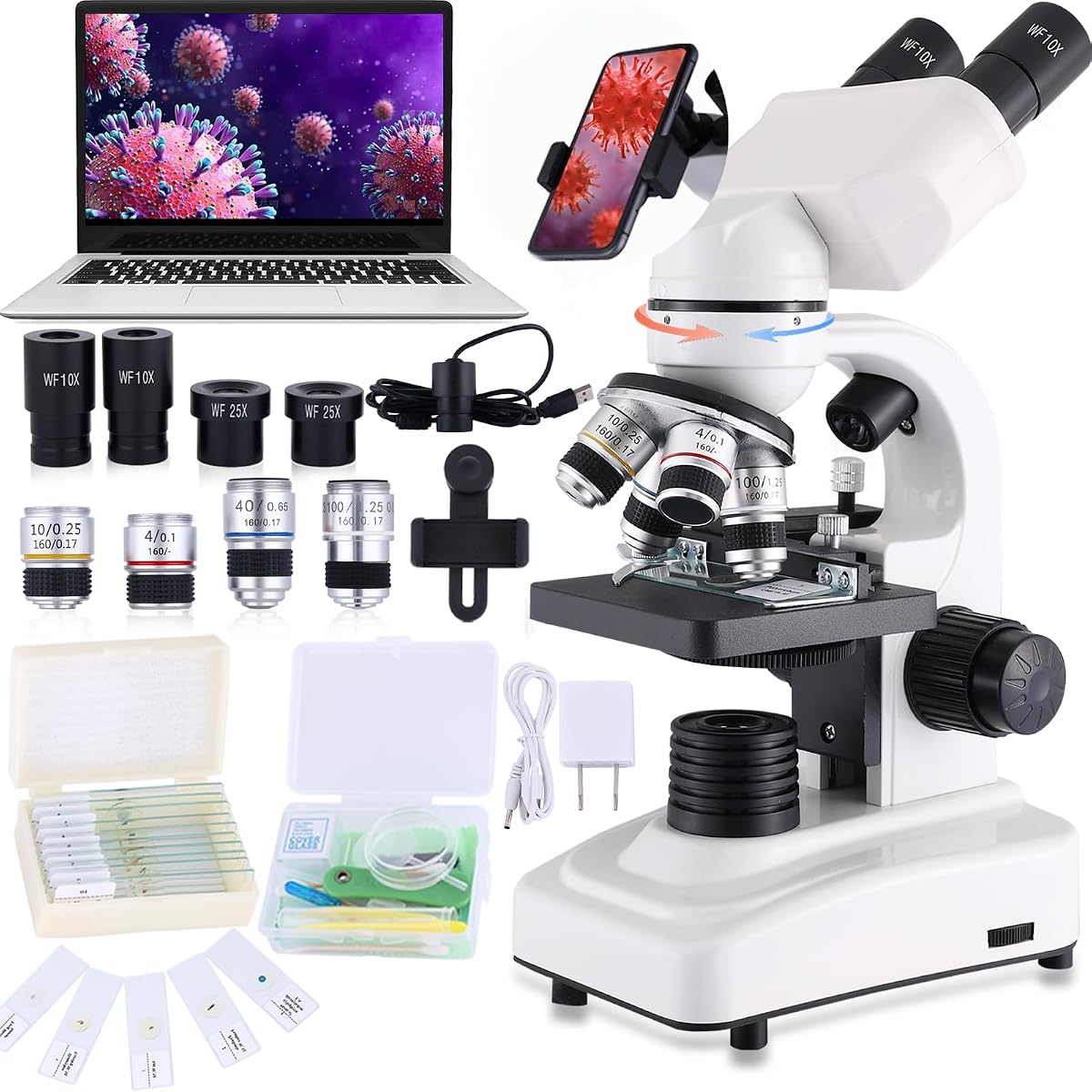
This adult-and-student compound microscope provides 40X to 2000X magnification through 4X, 10X, and 40X objectives, with WF10x, WF25x, and 2X eyepieces. Its 3.7 rating is the lowest in this group, but adjustable dual LEDs, a five-color filter, and a complete educational accessory set make it a relevant budget-oriented option.
We may earn a commission when you buy through this link, at no additional cost to you.
Upper and lower illumination supports both opaque and transparent subjects, while brightness control can help prevent an overly bright field. The five-color diaphragm filter wheel is a useful way to improve contrast when a soil suspension appears washed out. A phone adapter, blank slides, coverslips, tweezers, and prepared samples support immediate classroom or home activities.
Users should not interpret the broad magnification and eyepiece selection as equivalent to laboratory-grade optical performance. The 2X eyepiece can increase the stated maximum, but it does not create new specimen detail beyond what the objective and optical system resolve. Build quality, field brightness, and fine focus consistency are likely more important than the highest number when judging real usefulness.
This microscope is best for students, new hobbyists, and educators who need a functional compound scope for introductory observations without advanced imaging. It is less suitable for demanding taxonomic work or long-term professional research, where a higher-rated trinocular model and more refined optics would be preferable.
The five-color filter wheel can make low-contrast organisms easier to distinguish from surrounding soil particles. Changing the color is often more effective than increasing brightness when a specimen is visible but lacks definition.
Prepared slides, blank slides, coverslips, tweezers, and a phone adapter cover the basics of a lesson. The controls and accessory set are approachable for students while still supporting basic wet-slide observations of pond water and soil extracts.
We may earn a commission when you buy through this link, at no additional cost to you.
This research-grade trinocular microscope has the highest listed rating in the guide at 4.6. It combines 40X to 5000X claimed magnification, four achromatic objectives, a 1.3MP camera with USB 2.0 output, LED illumination, a variable diaphragm, and a double-layer mechanical stage for adult and professional-oriented observation.
We may earn a commission when you buy through this link, at no additional cost to you.
The camera opens a direct workflow for viewing specimens on a computer or projector, live streaming, recording, and image capture. Its 1.3MP sensor is a meaningful advantage over relying on a phone adapter. The four objectives provide a broader optical selection than many entry scopes, while the variable diaphragm helps control light entering the optical path.
The double-layer metal stage and X-Y movement are especially helpful for inspecting small, irregular soil particles and temporary wet mounts. As with other high-magnification models, the 5000X maximum should not be treated as a guarantee of laboratory-grade resolution. Sample thickness, illumination, cover placement, camera sensor, and operator technique all influence the final image.
This microscope is the leading choice for an adult who wants an integrated camera, mechanical stage, high-power objective selection, and a strong rating. It suits serious hobby observation, teaching demonstrations, and research-oriented environments, while beginners may find the trinocular controls and camera workflow more demanding than necessary.
A 1.3MP camera and USB output simplify the path from microscope to computer. Live viewing on a larger display makes the scope useful for teaching, collaborative review, and recording a sequence of soil-sample observations without a separate phone mount.
The variable diaphragm and NA1.25 spotting scope described in the product information give the user more control over the light reaching the sample. That control can make low-contrast organisms more distinct and reduce the need to rely only on software brightness.
We may earn a commission when you buy through this link, at no additional cost to you.
This binocular microscope includes WF10x and WF25x eyepieces, 4x, 10x, 40x, and 100x achromatic objectives, and a stated 40X to 2000X range. Its 4.1 rating and USB 2.0 electronic eyepiece make it an interesting middle ground for adults who want both comfortable viewing and a direct route to digital images.
We may earn a commission when you buy through this link, at no additional cost to you.
The six magnification combinations offer meaningful selection at common biological observation levels. Dual LED illumination provides options for transparent and opaque subjects, while coaxial and fine focus adjustments help users move between rapid focusing and precise sharpening. The electronic eyepiece can take photos and record video on a PC, avoiding the need for a separate phone attachment.
Because the digital component is an electronic eyepiece rather than a clearly specified third trinocular port, image capture may require changing how the microscope is used or removing the eyepiece. The 2000X maximum is also lower than the 5000X figures of several competing models. Users should evaluate the actual 100x objective, lighting, and sensor performance rather than focusing only on the headline range.
This microscope fits adult learners, hobbyists, and educators who want a binocular compound scope with basic PC documentation. It is a sensible pick when a separate camera is unnecessary, but users who need uninterrupted simultaneous viewing and computer output should favor a dedicated trinocular model.
Four objectives and two eyepieces provide several combinations for moving from a broad view toward detailed examination. This is helpful in soil work, where finding a particle at low power and then inspecting it at higher power are separate stages.
The USB electronic eyepiece allows PC-based photo and video capture without a separate phone clip. It is a convenient option for creating records of prepared slides, provided the user is comfortable with the eyepiece-based digital setup.
We may earn a commission when you buy through this link, at no additional cost to you.
Choosing a microscope for soil microbes means balancing optical capability, sample support, illumination, focus control, and documentation needs. The most useful purchase is not necessarily the one with the highest stated magnification, but the one that makes wet or particulate specimens stable, visible, and easy to inspect.
A compound microscope sends light through a specimen and uses an objective and eyepiece system to form an enlarged image. This design is generally more appropriate for prepared soil suspensions, wet mounts, and small translucent organisms because users can vary optical magnification, focus, and illumination. A handheld digital microscope is more convenient for portable inspection of soil grains, roots, insects, and larger surface features, but the supplied Skybasic description explicitly notes that it behaves more like a fixed-focus magnifying glass and is not intended for serious professional biology.
For recurring slide work or a home laboratory, favor a compound binocular or trinocular model. Choose a portable digital scope when convenience, travel, and quick phone-based documentation matter more than resolving fine cellular detail.
A 40X to 2000X range covers many introductory soil-microscopy tasks, while models advertised up to 2500X or 5000X provide additional high-power options. Objective magnification is central because a 2X eyepiece or Barlow lens can increase the stated total without adding equivalent detail. Resolution also depends on optical correction, illumination, camera quality, coverslip quality, and specimen preparation. A very high number does not compensate for a poorly focused, overly thick, or unevenly suspended sample.
Prioritize a sound objective range, reliable fine focus, and good illumination over the maximum headline figure. For microorganisms, examine low magnification first and increase power only after locating and centering the target.
Soil preparations can be nearly transparent, densely particulate, or a mixture of both. A bottom LED illuminates translucent organisms and suspended particles, while top illumination reveals the texture of opaque fragments. Adjustable brightness is important because excessive light can wash out low-contrast forms. Color filters and a diaphragm can improve contrast, and the PalliPartners educational model includes a five-color filter wheel. A built-in iris or variable diaphragm in more advanced models offers another way to control the optical environment.
Look for both top and bottom lighting if you will examine varied preparations. Start with lower brightness, adjust the condenser or aperture when available, and use a filter to improve separation before increasing magnification.
Binocular eyepieces allow a user to keep both eyes open, which improves comfort during lengthy comparisons and reduces the repeated need to close one eye. Trinocular scopes add a third optical path for a camera while two people continue viewing through the eyepieces. This arrangement is valuable for classroom demonstrations, live digital observation, and collaborative work. Some binocular models use a removable USB electronic eyepiece for documentation, but that is not always as seamless as a dedicated trinocular camera port.
Choose binocular viewing for regular personal observation. Choose trinocular access when recording, streaming, or sharing live images is central to the intended workflow.
A mechanical stage with X-Y movement and a larger support surface makes it easier to locate and track a tiny soil organism without repeatedly moving the slide by hand. A double-layer stage can improve stability, particularly with wet mounts that tend to shift. Simple clipped stages are adequate for basic demonstrations, but they offer less precise positioning. Secure slide support is especially valuable when a suspension contains moving organisms, because the user must keep a target centered while adjusting focus and light.
Favor a mechanical or double-layer stage for repeated work and careful documentation. For portable digital microscopes, a stable stand is the equivalent feature that helps prevent movement during capture.
Coarse and fine focus controls let a user find a specimen quickly and then refine the image with small movements. Side-by-side or coaxial placement determines how easily the controls can be reached while looking through the eyepieces. Wide-field eyepieces can present a larger area and make navigation less tiring. Adjustable interpupillary distance, diopter correction, and refractive index improve the fit for different users, especially in shared educational settings.
Choose responsive coarse and fine controls and comfortable wide-field eyepieces. If multiple people will use the microscope, adjustable eye spacing and correction settings are worth more than a minor increase in advertised magnification.
Digital capture can make soil observations easier to compare, teach, and archive. A dedicated trinocular camera allows viewing to continue while images appear on a computer or projector. Phone adapters offer a less integrated alternative, and electronic eyepieces provide another route. Accessories matter too: blank slides, coverslips, droppers, pipettes, collection containers, tweezers, and dissection tools support proper sample collection and preparation. A broad accessory box is useful, but it should not replace attention to optical and mechanical quality.
Prioritize the recording path you will actually use. Confirm camera compatibility, included cables, and software requirements, and make sure basic slide and transfer tools are available for wet soil mounts.
Begin with a representative soil sample and separate the solid material from the water or other extraction liquid. Let the mixture settle briefly, place a small drop on a clean slide, add a coverslip, and prepare the mount without pressing hard enough to distort organisms or trap large air bubbles. Wear gloves when handling unknown material, avoid direct contact, and follow appropriate safety practices for the source. Clean the slide and coverslip before adding the sample.
Place the prepared slide on the stage, secure it, and start with the lowest useful magnification. Use bottom illumination for a thin wet mount, adjust brightness downward if the field looks washed out, and bring the sample into focus with the coarse control. Center a target before switching to a higher objective. Use fine focus, lighting adjustments, and filters to reveal details rather than assuming greater magnification alone will improve the image.
After use, remove the slide, wipe the stage and lenses with an appropriate lint-free method, and switch off or unplug the microscope according to its instructions. Do not use harsh chemicals on optical surfaces, and keep dust away from the eyepieces and objectives. Store the instrument in a dry, stable area with the stage and focusing mechanisms protected. Update any required digital software and verify connections before the next session.
A binocular compound microscope with 40X to at least 2000X magnification, adjustable top and bottom LEDs, and reliable fine focus is a practical home choice. The Compound Microscope with Wide-Angle Eyepieces is particularly comfortable for prolonged viewing, while the Adult and Student Compound Microscope offers a more economical starting point. Actual results also depend on preparing a thin, well-mixed suspension and using controlled illumination.
A digital microscope can show larger soil organisms, particles, plant roots, and surface detail, but it is less suitable for resolving very small microorganisms than a compound microscope. The Skybasic model in this guide is portable and connects to phones or computers, yet the supplied information describes it as a fixed-focus magnifier rather than a serious professional biological microscope.
Most introductory observations begin at lower power, and higher magnification is useful only after a target has been located and properly illuminated. A 5000X claim combines multiple lenses and does not guarantee equivalent resolution across every model. Reliable focus, good optics, sample preparation, and contrast usually affect the result more than the maximum number.
Reduce excessive brightness, use the bottom light for a translucent wet mount, and adjust the aperture or diaphragm if the model provides one. A color filter can add contrast, as offered by the five-color filter wheel on one model. Increasing magnification too early may make the organism smaller and harder to find, so locate and center it first.
A trinocular microscope is better when you want to attach a camera while keeping the visual eyepieces available for viewing or teaching. A binocular microscope is usually simpler and sufficient for personal observation. If documentation is important, check whether the model includes a camera, requires a separate electronic eyepiece, or only provides a phone adapter.
Useful basics include clean slides, coverslips, a dropper or pipette, collection containers, a small mixing tool, labels, and gloves. Tweezers can position soil particles, while a notebook or camera helps record observations. The PalliPartners binocular kit includes several collection and dissection tools, whereas other models provide different combinations of slides and lab accessories.
Many models are designed for educational use, and the PalliPartners compound scope is listed for ages 8 to 18 with adult guidance and SGS safety certification. Children should be supervised when collecting samples, handling glass slides, operating electrical equipment, or cleaning the instrument. Simpler models are often easier for first-time users.
Turn off or unplug the microscope, remove the slide, and wipe loose soil from the stage with a soft brush or suitable lint-free material. Clean slides and coverslips separately, and use only manufacturer-approved methods on lenses and other optical surfaces. Prevent liquid from entering the body, and store the microscope in a clean, dry, stable location.
The best overall balance in this guide is the Compound Microscope with Wide-Angle Eyepieces because its binocular viewing, mechanical stage, dual lighting, and 40X to 2500X range suit extended soil inspection. The Research Grade Trinocular Microscope is the strongest rated option for integrated digital capture, while the Adult and Student Compound Microscope provides an accessible compound option with useful contrast controls.
Prioritize the features that match your actual workflow: dual illumination for varied wet mounts, fine focus for small organisms, a stable mechanical stage for moving samples, and a camera path for documentation. A portable digital microscope can be ideal for outdoor inspection, but a compound system is the more appropriate choice for regular slide-based soil-microbe observation.
Before purchasing, verify the current listing, included accessories, camera compatibility, and availability. Product configurations and promotions can change, so compare the present offering carefully rather than relying solely on a previously seen deal or an advertised magnification figure.