
Elite 16/2 Landscape Lighting Wire
4.8Editor score
Pure copper conductors
Direct burial rated
UL safety listings
Fifty-foot installation length
Our best Low Voltage Landscape Wire guide compares 10 options for copper conductivity, gauge, burial ratings, length, flexibility, and outdoor lighting use for
Low voltage landscape wire connects outdoor lighting systems safely and reliably, but the right cable depends on gauge, conductor material, length, burial rating, and installation conditions. A suitable choice should resist moisture, sunlight, abrasion, and long-term outdoor exposure while maintaining dependable power delivery to path lights, spotlights, and fixtures.
We compared ten widely available options using their stated specifications, including copper or copper-clad aluminum construction, wire gauge, cable length, maximum working voltage, direct-burial capability, listing information, and stated flexibility. The list covers 12, 14, and 16 AWG wire in lengths suited to smaller projects and larger residential lighting installations.
Each review explains where the cable stands out and where careful buyers may need to compromise. The top selections favor pure copper, direct-burial construction, useful certifications, and installation-friendly flexibility. Product availability and pricing can change, so confirm the current specifications and listing details before purchasing.
4.8Editor score

4.8Editor score

4.8Editor score
The comparison below highlights the major differences among the ten cables, including conductor type, gauge, length, voltage rating, and outdoor installation suitability. These specifications help narrow the field before considering the practical needs of your lighting layout.
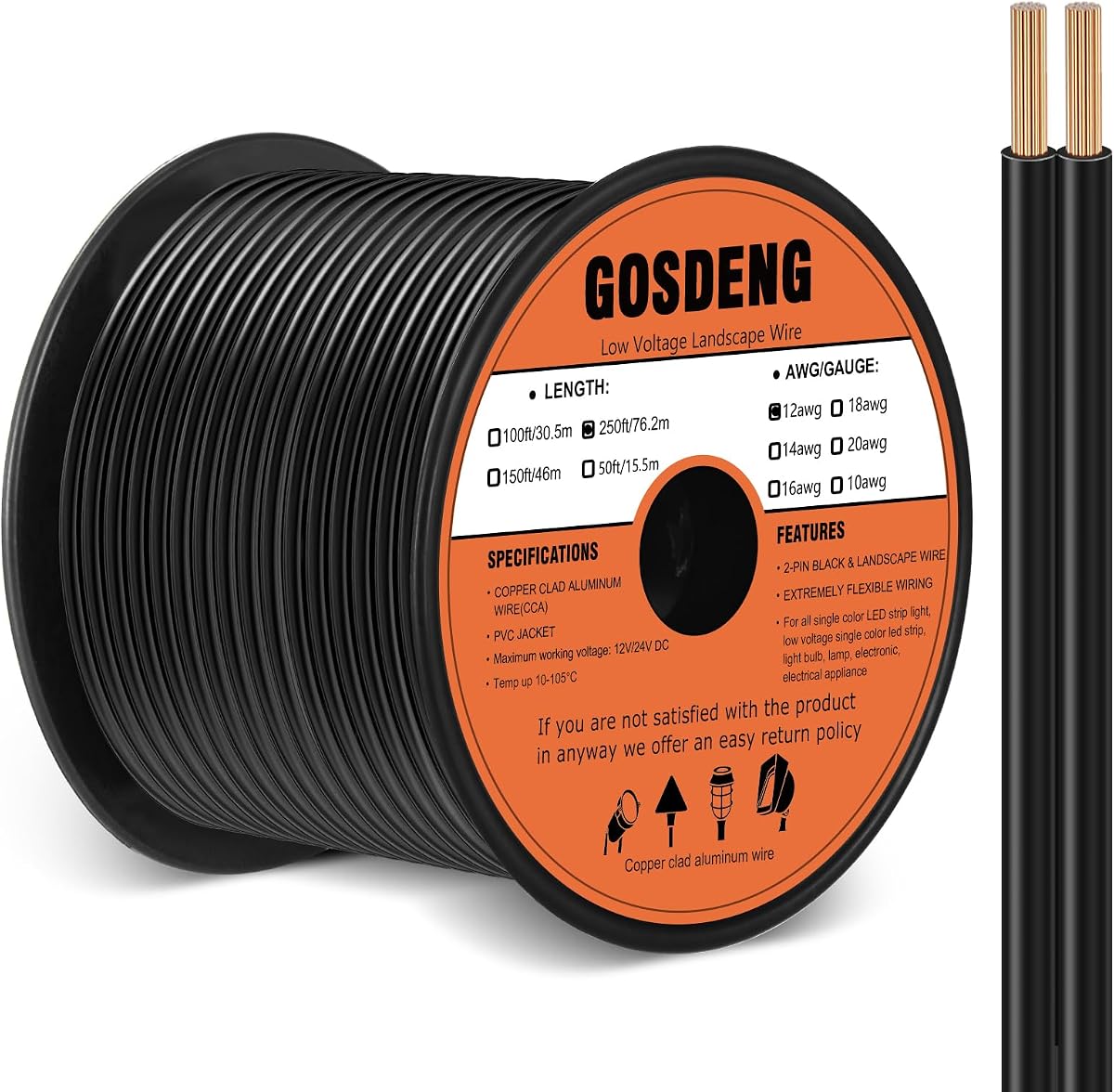


The 12/2 Low Voltage Landscape Wire, 12 Gauge Direct Burial Cable 250ft is a 250-foot roll built around 12 AWG, two-conductor low-voltage wire. It has a 4.3 rating and stands apart from most competitors in this list because it uses copper-clad aluminum rather than pure copper. Its black PVC jacket is described as flexible, flame retardant, and resistant to aging, acids, alkalis, and damp conditions.
We may earn a commission when you buy through this link, at no additional cost to you.
The most appealing feature is the combination of a large 12-gauge conductor size, a generous cable length, and manageable handling characteristics. Copper-clad aluminum is lighter and more flexible than copper, according to the product information, which can help when routing wire around beds, across paths, or through a larger outdoor installation. The stated operating range extends from approximately -35°C to 105°C, and the wire is marketed for 12-volt and 24-volt DC hookups.
The principal compromise is conductor material. Copper-clad aluminum can be a sensible choice for uncomplicated low-voltage runs, particularly where reduced weight and easier handling matter, but it does not provide the same conductivity as the pure copper alternatives here. Long paths with several high-wattage fixtures deserve careful attention to load, voltage drop, and circuit design. The product information itself positions CCA as a lighter and more flexible option rather than a direct replacement for every copper installation.
This cable is best for installers who want 12-gauge capacity and a long roll without the weight of a full copper cable, particularly when the lighting layout includes distributed loads and each run is not excessively long. It is less compelling for demanding installations, unusually long circuits, or buyers who place maximum conductivity and minimal voltage drop above all other considerations. For those priorities, a pure copper 12/2 option is the safer recommendation.
The flexible PVC jacket and copper-clad aluminum construction are intended to simplify routing, extension, and general handling. That makes this roll useful for projects where cable must move around garden beds, edging, and other obstacles.
Its 12-gauge size offers useful current-handling potential, but CCA conductivity remains the deciding limitation. Evaluate run length and connected load carefully before using it on extended lighting circuits.
We may earn a commission when you buy through this link, at no additional cost to you.
The SUNVIE 12/2 Low Voltage Landscape Wire 12 Gauge Pure Copper Wire, 250FT combines 12 AWG conductors, pure copper construction, and a 250-foot length. Its 4.8 rating reflects a broadly favorable customer response, while the stated ETL listing and VW-1 fire-resistant insulation make it one of the strongest all-around choices in the group.
We may earn a commission when you buy through this link, at no additional cost to you.
Pure copper is the wire's defining strength. The product information emphasizes high conductivity and minimal voltage drop, including over extended 250-foot runs, which is particularly relevant for low-voltage lighting where dimming or uneven output can become noticeable when voltage falls. The cable also supports direct burial and is designed to withstand sunlight, abrasion, and moisture. That combination addresses the environmental conditions a landscape installation actually encounters.
Installation handling is another advantage. Its improved PVC insulation is described as easy to strip and flexible in both hot and cold conditions, reducing frustration when routing the cable around beds, along walls, or between fixtures. The 300-volt maximum working rating accommodates low-voltage landscape systems and many other low-voltage device connections. Users can deploy it for path lights, wall lights, spotlights, in-ground lights, and additional compatible fixtures.
The trade-off is weight and potential over-specification. A 12-gauge pure copper 250-foot roll is substantial, and not every small garden requires that conductor size or cable quantity. In exchange, buyers receive high conductivity, useful capacity, independently stated safety testing, and direct-burial versatility. This is the recommendation for households that want fewer compromises when building a medium-to-large landscape lighting circuit.
Using pure copper helps maintain a consistent supply across longer cable runs. The reduced voltage-drop concern makes this option especially attractive for installations with multiple fixtures spread across a broad outdoor area.
Direct-burial capability, environmental resistance, and a flexible jacket cover the most common installation demands. The wire is suitable for exposed runs, underground trenches, and compatible low-voltage lighting fixtures.
We may earn a commission when you buy through this link, at no additional cost to you.
The SUNVIE 100FT 14/2 Low Voltage Landscape Wire ETL Listed Copper Wire 14AWG offers a balanced middle ground between conductor capacity and installation convenience. It uses 14 AWG pure copper, two conductors, SPT-2 black PVC insulation, and supplies 100 feet. The 4.8 rating and ETL listing make it a credible choice for common residential lighting projects.
We may earn a commission when you buy through this link, at no additional cost to you.
Pure copper supports conductivity and limits voltage drop, while the flexible jacket is designed to remain workable in hot and cold conditions and is easy to strip. The wire is also designed for direct burial, with stated resistance to sunlight, abrasion, and moisture. That makes it appropriate when the cable will cross soil, run near planted areas, or remain exposed to changing outdoor conditions.
The stated 300-volt maximum working rating provides ample compatibility with low-voltage lighting systems. Buyers can use the cable with path lights, wall lights, spotlights, in-ground lights, and other compatible devices. Compared with the larger 12-gauge SUNVIE model, this option is easier to maneuver and may align better with a typical garden installation where the total cable requirement remains near 100 feet.
The limitation is straightforward: one hundred feet may not cover a large property, and 14 AWG provides less capacity than 12 AWG. Rather than adding another roll, buyers should map their routes and confirm that the available length includes the necessary trenching, turns, service loops, and connections. For a compact or medium-size landscape system, this is a balanced and well-specified option.
The 14 AWG gauge is a versatile middle choice for many low-voltage fixture arrangements. It provides a practical compromise between copper conductivity, cable weight, and ease of routing.
ETL listing, VW-1 fire resistance, and direct-burial design provide useful confidence for outdoor installations. The product is also described as stable under continued exposure to sunlight or burial underground.
We may earn a commission when you buy through this link, at no additional cost to you.
The Elite 16/2 Landscape Lighting Wire is a 50-foot roll designed for low-voltage outdoor lighting. It carries a 4.8 rating and uses 16 AWG pure copper conductors rather than CCA. Its certification details distinguish it from many budget options: the product information states that it is UL listed under UL 1581, UL 13, and UL 1493, as well as CSA22.2.
We may earn a commission when you buy through this link, at no additional cost to you.
Pure copper provides the foundation for dependable signal transmission and flexibility. The cable is also described as direct-burial rated, waterproof, UV resistant, and pressure tested. Those attributes align closely with the demands of garden lights, accent lighting, patio fixtures, path lights, deck lights, spotlights, and underwater lighting applications. Its stated use in applications up to 30 volts targets the core low-voltage landscape category.
This cable also carries the most detailed certification information in the roundup. Multiple UL and CSA references give shoppers clearer safety documentation than a general compliance claim, while the California-based manufacturer description emphasizes transparency and trusted certifications. These details do not replace local code checks, but they help distinguish the wire for buyers who value documented testing.
The limitation is its 50-foot length, and 16 AWG has less current capacity than 12 or 14 AWG. It is best for a focused project such as a path, porch, small patio, or several accent fixtures rather than an expansive property. When the route fits comfortably within 50 feet and the load is modest, it provides an unusually well-documented, portable option without sacrificing pure-copper construction.
References to multiple UL standards and CSA22.2 make certification easy to verify. This is especially helpful for buyers who want clear safety documentation before purchasing cable for an outdoor installation.
Fifty feet is manageable for short routes and compact gardens. It also avoids purchasing excess cable, though larger properties may require multiple rolls or a longer alternative.
We may earn a commission when you buy through this link, at no additional cost to you.
The 14/2 Low Voltage Landscape Wire is a 100-foot, 14 AWG two-conductor cable made with pure bare copper. It has a 4.7 rating and is positioned for low-voltage outdoor lighting installations of 30 volts or less. The black cable is described as flexible, easy to strip, and certified for direct burial use.
We may earn a commission when you buy through this link, at no additional cost to you.
Its heavy-duty jacket is designed to protect against tearing, cuts, and scraping, while the product information states that the cable endures sunlight exposure, wear and tear, and damp conditions. Those qualities matter in landscapes where wires cross open beds, edging, exposed hardscapes, or underground trenches. Pure copper also provides stronger conductivity and flexibility than copper-clad aluminum, a meaningful advantage on low-voltage circuits.
The cable works with a broad collection of fixtures, including path lights, outdoor spotlights, deck lights, garden accent lights, and underwater lights. Its stated 300-volt maximum gives installers a broad working-voltage allowance, even though typical landscape systems operate at much lower levels. The product also carries a lifetime warranty, adding a distinct assurance that the manufacturer does not list in the same detail on several alternatives.
What may require more attention is the specificity of the safety information. The product data highlights direct-burial certification and the lifetime warranty but does not name an independent listing standard. It is a strong fit for a 100-foot residential run where flexibility, copper conductivity, and jacket durability are priorities. Buyers who place documented third-party safety listings above every other factor should compare the explicitly listed options before finalizing.
Pure bare copper supports efficient power delivery and easy handling. It is a practical choice for mixed fixture runs where maintaining brightness across multiple outdoor lights matters.
The flexible, easy-to-strip jacket supports installation around garden features. Heavy-duty protection against tears, cuts, and abrasion adds confidence in high-wear locations.
We may earn a commission when you buy through this link, at no additional cost to you.
The 16/2 Low Voltage Landscape Wire provides 100 feet of 16 AWG two-conductor cable in black. It earns a 4.8 rating and uses pure bare copper instead of CCA. Its stated 300-volt maximum working rating covers low-voltage installations at 30 volts or less, while direct-burial certification makes it suitable for trenches and other outdoor routing needs.
We may earn a commission when you buy through this link, at no additional cost to you.
The cable is described as flexible and easy to strip, important qualities when moving through landscaping, around walls, and between tightly spaced fixtures. Its heavy-duty jacket is intended to resist tearing, cuts, and scraping, while the overall construction is built for sunlight exposure, wear, and damp conditions. It can be used with path lights, outdoor spotlights, deck lights, garden accents, and underwater lights.
Pure copper is the notable advantage over similarly sized CCA cable. The stated construction is intended to deliver stronger signal and greater conductivity, which can help preserve consistent fixture output. At the same time, 16 AWG remains lighter and less demanding to route than 12 or 14 AWG. That makes it useful when the lighting plan includes numerous small fixtures but relatively modest loads.
The main caveat is electrical capacity. Sixteen-gauge conductors are not the right choice for every layout, particularly when several high-output fixtures sit at the end of a long circuit. This wire is most suitable for shorter runs or carefully distributed lighting loads. For projects of that scope, it provides an appealing combination of pure copper, a useful 100-foot length, and direct-burial outdoor readiness.
This cable preserves the conductivity benefits of copper while using a lighter 16-gauge construction. It is easier to route around residential landscape features than a thicker cable.
Direct burial certification and environmental resistance claims suit installations that cross soil or remain exposed to changing weather. The stated jacket protection also targets abrasion during installation and service.
We may earn a commission when you buy through this link, at no additional cost to you.
The Zonegrace 12AWG 2-Conductor 12/2 Direct Burial Wire is a 265-foot cable built for outdoor lighting and other low-voltage applications. It has a 4.8 rating, pure bare copper conductors, and ETL listing. Its combination of large conductor size and long roll makes it a premium option for properties where one dependable run must cover a substantial distance.
We may earn a commission when you buy through this link, at no additional cost to you.
Pure copper is presented as a stronger, more conductive alternative to CCA, supporting dependable signal and power delivery. The heavyweight jacket protects against tears, scrapes, and cuts, while its flexibility is intended to make routing and installation faster. Zonegrace describes the cable as industrial-grade direct-burial wire capable of use above ground, below ground, or in suitable conduit, including exposure to intense sunlight, high humidity, and dust.
The range of supported lighting applications is extensive. Path lights, area lights, floodlights, spotlights, downlights, underwater lights, deck and step installations, and hardscape accents are all identified as compatible uses. That versatility makes the roll appropriate for installers working across multiple fixture types rather than a single narrow application. ETL listing adds independently stated safety and quality testing to the already robust construction.
This is not a cable for every small project. A 265-foot roll of 12 AWG copper has meaningful weight and may leave substantial unused material after a short installation. Even so, it is the premium choice here for large gardens, extensive path systems, or multi-zone lighting layouts where lower gauge, shorter cable, or CCA would compromise flexibility and electrical performance. Its stated lifetime satisfaction guarantee further strengthens the ownership proposition.
Pure copper and a 12 AWG gauge create a strong foundation for long or heavily distributed lighting runs. The conductor material is intended to support better conductivity than CCA alternatives.
The industrial-grade jacket is designed for ultraviolet exposure, humidity, dust, abrasion, and physical damage. It supports direct burial, above-ground routing, and suitable conduit installations.
We may earn a commission when you buy through this link, at no additional cost to you.
The LUCKY TL 14/2 Low Voltage Landscape Wire supplies 100 feet of 14-gauge cable in black. It has a 4.6 rating and is intended for low-voltage systems operating at 30 volts or less. Its stated maximum working voltage is 150 volts, while the cable is ETL certified, RoHS compliant, and carries a VW-1 fire rating.
We may earn a commission when you buy through this link, at no additional cost to you.
The most distinctive installation feature is the rough surface on one side of the jacket. It helps users identify the wire ends quickly during termination and reduces the chance of confusion in a project with multiple connections. The cable is also described as flexible and tangle-free, with a jacket that peels away easily. These practical details can make a meaningful difference when connecting several fixtures.
Environmental specifications are also strong. The cable has a stated temperature range from -40°F to 140°F, is waterproof and corrosion-resistant, withstands direct sunlight, and can be buried directly underground. Its intended uses include landscape lamps, garden lamps, street lamps, and lighting around gardens and courtyards, making it a general outdoor cable for compatible low-voltage systems.
The main drawback is its 150-volt maximum working rating, which is lower than the 300-volt maximum stated for several competing cables. That does not prevent use with typical 12-volt or 24-volt landscape lighting, but it gives shoppers fewer headroom options for other compatible low-voltage equipment. It is best for standard lighting circuits where conductor identification and outdoor durability are especially useful.
A textured jacket side provides a tactile way to distinguish conductors. This practical detail can reduce installation errors and speed up work around crowded transformer or fixture connections.
The stated -40°F to 140°F range supports use across seasonal conditions. Waterproof, corrosion-resistant, and sunlight-resistant properties reinforce its outdoor orientation.
We may earn a commission when you buy through this link, at no additional cost to you.
The Lightkiwi 16/2 Landscape Wire is a compact 50-foot roll of pure bare copper landscape cable. It has a 4.7 rating, an ETL listing, and a construction specifically intended for low-voltage outdoor lighting rather than standard speaker wire. The cable can be used for spotlights, downlights, path and walkway lights, area and floodlights, in-ground fixtures, deck and step lights, hardscape lighting, and underwater systems.
We may earn a commission when you buy through this link, at no additional cost to you.
Pure copper is central to the cable's performance proposition. The product information emphasizes strong conductivity, stronger signal, and lower voltage drop compared with CCA. Its flexible, tear-resistant jacket is designed to guard against cuts and abrasion while remaining easy to install. That combination is useful for compact routes where routing through planting beds and around hardscapes may be difficult.
Direct-burial capability expands the installation choices. The cable may be buried underground, used above ground, or placed in conduit, and it is described as capable of withstanding sunlight, moisture, dust, and harsh outdoor conditions. ETL listing provides an independently stated safety credential, while the manufacturer also highlights a lifetime satisfaction guarantee and straightforward return process.
Its limitations are the same ones inherent to a short, smaller-gauge cable. Fifty feet suits a porch, short path, or focused group of fixtures, while 16 AWG requires sensible load distribution. It is an effective choice for targeted extensions or compact installations, especially when pure copper, ETL listing, and direct-burial construction are priorities without needing a full-length roll.
The cable is engineered for outdoor lighting rather than adapted from standard speaker wire. Its jacket and conductor arrangement focus on the moisture, sunlight, abrasion, and routing demands of landscape installations.
Pure bare copper supports consistent output and lower voltage drop. The compact length is particularly convenient for short paths, porch lighting, and localized fixture groups.
We may earn a commission when you buy through this link, at no additional cost to you.
The FIRMERST 16/2 Low Voltage Landscape Wire Outdoor Lighting Cable 500 Feet is the longest roll in this roundup. It provides 500 feet of 16 AWG two-conductor cable with a black jacket, a 300-volt maximum rating, and suitability for low-voltage lighting systems up to 30 volts. Its 4.8 rating makes it one of the strongest customer-rated choices in the group.
We may earn a commission when you buy through this link, at no additional cost to you.
The extraordinary length is the main attraction. It can cover sprawling paths, numerous lighting zones, large gardens, and complicated routes without interrupting the installation for multiple shorter rolls. The flexible PVC jacket is described as easy to route, cut, and strip, and its stated temperature range extends from -20°F to 140°F. Direct-burial outdoor construction allows it to handle sunlight exposure and underground placement.
Safety details are clear. The cable is ETL listed and RoHS compliant, and its insulation carries a VW-1 flame rating. Its broad applications include pathway lights, landscape lights, spotlights, solar systems, outdoor speakers, and other low-voltage projects. This makes the roll adaptable beyond a single lighting style, provided connected equipment is compatible with its electrical specifications.
As with the other 16 AWG options, circuit design remains the primary consideration. A long cable run can place fixtures farther from the transformer, so load placement and voltage-drop planning deserve attention. The roll can also be excessive for a small installation. For extensive properties or professional contractors seeking substantial cable inventory in a single package, however, the combination of length, safety listing, and easy installation makes this an efficient choice.
Five hundred feet simplifies installation across broad outdoor areas. It reduces the need to coordinate multiple rolls and provides flexibility when routes branch around landscaping and hardscapes.
ETL listing, RoHS compliance, and VW-1 flame-rated insulation offer clear purchasing criteria. The cable can support many low-voltage lighting and accessory applications when load planning is appropriate.
We may earn a commission when you buy through this link, at no additional cost to you.
The right landscape cable depends on electrical load, run length, conductor material, burial conditions, and installation preferences. Use these factors to narrow the options before checking the final product listing and local electrical requirements.
Wire gauge determines how much current the cable can carry and how much voltage is lost over a distance. The roundup includes 12 AWG options for more demanding or extensive systems, 14 AWG as a versatile middle choice, and 16 AWG for smaller fixtures and shorter runs. Larger installations often benefit from heavier conductors because they resist voltage drop, but the correct gauge still depends on the transformer output, fixture load, and total cable distance.
Match the gauge to the load rather than choosing by cable appearance alone. Multiple bright fixtures placed far from the power source need more careful conductor sizing than a small group located nearby. Confirm the voltage rating of the lighting system and consult a qualified electrician when the load or layout is complex.
Nine of the ten products use pure or bare copper, while one uses copper-clad aluminum. Pure copper generally offers stronger conductivity than CCA and is well suited to long outdoor lighting runs where voltage drop can affect brightness. CCA is lighter and more flexible, which can make handling easier, but it is a more significant compromise for circuits intended to maintain consistent output over distance.
Prefer pure copper when long runs, multiple fixtures, or consistent brightness are priorities. Consider CCA only after accounting for run length, load, and the possibility of voltage drop. Always verify whether a listing specifies copper, bare copper, CCA, or copper-clad aluminum, since the terms are not interchangeable.
The available rolls range from 50 feet to 500 feet, with most options offering 100 feet and two providing 250 feet or more. Measure the entire proposed route rather than only the straight-line distance between fixtures. Include turns, service loops, connections around obstacles, trench depth allowances, and the extra needed to reach a transformer or connection point.
Avoid buying a roll that is barely sufficient. A small amount of extra cable can be valuable during installation, but a very large excess may be unnecessary for a compact project. For broad properties, the 265-foot and 500-foot rolls can reduce the need to join multiple pieces, while 50-foot options suit focused installations.
Direct-burial cable is designed for installation underground without a separate conduit when used within its stated instructions and local requirements. Most products in this roundup claim direct-burial suitability, but their documentation varies. Verify the claim on the actual listing, review installation directions, and confirm any local code requirements before trenching.
Also consider whether portions of the route will instead remain above ground, pass through conduit, or cross areas exposed to physical damage. A cable with sunlight, moisture, abrasion, and corrosion resistance is useful throughout a mixed outdoor installation, not only for the buried section.
ETL and UL listings provide independent safety and quality information that can help distinguish outdoor wire from generic hookup or speaker cable. Among the selections, SUNVIE and Zonegrace are explicitly described as ETL listed, Elite states several UL and CSA standards, FIRMERST is ETL listed and RoHS compliant, and LUCKY TL is ETL certified and RoHS compliant.
A listing does not eliminate the need to follow local electrical rules. It does, however, provide useful documentation to compare alongside construction, gauge, and conductor material. Keep the certification information with the product documentation and ensure that the exact model and length you purchase carry the stated marks.
A flexible jacket makes routing through garden beds, along walls, and around fixtures much easier. SUNVIE describes improved insulation that is easy to strip and remains flexible in hot and cold conditions, while FIRMERST emphasizes easy cutting, stripping, and routing. LUCKY TL adds a rough jacket side that helps users distinguish conductors during connections.
Flexibility matters because a cable that is difficult to handle can be strained, kinked, or damaged during installation. Look for an easy-strip jacket, adequate bendability for the planned route, and enough ruggedness for abrasion against rocks, edging, and soil. A wire that is easy to terminate also reduces avoidable connection errors.
Landscape wire is exposed to sunlight, rain, humidity, soil moisture, temperature changes, dust, and physical wear. Product specifications variously mention UV resistance, flame resistance, corrosion resistance, water resistance, and operating-temperature ranges. These claims should complement your decision about burial rating, jacket strength, and conductor quality rather than replace them.
Choose cable that is designed for the specific outdoor route. Underground sections need a direct-burial product, while exposed sections benefit from UV and weather resistance. Fixtures near pools or other wet locations require compatible low-voltage equipment and appropriate installation practices, even when the cable itself carries outdoor-use claims.
Low voltage does not eliminate electrical-design concerns. The total connected wattage, distance from the transformer, number of fixtures, and conductor size all influence the voltage available at the end of a circuit. Products with pure copper and larger gauges generally offer more margin, while smaller 16 AWG cables are best reserved for suitably modest and well-distributed loads.
Break large installations into appropriately designed circuits rather than connecting every fixture to one distant run. Confirm that the transformer's output and wiring plan meet the system's requirements. If the arrangement involves high loads, long distances, or uncertainty about circuit capacity, professional electrical guidance is more valuable than a generic cable comparison.
Plan the lighting layout before cutting cable. Map every fixture, the transformer location, trench routes, and any obstacles that may require extra length. Separate circuits according to the transformer's capacity and the lighting load, and verify conductor gauge and voltage-drop requirements before purchasing.
Install the cable according to the manufacturer's instructions and applicable local requirements. Wear appropriate protection, route the wire without sharp bends, and avoid damage from garden tools, edging, and vehicle traffic. When using direct-burial cable, follow the stated trenching and burial instructions; where conduit is required, use compatible fittings and do not assume outdoor suitability means every installation method is allowed.
Terminate connections carefully, keep the conductors clean and dry, and use fittings appropriate for the fixture, transformer, and outdoor location. Inspect exposed sections periodically for abrasion, cracking, corrosion, or accidental damage. Keep connections accessible for servicing, and replace damaged cable rather than repairing it with an improvised splice.
Yes, 14 AWG is a common middle-ground choice for many 12-volt and 24-volt landscape lighting systems. It performs well when the connected load is moderate and the transformer is reasonably close to the fixtures. Run length matters, however, so long circuits or many high-output lights may benefit from 12 AWG.
The first number identifies the conductor gauge, while the second indicates that the cable contains two conductors. A 12/2 cable is physically heavier and generally suited to greater current demands than 14/2 or 16/2. The 14/2 and 16/2 options are lighter and often more practical for smaller lighting loads.
Copper-clad aluminum can be suitable for some low-voltage lighting connections because it is lighter and more flexible than copper. However, pure copper generally provides better conductivity and lower voltage over longer distances. Buyers should carefully assess run length and load before selecting a CCA cable.
Only use cable that is specifically identified as direct burial for an underground installation. Most of the products listed here make that claim, but local requirements may still call for conduit, additional depth, or protective routing. Follow the manufacturer's instructions and verify local electrical codes before digging.
ETL and UL listings indicate that the wire has been evaluated against applicable safety and quality standards by an independent certification organization. The marks help buyers verify product compliance, although they do not replace correct installation practices or compliance with local electrical codes.
Yes, 16 AWG can be used for compatible low-voltage landscape lighting when the cable length and connected load are appropriate. Because it has less capacity than 12 or 14 AWG, it is best for shorter runs or smaller fixture groups. Long extensions and several bright fixtures can increase voltage drop and dim output.
Measure the complete route from the power source to each fixture, including turns, service loops, connections, and obstacle clearance. Do not rely only on the straight-line distance between lights. For large installations, calculate total cable needs by circuit and consider buying one suitably long roll to reduce the number of connections.
A purpose-built low-voltage landscape cable is generally a better choice. It is designed for outdoor exposure, direct burial where rated, and the demands of lighting installations. Several products in this roundup explicitly distinguish themselves from standard speaker wire for that reason.
The Elite 16/2 cable stands out as the value-focused selection because it combines pure copper, multiple stated safety listings, direct-burial capability, and a convenient 50-foot length. The SUNVIE 12/2 offers the strongest overall balance for larger systems, while the Zonegrace 12AWG provides premium pure-copper construction and an exceptional 265-foot roll.
Prioritize conductor material, gauge, length, and environmental suitability over minor differences in packaging or cable wording. Pure copper is the most consistent choice for conductivity, 12 AWG offers more capacity, and a length that comfortably covers the full route avoids unnecessary joins. For every installation, verify the final listing, transformer compatibility, load, and local electrical requirements.
Prices and availability change over time, so compare the current product details before ordering. Confirm that the selected listing still shows the required gauge, length, conductor material, burial rating, and safety certification. Buying the right cable for the route and electrical load will provide a more useful installation than choosing solely by roll length.