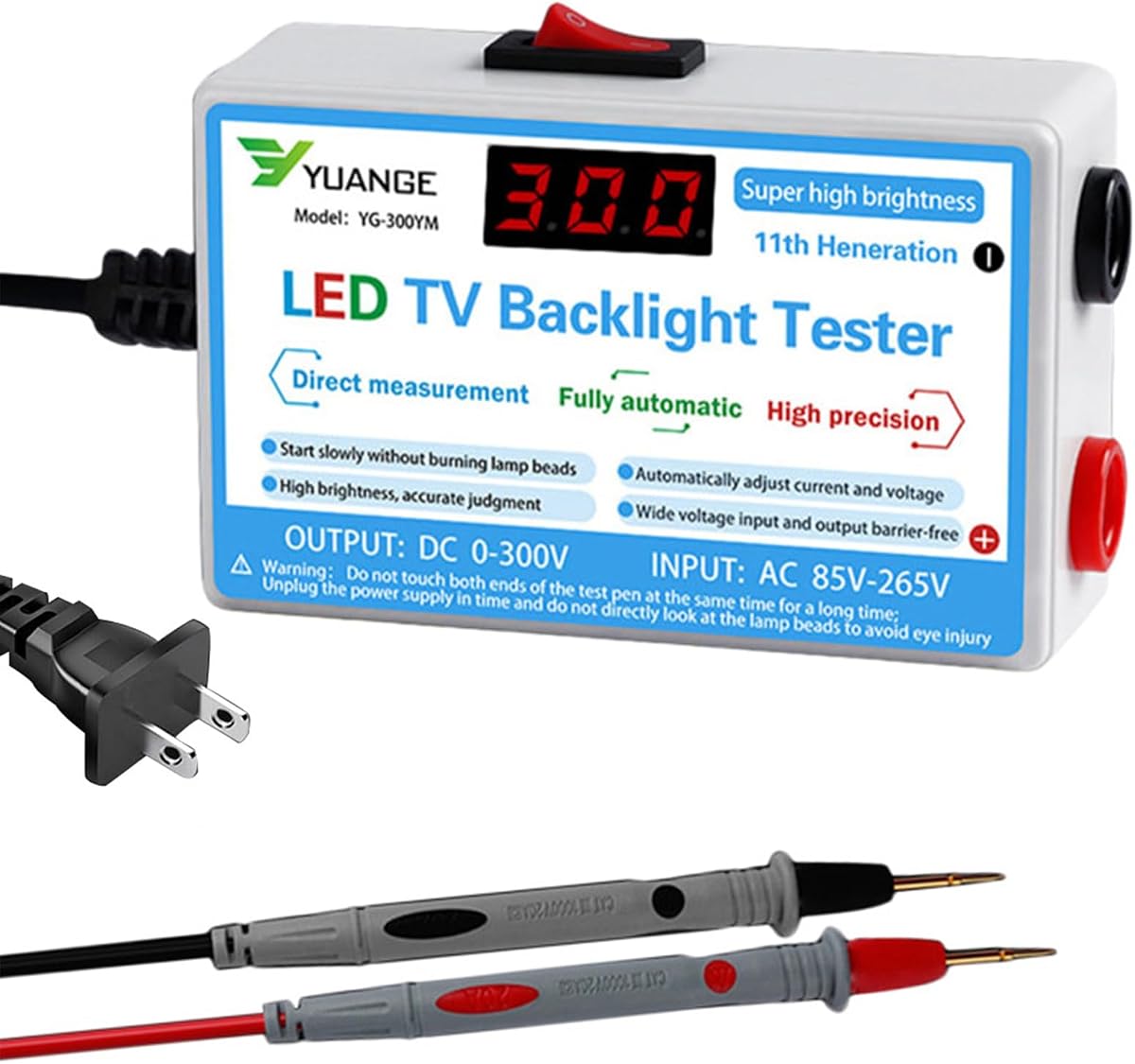
Our LED Lamp Bead TV Backlight Tester guide compares voltage ranges, displays, probes, safety features, and repair versatility for professional LED work.
As an Amazon Associate we earn from qualifying purchases. We may earn a commission when you buy through links on this page, at no additional cost to you.As an Amazon Associate we earn from qualifying purchases.Purchases through our links may earn us a commission, at no extra cost to you.
An LED Lamp Bead TV Backlight Tester helps technicians diagnose faulty light bars, individual beads, LED strips, and backlight assemblies without immediately removing a display from its housing. The most useful tools combine adjustable output, clear voltage or current readings, safe probe contact, and enough range for modern television and display boards.
We compared the ten products in this guide using their stated voltage ranges, current capabilities, display functions, probe designs, protective features, supported applications, and included accessories. The list includes compact 0-300V models, a wider 0-330V instrument, and testers that can also check DC voltage or constant-current driver boards.
Each review explains the practical strengths and limitations of its tester while showing how it fits into an LED repair workflow. Product features and availability can change, and prices fluctuate frequently, so check the current listing before purchasing to confirm the latest specifications, package contents, and optional variants.
Top 3 Picks for Best LED Lamp Bead TV Backlight Tester
Best Budget
LED Light and TV Backlight Tester, LED Strip Lamp Beads Light Source Testing Tool 0-300V Adaptive Voltage with Gold Plated Pin and Power Cable fits All LED-Lights Repair(Color:A – Without AC Switch)
Top 10 Best LED Lamp Bead TV Backlight Tester in 2026 Compared
This side-by-side comparison focuses on the specifications that most affect LED repair work: output range, current capability, measurement functions, portability, protection, and package contents. It highlights meaningful differences among the ten testers rather than treating models with similar 0-300V specifications as interchangeable.
This orange LED and TV backlight tester combines adaptive 0-300V output, a digital voltage display, and pointed probes for examining individual beads, strips, light boards, and television backlight bars. Its 4.5 rating reflects a generally practical feature set, while its greatest attraction is the combination of portable dimensions and an adjustable output designed to help technicians locate a failed group without immediately dismantling the display.
Pros
Broad LED testing coverage
Clear live voltage readout
Dual gold-plated pins included
Integrated power cable
Supports single and double bars
Cons
Version lacks power switch
Requires careful probe handling
We may earn a commission when you buy through this link, at no additional cost to you.
The tester automatically adapts voltage and current to the connected light source and can identify bead groups and light bays. Gold-plated pins are included for contact with LED test points, and the package contains the tester, two pins, and a power cable. The product description also emphasizes heat and cold isolation, a compact body measuring approximately 100 by 37 by 58 millimeters, and the ability to illuminate single or double LED backlight bars.
Its limitations deserve attention. The listed version is explicitly described as being without a power switch, so operation must be controlled through the plug or another part of the workflow. The instructions also warn against touching the output terminals for extended periods and against looking directly at illuminated beads. The tester is therefore convenient for deliberate diagnostic work but not a device for casual experimentation or repeated unattended contact.
This is a strong general-purpose choice for technicians who service LED televisions, computer displays, laptops, strips, and individual lamps. It offers more visible information and broader application support than a simple continuity pen while remaining suitably compact. For users who value direct pin contact, real-time output information, and a broad 0-300V operating range, it deserves serious consideration.
Fast Location of Faulty Light Groups
The live display and adaptive output let a technician observe the response while moving between bead groups. That makes the tool useful for narrowing down a backlight failure without first removing the entire screen assembly.
Useful for Multiple Light Sources
Beyond television bars, the stated applications include LED strips, light boards, computer and laptop backlights, and individual beads. This broad compatibility makes it useful for repair work that extends beyond a single television brand.
This Type A tester delivers the core functions needed for LED backlight diagnosis: adaptive 0-300V output, automatic adjustment to voltage and current, and a digital display for real-time output information. Its 4.0 rating is the lowest among the selected products, but the listing describes a capable tool for beads, strips, light boards, and single or double television backlight bars.
Pros
Affordable entry point
Adaptive voltage and current
Portable integrated-cable design
Tests beads, boards, and bars
Multiple output modes
Cons
No power switch
Lowest rating in comparison
We may earn a commission when you buy through this link, at no additional cost to you.
The package includes one tester, two gold-plated pins, and one power cable. Its integrated cable-and-box arrangement measures approximately 100 by 37 by 58 millimeters, making it straightforward to carry between repair locations. A short press across the positive and negative probe ends switches between high and low voltage, providing a useful way to start with a lower output when probing a sensitive point.
The absence of a power switch is the main practical drawback. Users must also observe the warning against deliberately using 300V during detection because the listing states that this could damage equipment. Probe terminals should be touched only briefly, and illuminated beads should not be viewed directly. These are sensible precautions, but they add procedural steps compared with a model that offers an integrated switch.
For a new technician building a repair kit on a constrained budget, this model provides the essential voltage range and broad LED compatibility without omitting the digital display or pointed probes. It is most attractive for users who already understand safe LED testing methods and who want a portable tool for bars, boards, strips, and beads.
Lower-Cost Path Into Backlight Repair
The tester covers the functions most often needed for initial LED diagnosis without adding a separate voltage display. It is a practical foundation for repairers who want bead, strip, board, and television-bar coverage in one compact device.
Switchable High and Low Output
The described three-second probe short switches between voltage ranges. Starting at a lower output can make initial contact more controlled, although the tester should never be used at 300V for detection according to its instructions.
The TKDMR tester is built around a clear repair purpose: diagnosing LED television backlight problems and locating failed LEDs. It combines an 85-265V input range, 0-300V output, and a 30mA working current. Its 4.7 rating is among the highest in the group, and the listing emphasizes intelligent output adjustment as a practical feature for technicians who need consistent control.
Pros
Strong 4.7 customer rating
Automatic output adjustment
Clear application-specific purpose
Portable pocket-size format
Designed to protect LEDs
Cons
Focused on LED backlight testing
Fewer accessory details provided
We may earn a commission when you buy through this link, at no additional cost to you.
Safety-oriented construction is a major selling point. The description states that output voltage and current adjust intelligently, that the tester does not spark when the test pen is short-circuited, and that it is designed to check backlights of different display sizes without burning beads or the LED panel. Dual power and tester isolation and a pocket-size format further support field use.
This model is more narrowly positioned than multipurpose meters that also test driver boards or evaluate electronic components. Its stated 30mA working current may require careful comparison with the demands of a particular light source, and buyers should confirm that a backlight falls within its operating specifications. The description also does not detail the exact package contents as clearly as several competing listings.
Despite those caveats, this tester represents a balanced choice for TV backlight work. Its high rating, intelligent adjustment, and clear emphasis on protecting LED beads make it attractive to repairers who prioritize controlled diagnostics. It is a particularly sensible pick for technicians who want a focused television-backlight instrument rather than a broader electrical test station.
Controlled Output for Delicate Backlights
Intelligent adjustment of both voltage and current helps the output respond to the connected source. The stated design goal is to diagnose a variety of backlight sizes without deliberately burning the tested LEDs.
Suitable for Field Diagnostics
The pocket-size housing and dual isolation make the tester convenient for service visits. Its dedicated design focuses attention on locating defective backlight LEDs rather than spreading the controls across unrelated applications.
The Liphontcta tester expands the usual backlight-checking role with measurement functions for voltage regulators, electrolytic capacitors, DC power supplies, and circuit leakage. It supports LED strips, COB light sources, individual beads, and television backlights, giving it broader appeal for repairers who need to move between visual diagnostics and basic component checks.
Pros
Tests several LED formats
Adds DC voltmeter use
Can test without screen removal
Supports circuit leakage checks
Manual and pens included
Cons
Less explicit digital-display detail
No current-range specification
We may earn a commission when you buy through this link, at no additional cost to you.
Its listed specifications emphasize testing the voltage parameters of different components and using the unit as a DC voltmeter below 300V. The product can check LED television backlights of various sizes without removing the screen, and the package includes one tester, two pen probes, and a manual. These details make it a practical all-in-one addition to a compact electronics repair kit.
Compared with the most explicitly digital models in the comparison, the listing says less about the exact display format and does not provide a current output range. That makes it harder to determine precisely how the tester will behave with a particular strip or bead without consulting the manual. The measured claims should also be considered in the context of a general-purpose repair instrument rather than laboratory-grade equipment.
This model is a good fit for technicians who routinely service LED strips, COB boards, beads, and television panels and who appreciate the convenience of a DC voltage function. It is less obviously specialized than the focused TV testers, but that versatility may be exactly what a working repair shop needs.
More Than a Backlight Tester
The ability to assess voltage characteristics, check circuit operation, look for leakage, and serve as a DC voltmeter extends the tool beyond merely lighting a television backlight.
Broad Light-Source Compatibility
Strips, COB sources, single beads, and television backlights are all listed as supported test targets. That makes the tester useful for display repair, general lighting service, and board-level diagnostics.
This black tester stands apart from several budget-oriented alternatives through its integrated power switch, pair of probe pens, and stated 18W power rating. It provides adaptive 0-300V output, live voltage information, and automatic voltage and current adjustment for testing beads, strips, light boards, and single or double television backlight bars.
Pros
Integrated power switch
Readable digital output
Tests series and parallel beads
Supports single and double bars
Manual included
Cons
Explicit 300V detection warning
No stated power-cable inclusion
We may earn a commission when you buy through this link, at no additional cost to you.
The switched design is especially convenient during service work because a technician can control power without unplugging the unit at the wall. The device measures approximately 4.09 by 1.42 by 2.48 inches, and its package includes the tester, one pair of probe pens, and a user manual. A three-second short across the positive and negative ends of the probe switches between high and low voltage.
The listing contains an unusual internal inconsistency: the product title mentions a power cable, while the package description names the tester, probe pens, and manual but does not explicitly list a cable. The instructions also forbid using 300V for detection because that level may damage equipment. Buyers should verify the current package contents and consult the manual before relying on a specific connection method.
This tester is well suited to repairers who value a physical power control and flexible voltage modes during repeated probing. Its 4.3 rating is solid, and the broad LED compatibility is useful. Just verify the accessories and avoid the explicitly prohibited 300V detection mode when using it.
Practical Power-Switch Convenience
A dedicated switch reduces the need to disconnect and reconnect the instrument during a diagnostic session. It is a small control feature, but it can make routine bench and field work more orderly.
Flexible LED Series and Parallel Testing
The listing states that the adaptive output is suitable for most series and parallel lamp-bead arrangements. The two probe pens also support direct checking of single or double light bars.
This tester combines a 0-300V adaptive range with a real-time digital display for voltage and current. Its 4.5 rating places it among the more well-regarded products in the comparison, while the listing emphasizes compatibility with LED beads, strips, television backlights, monitors, and laptop displays.
Pros
Live voltage and current
Automatic voltage adjustment
Multiple stated protections
Tests bars, strips, and beads
Integrated cable improves portability
Cons
No current limit published
Protection details lack test depth
We may earn a commission when you buy through this link, at no additional cost to you.
Protective features include heat and cold isolation, short-circuit protection, and an anti-electric-shock design. The unit can help identify defective beads or strips by connecting the probes to positive and negative terminals, and it can illuminate single or double LED bars. A compact body with an integrated power cable makes it straightforward to carry between jobs.
The listing does not state a specific output-current range, so technicians should establish compatibility with the light source being tested rather than assuming it will suit every assembly. Likewise, the safety claims are useful points to compare, but they do not replace correct polarity checks, isolation from other circuits, and careful probe handling.
This is a balanced choice for users who want visible electrical information and several protection features without moving beyond the familiar 0-300V class. It is especially appealing to home-leaning repairers and service technicians who work across televisions, monitors, laptops, and standalone LED lighting.
Immediate Electrical Feedback
Showing voltage and current together gives a technician more context than a simple lit-or-dark result. That information can help distinguish an unresponsive section from a circuit that is producing a measurable response.
Protection Built for Routine Service
Short-circuit protection and electrical isolation are particularly relevant when probing exposed light boards. Even with those features, correct polarity and deliberate probe placement remain essential.
This multipurpose model is the most technically expansive selection in the comparison. It tests real-time voltage and current on constant-current driver boards and handles LED strips, panels, individual beads, COB sources, television backlights, displays, computers, and vehicle lighting. Its output range extends to 330V, while adjustable current reaches 150mA.
Pros
Widest stated voltage range
Adjustable current control
Tests constant-current drivers
Wrong-polarity bead protection
Supports high- and low-voltage strips
Cons
Larger than focused testers
Manual adjustment required
We may earn a commission when you buy through this link, at no additional cost to you.
Manual controls provide more granular control than an entirely automatic tester. The stated operating range is 20-330V DC and 20-150mA, allowing a technician to select a suitable output for different assemblies. The listing also claims that a single LED bead will not burn out from incorrect polarity when voltage is set around 20V and current is limited to 1mA, adding a useful layer of bead-level protection.
That flexibility comes with greater responsibility. Manual settings demand careful interpretation and a sound understanding of the test source, while the broad range can exceed the needs of a simple strip or single bead. Compared with compact 0-300V testers, this model may also be less convenient for the smallest service kits, although its multipurpose role justifies that trade-off for professional users.
For a technician who needs more than TV bead identification, this is the strongest option in the list. Its 4.7 rating, driver-board testing, current control, and 330V ceiling distinguish it from the more specialized tools. It is best suited to an established repair workflow where variable output and driver-level diagnostics are valuable.
Driver-Level Diagnostic Capability
Real-time voltage and current readings from a constant-current driver board help locate faults in the power path before focusing only on the LEDs themselves. This expands the tester beyond simple light-source activation.
Fine Control for Delicate Work
The adjustable current range allows the output to be reduced for a single bead or raised for a larger strip and panel. The listed low-current, low-voltage configuration also helps protect a bead during reversed-polarity checks.
The white LED TV Backlight Tester offers adaptive 0-300V output with intelligent control over voltage and current. Its 4.7 rating indicates strong customer reception, and the listing gives particular emphasis to reverse protection, dual isolation, and the ability to test a single bead, COB source, or LED strip.
Pros
High 4.7 customer rating
Intelligent voltage and current
Reverse-polarity protection
Dual isolation design
Measures DC under 300V
Cons
Package contents not detailed
No explicit current range
We may earn a commission when you buy through this link, at no additional cost to you.
The tool is intended for television and display backlight work that can be performed without removing the screen. Its measurement functions extend to voltage characteristics of electronic parts, capacitor withstand values, regulator stabilization, circuit turn-on, and leakage checks. It may also be used as a DC voltmeter for a power supply below 300V.
The absence of a stated current range and a clear package inventory means buyers should review the listing carefully before ordering. Protection features reduce certain risks, but they do not make every output combination suitable for every board. Correct polarity, a suitable starting voltage, and careful avoidance of the prohibited 300V detection mode remain necessary.
This tester is a strong choice for users who place high value on reverse-polarity protection and isolation while also needing several diagnostic functions. Its high rating and adaptive output make it an appealing all-purpose option for display repair and general LED service.
Protection During Reversed Contact
Reverse protection is particularly valuable when first identifying the anode and cathode of an unfamiliar board. It adds confidence during the preliminary probing stage, although correct polarity should still be established.
Useful Component-Level Checks
Testing capacitor behavior, regulator output, circuit leakage, and DC supply voltage helps a technician investigate why a backlight is not operating rather than treating every dark panel as an LED failure.
This tester uses a soft-start approach in which the voltage rises gradually after power is applied. It has a stated 85-265V input, 0-300V output, and 30mA test current, making it suitable for television backlight bars, individual beads, strips, plates, and other LED light sources. Its 4.5 rating reflects a broadly positive customer response.
Pros
Gentle soft-start behavior
Quick bead and strip checks
Highlights lit test points
No sparking on probe short
One-year warranty stated
Cons
Full-size display removal needed
Higher-voltage mode remains restricted
We may earn a commission when you buy through this link, at no additional cost to you.
The gradual ramp can make initial contact more controlled than an immediate high-output test. Once powered, the operator confirms the positive and negative test points and uses the gold-plated probe to touch a bead, strip, bar, or plate. Illuminated high-brightness beads help reveal polarity and show which sections respond.
The soft-start does not remove the need for caution. The listing explicitly says that 300V must not be used for detection because it may damage equipment, and it warns against looking directly into the active beads. It also notes that the voltage display can take several seconds after power-on to settle at its normal value, so technicians should avoid interpreting a brief reading delay as a failed circuit.
The product is a good option for repairers who value a gradual startup and straightforward probe identification. Its stated one-year warranty and online support add reassurance, but users should still follow the voltage restrictions. Overall, it fits general television and lamp-bead maintenance where controlled startup is more important than advanced driver-board measurement.
Gentler Initial Output Ramp
The soft-start mode raises voltage gradually instead of applying the selected output instantly. That behavior can make early contact with a single bead or test point more measured.
Fast Polarity Identification
Brightly illuminated beads make it easier to distinguish anode and cathode during inspection. The technique remains a visual diagnostic step, so the operator should avoid staring directly into the light source.
This tester combines adaptive 0-300V output with a digital display of real-time voltage and current. Its 4.6 rating is among the strongest in the comparison. The product is aimed at LED television, computer, laptop, strip, bead, and backlight work, with an internal adjustable voltage that can self-correct as the output changes.
Pros
Strong 4.6 customer rating
Adaptive self-correcting output
Compact cable-integrated design
Supports television and computer repair
Single and double bar testing
Cons
Switching method is less convenient
No published current range
We may earn a commission when you buy through this link, at no additional cost to you.
Gold-plated pins and an integrated power cable support direct testing of single or double LED bars. Heat and cold isolation are listed, along with a compact housing intended for convenient carrying. The tester can illuminate a bar and provide operating-voltage information, allowing a technician to distinguish a group that responds from one that remains inactive.
The listing gives less detail about output-current limits and protection circuitry than several competing products. It also does not describe an integrated power switch, so users may need to control the device through its power connection. Safe operation still depends on avoiding prolonged terminal contact, confirming polarity, and disconnecting the backlight from other circuits before testing.
This model is a well-rounded final option for technicians who move among televisions, computers, laptops, and standalone LED sources. Its strong rating, portable construction, and live electrical readouts make it a practical addition to a repair kit, particularly for users who value simple pointed-probe testing and compact storage.
Portable for Varied Repair Locations
The integrated power cable and compact body reduce the number of separate items to carry. That is useful for technicians who move between a bench, a customer site, and a television installed in a confined cabinet.
Self-Correcting Output Assistance
The adjustable, self-correcting voltage output can simplify testing across different light groups. Live voltage and current readings still provide the evidence needed to judge whether a section is behaving normally.
We may earn a commission when you buy through this link, at no additional cost to you.
Buying Guide – How to Choose the Best LED Lamp Bead TV Backlight Tester
The right tester depends on the LED assemblies you service, the level of control you need, and how much diagnostic information you want beyond simply illuminating a backlight. Compare output range, current behavior, protection, accessories, and measurement functions before choosing.
Output Voltage Range
Most television backlights and LED strips in this comparison operate within a 0-300V output range, making that the central specification to verify. The multipurpose model reaches 330V and may suit broader service work, but a higher maximum is not automatically better. The tester must be able to reach the operating voltage of the target assembly while remaining easy to adjust down for a single bead or low-voltage strip.
Choose a tester whose stated range covers your usual workloads, and confirm the source instructions separately for the particular backlight.
Adjustable Current Capability
Current is as important as voltage when testing LEDs because diodes must operate within a suitable current range. Several listed testers provide 30mA, while the multipurpose option supports an adjustable 20-150mA range. Fine current control can help protect a single bead and allow one instrument to handle both delicate and larger light sources.
Prioritize a tester with a clearly documented current limit or adjustment range, especially if you work on individual beads as well as full backlight bars.
Voltage and Current Readouts
A digital readout gives more diagnostic context than a tester that only shows whether LEDs illuminate. Voltage and current values can reveal whether a bar is drawing an appropriate load, help compare sections, and support troubleshooting beyond a simple on-or-off result. The listing should clearly state the display functions rather than relying on general phrases such as smart testing.
Look for explicit real-time voltage and current displays, along with indicators that the readings have stabilized before drawing a conclusion.
Protection and Safe Startup
Useful safeguards include short-circuit protection, reverse-polarity protection, dual isolation, and controlled voltage ramping. These features matter because LEDs are sensitive to incorrect polarity and excessive output. A soft-start function may also reduce the shock of applying full output immediately to an unknown test point.
Treat protection features as an added layer rather than a substitute for safe procedures. Start at a suitable output, confirm polarity, and follow every warning supplied with the instrument.
Compatibility With Light Sources
A television-focused tester may cover backlight bars, bead groups, strips, and COB sources, while a broader model may also support constant-current driver boards, vehicle lighting, computer displays, and other components. Match the tool to the breadth of work handled by your repair service. A general-purpose instrument can save bench space, but a focused one may be easier to operate in television-only work.
List the light sources you actually repair and choose a tester that covers them all without requiring separate instruments for common tasks.
Probe Design and Accessories
Gold-plated pointed pins can make contact with tiny bead test points more precise than broad clip leads. Some packages include two pins, a pair of probe pens, a manual, and a power cable, while others use an integrated cable design. Consider whether you prefer pointed probes for pinpoint contact or larger pens for repeated placement across a light board.
Check the package contents before ordering, especially when a listing mentions cables in its title but gives a shorter inventory elsewhere.
Portability and Power Control
Compact testers are easier to carry to customer locations and fit more readily into a crowded service bag. Integrated cables reduce loose parts, while an integrated power switch allows faster control during repeated tests. However, a compact unit with fewer controls may not provide as much manual adjustment as a larger multipurpose instrument.
Balance portability against control. For frequent field work, a small automatic model may be ideal; for bench diagnostics, manual voltage and current adjustment may be worth the additional bulk.
Additional Measurement Functions
Some testers can serve as a DC voltmeter below 300V, check capacitor withstand behavior, inspect regulator voltage, identify leakage, or test constant-current driver boards. These additions can reduce the need for separate tools, although they also increase the importance of reading the manual and understanding the test limits.
Choose extra functions only when they support your regular work, and verify their stated limits before using them on a board or power supply.
How to Use and Care for Your LED Lamp Bead TV Backlight Tester
Before testing, disconnect the television, display, or light source from its normal power supply and remove any circuit that could create an unintended loop. Visually inspect the backlight and identify likely anode and cathode points. Read the tester instructions, verify that its voltage and current capabilities suit the assembly, and start with a low or moderate output rather than applying maximum power immediately.
Connect the tester and allow its display to stabilize, particularly if the model uses a soft-start ramp. Touch the positive probe to the anode and the negative probe to the cathode, then observe whether the bead, strip, bar, or COB source illuminates. Move methodically from one group to the next, compare the readings, and record voltage and current values for both working and suspect sections. Do not stare directly into bright illuminated beads.
Afterward, turn off the tester, disconnect the probes, and return the LED assembly to a safe state before reconnecting its normal circuitry. Keep the unit dry, store the power cable and probes without sharp bends, and avoid operating it in wet or overheated environments. Periodically inspect the cable, probe tips, and housing for wear, and follow the manufacturer's instructions regarding service, voltage limits, and replacement accessories.
Frequently Asked Questions
What is an LED Lamp Bead TV Backlight Tester used for?
It is used to diagnose LED television backlights, light bars, strips, COB sources, and individual beads. By applying controlled voltage and current, it can show whether a light group responds, help identify defective sections, and provide voltage or current readings without requiring the entire screen to be removed in many cases.
Is a 0-300V tester suitable for most LED backlights?
A 0-300V tester covers the output range used by many products in this comparison, but suitability depends on the actual backlight design. Confirm the assembly's expected voltage, verify polarity, and start at a lower output. Never use the maximum output merely as a discovery test unless the instructions explicitly permit it.
Can these testers check a single LED bead?
Yes, they are designed to test single beads as well as complete strips and light bars. Use a low current and suitable voltage, identify the anode and cathode, and maintain brief probe contact. Models with adjustable current or reverse-polarity protection provide additional safeguards, but those features do not eliminate the need for correct handling.
Do I have to remove the television screen to test its backlight?
Several listed testers are specifically designed to test television backlights without removing the screen. Access and board layout still vary by television, so a technician may need to reach test points through an appropriate opening and should not remove protective parts unless the repair process and safety procedures call for it.
What is the difference between an LED tester and a multimeter?
A general multimeter primarily measures electrical properties such as voltage, resistance, and continuity. An LED backlight tester is designed to output controlled voltage and current into an LED assembly, light the source, and help identify individual groups or beads. Some products add DC voltage measurement, but their primary purpose remains LED source diagnosis.
Why should I avoid looking directly at illuminated LED beads?
A working backlight bead can be extremely bright, especially during a tester diagnostic. Direct viewing may cause eye discomfort or injury. Keep your eyes out of the light path, use the display readings rather than staring at the source, and work in a well-lit area without aiming the illuminated beads toward another person.
What should I do if the tester shows a voltage but the backlight remains dark?
Check polarity and probe contact first, then confirm that you are testing the intended anode and cathode points. Compare the readings with a known working group, verify that the backlight is disconnected from other circuits, and make sure the selected output is appropriate. If the entire bar remains inactive, continue investigating the driver board and series connections.
Is a tester with a higher maximum voltage always better?
No. A higher maximum is useful only when the supported light sources require it and the instrument provides safe, usable control at lower voltages. Current adjustment, readable displays, probe quality, protection, and ease of use often matter more during day-to-day repair than a small increase in the maximum voltage.
Final Thoughts on Choosing the Best LED Lamp Bead TV Backlight Tester
The TKDMR model is the editor's choice for balanced television-backlight diagnostics, combining a 4.7 rating, 0-300V output, 30mA current, intelligent adjustment, and a portable protective design. The Type A LED tester is the best budget option for a new kit because it includes the essential digital display, gold-plated pins, and adaptive output in a portable package.
The multipurpose 0-330V tester earns the best premium distinction because its adjustable current and constant-current driver-board testing go beyond basic bead illumination. Whichever model you choose, prioritize a voltage range that matches your work, a documented and appropriate current level, readable measurements, safe startup behavior, and probes suited to the test points you regularly use.
Ratings and product configurations can change, and listed prices are not fixed, so review the current Amazon listing before buying. Confirm the package contents, current variant, operating limits, and warranty information. With the correct tool and a disciplined testing process, you can narrow down backlight faults faster and avoid replacing assemblies before the underlying problem has been identified.
Explore the best 90 Degree Zerk Fitting options, comparing thread sizes, angles, materials, quantities, compatibility, and construction for reliable maintenance