
Insta360 X3
4.6Editor score
5.7K 360 Active HDR
4K single-lens capture
FlowState stabilization
Insta360 action cameras appeal to creators who want more shooting flexibility than a conventional fixed-lens camera provides. Some models capture complete 360-degree scenes, others prioritize compact point-of-view recording, and several can switch between immersive footage and conventional flat video. The right choice depends on your subjects, editing style, environment, and tolerance for 360 workflows.
The cameras in this guide were compared using the supplied specifications and customer ratings, with particular attention to sensor resolution, stabilization, waterproofing, battery runtime, audio, field of view, and editing features. The list covers 360-focused models, traditional action cameras, lightweight wearable options, starter bundles, and one renewed X5, making it useful for a wide range of activities.
Each review explains the strongest reasons to choose a particular model while also identifying the compromises that may affect your workflow. The Insta360 X5 Essentials Bundle, Insta360 Ace Pro 2 Dual Battery Bundle, and Insta360 X3 stand out in the top selections, although another model may better fit ultra-compact or entry-level priorities. Prices and bundle contents can change, so confirm current details before purchasing.
4.6Editor score

4.5Editor score

4.7Editor score
As an Amazon Associate we earn from qualifying purchases.
The comparison below highlights the most important differences among the ten cameras, including capture format, sensor platform, durability, runtime, stabilization, and creative flexibility.

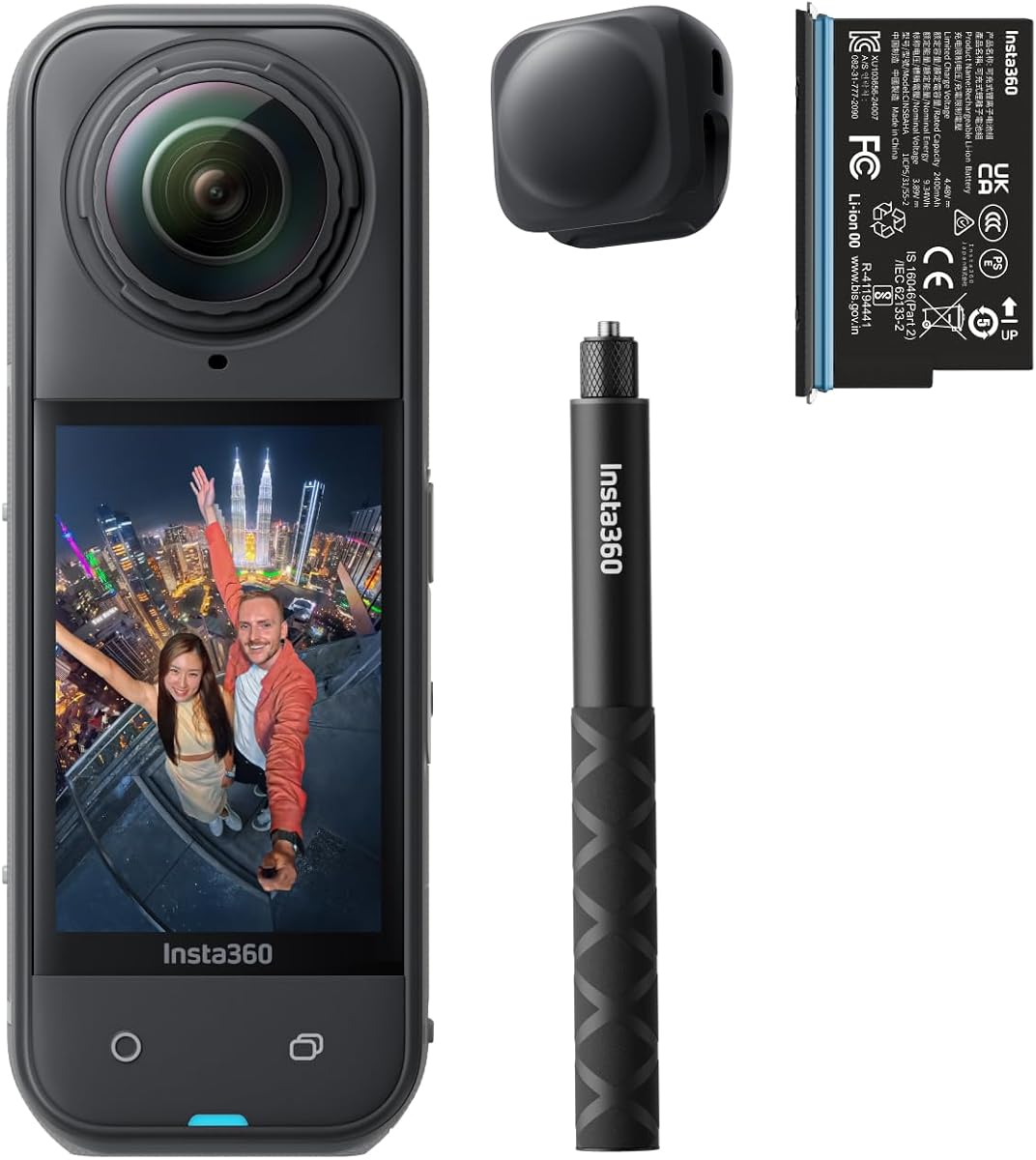


The Insta360 X3 is a balanced 360 action camera for creators who want the freedom of immersive recording without giving up conventional wide-angle footage. Its 4.6 rating reflects a well-established feature set, and the camera remains attractive for riders, skiers, travelers, and everyday vloggers. It can record 5.7K 360 Active HDR video or switch to a 4K single-lens perspective, making it more versatile than a camera designed for only one shooting style.
We may earn a commission when you buy through this link, at no additional cost to you.
The most compelling feature is the ability to capture first and choose the viewing angle afterward. Reframing in the Insta360 app allows a single recording to become a front-facing, rear-facing, or wide conventional clip. That reduces the need to constantly turn the camera toward a subject, which is especially useful during activities where stopping or adjusting the camera is inconvenient. FlowState Stabilization keeps motion smooth, while Horizon Lock helps maintain a level horizon. For flat video, 4K30fps is supported, along with a super-wide 170-degree MaxView mode at 2.7K60fps.
The principal compromises reflect the camera's position in the range. Newer X-series bodies offer higher-resolution sensors, larger displays, replaceable lenses, and longer battery life, so buyers seeking the longest possible endurance or the strongest low-light performance should examine the X5 or X6. The X3 is also a two-lens 360 camera, and its lens design does not offer the same replaceable-lens convenience found on the newer X5. Its 2.29-inch touchscreen remains useful, but it is smaller than the displays in later models.
Despite those limitations, the X3 is an easy recommendation for a buyer who values flexible framing, dependable stabilization, and established 360 capture without moving to the latest premium generation. It suits people beginning their 360 journey as well as creators who want a straightforward action camera with a familiar editing workflow. Choose it when versatility matters more than having the newest sensor, longest runtime, or most advanced lens system.
The shoot-first workflow is the X3's defining advantage. By recording the complete environment, you can choose a useful angle and crop later instead of missing a moment while trying to point the camera correctly.
FlowState Stabilization and Horizon Lock reduce shake and camera tilt, while the single-lens mode provides a familiar alternative for direct-to-camera content, road rides, and conventional action sequences.
We may earn a commission when you buy through this link, at no additional cost to you.
The Insta360 X6 is the most advanced camera in this roundup, bringing dual 1/1.1-inch square sensors, native 8K50fps 360 recording, 10-bit color, and a sophisticated AI editing system. Its 4.5 rating reflects a premium product aimed at creators who demand high-resolution source material and professional control. The X6 is especially relevant to filmmakers, serious 360 specialists, and users producing heavily reframed videos where extra detail in the original file is valuable.
We may earn a commission when you buy through this link, at no additional cost to you.
Image quality is the headline feature. The custom-built 1/1.1-inch sensors work with a triple-chip system that includes a 4nm flagship processor and two professional imaging chips. Creators can record 8K50fps immersive footage, while flat single-lens output reaches 5K60fps, 5K30fps at a 170-degree field of view, or 4K120fps. Ten-bit recording captures more than one billion colors, and InstaFrame 2.0 can follow a person, pet, or object and output smooth flat video without extensive manual work.
The package also addresses several common ownership concerns. Tougher, replaceable lenses are easier to swap, reducing the consequence of a scratched lens. The Xtreme Battery provides up to 140 minutes at 8K30fps, and 360 wind-protected microphones are designed to retain voices while reducing disruptive wind noise. The trade-off is that the X6 represents a much larger purchase commitment than the entry-oriented X3 or some more compact models, and high-resolution 360 files still demand considerable storage and editing resources.
The X6 is the strongest choice for buyers who want the most capable 360 platform in the group and are prepared to manage higher-resolution files. It is less compelling for someone seeking a small wearable camera or a conventional action-camera workflow with minimal post-production. For dedicated 360 filmmaking, however, the combination of sensor size, frame-rate options, tracking, audio, and replaceable lenses makes the X6 difficult to dismiss.
Capturing native 8K50fps gives editors substantial latitude to isolate subjects and create conventional-looking views from 360 footage. The dual large sensors also form the foundation for the camera's more demanding image-processing features.
InstaFrame 2.0, AI Director, and Auto Edit 2.0 can help turn a recording into a more conventional tracked shot or assembled vlog, while manual tools remain available for creators who want a different perspective.
We may earn a commission when you buy through this link, at no additional cost to you.
The Insta360 X5 Starter Bundle is a strong all-around 360 camera with an emphasis on endurance. It records 8K30fps video through dual 1/1.28-inch sensors and carries a 4.6 rating. The camera is waterproof to 49 feet without a dive case, while its stated battery runtime of up to 208 minutes makes it appealing for long rides, extensive travel days, and extended shooting sessions where carrying spare power may be inconvenient.
We may earn a commission when you buy through this link, at no additional cost to you.
The triple AI chip design supports advanced noise reduction and image processing, giving the X5 an important advantage in dim environments. FlowState Stabilization and 360-degree Horizon Lock keep footage smooth and level, and InstaFrame Mode can either automatically frame a tracked person or lock onto a fixed angle. A new four-microphone array and Wind Guard improve vocal pickup in windy settings. The fully replaceable lenses are also a meaningful upgrade because a damaged lens can be changed without replacing the entire camera.
Compared with the X6, the X5 does not offer the same 8K50fps maximum, larger 1/1.1-inch sensors, or 10-bit color. The Starter Bundle also lists the 114-centimeter Invisible Selfie Stick, while the description notes that it is sold separately in some configurations, so buyers should confirm the exact package contents. The long runtime also depends on the selected shooting mode, so high-resolution 360 capture and maximum-duration recording are not necessarily the same scenario.
For most 360 users, the X5 delivers the most balanced mix of image quality, ruggedness, battery life, and repairability in this guide. It is a particularly compelling choice for outdoor creators who regularly work near water or travel far from charging opportunities. Choose it over the premium X6 if your priority is practical endurance rather than the very highest resolution and color depth.
An advertised runtime of up to 208 minutes provides meaningful freedom for long activities. Fast charging to 80 percent in 20 minutes also helps when the camera is used between trips or on consecutive shooting days.
Replaceable lenses reduce the impact of scratches, while the four-microphone Wind Guard arrangement is intended to preserve voices and ambient sound in difficult outdoor conditions.
We may earn a commission when you buy through this link, at no additional cost to you.
The Insta360 X5 Essentials Bundle combines the X5's strongest capabilities with a particularly useful collection of accessories. It earns a 4.7 rating, the highest among the listed products, and is our editorial selection for a buyer who wants a complete 360 setup rather than only the camera body. The package includes the X5, a 114-centimeter Invisible Selfie Stick, an extra battery, a utility fast charge case, standard lens guards, a carry case, and a lens cap.
We may earn a commission when you buy through this link, at no additional cost to you.
Core performance comes from dual 1/1.28-inch sensors capable of 8K30fps 360 recording, backed by a triple AI chip design for noise reduction and image processing. The replaceable lenses are described as tougher, more durable, and scratch-resistant. FlowState Stabilization and 360-degree Horizon Lock maintain smoothness and level horizons, while InstaFrame Mode supports both auto-framing and a fixed perspective. These features make the bundle suitable for travel, motorcycle footage, action sports, and family events where the camera may be left recording unattended.
The principal technical limitation is that it does not match the X6's 8K50fps recording, 1/1.1-inch sensors, or 10-bit color. Buyers focused on the highest possible 360 image quality may prefer that more premium platform. Also note that a microSD card is not included. Although the supplied bundle is more complete than many basic packages, storage requirements should be considered before recording extended 8K sequences.
Overall, this is the most convincing general-purpose 360 recommendation in the list. The high rating, long stated runtime, replaceable lenses, fast-charging accessories, and protective carrying options cover the needs of many creators without requiring each item to be assembled separately. It is also a sensible model for first-time 360 buyers, while offering enough tracking and stabilization features to serve experienced creators.
The extra battery, fast charge case, carry case, lens guards, and Invisible Selfie Stick cover common needs immediately. This reduces the number of separate accessories required for travel, riding, or action-sport shooting.
The X5's strong rating is supported by a practical combination of image quality, low-light processing, stabilization, replaceable lenses, and endurance rather than a single headline feature.
We may earn a commission when you buy through this link, at no additional cost to you.
The Insta360 Ace Pro 2 is the best fit here for creators who want polished conventional action-camera footage without managing a 360 edit. Its 4.5 rating reflects a capable 1/1.3-inch sensor, Leica Summarit lens, and dual AI chip system. The camera records 8K30fps video and 4K60fps Active HDR, while its PureVideo mode supports improved low-light capture up to 4K60fps. That combination makes it especially effective for motorcycles, diving, winter sports, travel, and action vlogs.
We may earn a commission when you buy through this link, at no additional cost to you.
The 13.5 stops of stated dynamic range and 2.4-micrometer equivalent pixel size provide a strong foundation for detailed 8K files. Leica color profiles add a recognizable visual treatment, while the 157-degree wide-angle lens and MegaView field of view preserve useful scene coverage. FlowState Stabilization keeps moving footage smooth. For creators who need direct access to settings or framing, the 2.5-inch flip touchscreen is larger and more flexible than a fixed display.
The main limitation is conceptual rather than a defect: this is not a 360 camera. You must aim it at the subject and cannot recover a missed angle through reframing. It is also waterproof to 39 feet and rated for temperatures down to minus 20 degrees Celsius, which is suitable for many conditions but not identical to the deeper waterproof rating offered by the X5. The 8K files are valuable for cropping and slow motion, yet they require more storage and processing than ordinary 4K recordings.
Buyers who want a traditional action camera with strong sensor performance, excellent stabilization, flexible viewing, and strong low-light tools will find a lot to like here. The dual battery bundle is particularly useful for extended shooting. Choose the Ace Pro 2 over a 360 body when immediate framing, a conventional aspect ratio, and a straightforward action-camera experience matter more than the ability to capture every direction.
The 1/1.3-inch sensor and Leica lens target creators who prioritize detail, dynamic range, and a recognizable color profile. Eight-kilobyte frames also provide flexibility for digital crops after recording.
The 2.5-inch flip touchscreen makes the camera convenient for solo creators, while FlowState Stabilization, Gesture Control, Timecode, and Pre-Recording support active shooting situations.
We may earn a commission when you buy through this link, at no additional cost to you.
The Insta360 X4 Standard Bundle is a proven midrange option for users who want high-resolution 360 recording, fast reframing, and conventional flat-video capability. Its 4.6 rating indicates a well-received camera, and the bundle includes the X4, a USB-C cable, standard lens guards, a lens cloth, a protective pouch, and a user guide. It can capture 8K30fps or 5.7K60fps 360 footage with Active HDR, giving creators a useful choice between spatial detail and smoother motion.
We may earn a commission when you buy through this link, at no additional cost to you.
The X4 also records 4K60fps flat video and supports 170-degree MaxView at 4K30fps. FlowState Stabilization and 360-degree Horizon Lock address common action-camera problems, while the app's AI-powered reframing lets users decide the viewing angle after recording. The brighter 2.5-inch Gorilla Glass touchscreen is practical for menus and playback, and the lens guards have been made easier to apply and remove.
Durability is another strength. The camera is cold resistant down to minus 20 degrees Celsius and waterproof to 33 feet without a case, increasing to 164 feet with the Invisible Dive Case. Its 2290mAh battery provides up to 135 minutes of runtime, but the X5 and X6 offer longer endurance. The X4 also uses an earlier lens-guard design rather than the X5's fully replaceable lenses, so the newer model may be more attractive for users concerned about long-term wear.
The X4 remains a solid choice for 360 enthusiasts who want more than basic resolution and extensive frame-rate options. It is particularly suitable for action sports, group activities, and travel where a single shot can cover multiple subjects. Those willing to accept newer technology should compare the X5, but the X4 offers a mature and capable alternative when its current configuration fits the budget.
The ability to select 8K30fps or 5.7K60fps lets creators prioritize detail or fluid motion. Flat 4K60fps and 170-degree MaxView modes add flexibility for conventional action edits.
Cold resistance, waterproofing, removable lens guards, and a bright protected display support use in demanding outdoor environments. The pouch and cloth add basic protection for transport and maintenance.
We may earn a commission when you buy through this link, at no additional cost to you.
The Insta360 GO 3S is built around portability, hands-free capture, and unconventional mounting angles. The camera itself weighs only 39 grams and can record 4K footage, making it easy to wear on a cap, attach to a pet, or place on a surface where a larger action camera would be intrusive. Its 4.2 rating is the lowest in this group, but that does not make it less capable for creators whose priorities are compact size and flexible perspectives rather than maximum sensor resolution.
We may earn a commission when you buy through this link, at no additional cost to you.
A new wide-angle lens and MegaView field of view support 4K point-of-view footage, while FlowState Stabilization and Horizon Lock keep the tiny camera smooth and level. The included Action Pod provides a large 2.2-inch flip screen, remote control, live preview, and up to 140 minutes of battery life. It can also charge the camera while shooting, which is useful for longer sessions. QuickCapture, Gesture Control, and Voice Control reduce reliance on the small camera's physical controls.
Waterproofing needs careful attention. The GO 3S camera is IPX8 waterproof to 10 meters on its own, and a Dive Case expands that capability to 60 meters. The Action Pod is only IPX4 splash resistant and should not be submerged. Small cameras also involve practical compromises: storage is built in rather than centered on a user-replaceable card, and the compact body cannot offer the sensor area or dual-lens 360 capability of the X-series cameras.
Choose the GO 3S for travel, cycling, running, pet perspectives, and first-person vlogs where weight and unobtrusive mounting are decisive. It is less suitable for a creator who wants interchangeable storage, very fine detail at maximum resolution, or the ability to capture a complete 360 environment. Within the tiny wearable category, however, its screen, controls, mounting options, and battery system make it a notably complete package.
The magnetic design and included Magnet Pendant, Easy Clip, and Pivot Stand allow the camera to become a wearable, pet camera, or nearly invisible viewpoint. That flexibility can transform a simple activity into more engaging footage.
The larger 2.2-inch flip display, live preview, remote operation, and charging-while-shooting capability make the pod more than a simple battery enclosure. It is the primary control and viewing solution for most users.
We may earn a commission when you buy through this link, at no additional cost to you.
The Insta360 X4 Air differentiates itself through a lightweight 165-gram body that retains core 360-camera functions. It has a 4.6 rating and records 8K30fps video with Active HDR, so the emphasis is not merely on portability. Shooters can capture a complete environment, select a perspective later in the app, and benefit from FlowState Stabilization and 360-degree Horizon Lock during movement. The result is a compact option for walks, travel, family events, and everyday documentation.
We may earn a commission when you buy through this link, at no additional cost to you.
Replaceable lenses are a particularly useful feature because they can be swapped if scratched or damaged without replacing the entire camera. The built-in wind guard helps manage disruptive noise, and the AI-powered editing tools provide one-tap templates, effects, and reframing options. The package includes an extra battery, a 114-centimeter Invisible Selfie Stick, and a lens cap, giving buyers several of the principal accessories needed for common 360 workflows.
One distinction from the standard X4 is weight. Although both support 8K30fps 360 capture, the Air's stated body weight is 165 grams, making it potentially easier to carry for extended periods. On the other hand, the available specifications do not provide the same detailed battery-runtime figure listed for the standard X4, so endurance should be checked against current product information. The supplied listing also mentions Insta360+ cloud storage and backup benefits, which depend on service availability and account conditions.
The X4 Air is a compelling recommendation for users who want full 360 capture without carrying a bulkier body. It may be particularly attractive to travel creators who value the replaceable-lens system and lightweight form. Those seeking the strongest low-light specifications, longest runtime, or a more premium sensor should compare the X5 and X6 before finalizing their choice.
The 165-gram design reduces the burden of carrying a full 360 system. It is well suited to travel, casual walks, and spontaneous recordings where a lighter body is easier to keep on hand.
The app combines reframing, templates, and effects, while the described Insta360+ service adds auto backup, cloud storage, cloud editing, and sharing tools for users who want a more connected workflow.
We may earn a commission when you buy through this link, at no additional cost to you.
The Insta360 GO Ultra upgrades the tiny-camera concept with a 1/1.28-inch sensor, 4K60fps recording, 4K Active HDR, PureVideo low-light mode, and an AI voice assistant. At 53 grams, the camera remains compact enough for caps, magnetic clips, and wearables. Its 4.3 rating reflects a feature set that is more advanced than the earlier GO 3S, particularly in low light, sustained runtime, and smart assistance.
We may earn a commission when you buy through this link, at no additional cost to you.
The camera itself can record for up to 70 minutes, while the included Action Pod extends operation to three hours. Fast charging from zero to 80 percent takes 12 minutes, and the system includes a Magnetic Pendant, Quick Release Safety Cord, Easy Clip, Lens Guard, USB-C cable, and guide. Three levels of FlowState Stabilization and 360-degree Horizon Lock help maintain smooth, level footage during runs, cycles, and other activities where body movement is unavoidable.
The AI voice assistant adds functions such as real-time translation, answers through Ask by Voice or Ask with Photo, and speaker identification through Voiceprint Recognition. These tools may be helpful for travel, while auto editing can assemble highlights and transitions from FreeFrame recordings. As with other very small cameras, storage is integrated rather than based on a user-replaceable microSD card, and the body itself lacks the large controls and screen provided by the Action Pod.
Choose the GO Ultra when you want a highly portable hands-free camera that still performs well at night and offers intelligent travel tools. It is a better fit than larger 360 bodies for cycling, running, diving with the appropriate case, and first-person daily vlogs. It is not the right choice for creators who need interchangeable storage, dual-lens 360 recording, or extensive physical controls on the camera itself.
The 1/1.28-inch sensor, 5nm AI chip, and PureVideo Mode give the compact camera stronger low-light credentials than its size might suggest. That makes evening walks and night activities more practical.
Real-time translation, voice-based questions, photo-based assistance, and Voiceprint Recognition can reduce reliance on a phone. Auto editing further speeds the creation of short social-ready videos.
We may earn a commission when you buy through this link, at no additional cost to you.
The renewed Insta360 X5 offers the same core imaging platform as the current X5 while presenting a potentially more economical route into 8K 360 capture. It carries a 4.7 rating, tied for the highest among the listed cameras. Dual 1/1.28-inch sensors record 8K30fps immersive footage, and the triple AI chip design supports noise reduction and improved processing in dim conditions. For buyers comfortable with renewed equipment, the core performance remains compelling.
We may earn a commission when you buy through this link, at no additional cost to you.
FlowState Stabilization and full 360-degree Horizon Lock keep the footage smooth and level. InstaFrame Mode offers automatic subject framing or a fixed angle, and the replaceable lenses are designed to withstand scratches and be exchanged when needed. A four-microphone array with Wind Guard focuses on clearer voices. The camera is waterproof to 49 feet, making it suitable for diving without a separate dive case and many other wet environments.
There is one notable difference in the stated endurance: this listing describes up to 185 minutes, compared with the 208 minutes listed for the new X5 configurations. Bundle contents are also more limited, including the camera, USB-C cable, lens cloth, protective pouch, and user guide. The Invisible Selfie Stick and microSD card are sold separately. As with any renewed electronic product, the condition, warranty coverage, and included accessories should be verified carefully.
This is a strong option for a creator who values the X5's sensor, replaceable lenses, low-light processing, and replaceable-lens repairability but wants to pursue a more value-oriented purchase. It is less appropriate if you require pristine packaging, the broadest accessory bundle, or maximum stated runtime. With appropriate expectations and attention to the seller's condition and warranty terms, the renewed X5 can still deliver a capable, durable 360 system.
Dual 1/1.28-inch sensors, 8K30fps capture, and triple-chip processing preserve the key strengths of the standard X5. AI-assisted reframing and InstaFrame Mode make the footage practical for conventional edits as well as immersive viewing.
A renewed camera should be evaluated for cosmetic wear, lens condition, battery performance, sealing, warranty terms, and accessory completeness. The stated 185-minute runtime is also slightly below the figure listed for the new X5 bundles.
We may earn a commission when you buy through this link, at no additional cost to you.
Choosing an Insta360 camera means balancing recording format, image quality, durability, battery life, and the amount of post-production you want. The most important distinction is whether you need a complete 360 scene or a small, traditional action-camera viewpoint.
A 360 camera records every direction and lets you reframe the footage later, making it ideal for travel, group activities, and action sequences where the subject may move unpredictably. Traditional action cameras are better when you want to aim the lens directly, fill the frame with a subject, and minimize editing. The X5 and X4 can produce both immersive and flat video, while the Ace Pro 2 focuses on conventional footage and the GO models use compact point-of-view recording.
Sensor size and resolution determine how much detail is available for cropping, reframing, and slow motion. The X6 leads this group with dual 1/1.1-inch sensors, while the X5 uses dual 1/1.28-inch sensors and the Ace Pro 2 offers a 1/1.3-inch sensor. Maximum 8K recording provides headroom for demanding edits, but it also creates larger files and greater processing demands. Consider whether your computer, storage, and editing workflow can handle the selected format.
Low-light quality depends on more than the resolution label. The X5 and X6 use multi-chip systems designed for noise reduction and image processing, while the Ace Pro 2 offers PureVideo mode and the GO Ultra combines a 1/1.28-inch sensor with its 5nm AI chip. If most footage will be indoors, at night, or during cloudy events, these dedicated processing features deserve more attention than a headline 8K specification.
Every model listed provides FlowState Stabilization, but Horizon Lock behavior varies by camera design. In 360 models, the camera can be rotated while the horizon remains level; conventional models level the view within their permitted range. The X5 and X6 also provide tracking through InstaFrame, helping turn a 360 recording into a steady flat shot. Stabilization cannot replace good composition, but it is essential for motorcycles, running, cycling, and handheld adventure footage.
The X5 models are waterproof to 49 feet without a case, the X4 to 33 feet, the Ace Pro 2 to 39 feet, and the GO 3S camera body to 10 meters. Deeper diving may require a dedicated dive case. Cold resistance also varies, with several models rated to minus 20 degrees Celsius. Match the camera to the environment rather than assuming a general waterproof label covers prolonged submersion, salt water, or freezing conditions.
Stated runtimes provide useful guidance but are rarely universal because resolution, frame rate, stabilization, screen use, and wireless features affect consumption. The X5 is listed at up to 208 minutes in standard configurations, the X4 at 135 minutes, the X6 at 140 minutes in 8K30fps, and the GO Ultra Action Pod at three hours. For a long trip, consider a spare battery, charging case, or power solution rather than relying on a single charge.
A 360 recording contains more material than the final clip will use, and the Insta360 app adds reframing, tracking, templates, and AI-assisted editing tools. That flexibility is valuable, but it adds a learning curve. Traditional footage requires less reframing and is easier to integrate into existing edits. Compact FreeFrame recordings can also produce flexible aspect ratios, while InstaFrame modes help automate conventional-looking tracking shots.
The X5 and X4 Air use replaceable lenses, reducing the impact of scratches. Other models may require more care around exposed optics. A 360 camera also benefits from lens guards, a robust case, and a reliable storage card. Some bundles include an Invisible Selfie Stick, fast charge case, batteries, or lens cap, while others list the stick or microSD card as sold separately. Check the exact contents before assuming a complete kit.
Before the first shoot, fully charge the battery, install a suitably rated storage card, update the camera and app, and confirm that the lens or lens guards are clean and secure. Format the card in the camera when practical, then test both a short 360 recording and a conventional clip. Checking the framing and stabilization before an important session prevents avoidable problems when storage, battery, or weather conditions are already less than ideal.
Choose the shooting mode according to the planned edit. Use 360 capture when a subject may move out of frame or when several people need to remain visible. Use flat or single-lens recording for direct action shots, and consider lower frame rates when extended recording time matters more than smooth motion. For low-light scenes, stabilize the camera as much as possible and keep the lens free of moisture or fingerprints. Wind Guards and lens protection are particularly valuable on motorcycles, boats, and exposed ridgelines.
After recording, transfer files through the Insta360 app, create any reframing or tracking edits, and preserve the original 360 file when possible. Clean lenses with the supplied cloth, keep charging contacts dry, and rinse salt or mud from the camera before drying it. Do not open the body or lens assembly, and allow wet components to dry fully before charging or storage. Check the seller's warranty and care instructions, especially for renewed equipment.
A 360 action camera captures the full environment, allowing you to select the viewing angle later. A traditional action camera records a fixed forward-facing perspective, which is simpler to frame and often more convenient for conventional edits. Insta360 offers both formats, including hybrid X-series models that can switch between immersive and flat footage.
The X5 and X6 are strong options for riders who want immersive 360 footage, strong stabilization, and flexible reframing. The Ace Pro 2 is better for creators who prefer direct conventional framing and a Leica-tuned look. Riders should also consider mount security, wind noise, battery needs, and the visibility of any selfie stick in the intended shot.
No, but it creates the characteristic third-person or drone-like perspective associated with Insta360 footage. Because the camera records the stick, software hides it from the selected view. Some bundles include one, while other listings state that it is sold separately, so always verify the package contents.
Several models can, but the depth depends on the specific camera. The X5 is listed as waterproof to 49 feet, the X4 to 33 feet, the Ace Pro 2 to 39 feet, and the GO 3S camera body to 10 meters. A deeper dive case may be needed for greater depth, and an Action Pod should not be treated as a waterproof underwater housing.
Not always. 8K provides additional detail for cropping, reframing, and slow motion, but it requires more storage and processing. 4K is often sufficient for online playback, while 5.7K or 8K can be valuable for aggressive edits. Your computer's editing performance and the delivery platform should influence the choice.
The GO 3S is the smallest model listed, with a camera body weighing 39 grams. The GO Ultra weighs 53 grams and adds a larger sensor and other advanced features. By comparison, the X4 Air is a 165-gram 360 camera, illustrating the difference between wearable point-of-view capture and a dual-lens 360 body.
A renewed camera can be a practical way to access a capable platform at a lower commitment, but condition and warranty should be checked carefully. Inspect the lenses, body, battery performance, sealing, and included accessories. This particular renewed X5 listing includes the core camera and basic accessories, while the selfie stick and microSD card are listed as sold separately.
Choose the X5 if endurance, replaceable lenses, and strong 8K30fps 360 performance are the priorities. Choose the X6 for larger 1/1.1-inch sensors, native 8K50fps recording, 10-bit color, and more advanced imaging hardware. The X6 is the stronger choice for demanding 360 work, while the X5 offers a more balanced feature set.
The Insta360 X5 Essentials Bundle is the most complete general-purpose choice in this guide, combining 8K30fps dual-sensor recording, replaceable lenses, strong stabilization, low-light processing, and a generous accessory package. The Insta360 Ace Pro 2 is the top option for traditional action footage, while the Insta360 X3 offers a mature, versatile 360 experience for buyers who do not need the newest hardware.
Your priorities should guide the final decision. Choose the X6 for the highest-end 360 image platform, the X5 for endurance and repairability, the X4 or X4 Air for lighter or established 360 workflows, and the GO 3S or GO Ultra when portability is essential. Low-light conditions, waterproof depth, bundle contents, editing style, and battery requirements can be more important than a single resolution figure.
Finally, verify the current listing before purchasing because prices, promotions, availability, and bundle contents can change. Check the included battery, charging case, selfie stick, storage card, lens guards, and warranty terms, and confirm that the camera's protection ratings match the conditions in which you plan to use it.