
Eye Hortilux Super HPS 1000W 2-Pack
4.7Editor score
Enhanced violet blue green spectrum
Seventeen percent more total energy
Reduced mercury content
Two 1000W bulbs included
Our Hps Lights for Growing guide compares 10 fixtures and bulbs by spectrum, power, efficiency, coverage, compatibility, and build for better plants.
HPS lights have long been associated with intense indoor and greenhouse illumination, especially during flowering. A capable system must do more than deliver raw brightness: it should provide an appropriate spectrum, pair correctly with its ballast and reflector, and manage the considerable heat produced by high-pressure discharge lamps. The right choice depends heavily on footprint, growing stage, and setup experience.
This guide compares ten HPS bulbs and lighting products using the supplied specifications, customer ratings, wattage, spectral claims, physical construction, and compatibility details. It includes complete double-ended systems, standalone lamps, and two LED alternatives that may appeal to growers seeking lower heat and different energy characteristics. Recommendations reflect the information available at the time of writing, without implying hands-on testing.
Each review identifies the product's most useful qualities and practical limitations, helping you distinguish a ready-to-grow fixture from a replacement bulb or an entirely different LED approach. Ratings and specifications can change as manufacturers revise products, while prices and availability fluctuate frequently. Always confirm the current listing, fixture dimensions, electrical requirements, and local safety guidance before purchasing.
4.7Editor score

4.0Editor score

4.4Editor score
The table below compares the ten products by their primary lighting format, electrical output, spectral emphasis, coverage claims, and key compatibility details so you can compare complete systems, replacement bulbs, and LED alternatives without losing sight of their different roles.




The Plantmax UltraGrow is a complete 1000W double-ended HID system that includes a matching Plantmax HPS bulb, a dimmable ballast, an adjustable reflector, and a controller port. Its 4.0 rating reflects a practical package for indoor growers who want more than a loose replacement lamp. The supplied feature set makes it especially relevant to larger setups where light placement and operating flexibility are important.
We may earn a commission when you buy through this link, at no additional cost to you.
Its strongest advantage is integration. Instead of separately matching a bulb, ballast, reflector, and enclosure, the buyer receives a coordinated system. The ballast provides selectable levels of 600W, 750W, 825W, 1,000W, 1,150W, and EXT, allowing output to be adjusted as plants develop or environmental conditions change. The controller port also provides a route for external control, which can be valuable in a more automated installation.
The premium Vega hammertone reflector has three adjustment modes intended to optimize coverage. That flexibility is useful when plants occupy a rectangular area or when light needs to be directed around nearby walls and equipment. On the other hand, a 1000W double-ended system is a substantial installation rather than a simple hanging lamp. It produces meaningful heat, and the two-ended lamp design requires careful handling and compatible installation practices.
This is the strongest recommendation for a grower who wants a ready-to-assemble 1000W HPS system with dimming, controller connectivity, and an included bulb. It may be unnecessary for a small tent or a grower replacing only a failed lamp, but it offers an unusually broad control package for an indoor flowering fixture. Check the available space, ventilation, electrical arrangement, and reflector clearance before installation.
The most fitting buyer is a serious indoor grower or greenhouse operator who values adjustable output and a fixture-centered purchase. The lower 4.0 rating should not be read as a lack of features; it simply reflects that this is a complex setup whose outcome depends heavily on room design, ventilation, and correct use. When those factors are addressed, the system stands out as the most complete option in this roundup.
The six ballast settings give growers more control than a fixed-output fixture. Lower settings can be useful during earlier growth stages or warmer periods, while the upper range supports a high-demand flowering setup.
The included bulb, reflector, dimmable ballast, and controller port reduce the need to source each major component separately. That convenience is the system's defining advantage for indoor installations.
We may earn a commission when you buy through this link, at no additional cost to you.
This two-pack of 1000W HPS bulbs targets growers seeking high-output red-spectrum lighting for flowering and bud development. It carries a 4.4 rating and advertises 1950μmol/s output, 136,000 lumens, and a 60% increase in red-spectrum focus. The E39 screw base and compatibility with both electronic and magnetic ballasts make the bulbs relevant to a wide range of existing HID setups.
We may earn a commission when you buy through this link, at no additional cost to you.
The emphasis on red spectrum is the feature most likely to appeal to flower-focused growers. According to the supplied description, the light concentrates more PAR on red wavelengths to improve photosynthetic utilization during flowering and support larger buds. A pair also simplifies replacement planning and can provide a matched set for a two-fixture arrangement, provided the ballast, reflector, wattage, and electrical configuration support two 1000W lamps.
The listed performance figures are manufacturer claims rather than independent findings, so growers should interpret them as specifications to compare against their needs. There are also operational cautions: allow five minutes for the bulb to reach full brightness and wait at least seven minutes before striking it again. Those restrictions matter for automated systems that might otherwise be configured for rapid cycling.
This set is best for a grower with compatible 1000W HPS equipment who prioritizes a red-heavy flowering spectrum and wants two bulbs in one purchase. It is not a complete lighting system, and it will not serve a space without suitable ballasts, reflectors, fixtures, ventilation, and appropriate electrical support. Confirm the base, wattage, ballast rating, and fixture dimensions before ordering.
The two-pack balances useful compatibility information with an assertive spectrum specification. Its 4.4 rating places it among the stronger-rated options here, although it lacks the integrated convenience of the Plantmax system. For a grower already committed to replaceable E39 HPS hardware, it is a straightforward and potentially useful way to acquire a matched high-output pair.
The bulb's increased red emphasis targets the flowering phase, where many growers prioritize compact, vigorous bloom development. It remains a high-pressure sodium lamp rather than a full-spectrum LED alternative.
The stated warm-up and restart intervals should be programmed into timers or environmental controls. Allowing the lamp to cool appropriately protects consistent operation and avoids repeated cycling.
We may earn a commission when you buy through this link, at no additional cost to you.
The Eye Hortilux HX66710 is a 600W Super HPS lamp designed to deliver optimized spectral energy for plant growth across the growing cycle. Its 4.6 rating is among the highest in this roundup, while the EN designation highlights lead-free construction and lower mercury content compared with standard HPS lamps. It is a compelling option for growers who prefer a replaceable 600W HID platform.
We may earn a commission when you buy through this link, at no additional cost to you.
The lamp's enhanced spectrum is designed to provide more usable energy than conventional high-pressure sodium light. That distinction can make it more suitable than a basic HPS bulb for growers who want a single lamp type to support multiple stages. The listed use for extending the growing season to 365 days also positions the product for controlled indoor and greenhouse environments where dependable year-round illumination is useful.
As a standalone lamp, it does not include the reflector, ballast, socket, or enclosure. The buyer must confirm that the existing fixture is designed for a 600W HPS lamp and appropriate HID operation. A more moderate output level than 1000W products can also be advantageous in smaller spaces, although the exact coverage still depends on the reflector and mounting height rather than wattage alone.
This is a strong recommendation for a grower with a compatible 600W setup who values enhanced spectrum, environmental attributes, and a well-regarded replacement lamp. It may appeal particularly to users seeking one HPS lamp for both vegetative and flowering periods. The key caveat is that buying the lamp does not create a complete fixture, so existing hardware must be safe and correctly rated.
Overall, the HX66710 balances a high rating with meaningful spectral and material advantages. It does not offer the plug-and-play simplicity of an LED, nor the all-in-one convenience of a system with an included bulb, but within the category of established HPS lamps it remains a notably strong and versatile choice.
Super HPS output is intended to provide optimized spectral energy throughout plant development. This makes the lamp easier to incorporate into a single-lamp strategy than an aggressively flowering-focused bulb.
The lead-free EN construction and reduced mercury level distinguish this model from standard HPS lamps. Those features may be important to growers seeking equipment with improved environmental characteristics.
We may earn a commission when you buy through this link, at no additional cost to you.
This 1000W HID system kit provides the reflector, ballast, and related hardware needed to build a configurable grow-light installation while leaving the bulb to be purchased separately. Its 4.0 rating reflects a versatile platform with support for both HPS and MH lamps, multiple power levels, a controller port, and a high-reflectivity aluminum hood.
We may earn a commission when you buy through this link, at no additional cost to you.
The adjustable ballast offers 600W, 750W, 1000W, and 1150W settings, with dual-voltage input from 120V to 220V. A controller port enables multi-deployment, which is useful for growers managing several zones or adding external control. The open-design Italian Vega aluminum reflector is promoted as delivering wider coverage and reducing dead spots, while graduated cooling fins and protections against short circuits, surges, ignition failures, and overheating improve the system's practical design.
The important limitation is that no bulb is included. A buyer who expects to unpack the kit and begin growing immediately will need to add a compatible HPS or MH lamp. The system also produces substantial heat, and the description specifically warns against operation in an unventilated enclosed area. A SunStream inline fan is recommended for best heat dissipation and equipment protection.
The kit suits experienced growers who want to select their own lamp and use a multi-fixture or controller-based installation. Its open reflector and adjustable ballast are particularly useful in a carefully planned room or greenhouse. Less experienced buyers may prefer a system that includes a bulb and has a simpler setup, while anyone working in a small tent should calculate heat and coverage before committing.
Despite the missing lamp, the kit offers strong customization. It is a better fit for a grower who already understands HID components than for someone shopping for a first all-in-one light. Correct electrical installation, ventilation, and bulb compatibility remain the three non-negotiable checks.
Because HPS and MH lamps are supported but not included, growers can select a spectrum and output that suit their crop and room. Confirm socket type, ballast compatibility, and wattage before buying a bulb.
The system's cooling design helps manage internal heat, but it cannot replace room ventilation. Inline airflow and adequate spacing remain essential for stable operation and equipment protection.
We may earn a commission when you buy through this link, at no additional cost to you.
The VIPARSPECTRA P4000 is a 450W full-spectrum LED grow light that serves as an alternative to traditional HPS and MH fixtures. It has a 4.7 rating, the highest shown among these products, and combines red, warm-white, cool-white, and infrared diodes with a dimmer knob. The specification describes a comparable lighting output to traditional 1000W HPS/MH while consuming 450W.
We may earn a commission when you buy through this link, at no additional cost to you.
The P4000's spectrum includes 52 red diodes at 660nm, 1,272 warm-white diodes at 3000K, 632 cool-white diodes at 5000K, and four infrared diodes at 730nm. This gives growers control over brightness and a broad light mix for seed starting, vegetative growth, and flowering. The manufacturer states coverage of five by four feet for vegetative growth and five by three feet for flowering.
Unlike a high-pressure sodium fixture, it uses a fanless design with broad aluminum heat sinks. The plug-and-play mounting system, on-off switch, and dimmer make it approachable for a new indoor grow. It is not, however, an HPS bulb and should not be evaluated as a drop-in replacement for HID equipment. The claimed energy comparison and yield benefits should be treated as manufacturer statements rather than independent test results.
This LED is a good choice for growers prioritizing lower heat, quiet operation, dimming, and a compact light footprint over traditional HID lighting. It may be particularly attractive in a sealed or small grow area where a 1000W HID system would be difficult to cool. Users should still adjust mounting height and brightness according to plant response and manufacturer guidance.
The P4000 earns its place in this comparison as a modern alternative rather than a conventional HPS option. Its rating, dimmer, efficient power draw, and broad spectrum make it a compelling choice for a new installation, while existing HPS owners seeking a replacement bulb will need to look elsewhere.
The dimmer allows growers to reduce output as plants approach the fixture or during sensitive early stages. It provides more granular control than many fixed-output HPS systems.
Large aluminum heat sinks and a fanless housing reduce mechanical noise while dissipating heat. The result can suit indoor rooms where a loud extraction or cooling setup would be less desirable.
We may earn a commission when you buy through this link, at no additional cost to you.
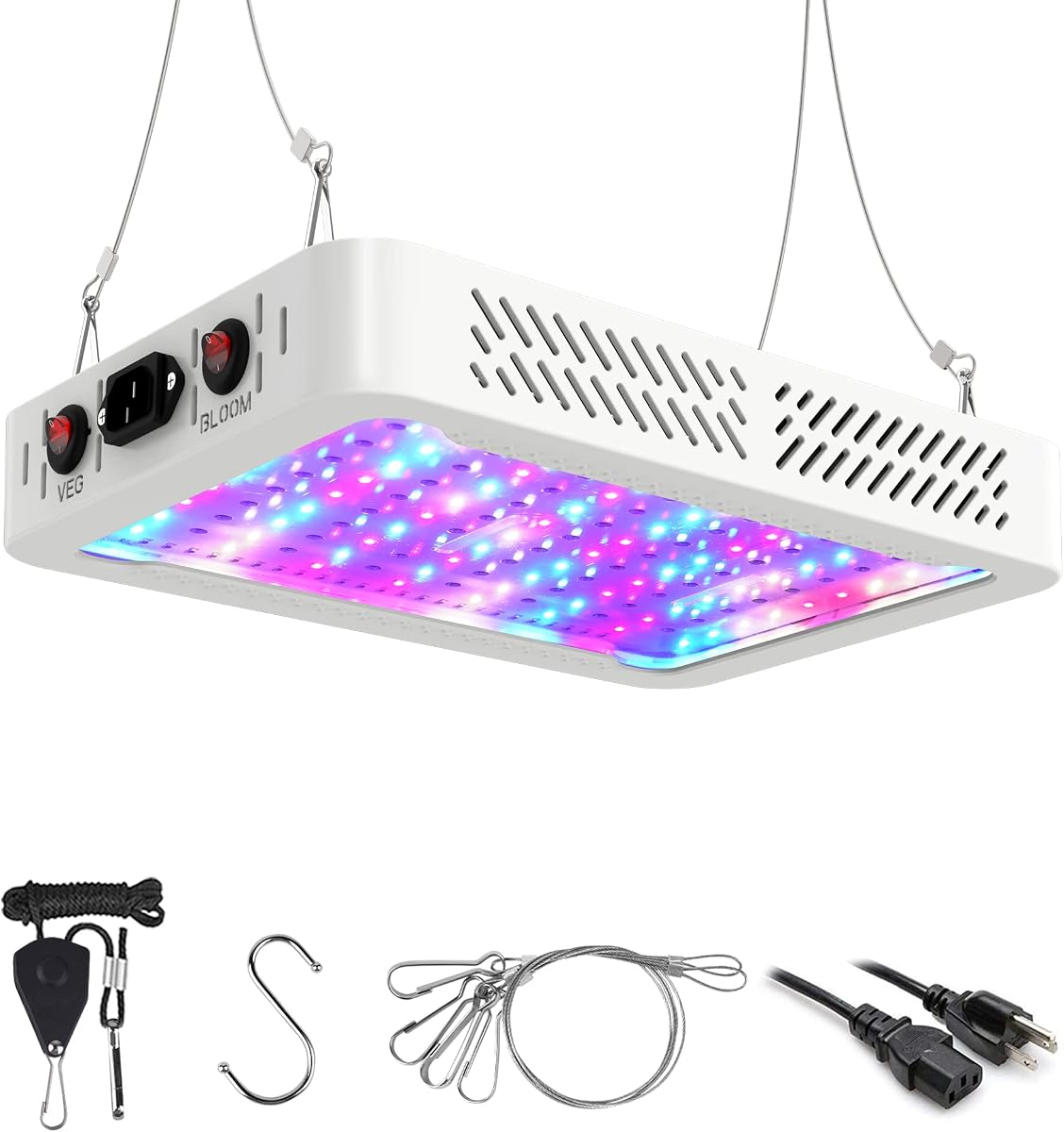
The Beelux 1000W LED is designed as an efficient alternative to a conventional 1000W HPS or MH system. Its actual power draw is listed at 110W, and the product is described as suitable for a four-by-four-foot grow area. With a 4.3 rating, it offers an interesting option for growers who want a familiar HPS-equivalent output claim without operating a high-heat discharge lamp.
We may earn a commission when you buy through this link, at no additional cost to you.
The light uses upgraded dual-chip technology and additional red LEDs to produce a full-spectrum output intended for seed starting, vegetative growth, and flowering. The supplied description claims a yield increase of 30% to 50%, but that figure should not be treated as independently verified. Its more concrete advantage is the contrast between nominal 1000W-equivalent output and 110W power consumption.
Thermal management relies on a fire-resistant optical-grade PC body, aluminum rear cover, and convection-assisted dissipation from six sides. The absence of a stated fan helps keep the unit quiet. Installation includes a power cord, two steel ropes, and an adjustable rope, allowing the height to be changed as plants grow. As with the other LED alternatives here, it is not interchangeable with a traditional HPS socket and ballast.
The product is well suited to a compact indoor grow where a large HID installation would create excessive heat. It may also appeal to greenhouse growers seeking a modern light for year-round or off-season use. Buy it as a new lighting solution, not as a replacement for a failed HPS bulb, and verify the recommended hanging distance and coverage assumptions against the fixture's instructions.
Its strongest case is efficiency in a moderate footprint. The 4.3 rating, dual-chip design, low power draw, and simple hanging system make the Beelux a credible alternative for growers prioritizing convenience and lower electricity use over traditional HPS format.
The listed 110W consumption contrasts sharply with the product's 1000W HPS-equivalent positioning. This can reduce the electrical and cooling demands of a small indoor installation.
Steel ropes and an adjustable rope make it possible to reposition the fixture as a canopy develops. This flexibility helps growers manage distance without repeatedly relocating fixed hardware.
We may earn a commission when you buy through this link, at no additional cost to you.
The Hortilux Super HPS is a 1000W enhanced-spectrum replacement lamp for growers already using compatible high-pressure sodium equipment. Its 4.5 rating and established product format make it a straightforward option for improving the spectral characteristics of a conventional HPS installation without replacing the entire fixture.
We may earn a commission when you buy through this link, at no additional cost to you.
According to the supplied information, the lamp provides 25% more energy in the violet, blue, and green spectrum than standard high-pressure sodium. The stated goal is to provide optimum spectral energy levels through all stages of plant growth when used with a Metal Ace conversion lamp. Its EN designation also means it passes EPA TCLP test criteria for disposal as non-hazardous waste.
The central advantage is enhanced spectrum without abandoning HPS infrastructure. That matters for growers with established ballasts, reflectors, and 1000W sockets who want a less basic lamp. The trade-off is that it is a single lamp, not a two-bulk set, and the fixture must be compatible with the operating requirements of a 1000W HPS source.
This lamp is a good match for a grower replacing a standard HPS bulb in a properly ventilated setup, especially one that values a more balanced spectral range. It is less suitable for a first-time buyer who has not selected a ballast or reflector. Check the socket, wattage, and electrical compatibility carefully, and avoid assuming all 1000W HID sockets support every lamp design.
Overall, the Hortilux Super HPS offers a focused upgrade path. It preserves the recognizable power and infrastructure of HPS lighting while adding spectral energy in regions that basic HPS bulbs can underrepresent.
The additional violet, blue, and green energy distinguishes this lamp from a standard HPS source. It is a meaningful upgrade for growers retaining a conventional HID platform.
Passing EPA TCLP criteria as non-hazardous waste can make end-of-life handling more straightforward. Users should still follow applicable local disposal and recycling rules.
We may earn a commission when you buy through this link, at no additional cost to you.
The Eye Hortilux Super HPS 2-Pack combines two 1000W enhanced-spectrum bulbs in a matched set. It holds a 4.7 rating, tying the highest score among the conventional HPS products in the roundup. The pair is intended for growers who want higher output, broader spectral energy, and consistent replacement lamps for two compatible HPS fixtures.
We may earn a commission when you buy through this link, at no additional cost to you.
The stated performance is substantial: 17% more total energy and 25% more energy in the violet, blue, and green spectrum than standard HPS lamps. The bulbs also contain less mercury. These features support the premium positioning, particularly for experienced growers seeking an upgrade within a familiar high-pressure sodium platform rather than switching to a different lamp technology.
The trade-off is power density. Two 1000W sources can create substantial heat and require deliberate room and canopy design. The purchase also assumes that the buyer has two appropriate fixtures, reflectors, ballasts, and electrical arrangements. A grower with one large reflector may find a single-bulb option more practical, while one with an existing dual-lamp setup may find this matched pair convenient.
This is the premium recommendation for a grower with a suitable two-fixture installation who values enhanced spectrum and long-term product pedigree. It is also a sensible replacement purchase after one lamp fails, because the second matching bulb maintains consistency across the setup. Verify warm-up behavior, socket compatibility, and any manufacturer requirements for the exact fixture before installation.
The two-pack delivers the strongest blend of rating, spectrum, and matched convenience in the HPS category. It does not include reflectors or ballasts, but within replacement lamps it offers a clear premium upgrade for a grower already committed to 1000W Super HPS hardware.
Buying two bulbs together helps maintain a consistent lighting strategy across paired fixtures. This is especially useful in symmetrical layouts where matching lamp characteristics can simplify visual and operational management.
The combined increase in total and specific spectral energy provides more usable light than a standard HPS source. Growers can retain established hardware while improving the quality of delivered light.
We may earn a commission when you buy through this link, at no additional cost to you.
The Eye Hortilux 1000-Watt Super HPS is a single enhanced-spectrum bulb for growers replacing one lamp or operating a single-fixture installation. It carries a 4.5 rating and provides 25% more energy in the violet, blue, and green spectrum than standard high-pressure sodium. The single-lamp format makes it more flexible than the two-bulb bundle.
We may earn a commission when you buy through this link, at no additional cost to you.
The glass construction and listed origin in the USA distinguish the product, while its package dimensions of 15.1 by 3.4 by 3.2 inches and listed weight of 0.8 pounds give shoppers basic handling information. The spectral claim aims to improve the light mix through plant growth when paired with a Metal Ace conversion lamp, as stated in the product information.
As with other standalone HPS lamps, the fixture carries most of the responsibility for safe operation. A compatible 1000W socket, ballast, enclosure, reflector, and cooling plan are required. The single pack is an attractive choice when only one position needs a replacement or when an even number of bulbs is unnecessary. It also avoids buying extra stock that will sit unused.
The recommendation is strongest for an existing HPS operator who wants to move from a standard lamp to enhanced spectrum without replacing the whole system. It may be less convenient for a new grower because none of the supporting hardware is included. Confirm wattage, socket, and ballast requirements, and follow all electrical and ventilation guidance supplied with the fixture.
This single bulb provides an accessible path into the Eye Hortilux Super HPS range. It combines a strong rating with enhanced spectrum and reduced purchasing complexity, making it a practical option for targeted upgrades.
The single pack is convenient for replacing one failed lamp or filling one fixture. It also allows growers to evaluate enhanced spectrum without immediately replacing every bulb in the room.
The 1000W output makes this lamp a specialist replacement rather than a general household bulb. Matching it to a correctly rated reflector, ballast, socket, and cooling system is essential.
We may earn a commission when you buy through this link, at no additional cost to you.
The Sylvania Plantastar 400W is a straightforward high-pressure sodium grow lamp for smaller or more moderate installations. It has a 4.4 rating and lists 50,000 lumens, 600μmol/s PPF, a clear ellipsoid shape, and a T14.5 form. The E39 mogul base and ANSI S51 ballast requirement make compatibility checks particularly important.
We may earn a commission when you buy through this link, at no additional cost to you.
The lamp is advertised for vegetative growth, flowering, seeding, and budding, with a wider spectrum intended to encourage healthy growth and yield. Its 400W rating makes it easier to manage thermally than a 1000W HPS fixture, while the 24,000-hour rated lifetime reduces the frequency of replacements. A standard five-year warranty also adds some reassurance for a long-lived component.
The key limitation is electrical specificity. The listed 100V operating requirement and ANSI S51 ballast mean it cannot be installed in an arbitrary 120V HPS socket or paired with just any magnetic ballast. The 2100K warm spectrum also reflects the traditional character of high-pressure sodium light, so growers seeking modern full-spectrum LED output should not confuse it with those alternatives.
This lamp is the budget recommendation for a grower who already has, or can acquire, the correct 100V ANSI S51 setup. It can be a sensible starting point for a modest indoor canopy or a supplemental greenhouse installation. It is not suitable for those who want a complete fixture, and it should not be used with incompatible ballast hardware.
The Plantastar delivers a useful combination of accessible output, a conventional base, long rated life, and strong customer feedback. Confirm compatibility and ventilation first; once those requirements are met, it is a dependable option for growers seeking a smaller-wattage HPS platform.
At 400W, the lamp demands less power and produces less heat than 1000W HPS alternatives. That makes it easier to incorporate into appropriately sized rooms and moderate canopies.
The E39 base, clear ellipsoid design, and 24,000-hour rated life make the lamp familiar to growers with compatible HID equipment. The five-year warranty adds backing to the longevity claim.
We may earn a commission when you buy through this link, at no additional cost to you.
Choosing an HPS light requires balancing lamp output, spectral quality, fixture compatibility, heat management, and coverage. The right product depends on whether you need a complete system, a replacement bulb, or a lower-heat alternative for a specific growing area.
Start by deciding whether you need a complete fixture, a controller-ready system kit, or a replacement lamp. The Plantmax UltraGrow includes a bulb, ballast, reflector, and controller port, while the 1000W HID kit supports HPS and MH bulbs but does not include one. Most Eye Hortilux, Hortilux, and Sylvania choices are bulbs that require compatible reflectors, sockets, ballasts, and wiring. LED products are complete plug-in fixtures and cannot replace a conventional HPS bulb.
HPS output should be matched to canopy size, mounting height, reflector design, and the room's cooling capacity. A 1000W lamp can deliver substantial intensity, but it also creates more heat and may be excessive for a small area. The 400W Sylvania is a more moderate starting point, while 600W and 1000W options suit increasingly demanding installations. Coverage claims supplied by manufacturers are useful comparisons, but actual distribution depends heavily on the reflector and fixture position.
Traditional HPS light is particularly red and yellow, which many growers favor during flowering. Super HPS products add energy in the violet, blue, and green regions, while the two-pack HPS bulb places an especially strong emphasis on red. Full-spectrum LEDs provide a different mix with dimming and lower heat. Compare spectral claims on their intended use rather than treating one universal spectrum as suitable for every crop and stage.
Base type is only the first check. Confirm lamp wattage, ballast wattage, ballast type, operating voltage, socket rating, fixture dimensions, and whether the fixture is designed for single-ended or double-ended lamps. The Sylvania Plantastar specifically lists 100V operation and an ANSI S51 ballast, while the double-ended Plantmax system uses different construction from conventional screw-base bulbs. A physically similar lamp can still be unsafe if the electrical specifications do not match.
HPS systems release substantial heat, and the included product information repeatedly emphasizes ventilation. Use an open, well-ventilated growing area, maintain clearance around fixtures, and consider an inline fan for enclosed rooms. LED alternatives produce less heat and may simplify temperature management, but they still require sensible mounting and environmental control. Heat planning also determines whether multiple high-wattage lamps can safely share one electrical and environmental system.
A bright lamp does not guarantee even coverage. The Plantmax and HID system products use adjustable or open aluminum reflectors intended to spread light and reduce dead spots. Standalone bulbs need a suitable reflector, and their effective footprint may differ from the coverage figures quoted for complete LED fixtures. Look for adjustability when the canopy is rectangular, plants are at different heights, or equipment creates obstacles that should remain outside the direct light path.
Dimming and external control can make a high-output fixture more adaptable. The Plantmax system offers six power levels and a controller port, the HID kit adds a controller port and four power levels, and the VIPARSPECTRA P4000 uses a simple brightness dimmer. Standalone HPS bulbs generally offer fewer operating controls, so they may require a more capable ballast and room-level environmental automation. Choose the control method that matches your monitoring and automation experience.
The listed products provide different longevity cues, including a 24,000-hour rated life for the Sylvania and two-pack HPS bulb, a five-year warranty for the Sylvania lamp, and a 90% output-maintenance claim for 5,000 hours on the two-pack HPS product. EN or TCLP-related language on some HPS lamps also addresses lead and mercury considerations. Review the actual warranty terms, replacement availability, and expected operating environment rather than relying on a single headline figure.
Before installation, read the instructions supplied with the lamp or complete fixture and verify the wattage, voltage, socket, ballast, reflector, and cooling requirements. Mount the light at the recommended height, keep the specified clearance from plants, walls, and combustible materials, and ensure the electrical connections are handled by a qualified person when required. For a replacement bulb, switch off and disconnect power before removing the old lamp and allow the fixture to cool completely.
Operate the system within its stated environmental limits and provide suitable air circulation. HPS lamps need a warm-up period, and the two-pack 1000W HPS product specifically calls for five minutes to reach full brightness and at least seven minutes before striking again. Do not repeatedly toggle the lamp to simulate a dimmer; use the ballast's dimming controls or the P4000's dedicated dimmer. Schedule the system consistently and monitor room temperature, humidity, and plant response.
Keep reflectors and cooling fins clean so that light output and heat dissipation are not restricted. Allow the lamp to cool before cleaning, and avoid touching the glass directly because oils from bare hands can create localized hot spots that shorten lamp life. Inspect sockets, cords, reflectors, and mounting hardware periodically, replace failed components with matching specifications, and follow local guidance for recycling or disposing of high-pressure sodium lamps.
HPS lights are high-pressure discharge lamps commonly used to provide intense illumination for indoor plants and greenhouse crops. Their spectrum is strongly weighted toward yellow, orange, and red wavelengths, which many growers favor during flowering and fruiting. Enhanced-spectrum models add more violet, blue, and green energy than traditional HPS bulbs. The correct fixture, ballast, ventilation, and mounting height are essential for safe and effective use.
HPS lamps can support seedlings, leafy growth, vegetables, and flowering plants, but their strongest traditional association is with flowering. Seedlings generally benefit from lower intensity and careful placement, so a dimmable system or a lower-wattage lamp may offer better control. Full-spectrum LEDs can be a practical alternative when a grower wants adjustable light in a small, heat-sensitive area. The right choice depends on crop, footprint, and available cooling.
No. The replacement must match the fixture's socket, wattage, voltage, ballast type, and physical design. A 1000W double-ended lamp is not interchangeable with a conventional E39 screw-base bulb, and a 400V Sylvania Plantastar requires the specified 100V ANSI S51 ballast. Always check the lamp and fixture documentation before purchasing, and never assume that similar wattage or shape guarantees compatibility.
They need enough airflow to remove heat and maintain a stable growing environment. The amount required depends on total lamp wattage, room size, insulation, temperature, humidity, and the distance between fixtures. Open designs and inline fans can help move hot air out of the room, while reflective surfaces and appropriate spacing reduce the heat retained near the canopy. Monitor conditions continuously rather than relying on a single room thermostat setting.
Enhanced-spectrum HPS bulbs provide more energy in the violet, blue, and green spectrum than standard HPS lamps, potentially giving growers a more balanced light mix while preserving familiar HPS infrastructure. The products in this roundup also vary in red-spectrum emphasis, total energy, mercury content, and output maintenance. A premium enhanced bulb can be worthwhile in a well-matched system, but compatibility and adequate ventilation remain more important than the spectrum label alone.
An HPS system is attractive for growers already equipped for HID lighting, seeking intense red-rich output, or comfortable with reflector, ballast, and heat-management requirements. An LED is often easier to install, quieter, dimmable, and more efficient, particularly in a compact room. The Plantmax UltraGrow and VIPARSPECTRA P4000 represent those different approaches in this roundup. Your crop, available area, electrical setup, and preferred level of control should determine the better route.
Expected service life depends on the model, operating hours, starting frequency, temperature, ballast quality, and maintenance. The Sylvania Plantastar lists a 24,000-hour rated lifetime, while the two-pack 1000W HPS product advertises more than 24,000 hours total and 90% output maintenance for 5,000 hours. Actual life varies, and declining output can occur before a lamp fails. Replace lamps when output, light distribution, or electrical condition no longer meets the grow's needs.
Only when the ballast and fixture are designed for dimming. The Plantmax UltraGrow provides selectable output levels and an EXT setting, while the 1000W HID system kit offers four power levels. Standard standalone HPS bulbs cannot safely be dimmed by an ordinary household dimmer or by reducing voltage outside the ballast's approved range. Use the controls provided by the manufacturer and follow the system's specific operating instructions.
The Plantmax UltraGrow 1000W is the leading all-in-one choice for a grower seeking a complete system with a matching bulb, adjustable reflector, dimmable ballast, and controller port. The Eye Hortilux Super HPS 2-Pack stands out as the premium traditional HPS option, combining a 4.7 rating with enhanced spectrum and matched 1000W bulbs. For a more moderate traditional HPS installation, the Sylvania Plantastar 400W offers accessible output, a long rated life, and a familiar E39 base, provided the required 100V ANSI S51 setup is available.
Prioritize compatibility before every other buying factor. Confirm whether you need a complete fixture, a bulb, or a controller-ready kit; match wattage and voltage to the ballast; and calculate canopy coverage using the actual reflector rather than wattage alone. Heat management is equally important, particularly for 1000W systems, so build airflow and electrical capacity into the room before installing multiple fixtures. If low heat, quiet operation, and simple dimming matter more than HPS format, the LED alternatives deserve careful consideration.
Finally, confirm the current listing details before ordering, because product specifications, ratings, availability, and prices can change over time. Compare the latest manufacturer instructions with the fixture and ballast you already own, and follow local electrical and safety guidance. A carefully matched lamp and setup will deliver more dependable results than an impressive specification used with the wrong hardware.