
Cooler Master Q300L V1
4.5Editor score
Compact Micro-ATX format
Tool-free removable panels
Flexible front I/O placement
Our Gray PC Case guide compares 10 gray and neutral-toned cases for airflow, hardware compatibility, build quality, cooling support, ease of use, and design.
A gray PC case sits between the boldness of black and the brightness of white, making it a versatile choice for gaming rooms, offices, and professional workstations. A well-proportioned neutral enclosure can reduce visual clutter while complementing metallic components, subdued lighting, and fabric-fronted designs. The right case also needs to fit your motherboard, graphics card, cooling hardware, and desired maintenance access.
We compared the 10 cases in this guide using the supplied specifications, focusing on form-factor support, graphics-card clearance, CPU-cooler height, radiator options, airflow design, included fans, cable management, accessibility, and distinctive construction features. Although several products use broader neutral finishes rather than a pure gray color, each offers a restrained appearance suited to buyers searching for a gray PC case.
Each review explains who the enclosure is likely to suit, where it stands out, and where buyers may encounter compromises. The ranking weighs useful specifications and the overall balance between capacity, thermal headroom, convenience, and appearance. Prices and availability change over time, so compare current listings and verify dimensions against your planned components before purchasing.
4.5Editor score

4.5Editor score

4.4Editor score
The comparison below highlights the major differences among these gray and neutral-toned cases, including their supported hardware, cooling arrangements, included components, and most useful design features.


The JONSBO X400 Gray earns the top position because it combines a genuinely gray industrial design with unusually broad ATX hardware support and a substantial cooling roadmap. Its 4.5 rating reflects a strong overall proposition for builders who want visual character, room for large components, and multiple ways to route cooling hardware. The skeletal frame, double-glazed side panel, and RGB-accented styling give it a more assertive appearance than a conventional office enclosure.
We may earn a commission when you buy through this link, at no additional cost to you.
Its most important advantage is the breadth of the cooling configuration. The specification lists up to 13 optional fan positions, top support for three 120mm or two 140mm fans, several side and bottom mounting areas, and AIO options including 240mm, 280mm, and 360mm radiators. A side-mounted 360mm AIO is a notable feature for a dual-chamber-style layout. The patented motherboard auxiliary airflow system can also direct air from a rear 120mm fan toward the motherboard compartment, addressing a common weakness of highly compartmentalized cases.
Convenience is another major strength. The top cover, side panels, and bottom plate use tool-free snap-on and snap-off arrangements, which can make initial assembly and later inspections faster. The case accepts ATX and Micro-ATX back-connect motherboards, allows GPUs up to 427mm, supports CPU air coolers up to 176mm, and accommodates power supplies up to 180mm. Two USB Type-A ports, one USB Type-C port, and audio connectivity provide a modern front panel.
There are trade-offs. At 460.2mm by 310.3mm by 476.5mm, the X400 is a large mid-tower, so buyers should confirm desk clearance before ordering. Its vertical GPU mode also requires a separate GPU conversion bracket and PCI-E extension cable. The case is a better recommendation for experienced builders or anyone prioritizing expandability and cooling over a small footprint. For most ATX gaming or workstation builds, however, its combination of access, capacity, and visual identity makes it the strongest all-around choice in this guide.
Because the supplied specifications do not confirm hands-on testing, the recommendation is based on documented fitment, cooling options, and accessibility rather than a claimed personal test. Buyers should still check motherboard socket layout, back-connect header arrangement, cable reach, and the dimensions of any cooler or liquid-cooling system they intend to install.
The X400 is unusually accommodating for a standard mid-tower. Its many mounting positions, side 360mm AIO support, and dedicated motherboard airflow guidance make it well suited to systems that will operate under sustained heavy workloads.
Snap-on panels reduce the need for tools during routine access. That makes the enclosure more convenient for upgrades, cable adjustments, dust cleaning, and troubleshooting than a design requiring screws to be removed from multiple panels.
We may earn a commission when you buy through this link, at no additional cost to you.
The Cooler Master Q300L V1 is a practical entry for builders creating a compact gray-toned system around a Micro-ATX or Mini-ITX motherboard. It carries a 4.5 rating and focuses on the fundamentals that matter: open airflow, a clear side view, flexible component placement, and a body small enough for tighter desks. The design skips some of the visual drama found in more elaborate gaming cases.
We may earn a commission when you buy through this link, at no additional cost to you.
The specification provides useful limits and allowances. It accommodates graphics cards up to 360mm, CPU coolers up to 159mm, and power supplies up to 160mm. Cooling flexibility includes support for a 240mm liquid cooler and five fan positions. Its perforated side surfaces promote air movement, while the transparent panel lets the internal components remain visible without turning the enclosure into a sealed display box.
A particularly useful feature is the modular I/O panel. It can be positioned at the front, top, or bottom on either side, allowing the builder to align controls and ports with the final case orientation. This is especially helpful if the case is placed beneath a desk or positioned beside a monitor. Magnetic dust filters also support routine cleanup while adding a distinctive pattern to the exterior.
The main limitation is motherboard format. It cannot accept a standard ATX board, which rules it out for users who plan to use full-size ATX hardware or want future expansion without changing platforms. The 240mm liquid-cooling ceiling is also less generous than larger cases. Those constraints are acceptable for a smaller, cost-conscious build with a compatible board and a modest graphics card. This is the budget recommendation for buyers who value efficient space use and practical features over full-size expansion.
As with every case in this roundup, compatibility should be verified before assembly. Check the exact motherboard dimensions, graphics-card width, cooler height, and power-supply length, especially if components sit close to the maximum listed limits. The case's compact proportions can make tolerance tighter even when the published figures appear adequate.
The Q300L V1 makes efficient use of desk space without abandoning airflow or component clearance. It is a strong fit for a compact gaming PC, home office, or media system using a smaller motherboard.
Moving the I/O panel to match the case orientation keeps frequently used ports accessible. This is a small decision that has a noticeable effect when the computer sits in a crowded workspace.
We may earn a commission when you buy through this link, at no additional cost to you.
The Fractal Design Mood is the most design-led option in the guide, using a light gray fabric enclosure to create a softer alternative to the typical metal gaming tower. Its 4.4 rating reflects a strong mix of compact dimensions, convenient access, and distinctive visual appeal. The removable enclosure slides away to expose the internal layout, allowing the fabric treatment to coexist with a highly visible component display.
We may earn a commission when you buy through this link, at no additional cost to you.
Inside, the case supports a graphics card up to 325mm and includes a PCIe 4.0 riser, opening the door to vertical GPU presentation without requiring the buyer to source that accessory separately. The power-supply area is concealed to maintain a clean appearance, while an included 180mm top fan supports airflow through the compact enclosure. Radiators up to 280mm are supported, allowing more substantial liquid cooling than the basic specification might initially suggest.
Ease of access is a defining feature. The fabric shell slides off for full access rather than requiring conventional panel removal, and the overall layout keeps the primary hardware visible once the enclosure is removed. The restrained light-gray finish is especially suitable for a living room, office, or studio where a black gaming chassis might look visually dominant.
The important compromise is CPU cooler height. The stated 114mm maximum leaves less room than many ATX cases, so oversized tower coolers are not an option. The case is also designed around compact Mini-ITX-class builds, and its GPU clearance is lower than several full-size mid-towers in this roundup. It makes the most sense for a builder who values aesthetics, a riser-equipped vertical layout, and a clean desk presentation more than maximum expansion. For that buyer, the Mood is a particularly refined premium gray PC case choice.
The fabric surface should also be considered when choosing a location. It gives the enclosure a distinctive look, but it is a different material character from conventional steel, aluminum, or glass. Users who prefer a textile-like appearance will find that a strength; those who want a traditional ventilated metal tower may prefer another model.
The sliding fabric enclosure separates the decorative outer shell from the functional chassis. Removing it exposes the system while preserving a distinctive look whenever the enclosure is installed.
The included PCIe 4.0 riser supports a vertical graphics-card presentation, which can make a compact system feel more intentional. Confirm riser cable routing and compatibility with the selected motherboard before finalizing the build.
We may earn a commission when you buy through this link, at no additional cost to you.
The NZXT H5 Flow is a compact ATX mid-tower that stands out for clean construction, strong airflow provisions, and a 4.7 rating. Although the title identifies the case as black rather than gray, its restrained appearance can suit buyers seeking a neutral chassis and a simpler alternative to heavily illuminated models. The enclosure is designed for full-size ATX builders who do not want a large tower.
We may earn a commission when you buy through this link, at no additional cost to you.
Its cooling arrangement is particularly balanced. The top, front, and side panels use ultra-fine mesh, while the power-supply shroud is perforated on both its side and bottom so two optional 120mm fans can draw air into the lower chamber. The case supports a radiator up to 360mm at the front and one up to 240mm at the top. Two 120mm airflow fans arrive installed, one at the front and another at the rear.
Cable management is integrated through wide routing channels, hooks, and straps. That approach keeps wiring behind the motherboard tray and gives the interior a clean appearance without requiring a large collection of aftermarket accessories. A compact ATX format makes the H5 Flow particularly useful for builders balancing expansion with desk space.
The main qualification is color. If a true gray finish is mandatory, this model is less literal than the JONSBO X400, Fractal Design Mood, or InWin Dubili. Buyers should also coordinate radiator and fan sizes carefully, because the front and top positions have different maximum lengths. Despite that, the H5 Flow is an excellent general-purpose compact case, and its high rating reflects the strong balance of thermal support, included fans, and orderly design.
Before purchasing, verify the dimensions of the graphics card, power supply, and CPU cooler against the current fitment information. The supplied product data does not list those detailed limits, so the case should not be judged as though every full-length component is guaranteed to fit.
Perforations on the side and bottom of the power-supply shroud allow intake fans to feed cooler air into the lower section. This supports the case's emphasis on efficient airflow despite its compact external dimensions.
Two 120mm fans are already installed at the front and rear. Builders get useful airflow immediately and can add compatible components as cooling needs or aesthetics change.
We may earn a commission when you buy through this link, at no additional cost to you.
The Cooler Master QUBE 540 combines a conventional mid-tower footprint with an unusually flexible orientation system. Its 4.4 rating is supported by broad motherboard compatibility, a 415mm graphics-card allowance, mesh-based airflow, and a reversible I/O panel. The ability to operate horizontally or vertically makes it appealing for builders who may later change the layout of a gaming station.
We may earn a commission when you buy through this link, at no additional cost to you.
It accepts ITX, ATX, and E-ATX motherboards, including boards up to 11 inches wide, yet remains described as a compact ATX design. The front is dominated by a full mesh panel, and a pre-installed 120mm SickleFlow fan provides immediate airflow. Additional radiator, fan, and storage choices are expected to vary with orientation, so the desired layout should be chosen before installation.
The reversible I/O panel and movable handles support the case's positioning flexibility. A tempered-glass panel preserves visibility of the components, while the front interface includes two USB 3.2 Gen1 Type-A ports and a USB 3.2 Gen2 Type-C port. These are the kinds of practical details that matter in a case intended for repeated handling and repositioning.
Only one fan is included, so users expecting a fully populated airflow setup will need to add more. The case's color is not identified as gray in the supplied title, making it a contextual selection for neutral-toned builds rather than a literal gray recommendation. Still, the QUBE 540 is a strong option for anyone prioritizing hardware range and adaptable orientation over a specific fashionable finish.
Its 415mm GPU clearance is especially useful for lengthy modern cards, while E-ATX support broadens motherboard options. Check component orientation, riser or vertical mounting requirements, and radiator placement in the selected position before ordering.
The reversible I/O panel and movable handles let the system fit a horizontal or vertical arrangement. This flexibility can help builders adapt to different desks, stands, and viewing preferences.
A full front mesh panel removes a major barrier to front-to-back airflow. The included 120mm fan provides a useful starting point, while the case's mesh layout supports additional cooling hardware.
We may earn a commission when you buy through this link, at no additional cost to you.
The CORSAIR 3500X RS ARGB is a panoramic mid-tower that emphasizes component visibility and flexible cooling. Its 4.6 rating reflects a well-rounded feature set, and the supplied title identifies a white finish. While that places it outside a strict gray-only search, the bright neutral enclosure can complement a gray-themed build or a workstation with a light aesthetic.
We may earn a commission when you buy through this link, at no additional cost to you.
Three RS120-R ARGB fans are preinstalled and can be controlled through a motherboard 5V ARGB header. Mounting positions at the side, roof, and power-supply area allow the enclosure to accommodate as many as ten 120mm fans. That is a high ceiling for a panoramic case and lets builders create a balanced push-and-pull arrangement around a large graphics card.
The visual design uses wraparound glass and removable front and side tempered-glass panels. Removing them improves access during the initial build and later upgrades, which is important in a case intended to showcase internal components. The motherboard support spans Mini-ITX through EATX, giving the build considerable flexibility.
The obvious caveat is that this is a white case rather than a gray one. Buyers whose primary requirement is a muted gray exterior should prioritize models explicitly described in gray or charcoal. Buyers who instead want a light neutral enclosure and panoramic RGB aesthetics may find this a compelling alternative. The ARGB ecosystem also introduces another consideration: check that the motherboard has a compatible 5V header and plan cable routing around the glass panels.
Side, roof, and power-supply mounting points create room for up to ten 120mm fans. This allows a builder to tailor airflow around the graphics card, CPU cooler, and radiator layout.
The front and side tempered-glass panels can be removed during assembly and maintenance. The result is easier component installation without giving up the panoramic finished appearance.
We may earn a commission when you buy through this link, at no additional cost to you.
The Lian Li O11 Vision Compact is built around an uninterrupted view of the system, with tempered-glass panels on the front, top, and left side. Its 4.5 rating makes it a notable choice for builders who want a compact ATX case that displays components from several angles. Like the CORSAIR model, it is explicitly white, but its neutral finish can work in a gray-and-white themed setup.
We may earn a commission when you buy through this link, at no additional cost to you.
The top mesh panel supports installation of a 360mm AIO, providing a strong option for compact liquid cooling. One of the case's most distinctive features is a second chamber that can conceal AIO tubing when the cooler is positioned on the side. That approach preserves the visual continuity of the chassis while keeping tubing out of the main viewing area.
Compatibility with back-connect motherboards complements the clean internal presentation. When cable connections are located at the rear of the motherboard, the visible chamber contains fewer wires and remains more visually open. The design is therefore best appreciated by builders who have already selected compatible hardware or are willing to choose it around the case.
Cooling placement requires more intentional planning than a conventional front-vented tower. The top mesh and side AIO arrangement can support substantial cooling, but radiator, pump, and tubing dimensions must be checked against the available space. Buyers also need to account for the way the case is positioned: the three-sided presentation is most rewarding when it can be seen rather than tucked beneath a desk.
Tempered-glass panels across the front, top, and left side provide a broad view of the hardware. The continuous presentation is especially effective with coordinated components and restrained cable routing.
The secondary chamber can hide tubing when the radiator is installed on the side. This preserves the clean internal appearance without preventing the use of a large liquid cooler.
We may earn a commission when you buy through this link, at no additional cost to you.
The Cougar Gemini M is the most explicitly iron-gray gaming case in the list, and it pairs that finish with a compact mini-tower format. Its 4.2 rating is lower than those of the leading picks, but the supplied specifications still show a capable chassis for compact gaming systems. The brushed metal-like front panel gives it a somewhat industrial appearance without looking as severe as a fully exposed-frame design.
We may earn a commission when you buy through this link, at no additional cost to you.
Its integrated Tre lux lighting system can display fourteen effects and is controlled through a button on the case. It also supports synchronization with Asus Aura Sync, Gigabyte RGB Fusion, MSI Mystic Light Sync, and ASRock Polychrome Sync. This integration is useful for buyers who want coordinated lighting without adding a separate lighting controller inside the chassis.
Component support is another strength. The case can accommodate up to two graphics cards that are 330mm long, according to the supplied product information. A full-sized tempered-glass side window provides a view of the interior, while the mini-tower format keeps the overall footprint smaller than many ATX models.
The integrated lighting and modest 4.2 rating suggest that buyers should pay particular attention to the current condition, included accessories, and exact motherboard fitment of the listing. It is also important to confirm that dual-graphics support suits the intended build, since modern systems often use a single powerful card instead. For a smaller gaming PC with a visibly gray exterior, however, the Gemini M has a clear identity and enough flexibility to be worth serious consideration.
The iron-gray front panel directly addresses the search for a gray enclosure. Its brushed appearance offers a more mature alternative to glossy or aggressively patterned cases.
Integrated Tre lux effects reduce the need for an additional in-case lighting module. Compatibility with major motherboard ecosystems also allows synchronization with the rest of a coordinated system.
We may earn a commission when you buy through this link, at no additional cost to you.
The InWin Dubili is a full-tower chassis aimed at builders who want abundant internal space and a distinctly titanium-gray finish. Its 4.4 rating reflects a construction focused on modularity, ventilation, cable management, and transportability. Four ARGB fans arrive preinstalled, giving a large system an active cooling foundation rather than requiring the chassis to begin empty.
We may earn a commission when you buy through this link, at no additional cost to you.
Its structure is composed of modular parts, and the supplied information highlights reversible handles and feet. Those details matter in a full tower because they make it easier to change the system's position and transport the chassis. An enhanced cable-management kit helps keep a large collection of power, data, and cooling wires organized despite the greater number of components such a system may contain.
Ventilation extends through the chassis while the design retains multiple cooling options. That versatility is valuable for advanced builds using several radiators, multiple graphics cards, extensive storage, or many fans. The ARGB lighting and gray metallic finish also align closely with the visual goal of a restrained but high-end gaming enclosure.
The trade-off is physical scale. A full tower is much larger than the compact choices in this guide, so buyers need to confirm room beneath a desk, behind a monitor, or inside a entertainment unit. The supplied data also gives fewer exact component-clearance figures than some product entries, making careful fitment checks essential. For builders who want room to grow and value transportability, the Dubili is a distinctive titanium-gray option with substantial included cooling hardware.
A component-based structure can make a full system easier to configure as storage, cooling, and expansion options change. The approach is well suited to enthusiasts who expect a long-term enthusiast platform.
The preinstalled fan set provides useful airflow and lighting from the start. Additional fans can be added where the chassis layout and planned cooling arrangement permit.
We may earn a commission when you buy through this link, at no additional cost to you.
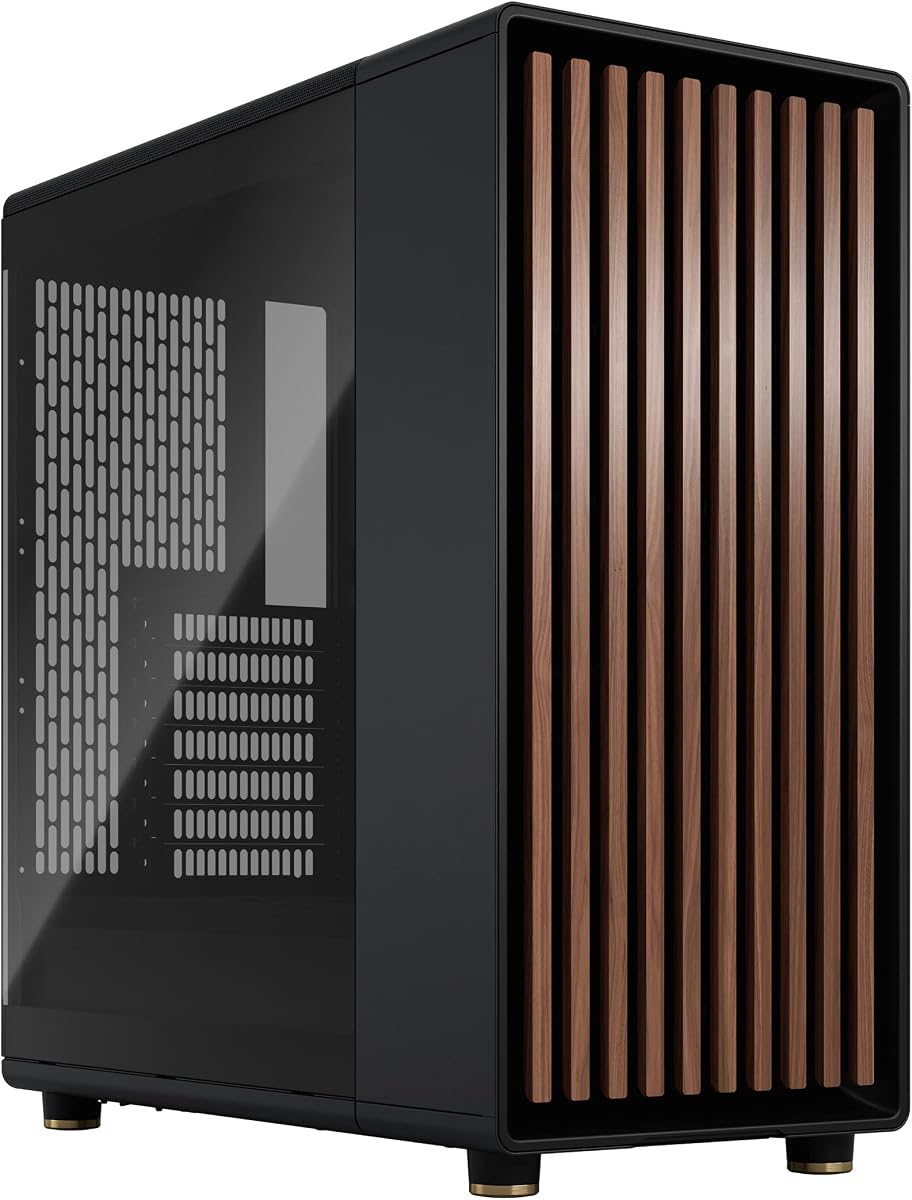
The Fractal Design North combines a charcoal-black chassis with genuine walnut wood front bars, producing one of the most distinctive appearances in this roundup. Its 4.7 rating makes it one of the strongest-rated cases here. While it is not a light gray product, the dark neutral finish and natural wood detail can provide a more organic alternative for a gray-themed or minimalist workstation.
We may earn a commission when you buy through this link, at no additional cost to you.
The open front and integrated mesh promote natural ventilation. The case supports ATX, Micro-ATX, and Mini-ITX motherboards, graphics cards up to 355mm, and a front radiator up to 360mm when the card length remains within 300mm. Two Aspect PWM 140mm fans are included, giving the system larger initial fans than most competing cases. Seven bridgeless expansion slots also support a broad range of add-in cards.
Storage provisions include two combined 3.5-inch and 2.5-inch mounts plus two dedicated 2.5-inch positions. The panels are designed for practical access: the side panels remove, the front unclips, and the top lifts away using an integrated tab. A clear tempered-glass side panel provides the customary view of the components without compromising scratch resistance.
The wood front changes radiator positioning compared with an all-metal mesh case. A large front radiator can reduce available GPU clearance, and buyers using that arrangement need to confirm the 300mm figure. The wood detail may also not suit someone seeking a uniformly gray enclosure. Despite those points, the North is an excellent airflow-focused mid-tower for anyone who appreciates refined materials and can work within the front-radiator trade-off.
Walnut front bars and charcoal metal create a mature, furniture-friendly appearance. The result can integrate more naturally into a living room or professional office than a conventional illuminated tower.
Two included 140mm PWM fans move a substantial amount of air while operating quietly. The open front further supports the case's natural-ventilation approach.
We may earn a commission when you buy through this link, at no additional cost to you.
Choosing a gray PC case requires balancing color and styling with motherboard format, component dimensions, cooling plans, airflow, accessibility, and the amount of room available for the finished system.
The motherboard form factor is the first constraint to confirm because it determines whether the case can house your chosen platform. Standard ATX is the most broadly compatible option, while Micro-ATX and Mini-ITX can reduce the required footprint. Full ATX support appears in the JONSBO X400, NZXT H5 Flow, Cooler Master QUBE 540, CORSAIR 3500X RS ARGB, Lian Li O11 Vision Compact, and Fractal Design North. The Q300L V1 supports Micro-ATX and Mini-ITX, and the Fractal Design Mood is oriented toward Mini-ITX builds.
Choose based on the board you own or plan to buy, not on the case category. Moving to a smaller board may save desk space, but it can also limit future expansion. Confirm mounting-hole locations and rear-panel clearance as well as the nominal form factor.
Graphics cards have become both longer and thicker, making clearance one of the most important case checks. Published figures range from 325mm in the Fractal Design Mood to 427mm in the JONSBO X400, with the QUBE 540 supporting 415mm and the North supporting 355mm. These values may change with radiator, fan, or front-panel configurations, so the maximum headline figure should not be treated independently of the cooling layout.
Measure the full card length from the mounting bracket to the farthest point, and include connector overhang. Then check the available clearance in the exact orientation and with the same cooling hardware you plan to install. Large cards need room not only for their length but also for power connectors and side-panel clearance.
Air-cooler height determines whether a large tower cooler can be used. The JONSBO X400 supports up to 176mm, the Q300L V1 up to 159mm, and the Fractal Design Mood up to 114mm. Other cases do not include those exact limits in the supplied specifications, so their current compatibility documentation should be checked. Liquid cooling removes the tower-height constraint but introduces radiator length, pump position, tubing, and mounting considerations.
For the best flexibility, choose a case with more CPU-cooler clearance than your chosen cooler requires. This leaves room for heat-sink variations and makes installation less stressful. Compact builds should account for the wider RAM or cooler fan assembly rather than relying on the bare heatsink height alone.
Cooling capacity determines how effectively the case handles sustained processor and graphics-card loads. The JONSBO X400 supports 360mm AIO radiators, including a side-mounted 360mm option. The NZXT H5 Flow supports a 360mm front radiator and a 240mm top radiator, while the Fractal Design North accepts a 360mm front radiator with a reduced GPU-clearance allowance. Smaller cases naturally offer more restricted choices, such as the Q300L V1's 240mm liquid-cooler support.
List every fan and radiator you intend to install, then map it to the case's mounting positions. Pay attention to the direction of the radiator, pump placement, tubing bend radius, and whether a top or side arrangement affects the graphics card. The number of included fans also matters: three are provided with the CORSAIR 3500X RS ARGB, four with the InWin Dubili, two 140mm fans with the Fractal Design North, and two 120mm fans with the NZXT H5 Flow.
A gray finish does not dictate whether a case performs well thermally. Look for open mesh, perforated panels, supportive fan positions, and a power-supply shroud that allows intake air to enter the lower chamber. The NZXT H5 Flow is an example of a compact design with perforated shroud surfaces, while the QUBE 540 uses a full mesh front. Cases with enclosed or fabric-heavy exteriors can still perform well, but their internal ventilation and included fan configuration deserve closer attention.
Intake fans should be paired with adequate exhaust, and dust filters should be removable for periodic cleaning. Pay attention to whether the front radiator changes the effective intake path and whether the rear exhaust can push air through both CPU and graphics-card zones. A visually open case is not automatically the best cooler, so component placement matters as much as panel design.
A case should remain convenient after the initial build. Tool-free panels in the JONSBO X400, removable glass in the CORSAIR 3500X RS ARGB, sliding fabric in the Fractal Design Mood, and accessible tabs in the Fractal Design North all simplify maintenance in different ways. Removable dust filters and visible cable routes also make long-term upkeep easier. A case that is difficult to open can encourage owners to postpone cleaning and reduce the likelihood of proper cable management.
Consider how often you expect to upgrade components. Frequent memory, storage, or cooling changes favor generous hand access and removable panels. A display-focused build can prioritize the viewing experience, but it should still provide a clear route for reaching connectors behind the motherboard tray.
Cable management affects both appearance and airflow. The NZXT H5 Flow includes wide channels, hooks, and straps, while the InWin Dubili provides an enhanced cable-management kit. Back-connect motherboard support in the JONSBO X400 and Lian Li O11 Vision Compact moves major connections behind the board, leaving the visible chamber less cluttered. Cases with a hidden power-supply area, such as the Fractal Design Mood, also reduce visual interruption.
Match the layout to the motherboard you own. A conventional ATX board requires adequate space behind the tray for connectors and cables, while a back-connect board can create a cleaner result but needs a compatible case and board. If you plan to use a riser, verify the cable type, bend requirements, and the card's final orientation.
External dimensions should be checked before focusing on internal features. The JONSBO X400 is a large mid-tower, the InWin Dubili is a full tower, and cases such as the Q300L V1 and Fractal Design Mood target more compact environments. The QUBE 540 can be used horizontally or vertically, and the InWin Dubili has reversible handles and feet. Orientation can affect radiator placement, graphics-card position, I/O access, and available desk space.
Measure the intended location rather than assuming a tower will fit beneath a desk. Account for the case feet, front I/O, panel clearances, and nearby walls or cabinets. Compact cases save space but may constrain component size, while large cases simplify expansion but require more room. Choose the smallest chassis that comfortably supports the hardware and cooling plan.
Begin by laying out the components, reading the case instructions, and identifying every mounting point before inserting the motherboard or power supply. Install the power supply with the fan orientation appropriate for the case, route cables through the designated channels, and confirm that the motherboard standoffs align with the correct holes. Connect the front-panel switches and USB ports before securing the rear I/O plate, as access can be more difficult after the board is fixed in place.
Install the graphics card and storage devices after the core airflow components are in place. Route data and power cables away from intake fans, secure slack behind the motherboard tray, and use the supplied hooks, straps, or channels. If using a vertical GPU, riser, or side-mounted AIO, check connector reach and cable bend radius before fastening everything permanently. A careful planning step prevents the need to dismantle the build later.
For ongoing care, power down and disconnect the system before opening the case. Use compressed air in short bursts to remove dust from fans, filters, radiators, and vents, and clean removable filters according to the manufacturer's guidance. Keep the exterior clean with a dry, lint-free cloth, and avoid aggressive cleaners on fabric, glass, coated panels, or wood. Inspect cable connections and dust filters periodically, especially in a full tower or a system operating in a warm environment.
The JONSBO X400 Gray is the strongest overall option because it combines broad ATX support, 427mm graphics-card clearance, numerous cooling positions, 360mm AIO capability, and tool-free panel access. Its large dimensions and separate requirements for vertical GPU hardware are the main considerations. A compact builder may prefer the Q300L V1, while design-focused buyers may favor the Fractal Design Mood.
Color itself does not determine how easily a case stays clean. Dust may be more visible on dark surfaces, while light gray finishes can show fingerprints and smudges, particularly on glass or coated metal. Regular wiping with a soft, dry cloth and periodic filter cleaning will help maintain the finish. Fabric-fronted models should not be treated with liquids unless the manufacturer permits it.
The Fractal Design Mood is explicitly described as light gray and is designed around a compact Mini-ITX-class build. The Cooler Master Q300L V1 is also compact, but it is a Micro-ATX and Mini-ITX case whose listed title does not specify a gray finish. The Iron-Gray Cougar Gemini M offers another compact option with a more traditional gaming-case design.
No, the finish itself does not determine thermal performance. Cooling depends on airflow paths, fan and radiator placement, mesh or perforation design, component layout, and the quality of the installed cooling system. The Fractal Design Mood uses a fabric enclosure, but its internal fan and radiator provisions still need to be evaluated against your components and expected workload.
Not automatically, even though several cases list generous graphics-card clearance. The JONSBO X400 supports up to 427mm, the QUBE 540 up to 415mm, and the Q300L V1 up to 360mm, but radiator placement can reduce usable room. Measure the card and its power connectors, then confirm clearance in the exact configuration you intend to build.
It depends on the design goal. The NZXT H5 Flow includes two 120mm fans, the CORSAIR 3500X RS ARGB includes three ARGB fans, the InWin Dubili includes four ARGB fans, and the Fractal Design North includes two 140mm fans. The Fractal Design Mood includes a large 180mm fan, while other models may offer fewer or require additional purchases. A complete configuration should be planned around intake, exhaust, radiator, and CPU-cooler needs.
These terms describe appearance rather than performance. Gray and iron-gray are neutral midtones, charcoal and black are dark finishes, and white is a bright neutral finish. A case explicitly marketed as gray may be preferable for a strict color match, while a white or charcoal model can complement a coordinated gray-themed room. Always check the actual finish because photography and lighting can make neutral colors look different.
Tempered glass is useful when displaying internal components and allows visual monitoring of lighting, cables, and general build quality. It is not inherently better for cooling, however, and a fabric or mesh design may suit a quieter or more understated office. Consider accessibility, fingerprint visibility, cleaning, and the visual character you want alongside thermal performance.
The JONSBO X400 Gray is the best overall pick for its exceptional cooling flexibility, generous ATX compatibility, 427mm GPU allowance, and tool-free access. The Cooler Master Q300L V1 is the budget and compact alternative, while the Fractal Design Mood stands out as the premium choice for its light-gray fabric design, removable enclosure, included riser, and large top fan.
Your next priority should be hardware fit rather than appearance alone. Confirm motherboard format, graphics-card dimensions, CPU-cooler height, power-supply length, radiator placement, and available desk space. Then choose between a feature-rich mid-tower, a compact enclosure, a display-focused design, or a full tower based on the system you actually intend to build.
Finally, check the current listing and availability before purchasing because prices, bundles, included accessories, and product configurations can change. The same discipline applies to fans and lighting hardware, which may be included in one package but absent in another. A careful compatibility check will help ensure that the selected gray PC case supports a clean, comfortable, and properly ventilated build.