
Uniden UM385BK
4.6Editor score
25-watt transmit power
IPX4 splash resistance
Full Class D DSC
Triple-watch monitoring
Compare the best flush mount VHF radio options for 2026, including key features, waterproofing, GPS, AIS, DSC, connectivity, and installation factors for boats.
A flush mount VHF radio is a permanently installed marine transceiver that places the main controls and display neatly within a helm console. A well-chosen model combines durable construction, clear audio, essential DSC functions, useful navigation connections, and enough features for the type of boating and coastal travel you do.
This guide compares ten fixed-mount radios and a closely related flush mount kit using the supplied product specifications, channel support, protection ratings, positioning options, network connections, and user-facing features. It covers practical choices for compact boats, larger offshore vessels, weather monitoring, AIS reception, emergency signaling, and advanced integrated systems.
Each pick highlights a distinct path for buyers, from straightforward waterproof radios to models with internal GPS, multi-device control, or extensive networking. Ratings and configurations can change, product availability also varies, and prices move over time, so confirm the current listing and installation requirements before buying.
4.6Editor score

4.5Editor score

5.0Editor score
The comparison below highlights the physical design, safety functions, positioning features, network capabilities, and protection standards that distinguish these fixed-mount marine radios and the related flush mount kit.
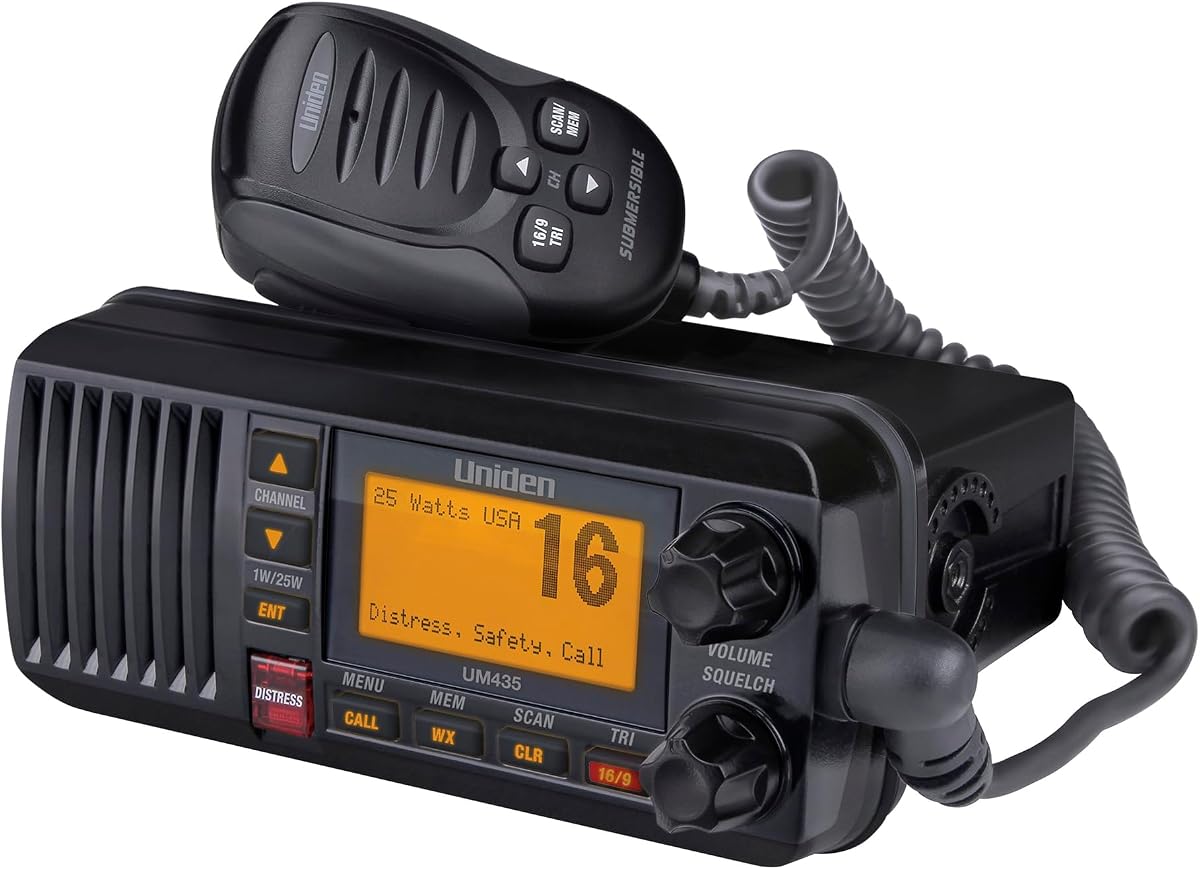



The Uniden UM435BK is a rugged fixed-mount marine radio designed for boats that need dependable VHF communication and substantial water protection. Its 4.6 rating reflects a favorable buyer response, while the IPX8 submersible specification makes it one of the most compelling choices in this guide for exposed helm installations. It supports USA, international, Canadian, four-digit, and Canadian B channels.
We may earn a commission when you buy through this link, at no additional cost to you.
The radio combines 25-watt and one-watt transmit settings with memory channel scanning, triple-watch and dual-watch monitoring, digital selective calling, position sending, and position requests. That combination suits a skippered boat, fishing vessel, or coastal cruiser where channel flexibility and emergency communication matter more than a large display or complex navigation network.
Its most important distinction from typical entry-level fixed radios is the fully submersible enclosure rather than merely splash-resistant construction. The stated three-year water protection warranty adds confidence, although buyers should still install the unit according to the manufacturer’s guidance and avoid treating the waterproof rating as immunity from every installation or seal-related problem.
Choose the UM435BK when ruggedness, channel breadth, and useful DSC features are the main priorities. It is a particularly attractive option for exposed or rough-water use, but it does not advertise built-in GPS or the broad NMEA integration found in more advanced Icom systems. Confirm the required antenna and remote microphone accessories before installation.
The IPX8 designation is the standout feature here. Compared with an IPX4 splash-resistant radio, a fully submersible housing offers stronger protection for a console exposed to spray, rain, or accidental immersion, provided the installation and seals are correct.
Support for USA, international, Canadian, four-digit, and Canadian B channels gives this radio broad usefulness across regions. Users who cross borders or travel among coastal regions gain more flexibility than they would from a unit restricted to a smaller channel set.
We may earn a commission when you buy through this link, at no additional cost to you.
The Uniden UM385BK is a straightforward 25-watt fixed-mount VHF radio with a 4.6 rating and a strong focus on emergency communication. It supports USA, international, and Canadian marine channels, adds S.A.M.E. weather alerts, and includes full Class D DSC with a dedicated distress button, position sending, and position requests.
We may earn a commission when you buy through this link, at no additional cost to you.
Its rugged handheld microphone is designed for operation from the helm, allowing a helmsman to transmit without leaving the primary controls. Triple-watch functionality allows the radio to monitor more than one priority channel at the same time, making it easier to remain aware of distress traffic, calling, and weather activity.
The main limitation is its IPX4 rating, which protects against rain and splashing water but does not provide the fully submersible specification offered by the UM435BK. Internal GPS is also not listed. Owners who want the radio to form a complete DSC system may need to investigate a compatible GPS source and the appropriate wiring and programming requirements.
For boaters seeking core marine VHF functions without moving to a networked or GPS-equipped console, the UM385BK is a practical selection. It is especially well suited to boats with a protected console, cruising areas covered by the listed channels, and skippers who prioritize clear DSC operation, weather alerts, and a usable remote microphone.
Full Class D DSC means the radio can monitor distress, safety, and calling signals while also providing position-related functions. The dedicated distress control simplifies access to an emergency procedure, although owners should still understand the sequence required to transmit a valid distress alert.
The included rugged microphone supports transmission from the steering position, which is important during docking, traffic, or changing conditions. Its design keeps the main radio body installed in the console while placing commonly used communication controls within reach.
We may earn a commission when you buy through this link, at no additional cost to you.
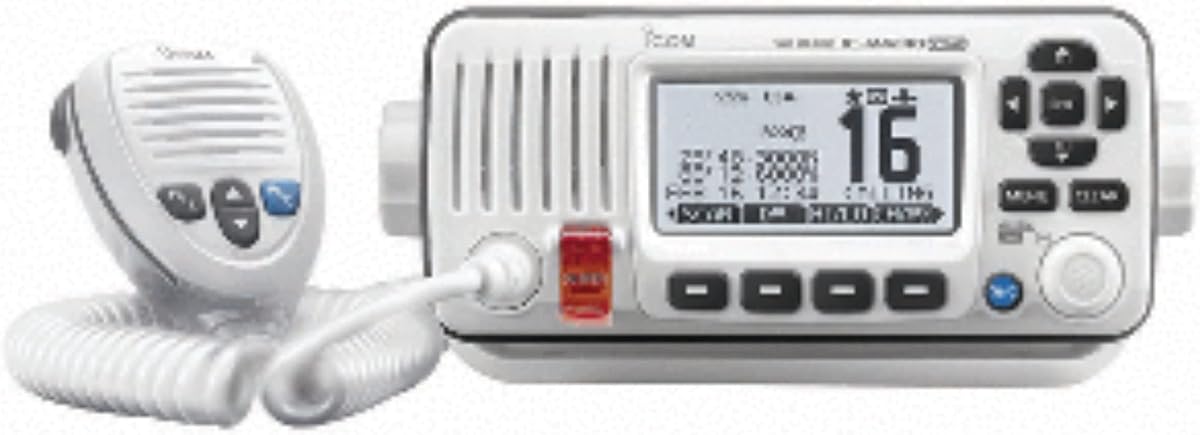
The Icom M424G 21 is a fixed-mount VHF radio with internal GPS, a 4.5 rating, and a balanced feature set for modern boats. Its most useful combination is the ability to obtain a position internally while retaining compatibility with a separate AIS transponder, weather alerts, and dual or tri-watch monitoring.
We may earn a commission when you buy through this link, at no additional cost to you.
The radio carries IPX7 protection, allowing submersion to one meter for 30 minutes under the stated specification. Its AquaQuake drainage function helps address water in the housing, while the built-in GPS supplies position information for DSC-related functions without requiring the radio to be connected to a separate GPS antenna.
It is not a fully integrated AIS radio based on the supplied information; instead, it is compatible with the Ma-500tr AIS transponder. That distinction matters for buyers because AIS reception and AIS transmission are separate capabilities. A boat that needs to show its own vessel on other ships’ displays will need an appropriate transponder or a radio with the required AIS functionality.
The M424G 21 is a strong all-around recommendation for boaters who want a protected fixed-mount radio, internal positioning, and expandable AIS use. It may not suit an owner seeking three command microphone positions or extensive NMEA data exchange, but it delivers a focused marine package for a single-station helm.
Internal GPS is one of the most consequential features in this model. It removes the need to source position from a separate GPS receiver for its core positioning function, although a proper VHF antenna and compatible mounting remain necessary.
IPX7 protection provides a meaningful advantage over splash-rated units, and AquaQuake offers a way to drain water that has entered the housing. Together they support use in wet, exposed helm environments when the unit is installed according to Icom guidance.
We may earn a commission when you buy through this link, at no additional cost to you.
The Icom IC-M330 is built for boats where console space is limited. Its ultra-compact, palm-sized fixed-mount chassis has a 4.3 rating and is designed to install in small helm areas without forcing a larger radio into the available panel space. The white finish also suits many modern fiberglass and aluminum console designs.
We may earn a commission when you buy through this link, at no additional cost to you.
The new speaker system is designed to deliver loud, clear sound with rich bass and crisp treble at high volume. A directional keypad and soft keys make frequently used functions accessible, while the receiver provides more than 70 decibels of selectivity and strong interference rejection for communication in RF-busy marinas and harbors.
DSC monitoring is comprehensive, covering distress, individual, group, all-ship, safety, position request and report, polling, and test calls. However, the model is identified as operating without GPS. Boaters requiring position information must verify whether they can supply it through the boat’s navigation system or an appropriate accessory interface.
Choose the IC-M330 for a small center console, sailboat dashboard, or skiff with a constrained electronics area. Its size, audible performance, and simple control layout are the defining strengths. The trade-off is that it does not include internal GPS, so buyers should plan the complete DSC installation rather than choosing it solely on compactness.
The compact chassis is the model’s central advantage. It allows a dedicated VHF radio to fit into a tight dashboard where a conventional full-size fixed radio may be difficult to position without obstructing visibility or other instruments.
The redesigned speaker prioritizes clarity and volume, which matters in noisy marinas, heavy rain, and rough conditions. Strong selectivity and interference rejection also help preserve intelligibility when numerous radio signals occupy the surrounding RF environment.
We may earn a commission when you buy through this link, at no additional cost to you.
The Icom IC-M605 is a high-feature fixed-mount VHF transceiver for boaters who want extensive communications control and integration with other marine electronics. It has a 4.3 rating, a large keypad, soft keys, active noise cancellation, and connectivity through NMEA 2000 and NMEA 0183.
We may earn a commission when you buy through this link, at no additional cost to you.
Its receiver provides 80 decibels of selectivity and strong IMD performance, making it well suited to busy ports, marinas, and offshore traffic. The radio automatically records up to two minutes of the last incoming call so a helmsman can replay a message. Active noise cancellation works on transmitted and received audio to improve intelligibility in rough conditions.
The IC-M605 also supports a 30-watt two-way hailer and foghorn when connected to the SP-37 horn speaker, allowing communication with the deck or shore. A 32-tone voice scrambler is available through the optional UT-112 accessory. Those features extend the radio beyond ordinary voice communication, but they also increase the importance of correct wiring and compatible equipment.
This model makes the most sense for an offshore boat, yacht, or heavily equipped console where sharing GPS, AIS, DSC, and frequency data with other displays is valuable. It is not the simplest choice for a small boat, and several listed capabilities depend on accessories. Buyers should compare the full helm architecture before selecting it.
NMEA 2000 and 0183 support allow the radio to exchange GNSS, DSC, and frequency information with a broader navigation system. For an integrated helm, this can reduce the need for isolated instruments and make position and distress data available across more displays.
Digital noise cancellation is especially useful in an open cockpit or on a boat with substantial engine and wind noise. Automatic recording of the last incoming call adds a practical layer of protection, allowing a skipper to recover a message that was unclear on the first attempt.
We may earn a commission when you buy through this link, at no additional cost to you.
The Garmin VHF 215 combines a fixed-mount form factor with Garmin’s broader marine electronics ecosystem, and its 4.8 rating is among the highest in this comparison. That makes it a logical candidate for a boat whose navigation, chartplotter, and other equipment are centered on Garmin products.
We may earn a commission when you buy through this link, at no additional cost to you.
The supplied listing identifies it as a marine radio and highlights a clean installed design rather than a portable handheld form. Its potential advantage is therefore not extreme feature count, but the potential simplicity of adding VHF communication to a compatible Garmin helm. The radio can be operated from the installed console while preserving the uncluttered appearance of a purpose-built dashboard.
Detailed claims about waterproofing, GPS integration, AIS, and NMEA connections cannot be confirmed from the supplied product data. Buyers should therefore consult the current manual and Garmin compatibility list rather than assuming features based only on the brand. Those checks are especially important when replacing an existing radio or reusing existing wiring.
The VHF 215 is best considered for a Garmin-equipped boat seeking a cohesive electronics setup and a well-received dedicated radio. Its high rating supports shortlisting it, but the final decision should be based on verified network compatibility, antenna requirements, DSC positioning, and flush-panel dimensions.
A marine radio is most useful when it fits the boat’s wider electronic architecture. For Garmin-centered systems, choosing a compatible VHF can simplify control and networking decisions, provided the current model and optional equipment are verified with Garmin.
The permanent console installation gives the radio a stable operating position and keeps the microphone and controls close to the helm. This arrangement is better suited to regular underway use than relying on a portable radio that must be found and held during a call.
We may earn a commission when you buy through this link, at no additional cost to you.
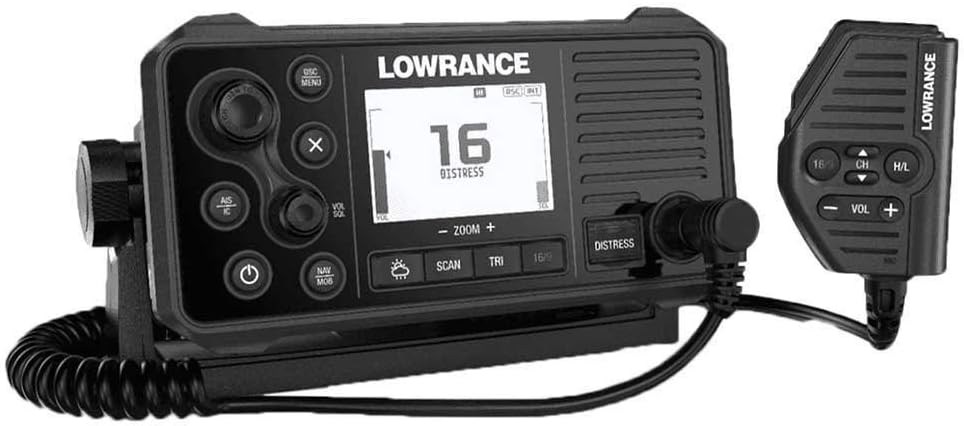
The Lowrance VHF Marine Radio is a fixed-mount option built around DSC, AIS reception, and Link-9 connectivity. Its 4.7 rating indicates strong buyer satisfaction, while the large clear white dot-matrix display should make channel and status information easy to interpret at the helm.
We may earn a commission when you buy through this link, at no additional cost to you.
AIS reception is particularly useful for seeing transmitting vessels in a compatible display. It does not, based on the supplied specification, establish that the radio can transmit an AIS signal or serve as a full AIS transponder. Buyers who need their own vessel to appear to other traffic should confirm that requirement separately.
Link-9 support positions the radio for integration with compatible Lowrance or multi-brand marine equipment. The product title does not identify the exact branded model beyond the supplied description, so installation compatibility, channel lists, GPS requirements, waterproof ratings, and control details should be confirmed with the manufacturer before purchase.
This radio is worth considering for a boat already using a compatible electronics network, especially when receiving AIS information is a priority. Its 4.7 rating and large display make it a strong candidate, but the incomplete model naming means buyers should inspect the package, documentation, and connector arrangement carefully.
AIS reception can give a compatible navigation display a useful picture of nearby transmitting vessels. Because the stated feature is AIS-RX rather than a complete transmitting specification, owners should match it to a separate transponder if vessel visibility is required.
The large white dot-matrix screen is intended to present channel, status, and alert information clearly. In a saltwater environment, glare, viewing angle, and nighttime readability still matter, so the display should be evaluated in the same lighting conditions found on the boat.
We may earn a commission when you buy through this link, at no additional cost to you.
The Icom M424G 42 is the white version of the M424G fixed-mount VHF radio with built-in GPS. It carries a 4.8 rating, making it one of the highest-rated products in this guide. The configuration is attractive for a boat with a light-colored fiberglass console or a coordinated white electronics layout.
We may earn a commission when you buy through this link, at no additional cost to you.
Built-in GPS is the defining functional advantage. It provides the radio with a position source without requiring a separate GPS receiver as the primary positioning source, which can simplify the DSC installation. As with any fixed-mount marine radio, a suitable VHF antenna and correctly installed mounting hardware remain essential to practical operation.
The supplied data is more limited for this white variant than for the related M424G 21 listing. It confirms the model family, built-in GPS, white finish, and fixed-mount radio format, but it does not independently list every protection, watch, or AIS feature. Buyers should treat those details as model-level information to verify rather than assume.
Choose the M424G 42 when you want the M424G platform, built-in positioning, and a white finish coordinated with the helm. It is a compelling option for modern center-console boats and coastal cruisers. Check the installation cutout, supplied microphone, antenna requirements, and complete manual for the exact model and regional configuration.
A radio that can establish its own position is better prepared to transmit useful location information through DSC. Internal GPS also reduces the number of separate connections required for that core function, although the full boat network may still provide additional benefits.
The white enclosure is a practical reason to compare this listing with the black M424G 21 version. Matching the radio to an all-white or predominantly white helm can create a more deliberate, professional appearance without adding a separate adapter.
We may earn a commission when you buy through this link, at no additional cost to you.
The Icom M510BB GW is a black-box fixed-mount VHF with a white command microphone and three command microphone ports. Its 5.0 rating is the highest supplied rating in the group. The architecture is tailored to larger boats or complex helm layouts where radio control may be needed from more than one station.
We may earn a commission when you buy through this link, at no additional cost to you.
Placing the main radio body behind a console panel keeps the visible helm uncluttered while allowing the command microphone to be installed at a different location. With three command microphone ports, owners can potentially control the same radio from multiple areas, such as the main helm, a flybridge, or a secondary steering station.
AquaQuake provides a drainage function for water that enters the housing, while anchor monitoring adds a practical boating safety tool. These features reflect a more advanced design, but the installation must be planned carefully. Cable routing, antenna placement, power connections, and command microphone locations all affect performance and usability.
The M510BB GW is the premium choice in this guide for a boat with multiple operational areas or a desire for a hidden radio installation. Its central benefit is flexible remote control rather than a single visible display. Buyers should budget the complete system, including any additional microphones, and have the installation handled according to Icom’s guidance.
Three command microphone ports give the M510BB GW exceptional flexibility for multi-station vessels. Instead of forcing every transmission through one helm, the skipper can place remote controls where they are most useful and keep a consistent operating method across the boat.
The black-box design separates the radio from the visible control surface. This can produce a cleaner console and make it easier to position the main electronics within a protected compartment while retaining a convenient white command microphone at the helm.
We may earn a commission when you buy through this link, at no additional cost to you.
The Icom MBF5 is not a VHF radio but a dedicated flush mount kit for a compatible two-way radio. It earns inclusion because a fixed-mount installation depends on the correct mounting hardware, and a purpose-designed kit can help create a stable, clean panel fit when replacing or installing a supported Icom model.
We may earn a commission when you buy through this link, at no additional cost to you.
Its listed package dimensions are 3.2 centimeters by 6.1 centimeters by 8.3 centimeters, giving a compact profile. The product type is identified as a two-way radio accessory. Buyers must confirm the compatible radio model, included hardware, required cutout, gasket arrangement, and whether a separate microphone or other installation components are required.
The kit’s 4.4 rating suggests generally positive buyer feedback, although ratings for an accessory should be interpreted differently from ratings for a complete transceiver. Installation quality, fit, and compatibility matter more than radio features in this category. Using the wrong kit can create gaps, misalignment, or unreliable retention.
Purchase the MBF5 only if your intended Icom radio explicitly supports it. It is best treated as a companion item during a planned installation or a replacement upgrade. If you need a complete communication system, choose one of the listed radios instead; the kit alone cannot transmit, receive, or provide DSC functionality.
Using the correct mount is an important part of a flush installation. The accessory can support the intended radio position and help preserve a neat dashboard layout when the replacement model and mounting pattern align correctly.
Because this is an installation component rather than a radio, compatibility must come first. Check the model number, cutout dimensions, supplied pieces, microphone provisions, and any sealing requirements in the installation instructions before purchase.
We may earn a commission when you buy through this link, at no additional cost to you.
The right fixed-mount marine radio depends on console space, exposure to water, positioning needs, navigation equipment, and how many stations must control communications. These factors help narrow the field before comparing controls, channel functions, and accessories.
A flush-mount radio is intended to sit within a prepared panel opening, with the display and controls facing outward and the enclosure protected behind the console. Verify whether the candidate model uses a conventional integrated face, a black-box body with a remote command microphone, or another arrangement. The Icom M510BB GW illustrates how a concealed radio can be paired with controls installed elsewhere on the boat.
Water-resistance standards describe different levels of exposure. An IPX4 radio is intended to resist damage from rain and splashing, while IPX7 and IPX8 indicate stronger protection against immersion under their respective test conditions. A boat with an exposed or low console may justify a more submersible model, especially when the manufacturer also provides drainage and seal-related features.
Digital Selective Calling can transmit or request vessel position, so the radio needs an accurate position source. Some models include internal GPS, as the Icom M424G variants do, while others are listed without GPS. A non-GPS model may still be able to obtain position from a compatible boat network, but that relationship must be confirmed through the manual and connector requirements.
AIS reception and AIS transmission are not interchangeable. Receiving AIS allows a compatible display to show certain transmitting vessels nearby, while an AIS transponder also broadcasts the vessel’s identity and position. The Icom M424G 21 is stated to be compatible with a Ma-500tr AIS transponder, which provides more flexibility than a receive-only arrangement.
Boats with multiple displays can benefit from a radio that exchanges GPS, AIS, DSC, or frequency data through NMEA connections. The Icom IC-M605 supports NMEA 2000 and NMEA 0183, while the Lowrance listing identifies Link-9 support. Network features can centralize information, but they also increase installation complexity and create compatibility dependencies.
A radio must be intelligible over engine noise, wind, rain, and conversation around the helm. Look for a high-quality speaker, adequate volume without distortion, and receiver selectivity that performs well in crowded RF environments. Dual-watch and tri-watch functions are also valuable because they let the radio monitor calling and distress traffic alongside a selected working channel.
A flush-mounted radio may be controlled from a remote microphone, and premium installations can support controls at several stations. More command ports are useful on flybridges, yachts, and boats with separate steering areas. They also require additional compatible microphones, cable routes, and careful configuration, so compare the complete system rather than only the radio body.
The radio should cover the waters where you operate. The Uniden models support combinations of USA, international, Canadian, four-digit, and Canadian B channels, while the Icom M424G includes weather channels with an alert function. Channel support matters for cross-border travel, while S.A.M.E. and other weather alert functions add information beyond standard voice communication.
Installation should begin with the boat’s electrical system, antenna arrangement, grounding, and console layout. Use the specified mounting hardware, follow the manufacturer’s cutout and sealing instructions, and keep the radio and microphone cables away from chafing points and moving components. A qualified marine installer is especially valuable when adding DSC, GPS, AIS, NMEA, or multiple command microphones.
After installation, program the radio for the vessel’s region, assign the correct MMSI information, configure DSC contacts and emergency signaling, and connect the appropriate positioning source. Test reception and transmission with a coordinated boat or authorized test method, check channel operation, weather alerts, watch functions, and microphone controls, and document the settings so the configuration can be restored after service.
For ongoing care, keep the microphone connector clean and dry, inspect the antenna and coax for damage, and never open or adjust a sealed radio unless authorized procedures permit it. After use in salt water, rinse exposed accessories with fresh water where appropriate, remove salt from controls, and let connectors dry completely. If the radio experiences immersion, unusual moisture behavior, or an impact, have it inspected rather than assuming the enclosure remains sealed.
A flush mount radio is permanently installed in the console with a fixed display, controls, and often a remote microphone. A portable radio is handheld and can move around the boat. A fixed model is generally more convenient for regular use and can integrate more readily with the vessel’s electrical, GPS, AIS, and navigation systems.
No. The Icom M424G models listed here include built-in GPS, while the Icom IC-M330 is specifically identified as operating without GPS. A radio without internal GPS may be able to receive position from a compatible navigation network, but the connection and data-sharing capabilities must be verified in the model documentation.
It depends on where the radio is installed and how exposed that location may be. IPX4 protects against rain and splashing, while IPX7 and IPX8 indicate stronger immersion resistance. Boats with low, open, or frequently washed-down consoles can benefit from the strongest suitable option, especially when backed by a drainage feature.
AIS reception allows the radio or a connected display to receive information from transmitting vessels in the area. AIS transmission also broadcasts the boat’s own identity and position. The Icom M424G 21 is compatible with a Ma-500tr AIS transponder, illustrating how reception and transmission may require separate equipment.
Yes, when the radio and its command system support multiple control stations. The Icom M510BB GW has three command microphone ports, allowing controls to be placed around a larger vessel. Each additional station requires compatible equipment, appropriate wiring, and a planned installation to preserve reliability and usability.
Start with the panel cutout, depth behind the console, antenna connection, power requirements, and microphone arrangement. Also verify GPS, DSC, AIS, NMEA, channel, and waterproofing compatibility. Checking the current manual prevents a common mistake: buying a physically attractive radio that cannot integrate with the boat’s existing network.
A proper marine VHF antenna and compatible coax are required for effective transmission and reception; the radio body alone is not a complete antenna system. Installation height, grounding, cable routing, and connector integrity all affect performance. Follow the radio and antenna instructions and avoid improvised connections that can impair reliability.
The products are related white and black versions of the M424G platform, but the supplied listings provide different levels of detail. The 21 listing lists protection, AIS compatibility, watch functions, AquaQuake, and weather alerts, while the 42 listing confirms the built-in GPS and white finish. Buyers should consult the manual for the exact model rather than assuming every feature is identical across regional variants.
The Uniden UM385BK is the most straightforward value-oriented choice, combining 25-watt power, full Class D DSC, triple watch, weather alerts, and an easy-to-reach microphone. The Icom M424G 21 stands out as the most balanced editor’s choice thanks to internal GPS, IPX7 protection, AquaQuake, and compatibility with an AIS transponder, while the Icom M510BB GW leads the premium group with three command microphone ports and a concealed installation.
For the wider list, prioritize the features your boat genuinely needs: strong water protection for an exposed console, internal or networked GPS for DSC, AIS reception or transmission based on collision-awareness goals, and NMEA connectivity only if the rest of the helm is prepared for it. Compact boaters may value the IC-M330’s small chassis, while integrated Garmin and Lowrance systems should focus on verified equipment compatibility.
Finally, check the current product listing, manual, installation cutout, included microphone, antenna requirements, and available accessories before ordering. Ratings and configurations can change, and current prices fluctuate, so the final purchase should reflect both the boat’s technical needs and the latest manufacturer information rather than ranking alone.