
Pyle Hydra Marine PLMRA402
4.0Editor score
Four independent channels
RCA and high-level inputs
Waterproof-ready marine design
This Compact Marine Amplifier guide compares ten options for power, weather resistance, connectivity, controls, and space-saving installation.
A compact marine amplifier should deliver clean sound without consuming valuable space in a boat, where every storage compartment and cable route matters. The best models combine useful power, corrosion-conscious construction, flexible input options, and protections suited to wet, exposed environments.
We compared all ten amplifiers by examining channel configuration, power ratings, enclosure and circuit-board protection, input methods, crossover controls, installation features, and overall suitability for marine audio systems. The list covers traditional marine amplifiers, compact Class D models, and head-unit-free Bluetooth options.
Each review explains where the amplifier excels, what trade-offs may matter, and which listeners should consider it. Product configurations differ considerably, from four-speaker systems to monoblock subwoofer amplification, so match the amplifier to your boat's wiring and audio plan.
4.0Editor score

4.2Editor score

4.1Editor score
This comparison highlights the major differences among the ten amplifiers, including channel count, power, weather protection, input flexibility, control options, and the type of marine installation each model is best suited to support.



The Pyle Hydra Marine PLMRA402 earns a 4.0 rating and stands out as a practical four-channel option for boats that need to drive several conventional speakers. It is designed around 100 watts per channel at maximum output, giving installers a straightforward way to build a distributed bow, stern, or cockpit audio system without moving to a much larger amplifier.
We may earn a commission when you buy through this link, at no additional cost to you.
Its strongest feature is connection flexibility. Premium RCA inputs support conventional head units, while high-level input terminals allow the amplifier to work with a marine receiver that only offers speaker-level output. Two adjustable gain controls help integrate the amplifier with different source equipment, and the compact four-channel layout is more versatile than a dedicated monoblock when powering a full speaker set.
Protection features include a heavy-duty aluminum alloy heatsink, thermal overload protection, speaker short protection, and an LED status indicator. Gold-plated speaker output terminals are intended to resist corrosion over time. The enclosure carries an IP-01 marine rating and is described as waterproof ready, although buyers should still treat it as a protected marine component rather than assume it is fully submersible.
This is a sensible pick for budget-conscious boat owners who want four independently controlled channels and broad source compatibility. It is less appropriate for someone seeking the strongest documented waterproofing or a high-end monoblock for a subwoofer. For a conventional multi-speaker marine installation, however, its channel count, input options, and protective design make it unusually versatile.
Four independent output channels let an installer distribute speakers around the boat without sharing one output pair between multiple locations. That makes the PLMRA402 well suited to zoning music for cockpit, bow, and stern areas.
RCA and high-level inputs cover both conventional marine head units and receivers with speaker-level outputs. This broad compatibility can simplify upgrades to older or unusually configured audio systems.
We may earn a commission when you buy through this link, at no additional cost to you.
The Kenwood KAC-M5001 carries a 4.0 rating and is built for a more specialized marine job: powering a subwoofer in a boat, car, or outdoor audio system. Its sealed Class D design delivers up to 300 watts RMS at 2 ohms and 200 watts RMS at 4 ohms, providing ample power for controlled low-frequency output when paired with a compatible subwoofer.
We may earn a commission when you buy through this link, at no additional cost to you.
Environmental protection is the standout feature. The chassis is rated IP67 and IP66 for waterproof and dustproof protection, can withstand submersion up to 3.3 feet for 30 minutes, and has undergone ASTM B117 salt spray testing. The sealed construction is a meaningful step up for installations exposed to spray, rain, or accidental moisture compared with many coated marine amplifiers.
Polymer multilayer capacitors in the filter circuits are intended to reduce distortion, while magnetically shielded output coils help limit radiated noise. A low-pass filter and bass-boost frequency switch provide useful tuning controls, and the included waterproof wired level control lets listeners adjust subwoofer output from a convenient location.
The trade-off is specialization. This monoblock is not intended to provide conventional full-range amplification for cockpit or tower speakers, so it works best as an addition to an existing system. Boaters seeking serious subwoofer performance in a sealed, purpose-built package should give this model strong consideration.
The sealed enclosure and IP67/IP66 ratings make the KAC-M5001 appealing where splashes, spray, and dust are persistent concerns. Its salt spray testing also targets the corrosion exposure common around waterways.
Low-pass filtering, bass boost, and a waterproof wired level control provide several ways to integrate the subwoofer with the rest of the boat's system. Signal sensing also helps reduce installation complexity.
We may earn a commission when you buy through this link, at no additional cost to you.
The NVX VADM4 v2 earns a 4.2 rating and is the strongest all-around choice in this guide for listeners who prioritize a genuinely small enclosure without giving up useful power. Its Micro Class D design measures only 6.49 inches long by 3.3 inches wide by 1.48 inches high, making it well suited to tight compartments and space-conscious marine installations.
We may earn a commission when you buy through this link, at no additional cost to you.
Output reaches 125 watts RMS per channel at 2 ohms and 80 watts RMS per channel at 4 ohms. The amplifier also supports balanced differential and low-level RCA inputs, while LED power and protection indicators provide useful status feedback. A conformal-coated, marine-grade circuit board is designed to withstand demanding environments, and four-way protection covers thermal issues, overload, speaker shorts, and DC offset.
The most impressive feature is its control suite. Users can select full-range, high-pass, or low-pass operation, adjust both filters from 40 to 400 Hz, and work across a stated 20 Hz to 20,000 Hz frequency range. These options allow one compact amplifier to serve full-range speakers, subwoofers, or a mixed arrangement when the wiring and crossover settings are designed correctly.
The compact footprint and flexible architecture justify the Editor's Choice designation, although installers must take time to set gain and crossover controls correctly. It is especially attractive to boaters who want a four-channel Class D unit with more system flexibility than a basic waterproof-ready marine amplifier.
At just over six inches long, the VADM4 v2 can be mounted in locations where a larger conventional amplifier would be difficult. That makes it particularly useful in compact cuddy cabins, under consoles, and near tightly routed wiring.
Full, high-pass, and low-pass modes allow the amplifier to adapt to different speaker roles. The broad adjustment ranges support cleaner system integration than a fixed-output compact unit.
We may earn a commission when you buy through this link, at no additional cost to you.
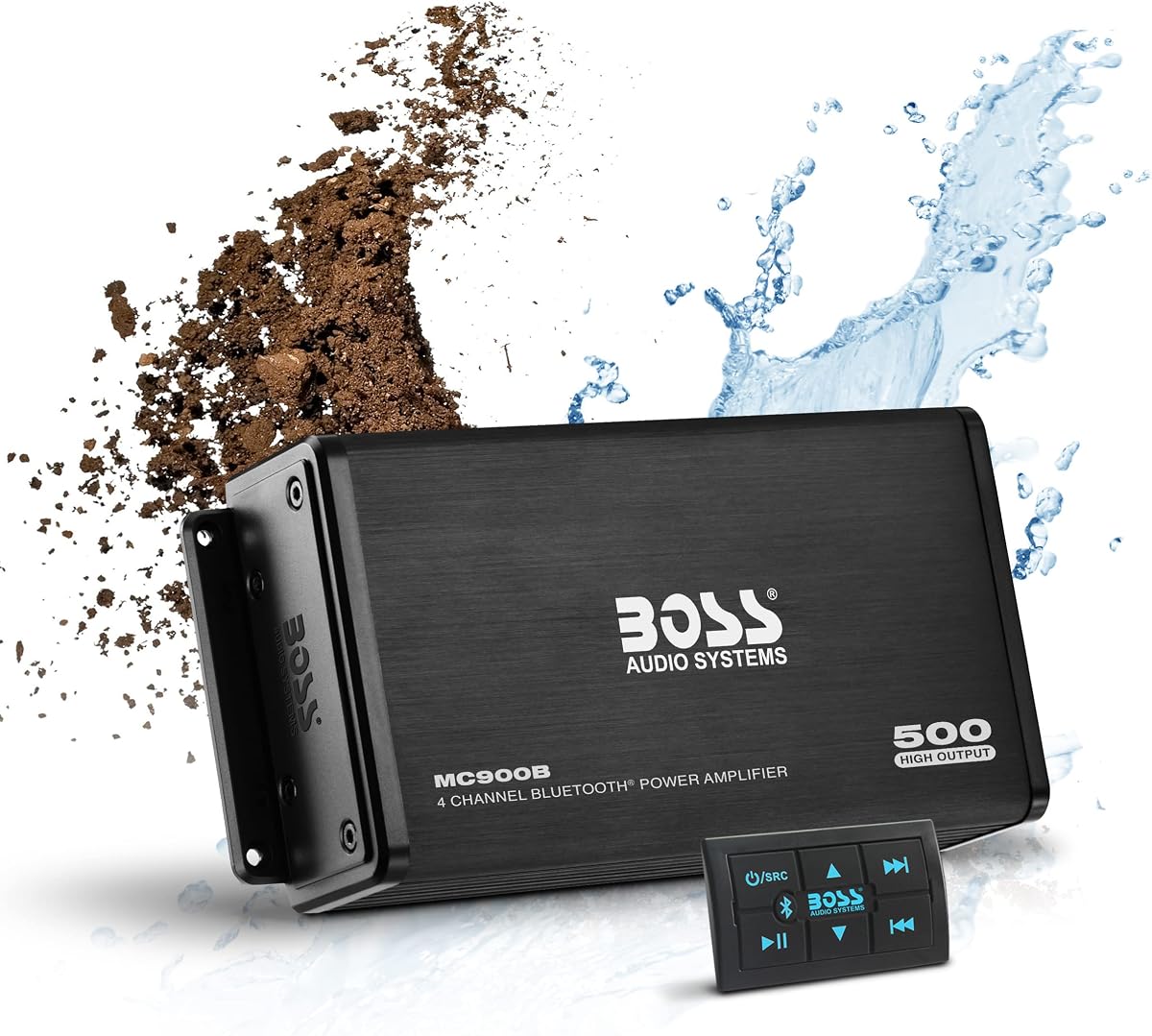
The BOSS Audio Systems MC900B has a 4.2 rating and appeals to boaters who want music without the complexity of installing a traditional marine head unit. It provides four channels at 94 watts RMS each into 4 ohms, while its included Bluetooth remote lets a phone or compatible music device control streaming and playback from a convenient location.
We may earn a commission when you buy through this link, at no additional cost to you.
The remote also supports audio from smartphones and MP3 players, and the amplifier includes a USB charging port. These features make the MC900B useful as a compact entertainment hub for boats, ATVs, and other recreational vehicles where a permanent source unit may be inconvenient or undesirable.
Its enclosure is described as weatherproof for light weather conditions rather than fully sealed. That distinction matters: the model is suitable for exposed installations that may encounter occasional spray, but it does not offer the same documented ingress protection as the Kenwood or DS18 models. The Class AB output stage is also less efficient than modern Class D architecture, although it remains a familiar and proven topology.
For simple Bluetooth marine audio, the MC900B is unusually convenient. It is a better fit for owners seeking streaming and charging than for demanding installers who need rugged waterproof certification or extensive crossover control. Professional installation is encouraged by the manufacturer for safe, correct operation.
A phone can serve as the primary audio source through the included Bluetooth remote. This removes the need for a permanent marine head unit while retaining control over common streaming apps.
At approximately 6.6 inches long and 1.75 inches wide or high, the amplifier is manageable in many boat compartments. The design supports convenient distributed-speaker installations where every inch matters.
We may earn a commission when you buy through this link, at no additional cost to you.
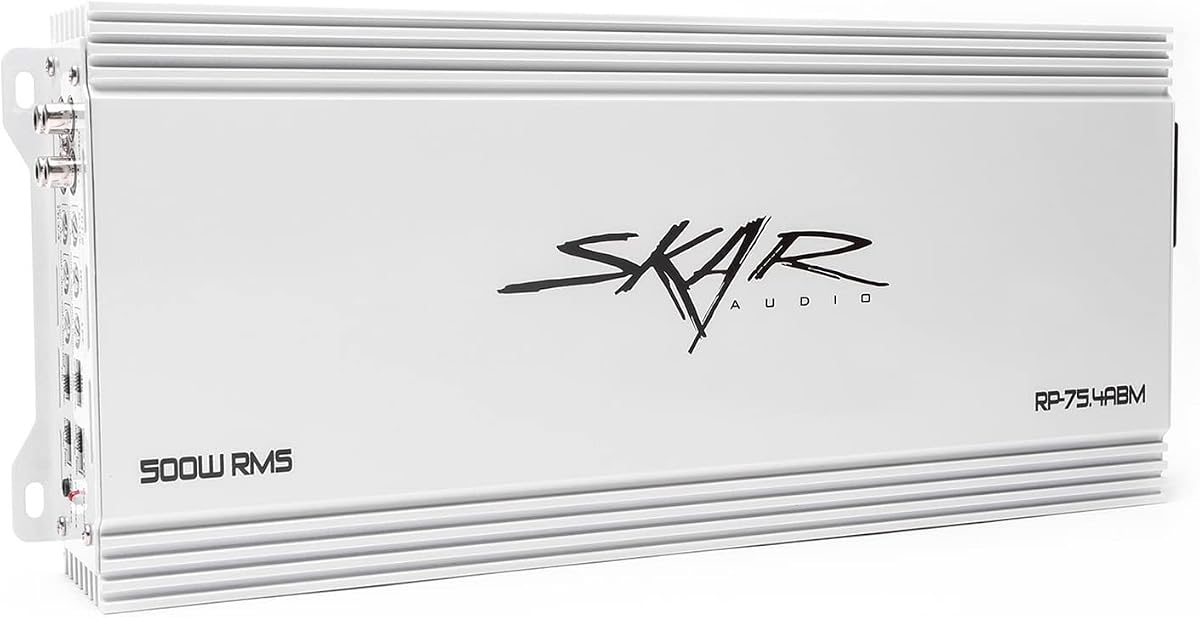
The Skar Audio RP-75.4ABM has a 4.5 rating, the highest customer rating among the products reviewed, and delivers a balanced set of marine-focused features. It is a 500-watt four-channel Class A/B amplifier rated at 75 watts RMS per channel into 4 ohms and 125 watts RMS per channel into 2 ohms.
We may earn a commission when you buy through this link, at no additional cost to you.
Its user controls include gain, variable low-pass and high-pass filters, and a three-position bass EQ switch offering 0, +6, and +12 dB. Those adjustments make it easier to balance a mixed marine system or align the amplifier's frequency range with the speakers connected to it. Four-way protection circuitry adds safeguards for the amplifier and connected equipment.
Marine considerations include a waterproof coating on the circuit board and rust-resistant paint on the mechanical case. Heavy-gauge power and ground terminals are designed to support strong current flow, and the stated signal-to-noise ratio is 105 dB. As with other marine amplifiers, a sealed location and secure cable connections remain important.
The main compromise is efficiency. Class A/B output stages draw more power than compact Class D amplifiers and do not offer the same space savings. Even so, the rich control panel and strong customer rating make this a compelling choice for listeners who want adjustable four-channel performance and conventional full-range behavior.
Variable filters and three bass EQ settings provide more control than many compact alternatives. These features help shape the output around different speaker placements and the acoustic conditions of an open cockpit or covered cabin.
The waterproof circuit-board coating and rust-resistant case finish address common sources of marine deterioration. Proper mounting and cable sealing remain necessary to realize the benefits.
We may earn a commission when you buy through this link, at no additional cost to you.
The Pyle PLMRMB4CB carries a 3.9 rating and offers an interesting combination of four-channel control, wireless streaming, and a low-profile marine enclosure. Its independent channels can support a distributed speaker arrangement such as bow, stern, port, and starboard zones without sharing a two-channel output.
We may earn a commission when you buy through this link, at no additional cost to you.
The brushed aluminum housing is designed to resist heat, moisture, and vibration, and the product is marketed as waterproof. Its compact, low-profile form is intended for mounting under consoles, inside storage compartments, or along transom walls where a larger amplifier would be inconvenient. Black and white versions allow the enclosure to coordinate with different console finishes.
Bluetooth wireless audio and RCA connectivity provide alternative source options, while a blue remote turn-on wire lets the amplifier wake with the boat's head unit and shut down when it is off. That automatic behavior helps avoid unnecessary battery drain and makes daily operation simpler than using a separate manual switch.
The product's 3.9 rating is lower than those of the leading models, and the supplied information does not describe a sealed IP-rated enclosure in the same detail as the Kenwood. Nevertheless, it may appeal to buyers who want four independent channels, low-profile construction, and convenient wireless source control in one package.
Four independent channels let separate speaker groups have their own level and crossover settings. That flexibility is useful when cockpit, bow, and stern speakers occupy very different acoustic environments.
The low-profile design supports concealed installation under a console or near the transom. Its enclosure finish can also be selected to blend more closely with the boat's interior.
We may earn a commission when you buy through this link, at no additional cost to you.
The Pyle Hydra Marine PLMRA200 has a 4.0 rating and serves buyers who need uncomplicated stereo amplification rather than extensive control over a multi-zone system. It is a two-channel, bridgeable marine amplifier rated for 400 watts maximum output, with a dual MOSFET power supply and adjustable input gain.
We may earn a commission when you buy through this link, at no additional cost to you.
RCA stereo inputs support conventional marine head units, while high-level terminals accept speaker-level output from receivers without RCA jacks. That makes the amplifier adaptable to both newer dedicated source units and older or more basic marine systems. A heavy-duty aluminum alloy heatsink supports thermal management, while thermal overload and speaker short protection help guard the installation.
Marine features include an IP-01 waterproof-ready rating and gold-plated speaker output terminals designed to resist corrosion. The LED indicator gives the installer or operator a visible indication of amplifier status. Compared with the four-channel PLMRA402, this model is simpler and better suited to a pair of speaker zones or a conventional stereo arrangement.
It does not offer the crossover menus, balanced inputs, or extensive channel flexibility found on the NVX. Still, for a simple, compact installation, the combination of source compatibility, bridgeability, adjustable gain, and marine-oriented construction makes the PLMRA200 a practical choice.
A two-channel layout reduces wiring complexity for a conventional boat stereo. It is easier to tune and troubleshoot than a larger multi-channel system when the goal is simply clear music in a cockpit or deck area.
Both RCA and high-level inputs allow the amplifier to adapt to the available marine receiver. Adjustable gain further improves source matching across different equipment.
We may earn a commission when you buy through this link, at no additional cost to you.
The DS18 NXL-N2 earns a 4.1 rating and is the premium choice for buyers who place a high priority on documented environmental protection in a very compact enclosure. Its IPX67 rating covers both dust ingress and temporary immersion, making it well suited to demanding marine and powersports installations.
We may earn a commission when you buy through this link, at no additional cost to you.
This two-channel Class D amplifier produces 150 watts RMS per channel at 2 ohms and 100 watts RMS per channel at 4 ohms. The maximum headline output is listed as 900 watts, so installers should focus on the RMS figures when matching speakers and designing the electrical system. A stable four-layer PCB layout is intended to withstand vibration and environmental stress.
The amplifier supports full-range, high-pass, and low-pass operating modes, allowing it to serve conventional speakers, tweeters, or subwoofers depending on the system design. That flexibility makes it useful for a wide range of boats, cars, ATVs, and UTVs, although correct impedance and crossover settings are essential to achieve the intended result.
The two-channel format is the main limitation for listeners who want independent control over four speaker groups. For premium compact builds that value robust weather resistance, efficient digital amplification, and a broad range of crossover roles, however, the NXL-N2 is one of the most compelling options in the guide.
The IPX67 designation gives this model a clear advantage in exposed installations. It is a stronger choice for washdown-prone areas than models described only as waterproof-ready or weather-resistant.
Full-range, high-pass, and low-pass modes let the amplifier address mids, tweeters, or subwoofers as the system changes. This versatility reduces the need for separate amplification in some installations.
We may earn a commission when you buy through this link, at no additional cost to you.
The Marine Bluetooth 4-Channel amplifier has a 4.2 rating and is designed for uncomplicated mobile audio in boats, golf carts, motorcycles, and similar vehicles. It eliminates the need for a conventional head unit, allowing a phone to provide music through Bluetooth while the amplifier handles four speaker channels.
We may earn a commission when you buy through this link, at no additional cost to you.
The included three-meter wired remote includes a three-color LED indicator that identifies the active source among USB, auxiliary, and Bluetooth. This arrangement is particularly useful when the amplifier itself is mounted in a concealed location. A dedicated remote gives the driver or passenger direct access to playback and source selection without reaching into a storage compartment.
The compact Class D design provides 60 watts per channel and supports USB and auxiliary playback in addition to wireless streaming. Its stated use for hidden installations makes it appealing where visible equipment would be undesirable. The supplied information describes the product as waterproof and highlights solid materials and durable construction, though it does not provide a specific IP rating.
Buyers should not confuse the remote's cable length with the amplifier's power or speaker wiring requirements, and the S-terminal connection should be secured tightly. It is best suited to moderate-volume distributed speaker systems and convenient phone-based music rather than high-output competition use.
Bluetooth streaming removes the need to install a conventional source unit. The wired remote keeps basic playback and source selection accessible even when the amplifier is hidden.
Four output channels make it convenient to install speakers in several areas of a boat or recreational vehicle. The compact Class D format helps preserve storage and mounting space.
We may earn a commission when you buy through this link, at no additional cost to you.
The Pyle PLMRMP3B has a 3.7 rating, making it the least highly rated model in this roundup, but it remains relevant for a specific need: very small four-channel amplification with direct support for phones, MP3 players, and conventional marine receivers. The included 3.5mm-to-RCA adapter and remote volume control make source access straightforward.
We may earn a commission when you buy through this link, at no additional cost to you.
Its micro form factor is the central attraction. Four channels are available in a housing intended for space-conscious installations, allowing a boat builder to distribute speakers without installing a physically large amplifier. The stated 800-watt figure is maximum power, so the amplifier should be evaluated using its four-channel configuration and proper speaker impedance rather than by the headline number alone.
RCA stereo inputs support marine head units, while the 3.5mm connection can serve a compatible phone or media player directly. Adjustable input gain helps match different source levels, and built-in power protection with soft turn-on and turn-off behavior is designed to protect the amplifier and vehicle electrical system during connection changes.
This model is less compelling for a new premium installation than the better-rated options in the guide, but it can be valuable where extreme compactness and simple direct input are the top requirements. Buyers should carefully match the amplifier to their speakers and electrical system rather than rely on its maximum power claim.
The included 3.5mm-to-RCA adapter enables straightforward connection to compatible phones and MP3 players. A wired remote provides volume control without requiring a full head unit.
The small four-channel enclosure can help preserve space in crowded compartments. It is especially relevant for builders seeking more channels than a conventional two-channel micro amplifier offers.
We may earn a commission when you buy through this link, at no additional cost to you.
The right compact marine amplifier depends on speaker count, available wiring, installation exposure, source options, and the output level required. Review these factors together rather than focusing on a single headline power number.
A four-channel amplifier is ideal when four speakers need independent control or two separate stereo zones. A two-channel unit is simpler for one conventional stereo pair, while a monoblock is specialized for a subwoofer. Confirm whether each channel must handle a different speaker, because a two-channel amplifier bridged into one channel cannot provide the same independence as a true four-channel model.
RMS ratings provide a more useful basis for matching than maximum or peak output. Compare the amplifier's continuous output at the impedance of each planned speaker load and ensure the speakers can handle that power. A higher maximum figure does not guarantee stronger clean output, while wiring two low-impedance speakers in parallel can change the load presented to the amplifier.
Words such as waterproof, waterproof ready, weatherproof, and marine grade can describe different levels of protection. A clearly stated IP rating is the easiest benchmark, with IP67 or IP66 options offering stronger evidence of resistance to dust and water than a basic coated chassis. Regardless of rating, protected placement, sealed cable connections, and corrosion-resistant terminals remain important.
Marine head units usually provide RCA outputs, but some systems use speaker-level connections. An amplifier with both input methods offers more installation flexibility. Head-unit-free systems should provide Bluetooth, USB, auxiliary input, or a combination, and a wired remote is valuable when the amplifier must be hidden. Make sure the control method matches how passengers will actually use the system.
Fixed-output amplifiers can be sufficient for straightforward full-range systems. High-pass and low-pass filters become valuable when speakers occupy different roles or when a subwoofer shares an amplifier. Gain controls are essential for clean integration, while bass boost and EQ can help shape the response but should be used conservatively to avoid distortion or damage.
Compact Class D amplifiers generally make efficient use of their enclosures, but power output still creates heat. Allow ventilation around the unit and avoid burying it beneath heavy insulation or equipment. Measure the compartment, including cable bend radius and access to terminals, because a model that is compact on paper may still be difficult to wire in a crowded installation.
An amplifier's power requirements can be substantial even when the enclosure is small. Use appropriately sized power and ground cables, a correctly rated fuse near the battery, and a solid connection to the battery or a suitable distribution point. Avoid routing power cables near sensitive electronics unnecessarily and ensure the amplifier's grounding setup supports the number and load of connected speakers.
Bluetooth-enabled models and included remote controls can make a boat easier to enjoy, especially when a traditional head unit would take up valuable dashboard space. However, extensive crossover controls, balanced inputs, or signal-sensing functions may matter more to installers building a carefully integrated multi-zone system. Choose the feature set that matches the installation rather than assuming more controls are always better.
Before installation, disconnect the boat's battery and identify the amplifier's power, ground, remote, signal, and speaker connections. Mount the unit on a stable surface in a ventilated location, use the recommended gauge of wiring, and install the appropriate fuse as close to the battery as practical. Prevent exposed copper from contacting the hull or other conductive surfaces.
Connect the amplifier according to the impedance of the selected speaker mode. A two-channel model may support bridge operation, but bridged output is mono and must not be connected to a conventional stereo input. Set gain conservatively, disconnect the subwoofer or briefly reduce volume when adjusting it, and use the amplifier's filters to keep bass out of small full-range speakers where appropriate.
After the system is connected, restore power and check that every speaker produces sound without distortion. Use the included remote or head-unit controls to set normal listening levels, then make small filter and gain adjustments. Inspect connectors periodically, keep the enclosure dry, and avoid power washing exposed electronics even when the amplifier carries a marine or IP rating.
A marine-rated amplifier is strongly recommended because boat installations encounter humidity, spray, vibration, and occasional standing water. The most important features are a clear ingress-protection rating or documented corrosion protection, sealed terminals, and a protected mounting location. Even a durable amplifier should not be assumed to tolerate prolonged submersion unless its specification explicitly says so.
Class D is often better suited to compact installations because it is generally smaller, lighter, and more power-efficient. Class A/B designs may provide a familiar sound character and can still work well in marine systems, but they usually consume more power and require more enclosure space. The best choice depends on available space, speaker load, thermal conditions, and system goals.
Yes, but the amplifier needs enough independent channels and the correct controls. A four-channel unit can power four speakers with individual level adjustment or operate as two stereo zones, while a two-channel model may require parallel wiring and offers less independent control. Carefully follow the amplifier's impedance and wiring instructions to avoid overloading a channel.
Not necessarily. A Bluetooth-equipped amplifier can use a phone as the audio source, which is convenient for smaller boats and hidden installations. A head unit may still be preferable when you want integrated radio functions, a larger display, preset controls, or a permanently mounted interface. Check whether the included remote supports the streaming apps and phone functions you intend to use.
The correct cable size depends on amplifier power, battery voltage, cable length, and acceptable voltage drop. Use the amplifier manufacturer's recommendations where available and choose marine-rated, tinned cable when appropriate. Install the main fuse near the battery, use a clean ground connection, and avoid undersized or improvised connections that can become hot or fail.
No. Maximum or peak power is not the same as continuous RMS output and should not be used as the sole comparison point. Match the amplifier's RMS rating at the actual speaker impedance to the speakers' power handling, while leaving appropriate headroom. Speaker compatibility, controls, protection, and fit are equally important.
Only when its environmental specifications support the location. An IP-rated model may tolerate exposure better than a merely waterproof-ready or weather-resistant unit, but direct sun, salt spray, and driven rain can still shorten component life. Where possible, choose a protected compartment with ventilation and keep every connection secure and dry.
Set gain as low as practical while still reaching the desired volume, and use the correct speaker impedance configuration. For a subwoofer, begin with the low-pass filter at its recommended starting point and adjust for blending. Avoid bass boost on small speakers, and listen for clean output at multiple volume levels rather than setting all controls to their maximum.
The Pyle Hydra Marine PLMRA402 offers the most approachable four-channel package, while the NVX VADM4 v2 stands out for its exceptionally small enclosure, strong RMS output, and flexible crossover controls. The DS18 NXL-N2 is the premium selection for listeners who prioritize documented IPX67 protection and a versatile ultra-compact two-channel design.
For a different boat or system, the best choice may be the sealed Kenwood monoblock for bass, the BOSS MC900B for convenient Bluetooth control, or a dedicated four-channel unit for independent speaker zones. Prioritize speaker compatibility, continuous output, environmental protection, and the layout of your existing wiring before focusing on headline wattage or extra features.
Finally, check the current listing, included accessories, warranty information, and technical details before purchasing, since manufacturer configurations and marketplace offerings can change. Compare the amplifier with your speaker impedance, electrical system, and intended mounting location rather than selecting solely on peak power.