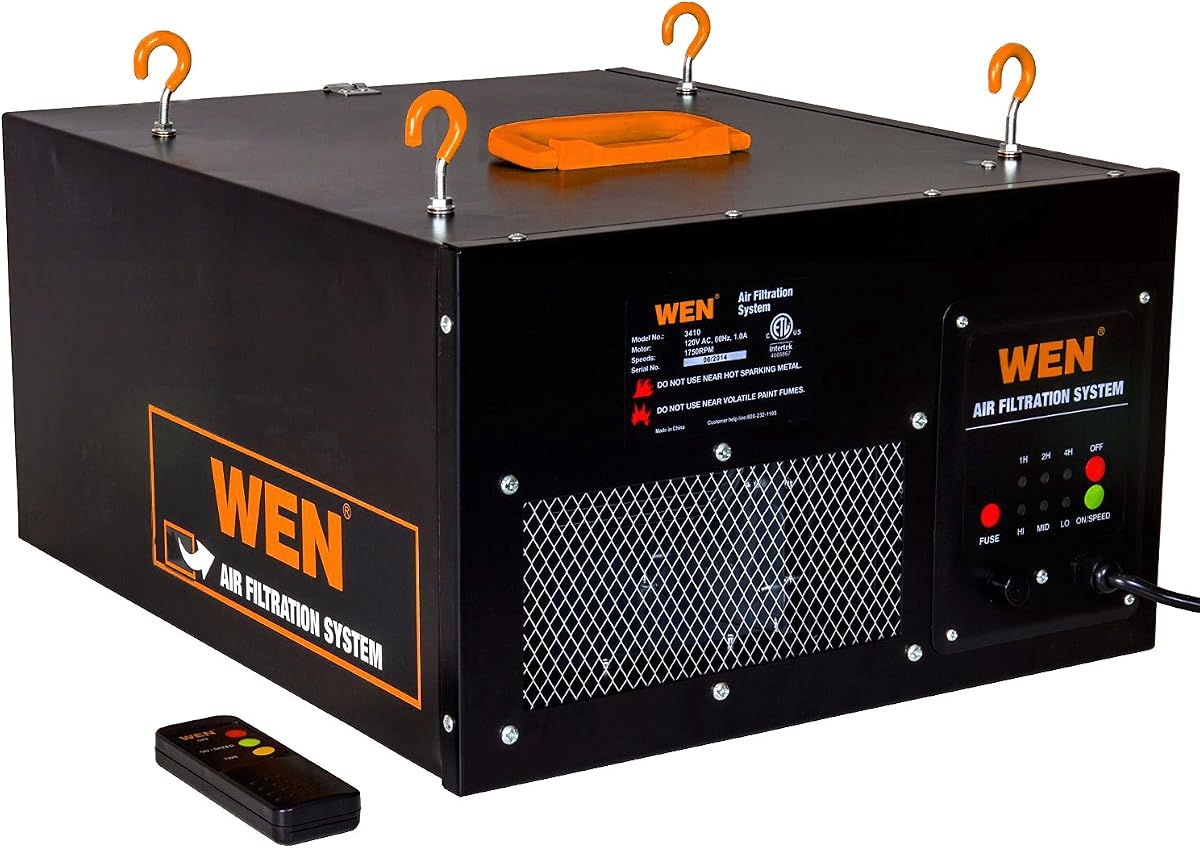
WEN 3410
4.6Editor score
Three selectable airflow speeds
Replaceable one-micron filter
Remote programmable timer control
Discover the best ceiling mounted air filtration systems for workshops and garages, with airflow, filtration, noise, mounting, and controls carefully compared.
Ceiling mounted air filtration systems are built to capture sawdust, wood particles, and other airborne debris without occupying valuable floor space. The most effective units combine strong airflow, efficient filters, useful remote controls, and mounting hardware that makes installation straightforward. They are especially useful in woodworking shops, garages, and other workspaces where equipment is already densely arranged.
This guide compares ten ceiling-hung and wall-mountable air filtration systems based on their documented airflow, filtration performance, room coverage, noise ratings, controls, and installation options. It includes compact models for smaller work areas, high-output systems for larger shops, and units with features such as ionizers, automatic sensors, programmable timers, and replaceable filters.
The selections show how filtration systems differ in intake design, power, maintenance needs, and operating convenience. The top picks represent especially balanced options for budget-conscious buyers, general workshop users, and buyers seeking premium filtration features. Product prices and availability can change, so readers should confirm current details at the linked listings before purchasing.
4.6Editor score

4.5Editor score

4.5Editor score
The table below compares all ten systems by their key airflow, filtration, coverage, control, and installation characteristics, making it easier to identify the right unit for a particular workshop or garage.


The Abestorm DecDust 1080 is a high-output ceiling-mounted filtration system designed for woodworking shops, garages, and similar work environments. Its listed customer rating is 4.5, and its defining combination of 270-degree intake, 780 or 1080 CFM airflow, and a relatively compact body makes it a strong general-purpose choice.
We may earn a commission when you buy through this link, at no additional cost to you.
The three-sided intake is intended to capture particles from a broader range of directions than a single-face collector. Two speed settings let the user increase airflow during heavy cutting, sanding, or grinding while reserving the lower setting for lighter work. Three slide-out MERV-11 filters are stated to trap 90 percent of particles between 3 and 10 microns, and the listed replacement interval is every four to six months.
Control and installation are straightforward. A touch panel and a remote with a 26-foot range provide two ways to operate the unit, while hanging chains and nails support ceiling or wall installation. At 19.4 inches long and wide, 9.6 inches high, and under 60 dBA, the DecDust 1080 offers a useful balance between output, noise, and space. The important restriction is that it cannot be shipped to California.
This is a sensible recommendation for buyers with a medium-to-large shop who want meaningful airflow without moving to the highest-output 1350 CFM class. It is particularly suitable for users who appreciate a 270-degree intake, multiple filter cartridges, and remote operation. Buyers in California should choose a compliant alternative, while others should confirm that the unit and included mounting hardware suit their ceiling structure before ordering.
The two-speed adjustment makes the unit adaptable to different tasks without forcing a single operating level. The 1080 CFM setting is appropriate for periods of heavy airborne debris, while 780 CFM can maintain circulation during less demanding work.
The touch panel gives direct access at the unit, while the 26-foot remote allows operation from across the work area. This convenience is useful when the collector is mounted high above a saw, bench, or sanding station.
We may earn a commission when you buy through this link, at no additional cost to you.
The WEN 3410 is a compact three-speed air filtration system with a 4.6 customer rating, the highest listed rating in this comparison. It is designed for spaces up to 400 square feet and offers 300, 350, or 400 CFM, making it better suited to smaller workshops, hobby rooms, and garages than the high-output models in the group.
We may earn a commission when you buy through this link, at no additional cost to you.
Its filtration arrangement includes a replaceable 1-micron filter and a replaceable 5-micron pre-filter. That combination addresses a different workspace profile from the predominantly MERV-11 systems in the roundup, while the lower airflow rating makes the unit more manageable for smaller rooms. The stated noise range is 50 to 60 dB, which aligns with its more compact output class.
The RF remote is one of the WEN 3410's most useful distinctions. It can operate from up to 26 feet away and does not require direct line of sight, so the unit can be controlled even when a wall, tool, or piece of equipment obstructs the view. It also supports power, speed selection, and a programmable timer that shuts the system off after a chosen number of minutes.
The WEN 3410 is a compelling budget-oriented recommendation for a home workshop, small garage, or compact hobby area. It may not provide the circulation capacity required for a large commercial shop or heavy continuous woodworking, but it offers convenient remote operation and a finer filter specification within a compact footprint. For buyers who prioritize control flexibility and manageable output, it is one of the strongest choices here.
Unlike a remote that depends on an unobstructed path, the RF design can send commands even when the unit is around a corner or behind equipment. That makes it practical for suspended installations in busy work areas.
The 300, 350, and 400 CFM settings provide more adjustment than a basic two-speed unit. Users can raise output when dust generation increases and reduce it during quieter periods or lighter tasks.
We may earn a commission when you buy through this link, at no additional cost to you.
The Abestorm DecDust 1350IG is built for large workshops where 1350 CFM of maximum airflow is more useful than a compact installation. Its customer rating is 4.3, and the combination of 360-degree intake, a built-in ionizer, and coverage for spaces up to 1700 square feet distinguishes it from the smaller Abestorm models.
We may earn a commission when you buy through this link, at no additional cost to you.
Air enters from all directions, allowing the unit to collect wood dust, sawdust, and particles generated by tools such as carvers, scroll saws, and rotary equipment. The two-speed airflow range is 1050 to 1350 CFM. A built-in ionizer generates positive and negative ions, which the manufacturer describes as helping treat particles and odors while improving purification.
Installation flexibility is a major strength. The system can hang from the ceiling with chains, sit on a workbench using four anti-slip rubber pads, or be screwed directly into the ceiling. A touch panel and 27-foot remote provide convenient control, while four MERV-11 filters are included and can be removed for cleaning and replacement. The listed replacement interval is every two to four months.
The tradeoff is noise and scale. Its documented range of 60 to 69 dBA is higher than several compact options, and the 20.5-inch-square housing is still substantial. Even so, the DecDust 1350IG is a logical choice for large, active shops that need more airflow and broader intake than the 780 or 1080 CFM units can provide. California shoppers should select a compliant model instead.
A 360-degree intake is useful when dust may travel from several directions around a central worktable. Combined with 1350 CFM, it is well suited to larger rooms and equipment arrangements that would challenge a compact collector.
The ability to hang, stand, or directly screw the unit into place lets the owner adapt the installation as the workshop evolves. Anti-slip pads also protect the housing when it is used on a workbench.
We may earn a commission when you buy through this link, at no additional cost to you.
The ALORAIR Purecare 1350IG delivers 1050 or 1350 CFM through a large 360-degree intake system. Its 4.2 customer rating reflects its position as a high-output option for large woodworking shops and garages, where the ability to move substantial airflow is more important than a compact footprint or low operating noise.
We may earn a commission when you buy through this link, at no additional cost to you.
Its vortex fan is designed to maintain airflow and static pressure even when the filter accumulates a large amount of wood chips. The built-in ionizer applies an electric discharge to incoming air, and the manufacturer states that this process can assist with dust and odor reduction. Its MERV-11 filter is documented as stopping 90 percent of 3-to-10-micron particles and 85 percent of 1-micron particles.
Remote operation, a timer cycle, and two-stage speed selection make daily use manageable. The timer can automatically shut the fan down after one to nine hours, while hooks and chains allow the unit to hang from a ceiling or sit on a workbench. At 20.5 inches long and wide and 9.8 inches high, it matches the general dimensions of other 1350 CFM collectors in the group.
This model is most appropriate for owners of large shops who need broad intake and strong circulation. The 60-to-69-dB noise specification and maximum airflow also make it less attractive for a quiet home office or compact hobby room. The system cannot be shipped to California, so buyers there should verify a compliant product before making a final decision.
The vortex fan is specifically designed to support static pressure as filter loading increases. That design focus makes the unit more relevant to users who regularly produce substantial wood debris.
The one-to-nine-hour timer can keep filtration running after the user leaves the bench and then shut it down automatically. It offers a convenient way to manage extended projects without continuous manual control.
We may earn a commission when you buy through this link, at no additional cost to you.
The ALORAIR Purecare 780IG is a ceiling-hanging collector for workshops up to 800 square feet. Its 4.4 customer rating and below-50-dBA specification make it an appealing middle ground for users who want more output than a small room model but value quieter operation than the largest 1350 CFM systems.
We may earn a commission when you buy through this link, at no additional cost to you.
The system draws air through a 270-degree intake and offers two airflow levels of 580 and 780 CFM. A strong vortex fan is designed to maintain static pressure as the MERV-11 filter gathers wood chips and other debris. The filter is stated to stop 90 percent of 3-to-10-micron particles and 85 percent of 1-micron particles, with replacement made straightforward.
A built-in ionizer treats incoming air with an electric discharge intended to assist dust and odor control. Users can operate the collector through the panel, an IR remote, or a timer set from one to nine hours. The remote is described as resistant to wireless interference, while hooks and chains allow the unit to be moved between a ceiling position and a workbench.
This is a well-rounded recommendation for a medium-sized shop where noise and airflow both matter. Its 18.35-inch-square housing is smaller than the 1350 CFM models, and the under-50-dBA specification is one of the quietest listed here. The unavoidable limitation is California availability: the product does not meet the stated California requirements and cannot be shipped there.
A listed noise level below 50 dBA makes the Purecare 780IG suitable for users who want background filtration without the higher noise range associated with maximum-output collectors. It is still a dust collector, so individual tool noise will remain a factor.
The 270-degree intake gathers debris from three sides, while the ionizer adds an electrostatic treatment step. Together, they create a more comprehensive setup than a basic single-speed collector.
We may earn a commission when you buy through this link, at no additional cost to you.
The ALORAIR Purecare 1350 is a straightforward high-capacity collector for large shops, providing 1050 to 1350 CFM and 360-degree air intake. Its 4.2 customer rating aligns with other powerful workshop systems, and its primary appeal is concentrated airflow rather than advanced sensing or premium multi-stage filter construction.
We may earn a commission when you buy through this link, at no additional cost to you.
The vortex fan is designed to generate strong circulation while maintaining static pressure as filter loading increases. Two speed settings allow the owner to match output to the task, and the MERV-11 filter is documented to capture 90 percent of 3-to-10-micron particles and 85 percent of 1-micron particles. The filter can be removed and replaced when maintenance is required.
The timer controller can shut the unit down automatically after a selected period of one to nine hours. An IR remote provides straightforward control, and the included hooks and chains allow the collector to hang above the work area or rest on a bench. Its 20.5-by-20.5-by-9.8-inch dimensions and 27-pound listed weight identify it as a substantial suspended installation.
Buyers should choose the Purecare 1350 when their workshop is large and produces heavy dust but they do not need an automatic air-quality sensor or a separate HEPA stage. Its 60-to-69-dB operating range makes it less appealing where low noise is essential. California shoppers cannot order this model because it does not meet the stated local requirements.
The Purecare 1350 focuses on airflow, filter efficiency, and manual speed selection. That simplicity can be valuable for users who already know when filtration should run and do not need an automatic sensor.
The vortex fan specification emphasizes maintaining static pressure as wood debris accumulates. This makes the collector relevant to regular sawing, carving, sanding, turning, and similar dusty operations.
We may earn a commission when you buy through this link, at no additional cost to you.
The DEWALT DWXAF101 stands apart with automatic air-quality sensing, four operating modes, and a two-stage filtration arrangement. Its 4.5 customer rating and three-year warranty make it the most feature-focused premium recommendation among the ten ceiling-mounted systems compared here.
We may earn a commission when you buy through this link, at no additional cost to you.
The filtration system combines a static cotton pre-filter with an H11 HEPA filter. The manufacturer states that this arrangement captures more than 95 percent of 0.3-micron particles, providing a notably fine filtration specification. A filter replacement indicator and washable pre-filter are included to help users manage routine maintenance and keep the main stage operating effectively.
The unit offers high, mid, low, and automatic modes. In automatic mode, an air-quality sensor identifies changing conditions and selects the appropriate gear. A remote control supports convenient adjustments, and built-in one-, two-, four-, and eight-hour timers can shut the system off when the work period ends. Hooks and chains allow it to hang from a shop ceiling without consuming floor space.
The DWXAF101 is best suited to buyers who value automatic adjustment, fine filtration, and recognizable brand support. Although the supplied information does not state a specific CFM figure or room-coverage area, its two-stage H11 HEPA configuration and automatic mode distinguish it from the more basic high-CFM alternatives. Verify the final dimensions and electrical requirements on the listing before installation.
The automatic mode uses an air-quality sensor to identify changes and adjust the operating gear. This can reduce the need to manually change speed as the type or amount of airborne debris changes.
The cotton pre-filter captures larger debris before it reaches the H11 HEPA stage. The stated ability to capture more than 95 percent of 0.3-micron particles makes this a compelling option for users prioritizing fine filtration.
We may earn a commission when you buy through this link, at no additional cost to you.
The Abestorm DecDust 780IG combines 580 or 780 CFM airflow with a built-in ionizer and a 270-degree intake. It has a 4.0 customer rating and targets workshops up to 800 square feet, offering a more specialized electrostatic-assisted design than the standard DecDust 780.
We may earn a commission when you buy through this link, at no additional cost to you.
According to the product information, the ionizer electrically charges dust particles so they can agglomerate more readily. The manufacturer states that this electrostatic-assisted adsorption can reduce filter clogging, extend filter lifespan by two to three times, lower fan load, and support quieter operation. Three MERV-11 filters are included to trap 90 percent of 3-to-10-micron particles.
The collector offers touch-panel and remote operation, with a stated remote range of 26 feet. It measures 18.35 inches long and wide, 8.82 inches high, and is documented below 50 dBA. Free hanging chains and nails support both ceiling and wall installation, making it flexible for different workshop layouts.
This is an appealing choice for a medium workshop that wants ionizer functionality without moving into the 1050-to-1350-CFM class. The tradeoffs are its lower 4.0 rating and lower maximum airflow compared with the leading Abestorm 1080. Users should evaluate the ionizer's claimed benefits in the context of their filter-maintenance routine, since routine cleaning and replacement will still be necessary.
The ionizer's charge-assisted particle treatment is intended to help limit filter clogging and extend service life. This could be especially relevant to users producing enough dust to load filters quickly.
At 8.82 inches high, the DecDust 780IG fits into a more compact suspended installation than many high-output collectors. The included chains and nails also allow wall placement when overhead mounting is inconvenient.
We may earn a commission when you buy through this link, at no additional cost to you.
The Abestorm DecDust 780 is a straightforward two-speed collector with 580 or 780 CFM airflow. It carries a 3.7 customer rating, the lowest in this group, but remains a practical option for buyers focused on core functions: multidirectional intake, remote operation, and a compact ceiling installation.
We may earn a commission when you buy through this link, at no additional cost to you.
The 270-degree three-sided intake is designed to capture airborne dust in workshop and industrial environments. Three slide-out MERV-11 filters are stated to trap 90 percent of particles between 3 and 10 microns. The manufacturer recommends checking or replacing the filters every four to six months, so buyers should include ongoing filter expense in the ownership calculation.
Both touch-panel and remote control are provided, and the remote has a 26-foot range. Free hanging chains and nails support ceiling or wall mounting. The unit measures 18.35 inches long and wide and 8.82 inches high, while its listed coverage extends to 800 square feet and its noise rating is under 50 dBA.
The DecDust 780 is best considered as a no-frills alternative within the Abestorm range. It does not list an ionizer, automatic sensing, or a fine HEPA stage, but it offers the same basic 270-degree intake and two-speed control as more specialized variants. Its lower customer rating warrants careful attention to the current listing feedback before purchase, while its documented specifications remain suitable for many medium workshops.
The lower and higher airflow settings simplify day-to-day operation. Users can increase collection during active cutting or sanding and select the lower setting when the workspace needs less circulation.
The three filters slide out for routine inspection and replacement. This design makes it easier to maintain the collection system without repeatedly moving the suspended housing.
We may earn a commission when you buy through this link, at no additional cost to you.
The ABESTORM DecDust 1350IG is a full-size hanging filtration system with 1050 to 1350 CFM airflow, 360-degree intake, and a built-in ionizer. Its 4.2 customer rating and 1700-square-foot stated coverage place it firmly in the large-workshop category.
We may earn a commission when you buy through this link, at no additional cost to you.
The ionizer generates positive and negative ions to treat particles, dust, sawdust, and odors as air passes through the system. The vortex fan supports high circulating airflow, and the four included MERV-11 filters can be removed for cleaning and replacement. The stated replacement interval is every two to four months, which is important to consider for high-dust applications.
Touch-panel and remote control offer flexible operation, with the remote working from up to 27 feet away. Matching mounting hardware is included, and the system can be suspended over a work area. At 20.5 inches long and wide, 9.8 inches high, and 27 pounds, it is a substantial unit that requires a suitable ceiling location and adequate clearance.
This model is recommended for large woodworking shops or garages that regularly generate sawdust and need complete directional intake. The documented 60-to-69-dBA noise level may be significant during extended use, and it offers no automatic sensor comparable to the DEWALT option. Even so, it is a capable choice when maximum airflow, 360-degree collection, and ionizer treatment are the priorities.
A complete 360-degree intake is advantageous in rooms where dust-producing work occurs on multiple sides of the collector. It reduces the need to orient a one-sided intake toward every active workstation.
Four filter units provide a substantial filtration arrangement, and the stated two-to-four-month replacement interval acknowledges the heavy loading typical of woodworking. Owners should plan for regular inspection and replacement.
We may earn a commission when you buy through this link, at no additional cost to you.
The right ceiling-mounted collector depends on room size, dust load, noise tolerance, filter requirements, and installation access. Comparing airflow and documented filtration specifications is the fastest way to narrow the field before considering controls and maintenance.
Airflow is one of the most important considerations because it determines how much air the collector can move through its filter. The systems in this guide range from 300 to 400 CFM to as much as 1050 to 1350 CFM. Larger, actively used shops generally benefit from higher output, while compact hobby spaces may be better served by the WEN 3410 or a 580-to-780-CFM collector. The listed coverage areas offer a starting point, but room dimensions, ceiling height, workstation layout, and the severity of dust production all affect real-world results.
A 270-degree intake captures from three sides, while a 360-degree system draws from all around the housing. Wider intake can be advantageous when dust travels from several directions or the collector sits near the center of a work area. It does not guarantee the same performance as a dedicated dust extraction system connected directly to a machine, but it can improve circulation around the equipment. Shoppers should also consider whether the collector will be mounted near walls, where a broad intake may partly face a restricted side.
Most high-CFM models use MERV-11 filters, with documentation stating that they capture 90 percent of 3-to-10-micron particles and 85 percent of 1-micron particles. The WEN 3410 uses a 1-micron main filter with a 5-micron pre-filter, while the DEWALT DWXAF101 uses a cotton pre-filter and H11 HEPA filter stated to capture more than 95 percent of 0.3-micron particles. These percentages are manufacturer-provided and should be compared within the context of airflow, filter area, maintenance, and replacement availability.
Noise specifications range from below 50 dBA to a documented 60-to-69-dBA range. Lower readings are generally more suitable for frequent communication, home workshops, and nearby living spaces, although the rating alone does not represent total workshop noise from tools. The WEN 3410 is listed at 50 to 60 dB, while several 780-CFM Abestorm and ALORAIR models are documented below 50 dBA. The 1350-CFM systems tend to carry higher documented noise because of their greater output.
Most units include chains, hooks, or mounting hardware for hanging from a ceiling, but the exact installation method varies. Some can also be placed on a workbench, screwed directly into a ceiling, or mounted on a wall. Buyers should verify joist locations, available clearance, electrical access, and the unit's listed weight before drilling or hanging hardware. A high-output model needs enough space around its intake, so the housing should not be pressed tightly against a ceiling or wall.
Remote control is especially helpful when the unit is mounted high above a workstation. Most systems offer touch and remote operation, but the remote technologies differ. The WEN 3410 uses an RF remote that works without direct line of sight, the DEWALT offers multiple speed settings plus automatic air-quality sensing, and several Abestorm and ALORAIR units include programmable timers. Automatic sensing is useful for variable workloads, while a timer can ensure the system shuts down after an extended project.
Ceiling-mounted units are convenient because they save floor space, but filter access can be less convenient than with a freestanding collector. Look for slide-out or easily removable filters, clear replacement intervals, and a maintenance process that can be performed safely from a ladder. The supplied information lists four-to-six-month replacement guidance for several 780- and 1080-CFM models and two-to-four-month guidance for 1350-CFM models. Actual service frequency will depend on dust type and how heavily the system operates.
Most of the listed systems use 115- or 120-volt power, with amperage requirements ranging from 0.6 to 1.5 amps. Check the exact electrical specification for the model you choose and plan the cord route to a suitable outlet. Several Abestorm and ALORAIR products cannot be shipped to California because they do not meet the stated California air-cleaner regulation requirements. Buyers should confirm both shipping eligibility and local requirements before placing an order.
Begin by reviewing the unit's instructions, electrical requirements, mounting hardware, and recommended filter orientation. Install the collector above or near the main source of dust, with adequate clearance around the intake and enough access to open the filter compartment. Confirm that the suspension point can support the listed weight and use the specified chains, hooks, nails, or screws rather than improvised fasteners.
During use, select the airflow setting that matches the task and dust load. Use a timer or automatic mode when appropriate, and avoid assuming that a ceiling collector replaces a machine-connected dust extraction system. It is intended to improve workshop air by collecting airborne debris, so position it so the intake is exposed to the working area rather than blocked against a wall or structural obstruction.
Inspect the filters regularly and clean or replace them according to the manufacturer's schedule. Because the unit is elevated, use a stable ladder and switch the system off before servicing it. Slide-out or removable filters make this task more manageable, and indicator features on the DEWALT model provide an added reminder to monitor filter condition.
Yes, most of the systems in this guide are specifically designed for wood dust, sawdust, and particles produced by woodworking tools. Models with 270-degree or 360-degree intake are especially useful when debris travels from several directions. They are best treated as ambient air filtration rather than a complete substitute for a dust port or dedicated collection system attached directly to machinery.
The appropriate airflow depends on room size, ceiling height, number of machines, and how much dust you create. The listed options range from 300 to 1350 CFM, with the WEN 3410 covering up to 400 square feet and the highest-output models covering up to 1700 square feet. Larger or more active shops generally benefit from choosing the upper end of the available range.
MERV-11 filters are commonly used in these workshop collectors because they are designed for a meaningful range of airborne particles. The listed Abestorm and ALORAIR systems are documented to capture 90 percent of 3-to-10-micron particles and 85 percent of 1-micron particles. The DEWALT offers a different two-stage arrangement with an H11 HEPA filter and cotton pre-filter for buyers seeking a finer stated capture specification.
The supplied product information gives different guidance depending on the model. Several Abestorm units list four-to-six-month replacement intervals, while the 1350-CFM Abestorm and ALORAIR-style systems list two-to-four-month intervals under their stated usage conditions. Actual service life depends on dust load, filter condition, and how often the collector operates, so frequent visual inspection remains important.
Mounting methods vary by product. The Abestorm DecDust 1350IG explicitly supports hanging with chains, standing on a workbench, or being screwed directly into a ceiling. Other models primarily use hanging chains, hooks, or nails and may also permit bench placement. Follow the product instructions, confirm structural support, and leave adequate space around the intake.
Several of the Abestorm and ALORAIR models explicitly cannot be shipped to California because they do not meet the stated California air-cleaner regulation requirements. This restriction applies to the Abestorm DecDust 1080, DecDust 1350IG, and the listed ALORAIR Purecare models. Shoppers in California should confirm eligibility and applicable regulations before ordering any system.
The WEN 3410, DEWALT DWXAF101, and most Abestorm and ALORAIR systems include remote controls in their listed features. The WEN uses RF technology that can operate without a direct line of sight, while the other remotes generally provide a stated unobstructed operating range. Controls are also generally available on the unit itself, so a remote is a convenience rather than the only operating method.
Noise depends on the model and operating speed. Products in this guide are documented from below 50 dBA up to a 60-to-69-dBA range, with the highest-output 1350-CFM systems generally at the louder end. The specification applies to the collector itself, while saws, sanders, and other tools may produce substantially more noise in the same workspace.
The WEN 3410 stands out as the value-oriented choice for small spaces because of its three speeds, replaceable one-micron filter, programmable timer, and RF remote. The Abestorm DecDust 1080 is the most balanced general recommendation, combining 780-to-1080-CFM airflow, a 270-degree intake, three MERV-11 filters, and under-60-dBA operation. The DEWALT DWXAF101 is the premium selection for buyers who prioritize automatic sensing, a washable pre-filter, and a stated H11 HEPA filtration stage.
Large workshops should focus first on airflow, intake direction, and available ceiling space, while owners of smaller areas should balance noise, controls, and compact dimensions. Remember that a ceiling collector is designed to capture airborne debris rather than replace extraction attached directly to a machine. Filter accessibility, replacement guidance, electrical needs, and regional shipping rules should be reviewed before installation.
Ratings, product configurations, promotions, availability, and prices can change, so use the linked listings to confirm the current details. Comparing the latest manufacturer information against the documented specifications in this guide will help ensure that the selected ceiling-mounted air filtration system fits the intended workshop, garage, or hobby space.