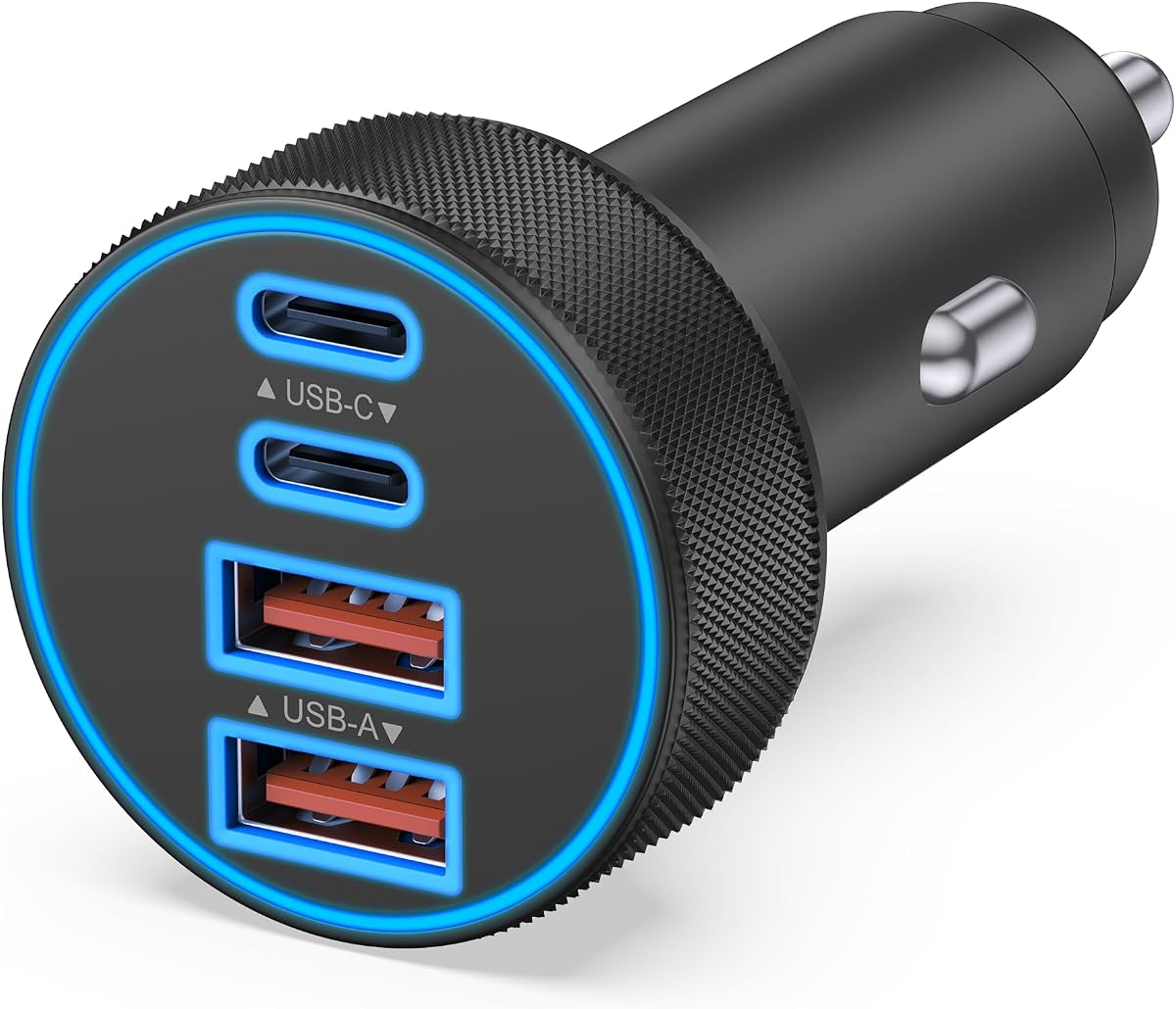
USB C Car Charger 4-Port 90W
4.6Editor score
90W combined charging output
Two USB-C and two USB-A ports
PD and QC fast charging
Intelligent power management
Discover the best Car Lighter USB Adapters, comparing fast charging, port layouts, compact designs, compatibility, safety features, and everyday vehicle use.
Car lighter USB adapters turn a vehicle’s 12-volt accessory socket into a convenient charging station for phones, tablets, GPS units, and other compatible electronics. The most useful models balance charging speed, port flexibility, physical fit, heat management, and dependable protection rather than focusing on headline wattage alone.
This guide compares ten car lighter USB adapters on output, port count, charging protocols, compatibility, construction, safety features, and suitability for different vehicles. It includes compact two-port models, high-wattage options, three-port designs, and a two-pack for drivers who want equipment in more than one vehicle.
The picks show that a four-port adapter is not automatically better than a smaller dual-port model, nor does maximum advertised power guarantee full speed for every connected device. Ratings, compatibility claims, and availability can change, and current prices should be checked before purchase because promotions and product details vary over time.
4.6Editor score

4.7Editor score
4.6Editor score
The table below compares all ten adapters by charging capacity, port configuration, physical design, and notable features, making it easier to identify the right option for a single vehicle, multiple devices, or a replacement stored in a glove box.


This four-port adapter combines a substantial 90W output rating with a practical mix of two USB-C and two USB-A connections. Its 4.6 rating reflects a well-received design that appeals to drivers who regularly carry several devices. The charger supports PD, QC, and PPS fast-charging protocols, giving it broader appeal than a basic fixed-output adapter.
We may earn a commission when you buy through this link, at no additional cost to you.
The main attraction is flexibility. Two USB-C ports can serve compatible phones, tablets, and other modern equipment, while the USB-A ports remain useful for older accessories and cables. The listed output allows PD charging up to 45W and QC charging up to 45W, with the adapter distributing power intelligently among connected devices. An all-metal housing is also useful because heat can build up during sustained high-output use.
Its size is the main trade-off. At 2.71 by 1.56 inches, it is less discreet than the thumb-sized products later in the list and may protrude more in vehicles with shallow or crowded accessory sockets. Advertised charging times also depend on the connected device, its battery condition, the cable used, and whether several devices draw power at the same time. Buyers should verify their vehicle’s electrical specifications before installation.
This is the strongest all-around recommendation for households, road trips, and shared vehicles. Choose it when having enough connections and broad fast-charging support matters more than finding the smallest possible adapter. For a vehicle that regularly carries multiple phones, a tablet, and an older USB-A accessory, the four-port layout can eliminate the need for several separate cables or chargers.
Four connections allow passengers and drivers to charge several devices without bringing a larger home charger into the car. The mix of USB-C and USB-A is especially practical for mixed device fleets.
The intelligent power-management system includes protection against overcurrent, overvoltage, overload, overheating, and short circuits. These safeguards make the higher-output design more reassuring for extended journeys.
We may earn a commission when you buy through this link, at no additional cost to you.
This LISEN package includes two compact adapters, each combining a 36W PD USB-C port and an 18W QC USB-A port. Its 4.6 rating and 69W headline output make it a compelling option for drivers who want a spare for another vehicle, a glove box, or a shared family car. The supplied information positions the two-port approach as a deliberate alternative to larger multi-port chargers.
We may earn a commission when you buy through this link, at no additional cost to you.
The USB-C port supports fast charging for recent iPhone series, while the USB-A connection covers many Android phones, tablets, and smaller accessories. Splitting the output between two dedicated cores can also reduce the concentration of power in a single port. Its all-aluminum shell is designed to remain cooler than a comparable plastic body, and the thumb-sized form should sit relatively flush in many sockets.
The compromise is obvious: this is not the choice for a driver who regularly needs three or four simultaneous connections. Its combined output also does not mean each connected device will receive 69W. Device compatibility, the attached cable, and the number of active ports influence real charging results. The included replacement promise and suitability for fleet deployment add confidence for organizational buyers.
The two-pack makes this an excellent choice for households with multiple drivers, delivery fleets, or anyone who wants a reliable backup. It balances modern USB-C support with a familiar USB-A port without filling the console with separate adapters. For most two-device use, the LISEN approach is simpler and tidier than a larger multi-port unit.
Two complete adapters can be placed in separate cars or kept as a spare. That makes the package practical for commuters, couples, and small business fleets.
A USB-C and USB-A combination covers most daily charging needs while avoiding the visual clutter of a larger adapter carrying several unused ports.
We may earn a commission when you buy through this link, at no additional cost to you.
The Anker 323 combines a 30W USB-C connection with a 22.5W USB-A connection and carries a 4.7 rating, the highest among the products in this guide. That makes it a strong option for drivers who want a straightforward, reputable two-port charger without carrying a larger four-port block. PowerIQ 3.0 is designed to recognize connected devices and provide compatible fast charging.
We may earn a commission when you buy through this link, at no additional cost to you.
Anker reports that an iPhone 14 Pro can reach 50 percent in 25 minutes and a Samsung S23 can reach 50 percent in 27 minutes under its stated test conditions. The USB-C and USB-A ports can charge two devices at once while retaining useful individual output levels. ActiveShield 2.0 monitors temperature and adjusts power output to help safeguard connected devices during use.
It cannot compete with four-port adapters for sheer connection count, and its 52.5W aggregate rating is below several 67W, 69W, and 90W options. The advantage is a clearer use case: one modern phone and one secondary device, with less unnecessary hardware around the socket. The included welcome guide, 18-month warranty, and customer service add consumer support that is not specified for every competing product.
For most couples or solo drivers charging one primary phone and a second smaller device, this is an especially balanced selection. It provides modern fast charging, recognizable charging technology, and active thermal monitoring without the larger footprint associated with maximum-output models. It is also a sensible alternative for anyone who values a straightforward design over having every possible port available.
PowerIQ 3.0 is designed to match output to the connected device, helping compatible phones reach useful charge levels during short driving windows.
ActiveShield 2.0 monitors temperature and adjusts output, providing a clear safety benefit when the charger is used in a hot vehicle or under sustained load.
We may earn a commission when you buy through this link, at no additional cost to you.
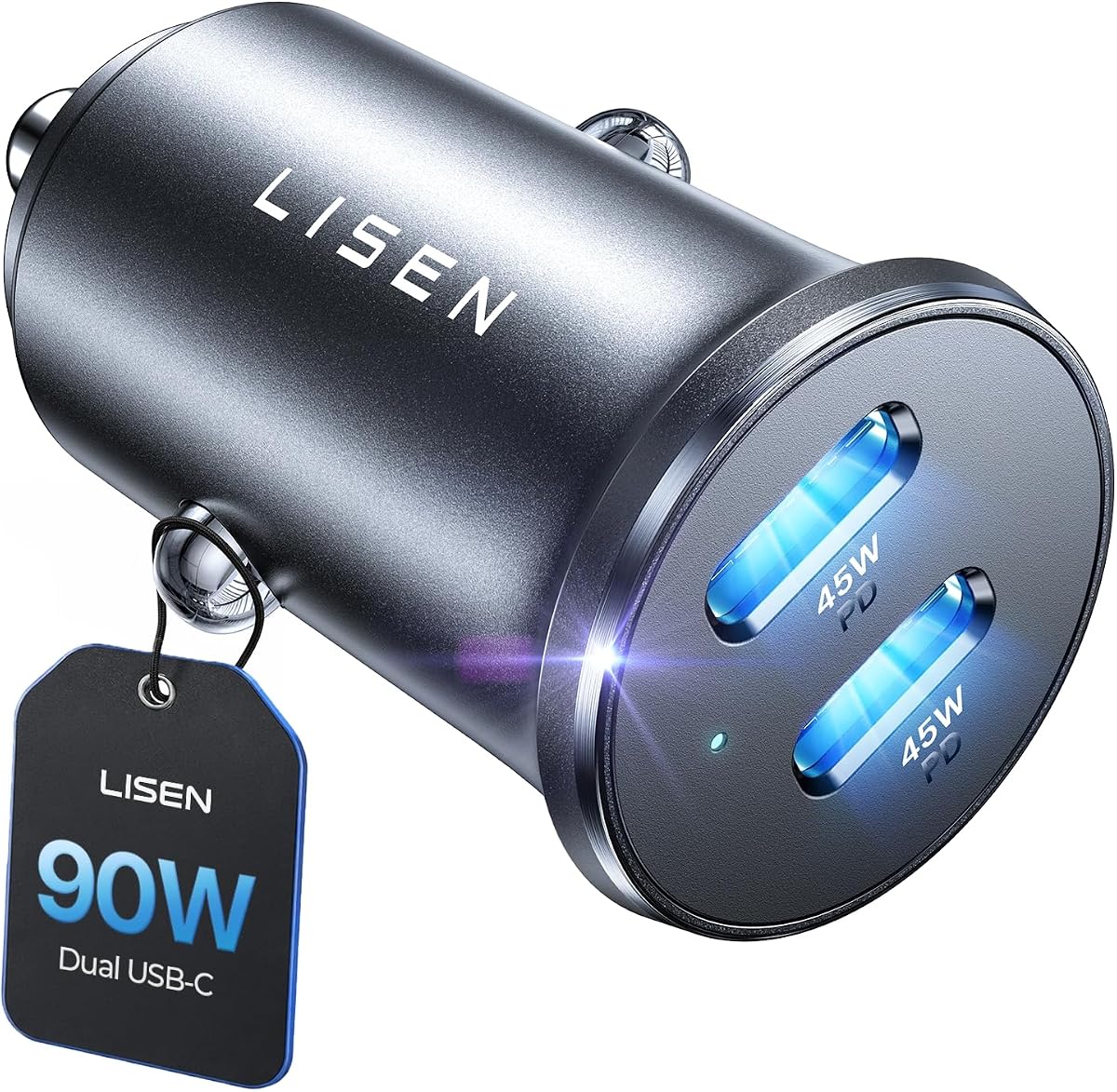
This LISEN adapter uses two USB-C ports, each listed at up to 45W, for a total advertised output of 90W. Its 4.6 rating reflects a compact, high-power design aimed at newer phones and tablets. Unlike many competing adapters, it does not include USB-A, producing a cleaner setup for travelers whose devices all use the current connector.
We may earn a commission when you buy through this link, at no additional cost to you.
Power Delivery 3.0 support enables fast charging for compatible devices, and the product information cites an iPhone 18 Pro reaching 83 percent in about 30 minutes. The thumb-sized body measures 2.1 by 0.9 inches, helping it fit more discreetly than the larger four-port option. Its metal alloy shell contributes to heat dissipation and gives the charger a sturdy, refined appearance.
USB-C-only compatibility is the defining limitation. Drivers with older accessories, cameras, power banks, or devices that still require USB-A will need another cable or a different adapter. The listed UL, CE, FCC, and RoHS certifications and intelligent power-management chip are positive features, but buyers should still confirm that their devices support the relevant charging standard and cable.
This adapter is best for a modern device ecosystem where two USB-C phones or a phone and tablet are charged regularly. Its combination of high output, discrete size, and all-metal construction makes it a premium alternative to bulkier multi-standard models. It is particularly attractive to drivers who value a clean connection layout more than backward compatibility.
Two USB-C ports avoid the need to carry separate cable types. Compatible phones, tablets, and other modern accessories can share the adapter without occupying extra socket positions.
The small metal enclosure provides useful heat dissipation while remaining less conspicuous than larger adapters. A pull-free, thumb-sized profile can also help preserve access to nearby console controls.
We may earn a commission when you buy through this link, at no additional cost to you.
The KENHAO adapter offers three ports, including two USB-C connections and one USB-A connection, under a 67W combined output rating. Its 4.7 rating places it alongside the Anker 323 as one of the highest-rated products featured. The configuration is versatile enough for modern phones, older accessories, and occasional tablet charging without becoming a large four-port block.
We may earn a commission when you buy through this link, at no additional cost to you.
The USB-C port is listed at up to 37W using PD, while the USB-A port supports up to 30W using QC 3.0. The supplied information states that compatible iPhone and Android models can reach 60 percent in 35 minutes, depending on the device. An intelligent chip provides overcurrent, overvoltage, overheating, and short-circuit protection, while the charger stops output when a connected device reaches full charge.
As with all multi-port adapters, maximum total output does not mean every port supplies its maximum rating at the same time. Power is shared according to device demand and the charger’s management system. The all-metal housing supports heat dissipation and shock resistance, but buyers should expect a somewhat larger footprint than a basic two-port model.
This is a versatile middle ground for families and road trips. Three ports are enough to support a driver, passenger, and accessory without the full bulk of a four-port design. It is a good choice when USB-C is your main connector but you still want one USB-A port available for an older cable or accessory.
The two-to-one USB-C-to-USB-A ratio gives modern devices priority while preserving a familiar connection for older accessories, cameras, and legacy power banks.
The metal enclosure is intended to dissipate heat during repeated charging. Combined with the listed circuit protections, it supports stable use during long journeys.
We may earn a commission when you buy through this link, at no additional cost to you.
This two-pack provides two compact three-port adapters, each rated for 70W total output. Its configuration includes one 40W USB-C PD port and two 30W USB-A QC ports, giving each vehicle room to charge multiple devices without duplicating every port on both included units. The adapters have a 4.6 rating and are positioned for commuters, families, and road trips.
We may earn a commission when you buy through this link, at no additional cost to you.
The product information states that compatible iPhone and Galaxy models can reach roughly 70 to 75 percent in 30 minutes. An integrated smart chip is designed to recognize devices and deliver appropriate output. Listed protections include overvoltage, overcurrent, overcharging, overheating, and short-circuit handling, with heat dissipation intended to keep operating temperatures low.
Compared with the KENHAO, the principal difference is port orientation: this option has one USB-C port and two USB-A ports rather than the reverse. That is favorable for older accessories but less ideal for a family using several USB-C phones. The 70W rating is shared across the three connections, so maximum performance will depend on the connected combination and the capabilities of each device.
The package shines for anyone driving two vehicles, sharing a charger with a family member, or wanting a spare stored in the trunk. It provides broad compatibility, including phones, tablets, GPS units, dash cams, and USB-A or USB-C accessories. Buyers should verify their device and cable requirements before choosing this over the more USB-C-focused alternatives.
Two complete units make it easy to equip a second vehicle or keep a backup accessible. The standardized three-port layout also suits small professional fleets.
The integrated chip recognizes connected devices and adjusts delivery, while listed safeguards cover common electrical faults and excessive temperature.
We may earn a commission when you buy through this link, at no additional cost to you.
The AILKIN option is a basic dual USB-A charger sold as a two-pack. It has a 4.6 rating and delivers up to 3.4 amps across two connections, with one port rated at 1A and the other at 2.4A. That makes it a practical choice for older phones, tablets, accessories, or vehicles whose drivers do not need USB-C fast charging.
We may earn a commission when you buy through this link, at no additional cost to you.
The charger is said to identify connected devices and charge two simultaneously. A blue LED indicator provides visible confirmation that the unit is powered. Its ABS and PC fireproof housing is accompanied by RoHS, CE, and FCC certification, while the listed protections address overheating, overcurrent, overcharging, and short circuits. Charging is designed to stop when a device battery is full.
This is deliberately not a USB-C or Power Delivery adapter, and the product data emphasizes that distinction. It cannot provide the fast-charging performance associated with modern PD or QC protocols, nor can it accept a USB-C cable. Older accessories may still benefit from the dedicated 2.4A connection, making it more useful than a basic one-port unit for a mixed but USB-A-only collection of devices.
The two-pack is best for older vehicles, backup use, or drivers who specifically need dual USB-A connectivity. It is less suitable for modern phone owners seeking rapid top-ups or anyone planning to move to USB-C accessories. Its simplicity and familiar connections remain useful, but newer protocol support gives more versatile options in this roundup.
The dedicated 1A and 2.4A outputs provide a simple way to charge many older USB-A devices without navigating more complex port layouts.
With two adapters included, drivers can keep one in each vehicle or store a backup where it is easy to retrieve during an emergency.
We may earn a commission when you buy through this link, at no additional cost to you.
The MOSWAG adapter emphasizes a nearly invisible installation more than charging capacity. Its 4.5 rating, thumb-sized body, and low-profile construction make it well suited to vehicles with narrow or crowded cigarette-lighter sockets. The adapter offers one USB-A port at up to 18W and one USB-C port at up to 7.5W for essential charging on the move.
We may earn a commission when you buy through this link, at no additional cost to you.
Its design is intended to barely protrude from the socket, preserving a clean dashboard appearance and making the charger easy to carry between vehicles. The all-aluminum shell is described as improving heat dissipation by about 15 percent compared with plastic chargers. A power-management chip and compliance with CE, FCC, and RoHS standards support the product’s safety positioning.
The output is much lower than that of the 67W, 69W, 75W, and 90W alternatives, and modern phones may charge at a more moderate rate. The product information also specifically warns not to use it for a dash camera. That makes it a better fit for occasional phone and accessory top-ups than for a high-output travel charging system.
Choose the MOSWAG when a discreet profile, simple USB-A and USB-C access, and a metal housing matter more than maximum wattage. It works particularly well in compact vehicles or for drivers who dislike adapters protruding from the console. For heavy charging or multiple high-powered devices, a larger three- or four-port model would be more appropriate.
The low-profile body reduces visual clutter and may preserve access to nearby controls. It is a particularly useful characteristic in vehicles with a recessed accessory outlet.
The aluminum housing is designed to dissipate heat more effectively than plastic, helping the compact charger maintain steadier operation during ordinary charging.
We may earn a commission when you buy through this link, at no additional cost to you.
The MRGLAS combines a 90W advertised output with a small, flush-fitting all-metal body. It has one USB-C port rated up to 45W and one USB-A port rated up to 45W, creating a two-port design that can deliver substantial output to compatible devices. Its 4.6 rating reflects a product focused equally on power, fit, and finishing.
We may earn a commission when you buy through this link, at no additional cost to you.
A particularly thoughtful feature is the pull ring, which makes the adapter easier to remove from a deeply recessed lighter socket. The body is intended to sit nearly flush so it does not obstruct the socket cover or protrude while driving. The metal construction also offers better heat dissipation and scratch resistance than typical plastic shells.
The built-in intelligent chip identifies devices and supports listed protections against overcurrent, short circuits, overvoltage, undervoltage, excessive temperature, and excessive power. The product information states that an iPhone 18 Pro Max and Samsung Galaxy S26 can reach 89 percent in 30 minutes under supported conditions. The two-year replacement promise adds an extra layer of reassurance, although buyers should understand it is a manufacturer commitment.
This adapter is an excellent match for someone who wants high charging capability without a four-port block. Its two ports are sufficient for a phone and secondary device, while the flush profile keeps the console tidy. It is particularly compelling for vehicles where a bulky adapter would be inconvenient or could interfere with a nearby storage compartment.
Ninety watts of advertised capacity is combined with a compact two-port layout, providing useful performance for devices that support fast-charging protocols.
The pull ring eases removal, while the flush body helps avoid an adapter that rocks or projects unnecessarily from the vehicle’s accessory outlet.
We may earn a commission when you buy through this link, at no additional cost to you.
The AINOPE charger combines a thumb-sized metal body with a straightforward dual USB-A layout. At 1.79 by 0.94 inches, it is among the most compact options in the guide, and its 4.6 rating indicates a generally favorable reception. It is aimed at drivers who want a small, uncomplicated charger for phones and other USB-A devices.
We may earn a commission when you buy through this link, at no additional cost to you.
Despite its size, the product supports QC3.0 and is described as charging devices at the maximum speed they support. Its compatibility list includes recent iPhone and Samsung Galaxy models as well as other Android and iOS devices. The metal shell is intended to improve heat dissipation, and the listed safeguards cover overcurrent and overcharging.
The main limitation is the absence of USB-C. Drivers who rely on a USB-C cable will need a different adapter, and the product data does not provide individual port wattage ratings, making detailed power comparison harder. A metal exterior can feel warm during use, but the manufacturer explains that this is part of the heat-dissipation function rather than evidence of failure.
The AINOPE works well for a small, stable collection of USB-A accessories and drivers who prioritize a compact installation. It may also fit vehicles where the socket is too shallow for a larger adapter. For modern USB-C ecosystems or several simultaneous high-power devices, one of the PD-equipped models will be a more flexible choice.
The compact form fits neatly into a vehicle socket and avoids the visual bulk of a larger adapter. Two USB-A ports remain sufficient for many basic charging tasks.
The all-metal enclosure is intended to draw heat away from the electronics. It may feel warm during charging because the shell is actively managing heat.
We may earn a commission when you buy through this link, at no additional cost to you.
The right car lighter USB adapter depends on your devices, vehicle, and charging habits. Output ratings, connector types, physical dimensions, and safety design should be considered together rather than judging a charger by wattage alone.
USB Power Delivery, Quick Charge, and Programmable Power Supply support determine how quickly compatible devices can negotiate a suitable charging rate. A high wattage figure alone does not guarantee that every phone, tablet, or laptop will charge at that rate, because the device must support the protocol and the cable must carry the required power. Checking connector type is equally important: USB-C adapters suit modern equipment, while USB-A remains relevant for older accessories and legacy phones.
Total wattage is shared across connected ports in most multi-port adapters. A model rated at 90W may offer a high individual output to one or two compatible devices, but that performance can fall when several devices draw power together. Single-port chargers can concentrate output more consistently, while three- and four-port models provide convenience for families and shared vehicles. The listed maximum for each port is more informative than the headline total when choosing for one specific device.
Port count should reflect realistic use rather than the largest number available. A two-port adapter is often enough for a driver and passenger, while three or four ports help when a navigation unit, dash camera, passenger phone, and tablet are all in use. Mixed USB-C and USB-A layouts offer broader compatibility, while all-USB-C designs create a cleaner setup for newer devices. Drivers carrying legacy accessories should avoid assuming that a modern USB-C port can accept every older cable.
Vehicle accessory sockets differ in diameter, depth, and surrounding trim. A compact adapter can sit almost flush, reduce dashboard clutter, and avoid interfering with a nearby socket cover. Larger multi-port models may protrude more and become easier to knock during rough roads. A pull ring or similarly accessible grip can be valuable when an adapter is deeply recessed. Before purchasing, compare the listed dimensions with the space available in the intended vehicle.
Car charging can involve extended high-output use, especially in warm weather. All-metal housings generally provide better heat dissipation than plastic bodies, while compact designs may require stronger power management because heat is concentrated into a smaller area. The charger should feel stable and secure without presenting an obvious sign of overheating. A metal exterior that becomes warm during sustained charging can be part of normal heat dissipation, particularly when the socket or vehicle interior is already hot.
Useful safety features include protection against overcurrent, overvoltage, undervoltage, overload, overcharging, short circuits, and excessive temperature. A smart controller can identify connected devices, negotiate an appropriate output, and stop or reduce power when a battery is full. Listed regulatory certifications such as UL, CE, FCC, or RoHS can provide additional context, while manufacturer warranties or replacement promises may improve the buying experience. No feature replaces correct installation, so the adapter should fit securely and remain unobstructed.
Most adapters in this guide support 12- to 24-volt vehicle systems, allowing use in cars, trucks, SUVs, and pickups. That does not mean every adapter is appropriate for every vehicle, especially larger commercial vehicles that use different accessory sockets. Check the socket shape and voltage before ordering. Drivers should also consider whether a crowded center console leaves enough room for the adapter, particularly when several charging cables must bend around console trim.
A two-pack can be more practical than a single premium-looking adapter when the vehicle is shared or a backup is valuable. One unit can stay in the car while another is stored for travel, a second vehicle, or replacement after wear. A multi-pack is also useful for small business fleets, provided the selected model offers the ports and protocols required by each vehicle. For one driver with one or two devices, a single compact adapter may be simpler and easier to manage.
Before first use, inspect the adapter, plug, and cable for visible damage and confirm that the cigarette-lighter socket is clean and fits securely. Start the vehicle if required by the manufacturer’s instructions, insert the adapter firmly but without force, and connect only one or two devices at first. Allow a brief period to confirm that the ports are delivering power and that the connector does not feel unusually hot.
For the best results, use a cable appropriate to the selected port and the connected device. USB-C cables vary substantially in supported power and data capability, and an inexpensive or damaged cable can prevent a high-output connection from reaching its intended rate. Keep the adapter seated in the socket, avoid leaving mobile devices exposed to direct sun while charging, and do not cover the adapter with papers, maps, or other objects that could obstruct cooling.
Unplug the adapter before changing devices if it is unusually hot, producing an odor, making an unusual noise, or behaving inconsistently. Clean the exterior with a dry or lightly damp cloth after allowing it to cool; do not push moisture or cleaning liquid into the socket. For long storage, remove the adapter from the vehicle, coil the cable loosely, and keep the unit in a dry place away from direct sunlight.
No. Higher wattage is useful only when the connected device and cable support the relevant fast-charging protocol. A smaller adapter may meet your needs more effectively if you charge one phone and prefer a discreet installation. For multiple high-power devices, look for a model with clearly stated individual port outputs and intelligent power allocation.
Only if the charger includes a USB-A port or you use an appropriate adapter. Some modern iPhone models use a USB-C-to-Lightning cable, but compatibility depends on the exact model and connector. Check the charging port on your device and the ports available on the adapter before buying, and avoid unnecessary adapters that add bulk and heat.
Some heat is normal because energy is converted and transferred during charging, especially at high output. A metal housing is often used to move that heat away from the electronics. Disconnect the adapter if it becomes excessively hot, smells unusual, or continues operating after the vehicle is off, as those signs may indicate a poor connection or a problem requiring attention.
Some higher-output adapters can charge compatible USB-C laptops or tablets, but the device must support USB-C Power Delivery and negotiate an appropriate power level. The listed 67W and 90W options describe support for devices such as MacBook Air in their supplied information. For sustained laptop use, verify both the laptop’s charging requirements and the adapter’s port-specific output before relying on it.
The product information does not specifically recommend unattended charging, so it is safest to unplug the adapter when it is not needed. Leaving a charger connected to a drained battery may affect the vehicle’s electrical system, depending on the vehicle and adapter. A fully charged adapter may also continue drawing small amounts of power when the vehicle is off, making physical removal the clearest approach.
It can. Multi-port adapters generally share a total power budget, so connecting several demanding devices can reduce the output available to each one. A single compatible device may receive the full available allocation, while several active ports divide the power according to device demand and the charger’s control system. Individual port ratings provide a more useful comparison than total wattage alone.
Metal construction can improve heat dissipation, but material alone does not determine safety. The most important considerations are sound power management, appropriate electrical protections, secure construction, and correct use. Several products in this guide combine metal housings with overcurrent, overvoltage, and temperature protections, which is a more complete safety picture than the shell material by itself.
The connected device, cable, and protocol all influence the result. A device that does not support PD or a related fast-charging standard may use a lower rate, while an undersized or damaged USB-C cable can limit communication or power delivery. Check the adapter’s supported protocols, use a cable rated for the intended output, and confirm that the device’s own charging specification is compatible.
The Anker 323 stands out as the most balanced overall choice for two-device charging, with a 4.7 rating, 30W USB-C output, 22.5W USB-A output, and ActiveShield 2.0 protection. The 90W four-port adapter is ideal for crowded vehicles and mixed device ecosystems, while the compact LISEN 90W dual-USB-C model delivers premium-style power when a modern, flush-fitting design is the priority.
Your decision should begin with the devices you actually carry. Choose multiple ports for families and shared vehicles, USB-C for a modern ecosystem, and USB-A for older accessories. Also account for socket clearance, heat management, individual port ratings, and whether a two-pack is more useful than a single adapter. The highest advertised wattage is useful only when it can be delivered to the equipment you need to charge.
Before purchasing, recheck the vehicle socket, cable requirements, supported charging protocols, current product details, and customer feedback. Ratings and specifications can evolve, and current prices change frequently. Comparing those details at the time of purchase will help ensure that the selected car lighter USB adapter fits both your devices and your vehicle as intended.