
2 Strand OS2 Riser Cable
2.9Editor score
1000-foot bulk spool
OS2 singlemode fiber
Indoor and outdoor rated
Riser-rated black jacket
Two-strand duplex design
Discover the best Bulk Outdoor Fiber Optic Cables, comparing fiber type, strand count, armoring, cable length, jacket rating, and installation needs for buyers.
Bulk outdoor fiber optic cables are engineered for demanding installations that require substantial cable length, environmental resistance, and dependable network performance. A suitable cable must balance fiber type, strand count, jacket rating, mechanical protection, and installation method rather than focusing on one specification alone.
This guide compares ten spooled and pre-terminated options for large-scale outdoor, riser, conduit, backbone, and campus projects. The comparison considers singlemode and multimode performance, cable construction, length, armoring, connector practicality, environmental suitability, and installation efficiency.
Each review reveals which use case the product best serves, from high-speed multimode links to long-distance singlemode networks. Ratings and specifications reflect the supplied product information, while current availability and prices can change, so buyers should confirm details before ordering.
2.9Editor score

4.2Editor score

The table below compares all ten cables by fiber type, strand count, available length, jacket or mechanical construction, and the installations each product is best suited to support.



This CableWholesale six-strand multimode cable combines a 1000-foot spool with support for 10Gbit transmission, giving it broad usefulness for campus, building, and short-range backbone work. Its supplied rating is 5, and its principal strengths are the generous length, outdoor-capable construction, and riser-rated installation flexibility.
We may earn a commission when you buy through this link, at no additional cost to you.
The cable is optimized for 850nm and 1300nm equipment, allowing it to work with a wide range of multimode transceivers and network devices. A robust black PVC jacket and aramid yarn add mechanical protection, while the riser rating supports vertical pathways, trays, and elevator-shaft applications when the installation meets the stated conditions.
Its main limitation is that multimode is intended primarily for shorter-distance links than OS2 singlemode. Buyers also need to plan suitable termination for the six fibers rather than expecting a plug-and-play assembly. Those constraints are reasonable for a bulk distribution cable intended to be cut into custom route lengths.
This is a strong choice for installers who need substantial multimode length, outdoor capability, and riser suitability in one package. It is especially appropriate for short-range 10G networks, FTTH work, enterprise facilities, and structured cabling projects where a 1000-foot spool reduces cutting waste.
The combination of a black PVC jacket, aramid yarn, and riser rating makes this cable useful across building environments. It suits outdoor runs, interior pathways, vertical trays, and other installations where both physical protection and recognized fire-performance classification are important.
Support for 10Gbit transmission and common 850nm and 1300nm wavelengths makes the cable practical for modern multimode networks. Matching the cable with compatible multimode transceivers is essential for predictable performance across every fiber in the spool.
We may earn a commission when you buy through this link, at no additional cost to you.
This six-strand OS2 singlemode spool is designed for long-distance networking, telecom access, enterprise links, and data center infrastructure. It uses 9/125 G.652.D fiber and offers 1000 feet of cable, giving installers room for long routes and several termination points without committing to short pre-cut assemblies.
We may earn a commission when you buy through this link, at no additional cost to you.
Its indoor and outdoor black jacket is described as resistant to moisture, UV exposure, and environmental conditions. Tight buffering and aramid yarn strength members improve handling and termination workflow, while six fibers provide more capacity than a point-to-point duplex cable and leave room for future growth.
The principal consideration is that singlemode requires compatible singlemode optics, and a bulk spool requires appropriate field or fusion termination. No numerical rating was supplied for this product, so buyers should evaluate current customer feedback and manufacturer documentation before committing to a larger project.
The cable is a compelling option for FTTH, campus backbone, building-to-building, conduit, and structured cabling work. It suits buyers who prioritize reach, future expansion, and installation flexibility over the convenience of factory-terminated connectors.
Six individually buffered fibers provide capacity for multiple services while preserving spare pathways for expansion. This is valuable in FTTH and enterprise installations where initial demand may be lower than the building's eventual fiber capacity.
The OS2 9/125 construction is intended for low-attenuation transmission over longer distances than multimode. A 1000-foot spool can cover substantial campus or building runs while allowing installers to optimize custom cuts and reduce unnecessary material.
We may earn a commission when you buy through this link, at no additional cost to you.
This six-strand, 50-micron multimode distribution cable is a practical choice for large indoor or outdoor short-range installations requiring plenum-rated construction. It has a supplied rating of 4.6 and is optimized for 10Gbit applications at 850nm and 1300nm wavelengths.
We may earn a commission when you buy through this link, at no additional cost to you.
The fire-retardant jacket is designed to reduce smoke and toxicity during a fire, while water-proof aramid yarn helps protect the fibers from external damage. Its compliance references include TIA/EIA and IEC standards, along with EU RoHS and REACH requirements, which can simplify qualification for structured cabling work.
The tradeoff is that this is loose bulk cable rather than a ready-to-connect patch cord. Installers must plan terminations, pulling methods, and bend-radius requirements. As a multimode option, it is also better aligned with short-range links than long-distance singlemode applications.
Choose this cable for FTTH access networks, telecommunications, CCTV, data communications, and local area networks where plenum performance and 1000 feet of 50-micron fiber provide useful installation capacity.
The low-smoke, fire-retardant jacket addresses installations where cable fire performance affects building safety. It is particularly relevant in plenums and other constrained commercial pathways, subject to the complete installation remaining compliant.
Optimization for 850nm and 1300nm equipment and stated compatibility with LED-based systems provide flexibility when an installation includes mixed generations of hardware. Buyers should still verify transceiver specifications before deployment.
We may earn a commission when you buy through this link, at no additional cost to you.
This 62.5-micron multimode spool is the clear choice in this group for legacy OM1-oriented infrastructure. Its supplied rating is 5, and the six-strand, 1000-foot format serves large installations requiring short-range LAN connections, telecommunications links, CCTV networks, and other conventional multimode applications.
We may earn a commission when you buy through this link, at no additional cost to you.
The cable uses a graded-step 62.5-micron core, black PVC outer jacket, and water-proof aramid yarn. It is optimized for 850nm and 1300nm wavelengths and stated as compliant with TIA/EIA 492AAAA-A, IEC 60793-2-10, and ISO/IEC 111801 for OM1 fiber.
Its 62.5-micron core is the main limitation for buyers planning modern, very high-speed short-reach links. Newer 50-micron or bend-insensitive options may be preferable where transceiver requirements and link budgets are tight. The plenum-rated jacket also assumes the cable will be installed in a pathway approved for that classification.
This product is most appropriate for organizations maintaining OM1-compatible equipment, extending an established multimode network, or creating short-range links where LED-based transceivers and older standards remain in service.
The 62.5-micron core directly supports the OM1 category identified in the supplied standards information. This makes the cable easier to integrate into older enterprise and telecommunications infrastructure without changing the established fiber type.
Six fibers and 1000 feet of length offer practical capacity for multiple floor or campus routes. Custom cutting reduces waste while keeping one cable type consistent across a large installation.
We may earn a commission when you buy through this link, at no additional cost to you.
This pre-terminated OM3/OM4 armored patch cable stands out for installation readiness. Its supplied rating is 4.2, and it combines a 328-foot length, industrial TPU jacket, stainless steel and fiberglass protection, LC uniboot connectors, and a removable pulling eye in a single outdoor-ready assembly.
We may earn a commission when you buy through this link, at no additional cost to you.
The thick jacket is described as resistant to UV exposure, abrasion, weather, moisture, and pulling stress. Its double-armored construction targets crushing, rodents, sharp bending, and heavy installation loads. A 5mm outer diameter makes it more mechanically robust than standard 3mm fiber cable while remaining practical for many conduits and raceways.
The tradeoff is that this is a fixed-length, factory-terminated duplex assembly rather than a bulk spool. It offers less freedom to choose every route length, and the larger diameter requires adequate pathway space. Direct burial also requires attention to burial depth, local rules, and installation quality.
This is an excellent choice for campuses, industrial sites, FTTH links, building backbones, surveillance networks, and outdoor data center connections where rugged deployment matters. The pulling eye makes long conduit pulls notably more practical.
The TPU jacket and dual mechanical protection layer address moisture, UV exposure, crushing, abrasion, and animal damage. These features make the assembly suitable for trenches, rooftops, coastal areas, mountain routes, tunnels, and other demanding environments.
The reusable swivel pulling eye allows the cable to be safely drawn through conduit, ducts, manholes, and bridge trays. It reduces the need for improvised rope-to-connector connections during long pulls.
OM3 and OM4 performance ranges support 10G, 40G, and 100G applications over appropriate multimode distances. LC uniboot connectors also reduce patch-panel clutter and support quick polarity reversal in dense equipment areas.
We may earn a commission when you buy through this link, at no additional cost to you.
This 328-foot armored singlemode patch cord offers a strong balance of outdoor durability and long-distance capability. It carries a supplied rating of 4.4, uses 9/125 OS1/OS2-compatible fiber, and arrives terminated with LC uniboot connectors for direct connection to compatible equipment.
We may earn a commission when you buy through this link, at no additional cost to you.
Stainless steel armor helps resist crushing, moisture, rodent activity, and UV exposure. Its black LSZH jacket has a stated low coefficient of friction, improving installation through long or congested conduits while also limiting toxic gas emissions in a fire. The uniboot design reduces clutter in dense patch panels.
Its fixed duplex format and 328-foot length are the main constraints. Installers needing several independent routes or highly customized lengths may prefer bulk distribution cable. Correct singlemode transceivers and compatible LC ports are also required for the intended network connection.
Choose it for FTTH, building-to-building backbones, telecom routes, data center interconnects, security surveillance, and industrial communication where a ready-to-deploy long singlemode link is needed.
Combining steel armor with an LSZH jacket protects a factory-terminated cable from physical and environmental hazards. It is a practical alternative when custom field termination would add labor, risk, and installation time.
The jacket's stated coefficient of friction below 0.2 is intended to improve pulling through congested pathways. This is valuable for telecom manholes, underground conduits, risers, and long building backbone routes.
We may earn a commission when you buy through this link, at no additional cost to you.
This 656-foot OS2 duplex cable offers an unusually long pre-terminated outdoor route in a relatively compact 3mm diameter. Its supplied rating is 3.8, and the product combines OS2 singlemode fiber, helical steel armor, an LSZH jacket, and LC connectors with a supplied adapter coupler.
We may earn a commission when you buy through this link, at no additional cost to you.
Its main attraction is the 200-meter length, which can span large campuses, building backbones, or outdoor conduit runs without a bulk-spool cutting workflow. The low-friction flame-retardant jacket is intended to improve installation speed and allow greater cable density in conduit.
The fixed 3mm diameter is smaller than many heavily armored outdoor assemblies, so buyers should not assume equivalent resistance to crushing or animal damage without considering the full installation. Its 3.8 rating is also lower than those of the other rated armored patch cables in this list.
This cable is most appropriate for long OS2 links where pullability and a ready-made LC termination matter more than maximum armor thickness. It can suit FTTH, data center, campus, and industrial backbone applications with compatible singlemode hardware.
At 656 feet, the cable can bridge substantial outdoor distances while retaining factory-installed connectors. The included LC singlemode adapter also provides a convenient way to extend or connect the assembly.
The 3mm diameter and low-friction LSZH jacket can be advantageous in occupied conduits. Installers should confirm pull tension, bend radius, and pathway clearance before selecting it over thicker direct-burial cable.
We may earn a commission when you buy through this link, at no additional cost to you.
This 50-micron, six-strand multimode spool is designed around vertical distribution. It has a supplied rating of 4.1, a 1000-foot length, and an outer jacket that is Riser Rated under UL 1666 for use in vertical trays without environmental air.
We may earn a commission when you buy through this link, at no additional cost to you.
The cable is intended for 10Gbit short-range runs between floors, through cable risers, and along elevator shafts. Water-proof aramid yarn and a black PVC jacket protect the fibers, while the tight-buffer arrangement supports dependable handling and termination.
The main limitation is that riser-rated construction is not a blanket approval for every environmental location or plenum. The product description specifically emphasizes vertical tray applications without environmental air, so pathway classification must be checked. Multimode also limits reach compared with singlemode.
Choose this product for large multistory buildings, schools, offices, and facilities that need a substantial quantity of 50-micron multimode cable for vertical riser and short-range floor-to-floor networks.
The UL 1666 riser rating and self-extinguishing construction are centered on reducing flame propagation in vertical pathways. This makes the spool relevant to structured cabling installations that connect equipment and floors through dedicated risers.
With 10Gbit support and 50-micron multimode cores, the cable fits modern short-range building networks. Six fibers add expansion capacity without moving to a substantially larger cable design.
We may earn a commission when you buy through this link, at no additional cost to you.
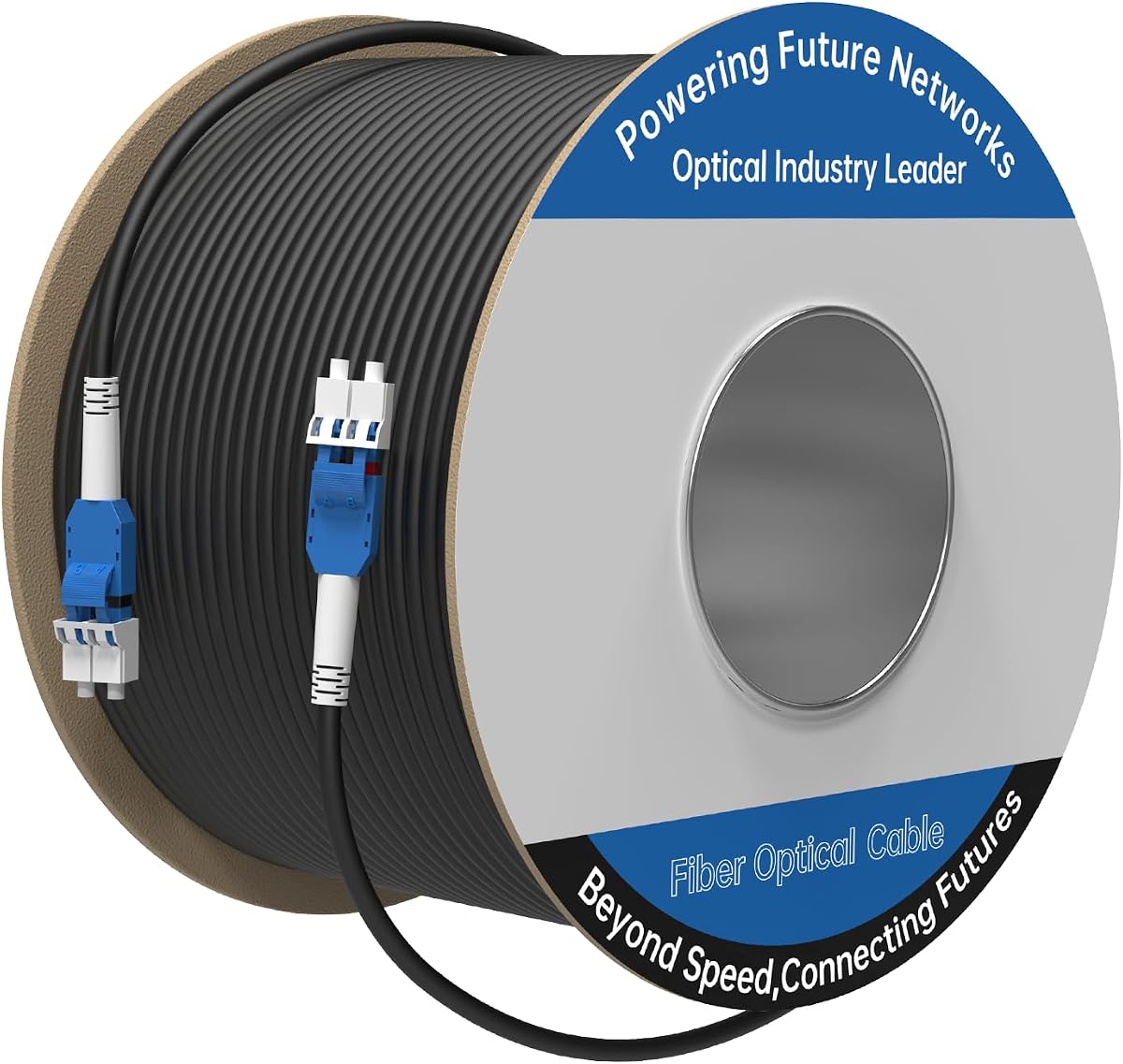
This two-strand OS2 spool offers a focused duplex option for buyers who need long-distance singlemode cable without paying for unused fiber capacity. It has a supplied rating of 2.9, and its 1000-foot spool uses G.652.D-compliant 9/125 singlemode fiber.
We may earn a commission when you buy through this link, at no additional cost to you.
The black riser-rated jacket is described as suitable for indoor riser and outdoor environments, with resistance to moisture, UV exposure, and environmental stress. Aramid yarn strength members support flexibility and durability, while tight buffering makes the two fibers easier to terminate.
The limited strand count is the defining tradeoff. It supports bidirectional point-to-point communication but leaves little room for additional channels or future growth without adding another cable. Its low supplied rating also warrants reviewing recent customer feedback and verifying specifications with the seller.
Best for a straightforward building link, ISP backbone, FTTH connection, or data center route where two fibers are sufficient. It is a sensible value-oriented bulk option for installers who can plan around a duplex architecture and need singlemode reach.
Two 9/125 OS2 fibers provide full-duplex capability with low attenuation over long routes. This focused configuration can reduce material waste when the installation has no realistic need for additional strands.
A 1000-foot spool supports multiple cuts, conduit routes, or spare service loops. Aramid reinforcement and tight buffering help the cable remain manageable during installation and termination.
We may earn a commission when you buy through this link, at no additional cost to you.
This twelve-strand armored OS2 distribution cable is the most feature-rich bulk backbone in the group. It uses Corning SMF-28 Ultra bend-insensitive optical fiber, comes on a 500-foot spool, and is designed for indoor and outdoor networking applications with up to 10Gbit transmission.
We may earn a commission when you buy through this link, at no additional cost to you.
Its twelve strands provide substantial capacity for enterprise backbones, data centers, audiovisual infrastructure, campus networks, and other multi-service pathways. Armoring adds mechanical protection, while bend-insensitive fiber can simplify routing around tight spaces and reduce sensitivity to installation handling.
No numerical customer rating was supplied, so the product's appeal here comes from its stated construction rather than a verified rating. The 500-foot spool is also shorter than the 1000-foot options, and buyers with extensive routes may need to account for additional material or spool inventory.
This is a premium selection for organizations that value a high strand count, established Corning fiber, and armored distribution construction. It is well suited to long-term infrastructure where capacity and installation flexibility justify a more specialized cable design.
Twelve fibers can support multiple backbone links, multiple services, or a combination of active and spare pathways. This makes the cable especially useful where future expansion is likely but replacing buried or concealed cable later would be difficult.
Corning SMF-28 Ultra fiber is designed to tolerate tight routing while maintaining dependable singlemode performance. The bend-insensitive characteristic can be particularly helpful in structured cabling pathways and complex building transitions.
Combining armoring with a riser-rated black jacket supports demanding outdoor and building distribution paths. The complete installation should be assessed for soil, moisture, UV, fire performance, and local code requirements.
We may earn a commission when you buy through this link, at no additional cost to you.
Choosing bulk outdoor fiber optic cable requires matching the fiber category, environmental rating, mechanical protection, capacity, and length to a specific route. The following factors help prevent costly mismatches between cable construction and network requirements.
Multimode fiber uses larger light-carrying cores and is generally appropriate for short-range links within buildings, campuses, and data centers. Singlemode OS2 fiber is the better direction for long-distance telecom, campus backbone, and building-to-building routes. The listed multimode options use either 50-micron or 62.5-micron cores, while the singlemode selections use 9/125 construction with OS1/OS2 or G.652.D references. Transceivers must match the selected fiber category for reliable operation.
A duplex route needs two fibers for bidirectional communications, while six-strand and twelve-strand cables provide additional active or spare pathways. Extra strands can be valuable where several services share a route, expansion is expected, or replacing cable later would be expensive. A two-fiber spool is more economical for a single point-to-point link, but it offers less room for growth. Count both required channels and sensible spare capacity before choosing.
Riser-rated cable is designed for vertical pathways such as trays, risers, and elevator shafts where flame propagation must be controlled. Plenum-rated cable serves environments with different fire and smoke requirements and should only be used where the complete pathway and local code permit it. Indoor and outdoor jackets add moisture and UV resistance, but that wording does not necessarily mean the cable is rated for direct burial. Check the jacket classification against the installation rather than relying on a broad indoor and outdoor description.
Armored cable adds resistance to crushing, pulling stress, rodents, abrasion, and other physical threats. It is especially relevant for direct burial, roadside trenches, industrial campuses, and routes exposed to heavy foot or vehicle traffic. Unarmored bulk cable can still work well in protected conduit or interior pathways, but it may need additional safeguards. Compare armor type, overall diameter, jacket thickness, and bend radius because a thicker assembly is not automatically suitable for every conduit.
A 1000-foot spool offers room for many custom cuts, service loops, and multiple routes, but buyers should account for termination length, splice allowance, pulling slack, and future repair access. Pre-terminated 328-foot and 656-foot assemblies simplify deployment but may not match irregular route lengths. Larger spools are not automatically more efficient if unused material becomes waste. A measured route plan and realistic installation allowance are more useful than choosing by spool size alone.
Bulk spools require a plan for paying out, pulling, supporting, cutting, and terminating the fibers. Pre-terminated patch cables reduce field-termination work and are useful when the route length is known. Pulling eyes, low-friction jackets, and compact uniboot connectors can make difficult installations easier. For bulk cable, also verify whether the reels can be positioned safely, whether a proper jacket is required, and how the cable will be supported outdoors and at transitions.
Fiber is sensitive to sharp bends, excessive pulling force, and tight termination practices. The listed products vary in diameter and construction, with bend-insensitive options available among the singlemode bulk cables. The exact minimum bend radius depends on the fiber and installation context, so installers should follow the applicable manufacturer guidance. Low-friction jackets help during pulling, but they do not eliminate the need to observe bend limits, avoid cable kinks, and secure the assembly properly.
LC-terminated assemblies must match the ports and adapter types used by the connected network equipment. Singlemode and multimode transceivers should not be interchanged simply because their connectors look alike. LC uniboot designs can reduce panel clutter, while supplied couplers may help extend or connect certain assemblies. Before ordering, confirm wavelength support, transmission distance, connector gender where relevant, polarity requirements, and the operating system support of connected transceivers.
Begin with a complete route survey that records the actual length, pathway type, elevation changes, bends, junctions, and termination locations. Confirm the jacket rating, fiber category, strand count, and armoring against the environment before paying out the cable. Mark both ends clearly and keep connector dust caps in place whenever a terminated end is exposed.
During installation, use the reel, supports, and pulling equipment intended for the cable's size and weight. Observe the manufacturer's bend-radius and pulling-force guidance, avoid twisting the cable, and keep sharp edges from contacting the jacket. At outdoor transitions, seal appropriate entry points and provide strain relief so cable weight and environmental movement do not transfer directly to the fiber or connectors.
For bulk cable, terminate only the fibers required for service, label each strand, and record the method and loss measurements used during fusion or connector termination. Keep a suitable reel available when possible because proper storage protects the cable from kinks, crushing, moisture, and UV exposure. Inspect terminations, jackets, armor, and pathway supports during maintenance, and replace damaged components rather than masking a poor connection.
Not automatically. An indoor and outdoor jacket may resist moisture and UV exposure, but direct burial also requires suitable mechanical protection and compliance with installation rules. Choose a cable specifically described as direct-burial rated when it will be placed in soil, and verify burial depth, armoring, and local requirements.
OS2 singlemode is generally the better choice for long-distance links, building backbones, telecom routes, and campus connections. Multimode is more practical for shorter connections and equipment designed for 50-micron or 62.5-micron optics. The distance, transceiver type, existing infrastructure, and expansion plan should guide the decision.
A standard full-duplex connection normally uses two strands, one for each direction. Additional strands are useful for spare capacity, multiple services, or growth. Choose six or twelve strands when the same buried or concealed route will need to support more than one connection over its service life.
Riser-rated cable is designed for vertical pathways where flame propagation is a concern, such as risers and elevator shafts. Plenum-rated cable is intended for plenum spaces and has different smoke and fire-performance characteristics. Neither rating replaces compliance with the complete pathway, and outdoor suitability must also be confirmed separately.
Pre-terminated cables are usually faster when the route length is known because they avoid field termination. Bulk spools provide more flexibility for unusual routes and can support several services, but they require careful handling and termination procedures. A factory-terminated assembly may be especially useful when pulling time or connector consistency is the priority.
No. Armoring improves resistance to crushing, abrasion, rodents, and pulling stress, but it cannot compensate for excessive bend radius violations, excessive tension, poor entry sealing, or incompatible connectors. Installation quality remains essential even with a rugged cable construction.
Only if the transceiver explicitly supports that fiber type and wavelength. A singlemode transceiver generally will not operate correctly over multimode fiber, and a multimode transceiver is not a substitute for singlemode equipment. Check the manufacturer's support list before pulling cable or ordering transceivers.
Store the cable in its original reel or a suitable reel, protected from crushing, moisture, direct sunlight, and sharp edges. Maintain the required bend radius and keep the jacket free from twists or kinks. Properly sealing and labeling each reel also simplifies future installation and traceability.
The strongest general-purpose choices depend on project design. The 328-foot OM3/OM4 armored assembly is especially practical for fast, rugged deployment, while the two-strand OS2 spool offers a focused duplex option. The twelve-strand armored OS2 cable stands out for organizations that require high capacity, premium Corning fiber, and future expansion in one backbone route.
Prioritize fiber category before cable features, then match jacket rating and armoring to the actual pathway. Strand count should reflect both current services and realistic growth, while cable length must include pulling, termination, and service-loop allowances. Factory termination can save installation time, whereas bulk distribution cable provides more freedom for custom routes and multiple channels.
Finally, verify connector compatibility, transceiver support, bend-radius requirements, and applicable installation standards before ordering. Ratings and product details can evolve, and prices change over time, so check the current listing, seller information, and technical documentation at the point of purchase.