
Eightwood RG58 BNC Connector Kit
4.5Editor score
Brass connector construction
Supports RG58, RG142, LMR195
Includes ten heat-shrink tubes
Compare the best BNC male crimp connectors for RG58, RG59, and low-loss coax use, comparing cable fit, materials, impedance, signal performance, and installatio
BNC male crimp connectors create dependable coaxial cable terminations for radio, antenna, video, test, and communications equipment. A good connector must match the cable, preserve 50-ohm impedance, secure the center contact, and maintain a consistent mechanical fit. Those details matter far more than a polished appearance.
This guide compares ten connector options by examining stated cable compatibility, impedance, center-contact and shell materials, plating, insulator construction, installation hardware, and intended applications. The list covers RG58, RG59, RG8X, and LMR-family coax choices, with separate attention to signal-loss and standing-wave claims.
Each review identifies the strongest use case and practical trade-offs for a particular connector. Product details and availability can change over time, so readers should verify the current specifications and manufacturer information before purchasing a connector for a critical installation.
4.5Editor score
4.9Editor score
4.6Editor score
The comparison below organizes all ten options by cable fit, stated electrical characteristics, construction, and intended installation role, making it easier to identify the right connector for a specific coaxial system.


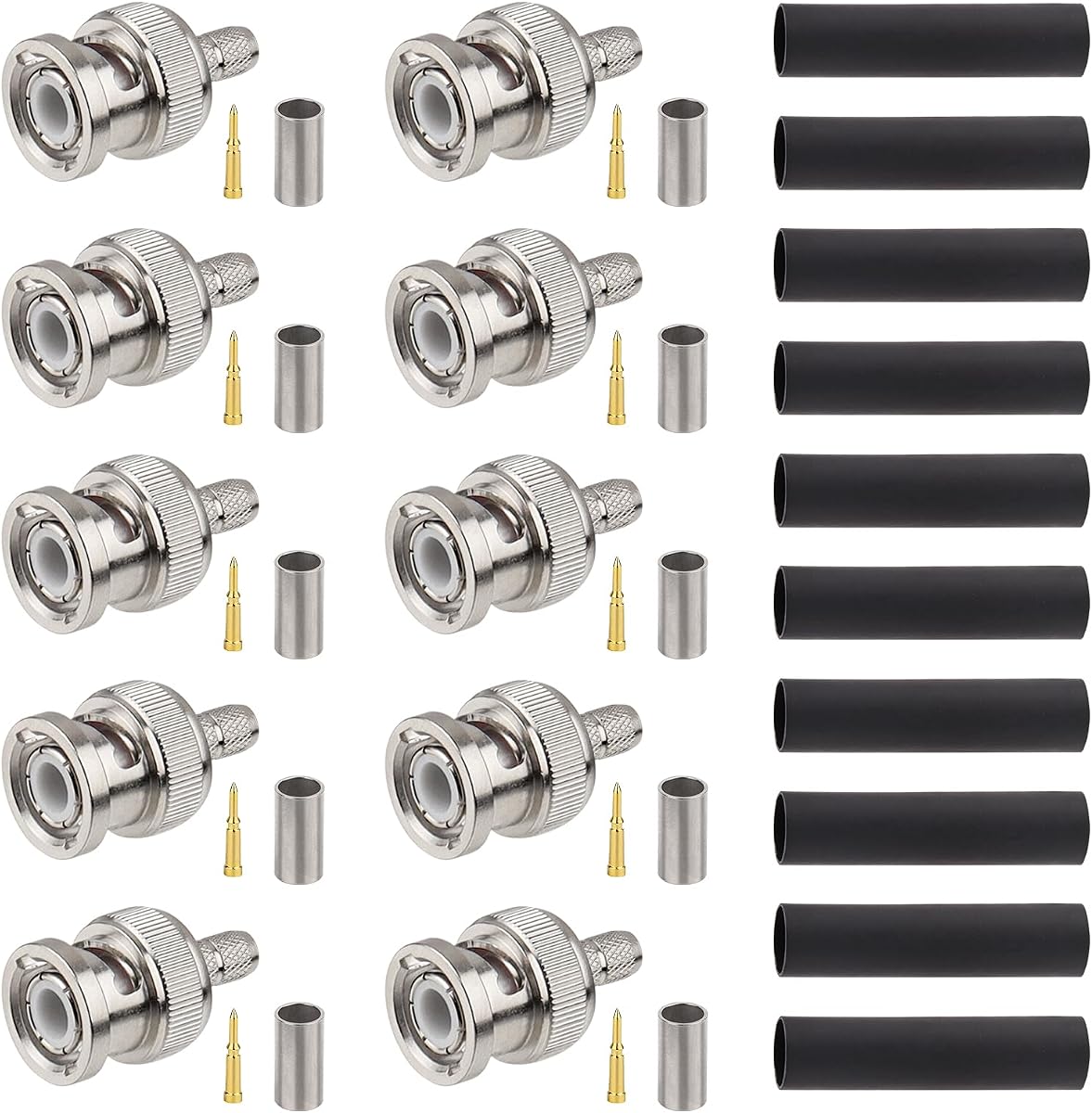
The Eightwood BNC Male Crimp Connector Kit is a straightforward 50-ohm option for installers working with RG58, RG142, or LMR195 cable. Its 4.5 rating reflects a generally favorable reception, while the use of brass rather than alloy gives the package a reassuring mechanical foundation. The ten connectors and matching heat-shrink tubes make it convenient for repeated cable assemblies.
We may earn a commission when you buy through this link, at no additional cost to you.
Its strongest feature is compatibility with three commonly used coax families. That makes the kit useful for antennas, VHF and UHF radio work, CB equipment, scanners, security cameras, oscilloscopes, spectrum analyzers, cable testers, and wireless sensors. Brass components support durability and solid contact, while the supplied heat-shrink tubes add strain relief and environmental protection after the termination is completed.
The trade-offs are mostly about specialization rather than obvious flaws. It is aimed at 50-ohm applications and does not describe detailed attenuation, VSWR, or operating-frequency figures, so buyers with strict high-frequency specifications may want more quantitative documentation. It also would not be the natural choice for thicker RG8X or LMR240 cable, and the 10-pack may be more than a single installer needs.
For hobbyists, technicians, and surveillance installers building a modest number of RG58-style jumpers, this is a practical budget-minded recommendation. It combines broad small-coax support with useful installation extras and avoids the complexity of a specialized RG59 or RG8X connector. Verify the cable dimensions and required crimp tooling before committing to it.
RG58, RG142, and LMR195 compatibility gives this kit broader utility than a single-cable package. It is particularly convenient for radio, antenna, and compact surveillance assemblies using one of those coax standards.
Ten included heat-shrink tubes let each finished cable receive a cleaner protective finish. Properly fitted tubing helps reduce movement at the connector body and adds useful resistance to moisture and handling.
We may earn a commission when you buy through this link, at no additional cost to you.
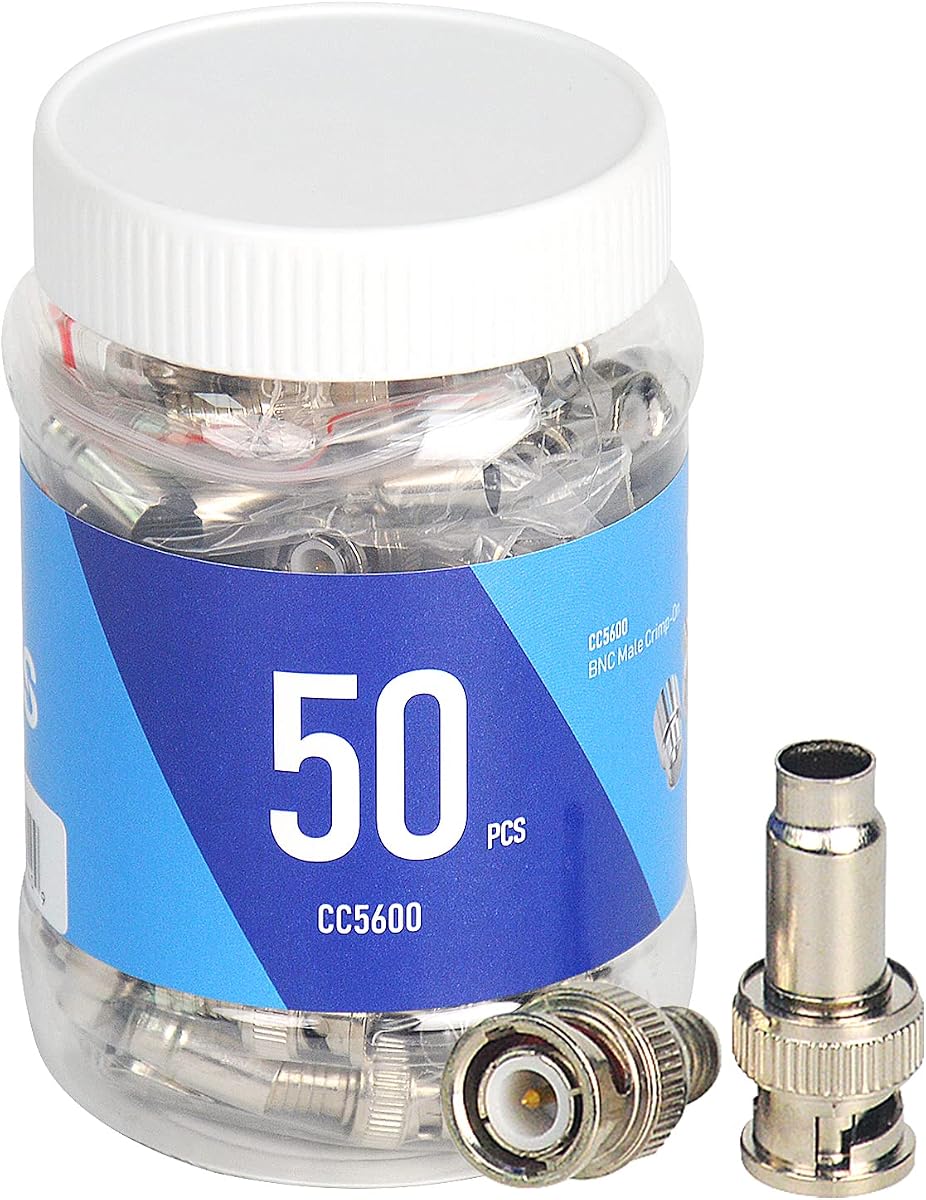
The ENS BNC Male Crimp-On Connector is built around a different job from most entries in this guide: terminating RG59 coax in professional CCTV and surveillance systems. It combines a two-piece crimp-on design with a fifty-piece quantity, giving installers enough connectors for camera runs, extension cables, or maintenance stock. Its 4.6 rating indicates strong user satisfaction.
We may earn a commission when you buy through this link, at no additional cost to you.
The two-piece construction is intended to provide secure, precise termination onto RG59. This is especially relevant for surveillance work where long camera leads may be routed through walls, ceilings, or outdoor environments. The product is presented as a durable option designed to support reliable signal transmission and minimize loss, making it appealing for repeatable professional installations rather than a single experiment.
Its most important limitation is cable specificity. This package is for RG59, so installers using RG58, RG8X, LMR195, or LMR240 need a different connector. The listing does not provide the same level of quantitative frequency, attenuation, or impedance detail found in some competing descriptions, so highly specialized RF engineers may want additional technical documentation before specifying it.
For CCTV technicians and buyers assembling multiple RG59 camera cables, the ENS kit is a strong all-purpose selection. Its large quantity, clear application focus, and crimp-on design offset the lack of broader cable compatibility. Choose it when the installation plan is centered on RG59 surveillance runs rather than mixed radio or antenna work.
Fifty connectors in one package reduce the need to reorder during a larger surveillance job. The quantity is particularly useful for installers handling several cameras, backup stock, or replacement work.
Matching the connector to RG59 is the central advantage for CCTV work. A purpose-fit connector can make the assembly process more consistent when compared with adapting a connector intended for a different coax diameter.
We may earn a commission when you buy through this link, at no additional cost to you.
The MOOKEERF BNC Male Crimp Connector stands out as the most technically detailed option in this roundup. Rated 4.9, it targets 50-ohm RG8X, LMR240, and related low-loss coax while specifying an operating range up to 1,000 MHz. Its stated attenuation below 0.1 dB at 500 MHz and VSWR below 1.15 make it appealing for serious RF jumper construction.
We may earn a commission when you buy through this link, at no additional cost to you.
Construction details reinforce its performance positioning. The center pin uses brass with gold plating, the insulator is Teflon, and the outer shell is copper with nickel plating for oxidation resistance. The listed compatibility extends to RG8X, LMR240, KMR240, 4D-FB, CNT240, and RG8 Mini low-loss cable, providing considerable flexibility among larger coax types.
The tradeoff is that this is not a general-purpose RG58 connector. Its dimensional design is aimed at larger low-loss cable, so using it with a smaller coax type would be inappropriate. Also, a high-performance connector cannot compensate for poor cable preparation, the wrong crimp die, or an inadequately shielded installation.
This is the strongest overall recommendation for radio operators, amateur-radio users, CB builders, and technicians assembling higher-frequency low-loss jumpers. The combination of a 4.9 rating, explicit electrical targets, and premium contact materials gives it a clear edge when its cable family matches the project.
Few competing listings state attenuation, VSWR, and maximum frequency with the same clarity. Those figures give experienced buyers useful context when evaluating a connector intended for RF jumper assemblies.
Gold-plated brass contacts, nickel-plated copper shielding, and a Teflon insulator form a sensible combination for a connector designed to preserve signal quality. The materials also address conductivity and oxidation concerns.
We may earn a commission when you buy through this link, at no additional cost to you.
The XRDS RF RG58 BNC Connector is a versatile ten-piece package supporting RG58, LMR195, RG400, RG142, and 3D-FB coax. Its 4.6 rating makes it one of the stronger-rated choices, while the broad cable list gives it appeal for both RF and video communication projects. It is designed as a general cable-mount solution rather than a niche one-cable package.
We may earn a commission when you buy through this link, at no additional cost to you.
The outer shell uses copper with nickel plating for corrosion resistance, and the inner needle uses gold-plated brass for conductivity. A locking BNC mechanism supports stable attachment, which is valuable where vibration or repeated unplugging could loosen an ordinary connection. The stated applications include telecommunications, video surveillance, RF systems, and antenna connections.
Compared with the MOOKEERF RG8X model, this connector offers less quantified performance information. The description mentions low loss, high signal integrity, and minimal VSWR without supplying frequency-specific figures. Because several coax names can correspond to different physical sizes and constructions, installers should also check the actual cable diameter against the connector specification.
This XRDS kit is a good choice for a technician who works with a mixture of smaller coax types and needs one broadly compatible package. It is especially useful for radio, surveillance, and general antenna wiring where the locking interface and plated contacts are more important than a highly specialized connector design.
Support for five cable families reduces connector inventory in mixed-service toolboxes. It is especially attractive when assembling different jumpers from stock RG58, RG142, LMR195, RG400, or 3D-FB cable.
The BNC locking mechanism helps maintain a consistent joint in radio and communications setups. That stability can reduce accidental disconnection during routine equipment changes or cable repositioning.
We may earn a commission when you buy through this link, at no additional cost to you.
The MOOKEERF 10 Pack BNC Male Crimp Connector is a balanced option for small-diameter coax projects. It supports RG58, RG142, RG400, LMR195, KSR195, and 3D-FB cable and has a 4.3 rating. Unlike several generic-looking alternatives, it also provides quantified electrical information, including 0.15 dB attenuation and SWR below 1.2.
We may earn a commission when you buy through this link, at no additional cost to you.
Its center pin is gold-plated brass, the outer shell is nickel-plated copper, and the insulator is Teflon, also known as PTFE. Those materials support stable conductivity, oxidation resistance, and dependable dielectric behavior. The connector is a straight cable-mount male design intended to mate with a female BNC interface.
Its main drawback is that it does not address larger RG8X or LMR240 cable. The stated attenuation is also higher than the figure given for MOOKEERF's RG8X-focused model, although real performance depends on the entire cable and installation. The 4.3 rating is positive but trails the strongest options in this guide.
For installers who want several small-coax options plus clear performance figures, this kit is a sensible middle ground. It is well suited to radio, scanners, test equipment, and antenna jumpers when the selected cable appears in the compatibility list.
The stated attenuation and SWR values make this listing easier to compare with technically oriented products. Buyers can assess the connector on measurable criteria rather than general claims about signal quality.
Six supported cable names cover several common workshop stocks. The ten-piece quantity is large enough for repeated projects without creating an unnecessarily large inventory.
We may earn a commission when you buy through this link, at no additional cost to you.
The XRDS RF RG8X BNC Male Connector is tailored to larger low-loss coax used in radio and antenna installations. It supports RG8X, LMR240, CNT240, KMR240, Mini8, Belden 9258, and 4D-FB cable, with a 4.2 rating. The package includes ten connectors plus compression sleeves and heat-shrink tubes for completing the termination.
We may earn a commission when you buy through this link, at no additional cost to you.
Its construction follows the pattern of quality RF connectors: nickel-plated copper for the outer shell, gold-plated brass for the inner needle, and Teflon as the insulator. The stated design goals include strong shielding, impedance matching, and minimal signal loss. Applications include CB and ham radio equipment, antennas, and broader RF communication systems.
The listing does not supply precise attenuation, VSWR, or frequency limits, making it less analytically detailed than the MOOKEERF RG8X option. The 4.2 rating is respectable but not among the strongest here. As with all larger-coax crimp connectors, the appropriate die and preparation of the cable's center conductor and braid are essential.
This kit is a good choice for builders assembling CB radio, amateur-radio, or antenna jumpers from the supported low-loss coax types. Its included sleeves and tubing add convenience, while the broad compatibility list helps standardize a workshop around one connector family.
Compression sleeves and heat-shrink tubes are included with the ten connectors. This makes the package more practical for repeatable terminations than a bare connector set.
The supported RG8X and LMR240 families are common in higher-power and longer RF runs. Matching the connector to this cable class is essential for both mechanical security and electrical consistency.
We may earn a commission when you buy through this link, at no additional cost to you.
The Anina 10-Pack BNC Male Crimp Connectors are a well-reviewed choice for RG58-style assemblies, with a 4.7 rating. The package includes connectors, individual gold pins, sleeves, and heat-shrink tubing, presenting a more complete termination kit than options that supply only the connector body.
We may earn a commission when you buy through this link, at no additional cost to you.
A reinforced alloy lock ring is paired with a brass body and copper contacts. The locking ring is intended to withstand repeated wear, while the contact materials support stable 50-ohm conductivity. Individual heat-shrink tubes can seal the finished termination against moisture and mechanical strain, an attractive feature for outdoor CB radio and security camera work.
The product information is emphatic about precise RG58 fitting and lists RG142 and LMR195 compatibility, with RG400 also mentioned in the description. Because the title focuses on RG58 and the broader claims use less consistent wording, checking physical dimensions before crimping is sensible. The listing also does not provide numerical attenuation or frequency figures.
This kit is a strong candidate for installers who want protection and assembly pieces organized in one package. It works particularly well for compact coax jumpers, surveillance connections, RF test equipment, and applications where strain relief after the connector is installed matters.
Gold pins, sleeves, tubing, and connector bodies are included in the kit. This reduces the chance of discovering a missing component midway through a cable-building session.
Heat-shrink tubing creates a protective barrier around the termination area. That added layer is useful for outdoor installations and cables that will be moved, routed, or exposed to changing conditions.
We may earn a commission when you buy through this link, at no additional cost to you.
The Fanbalunke BNC Male Connector is a basic 16-piece set for RG58-style cable assemblies. Its 4.0 rating indicates positive but less emphatic user feedback than the leading products. The connector supports RG58, RG142, and LMR195 coax and is designed for common 50-ohm RF applications.
We may earn a commission when you buy through this link, at no additional cost to you.
Potential uses include antennas, VHF and UHF radio, CB equipment, amateur-radio work, scanners, oscilloscopes, spectrum analyzers, cable testers, and wireless sensors. The straight cable-mount format is conventional and familiar, allowing an experienced installer to work efficiently when familiar with the correct crimp tooling and connector dimensions.
The description does not provide numerical attenuation, VSWR, or operating-frequency information, so it offers less guidance for demanding high-frequency work than several competing kits. It also does not mention included heat-shrink tubing. Buyers needing environmental sealing or quantified performance may prefer a more fully documented alternative.
Its value lies in quantity and simplicity. For schools, clubs, repair benches, or installers producing numerous small coax jumpers, sixteen connectors provide useful stock at a straightforward specification. Choose it when the priority is a familiar RG58-family connector rather than an extensive performance specification.
Sixteen connectors support batch production or repeated maintenance work. The package is well suited to clubs, training environments, and technicians who prefer keeping spare terminations close at hand.
The listed applications cover many common radio and test tasks. Its familiar cable-mount design makes it a practical option for technicians already experienced with BNC terminations.
We may earn a commission when you buy through this link, at no additional cost to you.
The Generic 50 Ohm BNC Male Crimp Connector is a compact ten-piece option with a 3.7 rating. Its clearest distinguishing specification is the total connector length of 23.6 millimeters, alongside support for RG58, RG142, and LMR195 cable. Those dimensions can help installers plan connector clearance in tight equipment spaces.
We may earn a commission when you buy through this link, at no additional cost to you.
The housing is described as aluminum alloy with nickel plating, while the contact uses pure copper for conductivity. The listing emphasizes easy installation without tools during the connector-handling stage, although a cable-mounted crimp connector still requires appropriate cable preparation and a compatible crimping method.
This entry has the lowest rating in the roundup, and it offers no numerical frequency, attenuation, or VSWR figures. Aluminum alloy may also be less reassuring for buyers who prioritize the mechanical reputation of brass or copper-based shells. The installation wording should be interpreted carefully because secure crimping still requires the correct process and tooling.
Its compact stated length is the main reason to consider it. Installers working with limited clearance may value that detail more than extensive specifications. For straightforward RG58-family jumper construction, it can be a functional choice, though the MOOKEERF and XRDS alternatives provide stronger material or application information.
At 23.6 millimeters, the connector is described as relatively short. That specification can help when the BNC plug must fit into a recessed panel or a crowded equipment enclosure.
The connector is intended to make termination predictable for familiar coax work. Buyers should still confirm the correct die and ensure the center conductor and braid are prepared consistently.
We may earn a commission when you buy through this link, at no additional cost to you.
The DIYSecuritycameraworld Professional RG59/BNC Male Crimp-On Connector is a bulk package of 50 pieces designed specifically for RG59 coax. It has a 4.5 rating and a clear surveillance-camera orientation. The listing is concise, identifying the connector type, cable, quantity, and the required RG59/6 crimping tool.
We may earn a commission when you buy through this link, at no additional cost to you.
Its fifty-piece quantity makes it practical for large camera installations, long service histories, or a workshop that prefers keeping substantial connector stock. The crimp-on male BNC format is appropriate for creating custom coax lengths instead of relying on a limited selection of prefabricated leads.
The obvious constraint is its narrow RG59 focus. It is unsuitable for RG58, RG8X, LMR195, and other coax families without a different connector. Buyers also need an RG59/6 crimping tool, and the listing provides no detailed attenuation, impedance, frequency, or plating specifications.
This connector is best recommended to security-camera installers already working with RG59 and compatible tooling. The large quantity and specialized purpose make it an efficient choice for repeated CCTV terminations, while its limited technical detail means technically demanding RF buyers should examine the product closely before using it in specialized systems.
Fifty connectors provide a practical reserve for multi-camera installations and replacement stock. This reduces interruptions caused by running out of connectors during a larger wiring project.
The specified RG59/6 crimping tool must match the connector's ferrule and body. Using the wrong die can weaken the mechanical grip and compromise the integrity of the termination.
We may earn a commission when you buy through this link, at no additional cost to you.
Choosing a dependable BNC crimp connector requires matching the connector to the exact coax family, considering the installation environment, and reviewing the stated electrical and material specifications.
Cable compatibility should be the first filter because BNC connectors are not automatically interchangeable among every coax type. The eight products marketed for RG58-family work support combinations of RG58, RG142, LMR195, RG400, or 3D-FB cable, while the ENS and DIYSecuritycameraworld options focus on RG59. The MOOKEERF and XRDS RG8X kits are intended for larger low-loss cable such as RG8X and LMR240. Because product names can describe equivalent or similar cable types rather than exact physical dimensions, compare the connector's stated cable range with the cable in your possession. A connector that looks mechanically similar can still be too large or too small for the braid, dielectric, center conductor, and crimp ferrule.
Choose the connector explicitly listed for your cable, then verify any manufacturer dimensions before crimping.
Most BNC installations in this category are described as 50-ohm systems. The Eightwood, ENS, MOOKEERF, XRDS, Anina, Fanbalunke, and generic options all identify 50-ohm use, matching common applications involving radio antennas, scanners, surveillance cameras, and test equipment. A nominal 50-ohm connector cannot compensate for a mismatched cable, an improperly prepared termination, or a device designed for a different impedance. Since BNC interfaces also appear in 75-ohm video contexts, installers should verify the complete cable and equipment system rather than relying on connector shape alone.
For 50-ohm RF systems, use a connector explicitly rated for that impedance and confirm that the coax matches.
The center contact and outer shell directly influence conductivity, mechanical strength, and corrosion resistance. Gold-plated brass contacts appear in the MOOKEERF, XRDS, and Anina options, while the Eightwood emphasizes a brass body. Nickel plating over copper is a common approach for shielding and oxidation resistance, and the generic option uses nickel-plated aluminum alloy with a pure-copper contact. Material alone does not guarantee performance, but it provides useful context alongside construction quality and dimensional design.
Prefer plated brass or copper contacts for demanding RF work and confirm that the shell is built for the cable's diameter.
Quantified performance figures are useful when the installation has meaningful signal-integrity or frequency requirements. MOOKEERF's RG8X model states an operating range up to 1,000 MHz, attenuation below 0.1 dB at 500 MHz, and VSWR below 1.15. Its smaller-cable model lists 0.15 dB attenuation and SWR below 1.2. Other products emphasize low loss, minimal VSWR, shielding, and impedance matching without providing equivalent numbers. A lack of specifications is not proof of inferior performance, but it gives an installer fewer objective points for comparison.
When specifications are available, compare them directly; otherwise prioritize documented materials, compatible sizing, and a proven application match.
Coax names alone do not capture every construction detail. RG58, RG142, LMR195, RG400, 3D-FB, RG8X, and LMR240 can differ in center-conductor size, dielectric, braid diameter, jacket thickness, and overall impedance. A connector that supports several names is advantageous only when it has been designed to accept the relevant jacket and ferrule dimensions. Before buying, measure the cable and compare its structure with the connector's compatibility chart. This is particularly important when adapting legacy cable or working with an off-brand equivalent.
Verify the physical cable dimensions, not just the printed coax designation, before selecting a connector.
A complete package can make repeated terminations faster and more consistent. The Eightwood and Anina kits include heat-shrink tubing, while the XRDS RG8X package includes compression sleeves and heat-shrink tubes. Those extras help with strain relief, sealing, and the finished appearance of a cable. The ENS and DIYSecuritycameraworld products concentrate on connector quantity, while the Fanbalunke package does not list tubing among its included parts. Tooling also varies: the DIYSecuritycameraworld listing specifically requires an RG59/6 crimping tool, whereas other listings provide less detail about their compatible dies.
Check for sleeves, tubing, pins, and the correct crimp die before beginning a termination.
The location and handling of the finished cable can be as important as the connector's internal design. Heat-shrink tubing is useful for reducing strain and limiting moisture exposure, particularly for outdoor radio antennas, CB installations, and security cameras. Indoor test-bench jumpers may need less environmental protection, but they still benefit from a secure crimp and tidy strain relief. Longer routes through walls or ceilings may also need careful bend radius and support so that mechanical stress does not reach the connector body.
Add strain relief and environmental sealing for exposed or frequently handled installations.
Pack sizes range from ten to fifty connectors. A ten-piece kit suits a small workshop or individual installer, while fifty-piece packages suit surveillance installers, clubs, or technicians who want spare stock. Buying a larger pack can simplify workflow, but unused connectors have no value if the selected cable type does not match the installation. Consider the number of completed runs, anticipated rework, and future projects before deciding between compact and bulk packages.
Select a pack size that covers current work and realistic spares without ignoring cable compatibility.
Begin by confirming that the connector is designed for the exact coax type and inspecting the cable, connector, center contact, ferrule, and any sleeves before installation. Strip the jacket and braid to the dimensions specified for the connector, keeping the braid uniform and avoiding nicking the center conductor or dielectric. Properly prepare the center conductor so the contact can sit cleanly without leaving excess wire that may interfere with mating.
Crimp the connector using the correct die and the tool identified by the connector instructions. For the DIYSecuritycameraworld RG59 set, an RG59/6 crimping tool is required. Follow the tool and connector instructions regarding ferrule placement and crimp sequence, since a mechanically correct joint is essential for both signal transfer and pull strength. Avoid repeatedly re-crimping a connector, as this can deform the body or ferrule and produce an unreliable connection.
After crimping, inspect the finished termination and add the supplied sleeves or heat-shrink tubing where applicable. Keep the connector body free of excessive strain, preserve the cable's recommended bend radius, and support long cable runs. Periodically check exposed installations for corrosion, movement, damaged insulation, or a loose mating interface, and replace a questionable termination rather than allowing an intermittent fault to disrupt equipment.
A BNC male crimp connector is a coaxial cable termination that uses a bayonet-style locking interface. The male plug connects to a female BNC port, while the center contact and outer shield are secured to the cable through the connector body and ferrule. These connectors are widely used with 50-ohm RF equipment, antennas, radio gear, and surveillance systems.
No. BNC describes the interface, but crimp connectors can be designed for different coax diameters and constructions. RG58, RG59, RG8X, LMR195, and LMR240 require appropriate connector designs and crimp tooling. Always compare the listed cable compatibility with the actual cable specification and dimensions before purchasing.
In many cases, a connector listed for both RG58 and LMR195 can terminate either cable because the two are commonly related in size and construction. Nevertheless, the manufacturer's compatibility list is the safest guide. Check the jacket diameter, dielectric, braid structure, and required crimp die rather than assuming every similarly named cable will crimp identically.
A compatible coaxial crimping tool is normally required. The DIYSecuritycameraworld RG59 set specifically calls for an RG59/6 crimping tool, and other connector families may require different dies or crimp profiles. Using the wrong tool can produce an insecure ferrule, deform the connector body, or create a poor electrical connection.
Gold-plated contacts can provide useful corrosion resistance and maintain a stable electrical interface in demanding RF applications. Plating is only one part of connector performance, however. Body material, dielectric quality, dimensional fit, crimp integrity, and installation technique also influence reliability and signal transfer.
Voltage standing wave ratio, or VSWR, describes how well an impedance-matched system reflects signal energy. A lower VSWR generally indicates fewer impedance-related reflections and more consistent transmission. MOOKEERF states VSWR below 1.15 for its RG8X connector and below 1.2 for its smaller-cable model, but the complete cable and connected equipment also affect the final measurement.
Use the connector's intended heat-shrink tubing and sleeves where supplied, and ensure the cable entry is sealed and mechanically supported. Avoid leaving the connector exposed to standing water, abrasion, or strain from a heavy cable. Periodic inspection is important because corrosion or movement at the strain-relief point can damage an otherwise sound termination.
Yes, provided the connector is compatible with the selected coax and the cable's impedance matches the antenna and radio equipment. RG58, RG142, and LMR195 options suit many smaller coax assemblies, while RG8X and LMR240 connectors are intended for larger low-loss runs. For critical high-power or high-frequency installations, verify the connector and cable specifications with the relevant equipment documentation.
The strongest all-around selection is the MOOKEERF RG8X kit because it combines a 4.9 rating with explicit frequency, attenuation, VSWR, and material information. The ENS RG59 package leads for high-volume surveillance work, while the Eightwood RG58 set provides a practical budget option with multiple compatible small coax types and included heat-shrink tubing.
Prioritize exact cable compatibility first, then evaluate the stated impedance, contact materials, shielding, dielectric, and assembly hardware. The best connector is not necessarily the one with the broadest description; it is the one engineered for the cable, equipment, frequency, and environment involved in your installation. If detailed RF performance matters, prioritize products that provide measurable specifications and documented compatible cable types.
Product specifications, packaging, and prices can change, so check the current listing before purchasing. Verify the cable diameter, connector dimensions, crimp-tool requirement, included parts, and latest product details to ensure that the selected BNC male crimp connector remains suitable for the intended project.