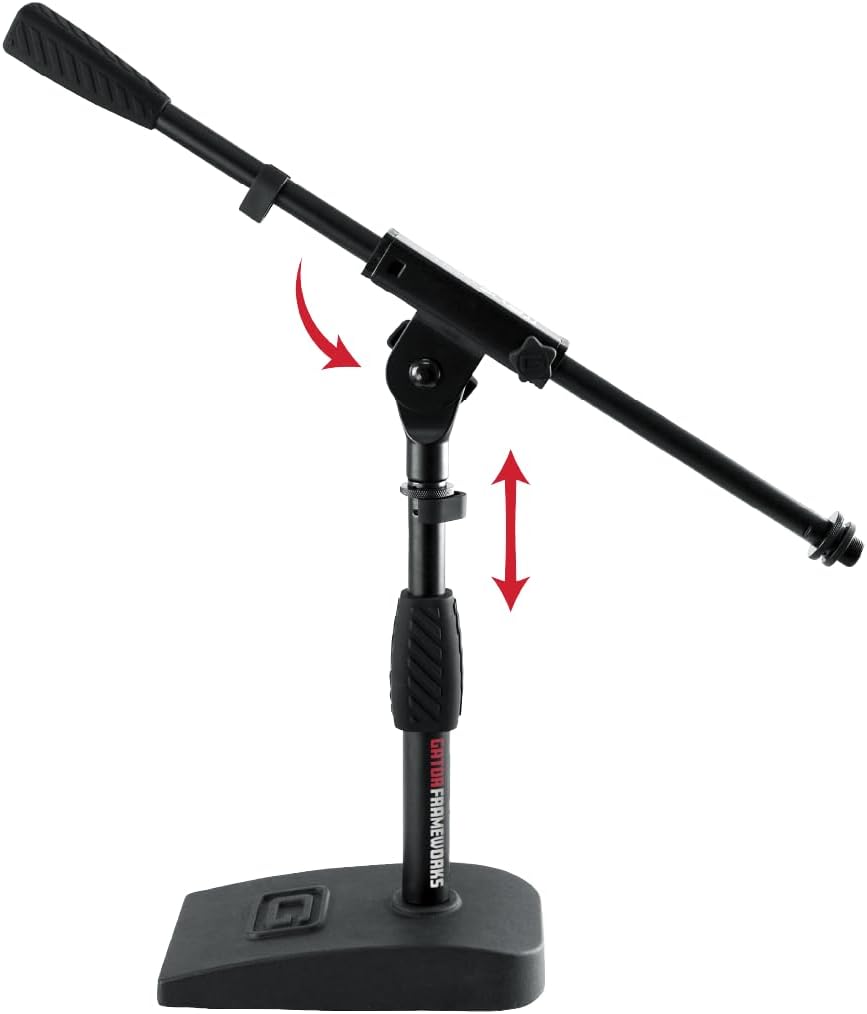
Gator Frameworks Desktop Microphone Stand
4.6Editor score
Substantial weighted desktop base
Long 16-inch positioning boom
Heavy-duty steel construction
A bass drum mic stand must do more than hold a microphone. It should place the mic accurately, resist vibration, protect nearby instruments, and remain stable without interfering with pedals or other stage hardware. The right choice depends on your setup, available floor space, desired reach, and whether the stand will be moved regularly.
We compared all ten options by examining their bases, height ranges, boom mechanisms, mounting threads, portability, vibration-control features, and suitability for kick drums and amplifiers. The list includes weighted desktop models, low-profile tripods, foldable stands, and two-pack bundles for users who need multiple positions or backup equipment.
Each review highlights the most useful features, practical limitations, and likely applications of its featured product. The top picks demonstrate particularly convincing combinations of stability, reach, adjustability, and versatility. As with all product listings, specifications and availability can change, so readers should verify current details before purchasing.
4.6Editor score

4.6Editor score

4.7Editor score
As an Amazon Associate we earn from qualifying purchases.
The comparison below highlights the principal differences among desktop stands, low-profile tripods, weighted bases, telescoping booms, and multipack options. It is designed to make it easier to identify the right combination of stability, reach, portability, and mounting compatibility for kick drum and amplifier recording.


The InnoGear Adjustable Desk Microphone Stand is our most balanced overall choice for bass drum and amplifier miking. It carries a 4.6 rating and combines a sturdy weighted base, a soft-grip twist clutch, and an independently adjustable boom arm. Rather than relying on one oversized feature, it offers the core qualities needed to place a microphone accurately around a kick drum, amp cabinet, snare, or tom.
We may earn a commission when you buy through this link, at no additional cost to you.
The heavy-duty powder-coated base is fitted with a rubber gasket that helps absorb vibration and maintain balance. Height adjusts from 11 to 15.8 inches, while the boom can be extended and angled independently. The stated maximum load is 4.4 pounds when the boom is extended halfway, which is important because positioning a dynamic bass microphone near a resonant shell can expose weak stands to noticeable energy. A 3/8-inch female-to-5/8-inch male adapter broadens compatibility with standard microphone clips.
The main limitation is its desktop scale. It works well on a sturdy platform near a drum kit or cabinet, but it is not a full-height floor stand for reaching over instruments or positioning a microphone high inside a kick drum. The changing load capacity also means the boom should not be extended farther than needed. Those limitations are reasonable for a model designed to provide weighted-base stability in a compact footprint.
This is an excellent choice for home-studio users, rehearsal rooms, podcasters recording an instrument, and live performers who need a stable low-profile option. It can also support common broadcast microphones such as the Shure SM7B, Audio-Technica AT2020, and Blue Yeti. For anyone seeking an adaptable kick drum mic stand without dealing with a full conventional stand, this InnoGear model is the strongest all-around recommendation.
A kick drum and guitar amplifier can transmit substantial low-frequency energy into a support. The powder-coated base and bottom rubber gasket help limit movement and unwanted vibration, giving the microphone a more consistent position when the source is played loudly.
Independent boom extension and angle adjustment make it easier to compare a forward bass mic position with a more distant inside-shell placement. The included thread adapter also allows the stand to work with common clips rather than restricting the user to one microphone fitting.
We may earn a commission when you buy through this link, at no additional cost to you.
The Stage Rocker Low-Profile Microphone Stand is a practical tabletop solution for kick drum, amplifier, snare, tom, and boundary miking. Its 4.3 rating reflects a generally capable design centered on a die-cast weighted base, telescoping boom, and straightforward T-handle adjustment. The included cable holder gives it a practical edge in setups where a loose XLR cable could otherwise pull against the microphone.
We may earn a commission when you buy through this link, at no additional cost to you.
The stand adjusts from approximately 16.54 to 20.87 inches when measured from the bottom of the legs to the mic threads at a 45-degree angle. Its boom extends approximately 8.27 inches, and the molded counterweight helps keep the arm horizontally balanced. Standard U.S. 5/8-inch threads support conventional mic clips, while non-slip feet help with floor vibration, balance, and scratch prevention.
Its primary shortcoming is modest boom reach compared with the AxcessAbles options, which extend up to 34.5 inches. The narrow base also requires a stable surface and enough clearance around the kick drum to avoid contacting the shell, hoops, pedal, or nearby stands. A product with a 4.3 rating may offer slightly less consensus appeal, but the listed construction provides a credible set of features for close-miking work.
Choose this Stage Rocker stand when you need a stable tabletop placement, want the microphone to remain close to the source, and appreciate a built-in cable-management solution. It is especially useful for guitar amp, bass amp, snare-bottom, keyboard amp, and theater applications. For larger spaces or greater boom reach, one of the extended low-profile tripods would be a better match.
The clip-on cable holder keeps the cable from dropping directly onto the floor or pulling the microphone off axis. That makes this stand particularly useful when a kick mic or amp mic must share a crowded stage area with several other cables.
The midpoint clutch and T-handle allow the height to be changed without searching for a small recessed screw. A molded counterweight helps maintain horizontal boom placement as the microphone is moved around the source.
We may earn a commission when you buy through this link, at no additional cost to you.
The Stage Rocker Foldable Tripod is the most portable selection in this guide, with a 4.6 rating and a listed weight of only 2.6 pounds. It suits mobile musicians, teachers, rehearsal groups, and anyone who needs to place a microphone at a kick drum, guitar cabinet, cajon, or other low source and then move it quickly afterward.
We may earn a commission when you buy through this link, at no additional cost to you.
The tripod has steel-reinforced plastic leg housings, individually adjustable legs, and rubber feet designed to reduce vibration, floor scuffs, and scratches. Its main height range is approximately 9.65 to 16.93 inches, while the telescoping boom extends up to 9.06 inches. The molded counterweight supports balanced horizontal placement, and standard U.S. 5/8-inch threads allow use with standard microphone clips.
Portability creates the obvious trade-off. A lightweight folding tripod cannot match the planted stability of a broad weighted desktop base, especially when a large-diaphragm condenser captures significant vibration. It also provides less boom reach than the taller AxcessAbles models. Those limitations are acceptable for close placement, traveling musicians, and controlled studio or rehearsal environments.
This stand is a strong recommendation for a musician who carries equipment to gigs, practices in changing spaces, or wants a compact alternative to a conventional full-height mic stand. It also works for snare or tom bottom miking, keyboard amplification, and floor use. Buyers placing a microphone very close to a powerful kick drum should favor a heavier weighted model for added resistance to movement.
The collapsible tripod and relatively light structure reduce the burden of carrying a separate stand to rehearsals, small stages, classrooms, and remote recording sessions. Rubber feet also help the folded stand remain considerate of the floor when stored or transported.
The compact height is useful for reaching under a cajon, toward the lower part of an amplifier, or into a kick drum without bringing a full-size stand into the playing area. Adjustable legs help distribute the footprint across uneven surfaces.
We may earn a commission when you buy through this link, at no additional cost to you.
The CAHAYA Mic Stand Desk Adjustable Metal Boom Arm combines a notably heavy base with a convertible design, earning it a 4.6 rating. The 4.4-pound A-frame base is intended to absorb vibration and reduce tipping, while a 0.76-pound counterweight balances the microphone at the opposite end of the boom. That makes it a strong candidate for users who regularly place heavier microphones near active drums or cabinets.
We may earn a commission when you buy through this link, at no additional cost to you.
Height adjusts from 8.7 to 13 inches, and the boom extends up to 10.2 inches while rotating through 180 degrees. The arm can be detached and combined with the included microphone clip to create a straight desktop stand. Two clip types are supplied, and the stand fits microphone diameters from 0.98 to 1.38 inches using the standard 5/8-inch adapter. Foam pads under the base help protect a desktop from scratches.
The most notable caveat is that the maximum stated capacity of 8.8 pounds applies with the arm half-extended. Extending the boom farther changes leverage and can increase the likelihood of sag. The substantial base also takes up meaningful desk area, and the 3/8-to-5/8-inch adapter must be removed with a coin using the described groove. Users who need a clean setup should check the available surface area before buying.
CAHAYA is ideal for a home studio where a kick drum is recorded through a close mic, for guitar amplifier capture, and for podcasters who want to alternate between boom and straight configurations. It is also useful for hand drums, tongue drums, and speakers. The detachable arm and high counterweight balance make this one of the more flexible desktop stands in the roundup.
The end-mounted counterweight offsets the pull of the microphone and helps keep the boom from settling downward. This is particularly useful when the user alternates between a close kick drum position and a more extended amplifier position.
Removing the boom converts the product into a straight microphone stand, allowing the user to adapt the footprint to a smaller recording area. Two clip styles improve compatibility with different cylindrical and tapered microphone bodies.
We may earn a commission when you buy through this link, at no additional cost to you.
The Stage Rocker Two-Pack provides two complete low-profile microphone stands, making it a convenient option for recording a kick drum and amplifier at the same time, maintaining separate studio and stage setups, or keeping a spare close-miking stand nearby. Both stands share the same 4.3-rated design, including die-cast weighted bases, telescoping arms, molded counterweights, and clip-on cable holders.
We may earn a commission when you buy through this link, at no additional cost to you.
Each unit adjusts from approximately 16.54 to 20.87 inches when measured to the mic threads at a 45-degree angle. The boom extends around 8.27 inches and uses a T-handle for quick changes. Standard U.S. 5/8-inch threads support conventional microphone clips, while the non-slip base feet help limit vibration and protect the floor. The included cable holders keep signal cables organized around both positions.
The primary drawback is storage and transport. Two stands with rigid weighted bases take considerably more room than a single folding tripod, which may matter for small rehearsal rooms, mobile performers, or users with limited vehicle space. The relatively short boom also does not offer the reach of the AxcessAbles models. For close placement, however, reduced reach can be beneficial because it keeps the microphone near the source.
This bundle is best for a drummer who wants separate kick and amp positions, a home studio owner producing multiple instrument tracks, or a band that wants a backup stand with the same low-profile design as its primary unit. It is less compelling for a solo user who only needs one position, but it simplifies the decision by supplying matching stands with separate cable management.
Two identical low-profile stands are useful when a kick drum and guitar or bass cabinet require different heights or placements. Matching hardware also keeps the visual footprint consistent and avoids mixing incompatible adjustment styles.
Each boom includes a clip-on holder, allowing signal cables to follow the arm rather than falling toward the floor. In a two-microphone session, this helps keep the working area more orderly and reduces unnecessary strain on the cables.
We may earn a commission when you buy through this link, at no additional cost to you.
The Gator Frameworks Short Weighted Base Desktop Microphone Stand is our premium recommendation because it combines a substantial desktop base with unusually long positioning reach for a compact stand. It has a 4.6 rating, heavy-duty steel construction, a 16-inch single-section boom, and an extended height capability that distinguishes it from more compact desktop models.
We may earn a commission when you buy through this link, at no additional cost to you.
The base measures 4.5 by 8 inches and incorporates a no-slip gasket to minimize movement and unwanted noise. Height can extend to 23 inches, while the 16-inch boom provides ample room to move a microphone toward or away from a kick drum, amplifier, snare, or other low-frequency source. Compatibility includes popular podcast and instrument microphones such as the Shure SM7B, Shure MV7, RODE Procaster, and RODE PodMic.
As with any long boom, leverage matters. Extending the arm fully can shift the balance of a heavier microphone, and the single-section design cannot break down as compactly as a multi-section telescoping arm. Its large base may also occupy a meaningful section of a desk or platform. Nevertheless, the steel build and weighted foundation make the trade-offs reasonable for a premium desktop configuration.
This Gator Frameworks stand is suited to users who need more reach without moving to a full-size floor tripod. It works particularly well for studio kick drum capture, amplifier miking, streaming, and compact performance setups. Buyers who prioritize durability, a broad base, and a long boom over maximum portability should find this model especially compelling.
The 16-inch boom gives the microphone more lateral freedom than most compact desktop stands. That reach is valuable when comparing positions around a kick shell or across the face of a guitar amplifier without relocating the base to a new surface.
A heavy-duty steel frame and broad 4.5-by-8-inch base provide a planted feel, while the no-slip gasket helps control movement and vibration. The construction also gives the stand a more substantial appearance suited to permanent studio placement.
We may earn a commission when you buy through this link, at no additional cost to you.
The InnoGear Desk Boom Arm Microphone Stand is built around one of the heaviest bases in the roundup. Its 5.4-pound base and thickened EVA protective pad prioritize stability and vibration control, while the removable boom and included adapter make it adaptable for kick drums, amplifiers, snare or tom miking, keyboard amplifiers, broadcasts, and podcasts.
We may earn a commission when you buy through this link, at no additional cost to you.
The main shaft adjusts from 9.84 to 14.57 inches. Stated load capacity reaches 8 pounds in one configuration and 4.4 pounds in another, depending on boom orientation, T-shaft position, and whether the inner tube is retracted. A microphone clip and 3/8-to-5/8-inch screw adapter are included. Compatibility is listed for microphones including the HyperX QuadCast SoloCast, Fifine K669B, Audio-Technica AT2020, Audio-Technica AT2035, Blue Snowball, and Blue Yeti.
The considerable base weight and footprint are the main trade-offs. This is not the most discreet option for a small desk, and the multiple boom configurations may require careful reading of the load guidance. The removable arm is useful, but a larger surface remains preferable to a narrow table. These considerations matter most when positioning a sensitive condenser microphone that can capture unwanted vibration.
This InnoGear model is a strong fit for a home studio, project room, or live setup where a planted base is more important than minimal footprint. It gives the user room to adjust the boom and supports common USB and dynamic microphones. For a permanent desktop installation, it offers an appealing combination of weight, reach, compatibility, and straightforward conversion between boom and straight configurations.
The 5.4-pound base is especially useful near a kick drum, where a lightly supported microphone can pick up cabinet or shell vibration. Its thick EVA pad cushions contact with the supporting surface and helps reduce transmission of unwanted movement.
Removing the boom creates a streamlined straight stand for desktop use, while reinstalling it expands positioning options. The included clip and adapter allow the same base to serve common USB, dynamic, and broadcast microphones.
We may earn a commission when you buy through this link, at no additional cost to you.
The AxcessAbles Low-Profile Microphone Tripod Stand Two-Pack is built for musicians who need considerable reach from a relatively low-profile floor stand. Each unit carries the two-pack's 4.5 rating and includes a telescoping boom that extends from 18.5 to 34.5 inches. The stand height adjusts from 19.7 to 28.5 inches, giving it more positioning freedom than most of the short desktop and tabletop choices.
We may earn a commission when you buy through this link, at no additional cost to you.
Both stands use collapsible tripod bases and include cable-management clips. Each package provides two 5/8-inch adapters for Euro and U.S. mic clip standards, along with reliable metal threads for mounting. The configuration is especially useful for a drummer who wants to place microphones over a kick drum and a guitar or bass amplifier without bringing full-height stands into the stage picture.
The added reach introduces a stability trade-off. Extending the boom farther from the base increases leverage, so careful placement is still necessary around a loud source. The collapsible tripod construction is also less rigid than a wide weighted desktop base, and the two-pack requires twice as much storage space. These are reasonable compromises for users who prioritize reach, portability, and multi-position capability.
This AxcessAbles bundle is a good fit for a working band, rehearsal room, home studio with two instrument positions, or a mobile player who needs a compact floor alternative. It is especially appropriate for kick drum, guitar cabinet, bass cabinet, cajon, and seated instrument miking. Those wanting one fixed desktop stand should examine the single-unit version or a heavier weighted model instead.
A boom that reaches 34.5 inches makes it easier to hover a microphone above a kick drum, extend toward a cabinet, or pull the mic away for a roomier sound. The vertical adjustment adds further control when the source is not directly beside the base.
Matching tripods can serve separate microphones or remain available as a backup during a rehearsal or show. Collapsible legs and included cable clips make the bundle practical for mobile use while helping keep the stage area orderly.
We may earn a commission when you buy through this link, at no additional cost to you.
The On-Stage DS7200B is the simplest and most budget-conscious choice, yet it has the highest rating in the guide at 4.7. Its round weighted base, 9-to-13-inch height adjustment, and standard 5/8-27 threading make it a sensible solution for a short mic position on a desk, table, podium, or low floor surface.
We may earn a commission when you buy through this link, at no additional cost to you.
The black metal finish is designed to resist chips and scratches, while the compact form makes the stand easy to place beside a kick drum, amplifier, snare, or other close-miking source. Because it uses standard mounting threads, it can accept common microphone clips and accessories. That simplicity is valuable for users who do not need an extending boom or complicated clutch adjustments.
The lack of a boom arm is the decisive limitation. The stand offers vertical adjustment but not the same horizontal reach as the Stage Rocker, InnoGear, Gator, or AxcessAbles boom models. It is therefore most appropriate when the microphone can be placed directly above the source or very close to it. Users needing to reach over a drum shell or away from an obstructing instrument will want a boom-style option.
Despite those limits, the On-Stage DS7200B offers strong value for podcasters, streamers, home recordists, and musicians working with a kick or amp on a stable platform. It is a dependable basic stand with a compact footprint and broad accessory compatibility. This is the pick to consider first when the goal is a straightforward mic holder without oversized hardware.
The 9-to-13-inch adjustment range gives a user enough movement for close instrument and voice placement. The straightforward vertical design avoids the leverage and complexity of a long articulating boom.
The round base is designed to fit on desks, tables, and podiums where a full tripod would be excessive. A durable finish helps the stand maintain a professional appearance through regular handling and transport.
We may earn a commission when you buy through this link, at no additional cost to you.
The AxcessAbles Short Microphone Stand combines a low-profile floor format with a boom that extends from 18.5 to 34.5 inches. Its 4.5 rating reflects a practical design for kick and bass drum capture, guitar and bass amplifiers, cajons, and other low sources where the microphone needs more horizontal reach than a basic desktop stand provides.
We may earn a commission when you buy through this link, at no additional cost to you.
The main stand height adjusts from 19.7 to 28.5 inches, giving the user control over vertical placement in addition to boom extension. A collapsible tripod base makes the unit easier to transport and store than a rigid weighted model. The included 5/8-inch adapter supports both Euro and U.S. microphone clip standards, and a cable-management clip helps keep the signal cable organized.
As with any long boom, extending the arm can reduce stability and increase downward force on the microphone. The tripod also lacks the broad, heavy foundation of the Gator, InnoGear, and CAHAYA desktop options. A user who plays a kick drum forcefully should extend only as far as necessary, position the legs securely, and confirm that the microphone clip is securely threaded. The trade-off is fair for the added reach.
Choose this AxcessAbles stand for a compact rehearsal setup, small stage, or studio where the microphone must extend over a source without a full-height stand. It is a particularly good single-unit option for musicians who want the reach of the two-pack without carrying two complete tripods. It also handles seated instruments and amplifier cabinets where horizontal positioning matters.
The extended boom can carry the microphone over a kick drum or toward a cabinet while keeping the stand itself relatively low. This helps conserve stage space and avoids raising the microphone through a high vertical stand.
Collapsible legs simplify transport between rehearsal rooms, studios, and stages. The cable clip gives the microphone cable a controlled route, reducing visual clutter and the chance of snagging the line during a setup change.
We may earn a commission when you buy through this link, at no additional cost to you.
The most useful bass drum mic stand is one that matches the source, placement, and environment. Base weight, boom reach, adjustment range, thread compatibility, and portability should be weighed against the way and where the stand will actually be used.
Prioritize a stable base and the shortest practical boom extension for the intended position.
Choose enough reach for the desired mic position without extending the arm farther than necessary.
Check the full mounted height, including the clip, rather than comparing base height alone.
Confirm both the microphone thread and clip type before selecting a stand.
Look for non-slip feet or a cushioned base when protecting floors and reducing mic movement matter.
Choose folding legs for frequent transport and a weighted base for permanent stability.
Check for cable clips and included adapters to reduce setup time and cable strain.
Choose a multipack for multiple positions and a single unit for a focused one-microphone setup.
Begin by choosing a level, stable surface or clear floor area away from the kick pedal, cymbal stands, cables, and other tripods. Assemble the base fully, tighten each locking point, and place the microphone clip only after confirming that the stand is upright. If the boom is extended, work gradually so the added leverage does not pull the microphone toward the floor.
Attach the microphone by matching its thread to the stand or the supplied adapter, then turn the clip until secure. Position the microphone with the grille and intended axis toward the source, and tighten the adjustment knobs only enough to hold the chosen angle. Route the XLR cable through the cable clip when one is included, leaving enough slack for the boom to move without pulling against the connector.
For storage, retract telescoping sections and loosen clutches before collapsing a folding tripod. Carry weighted desktop stands upright when possible, and protect the base feet and threaded mount from impacts. Periodically check screws, threads, rubber feet, and locking handles, especially after moving the stand between locations or using it with a powerful amplifier or kick drum.
A low-profile stand with a weighted or stable base and a short-to-medium boom is usually the most practical choice. It can place a microphone over the shell or inside the drum without interfering with the pedal or surrounding hardware. Stability matters more than extra reach, so extend the boom only as far as the recording position requires.
It can be, provided the supporting surface is sturdy and the base is properly weighted. The InnoGear, CAHAYA, Gator, and On-Stage options all use weighted bases for this reason. Avoid thin folding tables, place the base on a level surface, and consider a vibration-isolating pad when using a sensitive condenser microphone.
A straight stand works when the microphone can sit directly above the drum or in a fixed nearby position. A boom arm is more flexible when you need to compare different angles, reach over the rim, or move the microphone toward the front head. It also introduces more leverage, so the stand should be weighted and extended cautiously.
A standard 5/8-inch mount is the most common choice in this category, and many stands include adapters for different clip systems. Some desktop models also include a 3/8-to-5/8-inch screw adapter. Verify the microphone's socket, the supplied clip, and the adapter before installation to prevent an incompatible connection.
Yes. Every featured product is described as suitable for amplifier cabinets or closely related instrument applications. A low-profile boom is especially useful for placing a mic near a speaker grille, while a desktop model can work on a stable platform beside the cabinet. Watch the clearance around handles, stands, and signal cables.
Use the shortest extension that places the microphone effectively, because leverage increases as the boom moves away from the base. Fully extending a long boom can cause downward movement or instability. Lock the height and boom controls after positioning, and inspect the connection before recording or performing.
Weighted bases generally resist movement better and are preferable for permanent studio positions, large condenser microphones, and powerful sources. Lightweight folding tripods are easier to carry and can still work well for close miking in rehearsal or stage environments. The best choice depends on whether mobility or planted stability matters more.
A two-pack is useful for separate kick and amplifier positions, stage and studio setups, or backup equipment. A single stand is sufficient when only one source is being captured. Two-pack models provide matching hardware and may include cable management on every unit, but they also require twice the transport and storage space.
The InnoGear Adjustable Desk Microphone Stand is the best overall option because it balances a weighted base, independent boom adjustment, broad thread compatibility, and a manageable desktop footprint. The Gator Frameworks Desktop Stand is the premium alternative for users who want a particularly long boom and durable steel construction, while the On-Stage DS7200B delivers the most straightforward budget setup.
Prioritize stability first, then choose the reach and height that suit the exact microphone position. Desktop stands work well on sturdy platforms and in permanent rooms, folding tripods suit mobile use, and long-boom models help when the microphone must extend over an instrument. Thread adapters, removable arms, cable clips, and multipack configurations should be secondary considerations that support the intended setup.
Product specifications, ratings, and availability can change over time, so confirm the current listing details before buying. In particular, check the dimensions, included adapter, load guidance, and mounting hardware against the microphone and recording area. With those details confirmed, the right bass drum mic stand can provide repeatable placement and a cleaner recording setup.