
Extra Large Solar Automatic Chicken Coop Door
4.7Editor score
Extra-large poultry opening
Four operating modes
Waterproof control enclosure
Horizontal anti-pinch reopening
Remote range up to 165 feet
Our automatic chicken coop door guide compares 10 solar, battery, remote, and timer-equipped models for safety, weather resistance, ease, and flock fit.
An automatic chicken coop door gives a flock consistent access while reducing the daily need to open and secure the enclosure by hand. The best models combine dependable power, programmable scheduling, predator-conscious construction, and anti-pinch protection. A suitable opener must also fit the coop, suit the birds, and function reliably through changing seasons.
We compared all 10 products using the information supplied for each listing, focusing on opening size, power options, automation modes, safety systems, remote range, weather tolerance, installation, and poultry compatibility. The guide covers solar-assisted, battery-powered, dual-door, roll-up, and non-battery designs so owners can compare practical features rather than rely on a single approach.
Each review explains the standouts, limitations, and best-fit owner for the corresponding model, while the comparison table provides a quicker overview. Ratings and specifications reflect the supplied listing data, and product availability, configuration, and prices can change. Buyers should confirm the current listing and physical coop dimensions before ordering.
4.7Editor score

4.8Editor score

4.5Editor score
This side-by-side comparison organizes each automatic chicken coop door by its most consequential design choices: power source, automation, safety response, remote capability, opening size, and weather range. It is intended to make shortlisting faster while preserving the distinctions that matter to different flocks and coop designs.


This model combines a solar panel, rechargeable internal battery, timer, and light sensor in a conventional automatic chicken coop door format. Its 4.4 rating reflects a broadly capable design, while the 8.2-by-9.6-inch opening is intended for chickens and similarly sized poultry. The listing specifically warns that the entrance is not suitable for turkeys.
We may earn a commission when you buy through this link, at no additional cost to you.
Its main strength is flexibility. Solar power supports off-grid operation, and the included charging cable provides a way to replenish the battery when sunlight or weather limits charging. The LCD makes timer and light-sensor settings visible, while manual mode provides a direct alternative if automatic operation is not suitable for a particular day. The stated operating range of -26°C to 60°C also suits a broad range of climates.
The anti-pinch function is especially relevant for owners of small birds. When resistance is detected during closing, the door rebounds for 10 seconds and tries again, while a beep alerts the owner if it does not close fully. The trade-offs are a smaller opening than several extra-large competitors, no listed remote control, and the explicit turkey limitation. The opening also requires clearances in the surrounding chicken mesh.
This is a practical choice for a typical backyard flock that wants solar assistance without a complicated learning curve. Its clear display, selectable operating logic, and weather-resistant aluminum-and-ABS construction make it useful for daily scheduling. Choose it when the opening fits your birds, direct manual access is acceptable, and dependable solar or cable charging is preferred over extended remote operation.
Timer and light-sensor modes let the owner choose between fixed schedules and responses to natural light. The visible LCD reduces guesswork when checking the selected opening and closing conditions.
The anti-pinch retry and audible incomplete-close alert add protection around closing time. Aluminum and ABS components provide a stated operating range from -26°C to 60°C in snow, rain, and dust.
We may earn a commission when you buy through this link, at no additional cost to you.
FarmLite takes a distinctive approach with a non-battery-powered automatic chicken coop door that still supports timer and light-sensor control. The product carries a 4.4 rating and has an approximately 10.5-by-8.5-inch rough opening. Its American-owned brand positioning and stated customer support make it appealing to buyers who value ongoing assistance after installation.
We may earn a commission when you buy through this link, at no additional cost to you.
The infrared motion sensor is the most important feature for flock safety because it is designed to allow birds time to enter before the door closes. Owners can use either a programmed timer or a light sensor according to their schedule and changing seasons. Multiple power options add flexibility, although a 12-volt solar setup is required if the owner chooses solar operation and is not included with the door.
The key trade-off is that the product is described as non-battery powered, so buyers should carefully review the included components and installation requirements before assuming a particular power arrangement. There is also no listed remote control, which may make it less convenient for owners who want status information or operation from farther away. Weather resistance is a clear strength, while the moving parts should still be protected according to the manufacturer's instructions.
FarmLite suits owners who value a sensor-led closing system, flexible scheduling, and support from a US-owned brand. It is especially relevant for a coop with sufficient room for a roughly 10.5-by-8.5-inch opening and for buyers willing to select a separate power arrangement if solar operation is desired. Confirm the exact hardware, solar requirements, and installation dimensions before purchase.
The motion sensor helps the door wait for birds that are still entering. This approach can be more useful than a timer alone when the flock's return time varies.
The non-battery mechanism avoids routine battery replacement in the door itself, while separate 12-volt solar capability offers an off-grid option. The required solar equipment must be obtained separately.
We may earn a commission when you buy through this link, at no additional cost to you.
This solar-powered opener stands out for its remote control, readable angled display, and protected right-angle charging connection. It has a 4.4 rating and an 8.3-by-9.4-inch entrance, placing it in a conventional size range for chickens and other small poultry. The opening is explicitly not recommended for turkeys.
We may earn a commission when you buy through this link, at no additional cost to you.
The remote works within 20 meters, allowing the owner to open or close the door without walking to the enclosure during bad weather or when immediate intervention is needed. The 20-degree upward tilt makes the LCD easier to read in sunlight, which is useful when programming the timer or light-sensor mode. Meanwhile, the bottom-mounted right-angle plug is designed to keep the charging cable out of the birds' path.
Solar charging and the included cable offer two ways to maintain the internal battery, reducing dependence on wired power. Anti-pinch behavior includes automatic reversal and an alarm when the door does not close completely. As with the similarly positioned first-ranked model, the opening is not the largest option, and the remote is shorter-range than products offering 328 or 600 feet.
This model is a good fit for owners who want remote convenience but do not need extremely long wireless reach. It balances solar capability, visible programming, and connection-placement details that are especially relevant around a busy chicken entrance. Verify that the 8.3-by-9.4-inch opening provides enough clearance for the flock and that the remote's 20-meter range covers the intended operating location.
A 20-meter remote gives the owner a way to operate the entrance from a useful distance. It is especially handy during storms, darkness, or when monitoring the flock from another part of the property.
The tilted LCD improves visibility, and the right-angle plug reduces interference with poultry traffic. Solar charging and the included cable provide flexible replenishment options.
We may earn a commission when you buy through this link, at no additional cost to you.
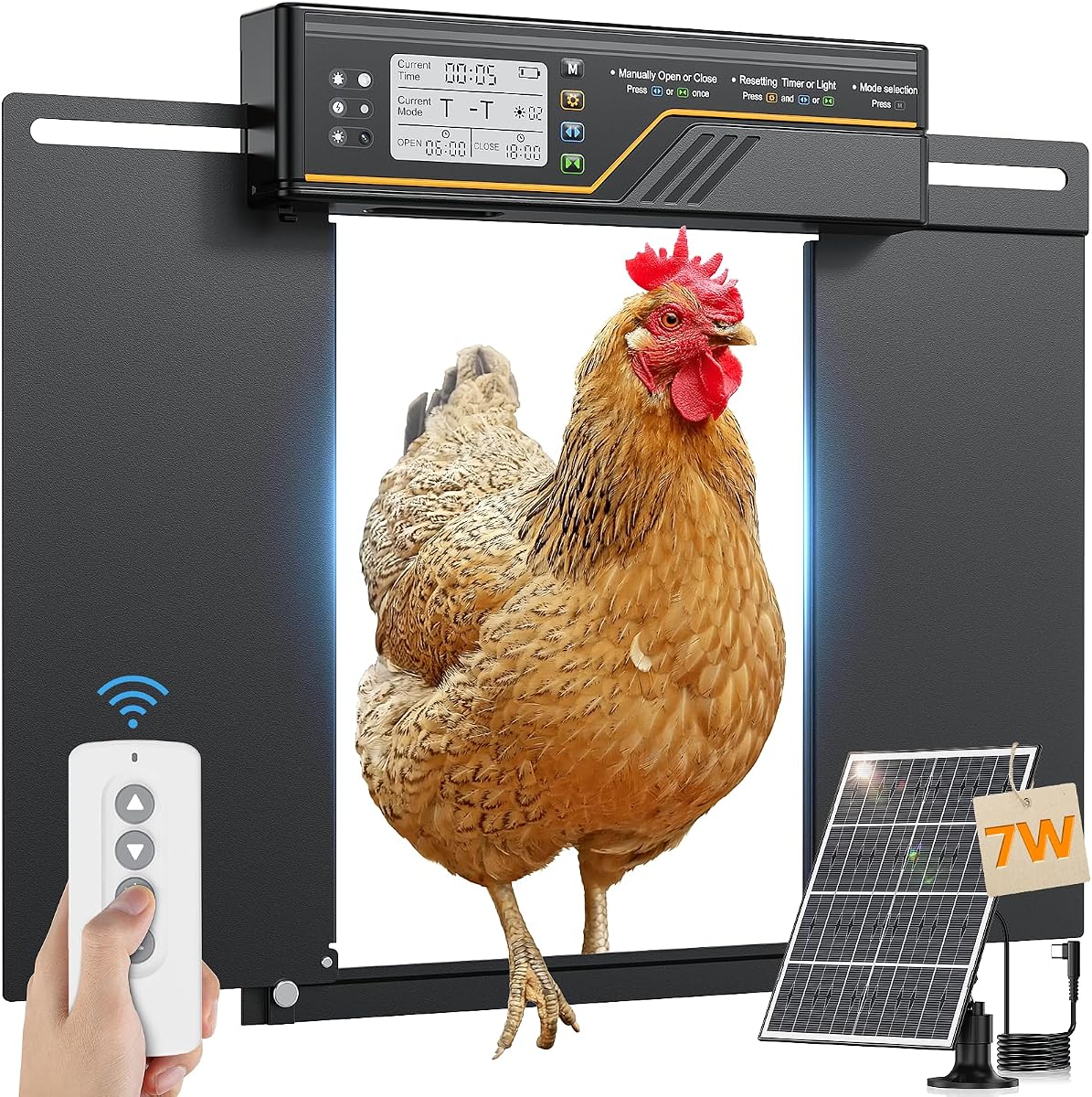
This extra-large solar automatic chicken coop door offers a spacious entrance, a long remote range, and a strong safety response. Its 4.7 rating is among the highest in the group. The listing describes the opening as 20% larger than competing doors, making it appealing for owners of larger chickens, ducks, geese, or any flock that needs more clearance than a compact opening provides.
We may earn a commission when you buy through this link, at no additional cost to you.
Four operating modes cover timer, light control, manual operation, and remote control. The LCD uses simplified graphics to keep settings understandable, while the included USB cable offers a second charging route. During a closing obstruction, the door reopens horizontally for several seconds before continuing. Its waterproof control box and rust-resistant aluminum door are specified for operation from -26°C to 60°C.
The principal drawback is that the listing does not state exact opening measurements, only a relative size claim. Owners need to compare the product physically or obtain precise dimensions before cutting a coop opening. The claim that installation takes no more than five minutes may not match every coop or installer's experience, especially if frame alignment requires adjustments. Those uncertainties are manageable but should be considered before purchasing.
This is our premium choice for a larger flock or a coop that needs generous clearance and long-distance remote control. It balances premium convenience with serious weather and safety features, particularly for buyers who want more than a basic timer. Measure carefully, read the installation instructions, and confirm the final opening size before committing to a layout.
The extra-large opening is intended to reduce crowding and make passage easier for larger birds. Exact dimensions are important, however, so coop measurements should guide the final purchase.
A remote range of up to 165 feet is useful on larger properties when no obstacle blocks the signal. Timer, light, manual, and remote modes cover both routine and immediate control needs.
We may earn a commission when you buy through this link, at no additional cost to you.
The 7W solar roll-up model is the most complete all-around option in this comparison, earning the highest listed rating at 4.8. It combines a 7-watt panel, 4000mAh rechargeable battery, USB-C charging, programmable sensors, and a 65-foot remote. Its 11.8-by-10.6-inch passage is one of the roomier openings and is intended to accommodate chickens, ducks, and geese.
We may earn a commission when you buy through this link, at no additional cost to you.
Timer, light-sensor, combined timer-and-light operation, and remote control provide several ways to manage the daily schedule. The roll-up mechanism saves ceiling space and helps the unit fit coops with limited vertical room. Its detachable components also reduce the space needed for storage. The aluminum construction and stated -4°F to 122°F range support year-round outdoor use.
The anti-pinch system is more developed than a simple one-time reversal. It gently reverses and retries after 10 seconds for up to three cycles, then lifts by 3 centimeters and sounds an alarm on the fourth detection. A roll-up curtain does require care around the track, and the installation instructions warn not to release the strap until the final step because an improperly released curtain may not roll back correctly.
This is our Editor's Choice because it balances opening size, power capacity, operating modes, remote control, and a detailed safety sequence without making any one area feel neglected. It is a strong match for owners of mixed poultry who want a spacious entrance and low-profile mechanism. Review the three-step installation carefully and confirm that the roll-up format suits the available space above the opening.
Instead of immediately forcing a closed position, the door retries several times and then raises with an alarm. That multi-stage response gives birds repeated opportunities to clear the passage.
The roll-up construction preserves vertical space, while solar and USB-C charging give the owner two replenishment methods. A 4000mAh battery adds useful capacity for variable sunlight conditions.
We may earn a commission when you buy through this link, at no additional cost to you.
This model is built around long-distance monitoring and control, with a stated 600-foot wireless connection and a portable controller. It has a 4.2 rating, the lowest numerical rating among the listed products, but its distinguishing features target owners who want to know the door's status from a considerable distance. The controller displays open, closed, or error status alongside battery information.
We may earn a commission when you buy through this link, at no additional cost to you.
A 120-degree motion sensor can detect approaching predators and trigger a deterrent alarm, with the indoor controller also sounding an alert. This adds a monitoring function beyond routine scheduling. The door system uses a detachable 5000mAh battery with solar, USB, or direct charging options, and the controller is stated to last 30 days following a three-hour charge.
Its anti-pinch behavior allows the door to rebound and wait 10 seconds before retrying up to four times, followed by alarms at both the door and controller if the obstruction remains. The trade-offs are meaningful. The exact opening dimensions are not provided in the supplied information, making flock fit harder to assess, and the 4.2 rating is lower than those of the other nine models. The advanced remote and monitoring system may also be unnecessary for a small backyard setup.
This product best fits owners with large properties, a need to monitor predator activity, or a preference for unusually long remote reach. It combines three power routes with a detachable battery and a roll-up, space-saving format. Before buying, request or verify the precise opening measurements and consider whether the controller's monitoring functions justify the added complexity for your particular coop.
The 600-foot connection and status display are intended for owners who are not always near the coop. Real-time open, closed, and error information can make troubleshooting more direct.
A 120-degree motion sensor triggers a deterrent alert, while solar, USB, and direct charging offer three ways to maintain power. The detachable 5000mAh battery supports serviceability.
We may earn a commission when you buy through this link, at no additional cost to you.
This red solar automatic chicken coop door delivers extensive programming in a relatively accessible package. Its 4.5 rating, 328-foot remote range, and six operating modes distinguish it from basic remotes that only open and close. The remote can adjust timing, light sensitivity, anti-pinch levels, schedules, and other settings from up to 328 feet away.
We may earn a commission when you buy through this link, at no additional cost to you.
Four automatic choices include light-sensor, timer, and combined light-and-timer arrangements, with two manual modes for temporary 24-hour use and permanent H mode. A 2000mAh rechargeable battery and included solar panel reduce routine power maintenance. The color LCD is designed for readability from different angles, and the motor operates at a low pitch to avoid unnecessary disturbance around the coop.
The aluminum frame is rated from -40°F to 140°F, a broad range for owners in cold or hot climates. The anti-pinch system reverses the door when an obstruction is detected, waits, and tries again. The main limitations are that the supplied data does not state an exact opening size, so fit must be confirmed separately. Programming six modes and multiple safety settings may also feel more complex than a straightforward timer door requires.
This is our budget pick because it combines solar power, a long programmable remote, flexible scheduling, and a wide temperature rating without relying on the most basic feature set. It is a good choice for owners who want meaningful remote control but do not need the 600-foot monitoring system. Confirm opening dimensions, then set the schedule and safety parameters before introducing the door to the flock.
The remote can change more than the door position, including timing, light sensitivity, and anti-pinch settings. That control is useful for seasonal adjustments without repeatedly visiting the control panel.
A low-pitch motor is designed to operate without disrupting nearby birds. Aluminum construction and a stated -40°F to 140°F range support use across demanding seasonal conditions.
We may earn a commission when you buy through this link, at no additional cost to you.
This extra-large solar remote opener shares a strong feature set with another highly rated option in the group. Its 4.7 rating, four operating modes, and remote range of up to 165 feet make it well suited to larger properties. The entrance is described as 20% larger than competitors, although exact opening dimensions are not included in the supplied listing information.
We may earn a commission when you buy through this link, at no additional cost to you.
Timer, light-control, manual, and remote modes give owners a flexible set of operating choices. A high-efficiency solar panel supports rechargeable batteries, while the included USB cable provides an alternative charging method. The large LCD uses a simplified graphical interface, making operating conditions and programmed settings easier to check during routine setup.
Safety is addressed with horizontal reopening when the door touches a chicken, followed by a pause and another closing attempt. The waterproof control box and full aluminum door are specified for -26°C to 60°C in snow, rain, and dust. The main concern is dimensional uncertainty: a relative size claim cannot replace exact measurements when determining whether the unit will fit the coop and whether the flock can pass comfortably.
This model is a strong choice for owners who want a high-rated, extra-large door with long remote control and flexible scheduling. It may be particularly attractive for larger chickens or mixed flocks. Before installation, verify the actual opening dimensions, panel placement, and available clearance around the horizontal reopening mechanism. Those checks will help ensure the safety system and passage operate as intended.
The extra-large entrance is intended to improve passage for larger birds, while 165-foot remote range supports control across a substantial property. Exact dimensions should still guide coop preparation.
Solar charging keeps the rechargeable batteries topped up, and USB provides a second option. Timer, light, manual, and remote modes adapt to different daily routines.
We may earn a commission when you buy through this link, at no additional cost to you.
The INNOLAND model focuses on a straightforward mechanical design with a reinforced gear drive, a large 11-by-9.5-inch opening, and conventional AA battery power. It carries a 4.4 rating. Rather than depending on solar positioning or a permanent charging cable, it runs for up to six months on three AA batteries, making it appealing for owners who value simplicity.
We may earn a commission when you buy through this link, at no additional cost to you.
Its external gear track is designed to reduce the accumulation of straw, mud, and snow that can contribute to jams. A quick-access maintenance cover and included cleaning brush make servicing easier. The high-contrast display and timer function keep configuration approachable, while the battery-level indicator and twist-lock compartment simplify maintenance.
The integrated sensor stops the door when it detects an obstacle, raises the door by 3 centimeters, and pauses for 10 seconds. It repeats the process three times before leaving the door partially raised and retrying every two hours to conserve energy. The trade-off is that three AA batteries are not included, and alkaline batteries are recommended. There is also no listed remote control or light-sensor operation.
This door is best for owners who want an extra-large opening, straightforward timing, and a power system that does not require solar placement. Its quick battery changes and accessible cleaning points make routine maintenance more approachable. Confirm that periodic battery checks fit your routine, and select alkaline batteries as recommended if you choose this model.
Three AA batteries can power the door for up to six months according to the listing. This removes solar placement concerns, although routine battery monitoring remains necessary.
The external gear track helps keep straw, mud, and snow from creating buildup. A quick-access cover and cleaning brush support routine upkeep in messy outdoor conditions.
We may earn a commission when you buy through this link, at no additional cost to you.
This 7W solar model uses a horizontal dual-door design that creates an 11.6-by-8.6-inch opening. It carries a 4.4 rating and is especially relevant for low-roof coops or structures with limited vertical clearance. The listing states that the horizontal configuration can accommodate larger chickens than a comparable vertical door while also improving the anti-pinch arrangement.
We may earn a commission when you buy through this link, at no additional cost to you.
Light-sensor, timer, remote-control, and manual modes cover routine scheduling and direct intervention. The remote has a stated range of 49.2 feet when no obstacle is present. A large LCD presents the current mode, opening and closing conditions, and battery level, helping owners confirm the configuration without interpreting a complicated interface.
The safety system reacts in 0.2 seconds when it detects even a slight obstacle. Both doors then open simultaneously and horizontally, avoiding the tight closing space associated with some vertical designs. The trade-off is a shorter remote range than many competitors, and the supplied information does not specify battery capacity. The solar design also requires an appropriate panel position with useful exposure to sunlight.
This door is a compelling option for owners with a low-roof coop, larger birds, or a strong preference for horizontal anti-pinch movement. Its 7-watt panel, four modes, and roomy passage provide a capable core feature set. Before ordering, compare the 11.6-by-8.6-inch opening with the birds' needs and check the surrounding space for the full movement of both door panels.
The dual-door layout saves vertical space and is suited to low-roof coops. Both panels move together horizontally, creating a broad 11.6-by-8.6-inch passage.
The safety sensor responds in 0.2 seconds when a slight obstacle is detected. Simultaneous horizontal opening helps remove pinch risk around birds near the entrance.
We may earn a commission when you buy through this link, at no additional cost to you.
The right automatic chicken coop door depends less on added features than on reliable fit, safe closing, adequate power, and a schedule that matches your flock. Use the following factors to narrow the options before comparing final products.
Begin with the physical dimensions of the opening rather than a product category. Products in this guide range from an 8.2-by-9.6-inch entrance to an 11.8-by-10.6-inch passage, while some extra-large models do not provide exact measurements. Account for the birds, not merely the nominal opening: larger chickens, ducks, and geese need comfortable clearance, and the first and third products explicitly warn that their openings are not suitable for turkeys. Also measure vertical and horizontal space around the door, including the direction in which it travels.
Solar charging is common in the group, but it is not the only approach. Options include an internal rechargeable battery with a solar panel, a detachable battery charged by solar, USB, or direct power, three AA batteries, and a non-battery mechanism with optional 12-volt solar equipment. Consider how much sunlight the panel receives, how far the coop sits from a charging point, and whether you are comfortable checking and replacing batteries. A solar panel cannot compensate for an installation that receives heavy shade, and a cable-free design still depends on adequate stored energy.
Timer mode is predictable because the door follows programmed hours. Light-sensor mode follows dawn and dusk, which can better reflect changing seasons. Combined modes offer mixed control, such as opening by light and closing by timer. Manual modes are useful for testing or unusual days. The programmable remote on the six-mode model can adjust timing, light sensitivity, anti-pinch levels, and schedules, while simpler remotes may only move the door. Select the amount of programming complexity that matches your routine rather than assuming every available mode will be used.
An anti-pinch system is one of the most important safety features in this category. The products use several variations: a bounce-and-retry sequence, horizontal reopening, a four-cycle response followed by an alarm, or rapid detection that opens both doors. Pay attention to the described behavior rather than merely the presence of the word sensor. A bird under the door is more likely than a person to encounter the closing edge, so the system should reverse, reopen, or raise the door without trapping an animal. An audible alert is also useful when the obstruction persists.
Remote ranges in this comparison extend from 49.2 feet to 600 feet, but the useful distance depends on walls, buildings, and other obstructions. Some listings qualify the range with a clear line of sight, while the 600-foot model is described as penetrating walls. Decide whether the remote is needed merely for a nearby override or for property-wide monitoring. The 600-foot product also displays door status and battery levels and offers a separate motion-sensor alert, making it more of a monitoring system than a standard remote.
Outdoor doors encounter rain, snow, dust, heat, and freezing temperatures. The stated temperature ranges differ considerably, from -4°F to 122°F for the roll-up model to -40°F to 140°F for the six-mode model. Aluminum construction appears repeatedly and is valued for resistance to rust and warping. Weather resistance is not only about the rated temperature: look for a waterproof control box, an external track that discourages debris buildup, and a cover that allows cleaning without dismantling the system.
Some listings describe installation as a five-minute or ten-minute process, but actual time depends on the coop, frame, and installer's experience. A product requiring only a few mounting screws may still need careful alignment to prevent binding. Roll-up systems save vertical space but include a specific strap-release sequence. Traditional batteries simplify power but require periodic checks, while solar and rechargeable systems need panel placement and occasional cleaning. Look for visible settings, accessible battery compartments, quick-access maintenance covers, and cleaning tools that fit your normal level of upkeep.
A basic timer-and-solar door can handle a stable routine with little programming. A programmable remote, color display, motion detection, and multiple safety responses add convenience but also create more settings to understand. More features are not automatically better for every flock. A small backyard setup may benefit most from reliable solar charging, a clear timer, and a simple obstruction sensor, while owners on larger properties may value long-range status information and instant remote intervention.
Install the unit with the power disconnected. Measure and mark the intended opening, attach the frame according to the supplied instructions, align the door so it moves freely, and position the solar panel where it receives the available sunlight. For roll-up models, follow the stated sequence and do not release the final strap until the frame and curtain are correctly assembled. Connect the battery or charging cable only after the mechanical installation is secure.
Test the mechanism before allowing the flock to rely on it. Run it manually and with the remote, then program the timer or light threshold according to the flock's routine. If a light sensor is used, adjust its sensitivity under the actual dawn and dusk conditions. Place a test obstacle in the closing path only when the unit is empty and follow the manufacturer's safety instructions. Confirm that the anti-pinch sequence opens, pauses, retries, and alerts as described.
During routine care, wipe the sensor and control surfaces, remove dirt from tracks, and inspect the door for alignment problems. Clean the solar panel so dust and debris do not reduce charging. Check battery indicators or test the battery compartment on schedule, and use a charging cable or replace batteries as directed. Review the timer after major seasonal changes, inspect weather seals and moving parts, and keep the entrance clear of straw, mud, snow, and other debris.
Choose an opening that comfortably accommodates the largest birds in your flock, including their feathers and normal movement. The models in this guide include openings from 8.2 by 9.6 inches to 11.8 by 10.6 inches, while some extra-large options do not state exact measurements. Measure the birds, the coop frame, and the area required for the door to travel. Pay particular attention if you keep turkeys, since two products explicitly state that their openings are unsuitable for them.
Solar operation depends on the panel placement, local winter sunlight, temperature, and the unit's battery and motor design. Several products here specify cold-weather operating ranges down to -15°C, -26°C, or -40°C, but the rated range does not guarantee the same amount of daily charging in every climate. Position the panel where it is not shaded, keep it clean, and use a wired charging option when available if extended cloudy weather is common.
A timer is useful when the flock follows a predictable schedule and you want the door to open and close at exact times. A light sensor responds to dawn and dusk, which can track seasonal changes more naturally but may also be influenced by shade, weather, or nearby artificial light. Some products support both, allowing one event to use a timer and the other to use light. The choice depends on the consistency of the flock's routine and the owner's control preference.
Anti-pinch systems detect resistance or an obstruction while the door is closing and respond by reversing, lifting, or reopening the passage. The products differ in the number of retries and what happens if the obstruction remains; some pause and try again, while others raise the door or sound an alarm. The feature should reduce the chance of a bird being trapped, but owners should still avoid leaving loose objects in the doorway and periodically test the system with the enclosure empty.
Most of the wireless remotes in this comparison do not require Wi-Fi. They use dedicated radio control, with stated ranges that vary from roughly 49 feet to 600 feet. The longest-range model also provides a portable controller with door and battery status, while the 328-foot model uses its remote to program settings. Walls, buildings, and other obstacles can affect practical range, so test the signal in the locations where you expect to use the remote.
Several products are specifically described as suitable for chickens, ducks, and geese, but the opening still needs to be large enough for the birds using it. Smaller standard openings are more appropriate for chickens and similarly sized poultry, while extra-large models are intended to accommodate larger birds. Measure the flock rather than relying on species alone, and check the listing for any explicit exclusions or weight guidance before installation.
Inspection frequency depends on the weather, coop debris, and power system. Clean the sensor and tracks regularly, remove straw and mud where they can obstruct movement, and wipe the solar panel so it charges efficiently. Check battery indicators at least according to the manufacturer's guidance and inspect the frame and moving parts for looseness or corrosion. Perform a closer safety inspection before seasonal weather changes or when the flock is younger and more likely to linger around the entrance.
Most of the listed products use mounting screws and are designed for straightforward installation, and several descriptions cite installation times of five or ten minutes. Actual difficulty depends on the coop structure, opening size, alignment, and power arrangement. Follow the supplied instructions, work with the power disconnected, test the door without poultry present, and confirm the opening and travel clearance before relying on the automation.
The 7W solar roll-up door is the strongest all-around selection because it combines a 4.8 rating, a generous opening, dual charging, remote control, and a detailed multi-cycle anti-pinch response. For buyers seeking a premium extra-large format, the 4.7-rated extra-large models offer strong weather protection, flexible modes, and remote control up to 165 feet. The six-mode programmable door stands out as the budget pick because remote programming, solar charging, and a wide temperature range are unusually useful at its tier.
Start with the dimensions and the flock, then narrow the field by safety and power. A small standard opening may be sufficient for chickens, while ducks, geese, or larger birds benefit from extra clearance. Confirm whether the preferred schedule is timer, light, or combined, and decide if remote operation is genuinely needed. Anti-pinch behavior, weather resistance, and accessible maintenance should remain high priorities even when other features stand out.
Before ordering, review the current product listing, included accessories, installation guide, and exact opening measurements. Power configurations and product details can change, and current prices should be checked directly with the retailer. With those checks completed, the right automatic chicken coop door can provide more consistent flock access, safer closing, and fewer demanding chores without compromising the durability required outdoors.