
ELEGOO ESP-32 Dev Boards
4.7Editor score
Dual-core processing at 240 MHz
Wi-Fi and Bluetooth 4.2
USB-C with CP2102
Over-the-air update support
This Arduino WiFi Module guide compares ten options for Wi-Fi, Bluetooth, flash memory, programming ease, expandability, and broad Arduino compatibility.
An Arduino WiFi Module can turn a basic microcontroller project into a connected device capable of exchanging data over a local network, accessing internet services, or communicating wirelessly with nearby peripherals. The best choice depends on board design, wireless capabilities, available memory, programming convenience, and how much room your project has for expansion.
This guide compares ten WiFi modules and boards selected for their relevance to Arduino-based development. The analysis considers processor performance, Wi-Fi and Bluetooth support, flash memory, connection methods, operating modes, voltage considerations, and compatibility with Arduino IDE. It covers both compact ESP8266 modules and more capable ESP32-based development boards.
Each pick highlights a different path for makers: the UNO R4 WiFi offers a polished all-in-one Arduino experience, the ESP32 boards provide flexible connected processing, and the ESP8266 modules remain useful for focused, space-conscious projects. Ratings and availability can change, and current prices should be checked before buying.
4.7Editor score

4.7Editor score

4.4Editor score
The table below compares all ten products by their core wireless platform, memory, programming connection, and best-fit use, making it easier to distinguish a fully integrated Arduino board from a bare module or ESP32 development platform.



The Arduino UNO R4 WiFi is the most complete all-in-one option in this guide. It combines a Renesas RA4M1 ARM Cortex-M4 microcontroller with an ESP32-S3 wireless chip, earning a 4.7 rating in the supplied product data. Unlike a bare module that must be adapted to an Arduino, it arrives as a complete board with USB-C programming, wireless connectivity, expansion options, and an integrated 12×8 LED matrix.
We may earn a commission when you buy through this link, at no additional cost to you.
Its standout feature is the division of work between the two processors. The RA4M1 can handle general-purpose embedded control, while the ESP32-S3 contributes Wi-Fi, Bluetooth 5.0, and substantial connected-processing capability. The board also includes CAN support for real-time communication, a Qwiic connector for I2C peripherals, a 12-bit DAC, an operational amplifier, and modern USB-C. These features make it useful for remote sensors, wireless controls, industrial or robotic communication, and interactive IoT projects without requiring a stack of adapter boards.
The built-in LED matrix is a particularly approachable feature. It can display status messages, dynamic visuals, or real-time data directly on the board, reducing the need to attach a separate display for simple feedback. The trade-off is that the UNO R4 footprint and feature set are larger than a bare ESP8266 module. It is also more complex than a classic Arduino UNO, so beginners who only need a tiny Wi-Fi accessory may find a simpler module easier to manage.
Choose the UNO R4 WiFi when you want a polished Arduino-centered experience with excellent connectivity and room for advanced peripherals. It is especially compelling for makers moving beyond blinking LEDs into connected controls, sensor networks, data acquisition, and projects that benefit from visual status feedback. For a broad IoT board that still feels unmistakably Arduino, this is the strongest recommendation.
The combination of Wi-Fi and Bluetooth 5.0 is handled on the main board, so common connected functions do not require a separate radio adapter. The ESP32-S3 also provides the processing headroom expected from contemporary IoT and edge-oriented projects.
The Qwiic connector simplifies I2C peripheral connections, while CAN supports dependable real-time messaging. Meanwhile, the built-in LED matrix provides an immediate way to display operating states, readings, or messages.
We may earn a commission when you buy through this link, at no additional cost to you.
The HiLetgo three-pack of ESP8266 ESP-01 modules offers a straightforward path to adding Wi-Fi to compact Arduino projects. The modules carry a 4.2 rating and support access point, station, and combined access-point-plus-station operation. Their primary attraction is versatility rather than integrated convenience: each is a small serial wireless transceiver that can become a self-contained network endpoint when programmed appropriately.
We may earn a commission when you buy through this link, at no additional cost to you.
All three operating modes add practical flexibility. Access point mode lets the module create its own network, which is useful for direct device-to-device communication. Station mode joins an existing wireless network, enabling access to routers and online services. Combined mode supports greater flexibility, and the listing specifically identifies LWIP support for AP-plus-station operation. The ESP8266 also has useful on-board processing and storage capabilities for simple connected tasks.
As bare modules, these products require more setup than a complete development board. You will generally need an appropriate USB-to-serial adapter, careful power management, and an Arduino IDE board selection compatible with ESP8266. The limited processing resources and memory also make them less suitable for demanding edge workloads, Bluetooth functions, or a large number of simultaneous peripherals. Their small size is valuable, but that advantage is offset by the need for careful wiring.
This is a sensible pick for makers building small sensor nodes, appliance controllers, or custom wireless links where a full development board would be too large. The three-module pack also gives you spare parts for prototypes or multiple devices. It is less convenient for a first-time Arduino user, but it remains a flexible option when compactness and inexpensive radio modules matter more than onboard conveniences.
Access point mode creates a local network, station mode connects to an existing router, and combined mode broadens the available operating arrangements. That range covers direct links, internet access, and flexible prototypes.
The compact ESP-01 format fits applications where board area is restricted. It is especially useful when the module is integrated into a custom circuit rather than used as a general-purpose development platform.
We may earn a commission when you buy through this link, at no additional cost to you.
The ESP8266 ESP-01S is a compact single-module option for Arduino projects that need Wi-Fi without a larger development board. It has a 4.4 rating, four megabytes of flash memory, and is identified as the ESP-01S version with a stronger signal. The package includes one ESP8266-01S module, making it a practical choice for a first connected prototype or a compact production-style integration.
We may earn a commission when you buy through this link, at no additional cost to you.
Four megabytes of flash is a meaningful advantage for this class of module because it provides room for the Wi-Fi firmware and application code. The product information also supplies a programming reference and specifically instructs users to select the Generic ESP8266 Module board in Arduino IDE. This makes the intended workflow clear, although it does not eliminate the need for a serial interface, voltage regulation, and suitable power delivery.
The ESP-01S is not the right choice for projects that require Bluetooth, substantial real-time processing, or many simultaneous I/O devices. Because it is a bare module, it also lacks a convenient onboard USB connection and user interface. It works best for makers who understand basic serial programming and voltage levels, or who want to solder the module into a compact custom board.
Choose this product when you specifically want a small ESP8266 module with four megabytes of flash and the ESP-01S form factor. It is a good middle ground between a bare ESP-01 and a fully equipped development board. For a simple environmental reader, smart switch, remote sensor, or basic control project, it provides the essentials without excess board space.
The four-megabyte flash specification gives this module more room for firmware than many minimal ESP8266 arrangements. That makes it practical for sketches that need networking support alongside a meaningful set of project instructions.
The supplied guidance identifies the Generic ESP8266 Module option in Arduino IDE. Users still need suitable programming hardware, but the supported setup is clearly defined.
We may earn a commission when you buy through this link, at no additional cost to you.
The Aitrip five-pack of ESP8266 ESP-01 modules is our best budget pick for makers who want several inexpensive wireless modules in one purchase. Each module has a 4.4 rating and supports access point, station, and combined access-point-plus-station modes. The package is particularly useful for distributed projects such as sensor nodes, appliance interfaces, or multi-device automation prototypes.
We may earn a commission when you buy through this link, at no additional cost to you.
The modules support Arduino use and AT commands, offering two ways to approach development. Arduino sketches can use the ESP8266 platform, while AT commands can provide a quicker path for configuration-oriented tasks. Their stated operating range is 3.0 to 3.6 volts, and the I/O voltage tolerance is listed as 3.6 volts maximum. This is a critical detail: the modules should not receive 5-volt logic signals, and the host circuit must handle conversion or use compatible levels.
Each module includes one megabyte of SPI flash, which is less storage than several alternatives in this guide. The hardware also has fewer integrated conveniences than a development board because it lacks an onboard USB programmer. These are acceptable compromises when the objective is a low-cost radio component and the maker is comfortable with external programming hardware. Connecting multiple modules also calls for careful documentation of each device's configuration.
This pack is best for beginners building their first Wi-Fi node, educators needing several identical modules, or makers planning a mesh of simple devices. It is less appropriate for compact devices that need larger application storage or users who want a completely self-contained board. Subject to correct power and signal handling, it provides a practical way to build several wireless prototypes at once.
Five matching modules make it easier to develop a coordinated system rather than a single isolated prototype. Each can be assigned to a different sensor, room, appliance, or monitoring location.
The 3.0-to-3.6-volt operating range and 3.6-volt maximum I/O tolerance are decisive compatibility details. Use a 3.3-volt supply and avoid connecting the module directly to 5-volt Arduino signals.
We may earn a commission when you buy through this link, at no additional cost to you.
The ELEGOO three-pack of ESP-WROOM-32 development boards is the best premium pick in this guide for makers who want substantial processing capability and flexible connectivity. The boards have a 4.7 rating and use a dual-core ESP32 platform capable of operating up to 240 megahertz. That capacity makes them suitable for sensor processing, automation logic, wireless communication, and connected-device tasks rather than simple signal forwarding alone.
We may earn a commission when you buy through this link, at no additional cost to you.
Wi-Fi supports standard 2.4-gigahertz networks, while Bluetooth 4.2 adds Bluetooth Classic and Bluetooth Low Energy options. These radios make the boards useful for wireless sensors, smart-home equipment, remote controls, and automation prototypes. The ESP32's power-saving features—including dynamic clock scaling and low-power operating modes—also give battery-operated projects a useful foundation, although actual battery life still depends on the entire system and workload.
Programming is handled through USB-C and a CP2102 serial bridge, with the listing noting that a USB-C cable is not included. GPIO, UART, SPI, and I2C interfaces allow attachment of displays, sensors, and motor drivers. Over-the-air update support is another major benefit: once deployed and configured through a compatible framework, firmware revisions can be sent over Wi-Fi without physically reconnecting the board.
Choose these boards for ambitious home automation, dual-radio devices, connected sensors, and prototypes that may evolve into more complex systems. Three boards in the pack also enable comparison, distributed nodes, or one board dedicated to development while others run deployed projects. The main drawback is that a USB-C cable is not supplied, and CP2102 driver requirements should be considered on computers where it is not already installed.
The dual-core 240-megahertz ESP32 platform has considerably more headroom than the basic ESP8266 options. That headroom is useful when networking, sensor interpretation, automation logic, and device control must operate together.
Over-the-air update support reduces the need to reconnect deployed hardware for each firmware change. It is especially useful for devices installed in inaccessible or inconvenient locations.
We may earn a commission when you buy through this link, at no additional cost to you.
The Arduino Nano ESP32 delivers modern connected processing in a compact, familiar form factor. Its 4.5 rating reflects a capable platform built around the ESP32-S3, a dual-core Xtensa 32-bit LX7 processor that can run up to 240 megahertz. It gives Arduino users access to Wi-Fi, Bluetooth 5.0, USB-C, HID capabilities, and MicroPython compatibility in a board that remains relatively small.
We may earn a commission when you buy through this link, at no additional cost to you.
The processing capacity supports more than a basic serial connection. It is appropriate for IoT devices, smart sensors, real-time data processing, and even edge machine-learning concepts. Wi-Fi and Bluetooth 5.0 provide broad wireless options, while HID support opens the board to custom keyboards, mice, controllers, and other USB input peripherals. MicroPython compatibility gives Python-oriented developers an alternative to the Arduino programming workflow for rapid experimentation.
This version is sold without headers, which is an important distinction. It is well suited to users who want a clean surface mount design or plan to solder their own connector arrangement. It is less convenient for beginners who expect to insert the board directly into a breadboard. It also lacks the Qwiic connector found on the UNO R4 WiFi, so I2C expansion may involve individual wiring rather than a dedicated plug-and-play interface.
Choose the Nano ESP32 for compact custom devices, wireless controllers, Python-based prototypes, and projects where the Nano footprint is desirable. It is a particularly attractive middle ground between a full development board and a tiny radio-only module. If easy prototyping is the priority, a version with headers may be more convenient, but the soldering-ready form is excellent for permanent embedded installations.
The ESP32-S3 combines dual-core processing with Wi-Fi and Bluetooth 5.0 while retaining a compact Nano-style layout. This makes it suitable for connected products that need more capability than a simple serial module can provide.
Arduino support and MicroPython compatibility allow developers to choose between familiar sketch-based work and a Python-oriented environment. HID support further broadens the possible connected peripherals.
We may earn a commission when you buy through this link, at no additional cost to you.
The four-pack of ESP8266 ESP-01S modules is a practical choice when a project needs several compact wireless nodes. Its 4.4 rating reflects a straightforward approach to distributed electronics, with the product information highlighting wearable electronics, wireless location sensing, home automation, and sensor networks as representative applications. The modules are also described as reusable and self-calibrated at the RF level.
We may earn a commission when you buy through this link, at no additional cost to you.
A multi-pack is helpful when several devices must communicate through the same network, when one module is reserved for testing, or when a maker anticipates projects that might be damaged during prototyping. The ESP-01S form factor is small enough for integration into compact assemblies, while Wi-Fi provides direct connectivity to local networks and broader internet-connected workflows.
This product is a bare-module option rather than a complete development board. Appropriate programming and power arrangements are therefore needed, and the limited ESP8266 resources should be considered before assigning complex work to each node. The concise product information also provides fewer explicit setup instructions than the more detailed entries elsewhere in this comparison. Buyers comfortable with established ESP8266 workflows will find that lack of elaboration less concerning.
Choose this four-module bundle for home automation nodes, wearable experiments, location-sensing prototypes, and sensor deployments that benefit from having several identical units. It is a better fit than a single module when redundancy and parallel development matter. For a simpler first experiment, one of the single-module choices may be sufficient, but for a coordinated build this bundle is more convenient.
The four-module pack is well suited to projects that require several endpoints, such as distributed sensors or automation controls. Spare units can also support independent prototypes and comparisons.
The small module format can be incorporated into custom circuits more readily than a full development board. That makes it useful where physical space and final-device integration are priorities.
We may earn a commission when you buy through this link, at no additional cost to you.
The five-pack of ESP8266 ESP-01S modules stands out among the multi-module options because each module has four megabytes of flash and a 4.5 rating. The product information identifies a 3.3-volt requirement, a 115200-baud rate, and a Generic ESP8266 Module selection in Arduino IDE. It also specifies SPI mode for the DOUT protocol, giving users a relatively concrete setup path.
We may earn a commission when you buy through this link, at no additional cost to you.
Four megabytes of flash per module provides more room for the network firmware and application code than the one-megabyte ESP-01 alternative. Five matching units also support a larger number of prototypes or distributed endpoints. The pack can be useful for home automation, IoT experiments, sensor networks, or a set of separate Wi-Fi-controlled devices, all using a consistent module type.
The 3.3-volt requirement is the most important practical consideration. Users should not power the modules from 5 volts or expose their inputs to incompatible logic levels. A separate USB-to-serial interface with an appropriate 3.3-volt environment is generally needed. The DOUT protocol and SPI-mode setting must also be configured correctly, which is manageable for experienced users but adds a learning step for beginners.
Choose this option when you want several ESP-01S modules with relatively generous flash and prefer the convenience of a five-unit set. It is a strong fit for standardized IoT nodes and multi-device experiments. Those seeking the simplest possible setup should consider a board with USB programming and onboard power management instead, while compact-module enthusiasts will find this package flexible and capable.
The four-megabyte flash specification applies across the five-module set, providing enough storage for the ESP8266 firmware and many application sketches. This is useful when several nodes will run related software.
The specified baud rate, Arduino IDE board selection, and SPI-mode requirement give programmers a clear checklist. Correctly following those details is especially important when the modules are being used as bare components.
We may earn a commission when you buy through this link, at no additional cost to you.
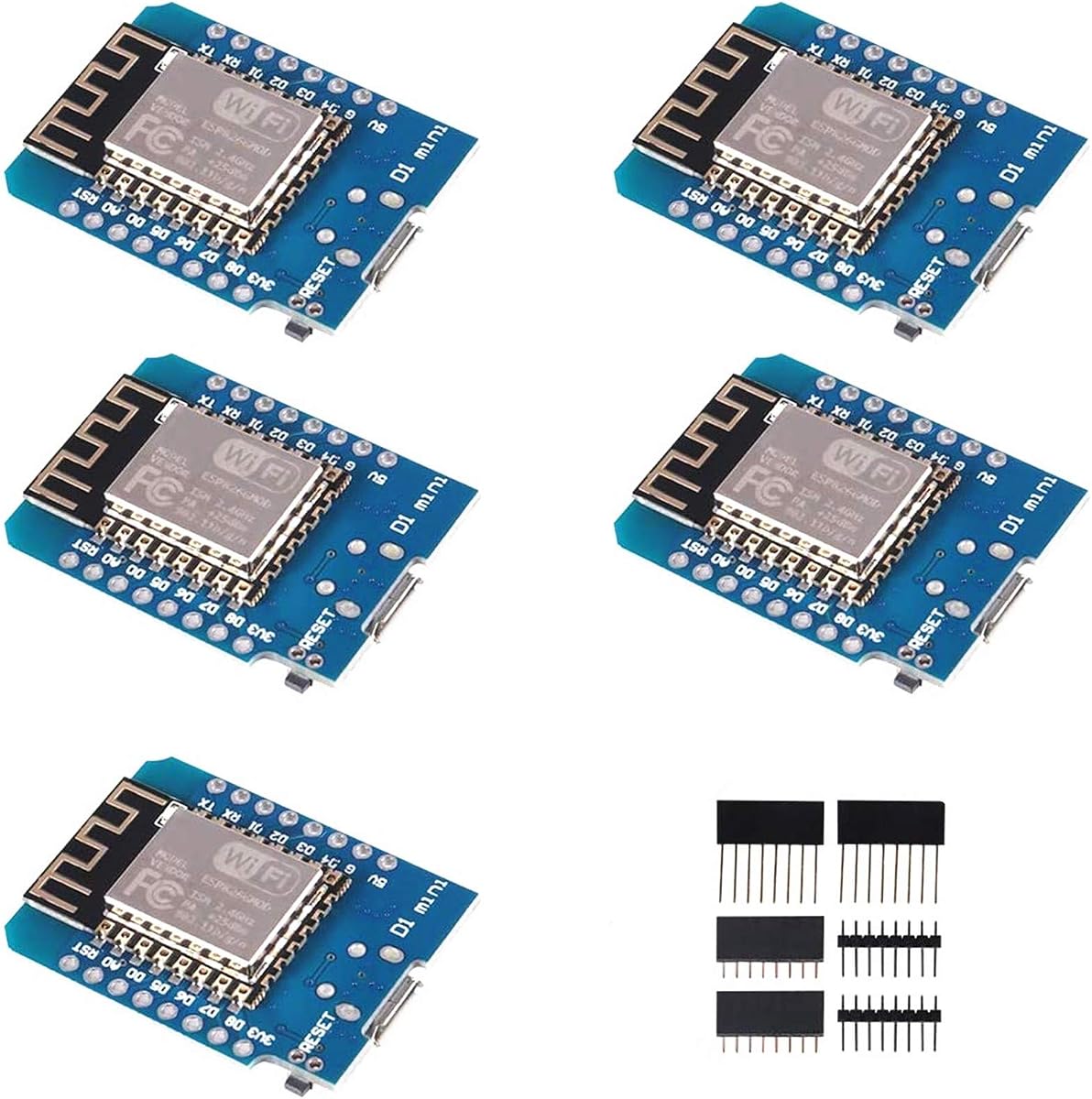
The ESP8266 D1 Mini five-pack is the most development-board-like ESP8266 option in this guide. It uses the ESP8266EX and ESP-12F, supports Arduino and compatible Arduino IDE workflows, and carries a 4.5 rating. Unlike a bare ESP-01, each D1 Mini includes a USB connection, regulated power circuitry, and a collection of broken-out pins, making it much easier to begin a prototype.
We may earn a commission when you buy through this link, at no additional cost to you.
The board provides eleven digital input/output pins, with interrupt, PWM, and I2C support across the applicable pins, plus one analog input. That is enough connectivity for typical sensors, relays, indicators, displays, and small automation systems. The D1 Mini is a well-established Wi-Fi development format for reason: it balances useful features with a modest footprint and a straightforward programming workflow.
One point needs care. The specification lists one megabyte of flash even though the product title refers to four megabytes, so buyers should verify the storage configuration for their exact use. The analog input is also listed with a maximum of 3.2 volts. The connection uses micro-USB rather than the more future-oriented USB-C found on several ESP32 choices, although micro-USB cables remain common for maker work.
Choose the D1 Mini pack when you want ESP8266 Wi-Fi without the wiring demands of a raw module. It is especially useful for learning, home automation, environmental sensors, and multiple prototypes. The five-board quantity provides room for parallel development, while the onboard programming connection and switching power supply simplify repeated testing.
The D1 Mini integrates the ESP8266EX-based module with a programming connection, regulated power, and accessible pins. That removes much of the setup required when working with a bare module.
Eleven digital I/O pins, interrupt and PWM support, I2C, and an analog input create a practical foundation for sensors, displays, relays, and other automation peripherals.
We may earn a commission when you buy through this link, at no additional cost to you.
The ten-pack of ESP8266 ESP-01 modules is built for projects that need many compact wireless endpoints. It has a 5.0 rating in the supplied data, the highest among the selected products. Its large quantity makes it appealing for sensor networks, teaching environments, automation arrays, and projects in which several identical modules will be programmed and deployed together.
We may earn a commission when you buy through this link, at no additional cost to you.
Each ESP8266 provides on-board processing and storage for connected tasks. The modules support access point, station, and combined modes, allowing them to create a local network, join an existing one, or use a flexible combined arrangement. Arduino compatibility and LWIP support in AP-plus-station mode make the product familiar to makers who work with common ESP8266 toolchains.
The trade-offs reflect the module format. Ten bare modules do not include ten USB programmers, and each unit needs a reliable 3.3-volt power source and appropriate signal levels. The lack of integrated USB makes initial programming less convenient than on a D1 Mini or ESP32 development board. The ESP8266 platform also lacks Bluetooth and has less processing capacity than newer dual-core ESP32 products.
Choose this ten-module pack when a project genuinely benefits from volume and standardization. It is a strong option for classroom labs, distributed environmental monitoring, multi-relay control, or proving a wireless concept across numerous devices. For a single prototype, a smaller bundle or complete board is more practical, but for a coordinated deployment this pack offers exceptional convenience and flexibility.
Ten matching modules are ideal when a final system includes many endpoints. They simplify procurement and make it easier to keep the same hardware and configuration across the entire network.
Access point, station, and combined operating modes let each module take on a suitable network role. LWIP compatibility in combined mode adds another useful option for connected arrangements.
We may earn a commission when you buy through this link, at no additional cost to you.
The right Arduino WiFi Module depends on how much processing your project needs, whether it must add Bluetooth, how the module will be programmed, and whether you prioritize a finished development board or a compact component for a custom circuit.
A complete development board integrates a processor, wireless radio, programming connector, power regulation, and accessible pins. It is easier for beginners, faster to test, and generally less prone to wiring errors. A bare module is smaller and more adaptable for embedded assemblies, but it usually requires a USB-to-serial adapter, careful voltage management, and more assembly knowledge. If you want to experiment quickly, favor the UNO R4 WiFi, Nano ESP32, D1 Mini, or ESP32 development board. If final-device size is critical, consider an ESP8266 ESP-01 or ESP-01S module.
The ESP8266 is sufficient for straightforward Wi-Fi endpoints, sensor reporting, appliance control, and compact networking tasks. ESP32 boards provide dual-core processing up to 240 megahertz, making them better suited to simultaneous radio activity, automation logic, and more demanding connected applications. The UNO R4 WiFi adds a separate Renesas RA4M1 processor, while the Nano ESP32 uses an ESP32-S3. Consider both the final firmware size and the amount of work expected to run while the radio is active.
Many ESP8266 products provide Wi-Fi only. The Arduino UNO R4 WiFi and Arduino Nano ESP32 include Bluetooth 5.0, while the ELEGOO ESP32 boards support Bluetooth 4.2, including Bluetooth Classic and Bluetooth Low Energy. Bluetooth can reduce dependence on a Wi-Fi network, support direct peripheral connections, and enable HID devices such as custom controllers. It is unnecessary for projects that communicate only over Wi-Fi, but it can materially simplify a design when local wireless control is part of the goal.
Flash memory determines how much code can be stored alongside the wireless firmware. The listed Aitrip ESP-01 modules have 1MB, while the ESP-01S options generally provide 4MB, and the D1 Mini specifications contain an inconsistency that buyers should verify. Programming also varies: development boards use USB-C or micro-USB, while bare modules need a compatible serial adapter. The ESP-01S listings specify the Generic ESP8266 Module board, a 115200-baud rate in one case, and SPI mode for DOUT in another. Confirm these details before building a setup around a module.
ESP8266 modules in this guide are intended for 3.3-volt operation. The Aitrip pack specifies a 3.0-to-3.6-volt range and a 3.6-volt maximum I/O tolerance, while the other ESP-01S pack explicitly says not to use 5 volts. Connecting a module directly to a 5-volt signal can cause damage. Use an appropriate 3.3-volt supply, confirm the logic levels of the Arduino or host board, and add level conversion where required. The D1 Mini's analog input is listed with a 3.2-volt maximum, another reminder to check each input separately.
A project involving many sensors, displays, or actuators benefits from a generous pin count and convenient expansion connectors. The UNO R4 WiFi includes a Qwiic connector for I2C peripherals and CAN support for real-time communication. The ELEGOO ESP32 boards expose GPIO, UART, SPI, and I2C, while the D1 Mini provides eleven digital I/O pins plus analog input and I2C support. Review the number and type of interfaces your project actually needs, then check whether external level shifting, pull-ups, or power regulation are required.
Access point mode lets a module create its own network, which is useful for direct setup and local communication. Station mode joins an existing router, making internet access and integration with other networked devices more straightforward. Combined AP-plus-station mode provides additional flexibility and appears explicitly in the HiLetgo, Aitrip, and ten-pack listings. Choose based on the network your project expects to use, and consider whether a direct access-point link is more reliable than relying on an existing router.
A USB-connected board simplifies repeated sketch uploads and serial monitoring, while a bare module demands a stable programming setup. The ELEGOO ESP32 boards add over-the-air update support through a compatible framework, allowing deployed firmware to be revised over Wi-Fi. This is valuable for remote or inaccessible installations, but OTA still needs careful rollout and recovery planning. Consider who will maintain the project after deployment, not just how quickly it can be built initially.
Before writing code, confirm that your board or module is powered at the correct voltage, especially when using a bare ESP8266. Install the appropriate board support in Arduino IDE, select the specified board profile, and use the required flash mode and baud rate. For development boards, connect the documented USB interface and verify that the computer recognizes the serial or programming bridge. A visual confirmation of the board identifier in the IDE is a good first check.
Begin with a minimal network sketch that performs one simple task, such as connecting to a local access point or reporting a sensor reading. Avoid placing credentials, sensitive information, or access tokens directly into code that may be shared or uploaded without review. Once the basic connection is stable, add the application logic in small sections and monitor serial output for network state, errors, and reconnection behavior. For OTA-capable boards, test the update process before relying on it in a remote installation.
Care for the module by keeping it away from moisture, conductive debris, high heat, and voltages beyond its specified limits. Bare ESP8266 boards need stable 3.3-volt power, careful antenna clearance, and sound connections that do not place strain on the small pins. Development boards should be disconnected before wiring external power to prevent backfeeding. Keep some space around the antenna region, and periodically check that the device still restarts reliably after power cycling.
An ESP8266 is a compact, low-cost Wi-Fi platform that works well for basic sensors, appliance controls, and simple network endpoints. An ESP32 provides more processing power, larger memory resources, and Bluetooth support in addition to Wi-Fi, making it better for dual-radio devices and more demanding IoT workloads. The actual ease of use also depends on whether you choose a ready-made development board or a bare module.
Not safely without checking the signal levels. The ESP8266 modules listed here are designed around 3.3-volt operation, and their inputs are not intended to receive 5-volt logic signals. Power the module from a suitable 3.3-volt source and use level shifting if the host controller outputs 5 volts. Confirm the particular module's voltage specification and make all connections while the system is unpowered.
In most cases, yes. Bare ESP8266 and ESP-01S modules need a compatible USB-to-serial interface to upload firmware and provide serial monitoring. You also need a stable 3.3-volt supply and the correct Arduino IDE settings. A development board such as the D1 Mini includes the programming and power circuitry, so it is a more convenient starting point for a first project.
The Arduino UNO R4 WiFi and Arduino Nano ESP32 offer the most integrated Arduino experience, while the ELEGOO ESP32 boards and D1 Mini are also convenient because they include USB programming. The UNO R4 WiFi additionally provides a Qwiic connector and onboard LED matrix, which can make common projects easier to assemble. A beginner should still choose hardware that matches the planned wireless protocol and available I/O.
In access point mode, the module creates and manages its own wireless network, allowing nearby devices to connect directly to it. In station mode, the module connects to an existing wireless network such as a home router. Combined AP-plus-station mode supports both roles and offers more deployment flexibility, but configuration can be somewhat more involved.
The required amount depends on the wireless firmware, libraries, and application code included in the build. The 1MB ESP-01 options may be limiting, while 4MB ESP-01S modules generally provide more room. A development board with adequate flash and flexible memory is preferable for complex sketches. Verify the actual board configuration before relying on a listed specification, particularly when product descriptions appear inconsistent.
Remote update capability is explicitly highlighted for the ELEGOO ESP32 boards, which support over-the-air updates through a compatible ESP32 software framework. The other bare ESP8266 entries do not state that feature in the supplied information, so it should not be assumed. OTA support is valuable for remote installations, but it should be configured and tested carefully, including a recovery plan for interrupted updates.
The ESP8266 products are Wi-Fi-focused and do not list Bluetooth support. The Arduino UNO R4 WiFi and Arduino Nano ESP32 provide Bluetooth 5.0, while the ELEGOO ESP32 boards specify Bluetooth 4.2 with Bluetooth Classic and BLE. Choose one of these boards when direct local connections, Bluetooth accessories, or HID peripherals are central to the design.
The Arduino UNO R4 WiFi is the standout all-round choice because it combines a capable Renesas processor, ESP32-S3 wireless connectivity, USB-C, CAN, Qwiic expansion, analog features, and a useful onboard LED matrix. The ELEGOO ESP32 boards are especially attractive for powerful dual-radio projects, while the Aitrip ESP-01 five-pack provides a budget-friendly way to create several basic wireless nodes.
Prioritize the form factor that matches your experience. Complete boards are easier to program and troubleshoot, while bare ESP8266 modules are better when a custom, compact assembly is required. If Bluetooth matters, choose an ESP32-based product. If flash capacity or network topology is important, review those specifications before purchasing, and ensure your power and signal levels are safe.
Ratings, seller information, and prices can change, so check the current listing and total project requirements before ordering. Also account for any adapters, cables, level shifters, sensors, and power supplies that are not included. A module that matches the project technically and can be obtained and deployed at a reasonable current cost is the most practical choice.
