
LVYUAN 4000W Power Inverter
4.5Editor score
4000W continuous output
Four AC outlets plus hardwire
Wireless remote and LCD
Our 4000 Watt Power Inverter guide compares ten models for pure sine wave quality, surge capacity, outlets, remote controls, safety, and mobile use for
A 4000 watt power inverter converts 12V DC battery power into household-style 110V or 120V AC, making it useful for RV travel, off-grid systems, mobile projects, and emergency backup. The best model balances clean output, usable surge capacity, battery compatibility, cooling, and convenient controls.
We compared all ten inverters by examining their listed power ratings, waveform type, AC and USB connections, remote-control options, protection systems, included accessories, and intended applications. The list covers pure sine wave and modified sine wave designs, giving readers practical alternatives for different equipment and budgets.
Each pick highlights the product's strongest contribution to the category, whether that is outlet flexibility, sensitive-electronics compatibility, monitoring, rugged construction, or straightforward installation. Ratings and specifications reflect the supplied product information, while prices and availability can change, so confirm current listing details before purchasing.
4.5Editor score

4.4Editor score

4.4Editor score
This side-by-side comparison highlights each inverter's waveform, continuous output, surge capability, connection options, and remote monitoring features to help identify the most appropriate model for your power setup.




This 4000W pure sine wave inverter combines 4000 watts of continuous output with an 8000-watt peak surge rating and a 4.4 rating. Its standout qualities are the adjustable low-voltage shutdown, comprehensive LCD remote, and generous selection of outlets, making it well suited to mixed loads in RV, mobile, solar, and emergency applications.
We may earn a commission when you buy through this link, at no additional cost to you.
The inverter converts 12V DC into stable 110V AC for refrigerators, microwaves, tools, air compressors, sump pumps, and other demanding appliances. Its low-voltage adjustment from 9.5V to 11V supports LiFePO4, AGM, gel, SLA, and deep-cycle batteries, while the remote displays battery voltage, AC output, load wattage, frequency, and warning indicators.
Four AC outlets, a USB port, and a Type-C port support several devices at once, and the included 15-foot wired remote makes operation from a cab, cabin, truck, or equipment room convenient. The main trade-off is that the product information does not identify an independent safety certification. Users who need a formally certified design may prefer the ETL-listed GIANDEL alternative.
This is the strongest general recommendation for buyers who want clean power, detailed status monitoring, battery-type flexibility, and numerous connection options in one package. It is particularly compelling for mobile living and off-grid installations where a remote display and configurable low-voltage cutoff are valuable.
The adjustable 9.5V to 11V shutdown is one of the inverter's most useful distinctions. It allows the operating threshold to be aligned with different battery chemistries, reducing the risk of excessive discharge while supporting common off-grid and RV battery configurations.
The 15-foot LCD remote consolidates voltage, wattage, frequency, and fault information in a readable display. That visibility helps users diagnose overloads or other conditions without opening the inverter enclosure each time they check operation.
We may earn a commission when you buy through this link, at no additional cost to you.
The LANDERPOW 4000W pure sine wave inverter earns a 4.4 rating and offers a balanced mix of clean output, efficiency, and connection flexibility. Its four AC outlets, hardwired terminal, USB charging, Type-C charging, and 15-foot LCD remote give it an unusually complete feature set for a mobile or residential power system.
We may earn a commission when you buy through this link, at no additional cost to you.
The listed efficiency exceeds 91%, and the pure sine wave output is intended to support inductive and capacitive loads such as window air conditioners, coffee machines, refrigerators, home theaters, and car audio. The 8000-watt surge capacity is designed to absorb demanding startup demands, while the hardwired terminal gives installers a higher-current option for tools or other heavy appliances.
Two 1AWG, two-foot pure copper battery cables are included, along with a heat-dissipating metal shell and protection against undervoltage, overvoltage, overload, overheating, short circuits, and reverse connection. Although it does not list an ETL certification, the stated coverage includes a one-year replacement and two additional years of extended support, and a visual guide is included to simplify setup.
This inverter is a strong choice for a home, RV, job site, or solar installation where users want pure sine wave quality and many outputs without settling for a basic design. It may be less compelling than a certified model for installations where formal regulatory documentation is mandatory.
Four AC receptacles support everyday household equipment, while the hardwired terminal expands the installation options for high-current loads. USB and Type-C outputs also reduce the need for separate adapters when charging smaller devices.
A stated efficiency above 91% limits conversion losses, and the full metal shell helps dissipate heat. Together, these features support sustained use when the connected load remains within the inverter's continuous rating.
We may earn a commission when you buy through this link, at no additional cost to you.
This Yinleader inverter combines a listed 5.0 rating with 4000 watts of continuous power, 8000 watts of peak output, and more than 90 percent conversion efficiency. Its dual-display system, remote control, and automatic cooling make it a practical option for RV, off-grid solar, and home emergency use.
We may earn a commission when you buy through this link, at no additional cost to you.
Both the main enclosure and the 16.5-foot wired remote have high-definition LCD screens, allowing users to check input and output voltage, frequency, and system status from a distance. Three AC outlets and one USB port support several essential devices, while the cooling system activates when internal temperature exceeds 45 degrees Celsius or under high-power operation.
Protection against overvoltage, undervoltage, overload, short circuit, overcurrent, overheating, and reverse polarity provides a broad safety framework. The high-strength casing is designed for impact resistance and heat dissipation, and compatibility includes lead-acid, gel, and lithium batteries. The main limitation is that it offers three AC outlets rather than the four found on several competitors, and no independent safety certification is identified.
For value-conscious buyers who prioritize monitoring, cooling behavior, and a broad protection suite, this is a compelling selection. It is less expansive in outlet count than the best hardwired models but remains a balanced option for typical mobile and backup loads.
Having an LCD on both the inverter and its remote is useful in installations where the main unit is tucked into a cabinet. Users can confirm operating status without walking directly to the enclosure.
The fan system considers both temperature and load rather than running continuously. That approach can maintain airflow during demanding operation while keeping noise lower during lighter use.
We may earn a commission when you buy through this link, at no additional cost to you.
The Energizer 4000W inverter provides 4000 watts of continuous power, an 8000-watt surge rating, and a 4.4 rating. Its defining advantage is documented ETL approval under UL STD 458, which may matter more to safety-conscious buyers than the extra convenience offered by some competing models.
We may earn a commission when you buy through this link, at no additional cost to you.
This is a modified sine wave inverter designed for phones, laptops, game consoles, Kindles, televisions, DVD players, lights, tablets, and similar electronics. Two standard North American AC outlets and two 2.4-amp USB ports provide enough connections for common travel and vehicle use, and the hardwire kit adds installation flexibility.
The LCD screen presents overload, overvoltage, undervoltage, high-temperature, and short-circuit conditions alongside input voltage, output wattage, and battery level. Free three-foot 0AWG battery cables are included, while a two-year warranty reinforces the brand's stated confidence. The tradeoff is waveform quality: modified sine output is less suitable for sensitive, inductive, or capacitive equipment than a pure sine wave model.
Choose this inverter for mobile projects where recognized safety testing, a two-year warranty, and basic device charging matter. Users running medical equipment, audio gear, variable-speed tools, or other sensitive loads should favor one of the pure sine wave options instead.
ETL approval under UL STD 458 distinguishes this model from listings that simply describe protective features. Buyers working in professional or highly safety-conscious settings can review the certification documentation before installation.
The LCD provides a quick view of battery condition, load status, and active fault categories. This helps travelers identify when a vehicle battery or connected appliance is creating an operating issue.
We may earn a commission when you buy through this link, at no additional cost to you.
The Sunivora 4000W inverter has a 4.3 rating and stands out for its unusually long remote-control range. It supplies 4000 watts continuously and 8000 watts during surges, with more than 90 percent conversion efficiency and an aluminum enclosure designed to withstand demanding mobile use.
We may earn a commission when you buy through this link, at no additional cost to you.
The remote can operate the inverter from up to 165 feet away, while its LCD reports input and output voltage, battery capacity, load capacity, output frequency, radiator status, converter temperature, and the reason protection activated. This degree of diagnostic detail is useful in larger RVs, work trucks, mobile installations, and remote equipment compartments.
Protection covers undervoltage, overvoltage, overload, overheating, short circuit, and reverse connection. Integrated cooling fins and intelligent fans help move heat away from the converter, and two 0AWG pure copper cables support stable power delivery. As a modified sine wave model, it is better suited to resistive and simpler electronic loads than highly sensitive or inductive equipment. The remote also arrives without a battery.
This is a practical selection for users who need to monitor and control an inverter from a considerable distance. The long-range remote, informative display, and robust thermal design compensate for the less refined waveform, while users with sensitive electronics should choose a pure sine wave alternative.
A 165-foot operating range makes the remote useful when the inverter is installed in a truck bed, cargo area, garage, or other location that is inconvenient to reach repeatedly. Monitoring information also supports faster troubleshooting.
Integrated fins and intelligent fans reduce heat accumulation around the converter. This thermal approach is important when powering tools or appliances that approach the unit's continuous capacity.
We may earn a commission when you buy through this link, at no additional cost to you.
The GIANDEL 4000W pure sine wave inverter combines a 4.4 rating with formal ETL listing under UL458 and a stated total harmonic distortion below 3 percent. These specifications make it the premium choice for users who prioritize clean output, safety documentation, and dependable performance in demanding applications.
We may earn a commission when you buy through this link, at no additional cost to you.
Its continuous output is 4000 watts with 8000-watt peak capability and efficiency up to 91 percent. Four AC outlets serve common appliances, while a hardwired block terminal supports heavy loads up to the inverter's 4000-watt range. The product data specifically identifies compatibility with RVs, boats, trucks, solar systems, and emergency power use.
Seven protection categories cover high voltage, low voltage, overload, short circuit, overheating, and reverse polarity, with a fuse included for protection. The aluminum alloy housing, intelligent cooling fan, and shock-proof pads support durability, while three pairs of 4AWG cables, a ground wire, and technical support make it a well-equipped package. The lack of a listed remote and relatively simple 2.4-amp USB port are the main disadvantages.
This inverter is best for RV, marine, mobile, and off-grid applications where electrical quality and independent compliance matter. Its clean output and hardwired capacity justify the premium positioning, particularly for users who value a defined low-distortion specification.
A stated total harmonic distortion below 3 percent produces AC output closer to utility power. That quality is valuable for electronics, audio equipment, medical devices, and motor-driven appliances that may behave poorly with a stepped waveform.
ETL listing under UL458 gives buyers a documented safety standard, while isolated input and output design, soft-start technology, and technical support add confidence for professionally planned systems.
We may earn a commission when you buy through this link, at no additional cost to you.
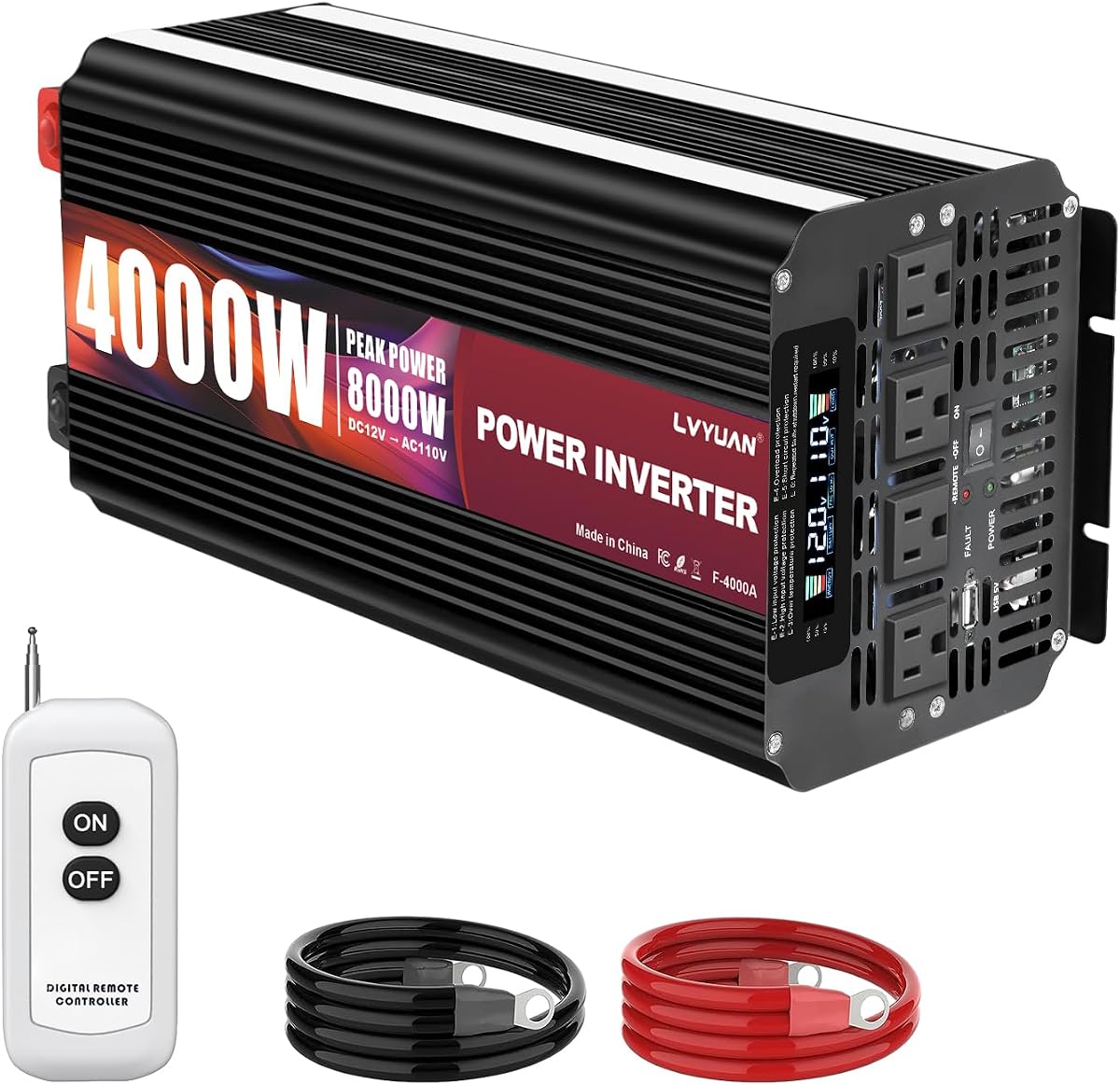
The LVYUAN 4000W inverter holds a 4.5 rating and combines 4000 watts of continuous power, 8000 watts of peak capacity, and a generous four-outlet layout. Its wireless remote, LCD display, and hardwired connection make it particularly attractive for RV cabinets, trucks, off-grid cabins, and solar systems.
We may earn a commission when you buy through this link, at no additional cost to you.
The LCD reports voltage, battery level, load, and alert conditions, while the wireless remote allows operation from a position that may be difficult to reach physically. Four AC sockets and a hardwire terminal provide flexibility for both portable appliances and more permanent wiring, making the inverter suitable for mobile living and off-grid use.
An intelligent cooling fan activates when internal temperature exceeds 104 degrees Fahrenheit or load exceeds 45 percent. Protection includes overvoltage, undervoltage, overload, short circuit, reverse polarity, and overheating. The principal uncertainty is that the supplied product information does not explicitly identify the waveform type or an independent safety certification, so buyers with sensitive electronics should verify those details before buying.
This model is a strong budget-focused recommendation for users who value outlet flexibility, remote operation, and a clear operating display. It is especially useful in hard-to-reach installations, although buyers who require explicitly documented pure sine wave output or formal certification should choose a model that states both.
The wireless remote removes the need to access an inverter mounted deep inside an RV cabinet, truck compartment, or storage area. A separate LCD panel provides status feedback close to the user.
The fan responds to both temperature and load thresholds. This can reduce unnecessary noise while ensuring greater airflow when the inverter is working hard or internal temperatures rise.
We may earn a commission when you buy through this link, at no additional cost to you.
This 4000W pure sine wave inverter offers 4000 watts of continuous output, 8000 watts of peak power, and both wired and wireless remote controls. It has a 4.1 rating and is positioned for camping, RV travel, vehicles, boats, solar systems, and power outages where output quality and monitoring flexibility are both important.
We may earn a commission when you buy through this link, at no additional cost to you.
Four AC outlets serve multiple appliances, while the remote panel includes 5-volt 3.1-amp USB and 20-watt Type-C charging. The inverter's dual LCD displays help track operating status, and its pure sine wave output is appropriate for sensitive electronic equipment and inductive or capacitive loads.
The product includes a cooling fan, LED indicator, and built-in fuse, along with protection for overcurrent, short circuit, low load, overload, overheating, and overvoltage. Its durable aluminum alloy construction is intended to improve reliability. The main drawback is the 4.1 rating, the lowest in this group, and the product guidance says the inverter should be turned off before activating either remote.
This inverter is a flexible middle option for users who want pure sine wave output, two remote-control options, and modern charging ports. It makes sense for RV travel and mobile backup use, though buyers who place the highest emphasis on customer ratings may prefer the Yinleader or LVYUAN selections.
The wired remote offers a stable connection and visible status feedback, while the wireless remote adds placement flexibility. Having both can be useful when an installation changes or different users prefer different control methods.
Four AC outlets and USB Type-C charging provide a convenient mix of conventional and modern power connections. The remote also includes charging ports, allowing compatible devices to recharge while the inverter is being monitored.
We may earn a commission when you buy through this link, at no additional cost to you.
The Homkeep 4000W inverter provides 4000 watts of continuous power, 8000 watts of peak output, and more than 90 percent conversion efficiency. It has a 4.1 rating but offers a practical combination of four AC outlets, two 3.4-amp USB ports, a Type-C port, an LCD display, and a remote controller.
We may earn a commission when you buy through this link, at no additional cost to you.
The remote can operate the inverter from up to 120 feet away, and the large high-definition screen shows input voltage, output voltage, and protection status. Its aviation aluminum alloy shell is intended to withstand harsh environments and collisions, while two smart cooling fans help manage heat and protect connected equipment.
The six protection categories cover undervoltage, overvoltage, overload, overheating, short circuit, and reverse connection. The listed no-load current of 1±0.3 amps is a consideration for owners who care about standby consumption, particularly during long periods when the inverter is connected but not carrying a meaningful load. The rating is also lower than most alternatives.
This model suits RV, truck, solar, holiday, hurricane, and emergency applications where modern charging ports are valuable. It is a reasonable feature-oriented option, but buyers seeking a stronger balance of efficiency, waveform clarity, and customer rating should examine the pure sine wave models with higher ratings.
Two 3.4-amp USB ports and a dedicated Type-C connection support several common charging needs. This makes the inverter useful for mixed loads where plugging in separate wall adapters would be inconvenient.
The large LCD provides immediate information about input and output voltage as well as protection indications. This helps users distinguish a normal shutdown from an overload, voltage problem, or overheating event.
We may earn a commission when you buy through this link, at no additional cost to you.
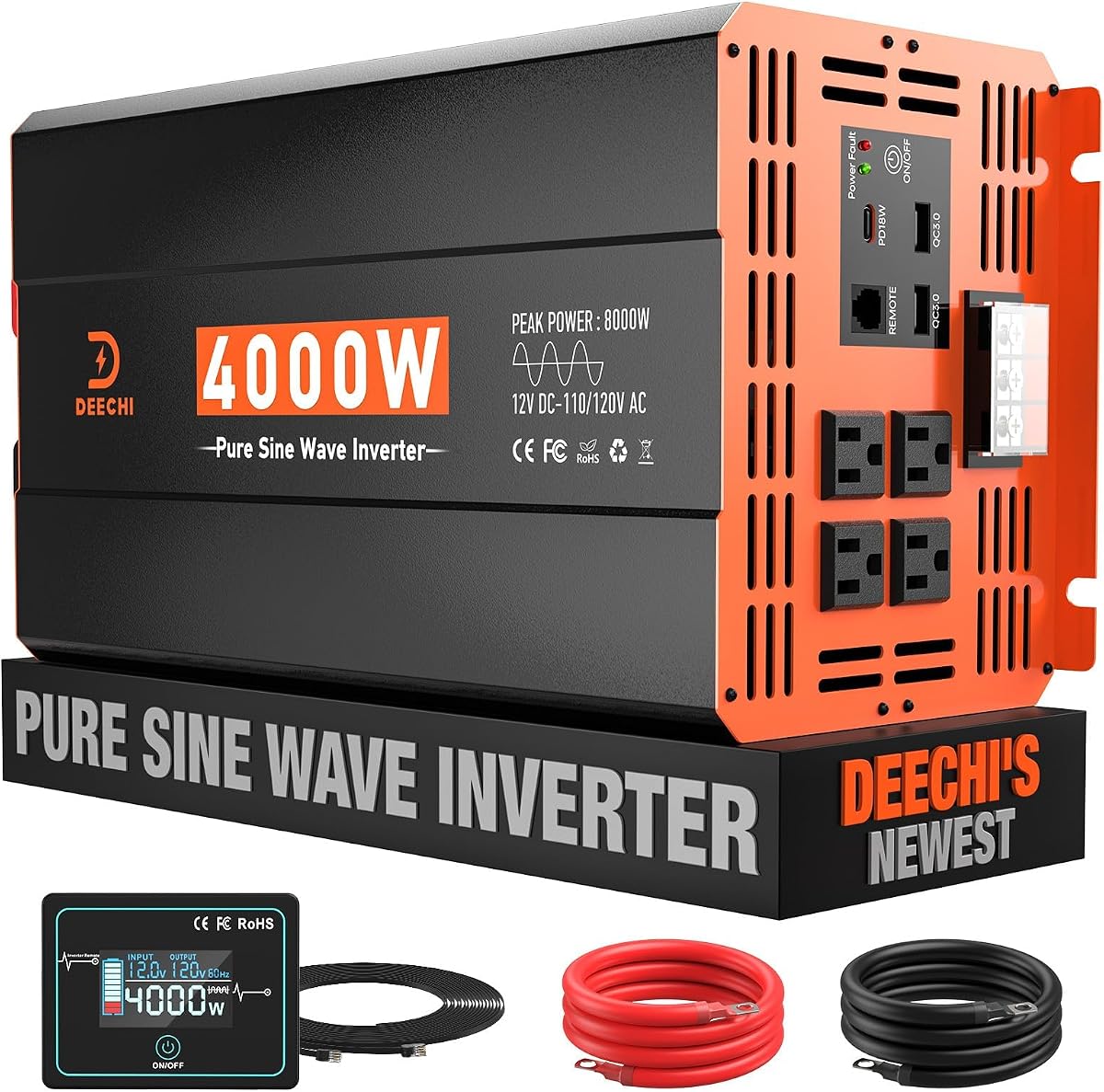
The DEECHI 4000W pure sine wave inverter delivers 4000 watts continuously and 8000 watts during surges, with a 4.4 rating. It is designed for RV, truck, home, solar, and vehicle use and emphasizes clean power, low energy consumption, and quiet thermal management.
We may earn a commission when you buy through this link, at no additional cost to you.
The aircraft aluminum shell is designed to resist drops and collisions, while dual intelligent temperature-control fans reduce heat and maintain a low-noise operating profile. The inverter's stated goal of stable 24/7 operation should still be understood within its continuous power limit and proper ventilation requirements.
Four standard North American AC outlets, two USB ports, a hardwire kit, and an 18-watt Type-C port give users a broad mix of connections. Compatibility extends to 12V and 12.8V batteries, and the included pure copper cable adds installation convenience. The 16.5-foot wired remote has a color display for tracking operating status and controlling the unit.
This is a well-rounded option for mobile and residential users who want pure sine wave quality without a large collection of outlets. It is particularly suitable where low-noise operation is valued, although a formally certified inverter may be preferable for professional installations with strict documentation requirements.
Dual intelligent fans respond to temperature rather than simply running at all times. This supports quieter operation in occupied spaces while preserving heat removal during demanding loads.
Four AC outlets cover common appliances, while the hardwire kit and Type-C port broaden the inverter's role. The 16.5-foot remote makes it easier to manage the unit from inside a vehicle or nearby room.
We may earn a commission when you buy through this link, at no additional cost to you.
Selecting a 4000 watt power inverter requires balancing output quality, actual load requirements, battery capabilities, safety features, and installation conditions. The following factors help distinguish models that merely meet the headline wattage from those better suited to continuous daily use.
Pure sine wave output is smoother and more similar to utility electricity, making it the safer choice for sensitive electronics, audio equipment, medical devices, variable-speed motors, and other loads that may produce noise or malfunction with stepped waveforms. Modified sine wave inverters are less complex and can suit basic phones, lights, televisions, and resistive heating elements, but the tradeoff is greater electrical noise and potentially less efficient operation of inductive loads.
A 4000-watt continuous rating describes the output available during sustained operation, while the listed 8000-watt surge capability is intended to handle brief startup demands from compressors, pumps, and other motor-driven equipment. Do not treat surge power as a continuous allowance. Check each appliance's running requirement and motor startup behavior, then leave sensible headroom so the inverter does not operate continuously at its limit.
The inverter's input system must match the battery bank. Most models here accept 12V DC, with some explicitly supporting lithium, lead-acid, gel, AGM, SLA, or deep-cycle batteries. Adjustable low-voltage shutdown is especially useful because different battery chemistries have different safe discharge thresholds. Users of lithium systems should confirm both the specified battery voltage and the permitted low-voltage cutoff before making a connection.
Outlet count determines how many conventional AC appliances can operate at once, but each outlet's amperage rating and the inverter's total load limit also matter. A hardwired terminal provides a better route for high-current or fixed loads and avoids relying on portable receptacles. USB and Type-C ports are convenient for phones, tablets, cameras, and other devices, but their output ratings should be checked before charging several high-power products simultaneously.
A remote control is particularly valuable when the inverter is installed inside an RV cabinet, truck compartment, battery box, or solar cabinet. A good display should show battery voltage, output voltage, load information, frequency where available, temperature, and fault status. Wired remotes offer consistent control without radio interference, while wireless remotes provide placement flexibility. Dual-display designs are useful when the user needs both local and remote status checks.
Overload, overvoltage, undervoltage, short circuit, overheating, and reverse-polarity protection help prevent unsafe operation and accidental battery damage. Reverse connection protection is particularly valuable during initial setup because miswired battery cables can cause immediate problems. Cooling also matters: a fan that responds to temperature and load can maintain safe operation without creating unnecessary noise. The inverter should still be installed with the airflow it requires and protected from moisture and overheating.
Independent safety certification can be important for RV, marine, occupational, or professionally installed applications. The Energizer is listed as ETL approved under UL STD 458, while the GIANDEL is described as ETL listed under UL458. Other models emphasize protection systems without stating a comparable certification. Warranty length, included technical support, documentation quality, and accessible service resources are also useful indicators of long-term ownership support.
Begin by confirming that the inverter's input voltage, waveform requirement, continuous rating, and surge capacity fit your battery and connected equipment. Read the included manual, identify the positive and negative terminals, and ensure the power switch is off before attaching the battery cables. Use the supplied or appropriately rated cables, keep the inverter well ventilated, and choose a protected, dry location away from flammable materials.
After wiring, turn on the inverter and use its LCD or remote to check battery voltage, output voltage, frequency, and fault status before adding loads. Connect essential devices one at a time and watch the displayed load information. Do not exceed the continuous rating, and remember that surge capacity is only for brief startup events. Disconnect loads before changing wiring, changing battery banks, or performing maintenance.
For long-term care, keep ventilation openings free of dust and debris, inspect cable connections for looseness or corrosion, and avoid moisture, excessive heat, and combustible materials. Watch the display for recurring warnings, and investigate overload, undervoltage, or overheating messages rather than repeatedly restarting the unit. Periodic battery checks, conservative load management, and orderly shutdowns help extend the life of both the inverter and connected equipment.
It means the inverter can supply up to 4000 watts of continuous AC output under its stated operating conditions. The total connected load should remain below that level for sustained use. Its 8000-watt surge rating is intended for brief startup demand, not for running a 4000-watt load continuously or a group of appliances totaling 8000 watts.
A pure sine wave inverter is the broadest choice and is especially useful for laptops, medical equipment, audio systems, variable-speed tools, and other sensitive loads. Modified sine wave models can work adequately for simple electronics, lights, and resistive appliances. Choose based on the equipment rather than on the inverter label alone, because poor waveform compatibility can cause noise, heat, or unreliable operation.
Battery capacity depends on how long you need the inverter to run, the battery voltage, converter efficiency, and the actual load. Higher battery capacity provides longer runtime, while a higher C-rate supports heavier loads. Calculate the expected watt-hours, divide by usable battery capacity, and allow additional headroom for conversion losses, cold conditions, and battery age.
The electrical rating may support the connection, but the vehicle's alternator and battery capacity must also be able to supply the load without excessive voltage drop. Running a 4000-watt load from a typical passenger vehicle can create a substantial drain and may require a dedicated deep-cycle battery, cable upgrades, or a stationary power system.
Continuous power is the level the inverter can sustain during normal operation. Peak power is a short-duration allowance for startup surges from devices such as refrigerators, pumps, and power tools. Repeatedly operating near the peak rating can cause overheating or shutdowns, so continuous loads should remain comfortably below that limit.
Possible causes include exceeding the continuous rating, insufficient battery voltage, poor cable connections, excessive startup surge, or an overheating condition. Check the remote or LCD fault message first, then reduce the load and verify battery and cable condition. If the problem continues at a clearly lower load, consult the manufacturer's troubleshooting guidance.
Many inverters draw a small no-load current even when no appliances are operating, and the model may have a low-voltage cutoff that allows battery depletion over time. For long storage periods, use the inverter's approved shutdown procedure or disconnect it according to the manual. The best approach depends on the battery chemistry and the inverter's protection design.
An inverter can be part of a solar system, but it needs a battery bank or other appropriate DC source and a charge controller that regulates the solar input. Panel output, battery charging requirements, inverter efficiency, and surge demand must be designed as a complete system rather than selected independently.
The LANDERPOW 4000W pure sine wave inverter is the best overall fit for buyers seeking extensive connection options, clean output, high efficiency, and a detailed LCD remote. The LVYUAN stands out as a budget-focused model with four outlets, wireless remote control, and a 4.5 rating, while the GIANDEL earns the premium position through UL458-listed safety, low total harmonic distortion, and a heavy-load hardwired terminal.
Prioritize continuous capacity, correct battery compatibility, and the waveform your equipment actually requires. Remote displays, active cooling, hardwired connections, and protection features are especially useful for RV, marine, mobile, and off-grid systems where the inverter may be installed out of immediate reach. Formal safety certification should be a deciding factor for professional or highly regulated installations.
Before buying, verify the current listing details, included accessories, warranty terms, and compatibility with your battery and appliances. Ratings and specifications provide a strong starting point, but prices, promotions, and availability change frequently. Comparing the current product page and installation requirements will help ensure the chosen inverter fits both the budget and the intended power system.
