
Motovera Self Leveling Laser Level
4.2Editor score
Bright green cross lines
Includes adjustable tripod
IP54 water resistance
Four brightness modes
Our laser level for tile work guide compares 10 green and red cross-line and 360-degree models for accuracy, coverage, mounting, and ease.
A reliable laser level for tile work turns alignment into a visible reference across walls, floors, and cabinets. The right model should project clear lines, hold its position accurately, and mount securely enough for repeated tile layouts. Green beams, self-leveling pendulums, and 360-degree coverage are especially useful for demanding installations.
We compared the 10 laser levels in this guide by examining their stated accuracy, range, projection system, leveling range, included mounting hardware, power options, and intended tile-related applications. The list includes compact cross-line tools, 3D and 4D models, and professional options for installers who need room-wide reference planes.
Each review identifies the feature that makes the model most useful in a particular tiling workflow, along with limitations such as indoor-only visibility, missing accessories, or reflective-surface effects. Product ratings and availability can change, as can pricing, so confirm the current listing and accessory package before purchasing.
4.2Editor score

4.8Editor score

4.4Editor score
The comparison below places each laser level side by side, emphasizing projection coverage, stated accuracy, power, and mounting options. These details help distinguish a simple cross-line tool from a multi-plane laser built for full-room tile layouts.





The Motovera 100ft Green Cross Line combines a bright green laser, an adjustable tripod, and a 100-foot stated indoor visibility range. Its 4.2 rating places it among the well-regarded options in this guide, while the included accessories make it especially approachable for a first tile layout.
We may earn a commission when you buy through this link, at no additional cost to you.
Its strongest selling point is the combination of a cross-line projector and a complete mounting kit. The green beam is described as four times brighter than standard red lasers, and the tool offers four brightness modes plus a pulse function. Accuracy is stated at ±1/9 inch at 33 feet, which is a useful starting reference for aligning tile rows, wall edges, cabinet faces, and decorative layouts.
The pendulum supports self-leveling within ±4 degrees and a manual mode for angled patterns. The flashing behavior in manual mode is a reminder rather than a fault, so users should understand that distinction before using it for sloped surfaces. IP54 protection and a stated 30-inch drop tolerance add job-site resilience, although the tool does not create the 360-degree coverage offered by higher-end models.
This is a strong choice for homeowners and tile installers who want a complete basic package without moving up to a multi-plane laser. It is particularly suitable for straight wall tiles, backsplashes, shelves, and repeat-room alignment. Those needing continuous reference lines around an entire room should look toward a 3D or 4D model instead.
The included adjustable tripod, batteries, carry bag, and manual remove several separate purchases from the setup process. A user can mount the tool at a working height, establish a horizontal reference, and begin marking tile positions with fewer accessories to source.
Four brightness modes make it easier to adapt the projected cross line to different indoor conditions. The pulse function can also support use with a compatible receiver, although no receiver is included in the stated kit.
We may earn a commission when you buy through this link, at no additional cost to you.
The CinusLinus 4D Green Laser projects 2×360-degree horizontal planes and 2×360-degree vertical planes, creating broad cross-line coverage for tile and renovation work. It carries a 4.4 rating and pairs that projection system with an adjustable tripod, remote control, and a rechargeable battery.
We may earn a commission when you buy through this link, at no additional cost to you.
The extended 360-degree planes allow a single unit to establish references across floors, walls, and ceilings. Brightness can be raised or lowered to suit changing indoor light, while self-leveling engages within ±4 degrees. The included 47-inch tripod has a three-way head and standard quarter-inch quick-release plate, simplifying setup at different installation heights.
There are important environmental limitations. The product information recommends indoor use because intense natural light can weaken the visible beam. Pulse mode is intended for dimmer conditions or use with a compatible laser receiver, but that receiver is not included. Manual mode is available for angled projections, though the projected line in that mode should not be treated as a level reference.
This model fits installers laying tile across multiple walls, establishing square grid lines, or checking cabinet and fixture heights throughout a room. It is more versatile than a standard cross-line tool but less finely configured than the app-controlled CIGMAN. Choose it when full-room planes and remote adjustment are priorities.
Four 360-degree planes place horizontal and vertical references around the working area. That coverage is useful for checking opposing walls, floor-to-ceiling alignment, and repeated tile courses without repeatedly repositioning a basic cross-line laser.
The remote duplicates the main function controls, allowing line selection from across the room. An integrated 4800mAh battery is rated for up to eight hours, which is convenient for longer tile installations and renovation sessions.
We may earn a commission when you buy through this link, at no additional cost to you.
The CIGMAN CM-G16 is the most complete tile-layout laser in this roundup, with four 360-degree planes, 16 visible green lines, and a 4.8 rating. It is designed to cover floors, walls, and ceilings while allowing individual planes to be switched on or off.
We may earn a commission when you buy through this link, at no additional cost to you.
Its standout feature is control. The included remote and Smart Leveling app let the installer select individual laser planes and choose among four brightness levels. A 4000mAh rechargeable battery, USB-C charging, and flash mode support extended work in varied lighting. Stated accuracy is ±1/8 inch at 33 feet, with an indoor working range up to 100 feet.
The accessories make integration with other equipment straightforward. It includes a magnetic L-shaped bracket, a 5/8-11 thread adapter, a carrying case, charging cable, and remote. IP54 protection suits demanding indoor job sites, while the three-year warranty adds reassurance. Pulse mode can extend the working distance to 164 feet with a compatible receiver, which is not included.
This is the strongest all-around recommendation for serious tile installers, remodelers, and advanced DIY users. Selective line control prevents unnecessary visual clutter, and the app reduces the need to reach the tool after setup. Buyers working on simple backsplashes may find its capabilities more than required, but it is especially well matched to whole-room tile layouts.
A 16-line laser can look busy in a finished room, so the ability to turn off individual planes is a practical advantage. Users can isolate one horizontal and one vertical reference while carrying out precise tile placement.
The Smart Leveling app and remote make it possible to alter line visibility without walking back to the mounted tool. This is especially helpful when checking several wall planes from different working positions.
We may earn a commission when you buy through this link, at no additional cost to you.
The Huepar HM03CG projects one 360-degree horizontal plane and two 360-degree vertical planes, giving tile installers a practical 3D reference without the 16-line density of a 4D model. Its 4.6 rating and included magnetic bracket make it a strong premium option for wall and floor layouts.
We may earn a commission when you buy through this link, at no additional cost to you.
Accuracy is stated at ±1/9 inch at 33 feet, with a working range up to 98 feet under stated conditions. The H and V buttons allow individual lines to be switched on or off, which helps isolate the reference needed for a specific tile course. The ABS body is covered with TPR soft rubber for a secure grip and added protection.
The mounting system is a major strength. A 1/4-20 thread supports tripods, while the magnetic bracket includes both 1/4-20 and 5/8-11 mounting options and nail holes for a wall-mounted position. The rechargeable battery is rated for eight hours and can be charged through a Type-C port using several common power sources.
A notable caution concerns glossy surfaces. The glass laser window can produce reflections around mirrors, glass, and glossy tiles, creating the appearance of extra lines. Use the laser thoughtfully around reflective tile and favor a matte or non-reflective setting. Despite that limitation, this is a refined, well-supported choice for contractors and serious remodelers.
The included 360-degree magnetic bracket offers several thread sizes and wall-mounting holes. That versatility helps place the laser near tile walls, cabinetry, or framing without committing to a permanent setup.
The stated device warranty extends to five years, while the battery carries a separate two-year warranty. Customer support is also described as available around the clock, adding useful coverage for a professional tool.
We may earn a commission when you buy through this link, at no additional cost to you.
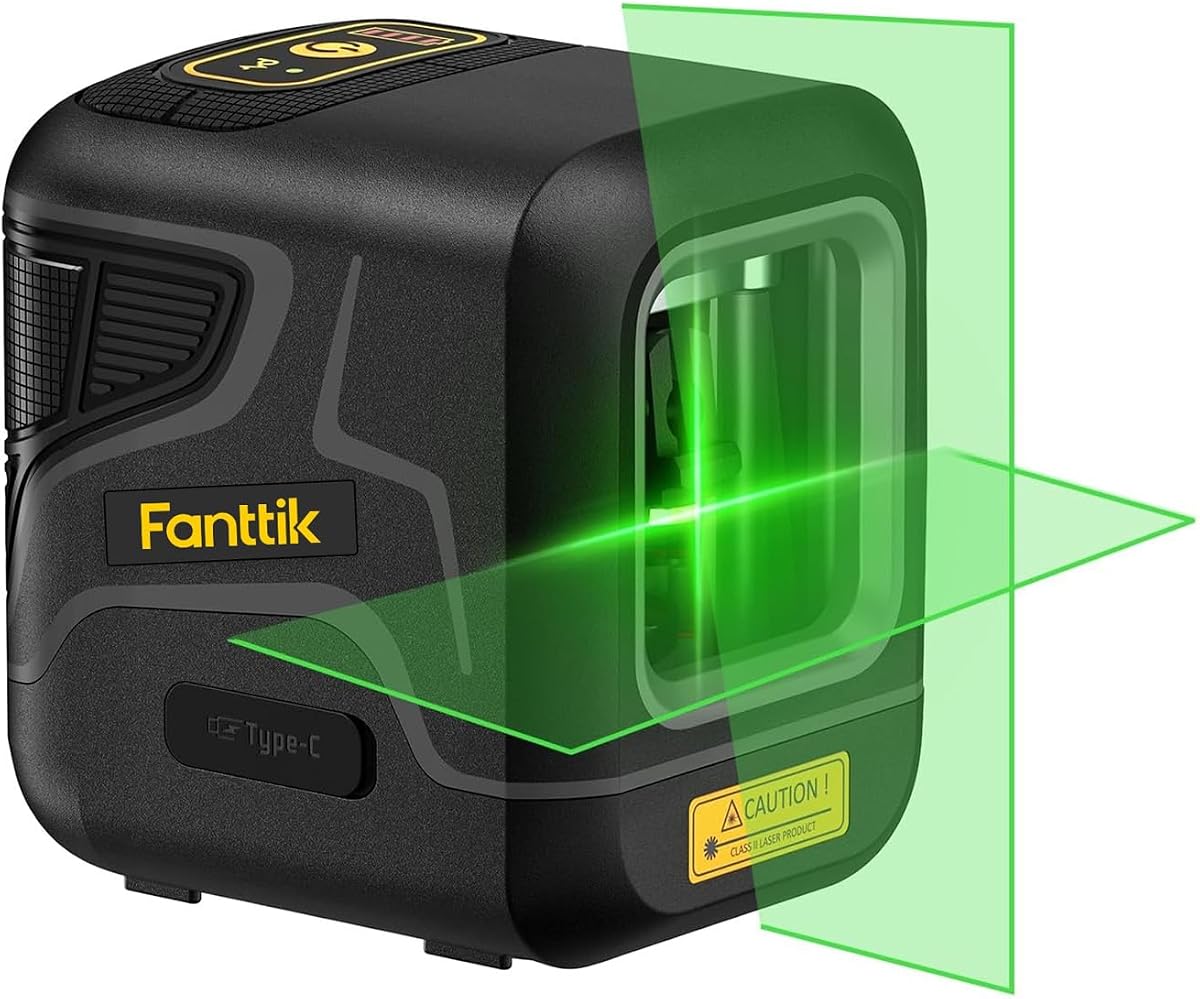
The Fanttik D2 is built for users who want a capable tile reference in a small, portable format. Its 4.5 rating, bright green cross lines, and stated 10-hour runtime distinguish it from basic short-range picture-hanging lasers.
We may earn a commission when you buy through this link, at no additional cost to you.
Accuracy is listed at within 1/8 inch at 30 feet, and the 360-degree rotating magnetic bracket makes it easy to change the line orientation. Self-leveling operates when the pendulum is unlocked, while manual mode supports angled lines for stairs, diagonal patterns, or unusual layouts. The tool weighs only 0.56 pound and includes TPE rubber protection.
Its practical limitation is the absence of a tripod in the stated package. Users can still mount it on metal through the bracket, but those needing a consistent floor- or table-height reference must add their own support. The 164-foot figure applies to pulse mode with a compatible receiver, which is not supplied, so it should not be interpreted as ordinary visible-beam range.
The D2 is a good fit for compact tile repairs, cabinet backsplashes, shelves, picture placement, and small renovation tasks. Its portability makes it easy to carry between jobs without adding bulk. For large-format tile or room-wide grids, a 3D or 4D laser would be a better match.
At 0.56 pound, the D2 is easy to keep in a tool bag and deploy quickly. The drawstring pocket, bracket, and USB-C cable keep the package compact without making it dependent on disposable batteries.
The integrated 2200mAh battery is rated for up to ten hours of continuous work. That figure makes the D2 comfortable for a full day of smaller installations, provided the tool is charged before the session.
We may earn a commission when you buy through this link, at no additional cost to you.
The Huepar BOX-1G combines a 150-foot green cross-line laser with a 40-inch tripod and four AA batteries. Its 4.4 rating and stated ±1/13-inch accuracy at 33 feet make it a strong all-in-one option for installers who value a ready-to-use support system.
We may earn a commission when you buy through this link, at no additional cost to you.
The laser projects a 130-degree horizontal line and a 150-degree vertical line. Users can select a single line or the cross-line pattern, and the single-line setting conserves power during less demanding portions of a layout. The self-leveling pendulum operates within four degrees, while manual mode permits angled projections for stairs and custom patterns.
The included aluminum tripod adjusts from 11.4 to 40 inches and uses a stable three-way head with a quarter-inch thread. It is best treated as an indoor accessory on flat surfaces in windless conditions, not a full outdoor jobsite stand. Outdoor use may also require a receiver because direct sunlight reduces naked-eye beam visibility.
This is a practical choice for bathroom walls, kitchen backsplashes, floors, and general renovation where a cross line and adjustable tripod are enough. It offers a persuasive accuracy specification without the added complexity of app control. Buyers needing lines on every room surface should consider a 3D or 4D model.
The stated ±1/13-inch accuracy at 33 feet is among the more precise figures in this group. It gives tile installers a dependable numerical baseline when judging whether the tool matches the tolerances of their materials and layout system.
The bundled tripod spans a broad working-height range and swivels through common portrait and landscape orientations. It can be placed on flooring, tables, or stable indoor surfaces, although users should protect furniture and confirm the surface is level.
We may earn a commission when you buy through this link, at no additional cost to you.
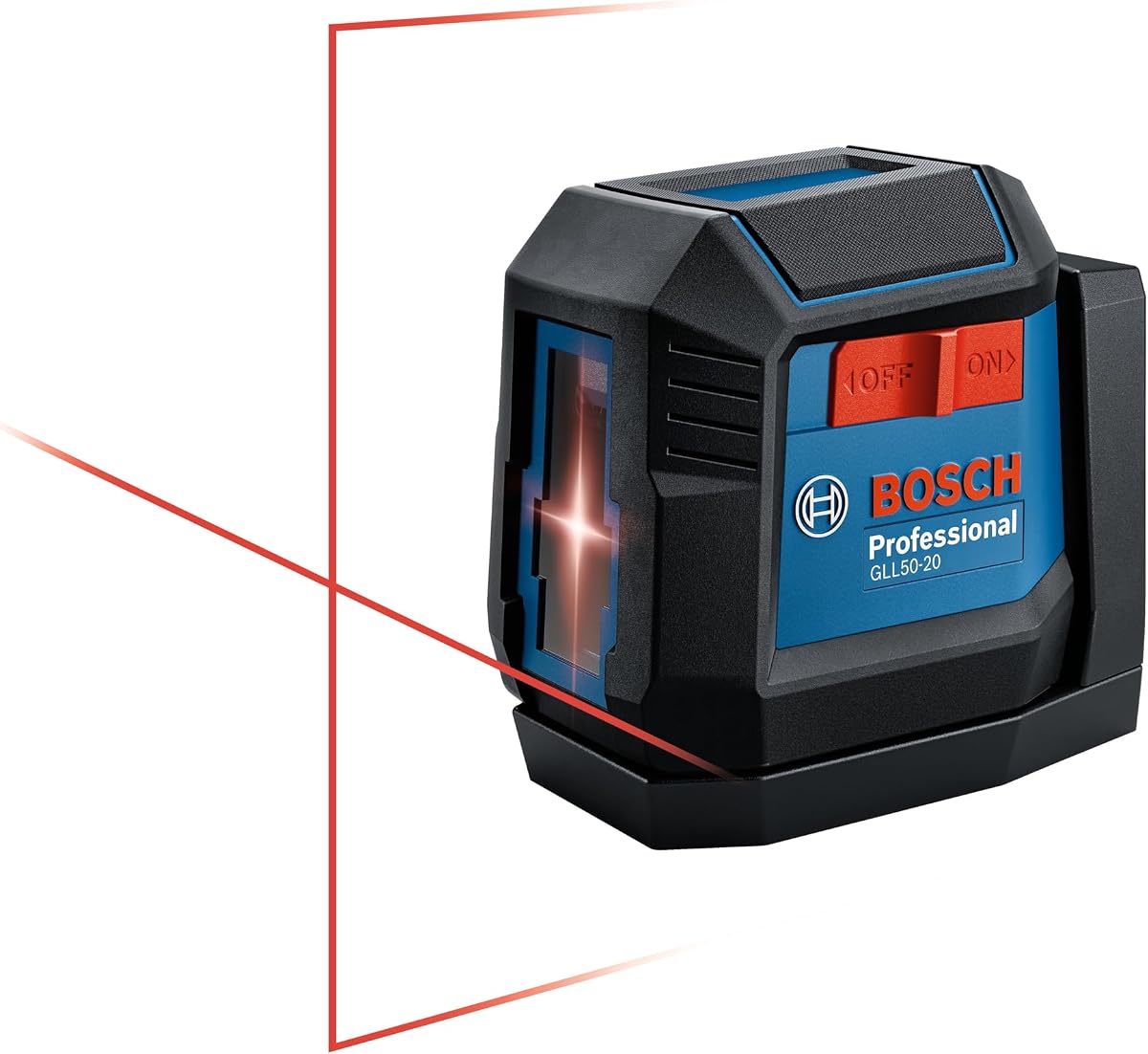
The Bosch GLL50-20 is a compact cross-line laser designed around jobsite durability and flexible mounting. It carries a 4.4 rating, projects level and plumb lines, and uses an integrated mount that works with magnets or a quarter-inch threaded connection.
We may earn a commission when you buy through this link, at no additional cost to you.
Its bright, thin lines cover up to 50 feet, with a stated accuracy of 5/16 inch at 30 feet. That makes it more appropriate for a bathroom, backsplash, cabinet run, or modest room than for a large open interior. The smart pendulum self-levels, blinks when out of level, and locks when switched off for transport.
The full rubber overmold housing protects major impact points, and an IP55 rating adds resistance to dust and water. The tool accepts two AA batteries, which are included, or Bosch's 3.7V Lithium-Ion battery when purchased separately. That makes it simple to start while preserving the option of a rechargeable setup.
Installers who prioritize a straightforward, impact-resistant cross line will find this Bosch useful. The trade-off is a shorter reach and less precise stated tolerance than several green-beam competitors in the guide. It is a sensible pick for compact indoor tile work where portability and rugged construction matter more than maximum coverage.
The roll-cage-like rubber design helps shield the tool at major impact points. Its IP55 rating further supports use in construction environments where dust and occasional moisture are expected.
Integrated magnets allow quick placement on suitable metal surfaces, while the quarter-inch thread fits standard tripods. The combination supports wall, furniture, and freestanding layouts without requiring a separate bracket.
We may earn a commission when you buy through this link, at no additional cost to you.
The Huepar 9011G is a compact green cross-line laser aimed at straightforward wall-tile alignment and general installation work. Its 4.3 rating, 100-foot stated range, and inclusion of a magnetic bracket make it a convenient alternative to larger multi-plane tools.
We may earn a commission when you buy through this link, at no additional cost to you.
The stated accuracy is ±1/16 inch at 16.4 feet, which is notably tight for a compact unit. A 110-degree field provides broad cross-line coverage, and the pendulum self-levels within ±4 degrees. Manual mode unlocks angled projection for stairs, wall patterns, and nonstandard designs, though those lines are not level references.
The package includes the laser, magnetic bracket, two AA batteries, a user manual, and a carry bag. Its soft-grip, palm-sized construction and stated 47.2-inch drop resistance improve portability and durability. The quarter-inch mounting thread allows tripod use, although a tripod is not part of the listed contents.
This is a good fit for installers laying tile along a wall or working within a relatively compact room. Users should place it on a stable, level surface or verify an uneven tripod head if the line flashes. For a sprawling room with multiple opposing walls, a 3D or 4D laser offers more convenient coverage.
The ±1/16-inch rating at 16.4 feet is useful for small-format wall layouts and detailed positioning. It provides a strong case for this model when the working area is close and precision matters more than multi-room projection.
Sliding the pendulum to its unlocked position enables self-leveling, while the locked position enables manual projection. The distinction is simple to learn, although a stable, level mounting surface remains important.
We may earn a commission when you buy through this link, at no additional cost to you.
The Klein Tools 93CPLG combines three 360-degree green laser planes with a compact, rechargeable design. It carries a 4.4 rating and gives tile installers broad room coverage without the larger footprint associated with some professional multi-plane lasers.
We may earn a commission when you buy through this link, at no additional cost to you.
The horizontal and vertical planes are stated to shine up to twice as brightly as standard red beams, improving visibility in many working environments. The stated range reaches 100 feet, while the integrated rechargeable battery provides more than six hours of runtime. The compact, lightweight body is intended to remain easy to store and use in confined work areas.
Tilt mode locks the pendulum so the laser can be held at different angles. That flexibility is useful for stairs or angled layout references, though the unit does not offer the app and remote controls found on the CIGMAN. Its internal battery is non-removable, so charging downtime is less convenient when a spare battery would normally be helpful.
This is an excellent option for professional tile installers who want 360-degree reference planes in a portable package. It is especially fitting for renovation crews moving a single reference tool between bathrooms, kitchens, and commercial interiors. The CIGMAN offers finer interface control, while the Klein prioritizes a simpler, established professional format.
The 360-degree horizontal and vertical planes provide the broad alignment coverage expected from a 3D laser. The stated compact construction makes it easier to transport between rooms without adding a large dedicated case.
The built-in rechargeable battery offers more than six hours of operation and removes the need to carry spare cells. Its non-removable design favors convenience over uninterrupted swapping.
We may earn a commission when you buy through this link, at no additional cost to you.
The DEWALT DW088K is a red-beam self-leveling cross-line laser with a 4.7 rating, durable overmolded housing, and an integrated magnetic bracket. It remains a recognizable option for contractors who need dependable level and plumb references around tile walls and installation areas.
We may earn a commission when you buy through this link, at no additional cost to you.
The laser is rated for approximately 1/8-inch accuracy at 30 feet. When paired with a compatible detector, its range can reach up to 165 feet, although neither the detector nor a tripod is included in the stated package. The integrated magnetic bracket offers a quick way to position the unit on suitable metal surfaces.
Durability is a central selling point. The housing has a one-meter drop rating, while an IP54 rating helps protect against water and debris. A durable storage case is included, making storage and transport more convenient for a tool that may move between several job sites.
The principal trade-off is visibility. A red line can be harder to see than the brighter green beams used by many competitors, especially in strongly lit rooms. Even so, this is a strong pick for users who prefer the DEWALT platform and primarily need a cross-line tool for interior tile and general construction layout.
The one-meter drop rating and overmolded construction suit tools that are repeatedly carried, mounted, and removed. IP54 protection further reduces concern around dust and light moisture encountered during interior renovation.
A compatible detector can extend the usable range to 165 feet, which is helpful in large rooms or brighter conditions. Because the detector and tripod are sold separately, include those costs and compatibility needs in the overall purchase plan.
We may earn a commission when you buy through this link, at no additional cost to you.
The most useful laser level for tile work is not automatically the model with the most lines. Consider room size, installation type, lighting, mounting method, and the level of precision your layout system requires before choosing.
A basic cross-line laser projects one horizontal and one vertical reference and is usually sufficient for a single backsplash or wall. A 3D laser adds vertical 360-degree planes, while a 4D model adds both horizontal and vertical 360-degree coverage. Wider coverage makes it easier to align opposing walls, floor tile, ceiling lines, cabinets, and repeating tile courses without moving the unit constantly.
Choose a cross-line for a focused installation and a 3D or 4D laser for whole-room tile layouts. More planes are not automatically better, because unnecessary lines can make intersections harder to interpret.
Accuracy specifications indicate how closely the projected line follows the manufacturer's reference under stated conditions. Figures such as ±1/8 inch at 30 feet may be adequate for many tile layouts, but large-format tile, diagonal patterns, and tightly controlled cabinet runs can benefit from a tighter rating. Always compare accuracy at the same distance, because a precise value at a short range may not apply across a full room.
Match the tolerance to the material and layout system rather than chasing the smallest number alone. Check that the stated working distance covers the farthest point you need to reference.
Green beams are generally easier for many users to see than red beams, particularly in bright work areas. Visibility also depends on ambient light, room finish, the camera or human eye, and the laser window. Reflective surfaces such as glass, mirrors, and glossy tile may scatter light and create the appearance of extra lines or false intersections.
For a highly reflective tile installation, control glare and reposition the laser when possible. A model with selectable lines can reduce confusion by limiting the number of visible planes.
A self-leveling pendulum allows the laser to correct for modest surface tilt. The listed self-leveling ranges in this guide are generally around ±3 or ±4 degrees, and the tool should be placed on a stable, level surface or a properly leveled tripod head. Flashing lines usually indicate that the pendulum is beyond its leveling range or that the unit is in manual mode.
A wider self-leveling range adds tolerance for imperfect setup, but stability matters more than the nominal number. Use a firm mounting point and do not treat a flashing warning as a usable level reference.
A quarter-inch thread is common on many laser levels, while a 5/8-11 thread accommodates heavier tripods and laser poles. Magnetic brackets are useful around metal framing, cabinetry, and suitable construction steel, but painted or nonmagnetic surfaces require a screw, nail, clamp, or tripod. Check the stated package because tripods, receivers, and some brackets are frequently optional.
For regular tile work, a stable tripod with a three-way head can be more valuable than extra laser features. Include a receiver only if you expect bright conditions or extended indoor range.
AA-powered tools are simple to keep running because spare batteries are easy to obtain, while rechargeable systems reduce recurring battery replacement. Runtime claims vary with selected lines and brightness, so treat the highest stated figure as a best-case guide. USB-C charging is convenient for contractors who already carry modern cables, and battery-status indicators help prevent unexpected shutdowns.
Choose disposable cells for simplicity and rechargeable power for frequent use. If the battery is not removable, plan charging around the work schedule rather than relying on a hot swap.
IP54 and IP55 ratings indicate varying levels of protection against dust and water, but neither rating makes a laser suitable for submersion or heavy rain. Rubberized housings, stated drop ratings, secure cases, and locking transport pendulums help protect the delicate internal mechanism. A lockable pendulum is particularly useful when the tool is carried in a vehicle or stored in a crowded toolbox.
Prioritize a rugged body and secure storage for construction use. Keep the lens window clean and protect the tool from impacts even when its stated construction is rugged.
Single-line operation conserves power and reduces visual clutter, while individual line selection is valuable in a 3D or 4D model. Remote controls and apps can make a mounted unit easier to manage, particularly when the relevant switches face away from the installer. Pulse mode improves compatibility with receivers, though it does not guarantee that a beam will be clearly visible in direct sunlight.
Choose advanced controls when they solve a recurring problem. If you mostly establish one wall at a time, a simple cross-line model may be easier and faster than a feature-heavy multi-plane laser.
Begin by choosing a stable mounting point and checking the room's reference surfaces with a conventional level. Set the laser on a level tripod, secure the locking screw, and place the tool where the beam will not be interrupted by workers, tile stacks, cabinet doors, or other moving objects. Confirm that the pendulum is unlocked for self-leveling and that the line has stopped flashing.
Mark the laser line lightly along the substrate rather than directly on finished tile whenever possible. Establish a perpendicular reference, check both ends of the proposed row, and then measure from the line to the wall or layout origin. Keep the instrument stationary during the marking process, and do not move it until all references have been recorded.
After the work, switch the laser off so the pendulum can lock for transport, then remove the batteries if the model uses them. Wipe the lens window with a soft, dry cloth, keep the housing dry, and store the unit in its case. Lock the pendulum and avoid placing the tool where it may be struck, exposed to excessive heat, or left with batteries installed for long periods.
It depends on the installation. A standard cross-line laser is enough for a single wall or backsplash, but 360-degree coverage is valuable for whole-room floors, multiple walls, cabinets, and repeating tile courses. A 3D or 4D model can save repeated repositioning, provided its extra lines do not make the selected reference confusing.
Green light is often easier to see in many indoor environments, which can make marking intersections more convenient. Red lasers can still work well in controlled lighting and may suit users who already favor a particular tool platform. Consider beam visibility, surface glare, and the presence of a compatible receiver rather than color alone.
Flashing commonly means the unit is tilted beyond its self-leveling range or that the pendulum is locked in manual mode. It can also indicate an unstable tripod or uneven surface. Place the tool on a firm, level support, check the pendulum position, and confirm that the mounting head is locked before using the line as a reference.
The required tolerance depends on tile size, material, wall condition, grout joint, and whether cuts can be adjusted. A stated accuracy around 1/8 inch at 30 feet may suit some layouts, while tight-pattern work may favor a more precise figure. Always compare specifications measured at the same distance and verify the tool on your actual surface.
Often, no. A visible line is usually sufficient indoors, and a receiver becomes more useful when the beam is faint, the room is large, or the work area has intense lighting. If you choose a model with pulse mode, confirm that the receiver supports the same laser color and operating mode before buying it separately.
A laser can help with alignment, but glossy tile and glass may reflect the beam and create false lines or distracting glare. Work from a matte substrate whenever possible, reduce ambient reflections, and position the laser to minimize the reflected path. If extra lines appear, verify them against a conventional level before marking.
A tripod is worthwhile for long tile layouts because it keeps the reference height steady and reduces the chance of shifting the tool. Some bundles include one, while established cross-line models often sell it separately. Confirm the thread size, stability, and intended indoor or outdoor use before purchasing a separate stand.
Outdoor visibility depends on the model, pulse mode, and receiver support. Direct sunlight can overwhelm a visible beam even when the tool has a long nominal indoor range. For exterior tile work, choose a laser and receiver explicitly rated for outdoor conditions, protect the unit from weather, and use a stable tripod designed for the environment.
The CIGMAN CM-G16 is the strongest all-around option because its 16 lines, selective controls, app, and remote support complex tile layouts. The Huepar HM03CG offers a refined three-plane alternative with premium mounting and warranty support, while the Klein Tools 93CPLG provides 360-degree coverage in a compact professional format.
For simpler installations, the Motovera bundle and Huepar cross-line options are easier to start with, especially when a tripod is already included. Prioritize projection coverage for multi-wall work, accuracy for precise layouts, and mounting stability for long jobs. A simpler cross-line laser remains a sensible choice when the project only needs one horizontal and one vertical reference.
Before buying, confirm the current product listing, rating, warranty terms, and included accessories. Prices and promotions can change, while tripods, receivers, and brackets may be sold separately. Check the stated range at your actual working distance and ensure the supplied mounting hardware fits the surfaces and supports in your project.