
260W Portable Power Inverter for Makita 18V Battery
4.4Editor score
260W AC output
Three USB charging ports
Built-in LED work light
Our guide compares the best Inverter for Makita 18V Battery options, covering power, ports, lighting, runtime, safety, and portability.
An inverter for Makita 18V Battery turns a compatible tool battery into a convenient source of AC and USB power for work sites, campsites, road trips, and emergency use. A worthwhile model should match available output to your devices, fit your Makita battery system, and provide useful safeguards against overload, overheating, and excessive discharge.
We compared all ten options by their rated power, AC waveform, supported battery configuration, charging ports, work-light functions, displays, dimensions, and safety features. The list covers compact single-battery units, higher-output pure sine wave models, and dual-battery designs that extend runtime when compatible packs are installed.
Each review explains where a product stands out and where its trade-offs may affect a purchase. Ratings reflect the supplied customer feedback and can change over time, while prices and availability also fluctuate, so readers should confirm current listing details before ordering or checking the final purchase decision.
4.4Editor score

4.3Editor score

4.1Editor score
The comparison below organizes each inverter by output, waveform, ports, lighting, and battery flexibility, making it easier to match a compact option or higher-capacity design to specific electronics and travel needs.


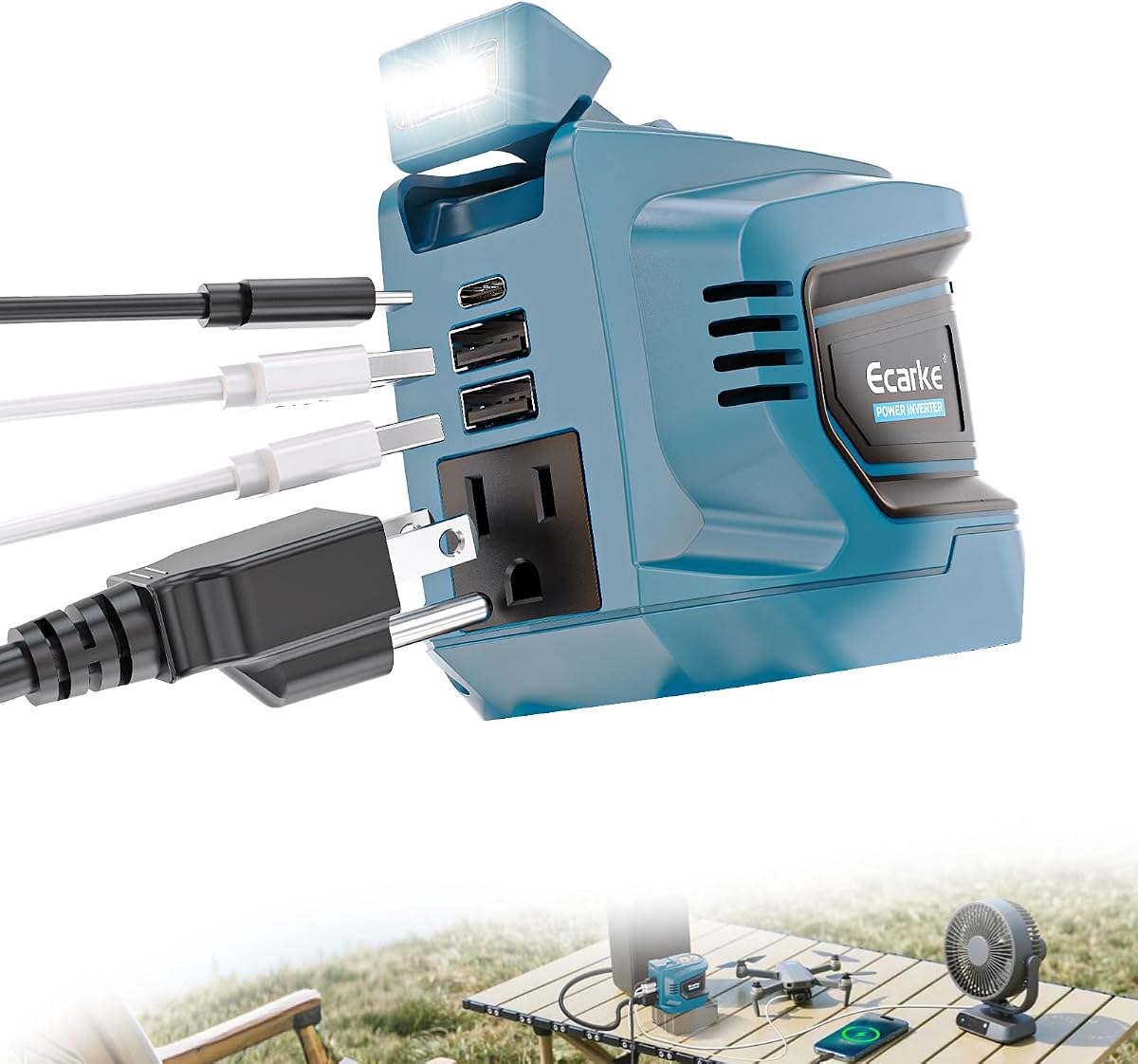

The Ecarke 220W Portable Power Inverter is designed for people who want a genuinely small Makita-battery power source without giving up the convenience of household AC. It has a 4.2 rating and is among the most compact selections here, weighing only 0.68 pounds. That size makes it especially appealing for a crowded tool bag, vehicle glove box, or lightweight camping pack.
We may earn a commission when you buy through this link, at no additional cost to you.
Its 220W continuous and 250W peak output is suitable for laptops, tablets, phones, LED lighting, mini projectors, camera chargers, and heating-element soldering irons. The outlet array includes one AC socket, two 5V/2.1A USB-A ports, and one 5V/2.1A Type-C port with 20W total output. This combination allows several small electronics to charge at once while still providing conventional AC power when needed.
The built-in 200-lumen LED has low, medium, and high brightness levels, an 85-degree adjustment, and an SOS strobe mode. Protection features include automatic shutoff below 15V, along with over-current, overload, overheat, and short-circuit protection. A cooling fan supports operation under load, although users should still account for the lower wattage ceiling and battery depletion when running demanding equipment.
This is the most travel-friendly choice for light electronics, charging tasks, and emergency illumination. It is less suitable for powering a high-draw appliance or as a backup for extended heavy use. Buyers who already own a compatible Makita 18V battery and prioritize pocketability over maximum output should consider it the most practical compact option.
At 0.68 pounds, the Ecarke is easy to carry without making a backpack feel bulky. Its modest 220W output still covers common travel and job-site electronics, making it a good fit for users who need an outlet rather than a full-size portable power station.
The adjustable LED, two USB-A ports, and Type-C port expand the inverter beyond a single AC outlet. These features make it practical for campsite charging, map reading, roadside repairs, and brief power needs away from a wall.
We may earn a commission when you buy through this link, at no additional cost to you.
The Kzreect 350W Pure Sine Wave Inverter is the strongest premium-oriented option in this roundup, with clean AC output, extensive charging support, and a dual-battery architecture. Its 4.1 rating reflects a capable package designed for users who need dependable power for laptops, CPAP machines, projectors, and other sensitive devices while away from wall outlets.
We may earn a commission when you buy through this link, at no additional cost to you.
The inverter supplies up to 350W of pure sine wave power through two AC outlets, with a combined maximum of 350W. It accepts two compatible Makita 18V battery packs and can switch between them automatically for extended runtime. A 140W USB-C PD3.1 port supports both input and output, while an additional 65W USB-C port and two 18W USB-A ports cover phones, tablets, and other USB-powered devices.
The 600-lumen LED provides three brightness levels, a strobe, and an SOS mode. Safety features include overload, short-circuit, overheating, and over-discharge protection, along with an intelligent cooling fan. The listed guidance favors 4Ah or larger batteries for best results. Users should also note that AC and USB outputs are disabled while the installed batteries are charging.
This is the most compelling option for sensitive electronics, extended portable use, and people willing to carry more than one battery. The trade-off is operational complexity around charging and the need to plan around combined output limits. Despite those constraints, the waveform, USB-C power, and battery switching make it a well-rounded premium choice.
Pure sine wave output is the defining feature of this model. It is better suited than a basic modified-wave inverter to electronics that can be sensitive to irregular AC waveforms, including portable medical equipment and quality audio or video systems.
Supporting two compatible battery packs gives users a way to extend operation without carrying a separate generator. Automatic switching improves convenience when the first pack reaches its limit, although battery capacity still determines total runtime.
We may earn a commission when you buy through this link, at no additional cost to you.
The LIVOWALNY 550W Power Inverter is the highest-capacity model listed and stands out for people who need more flexibility than a compact 200W or 220W unit can offer. It has a 4.0 rating, two AC outlets, clean pure sine wave output, and the ability to operate with one or two Makita 18V batteries.
We may earn a commission when you buy through this link, at no additional cost to you.
Its two AC outlets deliver 110V at 60Hz, while the USB array consists of one 24W USB-C port and two 20W USB-A ports. The listed device combination supports charging as many as five products at once. Connecting two compatible 18V packs enables parallel operation for longer runtime, while the unit continues to function with a single battery.
A built-in emergency light offers three brightness levels of 200, 400, and 600 lumens. The product is presented for laptops, tablets, cameras, medical equipment, camping, road trips, offices, and backup use. Its most notable distinction is the 550W inverter capacity, though users should verify the actual continuous output of any connected load and avoid exceeding the product's stated limits.
Choose this unit when a 350W ceiling may be too restrictive and when you already own compatible high-capacity batteries. The trade-off is a potentially bulkier setup and the need to monitor output carefully. Its combination of dual outlets, pure sine wave power, and parallel battery support makes it the most ambitious option in the list.
A 550W inverter capacity gives this model more room for compatible equipment than the other selections. That makes it relevant to users who want flexibility for a mix of electronics rather than only small travel accessories.
Running two compatible packs in parallel can extend runtime substantially. The single-battery fallback also means the inverter can remain useful when only one pack is available or practical to carry.
We may earn a commission when you buy through this link, at no additional cost to you.
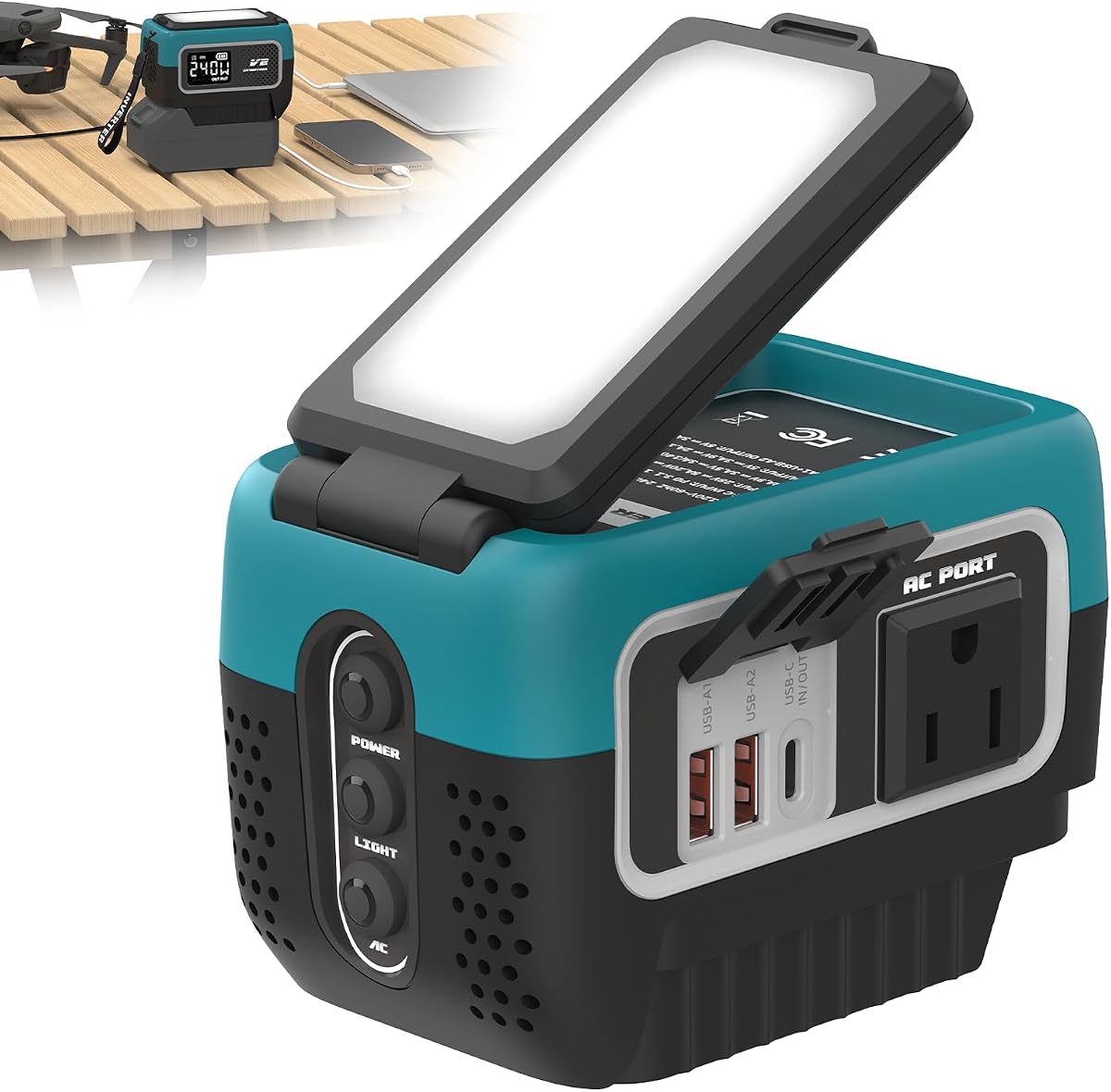
The 260W Portable Power Inverter for Makita 18V Battery delivers the most balanced mix of useful capacity, compact size, and straightforward operation. Its 4.4 rating is the second-highest among the ten products, making it a notable option for buyers who want more capability than the smallest 200W models without moving to a larger dual-battery design.
We may earn a commission when you buy through this link, at no additional cost to you.
It converts an 18V Makita battery into 110V AC with a 260W maximum. The product information notes that higher peak power helps start motor-driven equipment such as small refrigerators and pumps, although users should still verify the operating requirements of a specific appliance. Connections include one AC outlet, two 5V/2A USB-A ports, and one Type-C port supporting PD and QC up to 10W.
The plug-and-play battery arrangement is intended for Makita's blue and black sliding-interface 18V lithium-ion series, with no extra adapter required. A simple LED work light supports camping, vehicle repairs, outages, and tool storage. Short-circuit, overcurrent, low-voltage, overheating, overload, and over-discharge protection are complemented by an active cooling fan.
At approximately 380 grams, this is a strong recommendation for everyday portable power, particularly for laptops, fans, small televisions, drones, LED equipment, and selected medical devices. Its limitations are the lack of dual-battery support and the modest 10W Type-C output. Even so, it offers an effective core feature set at a budget-oriented level.
A 260W ceiling sits between the most compact units and the 350W models. It gives users enough room for common electronics while preserving a light, uncomplicated package that can be moved easily between a toolbox and a camping bag.
The sliding battery interface makes the unit attractive to existing Makita owners because no separate adapter is required. Inserting a compatible pack, pressing the power button, and using the outlets keeps the setup direct.
We may earn a commission when you buy through this link, at no additional cost to you.
The Ecarke 350W Power Inverter is an unusually complete option for users who want more than a basic battery adapter. It combines a 350W AC output, two 70W USB-C Power Delivery ports, an 18W USB-A port, a dedicated 12V DC socket, an 800-lumen work light, and a digital monitoring display. Its 4.3 rating reflects a versatile design that works for charging, powering, and illumination.
We may earn a commission when you buy through this link, at no additional cost to you.
The smart display reports battery voltage, current wattage, battery level, and error codes. A load-balancing chip distributes power across connected ports while keeping the total at or below 350W. Independent AC and DC switches let users disable the AC section while retaining DC or LED functions, which can preserve runtime when only low-power accessories are needed.
The light provides 400, 600, or 800 lumens and switches between 3000K warm white and 5000K cool white, plus an SOS strobe. Thermal management is handled by a heatsink and cooling fan. Seven protection features cover overload, short circuit, overheating, over-discharge, over-current, low voltage, and reverse polarity, with shutdown below 15V and an audible fault buzzer.
This is the most appealing all-rounder for a traveler, tradesperson, or technology user who wants meaningful USB-C charging in a tool-bag format. The shared output ceiling requires attention when several high-wattage devices are connected, and the manufacturer recommends removing the battery after use. Even with those points, the combination of ports, display, lighting, and controls makes this an excellent general-purpose choice.
Two 70W USB-C PD ports can charge compatible laptops faster and more conveniently than basic 10W or 20W Type-C connections. This makes the inverter more useful for mobile work where a full charging brick is impractical.
The bright adjustable light is useful for repairs, campsites, and roadside work. Independent AC and DC switches add further control by allowing the lighting or lower-power DC output to remain active without running the main AC outlet.
We may earn a commission when you buy through this link, at no additional cost to you.
The Kzreect 240W Pure Sine Wave Inverter combines clean AC with unusually fast USB-C charging in a single-battery format. It carries a 4.3 rating and targets laptops, CPAP machines, projectors, small televisions, and other sensitive electronics, making it a strong middle ground for mobile use.
We may earn a commission when you buy through this link, at no additional cost to you.
Its one AC outlet supplies up to 240W of 120V pure sine wave power. USB-C PD3.1 supports up to 140W output and accepts up to 140W input at 7A, allowing a compatible PD3.1 charger to recharge the installed battery without a separate battery charger. Two additional USB-A ports provide 18W each for phones, accessories, and smaller devices.
The built-in light offers 100, 300, and 600-lumen levels plus strobe and SOS modes. Its adjustable head can direct illumination toward repairs, a tent, or a roadside scene. The display provides battery level, charging status, and input or output power, while overload, overheating, over-discharge, and short-circuit protections are assisted by an intelligent cooling fan.
This model is best for someone who values clean power and high-speed laptop charging but does not need multiple AC sockets or dual-battery runtime. Its single-battery design simplifies packing, while the 240W limit still covers a good range of low- and medium-draw equipment. For users who want a refined portable inverter without a larger footprint, it is a particularly well-rounded choice.
The dual-role Type-C port accepts up to 140W input, offering a convenient way to replenish the installed battery from a compatible charger. That can reduce the number of separate charging components a user needs to carry.
Unlike many compact 200W and 220W alternatives, this model uses pure sine wave AC. That gives it broader relevance for sensitive electronics while preserving a relatively modest 240W output ceiling.
We may earn a commission when you buy through this link, at no additional cost to you.
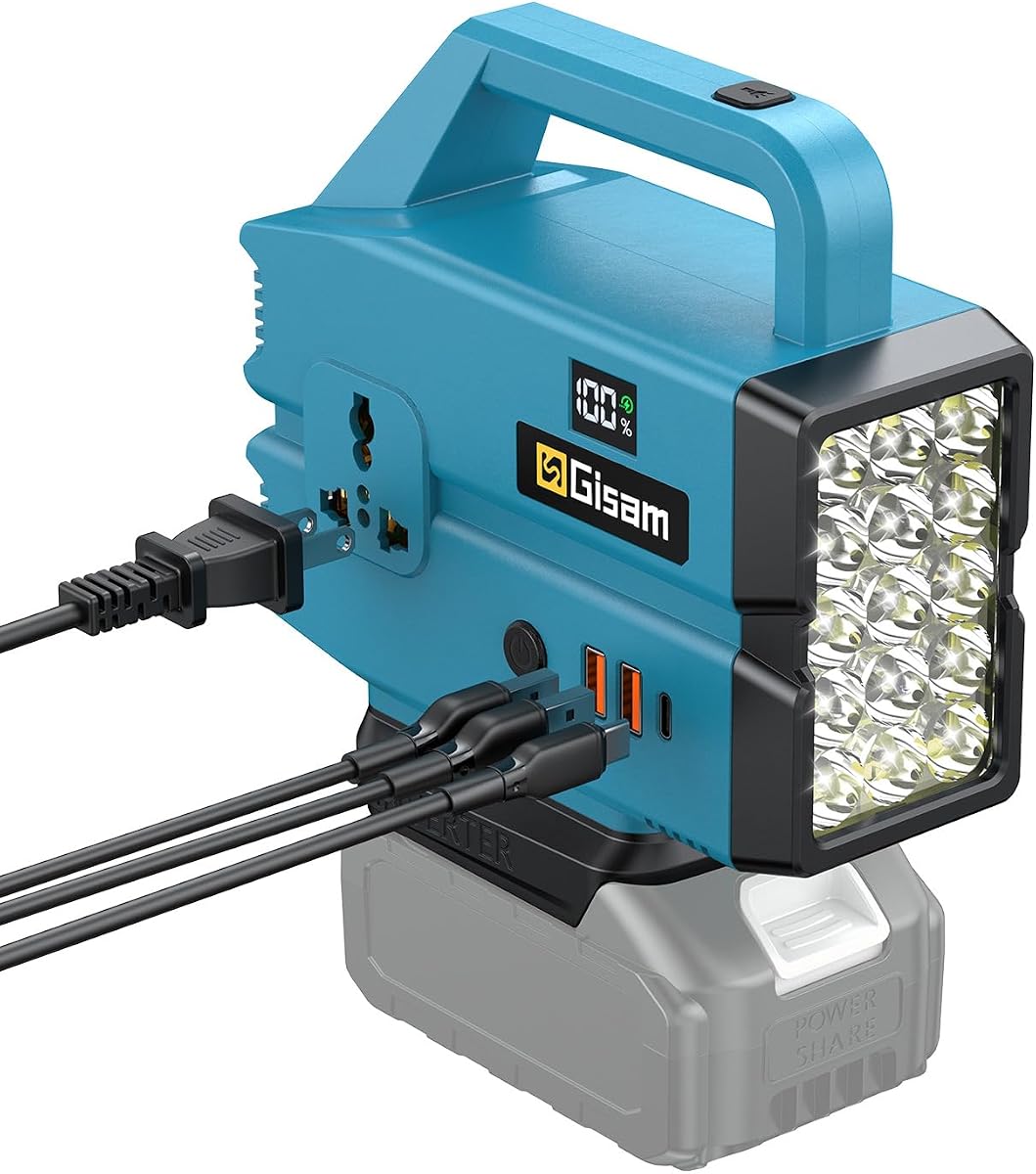
The GISAM 200W-250W Portable Power Inverter has a 5.0 rating, the highest numerical customer score in the group. It combines a 200W continuous AC output with 250W peak capability, two 70W Type-C ports, one 18W USB-A port, a dedicated 12V DC socket, and an independent high-output work light.
We may earn a commission when you buy through this link, at no additional cost to you.
The sliding battery connection is compatible with Makita 18V lithium-ion packs, including BL1850B, BL1840B, BL1830B, and other supported models. AC output converts the battery's 18-21V DC supply into 110V AC. Suitable loads include laptops, projectors, car refrigerators, drones, and other lower-wattage electronics, provided the device's requirements are checked before operation.
A 30W LED offers low, high, and SOS strobe modes with a listed illumination distance of up to 35 meters. The separate light switch means the lamp can operate independently of the inverter outputs. An LCD screen provides real-time battery level, and eight-part protection covers short circuit, overcurrent, under-voltage, over-voltage, overload, and over-temperature conditions. An active fan improves heat dissipation.
At 0.95 pounds, this is a capable compact option for USB-C charging, light, and modest AC loads. The 200W continuous limit and single AC outlet are less accommodating than higher-output models, and actual performance will depend on battery capacity and load. Still, its high rating, strong Type-C options, and separate work light make it particularly attractive for mobile users.
Although the AC inverter is limited to 200W, the two 70W USB-C ports create useful charging flexibility. Laptops, phones, tablets, speakers, and other compatible USB devices can draw power without occupying the single AC socket.
The dedicated 30W lamp can operate separately from the power outputs and offers low, high, and emergency modes. That separation makes the inverter useful for illumination even when inverter capacity is reserved for another device.
We may earn a commission when you buy through this link, at no additional cost to you.
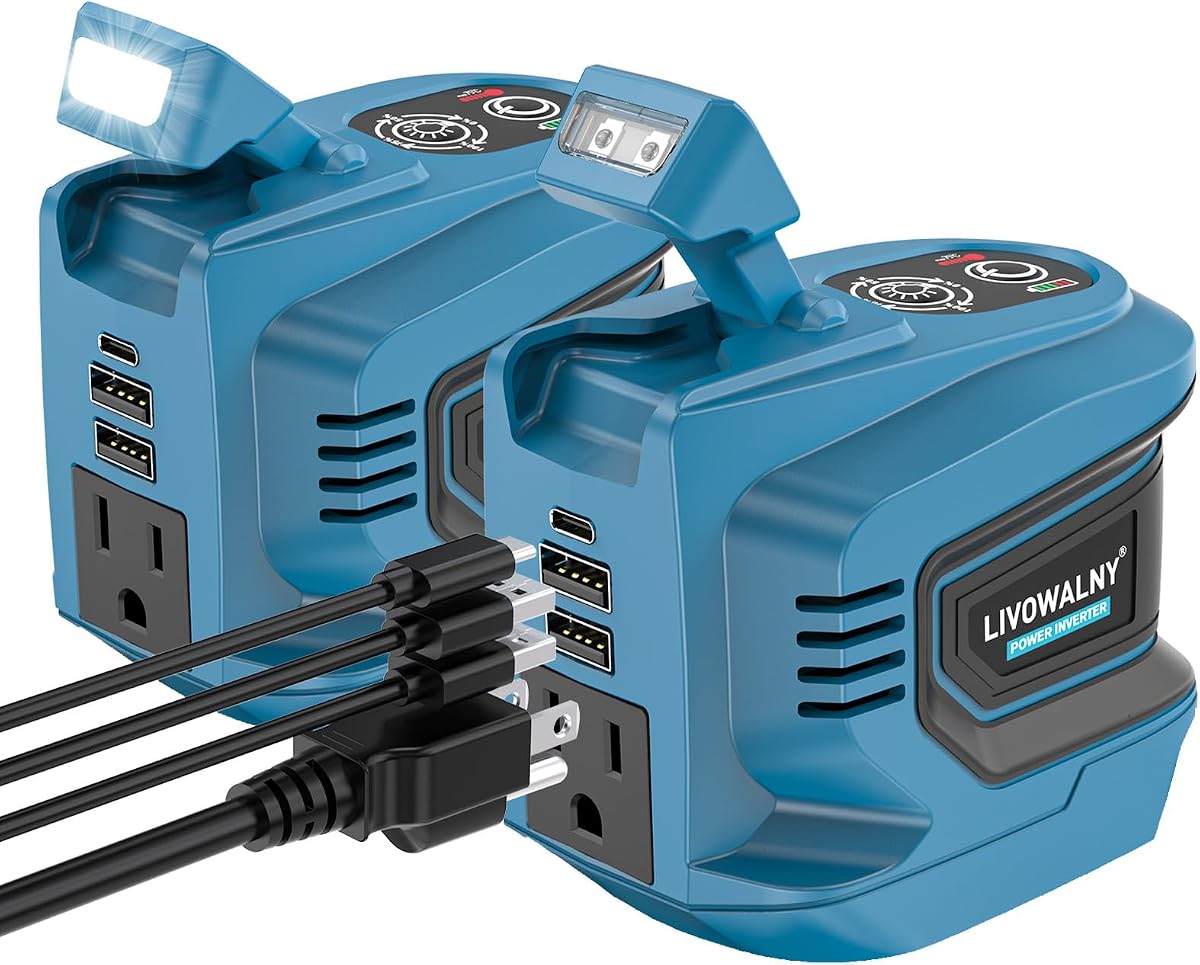
The LIVOWALNY 220W-250W two-pack offers a different proposition from the other products: redundancy instead of maximum single-unit power. It includes two compact inverter bodies, each designed to connect directly to a compatible Makita 18V lithium-ion battery. The product has a 4.1 rating and is aimed at users who want a spare unit or plan to divide power between different kits.
We may earn a commission when you buy through this link, at no additional cost to you.
Each inverter provides one 110-120V AC outlet rated to 220W. The charging hub adds two 5V/2.1A USB-A ports and one Type-C port rated for 36W, allowing phones, tablets, cameras, headphones, and other devices to charge alongside AC-powered equipment. The battery interface is designed to work without a separate adapter, though the battery and charger are not included.
A 200-lumen adjustable spotlight offers three brightness modes and an 85-degree angle adjustment. The dimensions are listed as 4.5 by 3 by 3.7 inches, with a weight of 0.68 pounds per compact unit. Overload, short-circuit, overheating, and battery-drain protection help support safe use.
This two-pack is most useful for owners with multiple battery-based kits, families sharing equipment, or users who want backup redundancy. It does not double the output of one inverter, and two separate batteries may be needed to keep both units operating. For travelers who value a backup, however, the arrangement is convenient and flexible.
Two small inverter bodies can be placed in different tool bags, vehicles, or camping kits. That avoids moving one unit back and forth when both locations need occasional charging or lighting.
Each unit combines one AC outlet, two USB-A connections, and a 36W Type-C port. The selection is suitable for travel kits where phones, cameras, headphones, and a small AC-powered device may need charging at the same time.
We may earn a commission when you buy through this link, at no additional cost to you.
The 200W Power Inverter for Makita 18V Battery is a simple, compact adapter for turning an existing tool battery into power for common travel and job-site devices. Its 4.2 rating and uncomplicated layout make it a practical entry point for people who primarily need to charge USB devices, light a workspace, or operate small AC-powered electronics.
We may earn a commission when you buy through this link, at no additional cost to you.
The battery interface fits Makita 18V lithium-ion packs such as BL1830B, BL1860B, BL1820B, BL1840B, and BL1850B. The listed compatibility removes the need for a separate adapter, although the battery is not included. Its 110V AC outlet supports loads up to 200W, which makes it more appropriate for laptops, cameras, and small appliances than high-draw tools or appliances.
Two 5V/2.1A USB-A ports and one 5V/3A Type-C port provide up to 20W of rapid charging for phones, tablets, headphones, and similar devices. A built-in 200-lumen spotlight has high, medium, and low modes with a 120-degree adjustable head. These functions give the compact unit value beyond its basic AC conversion.
A fan-cooled design is paired with protection against overheating, overload, short circuit, over- or under-voltage, and battery over-discharge. The result is a straightforward inverter with fewer advanced monitoring features than several rivals. Buyers seeking a simple charging and lighting solution will find it easy to understand, while heavier loads will require a higher-output model.
The direct fit for common Makita 18V packs keeps setup uncomplicated. It is an accessible way to reuse an existing battery for travel, charging, and emergency power without carrying a conventional generator.
The 120-degree adjustable light head can illuminate a vehicle repair, campsite, or toolbox. Three brightness levels let users balance visibility against battery consumption.
We may earn a commission when you buy through this link, at no additional cost to you.
The LIVOWALNY 350W Portable Power Inverter delivers one of the most versatile port arrangements in the roundup. It combines a 110V AC outlet, two 70W USB-C PD ports, an 18W QC USB-A port, and a dedicated 12V DC output within a 1.35-pound package. Its 4.1 rating makes it a strong choice for users who need more than a basic AC adapter.
We may earn a commission when you buy through this link, at no additional cost to you.
The two USB-C ports can charge compatible laptops, while the USB-A connection supports phones and smaller accessories. The 12V DC socket is a distinctive addition for heated mugs, humidifiers, Bluetooth microphones, and mini fans. These dedicated low-voltage options are useful when users want to preserve battery capacity and avoid unnecessary AC conversion.
The 800-lumen LED provides 400, 600, and 800-lumen levels, warm or cool color modes, and an SOS strobe. A digital screen displays battery voltage, power consumption, battery level, and error codes. Automatic load balancing distributes power across the ports while maintaining a maximum of 350W, and separate AC and DC switches can reduce consumption when the AC outlet is not needed.
A heatsink and cooling fan support thermal management, while seven protections cover overload, short circuit, overheating, over-discharge, over-current, low voltage, and reverse polarity. Low-voltage shutdown occurs below 15V. The main trade-off is the shared output ceiling, and the manufacturer advises detaching the battery after use. Even so, the controls, ports, and light make this an excellent all-purpose travel and work-site unit.
The port mix goes beyond the common one-outlet, two-USB design found on many compact competitors. Dedicated USB-C and 12V options give it value for both modern laptops and low-voltage accessories.
The digital display provides the information needed to manage a shared output budget. Users can monitor battery level, voltage, wattage, and error codes rather than discovering excessive draw only after shutdown.
We may earn a commission when you buy through this link, at no additional cost to you.
The right Makita battery inverter depends on the electronics you plan to power, how much runtime you need, and how portable the setup must be. Output class, waveform quality, ports, lighting, and battery handling should be weighed together before purchase.
Begin by identifying the maximum continuous wattage of every device that may operate at the same time. A 200W or 220W inverter works for small electronics and travel accessories, while 260W to 350W provides more room for laptops, fans, projectors, and compatible low-power appliances. The 550W-capacity LIVOWALNY is intended for users seeking the highest stated capacity, but the product description does not provide the same detailed continuous-output framing found on several rivals.
Match the inverter to the load rather than choosing solely by the largest number. Motor-driven equipment can create startup surges, so users should verify both running and start-up requirements. The GISAM model specifically notes a 250W peak output, and the Ecarke 220W unit also lists a 250W peak. For sensitive devices, staying comfortably below the maximum is prudent.
Pure sine wave output is the preferred choice for sensitive electronics because it provides smoother, more regular AC power. It is particularly relevant for CPAP machines, medical equipment, projectors, laptops, and audio equipment. The Kzreect 240W and 350W models and the LIVOWALNY 550W and 350W models are identified as pure sine wave products, giving this roundup several clean-output choices.
Basic modified-sine designs may be adequate for simple chargers or less sensitive loads, but they can produce noise or affect equipment performance. Users should follow the requirements of the device manufacturer rather than assuming every inverter is interchangeable. If a device list includes sensitive medical, audio, or professional equipment, pure sine wave output deserves priority.
USB-C port wattage can matter more than the number of ports. The Ecarke and LIVOWALNY 350W models provide two 70W USB-C PD connections, while the Kzreect 240W and 350W units use a 140W USB-C PD3.1 port. These ratings make them more suitable for compatible laptops than compact models whose Type-C ports are limited to 10W, 20W, or 36W.
Some USB-C ports also accept input and can recharge the installed Makita battery. The Kzreect 240W and 350W products support this function, potentially allowing a compatible PD3.1 charger to serve both the inverter battery and attached devices. Confirm protocol support, cable quality, and the power requirements of the connected laptop before relying on fast charging.
Most options in this guide use one Makita 18V battery, which keeps the package light and simple. The Kzreect 350W supports two compatible packs with automatic switching, while the LIVOWALNY 550W supports dual-battery parallel operation for longer runtime. These designs make sense for extended camping, outages, or mobile work where one pack may not last long enough.
Dual-battery capability does not automatically double every output rating. The Kzreect's two AC outlets share a 350W combined maximum, and the LIVOWALNY's parallel operation is intended primarily to extend runtime. Users should also consider charger availability, the number and health of their packs, and the added weight of carrying spare batteries.
A built-in light can make an inverter much more useful after dark. Output ranges from 200 lumens in the compact Ecarke, LIVOWALNY, and 200W models to 600 lumens in the Kzreect and LIVOWALNY 550W products and 800 lumens in the two feature-rich 350W models. Adjustable heads, warm and cool color modes, independent switches, and SOS strobes are additional conveniences.
Consider how the light will be used. A wide adjustment angle helps illuminate a workbench, repair area, or tent interior, while a high maximum output is beneficial for outdoor roadside work. A separate light switch can preserve the option to use illumination after the AC output is switched off, although the brightest setting naturally consumes more battery power.
A display can prevent surprise shutdowns by showing battery level, voltage, active power, charging status, or error codes. The Ecarke 350W and LIVOWALNY 350W units provide particularly detailed monitoring, while the Kzreect 240W displays battery level, charging status, and power information. The GISAM model includes an LCD for real-time battery level, and the smallest models omit a display for simplicity.
Independent AC and DC switches provide another useful layer of control. They let users turn off the AC outlet while keeping the LED or low-voltage output active, conserving a battery that is already carrying valuable energy. Users should still avoid leaving a powered inverter connected to a depleted pack for long periods.
The lightest units weigh about 0.68 pounds and measure only a few inches across, making them easy to place in a glove box, backpack, or crowded tool bag. Larger 350W and 550W models may offer more interfaces but can weigh around 1.35 pounds or more. Choose the smallest unit that still meets your power and waveform requirements.
Several products explicitly recommend removing the battery after use. That habit can prevent unnecessary standby drain and is especially sensible during storage. Keep the battery and inverter in a cool, dry location, avoid leaving either exposed to moisture, and allow the inverter's fan and ventilation paths to remain unobstructed.
All ten models describe some combination of overload, over-current, short-circuit, over-temperature, and over-discharge protection. Low-voltage shutdown is especially relevant when powering from tool batteries because it helps avoid excessive discharge. The feature-rich 350W models also list reverse-polarity protection, audible fault alerts, and automatic load balancing.
A cooling fan and heatsink improve heat dissipation, but they require airflow around the unit. Avoid placing the inverter in a sealed compartment or covering its vents during high-output use. Protection features are safeguards rather than permission to exceed output limits, so the connected-device total should always remain within the product's rating.
Begin with a fully charged, undamaged Makita 18V battery and confirm that its model is compatible with the inverter. Read the device instructions, identify each outlet's rating, and make sure the combined wattage of connected equipment stays below the inverter's continuous output limit. If a product supports two batteries, install them according to the manufacturer's instructions and confirm that each pack is properly seated.
For basic operation, connect the battery, press the power button, and allow the status indicators to initialize. Connect the DC device or AC appliance after the inverter is powered on. For USB-C charging, use a cable capable of the port's advertised power and verify that the laptop, tablet, or phone supports the relevant fast-charging protocol. Never treat the inverter as a substitute for a regulated battery charger unless its charging input explicitly supports that function.
After use, switch off connected devices, turn off the inverter, and remove the Makita battery. Store both components in a cool, dry place, keep the vents clear, and clean dust from the fan and housing with a dry or lightly damp cloth after the unit is disconnected. Investigate displayed fault codes rather than repeatedly restarting, and stop using the inverter if a battery, connector, plug, or housing shows heat, swelling, impact damage, or corrosion.
No. Every product in this guide is a tool-only or battery-adapter design, and the supplied information explicitly states that batteries and chargers are not included. A compatible Makita 18V battery must be purchased separately or already owned. Check the battery model and physical interface before ordering, particularly if your collection includes packs with different connector styles.
Pure sine wave output is smoother and more consistent than modified sine wave output. It is generally a better match for sensitive electronics such as CPAP machines, projectors, laptops, and some medical equipment. Several products here provide pure sine wave AC, while the remaining compact models should be matched carefully to the electrical requirements of the intended loads.
Runtime depends on the battery's amp-hour capacity, inverter efficiency, device wattage, and how much of the output is being used. A lighter load generally runs longer, while high-wattage devices shorten runtime. Models with dual-battery support can extend operation by switching or combining compatible packs, but the actual duration varies with the equipment being powered.
Yes, if the combined draw remains within the inverter's total output limit. Many models offer one AC outlet plus multiple USB ports, while the LIVOWALNY 550W and Kzreect 350W provide two AC sockets with a shared output ceiling. USB charging often draws less than an AC appliance, so a phone and laptop may be easier to combine than two high-wattage appliances.
No. A USB-C output port charges connected devices, while a USB-C input port can accept power to recharge the inverter's installed battery. The Kzreect 240W and 350W models describe a dual-role port supporting both input and output. Always confirm the protocol, wattage, and cable requirements before attempting a function.
Low-voltage shutdown is a safety feature intended to prevent excessive battery discharge. Most of the listed inverters have protection for low voltage or over-discharge, and some specifically shut down below 15V. If this occurs, switch the inverter off, remove the battery, and recharge it with a compatible Makita charger rather than repeatedly attempting to restart the unit.
They are designed primarily for portable electronics, charging, lighting, and selected small appliances. Some product descriptions mention small tools or a 12V DC port intended for certain accessories, but continuous power-tool demands can exceed the inverter rating. Check the tool's input voltage, current, and startup behavior before using it, and never exceed the published output limit.
It is advisable, particularly for models that explicitly recommend removing the battery after operation. Doing so prevents unnecessary standby drain and keeps the battery in a controlled storage state. Turn off the inverter before sliding the pack free, and store the battery and inverter in a cool, dry location away from moisture and direct heat.
The 260W Portable Power Inverter is the strongest value-oriented choice, combining a 4.4 rating, lightweight construction, useful AC and USB outputs, and solid safety features. The Ecarke 350W earns the Editor's Choice distinction for its extensive controls, two 70W USB-C ports, detailed display, dedicated 12V output, and bright adjustable light. For premium performance, the Kzreect 350W adds pure sine wave output, dual-battery switching, and a 140W USB-C connection.
Prioritize the requirements of your actual devices rather than selecting solely by wattage. Pure sine wave output matters for sensitive electronics, high-wattage USB-C matters for laptops, and dual-battery support matters for extended operation away from an outlet. Compact travelers may prefer the 0.68-pound Ecarke 220W model, while users wanting a backup for multiple kits may favor the LIVOWALNY two-pack.
All of these products exclude batteries and chargers, so the full setup depends on compatible Makita 18V packs that you already own or plan to add. Ratings, prices, availability, and listing details can change, so check the current product page and confirm the output, battery fit, and device requirements before making a final purchase.