
5-Pack 20 amp Microwave Fuse
4.5Editor score
20A 250V electrical rating
6 x 30 mm ceramic size
Broad multi-brand compatibility
Microwave fuses guide comparing 10 options for amperage, voltage, dimensions, compatibility, construction, and replacement needs.
A microwave fuse is a small but essential safety component, and choosing the wrong one can leave an appliance unable to power on or create an avoidable safety risk. The most important considerations are current rating, voltage rating, physical dimensions, fuse type, and compatibility with the original part number.
This guide compares ten microwave fuse options using their stated specifications, replacement numbers, construction, pack quantity, and available customer feedback. It covers both 125-volt and 250-volt ceramic fuses, with particular attention to 6 x 30 mm slow-blow designs used by many microwave manufacturers.
Each review explains the product's strongest use case, compatibility details, and practical limitations. The recommendations favor exact-fit replacements over vague universality, while the top picks balance rating, pack quantity, and the breadth of the stated model compatibility.
4.5Editor score
4.7Editor score

4.7Editor score
The table below compares all ten selections by electrical rating, physical size, construction or fuse type, and the applications or replacement numbers stated in their product information.


This BOJACK replacement targets one of the most frequently encountered microwave fuse formats: a 6 x 30 mm, 20-amp, 250-volt slow-blow ceramic device. Its stated purpose is to protect microwave circuitry, and the product data specifically identifies compatibility with GE WB27X10388 and other microwave applications. It is a focused option for someone who has already confirmed the physical and electrical specifications of the failed fuse.
We may earn a commission when you buy through this link, at no additional cost to you.
The strongest attribute is the clear combination of dimensions and ratings. A 6 x 30 mm ceramic tube, 20A current rating, and 250V maximum voltage give a buyer concrete criteria to compare against the original part. The slow-blow design is appropriate for circuits that may experience brief startup or switching surges, while the ceramic body is the construction commonly associated with microwave oven fuses in this size class.
The main drawback is that the package contains a single fuse. That is entirely sensible for one targeted repair, but it provides no spare for a second failure or for a technician who regularly services several appliances. The word universal in the title should also be interpreted carefully: the product may fit physically, but electrical rating, fuse behavior, and the original manufacturer's part number still need to be checked before installation.
This is a strong recommendation for a homeowner or repair technician replacing one known 20A 250V slow-blow fuse, particularly when the old component matches WB27X10388. Buyers seeking multiple replacements or a broader stated model list may find a multipack option more convenient. Confirm the old fuse's markings and the appliance model before ordering.
The stated 6 x 30 mm size makes it straightforward to compare this fuse with the removed component. Match both the physical length and diameter rather than relying on appearance alone, then confirm the amperage and voltage printed on the original fuse.
Compatibility with WB27X10388 makes the product a practical candidate for many GE microwave applications. The listed part number should still be checked against the appliance manual or existing hardware before installation.
We may earn a commission when you buy through this link, at no additional cost to you.
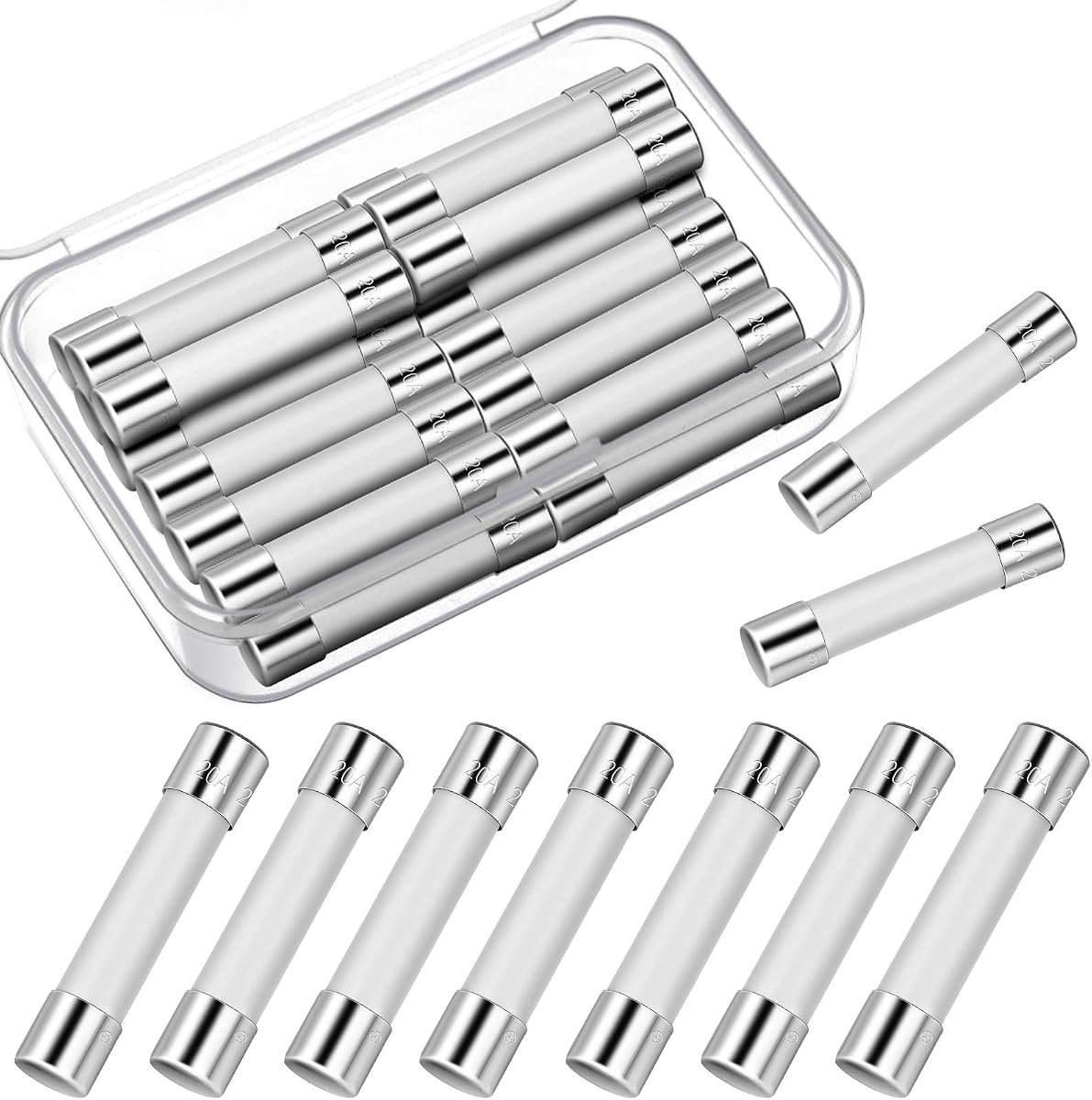
The Frienda 20-piece set is built around the same broadly used 20A 250V slow-blow ceramic format, but its large quantity makes it especially useful for repair technicians, property managers, or households with more than one compatible appliance. The stated compatibility includes GE WB27X10388 and Kenmore microwaves, giving buyers two recognizable points of reference when identifying a replacement.
We may earn a commission when you buy through this link, at no additional cost to you.
Its product information highlights three functions: protection against overload, overcurrent, and short circuits. The ceramic tube is filled with sand, which is intended to contain the fuse element and reduce the likelihood of glass fragments when a fuse operates. The product also describes itself as a slow-acting, time-delay fuse designed to withstand surge current, matching the operating behavior expected from many microwave oven fuses.
The principal caution is that this is an aftermarket replacement rather than an original component. Brand and model references are included to demonstrate compatibility, not to imply that the product was manufactured by those brands. Also, a 250V fuse should not be substituted for a 125V-only application merely because the physical dimensions match; the voltage marking must be part of the compatibility decision.
For anyone who wants a substantial supply of 20A 250V slow-blow ceramic fuses, this package is one of the most practical choices in the list. It works particularly well for technicians who service multiple compatible microwaves or want backups on hand. Verify the original part number and electrical markings, disconnect the appliance before service, and treat repeated failures as a sign that another component needs inspection.
The large pack is useful for maintenance work, multi-apartment inventories, and repeat repairs. It also means the buyer can compare several failed fuses or retain spares without needing to order again.
A sand-filled ceramic fuse is designed to manage the fuse element when it operates. The product information emphasizes that this construction will not produce glass fragments, making it a practical alternative to a similarly sized glass fuse.
We may earn a commission when you buy through this link, at no additional cost to you.
This five-pack offers a balanced choice for a common 20A 250V microwave fuse repair. It measures 6 x 30 mm, uses slow-blow ceramic construction, and is described as a direct replacement for most microwave models. That broad positioning is supported by a compatibility list covering GE, Whirlpool, Kenmore, KitchenAid, Jenn-Air, Amana, and Magic Chef.
We may earn a commission when you buy through this link, at no additional cost to you.
The product data goes beyond brand names and lists numerous replacement numbers, including WB27X10388, 875392, AP3994062, PS1481237, EAP1481237, and WB27X10928. It also describes a heavy-duty ceramic tube, strengthened end caps, and high-purity quartz sand. Those details make it useful for buyers who want more information than a simple size and amperage label.
The trade-off is that a long compatibility list can encourage overly broad assumptions. A physical size match does not override differences in rated voltage, current, or time-delay behavior. This particular set is intended for 20A 250V applications, so it is not the right choice for a microwave that requires a 125V fuse. Users should also determine why the original fuse failed rather than treating repeated replacement as a permanent solution.
This is an appealing pick for a common GE or other major-brand microwave that uses a verified WB27X10388-type fuse, especially when a homeowner wants several replacements in one order. It is less suited to owners of a 125V system or those who cannot confirm the old fuse's specifications. Exact matching remains the essential final step.
Listing numerous original and aftermarket part numbers can make identification faster. Search the appliance model and old fuse marking against the supplied references instead of assuming every similar-looking fuse is interchangeable.
The stated ceramic tube, reinforced end caps, and quartz-sand filling provide a clear construction profile. These features align with the slow-blow fuse format commonly used in microwave oven circuits.
We may earn a commission when you buy through this link, at no additional cost to you.
This two-pack is intended for microwave ovens using a 20A 125V fuse, including models associated with GE, Kenmore, and Frigidaire. The product data names 1810711, 5304509451, EA3486694, PS3486694, AH3486694, and AP4980426 as relevant replacement references and includes a long list of compatible models from major appliance brands.
We may earn a commission when you buy through this link, at no additional cost to you.
Its most useful feature is diagnostic guidance. The listing points out that a fuse that blows immediately after replacement may indicate a door-switch problem and recommends checking the switch for continuity. It also explains that repeated blown fuses can indicate an unresolved short. This is more helpful than simply replacing the fuse and hoping the appliance resumes normal operation.
The limitations are the smaller two-piece quantity and the need to ensure the appliance actually uses a 125V-rated fuse. Although the product offers broad model coverage, part numbers and model numbers should be checked against the appliance documentation. The listing also emphasizes disconnecting the appliance from the power supply before servicing, which is essential because a microwave may retain hazardous voltage after unplugging.
This is a sensible selection for a technician or homeowner who has confirmed a 20A 125V application and wants one spare alongside the immediate repair. Its emphasis on diagnosing a door switch or short makes it particularly useful when the original fuse failure may have more than one cause. Use it only after the electrical rating and appliance model have been verified.
The diagnostic notes explain why a replacement fuse may fail again. Checking door-switch continuity and locating a possible short can prevent a cycle of repeated fuse replacement.
The extensive list of compatible models is useful when the original fuse has become difficult to read. Buyers should still compare the model number, fuse marking, and physical dimensions before installation.
We may earn a commission when you buy through this link, at no additional cost to you.
This BOJACK ten-pack combines the straightforward specifications of the single-fuse version with a more useful quantity for maintenance. Each fuse is listed as a 20A, 250V, 6 x 30 mm slow-blow ceramic component, with compatibility identified for GE microwaves and the WB27X10388 replacement number.
We may earn a commission when you buy through this link, at no additional cost to you.
A ten-piece package is useful for appliance-repair professionals, landlords, repair shops, or anyone maintaining several compatible machines. Having spares immediately available can reduce delays when a second unit develops the same fault. The stated ceramic construction and time-delay behavior also provide the essential type information needed to match a conventional microwave oven fuse.
The listing is concise and does not provide the long brand or model list found on some competing products. That makes the selection straightforward for a known WB27X10388 application, but it offers less help for owners who do not know the original part number. As with any aftermarket fuse, a successful repair still depends on checking both the old component's electrical rating and the appliance's required fuse type.
This is a good middle ground between a single replacement and a larger technician-oriented inventory. It is best for someone who already knows their microwave uses a 20A 250V 6 x 30 mm slow-blow fuse, particularly a 125V appliance owner. For a one-time household repair, the smaller pack may be more convenient; for recurring service needs, ten replacements are convenient to keep on hand.
A ten-pack can support a small maintenance inventory without requiring repeated single purchases. It is especially convenient when several appliances use the same verified fuse specification.
The stated compatibility makes this pack a practical choice for GE systems requiring WB27X10388. Confirm the old fuse marking to ensure the amperage, voltage, and delay behavior also match.
We may earn a commission when you buy through this link, at no additional cost to you.
This ten-pack is another option for 20A 250V, 6 x 30 mm slow-blow ceramic fuses, with compatibility described for GE WB27X10388 as well as Whirlpool and Kenmore microwaves. It is especially useful for buyers who want the manufacturer information to state the fuse's materials as precisely as its electrical ratings.
We may earn a commission when you buy through this link, at no additional cost to you.
The construction is described as a ceramic tube with alloy and nickel-plated brass components, along with quartz sand filling. The fuse type is identified as slow-blow, or time-delay, and the stated use is overcurrent protection in electronic circuits. These details are helpful because not every physically similar ceramic tube behaves identically during a transient current.
As with the other 250V options, the key limitation is that this fuse must not be treated as a universal solution for every microwave. A microwave designed around a 125V fuse should retain that rating, and some appliances may use a different amperage, length, or interruption characteristic. Confirming the original marking is more reliable than comparing the exterior alone.
This package is well suited to repair technicians who know the required specification or to owners of compatible GE, Whirlpool, and Kenmore models who have verified WB27X10388. It is less appropriate for a first-time buyer with an unidentified fuse because the product information does not offer as extensive a model-number list. Exact electrical matching remains the deciding factor.
The stated ceramic, alloy, nickel-plated brass, and quartz-sand construction makes this product easier to compare with a removed quartz-sand fuse. Match the construction and delay type as well as the printed ratings.
A slow-blow characteristic is designed to tolerate brief current changes that could otherwise open a fast-acting fuse. That behavior makes this format suitable only when the microwave's circuit design calls for the same time-delay type.
We may earn a commission when you buy through this link, at no additional cost to you.
This five-pack is built for 20A 125V microwave fuse applications and centers on replacement part 5304509451. The product data describes compatibility with Frigidaire microwaves and includes a long list covering models from GE, Kenmore, Frigidaire, and other related product lines. It is a practical option when the appliance's required fuse is known to be 125V.
We may earn a commission when you buy through this link, at no additional cost to you.
A notable strength is the breadth of model references. Names such as 00469295, 30469294, 50462164, 50469293, 70462163, and 79083383710 are included alongside many model identifiers. This gives owners of a covered model several ways to cross-check fit and reduces reliance on generic physical appearance alone.
The product also repeats the practical warning that continually blown fuses may indicate a door-switch problem or an unresolved short. It notes that the fuse should not fail unless the circuit pulls above its rated current, which explains why replacing it without investigating the cause can be ineffective. The five-piece quantity supplies spares, but it does not resolve the underlying electrical fault.
This pack is recommended for technicians or owners who can match the appliance to the listed model numbers and confirm the original 20A 125V specification. The dense compatibility lists require careful reading, and the product's customer feedback is not the strongest in this guide. Exact identification, rather than choosing from the list by brand alone, should guide the purchase.
The unusually long model list is valuable for matching a covered appliance without relying solely on a generic part number. Look for the exact model identifier and verify the fuse marking before ordering.
The stated advice to check door-switch continuity and look for a short is essential when a new fuse opens immediately. Replacing the component repeatedly without locating the cause can damage the microwave further.
We may earn a commission when you buy through this link, at no additional cost to you.
This four-piece repair set differs from the other options by including a KW3A microwave door switch alongside 20A 250V 6 x 30 mm slow-blow ceramic fuses. That combination addresses a common diagnostic situation: a microwave may continue blowing its fuse because of a door-switch problem, so having both components can be useful for a more complete repair.
We may earn a commission when you buy through this link, at no additional cost to you.
The fuse portion has familiar specifications and a slow-blow, time-delay construction with quartz-sand filling. The door switch is described as normally closed or normally open, with plastic housing, a gray color, a listed current of 16A, voltage ratings of 125V and 250V, and a stated temperature resistance of 105 degrees. These details help distinguish the switch from visually similar KW3A units.
The challenge is that the switch size is communicated primarily by reference to the product image rather than a numerical measurement. A buyer must compare the physical switch, terminal arrangement, mounting position, and intended open or closed configuration with the failed component. The switch should also be confirmed as the correct circuit function rather than installed solely because its housing looks similar.
This kit is best for a technician or confident DIY owner who has identified a failed fuse and may also need to inspect or replace a compatible door switch. It offers more diagnostic value than a fuse-only pack, but it is less convenient for someone seeking only a straightforward spare. Verify both components independently, follow the appliance service guidance, and never assume the door switch alone is the cause of every fuse failure.
Including a door switch alongside several fuses streamlines repairs in which the fuse and switch are both suspected. The kit can support both initial replacement and follow-up testing without sourcing each component separately.
Because the switch dimensions are presented through an image, compare the housing, terminals, and mounting points with the original part. Electrical ratings alone cannot confirm that the mechanical switch will fit correctly.
We may earn a commission when you buy through this link, at no additional cost to you.
This ten-pack is a strong inventory choice for 125V microwave systems using the 5304509451 and WB27X11138 formats. The stated 20A 125V rating and 6 x 30 mm dimensions make it a candidate for GE, Frigidaire, and Hotpoint appliances, while the extensive replacement-number list helps narrow the fit.
We may earn a commission when you buy through this link, at no additional cost to you.
The product data identifies WB27X11138, 1810711, AH3486694, AP6230606, EA3486694, PS12071294, PS3486694, AP4980426, and 261201200040 among compatible references. It also describes the fuses as providing overcurrent and short-circuit protection, cutting power when a component failure or overload occurs. The installation description is direct: remove the damaged ceramic fuse and install a new one.
Its main limitation is the 125V rating, which makes it unsuitable for an appliance that specifically requires a 250V fuse. It is also important to recognize that multiple replacement numbers do not guarantee every microwave using one of those numbers has the same electrical design. Buyers should verify the original fuse's marking, the appliance model, and the physical dimensions before purchase.
This is an excellent choice for repair professionals, landlords, or households with several compatible 125V appliances. The ten-piece quantity and large number of stated part references make it particularly useful for maintaining spares. For a single confirmed 125V microwave repair, it may be more stock than necessary, but it reduces the chance of a future replacement delay.
The list of original and aftermarket part numbers provides several ways to confirm a match. Cross-reference the old fuse and appliance model rather than selecting a number based only on brand familiarity.
Ten fuses are especially useful for technicians, maintenance teams, and multi-unit properties. Keeping exact-match spares can simplify repeat service, provided the underlying fault is also corrected.
We may earn a commission when you buy through this link, at no additional cost to you.
This eight-pack is designed around a clearly identified 20A 125V, 6 x 30 mm Type 611 microwave fuse. The product data describes it as a direct replacement for GE, Frigidaire, and Hotpoint microwaves and names WB27X11138, 5304509451, 5304464087, 5304488359, AP5648907, and PS5136235 among its compatible references.
We may earn a commission when you buy through this link, at no additional cost to you.
Its straightforward identification is one of the strongest features. The listing emphasizes that this is not a standard 5 x 20 mm glass fuse and notes that the replacement is marked 20A 125V and 611. This makes it easier to distinguish from a superficially similar fuse after removal and helps prevent a size-related mismatch during ordering.
The safety guidance is unusually direct. It advises unplugging the oven, discharging the high-voltage capacitor, using the fuse only in 20A 125V microwave ovens, and replacing a blown fuse with the same type and rating. It also explains the protective role of the fuse in limiting damage to components such as the magnetron, control board, and high-voltage assembly after a surge or component failure.
This is a well-presented choice for owners or technicians who know their appliance uses a Type 611, 20A 125V fuse. The eight-piece quantity offers a practical balance between spares and excess inventory. It should not be installed in a higher-voltage appliance or a circuit with a different amperage requirement, and repeated fuse failures should be investigated before replacing it again.
The stated 611 designation and visible 20A 125V markings make it easier to compare the replacement with the original. This is particularly helpful when several ceramic fuse sizes look nearly identical on a workbench.
The product information emphasizes unplugging the appliance and discharging the high-voltage capacitor before replacement. Those steps matter because a microwave can retain dangerous voltage even after it is disconnected from power.
We may earn a commission when you buy through this link, at no additional cost to you.
The safest choice is the fuse that matches the original component in every essential category, including electrical rating, physical dimensions, fuse behavior, and the appliance's specified part number.
Current rating is one of the most important specifications to compare. Most products in this guide are rated for 20 amps, but that does not make every 20A fuse interchangeable. The amperage printed on the removed fuse should match the replacement, and the appliance manual or original part listing should support that rating. A lower-rated fuse may open without adequately protecting the circuit, while an incorrectly higher-rated fuse may fail to interrupt the same overcurrent condition.
In practical terms, look for the same amp rating on the old and new parts. If the marking is unreadable, identify the exact appliance model and locate the documented fuse specification before ordering. Do not estimate from the microwave's cooking power or assume every 20A microwave uses an identical fuse.
This guide includes both 20A 125V and 20A 250V products, and those groups should not be treated as interchangeable simply because many tubes share the same physical dimensions. Voltage is part of the fuse's designed interruption rating, and the replacement should match what the appliance requires. A 250V fuse may have a higher voltage rating than a 125V circuit, but the manufacturer's design and other operating characteristics still govern correct selection.
Read the voltage marking on the old fuse or find the correct part number in the appliance documentation. If you cannot determine whether the unit requires 125V or 250V, pause and verify before purchase. Exact matching also prevents a common source of confusion when a listing says it fits a particular brand but includes fuses for different circuits.
The most common size among these selections is 6 x 30 mm, with one listing expressing it as 6.35 x 30 mm. That difference is small and may reflect rounding, but end-cap dimensions, tube length, and diameter still need to be considered. A fuse with the right rating but the wrong length may not make proper contact in the holder, while an incorrect diameter may not fit securely.
Use calipers or a precise ruler to measure the original if the marking cannot be read. Compare both diameter and total length, and inspect the end caps and holder. Do not stretch the holder contacts or force a different fuse into place. When two common sizes are possible, consult the appliance service information rather than making a visual guess.
These are slow-blow, time-delay ceramic fuses, a type commonly used in microwave ovens. The time-delay behavior allows the fuse to tolerate short startup or switching surges that could otherwise cause a fast-acting fuse to open. Ceramic construction and quartz-sand filling also distinguish this format from many general-purpose glass fuses. A household 5 x 20 mm glass fuse with a similar amp rating is not automatically an acceptable substitute.
Check whether the original is marked slow-blow, time-delay, or another specified characteristic. Replace it with the same type and rating rather than choosing a fast-blow fuse simply because it fits. The sand-filled ceramic construction listed for most of these options is designed to contain the internal fuse element when the device operates.
Original part numbers are often more reliable than a broad brand label. Common references in this guide include WB27X10388 for 20A 250V applications and 5304509451 or WB27X11138 for 20A 125V applications. Cross-reference the old fuse, appliance model, and any manufacturer service documentation before making a final selection. A listing that names many models is helpful only if the exact model or part number appears in its stated compatibility information.
Start with the fuse's printed markings, then use the model number to rule out incorrect options. Avoid choosing solely because a product says it is universal, since that phrase may refer only to physical dimensions. If a listing provides several replacement numbers, confirm that the number associated with your exact component also carries the same amp, voltage, and size.
Pack quantities range from a single fuse to twenty replacement fuses. A small pack is convenient for one household repair, while larger packs make sense for technicians, landlords, and owners of several compatible appliances. The quantity does not affect the electrical safety of an individual fuse, but buying excess replacements for an unidentified application increases the risk of using the wrong type later.
Choose the pack based on the number of appliances you service and your ability to store the fuses safely. A five- or ten-piece package is convenient for maintenance stock, while a twenty-piece set offers the largest reserve. Regardless of quantity, store replacements where they cannot be crushed, exposed to moisture, or mistaken for ordinary electrical components.
A blown fuse is a symptom that an abnormal condition was present, not necessarily the root cause. Several listings specifically recommend checking the microwave door switch for continuity when a new fuse blows immediately. Other possible causes include a short, a failed component, a wiring problem, or a high-voltage circuit fault. Repeatedly replacing the fuse without investigating the circuit can cause additional damage.
If the microwave works after one replacement, monitor it rather than ignoring the event. If it fails again, stop and obtain a proper diagnosis. A technician can test the relevant circuits and determine whether the fuse, door switch, or another component is responsible. Remember that even a successful fuse replacement does not guarantee the rest of the appliance is sound.
Microwave service can involve hazardous residual voltage, even after the appliance is unplugged. A high-voltage capacitor may retain a dangerous charge for a period of time. The appropriate repair manual or qualified technician should guide capacitor discharge and component testing. Basic fuse replacement is a separate task from servicing the high-voltage section, and unplugging the appliance does not eliminate every internal hazard.
Only replace a fuse with the oven fully disconnected and after the appropriate discharge procedure has been followed. Do not bypass the fuse, change its rating, or install a higher-rated component to stop repeated failures. A replacement fuse is a protective device, not a cure for an electrical short. When the required procedure is unclear, professional service is the safer choice.
Begin by identifying the failed fuse, its amperage, voltage, dimensions, and any printed type or part number. Check the appliance model and service documentation as a second confirmation. A replacement should match all of those characteristics, not just the diameter. If the old fuse is badly damaged or the markings are unreadable, determine the required specification before ordering rather than relying on visual similarity.
Before opening the microwave, unplug it and follow the appliance's safety instructions for discharging the high-voltage capacitor. Once the appliance is safe to work on, remove the old fuse without forcing it, inspect the holder and surrounding wiring, and install the new fuse in the correct orientation if the holder is directional. The fuse should seat securely without being bent, crushed, or forced.
Restore power only after confirming the replacement is correct and the holder is properly closed. Test the microwave while monitoring it for unusual behavior. If the new fuse blows immediately, disconnect the appliance and investigate the door switch, wiring, short circuit, or other failed component rather than installing another fuse. Store spare fuses dry and protected from physical damage, and record the correct part number for future service.
Most products in this guide are 6 x 30 mm, although one lists 6.35 x 30 mm. Read the marking on the original fuse and measure both its diameter and length, then confirm the result with the appliance model documentation. A different microwave can use a different fuse even when it has the same brand.
They may share the same physical size, but they are not automatically interchangeable. The voltage rating, amperage, fuse type, and manufacturer specification must all match the circuit. Use the rating printed on the original component and confirm it against the appliance documentation before replacement.
A slow-blow fuse, also called a time-delay fuse, is designed to tolerate brief current surges that can occur during normal appliance operation. The ceramic and quartz-sand construction is common for this fuse category. It should not be confused with a fast-blow or standard glass household fuse that has the same physical dimensions.
An immediately blown replacement usually indicates that the underlying fault remains, such as a failed door switch, a short circuit, or another defective component. Disconnect the microwave and test the relevant circuits instead of repeatedly replacing the fuse. If you are not qualified for microwave electrical diagnosis, have a repair technician inspect it.
Replacing the fuse itself is a small physical task, but accessing it may require removing the microwave's outer cover, and a disconnected appliance can still retain dangerous capacitor voltage. Follow the appliance's service instructions, use appropriate protective equipment, and discharge the capacitor correctly. If you are uncertain about high-voltage service, seek qualified help.
The key factors are the required electrical rating, dimensions, time-delay or fuse type, and the original part number. Aftermarket ceramic fuses can be suitable when they meet those specifications and are supported by the appliance's service information. Brand names in a compatibility list demonstrate potential fit; they do not mean the aftermarket fuse was made by the appliance manufacturer.
A single household appliance may only need one immediate replacement, while technicians or landlords may prefer five or ten for maintenance stock. Quantity is less important than retaining the exact correct specification. If the microwave repeatedly blows fuses, determine the cause before accumulating spare parts or continuing to replace them.
A household glass fuse may have the same amp rating but differ in dimensions, voltage rating, or time-delay behavior. Microwave oven fuses commonly use a 6 x 30 mm slow-blow ceramic format, and substituting a different fuse can compromise protection. Replace the original with the same specified type and ratings.
The Frienda 20-piece set stands out for its large supply, 20A 250V slow-blow specifications, sand-filled ceramic construction, and compatibility references. The BOJACK 10-pack provides a similarly useful maintenance quantity with concise specifications, while the five-pack 20A 250V option is the top budget-oriented choice for buyers who value broad brand and part-number guidance.
Prioritize exact electrical and physical matching above every marketing term. Confirm the amperage, voltage, length, diameter, fuse behavior, and original part number, and investigate why the previous fuse failed. For 125V systems, the 5304509451 and Type 611 selections may be more appropriate; for 250V systems, the WB27X10388-oriented ceramic options offer several solid choices.
Availability and market conditions can change, so check the current listing details before purchasing. Confirm that the package quantity and included components still meet your needs, read the latest product information, and compare the replacement against the removed fuse one final time before installation.