
NOYITO Dual Output Module
4.2Editor score
12V output rated 8A
5V output rated 500mA
Wide 100-260VAC input
Overload and short-circuit protection
A dual voltage power supply for 12V and 5V combines two common DC outputs in one enclosure, simplifying projects that operate sensors, circuit boards, LED systems, cameras, or other mixed-voltage equipment. A capable unit should provide stable output, adequate current on each rail, suitable electrical protection, and a connection method that fits the installation.
This guide compares ten dual-output and adjustable power supplies based on their published voltage, current, wattage, input range, protection features, enclosure style, and intended applications. The selections include industrial modules, enclosed Mean Well supplies, DIN-rail equipment, a multi-voltage open-frame unit, and a universal adapter for lower-power electronics.
Each review explains where the supply fits best, which electrical details deserve attention, and where its specifications may limit a particular project. The strongest all-around choice is the RD-65A, while the NOYITO module offers flexible high-current 12V capacity and the RD-50A-VP provides a compact enclosed option. Prices and availability can change, so confirm current listing details before ordering.
4.2Editor score
5.0Editor score

4.6Editor score
As an Amazon Associate we earn from qualifying purchases.
The comparison below places all ten candidates side by side, focusing on the electrical ratings and installation details that determine whether a unit can safely power a particular 12V and 5V load.



The NOYITO AC to DC Power Supply Module is a dual-output industrial-style module rated for 12V at 8A and 5V at 500mA. Its 4.2 rating reflects a practical balance of strong 12V capacity, compact construction, and a broad AC input range. The double-sided PCB design and stated protections make it especially relevant to control panels and mixed-voltage electronics.
We may earn a commission when you buy through this link, at no additional cost to you.
Its most useful feature is the asymmetric output allocation. A project with several 12V motors, fans, or control relays can draw from the 8A 12V rail, while smaller logic or sensor circuits can use the 5V output. The listed maximum power is 100W, and ripple noise is specified at no more than 200mV. The input accepts 100-260VAC at 50/60Hz, covering a wide range of installation environments.
The important limitation is the 5V output. The manufacturer rates it at 500mA but notes that reaching 1A requires stronger module cooling. That makes the product less suitable for systems with several powered USB peripherals or multiple high-current 5V loads. Buyers should also recognize that this is a module rather than a fully enclosed consumer adapter, so wiring, strain relief, airflow, and electrical enclosure remain the installer's responsibility.
This is a compelling choice for builders who need more 12V current than most compact dual-output supplies provide and want a lower-cost industrial module. It is less appropriate for a beginner expecting a plug-in adapter or for a project where the 5V rail must consistently deliver 1A without additional thermal planning.
The 8A 12V rail can support a collection of relays, indicator circuits, or small motors, while the 5V rail serves lower-current control and sensing equipment. This imbalance makes the module particularly useful in industrial control and automation-style builds.
Overcurrent, overload, and short-circuit protection are listed, helping the module respond to common electrical faults. The wide 100-260VAC input also provides installation flexibility across regions using different mains standards.
We may earn a commission when you buy through this link, at no additional cost to you.
The Mean Well RD-35A is a 32W dual-output switching supply with a 5V primary output rated at 4A and an additional 12V output. Its 4.5 rating indicates a well-regarded option for projects that need both common DC voltages without the capacity of a larger industrial unit. The RD family format also makes it a familiar choice for enclosed system installations.
We may earn a commission when you buy through this link, at no additional cost to you.
The 5V rail is the standout here. A 4A rating is suitable for controller boards, sensors, logic circuits, and other 5V equipment, while the 12V branch can support lower-current motors, fans, or relay circuits. Because the maximum total output is only 32W, careful load planning is important. Adding several high-current 5V peripherals or motors can exceed what the compact enclosure can provide.
One honest drawback is that the supplied specifications do not state the 12V branch's current rating in the same way as the primary output. The listing identifies a 5V primary output at 4A, a 12V additional output, and 32W maximum power, but a buyer needing substantial 12V current should consult the product documentation before committing. Terminal polarity and conductor sizing should also be checked against the actual model.
Choose the RD-35A for a compact control system, industrial electronics enclosure, or mixed-voltage automation project with moderate power requirements. It is a better fit than a large open-frame supply when a modest, enclosed 32W unit is sufficient, and a better fit than the NOYITO module when a more balanced conventional application is the goal.
The listed 4A primary output gives the RD-35A useful capacity for logic boards, sensors, and embedded systems. It can consolidate common control-voltage requirements without introducing a large external power brick.
At 32W maximum output, the RD-35A is aimed at smaller installations rather than power-hungry motors or extensive LED arrays. Matching the supply to realistic load totals reduces stress and leaves operating headroom.
We may earn a commission when you buy through this link, at no additional cost to you.
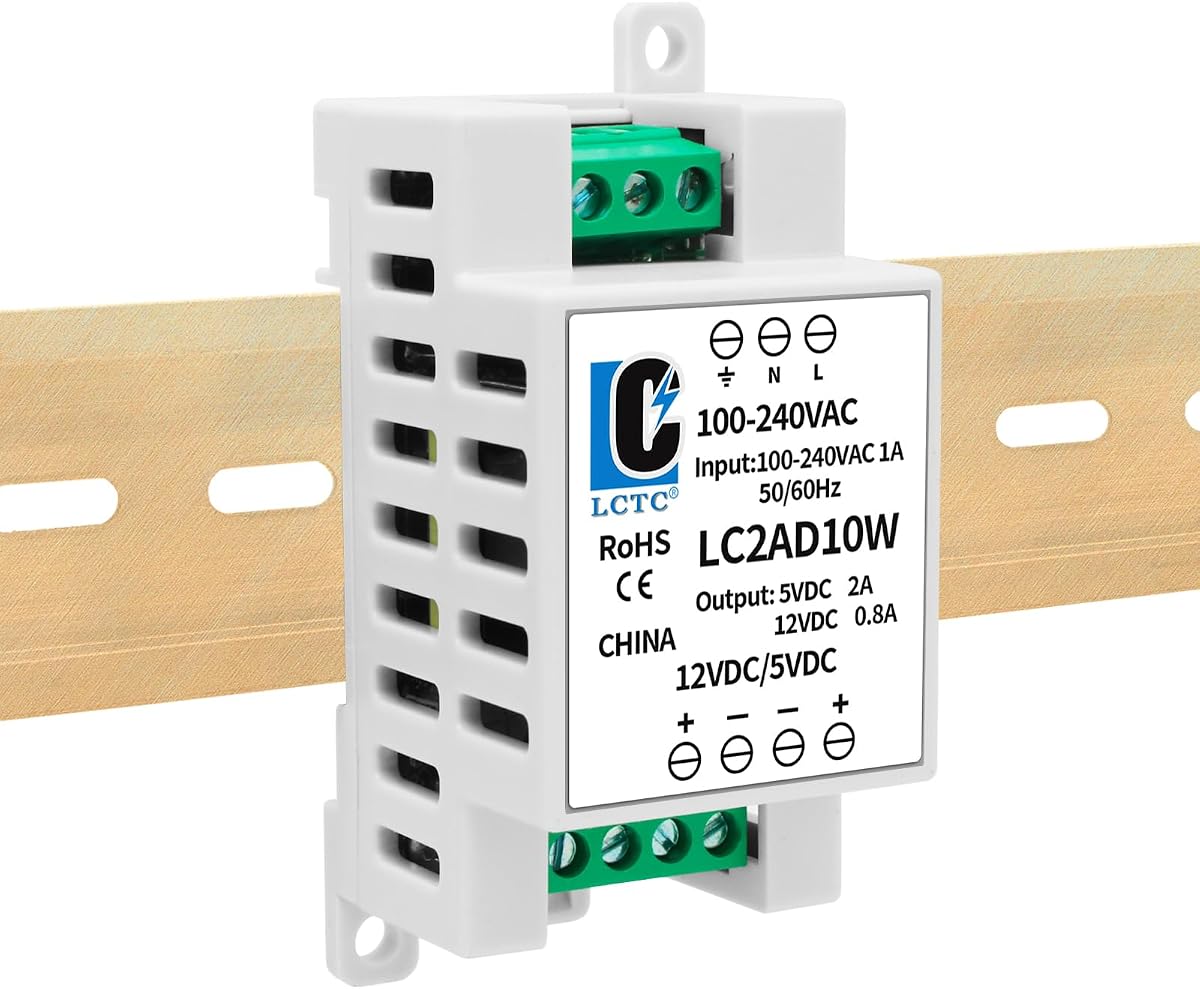
This 5V 12V Power Supply din Rail unit provides a 5V output rated at 2A and a 12V output rated at 800mA from a 100-240VAC input. Its 3.6 rating is the lowest among the listed dual-output models, so buyers should approach it as a specialized low-power choice rather than a general-purpose industrial supply.
We may earn a commission when you buy through this link, at no additional cost to you.
The main reason to consider this product is its DIN-rail installation format. The listing specifically identifies distribution-box suitability, and DIN mounting can make a compact, organized installation easier in low-voltage control cabinets. Its flame-retardant shell and stated overload, overvoltage, and short-circuit protection are also useful attributes for organized electronics installations.
Capacity is the central limitation. The 10W total output is modest, and the 800mA 12V branch is not intended for large motors, high-power LED strips, or demanding amplifier sections. Even the 5V branch is limited to 2A, which may be tight for multiple peripherals. Because of the lower customer rating and limited specification detail, conservative load calculations and careful terminal inspection are especially important.
This supply best suits a small distribution box containing a few sensors, indicator modules, low-power CCTV components, or an Arduino-style control project. It is less attractive when an installation needs substantial current, generous output headroom, or the support history associated with a more established industrial series.
DIN-rail mounting helps keep compact control electronics arranged neatly. The form is particularly attractive for low-voltage cabinets where a freestanding adapter would be inconvenient or where a permanent terminal-based layout is preferable.
With 10W total output, the supply is best treated as a purpose-built option for small mixed-voltage circuits. Checking the current draw of every connected device before installation helps prevent the supply from being pushed beyond its intended role.
We may earn a commission when you buy through this link, at no additional cost to you.
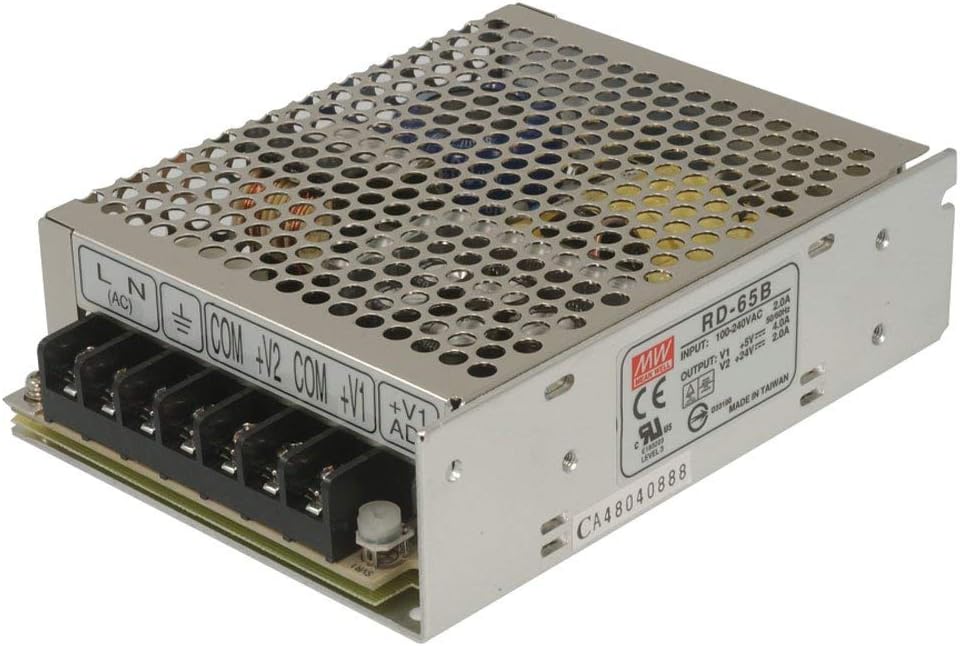
The Mean Well RD-65A combines a 5V primary output with an additional 12V output and a maximum output power of 66W. Its 4.3 rating makes it a solid conventional choice for enclosed control systems that need more capacity than the RD-35A but do not require the higher output of the RD-125A.
We may earn a commission when you buy through this link, at no additional cost to you.
The 6A primary current is useful for 5V logic, communications equipment, sensors, and other control electronics. The 66W family capacity also makes the supply more versatile for a project with a meaningful collection of low-power loads. Its enclosed construction is valuable for installation areas where an exposed open-frame board would be less convenient or less appropriate.
The listing identifies the 12V output but does not provide a separate current rating for that branch, and the product title's references to 8A and 1A can be confusing when compared with the structured specifications. A prospective buyer should confirm the exact output table, terminal arrangement, and model data before wiring equipment. The unit is also physically larger than lower-wattage options, which matters in a tightly packed cabinet.
The RD-65A is well suited to industrial control panels, access-control equipment, mixed logic and relay circuits, and other enclosed 12V/5V installations. It offers a practical middle ground: more headroom than compact 10W or 32W supplies, with a clearer 5V current rating than some of the listings in this roundup.
The 66W rating gives this unit room for a broader collection of electronics than compact DIN-rail models. It is a logical choice when a project has outgrown a small adapter but does not justify a substantially larger supply.
The enclosed format is a practical advantage in permanent installations. It is easier to organize than an exposed module and gives the installer a more conventional option for industrial or electronics-control environments.
We may earn a commission when you buy through this link, at no additional cost to you.
The Arcity 5V 12V 24V Output Switching Power Supply Unit stands out because it includes a third output rail. Its published outputs are 5V at 8A, 12V at 7A, and 24V at 5A, giving the unit flexibility for projects that combine common industrial, electronics, and audiovisual voltage requirements. Its 4.6 rating reflects strong customer reception.
We may earn a commission when you buy through this link, at no additional cost to you.
The output flexibility is valuable. A single unit can support 5V controllers, 12V motors or LED systems, and 24V equipment, provided the combined demand stays within the unit's limits. The listing also identifies a switchable 110V/220V input, low ripple noise, low power consumption, and a housing designed to aid heat dissipation. These characteristics suit experienced builders working with varied equipment.
Protection is another strength. Overvoltage, overcurrent, short-circuit, over-temperature, surge and inrush, and overpower protection are all listed, providing one of the broadest protection descriptions in this guide. However, this is an open-style supply intended for installation rather than a plug-in wall adapter. It should be mounted, wired, and enclosed appropriately, with attention to polarity, ventilation, and exposed conductors.
Choose the Arcity when a project genuinely benefits from 5V, 12V, and 24V in one unit, particularly for multi-game machines, CCTV systems, LED installations, or mixed electronics. It is a less convenient choice for a casual user who wants a simple enclosed adapter, but it offers exceptional output versatility for properly planned installations.
Providing 5V, 12V, and 24V can simplify a multi-voltage installation by reducing the number of separate supplies required. It is especially helpful in custom equipment where several subsystems operate at different DC levels.
The stated OVP, OCP, SCP, OTP, surge and inrush, and OPP functions provide a reassuring range of safeguards. They do not replace correct installation, but they make the unit more appropriate for permanent projects and mixed equipment.
We may earn a commission when you buy through this link, at no additional cost to you.
The Wefomey Universal Power Supply is a variable 3V to 24V adapter rated up to 3A and 72W. It is not a conventional fixed 5V-and-12V dual-output supply, but its broad adjustment range makes it a versatile option for testing and powering many common low-voltage devices. Its 4.5 rating indicates strong overall customer reception.
We may earn a commission when you buy through this link, at no additional cost to you.
The LCD display provides a practical way to see the selected output voltage, and the supplied connection options are extensive. Listed tips cover several barrel sizes, Micro-USB, USB Type-C, a DC terminal connector, and an alligator-clip lead. A four-way splitter is also included for powering more than one compatible device, subject to the strict combined-current limits stated in the listing.
The distinction between a universal single-output adapter and a true dual-output supply is important. Although it can produce 5V or 12V, it does not simultaneously provide independent 5V and 12V rails. Voltage tolerance is stated at plus or minus 5% of the setting, and the product is intended for indoor use. Users must also verify connector size, polarity, and device current requirements before connecting anything.
This adapter is a good fit for electronics repair, hobby benches, LED strips, small routers, cameras, and other compatible household devices. It is not the right choice when 5V and 12V must be available at the same time, and it is unsuitable for loads beyond the specified current and power limits. Its strength is adjustment and connector convenience rather than simultaneous dual-voltage output.
The real-time LCD display helps users confirm the selected voltage before connecting a device. This is particularly useful when testing multiple products or working with equipment that accepts a range of low-voltage inputs.
The broad tip assortment reduces the need to search for a separate lead for each device. Barrel adapters, USB connectors, terminal fitting, and alligator clips support both ready-made products and DIY wiring.
We may earn a commission when you buy through this link, at no additional cost to you.
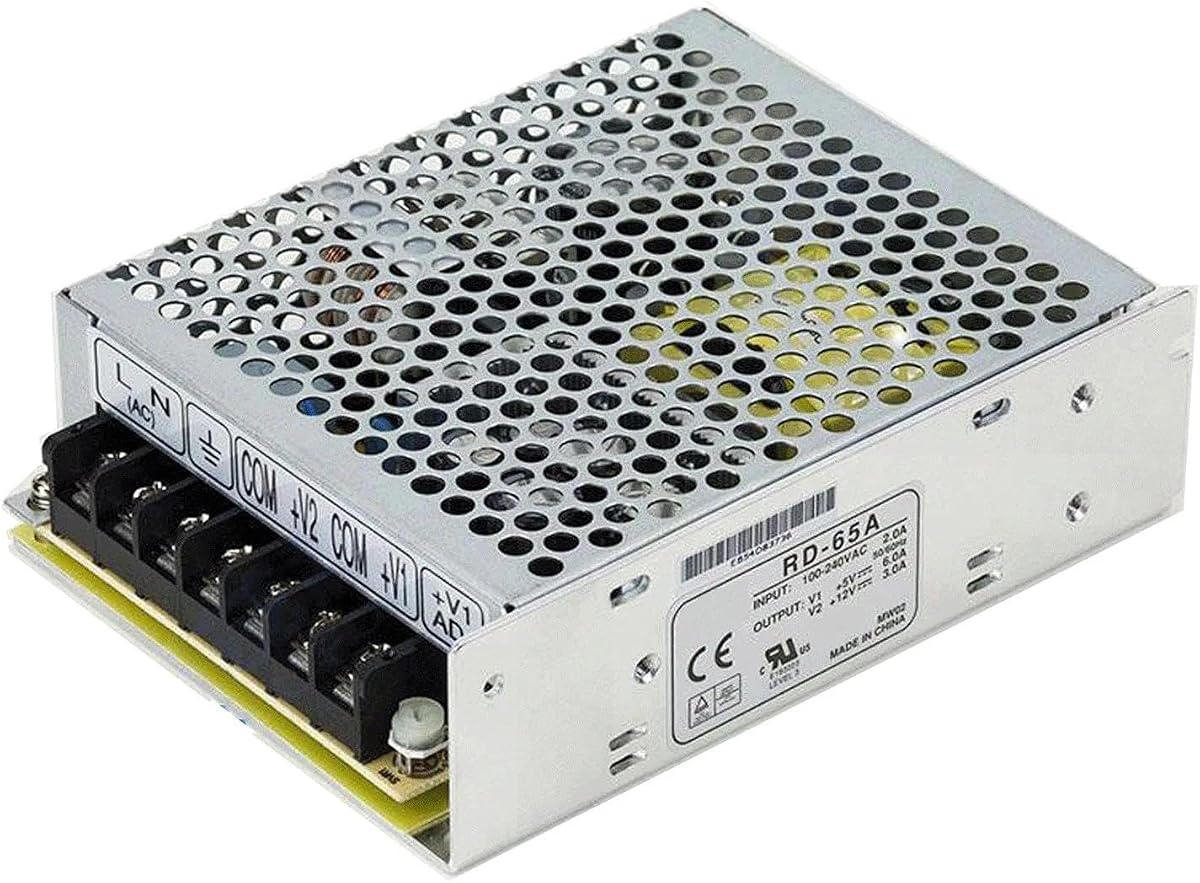
The RD-65A 5V/12V Dual Output 66W Power Supply is the strongest all-around selection in this guide. It clearly specifies 5V at 6A and 12V at 3A, and its 5.0 customer rating is the highest among the products reviewed. The detailed environmental and protection information also gives it an edge for demanding control-system use.
We may earn a commission when you buy through this link, at no additional cost to you.
This output split is more informative and balanced than many of the abbreviated listings in the roundup. A 6A 5V rail can support controller and logic loads, while the 3A 12V branch has meaningful capacity for relays, valves, fans, and other 12V devices. The 66W total maximum output provides a clear ceiling for load calculations rather than leaving the installer to infer capacity.
The industrial feature set strengthens the case. The listed operating range extends to 70°C, the unit is described as tested to withstand 300VAC surge input and 5G vibration, and it uses long-life electrolytic capacitors rated for 105°C. Comprehensive protection features are also mentioned. None of these details guarantee suitability for every environment, but they show that the product is designed with more demanding installations in mind.
This RD-65A is the recommended choice for industrial automation, control cabinets, access systems, and mixed 5V/12V electronics that need clearly stated rail currents. It is also a strong option for anyone who values a 5.0 rating and published environmental testing. For a low-power hobby project, however, its capacity may be more than necessary.
Stating 5V at 6A and 12V at 3A makes it straightforward to allocate loads and estimate whether the combined draw will remain under 66W. Clear rail ratings are one of the most useful features in a dual-output supply.
The stated 70°C operating range, 300VAC surge tolerance, 5G vibration testing, and 105°C capacitors make this model a stronger candidate for industrial use than a lightweight general-purpose adapter. Proper enclosure and installation remain essential.
We may earn a commission when you buy through this link, at no additional cost to you.
The Mean Well RD-125A is the highest-output-capacity enclosed supply among the traditional Mean Well RD models in this roundup. Its structured specifications list a 5V primary output, 7.7A primary current, 12V additional output, and 130.9W maximum power. The 4.0 rating is respectable, although lower than the leading selections.
We may earn a commission when you buy through this link, at no additional cost to you.
The 130.9W capacity is the main attraction for projects with several powered components, larger control systems, or mixed logic and power circuits. Its 5V branch is rated at 7.7A, providing substantial current for demanding controller boards, communications hardware, or multiple low-voltage loads. The RD-125 family designation also suggests a conventional industrial format intended for permanent installations.
Care is needed when interpreting the Amazon product title, which refers to 15A and 10A, while the structured bullet points give a 7.7A primary current. The exact output table from the manufacturer should be consulted before connecting loads. The supply also creates more heat and physical bulk than lower-wattage models, so ventilation, mounting, and cabinet space need to be considered.
Choose the RD-125A when a project has outgrown a 32W or 66W supply but does not need a three-output open-frame unit. It is a sensible option for larger control panels and mixed 12V/5V electronics. Projects with very small loads should choose a smaller unit to avoid unnecessary cost, heat, and space consumption.
The 130.9W maximum output is appropriate for installations with more equipment than a compact supply can support. It offers room for a greater number of sensors, relays, indicators, and powered modules on the same distribution network.
The listed 7.7A primary current is useful when the 5V side carries more demanding logic or communications equipment. Comparing actual load requirements against both rail ratings prevents one branch from becoming the limiting factor.
We may earn a commission when you buy through this link, at no additional cost to you.
The Mean Well RD-50A-VP is a compact enclosed switching supply with dual 5V and 12V outputs and 54W rated power. Its 4.6 rating makes it one of the better-reviewed products in the guide, while the enclosure and screw-terminal arrangement make it particularly attractive for organized, permanent wiring.
We may earn a commission when you buy through this link, at no additional cost to you.
Its physical dimensions are listed as 1.4 inches high by 3.8 inches wide by 3.9 inches long. That compact footprint can be valuable in a control cabinet where space is limited. The 88-264VAC input range is broad, and the minimum isolation voltage is specified at 3000V, giving the product a more industrial-oriented specification profile than a typical plastic wall adapter.
The principal trade-off is output detail. While the listing clearly identifies dual 5V and 12V outputs, 54W total power, and screw-terminal construction, it does not provide individual branch current ratings in the supplied information. Buyers should obtain the current model datasheet before selecting it for several motors, high-current sensors, or other demanding 12V equipment.
This RD-50A-VP is a strong recommendation for a compact control-panel project requiring reliable terminal connections and a professional enclosed format. It is also a logical choice when 54W is sufficient but a larger RD-65A or RD-125A would consume unnecessary space. Its combination of enclosure quality, compact size, and a 4.6 customer rating makes it the premium pick here.
The compact enclosure is easier to fit into a crowded cabinet than a large open-frame supply. Screw terminals also support a cleaner fixed installation than a temporary adapter-and-barrel-plug arrangement.
An 88-264VAC input range and 3000V minimum isolation specification give this model a strong electrical profile for embedded systems. These details support use in professionally planned low-voltage installations when paired with appropriate wiring and enclosure.
We may earn a commission when you buy through this link, at no additional cost to you.
The RD-50A 54W 5V 6A 12V 2A Dual Output Power Supply provides clearly separated ratings for its two outputs. It offers 5V at 6A and 12V at 2A within a 54W maximum, with an 85-264VAC input range. The product has no available customer rating, so its assessment must rely more heavily on the published electrical specifications.
We may earn a commission when you buy through this link, at no additional cost to you.
The rail currents are easy to understand and useful for initial load planning. The 5V branch can support a substantial collection of logic and control electronics, while the 12V branch is suited to moderate loads such as relays, smaller fans, or compact motor systems. The broad 85-264VAC input range makes the unit appropriate for many regions and installations using varying mains standards.
The supplied listing provides little detail beyond the core output ratings and identifies the product as an industrial power supply. It does not state the enclosure type, protection functions, operating temperature, or connector arrangement. Those omissions make direct comparison with more fully documented products difficult, and buyers should request the current datasheet and installation instructions.
This RD-50A is best considered when a clear 5V-and-12V allocation and 54W total capacity meet the project's needs. It may suit an installer who wants simple, established output ratings without paying for a much larger unit. Because there is no customer rating and limited descriptive information, technical documentation should take priority over assumptions based on the model name alone.
The 6A and 2A rail ratings provide a clear basis for assigning 5V and 12V loads. This is especially helpful when the application mixes control electronics with moderate 12V equipment and needs a dependable output ceiling.
An 85-264VAC input range gives the supply flexibility across many mains environments. It remains important to confirm local voltage, connection, grounding, and protective-device requirements during installation.
We may earn a commission when you buy through this link, at no additional cost to you.
Selecting a dual voltage power supply starts with the loads, not the product name. Calculate current, voltage, wattage, connection, enclosure, and environmental requirements before comparing models, because a unit that looks versatile can still be unsuitable if one output rail lacks capacity.
Every connected device should be checked for its required DC voltage and current. Add the current of all 5V devices to determine the 5V load, and do the same for 12V devices. A dual-output supply can fail even when its total wattage looks sufficient if one branch reaches its current limit first. Keep some operating headroom rather than designing for a perfect 100% load, especially for switching supplies that also produce heat.
Choose a supply with rated current above the calculated load on each rail.
Total output power is the sum of voltage multiplied by current across the active rails. A 5V 2A branch contributes 10W, while a 12V 1A branch contributes 12W, producing a combined 22W. This total must remain below the supply's maximum output, and the individual rail limits must also be respected. Headroom is useful because startup surges, motors, and continuous operation can increase demand beyond a simple average.
Prioritize headroom over the largest headline wattage.
The input range determines whether the supply can accept the available AC supply. Options in this guide include 85-264VAC, 88-264VAC, 100-240VAC, and 100-260VAC, all at 50/60Hz in the supplied information. A wide range offers installation flexibility, but local plugs, cord requirements, grounding, and disconnect methods still need to be considered. Never assume a universal input range removes every regional installation requirement.
Verify the input range and local mains requirements first.
Enclosed units are convenient for permanent installations and protect internal components from incidental contact. Open modules can be useful inside a larger enclosure and may provide more flexible output capacity. DIN-rail supplies simplify organization in distribution boxes, while screw terminals suit fixed wiring. Consider available space, cable routing, ventilation, user access, and whether the installation will be serviced by someone comfortable working around exposed mains connections.
Match mounting style to the installation environment.
Overcurrent, overload, overvoltage, short-circuit, and over-temperature protection are common among industrial switching supplies. The Arcity model also lists surge and inrush protection, while the NOYITO and DIN-rail options emphasize combinations of overload, overvoltage, and short-circuit safeguards. Protection features reduce risk but do not make unsafe wiring, blocked ventilation, or exceeded current ratings acceptable. They should complement sound electrical design rather than replace it.
Treat protection as one layer of system safety.
Power supplies convert AC into DC and generate heat as they operate. Enclosed industrial models are generally better suited to sustained operation in control cabinets, while compact modules need unobstructed airflow. Ripple noise is especially relevant to sensitive audio, radio, communications, or measurement equipment. For demanding environments, published temperature ratings, vibration tolerance, surge testing, and capacitor specifications can help distinguish a robust supply from a general-purpose adapter.
Allow ventilation and compare environmental ratings.
Terminal blocks, DC barrel connectors, USB connectors, and alligator clips are not interchangeable without checking size and polarity. A universal adapter may fit many products but can still damage a device if its voltage, connector, or polarity is wrong. Industrial and DIN-rail models generally require the user to identify positive, negative, and earth connections correctly. Before buying, locate the wiring diagram, output table, fuse requirements, and model datasheet.
Never connect equipment before verifying wiring details.
A true dual-output supply provides independent 5V and 12V rails at the same time. A universal variable adapter can be set to either 5V or 12V but normally supplies only one selected voltage. It is a useful bench tool, but it does not meet a project that must power a 5V board and a 12V device simultaneously without a splitter or a second supply. Confirm simultaneous output requirements before choosing an adjustable adapter.
Use a dual rail when both voltages are needed together.
Before installation, identify the AC input, 5V terminals, 12V terminals, grounding points, and any sensor or adjustment connections. Confirm the supply's output table against the manufacturer's documentation, then calculate the expected current on each rail. Leave the supply disconnected while checking polarity and conductor placement. For adjustable units, verify the displayed setting independently before inserting a device.
Mount the unit in a clean, dry, ventilated location. Enclosed industrial supplies may be installed inside a suitable control cabinet, but they still require appropriate clearance around the housing. Keep connections away from moving parts, sharp edges, moisture, and excessive heat. Tighten terminal screws to the manufacturer's specified torque and use suitable wire gauge. Do not leave exposed mains wiring accessible when the installation is intended for routine access.
Power the system without sensitive loads first, then verify the actual 5V and 12V outputs with a suitable meter under expected operating conditions. Watch for unusual heat, odor, voltage instability, or overloaded branches. If the 5V output drops when a 12V device starts, the supply may be over its combined capacity or one rail may be at its limit. Disconnect loads before changing wiring, and replace a supply that shows physical or electrical damage.
It is an AC-to-DC supply that provides both a 12V output and a 5V output, generally through separate terminals. This lets one unit power a mixed collection of electronics without requiring two separate adapters. The two outputs may share an internal power budget, so both rail current ratings and total wattage must be checked before connecting a load.
Yes, when using a true dual-output supply and remaining within the current and total power limits. Add up the current drawn by all 5V devices and all 12V devices separately, then compare each total with its rail rating. Also check that the combined wattage remains below the supply's maximum output.
No. A higher capacity can provide more headroom, but it may also be larger, generate more heat, and cost more than a smaller project requires. Choose the smallest unit that comfortably supports both rails while meeting the enclosure, protection, and environmental requirements of the installation.
They can be safe when correctly sized, wired, ventilated, and installed according to the manufacturer's guidance. Pay particular attention to DC voltage, polarity, current, and connector type. Do not assume short-circuit or overload protection allows operation beyond the published ratings or compensates for incorrect wiring.
A universal adapter is suitable when only one voltage is needed at a time and the device matches its connector, polarity, and current rating. It does not independently provide simultaneous 5V and 12V outputs. A splitter may divide the available current and is not a substitute for a supply with separately rated rails.
It can reduce clutter and avoid using several low-quality adapters, but dual output alone does not guarantee low noise. Ripple specifications and component quality matter for sensitive audio, radio, communications, and measurement equipment. The NOYITO module states ripple noise of no more than 200mV, while other products emphasize stability without providing equivalent figures in the supplied information.
Follow the manufacturer's instructions regarding input fusing, output protection, branch circuits, and local electrical requirements. A correctly installed system may already include suitable internal protection, while additional branch protection may be appropriate for the wiring method. Do not change the fuse rating or add components without understanding the supply design and applicable electrical codes.
A DIN-rail supply is often easier to organize inside a control or distribution box, while a plug-in adapter is convenient for temporary or low-access installations. Neither is universally better. Consider rail availability, terminal style, current requirements, ventilation, serviceability, and whether permanent wiring or quick connections are more appropriate.
The RD-65A 5V/12V 66W supply is the leading all-around recommendation because it states clear 5V 6A and 12V 3A ratings, carries a 5.0 customer rating, and includes meaningful environmental specifications. The NOYITO module is the budget-oriented alternative for projects that prioritize an 8A 12V rail, while the RD-50A-VP is a compact premium option with an enclosed housing and screw terminals.
Prioritize the load calculation above every marketing label. Confirm each rail's current, total wattage, input range, connection method, protection, ventilation, and environmental needs. A 24V output can be useful for a broader project, but it does not make an open-frame supply more convenient; a 5V-and-12V unit with balanced ratings may be a much better fit for a control panel.
Finally, check the current listing, availability, manufacturer documentation, and electrical specifications before purchasing. Product details and prices can change, and a seller's title may summarize or even conflict with structured specifications. Using the current datasheet and wiring diagram will help ensure that the selected dual voltage supply matches the actual devices and installation conditions.
